A SEMINAR ON
CARBON DIOXIDE CAPTURING
&
SEQUESTRATION (CCS)
JUSTIN K GEORGE
ME CHEMICAL
DEPARTMENT OF CHEMICAL ENGINEERING
AISSMS COE PUNE
Objectives
 Identify the major sources of CO2
 To understand the CCS process
 CCS methods
 Impact of CCS on environment
 Advantages & disadvantages of CCS
 To understand the DAC process
Introduction
 CO2 is one of the major greenhouse gas
 IPCC report illustrate the estimated CO2 emission ranges are,
from 29 to 44GtCO2/year in 2020 &
from 23 to 84GtCO2/year in 2050
Projected potential of CO2 capture (CCS) is,
2.6 to 4.9GtCO2/year in 2020 ,i.e. 9-12% of emission &
4.7 to 37.5GtCO2/year in 2050 ,i.e. 4.7-37.5% of emission
 Several researches are now going on CCS
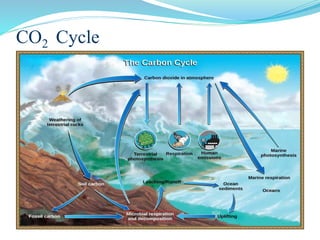
CO2 Cycle
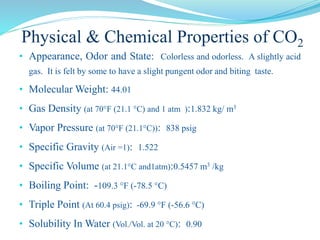
Physical & Chemical Properties of CO2
• Appearance, Odor and State: Colorless and odorless. A slightly acid
gas. It is felt by some to have a slight pungent odor and biting taste.
• Molecular Weight: 44.01
• Gas Density (at 70°F (21.1 °C) and 1 atm ):1.832 kg/ m3
• Vapor Pressure (at 70°F (21.1°C)): 838 psig
• Specific Gravity (Air =1): 1.522
• Specific Volume (at 21.1°C and1atm):0.5457 m3 /kg
• Boiling Point: -109.3 °F (-78.5 °C)
• Triple Point (At 60.4 psig): -69.9 °F (-56.6 °C)
• Solubility In Water (Vol./Vol. at 20 °C): 0.90
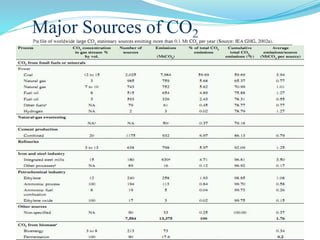
Major Sources of CO2
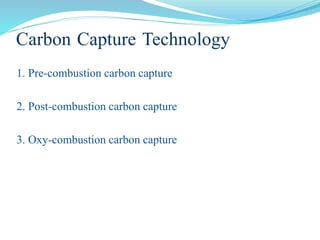
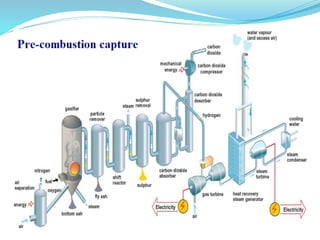
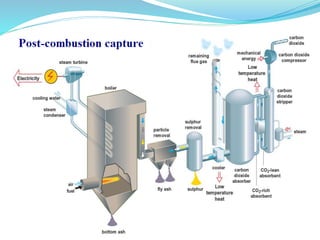
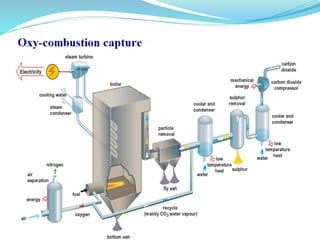
Carbon Capture Technology
1. Pre-combustion carbon capture
2. Post-combustion carbon capture
3. Oxy-combustion carbon capture
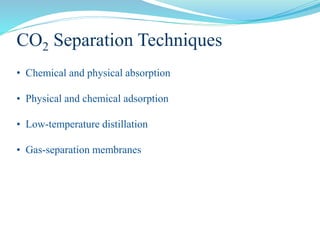
CO2 Separation Techniques
• Chemical and physical absorption
• Physical and chemical adsorption
• Low-temperature distillation
• Gas-separation membranes
Carbon Sequestration
Ways that carbon can be stored (sequestered):
 In plants and soil “Terrestrial Sequestration” (“carbon
sinks”)
 Underground “Geological Sequestration”
 Deep in ocean “Ocean Sequestration”
 As a solid material (still in development)
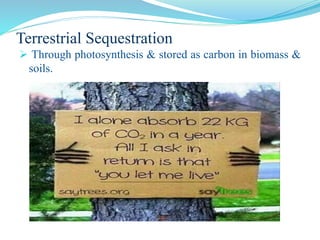
Terrestrial Sequestration
 Through photosynthesis & stored as carbon in biomass &
soils.
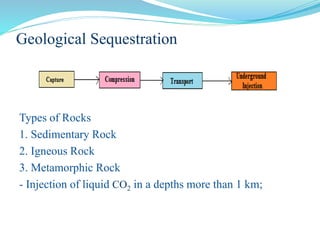
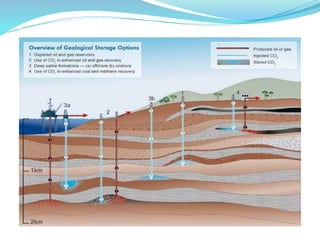
Geological Sequestration
Types of Rocks
1. Sedimentary Rock
2. Igneous Rock
3. Metamorphic Rock
- Injection of liquid CO2 in a depths more than 1 km;
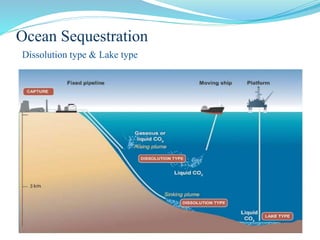
Ocean Sequestration
Dissolution type & Lake type
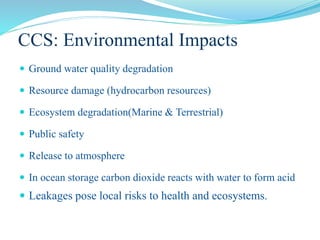
CCS: Environmental Impacts
 Ground water quality degradation
 Resource damage (hydrocarbon resources)
 Ecosystem degradation(Marine & Terrestrial)
 Public safety
 Release to atmosphere
 In ocean storage carbon dioxide reacts with water to form acid
 Leakages pose local risks to health and ecosystems.
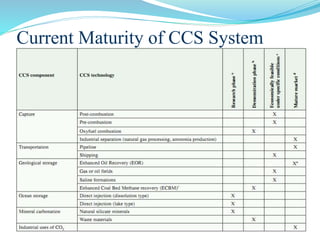
Current Maturity of CCS System
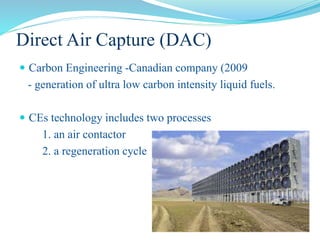
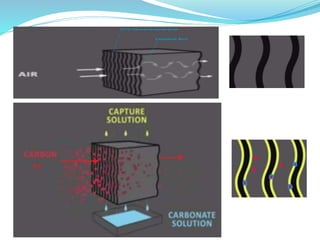
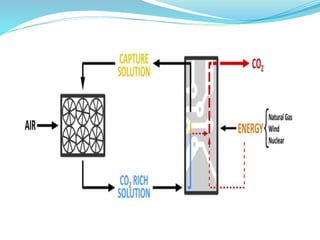
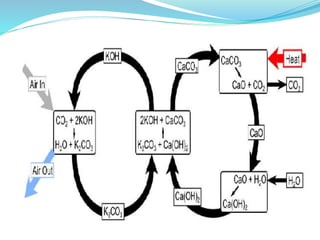
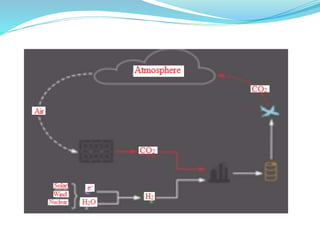
Direct Air Capture (DAC)
 Carbon Engineering -Canadian company (2009
- generation of ultra low carbon intensity liquid fuels.
 CEs technology includes two processes
1. an air contactor
2. a regeneration cycle
• CCS is one of the important measures that will make a significant
impact on reducing CO2 emissions.
• CCS implementation is picking up pace internationally ,
 Several activities have been initiated worldwide in the development of
CO2 capture for power generation industry.
• DAC- CEs Technology gives future scope
• CCS can make impact on climate change
Conclusion
References
 Gibbins, J., Chalmers, H. (2007). Preparing for global rollout: A ‘developed country
first’ demonstration programme for rapid CCS deployment. Energy Policy.
doi:10.1016/j.enol.2007.10.021.
 Jose ´ D. Figueroa, Timothy Fout- Advances in CO2 capture technology—The U.S.
Department of Energy’s Carbon Sequestration Program.
 United Nations Intergovernmental Panel on Climate Change, http://www.ipcc.ch/
 International Energy Agency, http://www.iea.org
 World Coal Institute, http://www.worldcoal.org/
 European Zero Emission Playfom, http://www.zeroemissionsplatform.eu/
 www.carbonengineering.com
 Pankaj Patware , Girish Thakur- A Roadmap For “Carbon Capture And Sequestration”
 In The Indian Context: A critical Review, 2013
 Sean I. Plasynski ,US DOE National Energy Technology Laboratory -Review of coz
capture technologies and some improvement opportunities.
 James T. Yeh and Henry W. Pennline ,National Energy Technology Laboratory,U.S.
Department of Energy-Study of CO, Absorption and Desorption in a Packed Column
CO2 capturing & sequestration process- CCS

CO2 capturing & sequestration process- CCS

  • 1.
    A SEMINAR ON CARBONDIOXIDE CAPTURING & SEQUESTRATION (CCS) JUSTIN K GEORGE ME CHEMICAL DEPARTMENT OF CHEMICAL ENGINEERING AISSMS COE PUNE
  • 2.
    Objectives  Identify themajor sources of CO2  To understand the CCS process  CCS methods  Impact of CCS on environment  Advantages & disadvantages of CCS  To understand the DAC process
  • 3.
    Introduction  CO2 isone of the major greenhouse gas  IPCC report illustrate the estimated CO2 emission ranges are, from 29 to 44GtCO2/year in 2020 & from 23 to 84GtCO2/year in 2050 Projected potential of CO2 capture (CCS) is, 2.6 to 4.9GtCO2/year in 2020 ,i.e. 9-12% of emission & 4.7 to 37.5GtCO2/year in 2050 ,i.e. 4.7-37.5% of emission  Several researches are now going on CCS
  • 4.
  • 5.
    Physical & ChemicalProperties of CO2 • Appearance, Odor and State: Colorless and odorless. A slightly acid gas. It is felt by some to have a slight pungent odor and biting taste. • Molecular Weight: 44.01 • Gas Density (at 70°F (21.1 °C) and 1 atm ):1.832 kg/ m3 • Vapor Pressure (at 70°F (21.1°C)): 838 psig • Specific Gravity (Air =1): 1.522 • Specific Volume (at 21.1°C and1atm):0.5457 m3 /kg • Boiling Point: -109.3 °F (-78.5 °C) • Triple Point (At 60.4 psig): -69.9 °F (-56.6 °C) • Solubility In Water (Vol./Vol. at 20 °C): 0.90
  • 6.
  • 7.
    Carbon Capture Technology 1.Pre-combustion carbon capture 2. Post-combustion carbon capture 3. Oxy-combustion carbon capture
  • 11.
    CO2 Separation Techniques •Chemical and physical absorption • Physical and chemical adsorption • Low-temperature distillation • Gas-separation membranes
  • 12.
    Carbon Sequestration Ways thatcarbon can be stored (sequestered):  In plants and soil “Terrestrial Sequestration” (“carbon sinks”)  Underground “Geological Sequestration”  Deep in ocean “Ocean Sequestration”  As a solid material (still in development)
  • 13.
    Terrestrial Sequestration  Throughphotosynthesis & stored as carbon in biomass & soils.
  • 14.
    Geological Sequestration Types ofRocks 1. Sedimentary Rock 2. Igneous Rock 3. Metamorphic Rock - Injection of liquid CO2 in a depths more than 1 km;
  • 16.
  • 17.
    CCS: Environmental Impacts Ground water quality degradation  Resource damage (hydrocarbon resources)  Ecosystem degradation(Marine & Terrestrial)  Public safety  Release to atmosphere  In ocean storage carbon dioxide reacts with water to form acid  Leakages pose local risks to health and ecosystems.
  • 18.
  • 19.
    Direct Air Capture(DAC)  Carbon Engineering -Canadian company (2009 - generation of ultra low carbon intensity liquid fuels.  CEs technology includes two processes 1. an air contactor 2. a regeneration cycle
  • 24.
    • CCS isone of the important measures that will make a significant impact on reducing CO2 emissions. • CCS implementation is picking up pace internationally ,  Several activities have been initiated worldwide in the development of CO2 capture for power generation industry. • DAC- CEs Technology gives future scope • CCS can make impact on climate change Conclusion
  • 25.
    References  Gibbins, J.,Chalmers, H. (2007). Preparing for global rollout: A ‘developed country first’ demonstration programme for rapid CCS deployment. Energy Policy. doi:10.1016/j.enol.2007.10.021.  Jose ´ D. Figueroa, Timothy Fout- Advances in CO2 capture technology—The U.S. Department of Energy’s Carbon Sequestration Program.  United Nations Intergovernmental Panel on Climate Change, http://www.ipcc.ch/  International Energy Agency, http://www.iea.org  World Coal Institute, http://www.worldcoal.org/  European Zero Emission Playfom, http://www.zeroemissionsplatform.eu/  www.carbonengineering.com  Pankaj Patware , Girish Thakur- A Roadmap For “Carbon Capture And Sequestration”  In The Indian Context: A critical Review, 2013  Sean I. Plasynski ,US DOE National Energy Technology Laboratory -Review of coz capture technologies and some improvement opportunities.  James T. Yeh and Henry W. Pennline ,National Energy Technology Laboratory,U.S. Department of Energy-Study of CO, Absorption and Desorption in a Packed Column