
PRESENTED BY-
AKHILESH KUMAR KUSHWAHA
M.TECH,FIRSTYEAR
CARBON CAPTURE AND
STORAGE
CARBON CAPTURE AND
STORAGE
Contents
CCS- What is it?
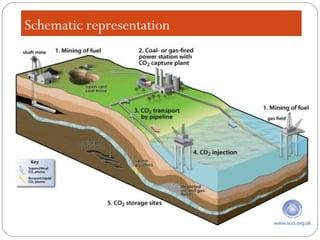
Schematic representation
History of CCS
Why we need CCS
 Large stationary sources of co2
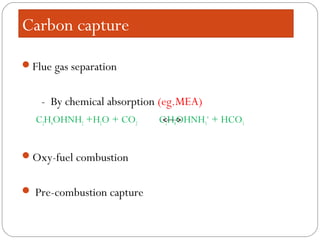
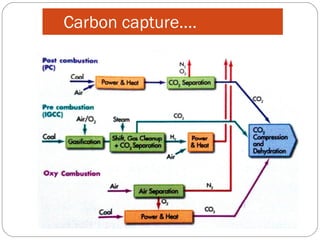
Carbon capture
Storage
CO2 reservoirs and storage capacities
Cost of CCS
Some projects
Conclusion
References
CCS-what is it?
CCS is a process consisting of
 the separation of CO2 from industrial and energy-related
sources
 transport to a storage location
 long-term isolation from the atmosphere (IPCC, 2005)
Suitable for large point sources:
- CO2-emitting industries
-natural gas production
-large fossil fuel/biomass plants
…CCS
• CCS is essentially a three stage technology where
CO2 is captured from large man-made CO2 emission
sources, transported via a network of pipelines and stored
in deep subsurface geological formations
• The capture process can potentially remove 90% of the
CO2 generated from fossil fueled (coal, oil and gas)
electricity generation and industrial processes
Schematic representation
A history of CCS: EOR as a starting point
• Large-scale injection of CO2 for purposes of EOR started in
1972 in the US (Permian Basin) – thus initially a commercial
justification
• Many new projects started in the 1970s as oil prices increased
• Today, more than 84 ongoing CO2 EOR projects and almost
40 Mtonnes CO2 injected each year (OSPAR, 2005)
• Benefit of EOR: additional income stream (with oil prices
USD 15-25 (!), Torvanger et al.)
Rising CO2 concentrations in the atmosphere from
pre-industrial levels of 280ppm to a present day
value of 365ppm has lead to increasing ocean
acidification and may be contributing to climate
change and a rising of global temperatures
 If fossil fuel combustion is allowed to continue to
grow unabated then it is projected that
CO2 emissions will reach 35.4 Gt a year by 2035
Why we need CCS?
About half of the extra CO2 from the atmosphere
will dissolve in the oceans, making the water
more acidic
The effects of this change on marine life is
unknown, but could be disastrous
The ocean already holds 400 Billion tons of fossil
fuel CO2. Consequently, the ocean is already 0.1
pH units more acid than before industrial CO2
emissions
By 2050 the ocean will be five times more acidic
CO2 affects oceans
 The IPCC 2007 Climate Change report which couples
CO2 rises to a world average temperature increase from
2.4-6.4°C by 2100
If the world is to maintain its current dependence on fossil
fuels then CCS is a necessary technology for tackling rising
atmospheric CO2
The average Earth surface temperature correlates well
with the amount of CO2 in the atmosphere
As the CO2 levels in the atmosphere have increased, the
surface temperature has gone up at the same time
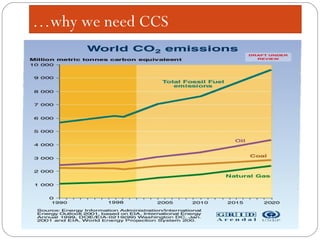
…why we need CCS
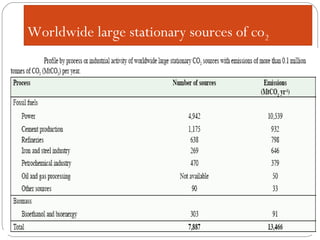
Worldwide large stationary sources of co2
…why we need…why we need CCS CCS
…why we need CCS
You may not believe in climate change, but most scientists believe
that the evidence of high CO2 levels and hot climates in the past is
compelling.
Like all preventive medicine, it's easier to put off the fateful day. But
when that day arrives, it causes you more pain, and costs more,
compared to early actions. Its important to realise that, even if we
act now, in 2012, the climate will carry on warming for another 3 or
5 degrees Centigrade.
 That means some parts of the world may have a dry and heat up to
become uninhabitable desert.
By acting now, we have a chance to limit that rise to less than 5
Centigrade, by keeping atmospheric CO2 less than 550 parts per
million.
…why we need CCS
Carbon capture
Flue gas separation
- By chemical absorption (eg.MEA)
C2H4OHNH2 +H2O + CO2 C2H4OHNH3
+
+ HCO3
Oxy-fuel combustion
 Pre-combustion capture
Carbon capture….
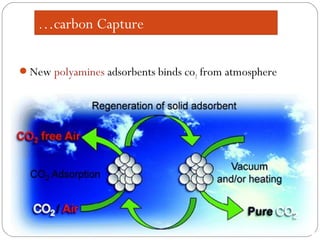
…carbon Capture
New polyamines adsorbents binds co2 from atmosphere
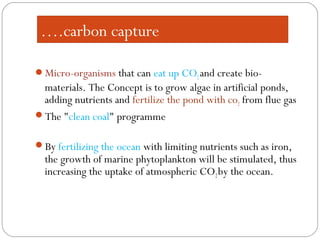
….carbon capture
Micro-organisms that can eat up CO2and create bio-
materials. The Concept is to grow algae in artificial ponds,
adding nutrients and fertilize the pond with co2 from flue gas
The "clean coal" programme
By fertilizing the ocean with limiting nutrients such as iron,
the growth of marine phytoplankton will be stimulated, thus
increasing the uptake of atmospheric CO2by the ocean.
…carbon capture
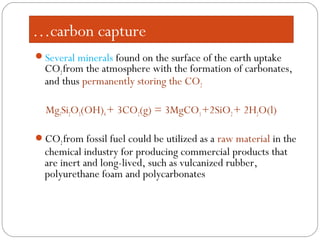
Several minerals found on the surface of the earth uptake
CO2from the atmosphere with the formation of carbonates,
and thus permanently storing the CO2
Mg3Si2O5(OH)4+ 3CO2(g) = 3MgCO3+2SiO2+ 2H2O(l)
CO2from fossil fuel could be utilized as a raw material in the
chemical industry for producing commercial products that
are inert and long-lived, such as vulcanized rubber,
polyurethane foam and polycarbonates
Storage
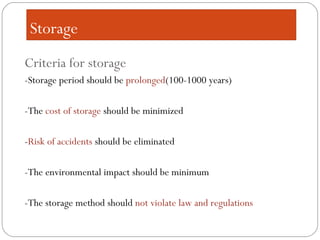
Criteria for storage
-Storage period should be prolonged(100-1000 years)
-The cost of storage should be minimized
-Risk of accidents should be eliminated
-The environmental impact should be minimum
-The storage method should not violate law and regulations
….storage
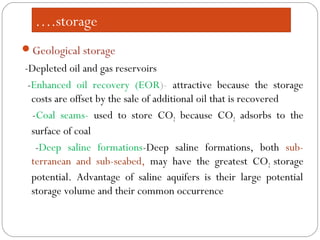
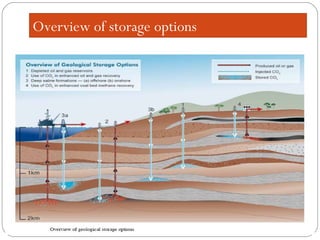
Geological storage
-Depleted oil and gas reservoirs
-Enhanced oil recovery (EOR)- attractive because the storage
costs are offset by the sale of additional oil that is recovered
-Coal seams- used to store CO2 because CO2 adsorbs to the
surface of coal
-Deep saline formations-Deep saline formations, both sub-
terranean and sub-seabed, may have the greatest CO2 storage
potential. Advantage of saline aquifers is their large potential
storage volume and their common occurrence
….storage
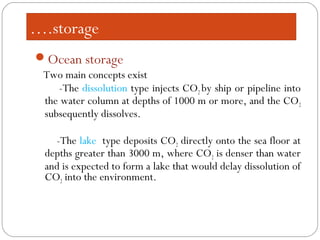
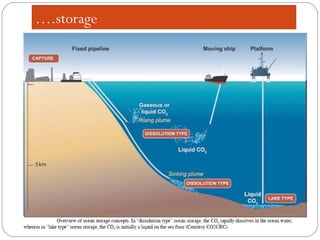
Ocean storage
Two main concepts exist
-The dissolution type injects CO2 by ship or pipeline into
the water column at depths of 1000 m or more, and the CO2
subsequently dissolves.
-The lake type deposits CO2 directly onto the sea floor at
depths greater than 3000 m, where CO2 is denser than water
and is expected to form a lake that would delay dissolution of
CO2 into the environment.
….storage
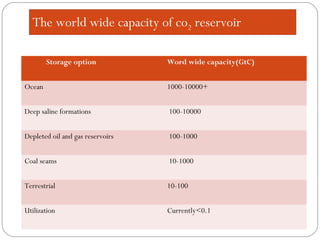
The world wide capacity of co2 reservoir
Storage option Word wide capacity(GtC)
Ocean 1000-10000+
Deep saline formations 100-10000
Depleted oil and gas reservoirs 100-1000
Coal seams 10-1000
Terrestrial 10-100
Utilization Currently<0.1
Overview of storage options
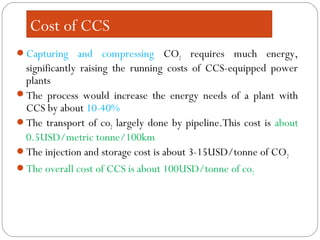
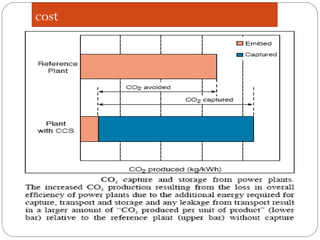
Cost of CCS
Capturing and compressing CO2 requires much energy,
significantly raising the running costs of CCS-equipped power
plants
The process would increase the energy needs of a plant with
CCS by about 10-40%
The transport of co2 largely done by pipeline.This cost is about
0.5USD/metric tonne/100km
The injection and storage cost is about 3-15USD/tonne of CO2
The overall cost of CCS is about 100USD/tonne of co2
cost
Some projects
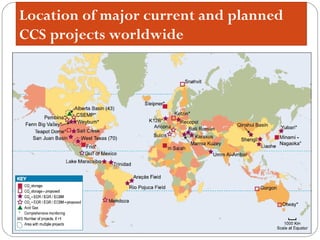
SLEIPNER is the oldest project (1996) and is located in
the North Sea where Norway's STATOIL strips carbon
dioxide from natural gas with amine solvents and
disposes of this carbon dioxide in a saline formation
The Weyburn project Weyburn started in 2000 and is
located in an oil reservoir discovered in 1954 in
Weyburn Southeastern Saskatchewan, Canada
 In Salah, which like Sleipner is a natural gas reservoir
located in In Salah, Algeria.
Location of major current and planned
CCS projects worldwide
conclusion
We should start CO2 capture and injection immediately, and
expect to have to continue until at least 2050. Hopefully by
this time we will have developed lower-carbon technology
and have reduced CO2 emissions to levels that are not causing
environmental damage.
references
 U.S. Department of Energy. (1993). The capture, utilization and disposal of carbon
dioxide from fossil fuel-fired power plants, DOE/ER-30194, Washington, DC
20585.
 Herzog, H., Drake, E. and Adams. E. (1997). CO2capture, reuse and storage
technologies for mitigating global climate change: a white paper. Massachusetts
Institute of Technology, Energy Laboratory Report under DOE Order DE-AF22-
96PC01257, Cambridge, MA .
 U.S. Department of Energy. (1999). Carbon sequestration research and
development, DOE/SC/FE-1, available from the National Technical Information
Service, Springfield, VA 22161.
 Herzog, H.J. (2001). What future for carbon capture and sequestration,
Environmental Science and Technology, 35, 148A-153A.
 Williams, D.J., Durie, R.A., McMullan, P., Paulson, C.A.J. and Smith, A.Y. (eds.)
(2001). Greenhouse gas control technologies, Proceedings of the Fifth International
Conference on Greenhouse Gas Control Technologies, CSIRO Publishing,
Collingwood VIC 3066, Australia.
Carbon Capture & Storage

Carbon Capture & Storage

  • 1.
    PRESENTED BY- AKHILESH KUMARKUSHWAHA M.TECH,FIRSTYEAR CARBON CAPTURE AND STORAGE CARBON CAPTURE AND STORAGE
  • 2.
    Contents CCS- What isit? Schematic representation History of CCS Why we need CCS  Large stationary sources of co2 Carbon capture Storage CO2 reservoirs and storage capacities Cost of CCS Some projects Conclusion References
  • 3.
    CCS-what is it? CCSis a process consisting of  the separation of CO2 from industrial and energy-related sources  transport to a storage location  long-term isolation from the atmosphere (IPCC, 2005) Suitable for large point sources: - CO2-emitting industries -natural gas production -large fossil fuel/biomass plants
  • 4.
    …CCS • CCS isessentially a three stage technology where CO2 is captured from large man-made CO2 emission sources, transported via a network of pipelines and stored in deep subsurface geological formations • The capture process can potentially remove 90% of the CO2 generated from fossil fueled (coal, oil and gas) electricity generation and industrial processes
  • 5.
  • 6.
    A history ofCCS: EOR as a starting point • Large-scale injection of CO2 for purposes of EOR started in 1972 in the US (Permian Basin) – thus initially a commercial justification • Many new projects started in the 1970s as oil prices increased • Today, more than 84 ongoing CO2 EOR projects and almost 40 Mtonnes CO2 injected each year (OSPAR, 2005) • Benefit of EOR: additional income stream (with oil prices USD 15-25 (!), Torvanger et al.)
  • 7.
    Rising CO2 concentrations inthe atmosphere from pre-industrial levels of 280ppm to a present day value of 365ppm has lead to increasing ocean acidification and may be contributing to climate change and a rising of global temperatures  If fossil fuel combustion is allowed to continue to grow unabated then it is projected that CO2 emissions will reach 35.4 Gt a year by 2035 Why we need CCS?
  • 8.
    About half ofthe extra CO2 from the atmosphere will dissolve in the oceans, making the water more acidic The effects of this change on marine life is unknown, but could be disastrous The ocean already holds 400 Billion tons of fossil fuel CO2. Consequently, the ocean is already 0.1 pH units more acid than before industrial CO2 emissions By 2050 the ocean will be five times more acidic CO2 affects oceans
  • 9.
     The IPCC 2007Climate Change report which couples CO2 rises to a world average temperature increase from 2.4-6.4°C by 2100 If the world is to maintain its current dependence on fossil fuels then CCS is a necessary technology for tackling rising atmospheric CO2 The average Earth surface temperature correlates well with the amount of CO2 in the atmosphere As the CO2 levels in the atmosphere have increased, the surface temperature has gone up at the same time …why we need CCS
  • 10.
  • 11.
    …why we need…whywe need CCS CCS …why we need CCS
  • 12.
    You may notbelieve in climate change, but most scientists believe that the evidence of high CO2 levels and hot climates in the past is compelling. Like all preventive medicine, it's easier to put off the fateful day. But when that day arrives, it causes you more pain, and costs more, compared to early actions. Its important to realise that, even if we act now, in 2012, the climate will carry on warming for another 3 or 5 degrees Centigrade.  That means some parts of the world may have a dry and heat up to become uninhabitable desert. By acting now, we have a chance to limit that rise to less than 5 Centigrade, by keeping atmospheric CO2 less than 550 parts per million. …why we need CCS
  • 13.
    Carbon capture Flue gasseparation - By chemical absorption (eg.MEA) C2H4OHNH2 +H2O + CO2 C2H4OHNH3 + + HCO3 Oxy-fuel combustion  Pre-combustion capture
  • 14.
  • 15.
    …carbon Capture New polyaminesadsorbents binds co2 from atmosphere
  • 16.
    ….carbon capture Micro-organisms thatcan eat up CO2and create bio- materials. The Concept is to grow algae in artificial ponds, adding nutrients and fertilize the pond with co2 from flue gas The "clean coal" programme By fertilizing the ocean with limiting nutrients such as iron, the growth of marine phytoplankton will be stimulated, thus increasing the uptake of atmospheric CO2by the ocean.
  • 17.
    …carbon capture Several mineralsfound on the surface of the earth uptake CO2from the atmosphere with the formation of carbonates, and thus permanently storing the CO2 Mg3Si2O5(OH)4+ 3CO2(g) = 3MgCO3+2SiO2+ 2H2O(l) CO2from fossil fuel could be utilized as a raw material in the chemical industry for producing commercial products that are inert and long-lived, such as vulcanized rubber, polyurethane foam and polycarbonates
  • 18.
    Storage Criteria for storage -Storageperiod should be prolonged(100-1000 years) -The cost of storage should be minimized -Risk of accidents should be eliminated -The environmental impact should be minimum -The storage method should not violate law and regulations
  • 19.
    ….storage Geological storage -Depleted oiland gas reservoirs -Enhanced oil recovery (EOR)- attractive because the storage costs are offset by the sale of additional oil that is recovered -Coal seams- used to store CO2 because CO2 adsorbs to the surface of coal -Deep saline formations-Deep saline formations, both sub- terranean and sub-seabed, may have the greatest CO2 storage potential. Advantage of saline aquifers is their large potential storage volume and their common occurrence
  • 20.
    ….storage Ocean storage Two mainconcepts exist -The dissolution type injects CO2 by ship or pipeline into the water column at depths of 1000 m or more, and the CO2 subsequently dissolves. -The lake type deposits CO2 directly onto the sea floor at depths greater than 3000 m, where CO2 is denser than water and is expected to form a lake that would delay dissolution of CO2 into the environment.
  • 21.
  • 22.
    The world widecapacity of co2 reservoir Storage option Word wide capacity(GtC) Ocean 1000-10000+ Deep saline formations 100-10000 Depleted oil and gas reservoirs 100-1000 Coal seams 10-1000 Terrestrial 10-100 Utilization Currently<0.1
  • 23.
  • 24.
    Cost of CCS Capturingand compressing CO2 requires much energy, significantly raising the running costs of CCS-equipped power plants The process would increase the energy needs of a plant with CCS by about 10-40% The transport of co2 largely done by pipeline.This cost is about 0.5USD/metric tonne/100km The injection and storage cost is about 3-15USD/tonne of CO2 The overall cost of CCS is about 100USD/tonne of co2
  • 25.
  • 26.
    Some projects SLEIPNER isthe oldest project (1996) and is located in the North Sea where Norway's STATOIL strips carbon dioxide from natural gas with amine solvents and disposes of this carbon dioxide in a saline formation The Weyburn project Weyburn started in 2000 and is located in an oil reservoir discovered in 1954 in Weyburn Southeastern Saskatchewan, Canada  In Salah, which like Sleipner is a natural gas reservoir located in In Salah, Algeria.
  • 27.
    Location of majorcurrent and planned CCS projects worldwide
  • 28.
    conclusion We should startCO2 capture and injection immediately, and expect to have to continue until at least 2050. Hopefully by this time we will have developed lower-carbon technology and have reduced CO2 emissions to levels that are not causing environmental damage.
  • 29.
    references  U.S. Departmentof Energy. (1993). The capture, utilization and disposal of carbon dioxide from fossil fuel-fired power plants, DOE/ER-30194, Washington, DC 20585.  Herzog, H., Drake, E. and Adams. E. (1997). CO2capture, reuse and storage technologies for mitigating global climate change: a white paper. Massachusetts Institute of Technology, Energy Laboratory Report under DOE Order DE-AF22- 96PC01257, Cambridge, MA .  U.S. Department of Energy. (1999). Carbon sequestration research and development, DOE/SC/FE-1, available from the National Technical Information Service, Springfield, VA 22161.  Herzog, H.J. (2001). What future for carbon capture and sequestration, Environmental Science and Technology, 35, 148A-153A.  Williams, D.J., Durie, R.A., McMullan, P., Paulson, C.A.J. and Smith, A.Y. (eds.) (2001). Greenhouse gas control technologies, Proceedings of the Fifth International Conference on Greenhouse Gas Control Technologies, CSIRO Publishing, Collingwood VIC 3066, Australia.