Carbon Capture and Storage
with its Utilization Strategy
for CO2 Emission
Reduction ProgramReduction Program
Case Study: PT. Krakatau Steel, Cilegon, Indonesia
07 September 2009
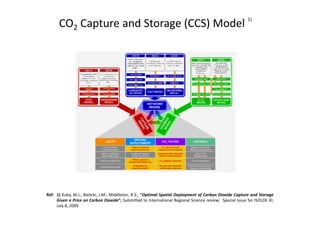
CO2 Capture and Storage (CCS) Model 1)
Ref: 1) Kuby, M.J., Bielicki, J.M., Middleton, R.S.; “Optimal Spatial Deployment of Carbon Dioxide Capture and Storage
Given a Price on Carbon Dioxide”; Submitted to International Regional Science review; Special Issue for ISOLDE XI;
July 8, 2009
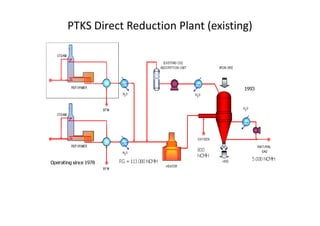
PTKS Direct Reduction Plant (existing)
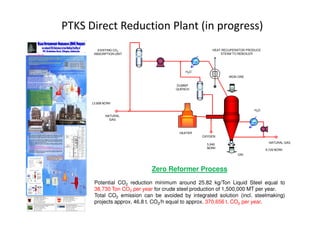
PTKS Direct Reduction Plant (in progress)
H2O
H2O
IRON ORE
EXISTING CO2
ABSORPTION UNIT
DUMMY
QUENCH
13.608 NCMH
HEAT RECUPERATOR PRODUCE
STEAM TO REBOILER
DRI
NATURAL GAS
HEATER
OXYGEN
NATURAL
GAS
9.720 NCMH
5.940
NCMH
Zero Reformer Process
Potential CO2 reduction minimum around 25.82 kg/Ton Liquid Steel equal to
38,730 Ton CO2 per year for crude steel production of 1,500,000 MT per year.
Total CO2 emission can be avoided by integrated solution (incl. steelmaking)
projects approx. 46.8 t. CO2/h equal to approx. 370,656 t. CO2 per year.
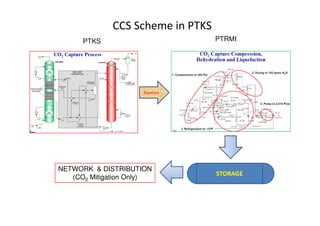
CCS Scheme in PTKS
Pipeline
PTKS PTRMI
STORAGE
NETWORK & DISTRIBUTION
(CO2 Mitigation Only)
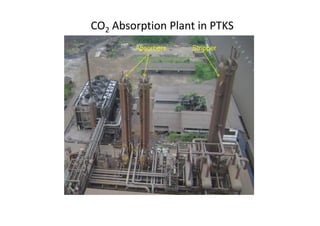
CO2 Absorption Plant in PTKS
StripperAbsorbers
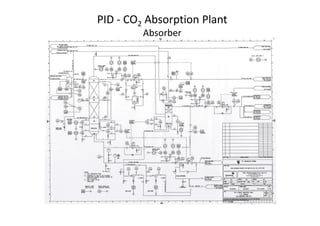
PID - CO2 Absorption Plant
Absorber
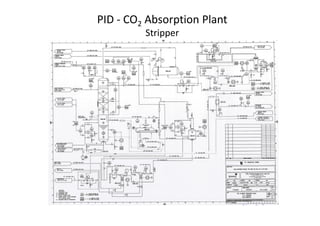
PID - CO2 Absorption Plant
Stripper
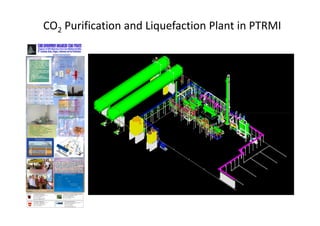
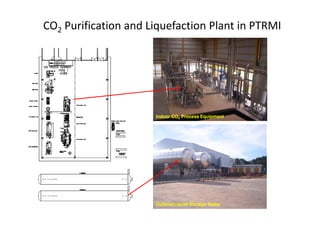
CO2 Purification and Liquefaction Plant in PTRMI
OutdoorLiquid Storage Tanks
Indoor CO2 Process Equipment
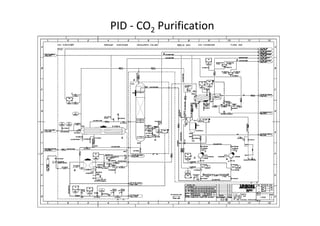
PID - CO2 Purification
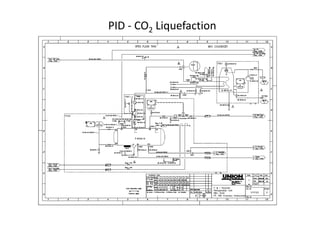
PID - CO2 Liquefaction
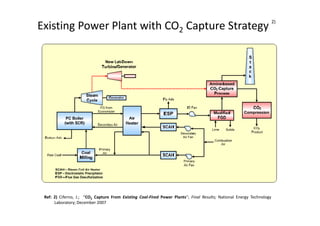
Existing Power Plant with CO2 Capture Strategy 2)
Ref: 2) Ciferno, J.; “CO2 Capture From Existing Coal-Fired Power Plants”; Final Results; National Energy Technology
Laboratory; December 2007
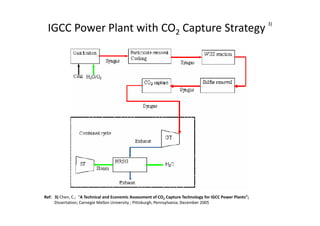
IGCC Power Plant with CO2 Capture Strategy 3)
Ref: 3) Chen, C.; “A Technical and Economic Assessment of CO2 Capture Technology for IGCC Power Plants”;
Dissertation; Carnegie Mellon University ; Pittsburgh, Pennsylvania; December 2005
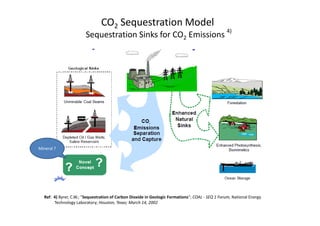
CO2 Sequestration Model
Sequestration Sinks for CO2 Emissions
4)
Ref: 4) Byrer, C.W.; “Sequestration of Carbon Dioxide in Geologic Formations”; COAL - SEQ 1 Forum; National Energy
Technology Laboratory; Houston, Texas; March 14, 2002
Mineral ?
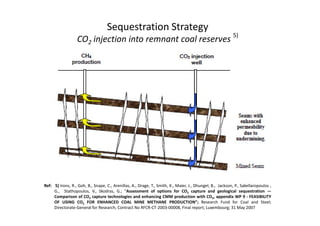
Sequestration Strategy
CO2 injection into remnant coal reserves
5)
Ref: 5) Irons, R., Goh, B., Snape, C., Arenillas, A., Drage, T., Smith, K., Maier, J., Dhungel, B., Jackson, P., Sakellaropoulos ,
G., Stathopoulos, V., Skodras, G.; “Assessment of options for CO2 capture and geological sequestration —
Comparison of CO2 capture technologies and enhancing CMM production with CO2, appendix WP 9 - FEASIBILITY
OF USING CO2 FOR ENHANCED COAL MINE METHANE PRODUCTION”; Research Fund for Coal and Steel;
Directorate-General for Research; Contract No RFCR-CT-2003-00008, Final report; Luxembourg; 31 May 2007
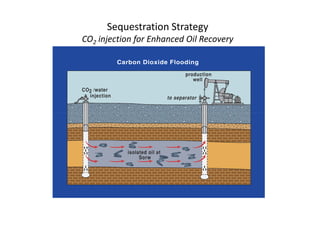
Sequestration Strategy
CO2 injection for Enhanced Oil Recovery
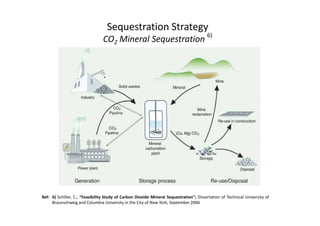
Sequestration Strategy
CO2 Mineral Sequestration
6)
Ref: 6) Schiller, C.; “Feasibility Study of Carbon Dioxide Mineral Sequestration”; Dissertation of Technical University of
Braunschweig and Columbia University in the City of New York, September 2006
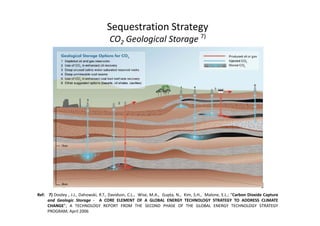
Sequestration Strategy
CO2 Geological Storage 7)
Ref: 7) Dooley , J.J., Dahowski, R.T., Davidson, C.L., Wise, M.A., Gupta, N., Kim, S.H., Malone, E.L.; “Carbon Dioxide Capture
and Geologic Storage - A CORE ELEMENT OF A GLOBAL ENERGY TECHNOLOGY STRATEGY TO ADDRESS CLIMATE
CHANGE”; A TECHNOLOGY REPORT FROM THE SECOND PHASE OF THE GLOBAL ENERGY TECHNOLOGY STRATEGY
PROGRAM; April 2006
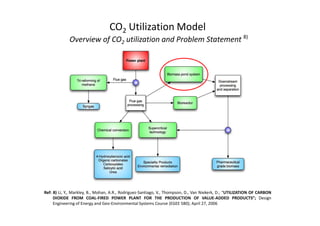
CO2 Utilization Model
Overview of CO2 utilization and Problem Statement 8)
Ref: 8) Li, Y., Markley, B., Mohan, A.R., Rodriguez-Santiago, V., Thompson, D., Van Niekerk, D.; “UTILIZATION OF CARBON
DIOXIDE FROM COAL-FIRED POWER PLANT FOR THE PRODUCTION OF VALUE-ADDED PRODUCTS”; Design
Engineering of Energy and Geo-Environmental Systems Course (EGEE 580); April 27, 2006
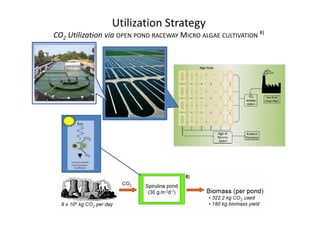
Utilization Strategy
CO2 Utilization via OPEN POND RACEWAY MICRO ALGAE CULTIVATION 8)
8)
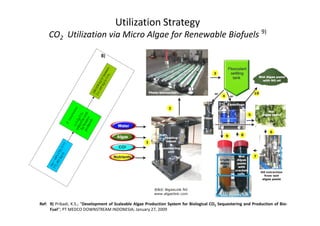
Utilization Strategy
CO2 Utilization via Micro Algae for Renewable Biofuels 9)
8)
Ref: 9) Pribadi, K.S.; “Development of Scaleable Algae Production System for Biological CO2 Sequestering and Production of Bio-
Fuel“; PT MEDCO DOWNSTREAM INDONESIA; January 27, 2009
Bioreactor Installation
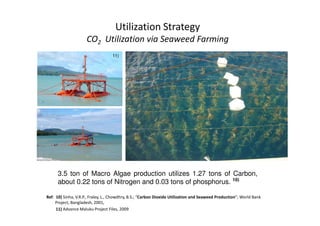
Utilization Strategy
CO2 Utilization via Seaweed Farming
11)
Ref: 10) Sinha, V.R.P., Fraley, L., Chowdhry, B.S.; “Carbon Dioxide Utilization and Seaweed Production”; World Bank
Project, Bangladesh, 2001,
11) Advance Maluku Project Files, 2009
3.5 ton of Macro Algae production utilizes 1.27 tons of Carbon,
about 0.22 tons of Nitrogen and 0.03 tons of phosphorus. 10)
Utilization Strategy
The Carbonate System of dissolved CO2 in the Seawater
12)
Ref: 12) Kleypas, J. and Langdon. C.; “Overview of CO2-induced Changes in Seawater Chemistry “; Climate & Global Dynamics,
National Center for Atmospheric Research, Boulder, CO 80307-3000, USA; 2001
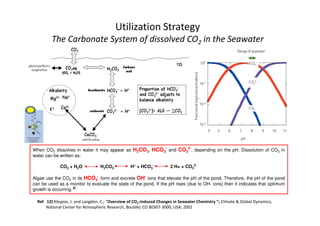
When CO2 dissolves in water it may appear as H2CO3, HCO3
-
and CO3
2-
, depending on the pH. Dissolution of CO2 in
water can be written as:
CO2 + H2O H2CO3 H+
+ HCO3
-
2 H+ + CO3
2-
Algae use the CO2 in its HCO3
-
form and excrete OH-
ions that elevate the pH of the pond. Therefore, the pH of the pond
can be used as a monitor to evaluate the state of the pond. If the pH rises (due to OH- ions) then it indicates that optimum
growth is occurring. 8)
Utilization Strategy
Supply Methods of CO2 in the Seawater 8)
12)
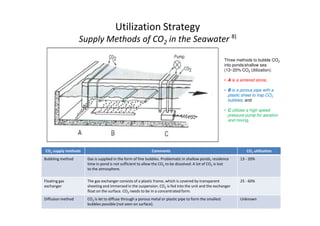
Three methods to bubble CO2
into ponds/shallow sea
(13~20% CO2 Utilization):
• A is a sintered stone,
• B is a porous pipe with a
plastic sheet to trap CO2
bubbles, and
• C utilizes a high speed
pressure pump for aerationpressure pump for aeration
and mixing.
CO2 supply methods Comments CO2 utilization
Bubbling method Gas is supplied in the form of fine bubbles. Problematic in shallow ponds, residence
time in pond is not sufficient to allow the CO2 to be dissolved. A lot of CO2 is lost
to the atmosphere.
13 - 20%
Floating gas
exchanger
The gas exchanger consists of a plastic frame, which is covered by transparent
sheeting and immersed in the suspension. CO2 is fed into the unit and the exchanger
float on the surface. CO2 needs to be in a concentrated form.
25 - 60%
Diffusion method CO2 is let to diffuse through a porous metal or plastic pipe to form the smallest
bubbles possible (not seen on surface).
Unknown
Utilization Strategy
Ref: 13) SIEW-MOI, P.; “MARINE ALGAE AND CLIMATE CHANGE: ADAPTATION AND MITIGATION”; Institute of Ocean and
Earth Sciences (IOES), University of Malaya, Kuala Lumpur, Malaysia, 2008
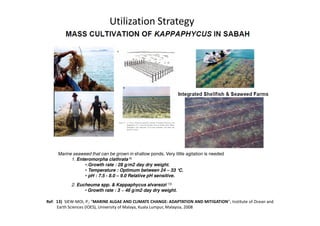
Marine seaweed that can be grown in shallow ponds. Very little agitation is needed
1. Enteromorpha clathrata 8)
•.Growth rate : 28 g/m2·day dry weight.
• Temperature : Optimum between 24 – 33 °C.
• pH : 7.5 - 8.0 – 9.0 Relative pH sensitive.
2. Eucheuma spp. & Kappaphycus alvarezzi 13)
• Growth rate : 3 ~ 46 g/m2·day dry weight.
Utilization Strategy
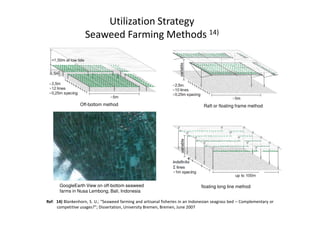
Seaweed Farming Methods 14)
Off-bottom method Raft or floating frame method
Ref: 14) Blankenhorn, S. U.; “Seaweed farming and artisanal fisheries in an Indonesian seagrass bed – Complementary or
competitive usages?”; Dissertation, University Bremen, Bremen, June 2007
With other floating material
for sufficient buoyancy
GoogleEarth View on off-bottom seaweed
farms in Nusa Lembong, Bali, Indonesia
floating long line method
Utilization Strategy
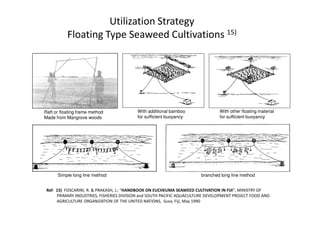
Floating Type Seaweed Cultivations 15)
Raft or floating frame method With additional bamboo With other floating material
Ref: 15) FOSCARINI, R. & PRAKASH, J.; “HANDBOOK ON EUCHEUMA SEAWEED CULTIVATION IN FIJI”; MINISTRY OF
PRIMARY INDUSTRIES, FISHERIES DIVISION and SOUTH PACIFIC AQUACULTURE DEVELOPMENT PROJECT FOOD AND
AGRICULTURE ORGANIZATION OF THE UNITED NATIONS, Suva, Fiji, May 1990
Raft or floating frame method
Made from Mangrove woods
With additional bamboo
for sufficient buoyancy
With other floating material
for sufficient buoyancy
Simple long line method branched long line method
Utilization Strategy
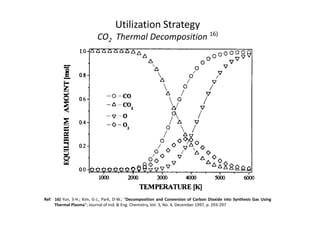
CO2 Thermal Decomposition 16)
Ref: 16) Yun, S-H.; Kim, G-J., Park, D-W.; “Decomposition and Conversion of Carbon Dioxide into Synthesis Gas Using
Thermal Plasma”; Journal of Ind. & Eng. Chemistry, Vol. 3, No. 4, December 1997, p. 293-297
Utilization Strategy
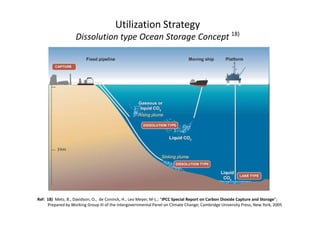
Dissolution type Ocean Storage Concept 18)
Ref: 18) Metz, B., Davidson, O., de Coninck, H., Leo Meyer, M-L.; “IPCC Special Report on Carbon Dioxide Capture and Storage”;
Prepared by Working Group III of the Intergovernmental Panel on Climate Change; Cambridge University Press, New York, 2005
Utilization Strategy
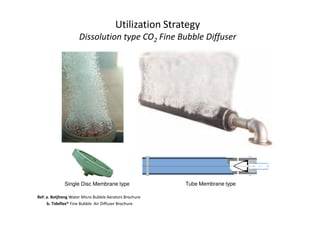
Dissolution type CO2 Fine Bubble Diffuser
Tube Membrane typeSingle Disc Membrane type
Ref: a. Botjheng Water Micro Bubble Aerators Brochure
b. Tideflex® Fine Bubble Air Diffuser Brochure

CO2 Capture and Storage (CCS) Model PTKS

  • 1.
    Carbon Capture andStorage with its Utilization Strategy for CO2 Emission Reduction ProgramReduction Program Case Study: PT. Krakatau Steel, Cilegon, Indonesia 07 September 2009
  • 2.
    CO2 Capture andStorage (CCS) Model 1) Ref: 1) Kuby, M.J., Bielicki, J.M., Middleton, R.S.; “Optimal Spatial Deployment of Carbon Dioxide Capture and Storage Given a Price on Carbon Dioxide”; Submitted to International Regional Science review; Special Issue for ISOLDE XI; July 8, 2009
  • 3.
    PTKS Direct ReductionPlant (existing)
  • 4.
    PTKS Direct ReductionPlant (in progress) H2O H2O IRON ORE EXISTING CO2 ABSORPTION UNIT DUMMY QUENCH 13.608 NCMH HEAT RECUPERATOR PRODUCE STEAM TO REBOILER DRI NATURAL GAS HEATER OXYGEN NATURAL GAS 9.720 NCMH 5.940 NCMH Zero Reformer Process Potential CO2 reduction minimum around 25.82 kg/Ton Liquid Steel equal to 38,730 Ton CO2 per year for crude steel production of 1,500,000 MT per year. Total CO2 emission can be avoided by integrated solution (incl. steelmaking) projects approx. 46.8 t. CO2/h equal to approx. 370,656 t. CO2 per year.
  • 5.
    CCS Scheme inPTKS Pipeline PTKS PTRMI STORAGE NETWORK & DISTRIBUTION (CO2 Mitigation Only)
  • 6.
    CO2 Absorption Plantin PTKS StripperAbsorbers
  • 7.
    PID - CO2Absorption Plant Absorber
  • 8.
    PID - CO2Absorption Plant Stripper
  • 9.
    CO2 Purification andLiquefaction Plant in PTRMI
  • 10.
    CO2 Purification andLiquefaction Plant in PTRMI OutdoorLiquid Storage Tanks Indoor CO2 Process Equipment
  • 11.
    PID - CO2Purification
  • 12.
    PID - CO2Liquefaction
  • 13.
    Existing Power Plantwith CO2 Capture Strategy 2) Ref: 2) Ciferno, J.; “CO2 Capture From Existing Coal-Fired Power Plants”; Final Results; National Energy Technology Laboratory; December 2007
  • 14.
    IGCC Power Plantwith CO2 Capture Strategy 3) Ref: 3) Chen, C.; “A Technical and Economic Assessment of CO2 Capture Technology for IGCC Power Plants”; Dissertation; Carnegie Mellon University ; Pittsburgh, Pennsylvania; December 2005
  • 15.
    CO2 Sequestration Model SequestrationSinks for CO2 Emissions 4) Ref: 4) Byrer, C.W.; “Sequestration of Carbon Dioxide in Geologic Formations”; COAL - SEQ 1 Forum; National Energy Technology Laboratory; Houston, Texas; March 14, 2002 Mineral ?
  • 16.
    Sequestration Strategy CO2 injectioninto remnant coal reserves 5) Ref: 5) Irons, R., Goh, B., Snape, C., Arenillas, A., Drage, T., Smith, K., Maier, J., Dhungel, B., Jackson, P., Sakellaropoulos , G., Stathopoulos, V., Skodras, G.; “Assessment of options for CO2 capture and geological sequestration — Comparison of CO2 capture technologies and enhancing CMM production with CO2, appendix WP 9 - FEASIBILITY OF USING CO2 FOR ENHANCED COAL MINE METHANE PRODUCTION”; Research Fund for Coal and Steel; Directorate-General for Research; Contract No RFCR-CT-2003-00008, Final report; Luxembourg; 31 May 2007
  • 17.
    Sequestration Strategy CO2 injectionfor Enhanced Oil Recovery
  • 18.
    Sequestration Strategy CO2 MineralSequestration 6) Ref: 6) Schiller, C.; “Feasibility Study of Carbon Dioxide Mineral Sequestration”; Dissertation of Technical University of Braunschweig and Columbia University in the City of New York, September 2006
  • 19.
    Sequestration Strategy CO2 GeologicalStorage 7) Ref: 7) Dooley , J.J., Dahowski, R.T., Davidson, C.L., Wise, M.A., Gupta, N., Kim, S.H., Malone, E.L.; “Carbon Dioxide Capture and Geologic Storage - A CORE ELEMENT OF A GLOBAL ENERGY TECHNOLOGY STRATEGY TO ADDRESS CLIMATE CHANGE”; A TECHNOLOGY REPORT FROM THE SECOND PHASE OF THE GLOBAL ENERGY TECHNOLOGY STRATEGY PROGRAM; April 2006
  • 20.
    CO2 Utilization Model Overviewof CO2 utilization and Problem Statement 8) Ref: 8) Li, Y., Markley, B., Mohan, A.R., Rodriguez-Santiago, V., Thompson, D., Van Niekerk, D.; “UTILIZATION OF CARBON DIOXIDE FROM COAL-FIRED POWER PLANT FOR THE PRODUCTION OF VALUE-ADDED PRODUCTS”; Design Engineering of Energy and Geo-Environmental Systems Course (EGEE 580); April 27, 2006
  • 21.
    Utilization Strategy CO2 Utilizationvia OPEN POND RACEWAY MICRO ALGAE CULTIVATION 8) 8)
  • 22.
    Utilization Strategy CO2 Utilizationvia Micro Algae for Renewable Biofuels 9) 8) Ref: 9) Pribadi, K.S.; “Development of Scaleable Algae Production System for Biological CO2 Sequestering and Production of Bio- Fuel“; PT MEDCO DOWNSTREAM INDONESIA; January 27, 2009 Bioreactor Installation
  • 23.
    Utilization Strategy CO2 Utilizationvia Seaweed Farming 11) Ref: 10) Sinha, V.R.P., Fraley, L., Chowdhry, B.S.; “Carbon Dioxide Utilization and Seaweed Production”; World Bank Project, Bangladesh, 2001, 11) Advance Maluku Project Files, 2009 3.5 ton of Macro Algae production utilizes 1.27 tons of Carbon, about 0.22 tons of Nitrogen and 0.03 tons of phosphorus. 10)
  • 24.
    Utilization Strategy The CarbonateSystem of dissolved CO2 in the Seawater 12) Ref: 12) Kleypas, J. and Langdon. C.; “Overview of CO2-induced Changes in Seawater Chemistry “; Climate & Global Dynamics, National Center for Atmospheric Research, Boulder, CO 80307-3000, USA; 2001 When CO2 dissolves in water it may appear as H2CO3, HCO3 - and CO3 2- , depending on the pH. Dissolution of CO2 in water can be written as: CO2 + H2O H2CO3 H+ + HCO3 - 2 H+ + CO3 2- Algae use the CO2 in its HCO3 - form and excrete OH- ions that elevate the pH of the pond. Therefore, the pH of the pond can be used as a monitor to evaluate the state of the pond. If the pH rises (due to OH- ions) then it indicates that optimum growth is occurring. 8)
  • 25.
    Utilization Strategy Supply Methodsof CO2 in the Seawater 8) 12) Three methods to bubble CO2 into ponds/shallow sea (13~20% CO2 Utilization): • A is a sintered stone, • B is a porous pipe with a plastic sheet to trap CO2 bubbles, and • C utilizes a high speed pressure pump for aerationpressure pump for aeration and mixing. CO2 supply methods Comments CO2 utilization Bubbling method Gas is supplied in the form of fine bubbles. Problematic in shallow ponds, residence time in pond is not sufficient to allow the CO2 to be dissolved. A lot of CO2 is lost to the atmosphere. 13 - 20% Floating gas exchanger The gas exchanger consists of a plastic frame, which is covered by transparent sheeting and immersed in the suspension. CO2 is fed into the unit and the exchanger float on the surface. CO2 needs to be in a concentrated form. 25 - 60% Diffusion method CO2 is let to diffuse through a porous metal or plastic pipe to form the smallest bubbles possible (not seen on surface). Unknown
  • 26.
    Utilization Strategy Ref: 13)SIEW-MOI, P.; “MARINE ALGAE AND CLIMATE CHANGE: ADAPTATION AND MITIGATION”; Institute of Ocean and Earth Sciences (IOES), University of Malaya, Kuala Lumpur, Malaysia, 2008 Marine seaweed that can be grown in shallow ponds. Very little agitation is needed 1. Enteromorpha clathrata 8) •.Growth rate : 28 g/m2·day dry weight. • Temperature : Optimum between 24 – 33 °C. • pH : 7.5 - 8.0 – 9.0 Relative pH sensitive. 2. Eucheuma spp. & Kappaphycus alvarezzi 13) • Growth rate : 3 ~ 46 g/m2·day dry weight.
  • 27.
    Utilization Strategy Seaweed FarmingMethods 14) Off-bottom method Raft or floating frame method Ref: 14) Blankenhorn, S. U.; “Seaweed farming and artisanal fisheries in an Indonesian seagrass bed – Complementary or competitive usages?”; Dissertation, University Bremen, Bremen, June 2007 With other floating material for sufficient buoyancy GoogleEarth View on off-bottom seaweed farms in Nusa Lembong, Bali, Indonesia floating long line method
  • 28.
    Utilization Strategy Floating TypeSeaweed Cultivations 15) Raft or floating frame method With additional bamboo With other floating material Ref: 15) FOSCARINI, R. & PRAKASH, J.; “HANDBOOK ON EUCHEUMA SEAWEED CULTIVATION IN FIJI”; MINISTRY OF PRIMARY INDUSTRIES, FISHERIES DIVISION and SOUTH PACIFIC AQUACULTURE DEVELOPMENT PROJECT FOOD AND AGRICULTURE ORGANIZATION OF THE UNITED NATIONS, Suva, Fiji, May 1990 Raft or floating frame method Made from Mangrove woods With additional bamboo for sufficient buoyancy With other floating material for sufficient buoyancy Simple long line method branched long line method
  • 29.
    Utilization Strategy CO2 ThermalDecomposition 16) Ref: 16) Yun, S-H.; Kim, G-J., Park, D-W.; “Decomposition and Conversion of Carbon Dioxide into Synthesis Gas Using Thermal Plasma”; Journal of Ind. & Eng. Chemistry, Vol. 3, No. 4, December 1997, p. 293-297
  • 30.
    Utilization Strategy Dissolution typeOcean Storage Concept 18) Ref: 18) Metz, B., Davidson, O., de Coninck, H., Leo Meyer, M-L.; “IPCC Special Report on Carbon Dioxide Capture and Storage”; Prepared by Working Group III of the Intergovernmental Panel on Climate Change; Cambridge University Press, New York, 2005
  • 31.
    Utilization Strategy Dissolution typeCO2 Fine Bubble Diffuser Tube Membrane typeSingle Disc Membrane type Ref: a. Botjheng Water Micro Bubble Aerators Brochure b. Tideflex® Fine Bubble Air Diffuser Brochure