LISTEN...LEARN...THINK....GROW 1
WELCOME TO BUSINESS
RESEARCH METHODS
EMGT 416
Zin-Eddine Dadach
Fall 2007-2008
LISTEN...LEARN...THINK....GROW 2
THE RESEARCH
PROCESS
LISTEN...LEARN...THINK....GROW 3
WHAT IS MANAGEMENT?
 Process of getting activities completed
efficiently with and through other people
( Robins, 1994)
 Set of activities directed at the efficient and
effective utilization of resources in the pursuit of
one or more goals ( Van fleet, 1991)
 THE PRIMARY ACTIVITY OF A MANAGER INVOLVES
COORDINATING AND FACILITATING THE
MANAGEMENT OF PEOPLE AND RESOURCES IN AN
ORGANIZATION
LISTEN...LEARN...THINK....GROW 4
TODAY’S MANAGER’S CHALLENGES
 During the last two decades, we have
witnessed a dramatic changes in the business.
 From the historic economic role, the business
has now evolved in response to social and
political changes, explosive technology growth,
innovations in global communication
 These dramatic changes have created new
knowledge needs for the MANAGER and new
publics to consider when evaluating any
DECISION
LISTEN...LEARN...THINK....GROW 5
MANAGER NEEDS MORE AND
BETTER INFORMATION
BECAUSE:
 More variables to consider
 More knowledge exist in any field of
management
 Global and local competition is more vigorous
 Quality of theories and models to make
decisions is improving
 More concerns from the governments about
public protection
 Public more informed wants to be included in
company decision making
LISTEN...LEARN...THINK....GROW 6
THE IMPACT OF COMPUTERS
AND INTERNET ON THE
INFORMATION
 Data mining is becoming important: Extract
meaningful knowledge from volumes of data
 Easier to analyze study data stored in computer
 Techniques of quantitative analysis become
more important with new powerful computers
 The number and power of the tools used to
conduct research ( INTERNET) has increased
fitting the complexity of the new business
environment
LISTEN...LEARN...THINK....GROW 7
INFORMED DECISIONS
 GOOD INFORMATION LEAD TO GOOD
DECISION
 In this very complex and competitive new
business environment, managers should
understand how to identify quality information
and to recognize the solid, reliable research on
which their high-risk decisions can be based
 Managers need also to know how to conduct
such research to get only the valuable
information
 These skills need understanding of the scientific
methods used for decision making
LISTEN...LEARN...THINK....GROW 8
TO GET VALUABLE INFORMATION YOU
NEED GOOD BUSINESS RESEARCH
METHODS
 The study of business research methods
provides us the knowledge and skills to
solve problems and meet the challenges
of a fast-paced decision-making
environment
LISTEN...LEARN...THINK....GROW 9
OBJECTIVES OF
THIS COURSE
LISTEN...LEARN...THINK....GROW 10
THEORY PART OF THE
COURSE
 WHY RESEARCH IS IMPORTANT?
 WHAT IS QUANTITATIVE RESEARCH?
 WHAT IS QUALITATIVE RESEARCH?
 ETHICAL CONSIDERATIONS DURING THE
RESEARCH PROCESS
 ETHICAL BEHAVIOR OF THE RESEARCHER
AND THE RESPONDENT
 DISCUSS THE ROLE OF LITERATURE
REVIEW AND THE CONCEPTS OF
REFERENCING
LISTEN...LEARN...THINK....GROW 11
STATISTICAL PART OF THE
COURSE ( SPSS PROGRAM)
 EXPLAIN THE CONCEPT OF HYPOTHESIS
TESTING
 THE ROLE AND NEED OF CAREFUL
RESEARCH
 DIFFERENCE BETWEEN CAUSAL AND CO
RELATIONAL ANALYSIS
 RESEARCH VARIABLES AND SURVEY
RESEARCH TOOLS
 DISCUSS MEASUREMENT TECHNIQUES,
VALIDITY AND RELIABILITY AND DATA
COLLECTION METHODS
 ANALYSIS OF DATA BY SPSS
LISTEN...LEARN...THINK....GROW 12
FINAL PROJECT
 AT THE END OF THE COURSE, YOU WILL
HAVE A CASE STUDY AND SUBMIT A
COMPLETE REPORT
 REPORT INCLUDE RESEARCH DESIGN,
PROCEDURES, DATA ANALYSIS AND
INTERPRETATION OF RESULTS IN LIGHT
OF THEORY
 IDENTIFY THE SIGNIFICANT COMPONENTS
OF THE DATA ANALYSIS FOR
ENGINEERING MANAGEMENT DECISION
MAKING
LISTEN...LEARN...THINK....GROW 13
MANAGER IN BUSINESS
RESEARCH
A CRITICAL CONSUMER OF INFORMATION
LISTEN...LEARN...THINK....GROW 14
THE RESEARCH PROCESS
 Manager should be able to conduct business
research
 Manager should find out the research process
of the information he wants to analyze
 The kind of research and its outcome depend
mainly on the research process:
 WHY RESEARCH IS DONE?
 WHO PAID FOR THE RESEARCH?
 WHO DID THE RESEARCH?
LISTEN...LEARN...THINK....GROW 15
WHO DOES RESEARCH ?
LISTEN...LEARN...THINK....GROW 16
ACADEMIC RESEARCH
 Every university has a scientific lab with
full time professors and graduated
students
 They are mainly two kinds of research
 basic research
 Practical research
LISTEN...LEARN...THINK....GROW 17
WHAT IS BASIC RESEARCH?
 A typical basic research is usually has a
theoretical background and is done in a
lab for theory building
 Basic research is done mainly by
graduate students and supervised by a
professor or a group of professors
 Basic research is financed by a
professor or an academic department or
the university
LISTEN...LEARN...THINK....GROW 18
OUTCOME OF BASIC RESEARCH
 The results of any basis research are to
be published in a journal, magazine,
newspaper, book
 In order to accept paper for publication,
scholars reviewing of the journal ensure
the level of quality of the research and
the theory and methods used.
 All the researchers in science and
engineering dream to publish in the
journals NATURE or SCIENCE
LISTEN...LEARN...THINK....GROW 19
APPLIED RESEARCH
 A typical basic research has a little
theoretical background and is practically
oriented
 The practical research is done mainly by
researchers in a lab and/or plant for
practical results to be used in industries
or agencies
 Practical research is financed by
industries or agencies to solve a
practical problem or a particular issue
LISTEN...LEARN...THINK....GROW 20
OUTCOMES OF APPLIED RESEARCH
 The results of any practical research are
not for publication.
 All the results should be submitted to the
industry or agency who financed the
research
 A contract including non-divulgation
between the industry and the professor
who supervise the research is signed in
the beginning of the research process
LISTEN...LEARN...THINK....GROW 21
GOVERNMENTAL RESEARCH
ORGANIZATIONS
 In GENERAL, Government organizations
have their “in house” research agencies
 The objective of governmental research
agencies is to use statistical research to
find solutions related to social, economic
and market issues .
LISTEN...LEARN...THINK....GROW 22
EXAMPLE OF UAE GOVERNMENT
RESEARCH AGENCIES
 The Economic & Policy Research of the
government of UAE
 This unit was developed to provide
applied research aimed at supporting the
UAE's growth and development.
LISTEN...LEARN...THINK....GROW 23
WHAT RESEARCH DOES EPRU
UNDERTAKE?
 The quality and reliability of UAE economic
statistics and their use for forecasting purposes.
 The international competitiveness, efficiency
and productivity of the UAE economy, including
the public and private sectors.
 Diversification of the UAE economy.
 International trade, including customs reform
and trade relations with GCC members.
 UAE labor market dynamics, including the issue
of Emiratization of the labor market.
LISTEN...LEARN...THINK....GROW 24
EXAMPLES OF CURRENT
RESEARCH PROJECTS OF EPRU
 An evaluation of the quality of UAE Economic
Statistics & Indicators.
 Trade Facilitation between GCC Member
States.
 The International Competitiveness of the
Countries of the MENA Region.
 The Efficiency of the Abu Dhabi Securities
Market and the Dubai Financial Market.
 The Efficiency and Productivity of UAE Banks.
LISTEN...LEARN...THINK....GROW 25
ECONOMIC RESEARCH
METHODS USED BY EPRU
 Economic models for time-series cross-
section and panel data.
 Non-parametric models including Data
Envelope Analysis and Structural
Equation Modeling.
 Computable General Equilibrium (CGE)
Modeling.
LISTEN...LEARN...THINK....GROW 26
The CGE MODEL IS USED TO
HELP ANSWER QUESTIONS
SUCH AS:
 How important are the contributions of the different emirates to
the UAE economy?
 What will happen to the economy if trade barriers are removed
between GCC countries?
 How well placed is the UAE economy to cope with the end of oil
exports?
 What can the UAE government do to increase the labor market
participation rates and employment rates for Emiratis?
 What can the UAE government do to keep the economy
growing and diversifying?
LISTEN...LEARN...THINK....GROW 27
CONSULTANTS RESEARCH
 Provide research & advisory services to
industry and government and
government
 Some consultant agencies are
multinational companies involved in
accountancy, finance, management and
business consultancy in general
 Examples of consultant agencies are
Price Water house Coopers and Ernest
& Young
LISTEN...LEARN...THINK....GROW 28
CONSULTANT RESEARCH FOR
OIL INDUSTRIES PLANNING
 The oil and gas industry is driven by the
development and delivery of natural
resources of unknown quality, quantity,
and origin.
 In this environment, it’s vital that industry
participants conduct risk management
planning.
LISTEN...LEARN...THINK....GROW 29
ERNST & YOUNG CONSULTANT
RESEARCH AGENCY
 To help the oil companies kick off their own scenario
planning exercises, the Ernst & Young Global Oil & Gas
Center brings the oil companies through nine scenarios
and possible outcomes.
 From evaluating hydrocarbon reserves to assessing
limited supplies within specific countries and states, we
provide food for thought on several “what ifs,” including:
 What if the global economy experienced a recession?
 What if alternatives became a major part of the energy
mix?
 What if there was no longer a secure supply of oil and
gas?
LISTEN...LEARN...THINK....GROW 30
MANAGERS RESEARCH
 Managers should see research as part of their
job
 Successful management depends on high
quality information
 A great deal of information like sales figures is
routinely available to the manager and does not
need research
 However, THE CREATIVE UTILIZATION of
such data ( like establishing market trends) can
be a research project
LISTEN...LEARN...THINK....GROW 31
EXAMPLES OF RESEARCH
FOR MANAGERS
 Clients
 Potential clients
 Staffing
 Performance
 Competitors
 Legal issues
 Sales
 Information technology
 Organizational
environment
 Organization
development
 Products
 Culture
 Productivity
 Strategy
 Quality
 Policy
 Finance
 Training & Staff
development
 Managerial effectiveness
 communication
LISTEN...LEARN...THINK....GROW 32
MANAGERS AND RESEARCH
RESULTS EVALUATION
 Managers need to conduct or
commission research if they require
information and understanding to aid in
their decision-making
 Managers who are familiar with research
process will be able to commission
research and evaluate results
LISTEN...LEARN...THINK....GROW 33
WHY STUDY RESEARCH
GOOD BUSINESS RESEARCH
REDUCES THE RISK IN DECISION-
MAKING
LISTEN...LEARN...THINK....GROW 34
DECISION MAKING CASE #1
 You are a new head of a machinery
manufacturer.
 Some of the old and well trained sales and
services staff left the company.
 Complaints from customers regarding poor
after sales services are on the increase
 HOW DO YOU BEGIN TO THINK ABOUT
HOW TO SOLVE THIS PROBLEM?
LISTEN...LEARN...THINK....GROW 35
DECISION MAKING CASE #2
 The head of the department chairs the
committee that is responsible to buy the
textbook for EMGT 316
 HOW IS HE GOING TO BEGIN TO
EVALUATE THE COMMITTEE
OPTIONS?
LISTEN...LEARN...THINK....GROW 36
CASE #3 : HOW DO YOU SET UP A
RESEARCH PROJECT?
 How will you come with a problem
statement ( problem & questions) ?
 How are you going to answer these
problem question?
LISTEN...LEARN...THINK....GROW 37
Why do managers study
research?
 The manager’s DECISIONS need more
and better information
 The availability of improved techniques
and tools to meet this need
 The resulting information overload if
discipline is not employed in process
LISTEN...LEARN...THINK....GROW 38
MANAGER NEEDS MORE AND
BETTER INFORMATION
BECAUSE:
 More variables to consider
 More knowledge exist in any field of
management
 Global and local competition is more vigorous
 Quality of theories and models to make
decisions is improving
 More concerns from the governments about
public protection
 Public more informed wants to be included in
company decision making
LISTEN...LEARN...THINK....GROW 39
GOOD INFORMATION LEAD
TO GOOD DECISION
 In this very complex and competitive new
business environment, managers should
understand how to identify quality information
and to recognize the solid, reliable research on
which their high-risk decisions can be based
 Managers need also to know how to conduct
such research to get only the valuable
information
 These skills need understanding of the scientific
methods used for decision making
LISTEN...LEARN...THINK....GROW 40
EFFECTS OF CONSUMERS
MAGAZINES ON BUSINESS
 Consumer magazines are independent and public
satisfaction oriented ( quality, durability, ease to use,
safety and price)
 Therefore, Consumer magazine (ex: “WHICH” in UK)
have a significant impact on consumer’s buying behavior
AND AFFECT THE SALES OF ANY COMPANY
 Companies whose products receive unsatisfactory marks
in consumer magazine will withdraw their products from
the market
 POSITIVE MARKS MAKES THE COMPANY INVEST
MORE ON ADVERTISEMENT
LISTEN...LEARN...THINK....GROW 41
WHAT IS BUSINESS
RESEARCH
THE FIRST STEP FOR ANY
DECISION MAKING : GETTING
INFORMATION
LISTEN...LEARN...THINK....GROW 42
DEFINITION
 A systematic inquiry whose objective is
to provide information to solve
managerial problems
LISTEN...LEARN...THINK....GROW 43
CASE #1: WHICH BUSINESS
PARTNERS?
 AIR SWISS IS LOOKING FOR
INTERNATIONAL PARTNERS
 YOU ARE ASKED TO INVESTIGATE
SIX POTENTIAL COMPANIES
LISTEN...LEARN...THINK....GROW 44
YOUR RESEARCH TEAM
INVESTIGATION
 PERTINENT DATA ARE COLLECTED FROM
PUBLIC SOURCES
 YOU WILL EXAMINE
 ANNUAL REPORTS,
 ARTICLES IN BUSINESS JOURNALS,
 TRADE MAGAZINES
 NEWSPAPERS
 FINANCIAL ANALYST’S ASSESSMENTS
 COMPANY ADVERTISEMENTS
LISTEN...LEARN...THINK....GROW 45
FINAL RESEARCH REPORT
 YOUR RESEARCH TEAM DEVELOP
SUMMARY PROFILE OF EACH
COMPANY
 THE FINAL REPORT HIGHLIGHTS THE
OPPORTUNITIES AND PROBLEMS
THAT THE ACQUISITION OF THE
TARGET COMPANY WILL BRING TO
ALL AREAS OF THE BUSINESS
LISTEN...LEARN...THINK....GROW 46
THE MANAGER DILEMMA
 THE SENIOR VICE PRESIDENT OF
SWISS AIR WILL READ YOUR
REPORT AND MUST MAKE A FINAL
PROPOSAL ABOUT WHICH IS THE
PREFERRED PARTNER WITH WHICH
TO JOIN FORCES
LISTEN...LEARN...THINK....GROW 47
CASE #2: BUYING A NEW
EQUIPMENT?
 A prominent manufacturer of medical
equipment contacts you to buy a new-
generation MRI scanner.
 The doctor committee is waiting for your
recommendations to decide either to buy
it or not
LISTEN...LEARN...THINK....GROW 48
YOUR INVESTIGATION
 Mining data from patients files from other
hospitals which are using the equipment
to find :
 How the new equipment is used
 For what kind of diagnosis it can be used
 Your try to confirm your data with
professional and associations journals
LISTEN...LEARN...THINK....GROW 49
FINAL RESEARCH REPORT
 Develop a profile that details the number
of patients that could be treated
 Estimate the overheads after buying the
equipment
 Estimate potential revenue that would be
realized after buying the equipment
LISTEN...LEARN...THINK....GROW 50
THE MANAGER DILEMMA
 AFTER READING THE REPORT, THE
DOCTORS COMMITTEE MUST
DECIDE WHETHER TO BUY A NEW
MRI SCANNER
LISTEN...LEARN...THINK....GROW 51
CASE #3 : CHECKING
DEPARTMENT EFFICIENCY
 A color manufacturer can not maintain
good profit level.
 The owner believes the inventory
management is weak area of the
company
 You are asked to make some
recommendations
LISTEN...LEARN...THINK....GROW 52
GET THE FIRST IMPRESSION
 You look at the present warehousing and
shipping operations and find excessive
sales loss and delivery delays because
of out-stock conditions
 An informal poll of customers confirm
your impression
LISTEN...LEARN...THINK....GROW 53
TRAINING NEEDED
 Based on this impression, you familiarize
yourself with the latest inventory
management techniques in a local
college library
LISTEN...LEARN...THINK....GROW 54
COLLECTING DATA
 You ask the warehouse manager to take
an accurate inventory
 You review the incoming orders of the
last year
 The owner shows you the production run
of last year and the method he uses to
assess the need for a particular color
paint
LISTEN...LEARN...THINK....GROW 55
SELECTING THE BEST
TECHNIQUE
 Modeling the last year business using
production, order and inventory
management technique, you select the
method that give you, in theory, the best
profit
 After two months, the new technique
used show a much lower inventory and a
higher order fulfillment
 Your recommend the new technique to
the owner
LISTEN...LEARN...THINK....GROW 56
THE MANAGER DILEMMA
 The owner must decide whether to
implement a new inventory management
system
LISTEN...LEARN...THINK....GROW 57
WHAT MUST A
RESEARCHER
ACCOMPLISH
DIFFERENT OBJECTIVES OF
BUSINESS RESEARCH
LISTEN...LEARN...THINK....GROW 58
RESEARCH STUDY
OBJECTIVES
 REPORTING
 DESCRIPTIVE
 EXPLANATORY
 EVALUATIVE
LISTEN...LEARN...THINK....GROW 59
OBJECTIVE #1 : REPORTING
 At the elementary level, a reporting study may
be produced simply to provide an account or
summation of some data or to generate some
statistics
 Reporting study call for knowledge and skills in
using information sources and dealing with their
gatekeepers
 Reporting research calls for little in the way of
inference or conclusion drawing
LISTEN...LEARN...THINK....GROW 60
REPORTING=GETTING
INFORMATION
 Sometimes the task might be quite
simple and the data readily available
 Sometimes the information are difficult to
get
LISTEN...LEARN...THINK....GROW 61
CASE STUDY : SWISS AIR
 The researcher needs to know which
information should be assessed in order
to value the company
 Knowing the type of information needed,
the researcher identifies possible
sources of information, like trade press
articles and annual reports
LISTEN...LEARN...THINK....GROW 62
THE VALUABLE SOURCES
 The public takes airplanes: the public
feedback is the most important source of
information
 Because of the evaluation of the
potential partners on the company
stock’s prices, only public sources are
used
 Other less sensitive reporting studies
could be interviewing the gatekeepers
LISTEN...LEARN...THINK....GROW 63
OBJECTIVE #2: DESCRIPTIVE
 A Descriptive study seeks to find out and
describe but not necessarily to explain
 A descriptive study try the answer the
following questions:
 Who?
 What?
 When?
 Where?
 How?
LISTEN...LEARN...THINK....GROW 64
WHO CAN DO DESCRIPTIVE
STUDY?
 This is the nature of much research produced
by governmental statistical agencies
 Examples are: collecting information regarding
the population, Households, Medical care
expenditure,…
 Such descriptive research is conducted on a
regular basis to monitor social and economic
changes
 GOVERNMENT AGENCIES COLLECT THESE
DATA AND OTHERS CAN USE IT FOR
POLICY, ACADEMIC OR POLITICAL
PURPOSES
LISTEN...LEARN...THINK....GROW 65
DESCRIPTIVE STUDY IS
STATISTICAL
 Descriptive studies may involve the
collection of data and an examination of
the distribution and the number of times
the researcher observes a single event
or characteristic (research variable)
 Descriptive studies may also involve an
assessment (study) of the interaction of
two or more variables
LISTEN...LEARN...THINK....GROW 66
CASE STUDY: BUYING A NEW
EQUIPMENT IS A DESCRIPTIVE STUDY
 The researcher must present data that reveal:
 Who is affiliated with the insurer
 Who uses managed healthcare programs ( both
doctors and patients)
 General trends (TENDENCY) in the use of MRI
in diagnosis illness and relationship with patient
characteristics
 Doctor referrals
 Technology use patterns
LISTEN...LEARN...THINK....GROW 67
DESCRIPTIVE RESEARCH
DEFICIENCY
 Descriptive research may or may not
have the potential for drawing powerful
inferences ( link between data and the
decision to make)
 Some organizations that have databases
of their employees , customers, suppliers
do not mine them regularly to take
advantage of the decision-making insight
they may provide
LISTEN...LEARN...THINK....GROW 68
DESCRIPTIVE RESEARCH FOR
NON-PROFIT ORGANIZATIONS
 Descriptive research can not explain why
an event has occur and why some
variables interact in the research
 Descriptive research is popular in
business research because of its
versatility across disciplines
 For non-profit organizations, descriptive
research has broad appeal to
administrators and policy analysts for
planning, monitoring, and evaluating
LISTEN...LEARN...THINK....GROW 69
OBJECTIVE #3
:EXPLANATORY RESEARCH
 Explanatory research moves beyond
description to seek to explain the
patterns, relationships and trends
observed or discovered
 intend to describe why and how
something work or to make something
easier to understand
LISTEN...LEARN...THINK....GROW 70
EXPLANATORY RESEARCH
NEEDS CAUSALITY
 Why a particular product is so popular?
 How staff bonuses bring about increases in
efficiency?
 Such questions raise the difficult issue of
causality ( NOTHING CAN NOT HAPPEN
WITHOUT A CAUSE)
 To establish causality ( link between two
events) requires the researcher to be rigorous
in the collection, analysis and interpretation of
data
LISTEN...LEARN...THINK....GROW 71
OBJECTIVE #4: EVALUATIVE
RESEARCH
 Aims to make judgment on the success
or effectiveness of policies, practices,
strategies or programs
 Example #1: if an advertising campaign
has been cost effective
 Example #2: if a particular program is
meeting required performance standards
 In the private sectors, this research
could be done for profitability purposes
LISTEN...LEARN...THINK....GROW 72
BUSINESS RESEARCH:
APPROACHES OR
PARADIGM
LISTEN...LEARN...THINK....GROW 73
WHAT IS PARADIGM ?
 One that serves as a pattern or model.
 Since the 1960s, paradigm has been used in
science to refer to a theoretical framework, as
when Nobel Laureate David Baltimore cited the
work of two colleagues that "really established a
new paradigm for our understanding of the
causation of cancer."
 Thereafter, researchers in many different fields,
including sociology and literary criticism, often
saw themselves as working in or trying to break
out of paradigms.
LISTEN...LEARN...THINK....GROW 74
PARADIGM IN BUSINESS
RESEARCH
 PARADIGM provides guidelines and
principles concerning the way business
research is conducted
 The two most important paradigms in
social science research are
 The positivist approach
 The critical/ interpretive approach
LISTEN...LEARN...THINK....GROW 75
POSITIVIST RESEARCH
 The researcher is independent on the research
and the objective is to describe and explain.
 Behavior of individuals, groups or organizations
under study is explained on the basis of the
facts and observations.
 Quantitative data are gathered using theories
and models
 It consists of the empirical part of the study
 It is also known as scientific, empiricist,
quantitative, deductive
 Mostly used in natural sciences
LISTEN...LEARN...THINK....GROW 76
CRITICAL/INTERPRETIVE
RESEARCH
 Human phenomena can not be studied
as non-human phenomena
 The social world is socially constructed
and subjective
 The “reality” to be studied is the
perceptions of the actors involved in a
given social milieu and not a social
model imposed by the researcher
LISTEN...LEARN...THINK....GROW 77
CRITICAL/INTERPRETIVE
RESEARCH
 The researchers are part of the research
process
 The researcher gets inside the mind of
the his/her subjects to see the world
from their point of view
 Provide their own explanations of their
situations and behavior
LISTEN...LEARN...THINK....GROW 78
POSITIVIST OR CRITICAL
APPROACH
 Both approaches make assumptions that
need to be weighted before selecting a
research methodology
 Researchers are free to choose one or
another approach however a mix of the
two approaches is recommended
because the findings provide a broader
insight or understanding the issues being
investigated
LISTEN...LEARN...THINK....GROW 79
QUANTITATIVE &
QUALITATIVE
APPROACH
LISTEN...LEARN...THINK....GROW 80
DEFINITIONS
 Quality is the essential character or nature of
something while Quantity is the amount
 Quality is the “WHAT” while Quatity is the
“HOW MUCH”
 Qualitative refers to the meaning or model or
analogy or metaphor characterizing something
 Quantitative assumes the meaning and refers
to a measure of it
LISTEN...LEARN...THINK....GROW 81
INTRODUCTION
 Most business research involves the collection,
analysis and interpretation of statistical
information
 Sometimes the research is quantitative :
number of sick days by employees during one
year or the level of sales of a product
 Sometimes the research is qualitative in nature
like level of satisfaction of clients , but it is
represented in a quantitative manner ( scores
between 0 and 5)
LISTEN...LEARN...THINK....GROW 82
QUANTITATIVE APPROACH
 Collection of numerical data and their analysis
 DATA MAY DERIVE FROM
QUESTIONNAIRE-BASED SURVEYS, FROM
OBSERVATION OR FROM SECONDARY
SOURCES SUCH AS SALES DATA
 It relies on numerical evidence to draw
conclusions or to test hypotheses
 The reliability of the results requires a study of a
large number of people or organizations
 Computers are used for this kind of study
LISTEN...LEARN...THINK....GROW 83
SAMPLE  LARGE
POPULATION
 The aim of such study is to link the
observations in one sample to a more general
population
 Example : Testing a new drug for a sample of
people ( paid by the company but their health
history should be known by the pharmaceutical
company)
 The conclusions of the research are made for
the general public
LISTEN...LEARN...THINK....GROW 84
QUALITATIVE APPROACH
 Not concerned by statistical analysis
 Collecting a great number of data for a
relatively small number of subjects and
not a limited amount of information for a
large number of subjects
 The information collected is not in
numerical form and conclusions are not
based on numerical analysis
LISTEN...LEARN...THINK....GROW 85
QUALITATIVE APPROACH
 The objective of the research is to fully
understand the experiences and
situations of few people
 The methods used for gathering
qualitative information include:
observation
 informal and unstructured and in-
depth interviewing
 participants observation
LISTEN...LEARN...THINK....GROW 86
QUANTITATIVE VS
QUALITATIVE APPROACH
 Some researchers use only one
approach
 When both are used, Quantitative
approach should be based on initial ,
exploratory qualitative approach
 However, the two approaches could be
used together as computers are
increasingly used to analyze qualitative
data
LISTEN...LEARN...THINK....GROW 87
INDUCTION AND
DEDUCTION
APPROACH
LISTEN...LEARN...THINK....GROW 88
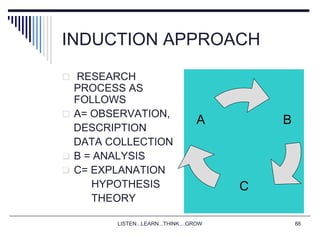
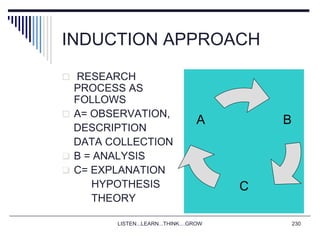
INDUCTION APPROACH
 RESEARCH
PROCESS AS
FOLLOWS
 A= OBSERVATION,
DESCRIPTION
DATA COLLECTION
 B = ANALYSIS
 C= EXPLANATION
HYPOTHESIS
THEORY
B
C
A
LISTEN...LEARN...THINK....GROW 89
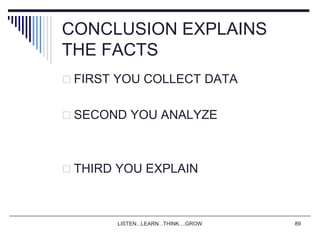
CONCLUSION EXPLAINS
THE FACTS
 FIRST YOU COLLECT DATA
 SECOND YOU ANALYZE
 THIRD YOU EXPLAIN
LISTEN...LEARN...THINK....GROW 90
EXAMPLE OF INDUCTION
 SUPPOSE YOUR FIRM SPENDS $ 1 MILLION ON
REGIONAL PROMOTIONAL CAMPAIGN HOWEVER
SALES DID NOT INCREASE : WHY?
 CONCLUSION : PROMOTION POORLY EXECUTED.
 THIS CONCLUSION IS INDUCTIVE SINCE
SALES SHOULD INCREASE AFTER
PROMOTIONAL CAMPAIGN
 ALSO WE KNOW BY LOGIC IF THE
PROMOTION IS POORLY EXECUTED ,
SALES WILL NOT INCREASE
LISTEN...LEARN...THINK....GROW 91
HYPOTHESIS FOR THE
POOR PROMOTION
 REGIONAL RETAILERS HAVE NOT
ENOUGH STOCK TO FILL CUSTOMER
REQUESTS
 A STRIKE BY THE TRUCKING FIRM
EMPLOYEES PREVENTED STOCKS
TON ARRIVE ON TIME
 A HURRICANE CLOSED ALL RETAIL
LOCATIONS
LISTEN...LEARN...THINK....GROW 92
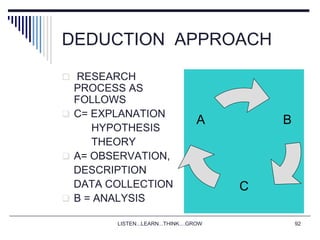
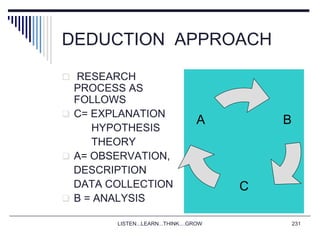
DEDUCTION APPROACH
 RESEARCH
PROCESS AS
FOLLOWS
 C= EXPLANATION
HYPOTHESIS
THEORY
 A= OBSERVATION,
DESCRIPTION
DATA COLLECTION
 B = ANALYSIS
B
C
A
LISTEN...LEARN...THINK....GROW 93
DATA CONFRONT PRIOR
REASONING: TRUE OR FALSE
 FIRST A PRIOR REASONING IS
ASSUMED
 SECOND DATA ARE COLLECTED
 THIRD COLLECTED DATA WILL
CONFIRM OR NEGATE THE
REASONING
LISTEN...LEARN...THINK....GROW 94
CASE FOR STUDY
 All regular employees are trusted not to
steal ( assuming theory)
 John is a regular employee ( collecting
data)
 John can be trusted ( conclusion)
LISTEN...LEARN...THINK....GROW 95
LISTEN...LEARN...THINK....GROW 96
EXPERIMENTAL &
NON-EXPERIMENTAL
RESEARCH
LISTEN...LEARN...THINK....GROW 97
EXPERIMENTAL RESEARCH
 DONE IN LABORATORY BY
SCIENTISTS IN FIELD LIKE BIOLOGY
AND ENGINEERING
 RESEARCHER HAS CONTROL ON
SOME VARIABLES
LISTEN...LEARN...THINK....GROW 98
NON-EXPERIMENTAL
RESEARCH
 REAL WORLD
 PEOPLE
 NO CONTROL ON THE VARIABLES
 EX: TWO PEOPLE WITH SAME
INCOME CAN DIFFER MARKEDLY IN
PERSONALITIES, FAMILY
SITUATIONS, HEALTH
LISTEN...LEARN...THINK....GROW 99
PLANNING & DESIGNING
RESEARCH
THE PROCESS INVOLVED
LISTEN...LEARN...THINK....GROW 100
THE ELEMENTS OF THE PROCESS
 THE RESEARCH PROCESS CAN BE
DIVIDED INTO EIGHT MAIN ELEMENTS
(FIGURE 3.1 PAGE 46)
 SELECT TOPIC
 REVIEW LITERATURE
 INVENT NEW FRAMEWORK
 DECIDE RESEARCH QUESTIONS
 LIST INFORMATION NEEDS AND ORGANIZE
 DECIDE RESEARCH STRATEGY
 CONDUCT RESEARCH
 REPORT FINDINGS
LISTEN...LEARN...THINK....GROW 101
INTERACTION IN THE FOUR
FIRST ELEMENTS
 THE VARIETY OF APPROACHES TO
RESEARCH SUGGESTS THAT NOT
ALL THE RESEARCH PROJECTS WILL
FOLLOW PRECISELY THE SAME
SEQUENCE
 THERE IS A GREAT DEAL OF
INTERACTION BETWEEN THE FOUR
ELEMENTS OF THE PROCESS (
FIGURE 3.1)
LISTEN...LEARN...THINK....GROW 102
ELEMENT # 1:
SELECTING A TOPIC FROM
DIFFERENT SOURCES
LISTEN...LEARN...THINK....GROW 103
I) FROM PERSONAL INTEREST:
IF THE RESEARCHER
 RESPONSIBLE FOR A PARTICULAR
FUNCTION IN AN ORGANIZATION
 MEMBER OF A SOCIAL GROUP
BASED ON GENDER, ETHNICITY OR
OCCUPATION
 LIVE IN A PARTICULAR LOCATION
HAVING SPECIFIC PROBLEMS
LISTEN...LEARN...THINK....GROW 104
ADVANTAGES AND
DISADVANTAGES
 ADVANTAGES:
 KNOWLEDGE OF
PHENOMENA
 EASY ACCESS TO
INFORMATION
FROM INDIVIDUALS
 HIGH LEVEL OF
MOTIVATION
 DISADVANTAGES:
 NON-OBJECTIVE (
PART OF THE
SITUATION)
LISTEN...LEARN...THINK....GROW 105
II) FROM LITERATURE
 MOST COMMON SOURCE OF IDEAS FOR
ACADEMIC RESEARCH
 THERE ARE A VARIETY OF FORMS:
 THEORY TESTED IN USA ONLY
( YOU CAN TRY TO STUDY THE THEORY
SOMEWHERE ELSE)
 A THEORY DEVELOPED IN RELATION TO
MANUFACTURING ( YOU CAN STUDY THE
SERVICE ORGANIZATIONS)
 WIDELY ACCEPTED THEORY BASED ON
MEN ( YOU CAN STUDY IT ON WOMEN)
LISTEN...LEARN...THINK....GROW 106
 A THEORY TESTED LONG TIME AGO
AND NEW TESTING TECHNIQUES
ARE NOW AVAILABLE
LISTEN...LEARN...THINK....GROW 107
ACADEMIC RESEARCH : MY
MASTER THESIS
 A NEW AMINE DEVELOPED BY
MOBILE WAS TESTED AND
COMPARED WITH THE WELL KNOWN
AMINE ( MEA) FOR A SPECIFIC
THERMODYNAMIC BEHAVIOR
 I COMPARED THE SAME AMINES BUT
THE COMPARISON WAS DONE FOR
THE ABSORPTION RATE PROPERTY
OF BOTH AMINES
LISTEN...LEARN...THINK....GROW 108
CRITICAL REVIEWING NEEDED
IN LITERATURE SOURCE
 IN THE CASE, SELECTING A TOPIC AND
REVIEWING THE LITERATURE ARE
COMBINED
 A GOOD RESEARCHER SHOULD IDENTIFY
NOT ONLY WHAT THE LITERATURE SAYS
BUT ESPECIALLY WHAT IT DOES NOT SAY
 MOST RESEARCHERS DO NOT TELL YOU
EVERYTHING ABOUT THEIR WORK : YOU
NEED TO READ CAREFULLY, IMAGINE AND
GUESS
LISTEN...LEARN...THINK....GROW 109
III) POLICY OR MANAGEMENT
 CAN BE SPONSORED BY PRIVATE OR
INDUSTRIAL ORGANIZATIONS OR DONE BY
ACADEMICS
 ACADEMICS : RESEARCH RESULTS MADE
PUBLIC AND OBJECTIVE IS METHODOLOGY
FOR WIDE AND GENERAL APPLICATIONS
(PARADIGM)
 PRIVATE ORGANIZATIONS: RESEARCH
FOR A PARTICULAR APPLICATION AND
RESULTS REMAIN CONFIDENTIAL
 GOVERNMENTAL ORGANIZATIONS: LIES
BETWEEN THE TWO APPROACHES
LISTEN...LEARN...THINK....GROW 110
EXAMPLES OF RESEARCH
TOPICS ( FIGURE 3.2 PAGE 47)
 PERSONAL INTEREST
 THE LITERATURE
 POLICY AND MANAGEMENT
 SOCIAL
 POPULAR ISSUES
LISTEN...LEARN...THINK....GROW 111
ELEMENT #2:
REVIEWING THE LITERATURE
LISTEN...LEARN...THINK....GROW 112
OBJECTIVE OF REVIEWING
LITERATURE
 IDENTIFYING AND ENGAGING WITH
PREVIOUS WORK RELEVANT TO THE
TOPIC OF INTEREST
LISTEN...LEARN...THINK....GROW 113
THE ROLE OF THE
LITERATURE REVIEW
 THE ENTIRE BASIS OF THE RESEARCH
 A SOURCE OF IDEAS ON TOPICS FOR
RESEARCH
 A SOURCE OF INFORMATION ON
RESEARCH DONE BY OTHERS
 SOURCE OF METHODOLOGY OR
THEORETICAL IDEAS
 SOURCE OF COMPARISON BETWEEN
YOUR RESEARCH AND OTHERS
 SOURCE OF DATA SUPPORTING YOUR
RESEARCH ( EX: DATA ON LOCAL MARKET)
LISTEN...LEARN...THINK....GROW 114
STEPS OF REVIEWING
LITERATURE
 THE REVIEWING LITERATURE IN THE
BEGINNING OF THE PROJECT IS
TEMPORARY (JUST TO START THE
PROJECT)
 TIME DOES NOT ALWAYS ALLOW
COMPLETE LITERATURE REVIEW
 PROCEED WITH THE PROPOSED
RESEARCH IN THE HOPE THAT ALL THE
RELEVANT ELEMENTS HAVE BEEN
IDENTIFIED
 EXPLORATION OF LITERATURE WILL
CONTINUE DURING THE PROJECT
LISTEN...LEARN...THINK....GROW 115
RISK OF INCOMPLETE
LITERATURE REVIEW
 DURING THE PROJECT PROCESS, THE
RESEARCHER MAY FIND A PUBLICATION (
OLD OR NEW ) WHICH COMPLETELY
NEGATES OR UPSTAGES ( DIMINISH THE
VALUE) HIS WORK JUST BEFORE
FINISHING
 THIS RISK IS VERY HIGH IN NATURAL
SCIENCES
 BUT MINIMAL IN SOCIAL SCIENCES
BECAUSE IN TWO DIFFERENT PLACES,
SAME RESEARCH PROJECT GIVES
DIFFERENT FINDINGS ( SUBJECTIVE)
LISTEN...LEARN...THINK....GROW 116
HOW TO GET NEW
LITERATURE SOURCES
 FOR FASHIONABLE PROJECTS,
LITERATURE REVIEW SHOULD
INCLUDE UNPUBLISHED
LITERATURE AND ONGOING
RESEARCH
 KNOWING THE PROJECT, FIND THE
CENTERS INVOLVED AND GET
INFORMATION THROUGH DIRECT
APPROACHES, ANNUAL REPORTS,
NEWSLETTERS, WEB SITES,
LISTEN...LEARN...THINK....GROW 117
FASHIONABLE PROJECTS:
 COMMUNICATION NETWORKS ARE
VERY ACTIVE
 SEARCH FOR SEMINARS AND
CONFERENCES RELATED TO THE
PROJECT, GET THE MOST RECENT
PAPERS, CONTACTS OTHERS
RESEARCHERS,
 POSSIBLE COLLABORATION
LISTEN...LEARN...THINK....GROW 118
CONCLUSION OF THE
LITERATURE REVIEW
 ACADEMIC PROJECTS: COMPARE
METHODOLOGIES AND DISCUSSING
MERITS AND DEFICIENCIES AND
EXPLAIN HOW CONCLUSIONS ARE
RELATED TO YOUR PROJECT
 MANAGERIAL PROJECTS: SHORTER
CONCLUSION RELATED TO
RELEVANT AND USEFUL FINDINGS
INSTEAD OF METHODOLOGY USED
LISTEN...LEARN...THINK....GROW 119
ELEMENT #3
DEVISING A CONCEPTUAL
FRAMEWORK
LISTEN...LEARN...THINK....GROW 120
CONCEPTUAL FRAMEWORK
 The development of a conceptual
framework is the most important and the
most difficult element of the project
 It is sometimes also the weakest
element in research proposals
 Conceptual framework involves concepts
LISTEN...LEARN...THINK....GROW 121
CONCEPTS
 To understand and communicate information
about objects and events, there must be a
common ground on which to do it.
 CONCEPT SERVE THIS PURPOSE
 Concepts are generally accepted collection of
meanings or characteristics associated with
certain events, objects, situations and
behaviors
LISTEN...LEARN...THINK....GROW 122
EXAMPLE OF CONCEPTS
 IF WE SEE A MAN PASSING, WE
IDENTIFY THAT HE IS
 WALKING
 SKIPPING ( JUMPING)
 CRAWLING ( ON THE KNEE)
 HOPPING ( SHORT JUMP)
 RUNNING
 THIS IS A CONCEPT
LISTEN...LEARN...THINK....GROW 123
SOURCES OF CONCEPTS
 SOME CONCEPTS ARE ACQUIRED
FROM PERSONAL EXPERIENCES
AND IF WE CHANGE SOCIETY, WE
WILL HAVE THE SAME CONCEPTS
BUT IN A DIFFERENT LANGUAGE
 SOME CONCEPTS ARE UNIQUE TO A
PARTICULAR CULTURE AND CAN
NOT BE TRANSLATED INTO
ANOTHER LANGUAGE
LISTEN...LEARN...THINK....GROW 124
BORROWING CONCEPTS
 GRAVITATION BORROWED FROM PHYSICS
AND USED IN MARKETING TO EXPLAIN
WHY PEOPLE SHOP WHERE THEY DO
 DISTANCE IS USED IN ATTITUDE
MEASUREMENT TO DESCRIBE THE
DEGREE OF VARIABILITY BETWEEN
ATTITUDES OF PEOPLE
 VELOCITY IS USED IN ECONOMY
 FLAVOR BORROWED FROM FOOD
SCIENCE TO ENGINEERING ( HE DOES NOT
HAVE THE FLAVOR OF SCIENCE)
LISTEN...LEARN...THINK....GROW 125
CONCEPTS IN BUSINESS
RESEARCH
 WE DESIGN HYPOTHESES USING
CONCEPTS
( FOR EXAMPLE : WHAT IS A GOOD
COMPANY?)
 TWO PEOPLE MAY HAVE TWO
DIFFERENT OPINIONS OR
CONCEPTS
LISTEN...LEARN...THINK....GROW 126
THE IMPORTANCE OF
CONCEPTS
 WE DEVISE MEASUREMENT
CONCEPTS BY WHICH TO TEST OUR
HYPOTHETICAL STATEMENTS
 WE GATHER DATA USING THESE
MEASUREMENTS CONCEPTS
 SOME PEOPLE INVENT CONCEPTS
TO EXPRESS THEIR IDEAS
LISTEN...LEARN...THINK....GROW 127
COMMUNICATING OUR
CONCEPTS: THE ART
 THE SUCCESS OF RESEARCH
DEPENDS ON HOW CLEARLY WE
CONCEPTUALIZE ( FORM AN IDEA)
 THIS IS THE ART PART OF BUSINESS
RESEARCH.
 YOUR CONCEPTS ARE THE RESULT OF
YOUR OWN EXPERIENCES.
 YOUR OWN ART WILL HELP YOU CHOOSE
THE RIGHT QUESTIONS RELATED TO YOUR
CONCEPTS USED FOR THE RESEARCH
LISTEN...LEARN...THINK....GROW 128
WE NEED CLEAR
CONCEPTS
 HOW OTHERS UNDERSTAND THE
CONCEPTS WE USE
 WHEN WE NEED TO MEASURE
ATTITUDE OR SATISFACTION OF
PEOPLE WHICH ARE ABSTRACT
 EXAMPLE: SOME PEOPLE DO NOT
CONCEPTUALIZE THAT HUNTING IS
A CRIME
LISTEN...LEARN...THINK....GROW 129
EXAMPLE #1 THAT NEEDS
CONCEPT
 If you want to know: what will be the employee
reaction to the new flexible work schedule ?
 You may ask :
 Which employees?
 What reaction?
 THESE QUESTIONS REQUIRE THE USE OF
CONCEPTS, CONSTRUCTS AND
DEFINITIONS
LISTEN...LEARN...THINK....GROW 130
CHALLENGE: CONCEPTS THAT OTHER
CLEARLY UNDERSTAND
 EXAMPLE : IN YOUR
QUESTIONNAIRE, YOU ARE ASKING
RESPONDENTS : “ FAMILY TOTAL
INCOME”
 SEEMS AN EASY QUESTION BUT
YOU WILL HAVE CONFUSING
ANSWERS AND YOU CAN NOT
QUANTIFY THEM
LISTEN...LEARN...THINK....GROW 131
WE NEED TO BE MORE PRECISE
ABOUT
 TIME PERIOD : WEEKLY, MONTHLY,
ANNUALLY
 BEFORE OR AFTER INCOME TAXES
 FOR HEAD OF FAMILY ONLY OR ALL THE
FAMILY MEMBERS
 FOR SALARY AND WAGES ONLY OR FOR
DIVIDENDS, INTEREST, AND CAPITAL GAIN
 INCOME IN KIND SUCH AS FREE RENT,
EMPLOYEE DISCOUNT, OR FOOD STAMP
LISTEN...LEARN...THINK....GROW 132
EXAMPLE THAT NEED
CONCEPT
 Why did the stock market price surge
higher when all the normal indicators
suggested it will go down
 You may ask:
 What are the normal indicators
 THIS QUESTION ALSO REQUIRE THE
USE OF CONCEPTS, CONSTRUCTS
AND DEFINITIONS
LISTEN...LEARN...THINK....GROW 133
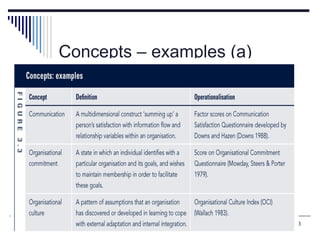
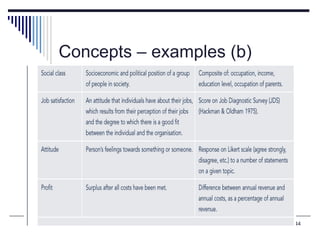
FIGURE 3.3 PAGE 50
 Examples of concepts encountered in
management research, their definition
and they might be operationalised or
communicated in a qualitatively or
quantitatively assessable or measurable
form
LISTEN...LEARN...THINK....GROW 134
CONCEPTUAL
FRAMEWORK
LISTEN...LEARN...THINK....GROW 135
IMPORTANCE OF
CONCEPTUAL FRAMEWORK
 A conceptual framework of a researcher
indicates how he views the concepts
involved in his study and also the
relation between concepts.
 The conceptual framework is original to
each researcher. It depends on the
researcher CONCEPTS based on his
experiences, education and know-how
LISTEN...LEARN...THINK....GROW 136
COURSE OF THE STUDY = CONCEPTS
+ CONCEPTUAL FRAMEWORK
 THE CONCEPTS IDENTIFIED,
 THE CONCEPTUAL FRAMEWORK
 DETERMINE ALL THE COURSE OF
STUDY
LISTEN...LEARN...THINK....GROW 137
CONCEPTUAL FRAMEWORK
AND TYPES OF RESEARCH
 IT IS NECESSARY TO DECIDE FIRST
UPON THE KINDS OF RESEARCH
BEING CONDUCTED IN ORDER TO
ELABORATE ITS CONCEPTUAL
FRAMEWORK.
 CONCEPTUAL FRAMEWORK ARE
DIFFERENT IF THE RESEARCH IS
DESCRIPTIVE, EXPLANATORY OR
EVALUATIVE
LISTEN...LEARN...THINK....GROW 138
DESCRIPTIVE RESEARCH
 DESCRIPTIVE RESEARCH RARELY
REQUIRES ELABORATE
CONCEPTUAL FRAMEWORK BUT
CLEAR DEFINITIONS OF CONCEPTS
INVOLVED ARE REQUIRED
LISTEN...LEARN...THINK....GROW 139
EXPLANATORY/
EVALUATIVE RESEARCH
 NEED WELL DEVELOPED
CONCEPTUAL FRAMEWORK THAT
FORMS THE BASIS FOR THE
EXPLANATION AND THE
EXAMINATION REQUIRED FOR THE
RESEARCH
LISTEN...LEARN...THINK....GROW 140
EXPLANATORY/
EVALUATIVE RESEARCH
 EXPLANATION INVOLVES IDEA OF
CAUSE EFFECT
 RELATIONSHIPS BETWEEN INPUTS
AND OUTPUTS
 ACTIONS AND OUTCOMES
LISTEN...LEARN...THINK....GROW 141
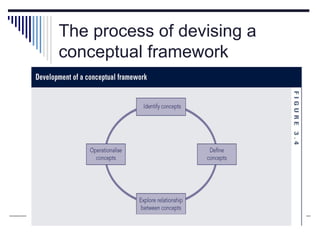
DEVELOPMENT OF
FRAMEWORK (FIGURE 3.4 P.51)
 The development of a framework
involves four elements:
 Identification of concepts
 Definition of concepts
 Exploration of relationships between
concepts
 Operationalisation
LISTEN...LEARN...THINK....GROW 142
The process of devising a
conceptual framework
LISTEN...LEARN...THINK....GROW 143
Concepts – examples (a)
LISTEN...LEARN...THINK....GROW 144
Concepts – examples (b)
LISTEN...LEARN...THINK....GROW 145
APPLIED RESEARCH
 IN APPLIED RESEARCH SUCH AS
PLANNING AND MARKETING IN AN
ORGANIZATION  READY MADE
IDEAS CAN BE FOUND IN PLANNING
OR MARKETING LITERATURE
LISTEN...LEARN...THINK....GROW 146
ACADEMIC RESEARCH
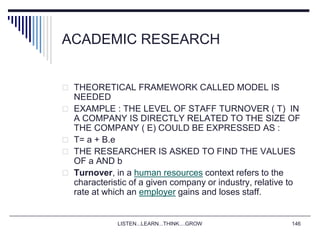
 THEORETICAL FRAMEWORK CALLED MODEL IS
NEEDED
 EXAMPLE : THE LEVEL OF STAFF TURNOVER ( T) IN
A COMPANY IS DIRECTLY RELATED TO THE SIZE OF
THE COMPANY ( E) COULD BE EXPRESSED AS :
 T= a + B.e
 THE RESEARCHER IS ASKED TO FIND THE VALUES
OF a AND b
 Turnover, in a human resources context refers to the
characteristic of a given company or industry, relative to
rate at which an employer gains and loses staff.
LISTEN...LEARN...THINK....GROW 147
FOR THE SAME EXAMPLE:
TURNOVER IN A COMPANY
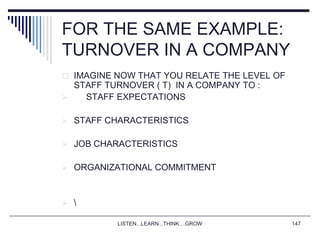
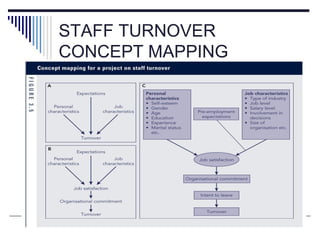
 IMAGINE NOW THAT YOU RELATE THE LEVEL OF
STAFF TURNOVER ( T) IN A COMPANY TO :
 STAFF EXPECTATIONS
 STAFF CHARACTERISTICS
 JOB CHARACTERISTICS
 ORGANIZATIONAL COMMITMENT

LISTEN...LEARN...THINK....GROW 148
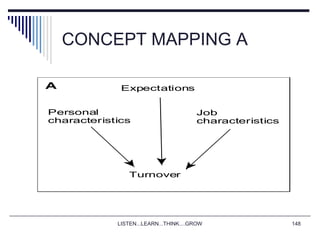
CONCEPT MAPPING A
A Expectations
Turnover
Job
characteristics
Personal
characteristics
LISTEN...LEARN...THINK....GROW 149
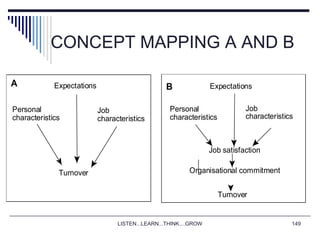
CONCEPT MAPPING A AND B
A
Personal
characteristics
Expectations
Job
characteristics
Turnover
B Expectations
Job
characteristics
Personal
characteristics
Job satisfaction
Organisational commitment
Turnover
LISTEN...LEARN...THINK....GROW 150
DECIDING
RESEARCH
QUESTIONS
LISTEN...LEARN...THINK....GROW 151
THE LINK BETWEEN
CONCEPTS AND RESEARCH
 DECIDING ON THE RESEARCH QUESTIONS
IS ONE OF THE MOST DIFFICULT TASKS IN
THE WHOLE PROCESS
 The scope/scale of the resultant project should
be manageable within the time/resources
available.
 Questions should be answerable
 Questions may be grouped into primary and
subsidiary
LISTEN...LEARN...THINK....GROW 152
EXAMPLE #1 OF RESEARCH
QUESTIONS
 Research question : What is the relationship
between advertising expenditure and revenue?
 Research objective – eg. The aim of the study
is to discover the relationship between
advertising expenditure and revenue.
 Hypothesis – eg. There is a positive relationship
between advertising expenditure and revenue
 THE RESEARCH RESULTS WILL TELL YOU :
TRUE OR FALSE
LISTEN...LEARN...THINK....GROW 153
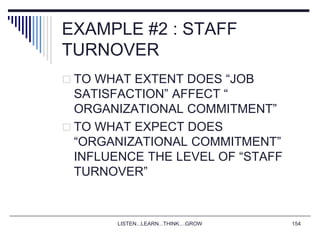
EXAMPLE #2 : STAFF
TURNOVER
 WHAT ARE THE RELATIVE
INFLUENCES OF “PERSONAL
CHARACTERISTICS”, PRE-
EMPLOYMENT EXPECTATIONS” AND
“JOB CHARACTERISTICS” ON “JOB
SATISFACTION”
LISTEN...LEARN...THINK....GROW 154
EXAMPLE #2 : STAFF
TURNOVER
 TO WHAT EXTENT DOES “JOB
SATISFACTION” AFFECT “
ORGANIZATIONAL COMMITMENT”
 TO WHAT EXPECT DOES
“ORGANIZATIONAL COMMITMENT”
INFLUENCE THE LEVEL OF “STAFF
TURNOVER”
LISTEN...LEARN...THINK....GROW 155
STAFF TURNOVER
CONCEPT MAPPING
LISTEN...LEARN...THINK....GROW 156
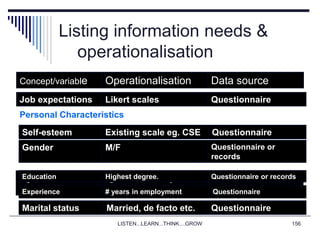
Listing information needs &
operationalisation
Self-esteem Existing scale eg. CSE Questionnaire
Concept/variable Operationalisation Data source
Gender M/F Questionnaire or
records
Job expectations Likert scales Questionnaire
Personal Characteristics
Age Age last birthday Questionnaire or
records
Education Highest degree. Questionnaire or records
Experience # years in employment Questionnaire
Marital status Married, de facto etc. Questionnaire
LISTEN...LEARN...THINK....GROW 157
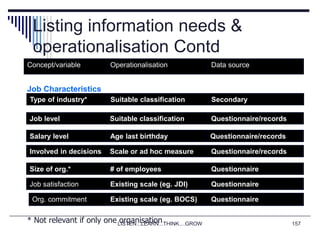
Listing information needs &
operationalisation Contd
Type of industry* Suitable classification Secondary
Concept/variable Operationalisation Data source
Job level Suitable classification Questionnaire/records
Job Characteristics
Salary level Age last birthday Questionnaire/records
Involved in decisions Scale or ad hoc measure Questionnaire/records
Size of org.* # of employees Questionnaire
Job satisfaction Existing scale (eg. JDI) Questionnaire
Org. commitment Existing scale (eg. BOCS) Questionnaire
* Not relevant if only one organisation
LISTEN...LEARN...THINK....GROW 158
HOME WORK FOR
OCTOBER 4TH 2007
 ANALYZE THE BUSINESS RESEARCH WORK DONE
FOR THE RADIO STATION WKLM AND
 WHAT WAS THE PROBLEM?
 HOW WKLM WANTS TO SOLVE THIS PROBLEM?
 HOW DID THEY SELECT THE SAMPLE?
 WHY PHONE SURVEY WAS USED?
 WHAT IS THE PROBLEM FACED DURING THIS
SURVEY?
 SUMMARIZE THE FINDINGS
 HOW THE FINDINGS ARE RELATED TO THE
OBJECTIVE OF THE RESEARCH?
 CAN YOU THINK ABOUT ANOTHER METHODOLOGY?
EXPLAIN
LISTEN...LEARN...THINK....GROW 159
DEVELOPING
RESEARCH
STRATEGY
LISTEN...LEARN...THINK....GROW 160
STEPS OF RESEARCH
STRATEGY
 Decide information ( DATA ) -gathering
methods – See Chs. 5-11
 Decide data analysis methods – See
Chs. 12-15
 Budget and timetable – See this chapter
Section II
LISTEN...LEARN...THINK....GROW 161
THURSDAY OCTOBER 4TH : RESEARCH
PROJECT PROPOSAL
THE REPORT SHOULD INCLUDE:
 SITUATION AND STATEMENT OF THE PROBLEM
 PURPOSE OF THE STUDY
 TYPE OF STUDY
 HYPOTHESES ( IF ANY)
 HOW ARE YOU GOING TO SELECT YOUR SAMPLE
AND WHY?
 WHICH DATA ARE YOU GOING TO COLLECT?
 WHICH SECONDARY DATA ?
 SOME QUESTIONS YOU ARE GOING TO ASK
LISTEN...LEARN...THINK....GROW 162
SOURCE OF
INFORMATION #1
GATHERING DATA
LISTEN...LEARN...THINK....GROW 163
GATHERING DATA
 As you explore your problem or topic,
you may consider many different types
of information sources, some much
valuable than others
 Information sources are generally
characterized into:
 Primary sources
 Secondary sources
 Tertiary sources
LISTEN...LEARN...THINK....GROW 164
WHAT ARE DATA?
 Data are facts presented to the
researcher from the study environment
 Data can be characterized by their
 Abstractness
 Verifiability
 Elusiveness
 Closeness to the phenomena
LISTEN...LEARN...THINK....GROW 165
Data as Abstractness
 Metaphorical ( related to metaphor)
 Example of Metaphor : he has a heart of stone (
not real )
 Example of Abstractions: the growth of GNP (
Gross National Product) can not be observed
directly, only the effects of it can be recorded
 GDP measures all production within the
country, by whoever happens to be working
here;
 GNP measures the production of all the
nationals, wherever they happen to be working.
LISTEN...LEARN...THINK....GROW 166
VERIFIABILITY OF DATA
 Our data are processed by our senses and can
be limited to the senses of other people
 Everything we know about the world and
ourselves has come through our senses.
 All our knowledge therefore is the product of
what we have seen, heard, smelt, etc.
 When sensory experiences consistently
produce the same results, our data are said
trustworthy because they may be verified
LISTEN...LEARN...THINK....GROW 167
ELUSIVE DATA
 Capturing data is elusive, complicated by
the speed at which events occur and
time-bound nature of observations
 Opinions, preferences or attitudes are
not the same from the 80’s to now
LISTEN...LEARN...THINK....GROW 168
CLOSENESS TO THE
PHENOMENA
 Data reflect their truthfulness by
closeness to the phenomena
LISTEN...LEARN...THINK....GROW 169
PRIMARY VS SECONDARY
DATA
 Much of business research involves the
collection and analysis of new data.
 Primary data:
 new data specifically collected in
current research project
 researcher is the primary user.
LISTEN...LEARN...THINK....GROW 170
KEY TERMS –DEFINITIONS
 However, research can also be done by the
analysis of existing data that was collected for
some other purpose, and the ability to locate
such secondary data is an important research
skill.
 Secondary data:
 data already exist - collected for some other
(primary) purpose
 researcher is the secondary user.
LISTEN...LEARN...THINK....GROW 171
SECONDARY DATA
USES AND ROLES
LISTEN...LEARN...THINK....GROW 172
USES/ROLES OF
SECONDARY DATA
 Background/preparation
 Complementary –
comparison/validation of primary data
collected
 Whole basis of project – re-analysis
of data
 Context setting (in report)
LISTEN...LEARN...THINK....GROW 173
SOURCES OF SECONDARY
DATA
 COMPANY INFORMATION
 GOVERNMENT AGENCIES
 EDUCATIONAL INSTITUTIONS
 PROFESSIONAL ORGANIZATIONS
 MANAGEMENT RELATED FIELDS
 ARCHIVES
 INTERNET
LISTEN...LEARN...THINK....GROW 174
SOURCE OF SECONDARY DATA
#1 : COMPANY INFORMATION
 This can be from internal or external sources.
 Internal sources comprise the internal records of a
company, and include financial accounts and sales
information, human resources records , customer
complaints, etc.
 External sources for public companies are available from
their annual reports and other reports on their finances
and structure that they are required by law to disclose.
 For private companies, newspapers, the financial press
and trade journals need to be searched for information.
 A number of electronic databases can be searched for
company information.
LISTEN...LEARN...THINK....GROW 175
SOURCE OF SECONDARY DATA
#2 “:GOVERNMENT AGENCIES.
 GOVERNMENT Bureau of Statistics,
 the GOVERNMENT Trade Commission,
 THE Government Index of Publications.
Information from these sources is
available via the Internet.
LISTEN...LEARN...THINK....GROW 176
SECONDARY DATA FROM UAE
GOVERNMENT STATISTIC
AGENCIES
 UAE STATISTICS
LISTEN...LEARN...THINK....GROW 177
SOURCE #3 OF SECONDARY
DATA: Educational institutions
and specialist centres
 Many universities have web pages where
information on conferences and publications
can be obtained.
 Specialist centres, often associated with
universities, provide a similar source of
information in their specialist areas.
 Academic researchers may be contacted for
information.
 These may be located from their being authors
of published papers, or from a number of
existing databases
LISTEN...LEARN...THINK....GROW 178
SOURCE #4 OF SECONDARY
DATA :PROFESSIONAL
ORGANIZATIONS
 These include business and professional
associations, societies, and not-for-profit
organisations, and can be located
through the telephone directories.
 Databases also exist that contain many
such associations and societies
LISTEN...LEARN...THINK....GROW 179
SOURCE #5 OF SECONDARY
DATA: Management-related fields
 Business research will often require the
seeking of information related to other
disciplines, such as law, psychology,
education, sociology, etc.
 Databases and other sources of
information are available for each of
these disciplines.
LISTEN...LEARN...THINK....GROW 180
SOURCE #6 OF SECONDARY
DATA :Archival material
 Archival material available via the
Internet is developing, and is accessed
through some newspaper and university
websites.
LISTEN...LEARN...THINK....GROW 181
SOURCE #7 OF SECONDARY
DATA : Internet-based resources
 .A number of websites are available that
give wide coverage and a large number
of links to other sources.
LISTEN...LEARN...THINK....GROW 182
SECONDARY DATA
FROM COMPANY
INFORMATION
CASE STUDY
LISTEN...LEARN...THINK....GROW 183
COMPANY SECONDARY
DATA AVAILABLE
 SECONDARY DATA COULD DE
 INTERNAL DATA
 EXTERNAL DATA
LISTEN...LEARN...THINK....GROW 184
SECONDARY INTERNAL DATA
FOR A COMPANY OR AN
ORGANIZATION
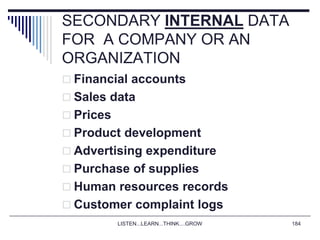
 Financial accounts
 Sales data
 Prices
 Product development
 Advertising expenditure
 Purchase of supplies
 Human resources records
 Customer complaint logs
LISTEN...LEARN...THINK....GROW 185
CASE STUDY FOR INTERNAL DATA :
Employee Turnover & Company
Performance
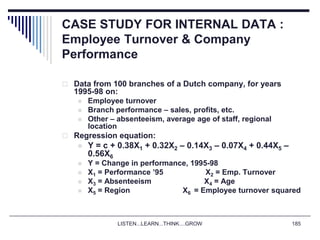
 Data from 100 branches of a Dutch company, for years
1995-98 on:
 Employee turnover
 Branch performance – sales, profits, etc.
 Other – absenteeism, average age of staff, regional
location
 Regression equation:
 Y = c + 0.38X1 + 0.32X2 – 0.14X3 – 0.07X4 + 0.44X5 –
0.56X6
 Y = Change in performance, 1995-98
 X1 = Performance ’95 X2 = Emp. Turnover
 X3 = Absenteeism X4 = Age
 X5 = Region X6 = Employee turnover squared
LISTEN...LEARN...THINK....GROW 186
SECONDARY EXTERNAL DATA
FOR A COMPANY OR AN
ORGANIZATION
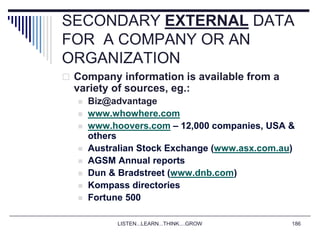
 Company information is available from a
variety of sources, eg.:
 Biz@advantage
 www.whowhere.com
 www.hoovers.com – 12,000 companies, USA &
others
 Australian Stock Exchange (www.asx.com.au)
 AGSM Annual reports
 Dun & Bradstreet (www.dnb.com)
 Kompass directories
 Fortune 500
LISTEN...LEARN...THINK....GROW 187
CLASS WORK
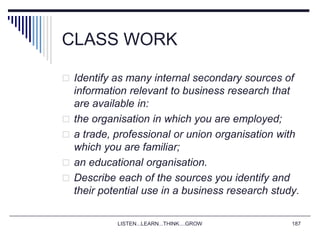
 Identify as many internal secondary sources of
information relevant to business research that
are available in:
 the organisation in which you are employed;
 a trade, professional or union organisation with
which you are familiar;
 an educational organisation.
 Describe each of the sources you identify and
their potential use in a business research study.
LISTEN...LEARN...THINK....GROW 188
COMPANY’S SECONDARY
DATA AND RESEARCH
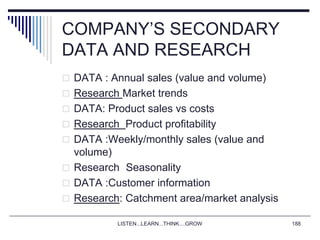
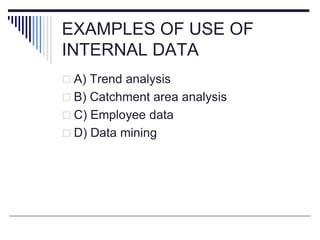
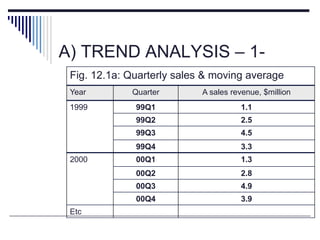
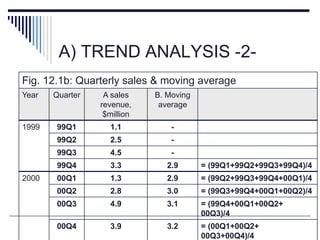
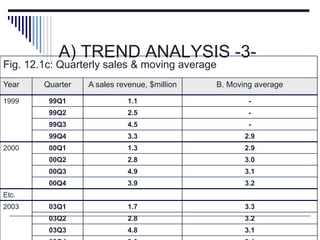
 DATA : Annual sales (value and volume)
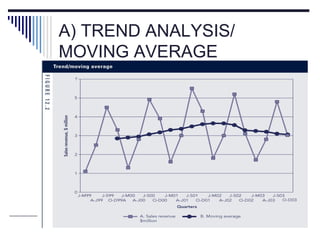
 Research Market trends
 DATA: Product sales vs costs
 Research Product profitability
 DATA :Weekly/monthly sales (value and
volume)
 Research Seasonality
 DATA :Customer information
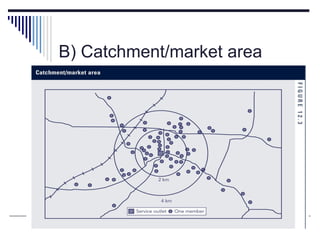
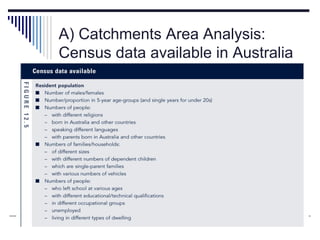
 Research: Catchment area/market analysis
LISTEN...LEARN...THINK....GROW 189
COMPANY’S SECONDARY
DATA AND RESEARCH
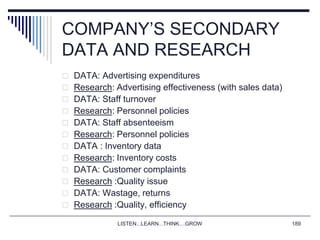
 DATA: Advertising expenditures
 Research: Advertising effectiveness (with sales data)
 DATA: Staff turnover
 Research: Personnel policies
 DATA: Staff absenteeism
 Research: Personnel policies
 DATA : Inventory data
 Research: Inventory costs
 DATA: Customer complaints
 Research :Quality issue
 DATA: Wastage, returns
 Research :Quality, efficiency
LISTEN...LEARN...THINK....GROW 190
TRADE, PROFESSIONAL,
UNION BODY SECONDARY
DATA AND RESEARCH
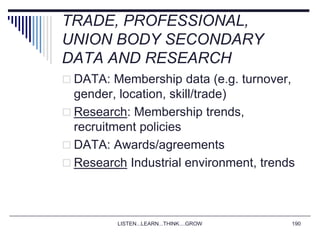
 DATA: Membership data (e.g. turnover,
gender, location, skill/trade)
 Research: Membership trends,
recruitment policies
 DATA: Awards/agreements
 Research Industrial environment, trends
LISTEN...LEARN...THINK....GROW 191
Educational Institution
secondary data and research
 DATA : Applications for places
 Research: Demand trends
 DATA: Attrition rates
 Research: Quality
 DATA: Student evaluations
 Research: Teaching quality
 DATA: Employment rates
 Research: Industry relevance, quality
 DATA: Student data
 Research: Gender distribution, geographical catchment
 DATA: Student grades
 Research :Quality
LISTEN...LEARN...THINK....GROW 192
CLASS WORK: USE THE
INTERNET
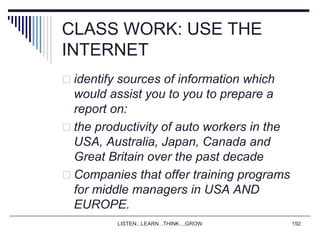
 identify sources of information which
would assist you to you to prepare a
report on:
 the productivity of auto workers in the
USA, Australia, Japan, Canada and
Great Britain over the past decade
 Companies that offer training programs
for middle managers in USA AND
EUROPE.
LISTEN...LEARN...THINK....GROW 193
GROUP WORK
SESSION
LISTEN...LEARN...THINK....GROW 194
SOURCE OF
INFORMATION #2
OBSERVATION
LISTEN...LEARN...THINK....GROW 195
THE IMPORTANCE OF
OBSERVATION METHOD
 Observation is a generally neglected
technique in business research.
 But, it is useful to understand that
systematic observation can be a reliable
and efficient research tool in many
situations.
 The observational method has been
used in several areas of management
research.
LISTEN...LEARN...THINK....GROW 196
WHAT TO OBSERVE?
 Time and motion studies are early examples of
research that use this method.
 Other forms of workplace behaviour, such as
the amount of work completed, or the times that
people arrive and leave the workplace, can be
studied by observation.
 Also, the observation of social behaviours of
employees, or the behaviour of customers in a
store can form a source of data for research.
LISTEN...LEARN...THINK....GROW 197
Example of time study
 In Quebec post-office, when you take the
ticket, the time appears in the ticket
automatically .
 This is the time you started to queue and
when you are front of the agent, he will
take the time and record how much you
stayed on-line
 Their project could be : how to decrease
the queuing time of costumers
LISTEN...LEARN...THINK....GROW 198
OBSERVATION TECHNIQUES
 Observation can be done by simply ‘looking’ or
with the use of still or time-lapse photography,
or video recording.
 In these above examples, it is possible that
questioning the subjects might not yield the
same information as might be gained from
direct observation.
 This could be because the subjects are not
aware of the patterns of behaviour that might be
observed, or because subjects might tend to
under-report negative behaviours, such as
lateness or laziness, and over-report positive
behaviours.
LISTEN...LEARN...THINK....GROW 199
OBSERVATION CONTEXTS
Spatial use of sites
Workplace behaviour
Consumer testing
Complementary research
Social behaviour
LISTEN...LEARN...THINK....GROW 200
CONTEXT: WORKPLACE
BEHAVIOR
 What might be observed?
 Physical actions
 Non-verbal behaviour (eg. Level of
voice, body language
 Time taken to complete tasks
 Distances between people
 Deviant behaviour –
 Employee relations, privacy & ethics
issues
LISTEN...LEARN...THINK....GROW 201
CONTEXT: CONSUMER
TESTING
 Sometimes called ‘mystery shopping’
 Can be seen as a form of participant
observation
 Researcher plays the incognito role of
shopper/user/observer
 Examples of what might be observed:
 Cleanliness of premises
 Information availability
 Product availability
 Staff availability, courtesy, knowledge
LISTEN...LEARN...THINK....GROW 202
CONTEXT:
COMPLEMENTARY
 For example:
 In a sample interview survey at a
site: may be necessary to count
(by observation) the total number
of users of the site and temporal
pattern of use of the site – to
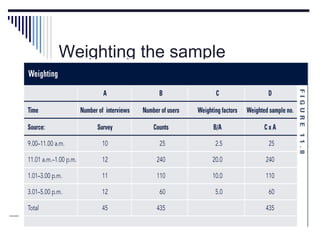
weight the sample
LISTEN...LEARN...THINK....GROW 203
CONTEXT : SOCIAL
BEHAVIOR
 Example: an industrial dispute
(especially if there are strikes,
picketing, lockouts, violence
LISTEN...LEARN...THINK....GROW 204
ELEMENTS OF
QUALITATIVE RESEARCH
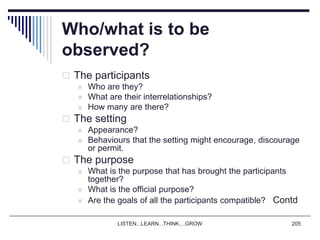
 Who/what is to be observed?
 Steps in setting up/implementing a
project
LISTEN...LEARN...THINK....GROW 205
Who/what is to be
observed?
 The participants
 Who are they?
 What are their interrelationships?
 How many are there?
 The setting
 Appearance?
 Behaviours that the setting might encourage, discourage
or permit.
 The purpose
 What is the purpose that has brought the participants
together?
 What is the official purpose?
 Are the goals of all the participants compatible? Contd
LISTEN...LEARN...THINK....GROW 206
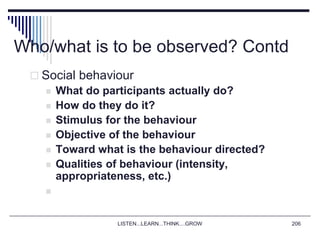
Who/what is to be observed? Contd
 Social behaviour
 What do participants actually do?
 How do they do it?
 Stimulus for the behaviour
 Objective of the behaviour
 Toward what is the behaviour directed?
 Qualities of behaviour (intensity,
appropriateness, etc.)

LISTEN...LEARN...THINK....GROW 207
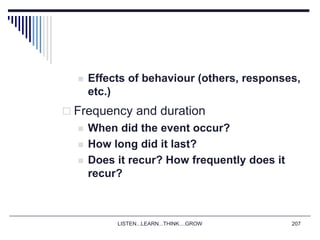
 Effects of behaviour (others, responses,
etc.)
 Frequency and duration
 When did the event occur?
 How long did it last?
 Does it recur? How frequently does it
recur?
LISTEN...LEARN...THINK....GROW 208
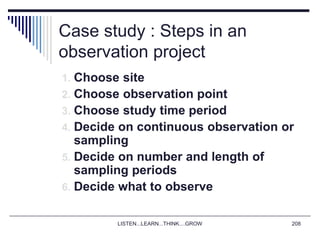
Case study : Steps in an
observation project
1. Choose site
2. Choose observation point
3. Choose study time period
4. Decide on continuous observation or
sampling
5. Decide on number and length of
sampling periods
6. Decide what to observe
LISTEN...LEARN...THINK....GROW 209
Case study
7 Divide into zones
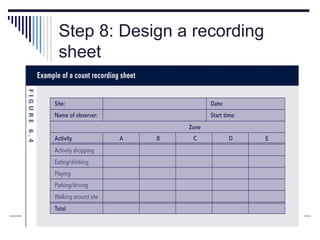
8 Design a recording sheet
9 Conduct study
10 Analyse data
LISTEN...LEARN...THINK....GROW 210
Step 1: Choice of site
Sites may be fixed by project
brief
If choice is possible, consider:
 Appropriate workplace/customer
behaviour
 Suitable conditions for
observation
LISTEN...LEARN...THINK....GROW 211
Step 2: Choice of observation
points
Some site can be observed from
one spot
Other required selection of
observation points to cover the
whole site
LISTEN...LEARN...THINK....GROW 212
Step 3: Choice of time period
 Need to take account of patterns of use by:
 Year
 Day of the week
 Time of day
 Weather conditions, season
 Public/school holidays
 Sampling of time-periods may be necessary
(see Step 4)
LISTEN...LEARN...THINK....GROW 213
Step 4: Continuous observation or
sampling?
 When counting:
 Continuous counts – of all people
entering site?
 Spot counts – of numbers present at
particular times
 Dependent on number of entrances,
resources available, technology available
 Qualitative – continuous observation (in
specified periods) more likely.
LISTEN...LEARN...THINK....GROW 214
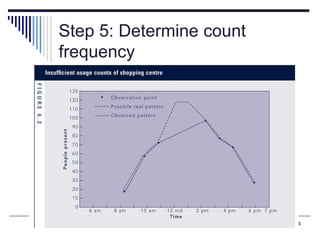
Step 5: Determine count
frequency
LISTEN...LEARN...THINK....GROW 215
Step 6: Decide what to observe
Record visitor numbers?
Also record characteristics?
(male, female, adult, children …)
Behaviour?
Possible to observe people’s
movement through a site
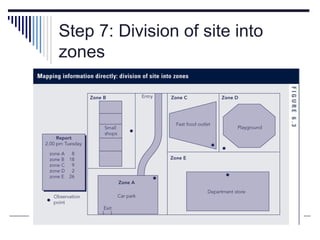
Use site map to record
information – see Figure 6.3
LISTEN...LEARN...THINK....GROW 216
Step 7: Division of site into
zones
LISTEN...LEARN...THINK....GROW 217
Step 8: Design a recording
sheet
LISTEN...LEARN...THINK....GROW 218
Step 9: Conduct the
observation
 Avoid boredom by circulating staff
between tasks/locations
LISTEN...LEARN...THINK....GROW 219
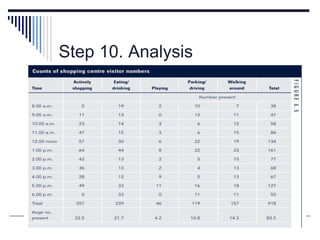
Step 10. Analysis
LISTEN...LEARN...THINK....GROW 220
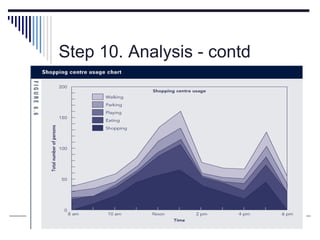
Step 10. Analysis - contd
LISTEN...LEARN...THINK....GROW 221
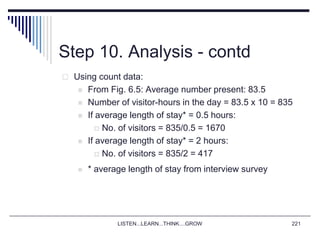
Step 10. Analysis - contd
 Using count data:
 From Fig. 6.5: Average number present: 83.5
 Number of visitor-hours in the day = 83.5 x 10 = 835
 If average length of stay* = 0.5 hours:
 No. of visitors = 835/0.5 = 1670
 If average length of stay* = 2 hours:
 No. of visitors = 835/2 = 417
 * average length of stay from interview survey
LISTEN...LEARN...THINK....GROW 222
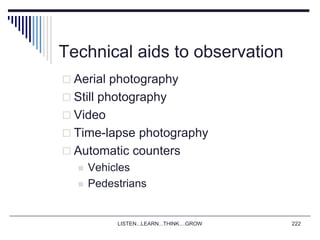
Technical aids to observation
 Aerial photography
 Still photography
 Video
 Time-lapse photography
 Automatic counters
 Vehicles
 Pedestrians
LISTEN...LEARN...THINK....GROW 223
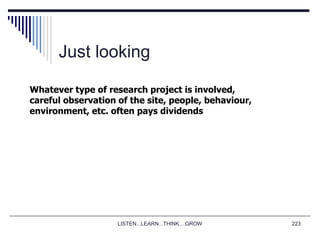
Just looking
Whatever type of research project is involved,
careful observation of the site, people, behaviour,
environment, etc. often pays dividends
LISTEN...LEARN...THINK....GROW 224
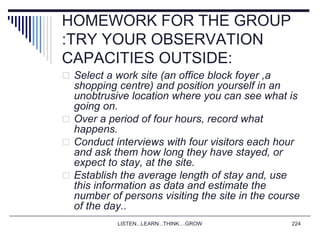
HOMEWORK FOR THE GROUP
:TRY YOUR OBSERVATION
CAPACITIES OUTSIDE:
 Select a work site (an office block foyer ,a
shopping centre) and position yourself in an
unobtrusive location where you can see what is
going on.
 Over a period of four hours, record what
happens.
 Conduct interviews with four visitors each hour
and ask them how long they have stayed, or
expect to stay, at the site.
 Establish the average length of stay and, use
this information as data and estimate the
number of persons visiting the site in the course
of the day..
LISTEN...LEARN...THINK....GROW 225
WRITING A REPORT
 Write a report on how the site is used,
who it is used by, how many people use
it, what conflicts there are - if any -
between different groups of users and
how the design aids or hinders the
activity which people engage in on the
site
LISTEN...LEARN...THINK....GROW 226
HELPFUL IDEAS
 Draw a map, as in Figure 6.3, and to construct a data
recording sheet, as in Figure 6.4.
 Quantitative and qualitative methods might be used.
 Suggested report headings:
 1. The nature and layout of the site
 2. The use of the site:
 a. Activities and numbers (quantitative)
 b. Observations on the use and mis-use of the site
(qualitative)
 3. Implications for design, layout and management.
 4 Comments on the research experience.
LISTEN...LEARN...THINK....GROW 227
QUALITATIVE
METHODS
LISTEN...LEARN...THINK....GROW 228
OBJECTIVE OF THE
CHAPTER
 The nature of qualitative research
methods and discussed and some of the
advantages that they might have over
quantitative methods are listed.
 A number of qualitative methods are
outlined, and examples of their use in
business research are given.
LISTEN...LEARN...THINK....GROW 229
THE NATURE OF QUALITATIVE
RESEARCH METHODS
 Use of qualitative rather than quantitative
information:
 a large amount of ‘rich’ information about
a small number of subjects
 Assumes that reality is socially and
subjectively constructed
 Researcher’s task is to uncover meanings
rather than test pre-established hypotheses:
usually inductive rather than deductive
 Assumes people are best able to describe
their own situation, beliefs, motivations etc.
LISTEN...LEARN...THINK....GROW 230
INDUCTION APPROACH
 RESEARCH
PROCESS AS
FOLLOWS
 A= OBSERVATION,
DESCRIPTION
DATA COLLECTION
 B = ANALYSIS
 C= EXPLANATION
HYPOTHESIS
THEORY
B
C
A
LISTEN...LEARN...THINK....GROW 231
DEDUCTION APPROACH
 RESEARCH
PROCESS AS
FOLLOWS
 C= EXPLANATION
HYPOTHESIS
THEORY
 A= OBSERVATION,
DESCRIPTION
DATA COLLECTION
 B = ANALYSIS
B
C
A
LISTEN...LEARN...THINK....GROW 232
DEFINITION OF
QUALITATIVE METHOD
 The term qualitative is used to describe
research methods that use and result in
data that is qualitative, rather than
numerical or statistical in nature.
 Qualitative research methods are more
likely to be employed when it is the
perceptions, meanings and
understanding of people that the
research seeks to uncover.
LISTEN...LEARN...THINK....GROW 233
SAMPLE FOR QUALITATIVE
METHOD
 Qualitative research studies tend to
obtain a large amount of ‘rich’
information from a relatively few number
of people or organisations, in contrast to
quantitative methods that usually collect
more limited information from a greater
number of cases.
LISTEN...LEARN...THINK....GROW 234
PROCESS OF QUALITATIVE
RESEARCH
 The process of doing qualitative research tends
to be less rigidly structured than for quantitative
research.
 In qualitative research a recursive rather than
sequential approach is common.
 Here the various components of the research
process, such as hypothesis formation, the
recording and analysis of data and writing, can
overlap and take place simultaneously,
rather than in a fixed non-overlapping order.
LISTEN...LEARN...THINK....GROW 235
ADVANTAGES OF
QUALITATIVE RESEARCH
 The researcher’s feelings as well as reasoning,
can help shape the research;
 Qualitative research focuses on people’s
understandings and interpretations, rather than
the finding of external causes or ‘laws’ for
behaviour;
 The results of qualitative studies are usually
presented in a narrative form, which makes
them more interesting and understandable for
those managers not trained in statistics;
 Qualitative methods can use a combination of
techniques to provide a broad understanding of
the social situation.
LISTEN...LEARN...THINK....GROW 236
Four qualitative methods used
in business research are
 In-depth interviews
 Group interviews or Focus groups,
 Participant observation,
 Ethnography ( scientific description).
LISTEN...LEARN...THINK....GROW 237
IN DEPTH INTERVIEW
LISTEN...LEARN...THINK....GROW 238
What is an interview?
 Interviewing is a skill that needs practice
to develop.
 Part of this is the ability to guide the
conversation so that it does not deviate
too far from the purposes of the
research, while not influencing the
interviewee’s responses and maintaining
a friendly atmosphere.
 .
LISTEN...LEARN...THINK....GROW 239
ANALYZING DATA OF
INTERVIEW?
 The analysis of interview data can vary, but this
should be guided by the conceptual framework
and research questions of the research project.
 The content of the interviews can be analysed
in a fairly holistic and informal manner.
 Alternatively, a more systematic approach can
be used where sections of the typed transcript
are ‘flagged’ with key words, and indexes
formed of the locations where certain ideas
arise.

LISTEN...LEARN...THINK....GROW 240
THE USE OF COMPUTER
 Specialised computer programs have
been designed to assist in the analysis
of data in this form, and graphical
representations of the results are
possible
LISTEN...LEARN...THINK....GROW 241
In-depth interviews time and
format
 In-depth interviews tend to be much longer than
questionnaire-based interviews and vary in
length from about half and hour to several
hours, with repeat interviews sometimes being
carried out.
 The in-depth interview is relatively unstructured,
with the interviewer asking unplanned
supplementary questions and encouraging the
respondent to explain the reasons for their
answers.
LISTEN...LEARN...THINK....GROW 242
Cases need In-depth interviews
 In-depth interviews, rather than
questionnaire-based ones, are more
appropriate when the information sought
is likely to be different for each subject
and vary in complex ways, and when it is
described in the form of narratives,
rather than statistical statements.
 They can also be used as a preliminary
to a larger questionnaire-based
quantitative study.
LISTEN...LEARN...THINK....GROW 243
 Interviews are commonly taped and
sometimes verbatim typed transcripts
produced.
 If taping is not possible, then notes must
be taken
 Check list
LISTEN...LEARN...THINK....GROW 244
Example of formal
questionnaire
 You want to know from the subject about
the training and educational activities he
took during the last ten years
 Answers will be ticking boxes
LISTEN...LEARN...THINK....GROW 245
In depth interview check list
 Topic : training & education
 Interviewer will shape the question
according to the particular subject
 Ex: if the interviewer is interested in the
influence of the training on current
attitudes in the workplace:
 A specific question could be: what useful
skills did you obtain ? or how satisfied
are you now with your job?
LISTEN...LEARN...THINK....GROW 246
Example of checklist
LISTEN...LEARN...THINK....GROW 247
Techniques interviewer could use
to encourage the subject to talk
 Non verbal response : Uh-huh
 That’s interesting invite to keep talking
 Reflection  take the last response as a new
question ( ex: so you think you do not need
further training)
 Probe  ( ex” why don’t you think you do not
need further training?)
 Backtracking  let’s go back to ….
 New topic  Can we talk about other kinds of
training?
LISTEN...LEARN...THINK....GROW 248
CLASS WORK
 Interview each other, using a similar
checklist and, if available, tape-
recorders.
 Suitable topics might be: career
aspirations; education experiences and
plans; purchasing behaviour in relation
to, say, holidays or computers or
food/drink.
LISTEN...LEARN...THINK....GROW 249
GROUP INTERVIEWS
OR FOCUS GROUP
LISTEN...LEARN...THINK....GROW 250
METHOD OF FOCUS GROUP
 This method is similar to the in-depth interview
except that groups of people are interviewed
rather than individuals separately.
 The number of people in each group is usually
between five and twelve.
 The interviewer, or facilitator, not only has the
role of guiding the discussion to ensure that all
topics are covered, but needs to ensure that all
members contribute to the discussion so that it
is not dominated by a small number of
participants.
LISTEN...LEARN...THINK....GROW 251
RECORDING/ANALYSIS OF
DATA
 The recording and analysis of data is similar to
that for in-depth interviews, although the
production of typed transcripts is less common
for focus groups.
 Focus groups are often used as an alternative
to in-depth interviews, especially when the
interaction between people is of interest in
itself, and where this interaction is more likely to
produce ideas than with individual interviews
LISTEN...LEARN...THINK....GROW 252
CLASS WORK
 Focus groups study: Five students + one
interviewer
 Select a topic
 Topics likely to be of common interest -
eg. films, music, the local environment,
transport.
LISTEN...LEARN...THINK....GROW 253
PARTICIPANT
OBSERVATION
LISTEN...LEARN...THINK....GROW 254
TECHNIQUE USED
 Here the researcher becomes a participant in
the social processes being studied.
 For example, researchers have become
members of work teams in order to gain
insights into the motives and behaviours of
other employees.
 This method can be used when complex and
detailed information is required on group
dynamics and interpersonal relationships, and
becoming a member of the group is an effective
way of achieving this.
LISTEN...LEARN...THINK....GROW 255
ETHICAL ISSUES
 Ethical issues can arise if deception is
involved by the researcher not informing
the group or others of the research
project, or if a ‘disguise’ of a journalist or
writer is adopted.
LISTEN...LEARN...THINK....GROW 256
CLASS WORK
 Observe certain features of your
workplace or in the educational
institution or at leisure - examples could
be power relationships, perhaps in
relation to gender; or communication
practices.
QUESTIONNAIRE
SURVEYS
LISTEN...LEARN...THINK....GROW 257
INTRODUCTION
 This part of the course describes the
different types of questionnaire surveys
that are used in business research, as
well as their relative advantages and
disadvantages.
 Issues related to the design of
questionnaires, and the processing of
subjects’ responses for statistical
analysis, are also discussed.
LISTEN...LEARN...THINK....GROW 258
OBJECTIVE OF THIS
CHAPTER
 Questionnaire surveys involve the
gathering of information from individuals
using a standard set of questions, called
a questionnaire, or interview schedule.
 Surveys use only a part of the population
that the researcher is concerned with,
and the way that such samples can be
chosen to represent populations is the
focus of this chapter.
LISTEN...LEARN...THINK....GROW 259
THE IMPORTANCE OF ASKING
THE RIGHT QUESTIONS
 Questionnaire-based studies rely on
individuals’ answers to the researcher’s
questions, and the information obtained
therefore depends on their ability to
recall information, to correctly interpret
meaning of the questions, and their
honesty.
 Samples used in questionnaire surveys
typically vary from about 50 to several
thousand subjects.LISTEN...LEARN...THINK....GROW 260
QUESTIONNAIRE ARE
QUANTITATIVE
 Questionnaire surveys are generally
regarded as a quantitative, rather than
qualitative, research methodology.
Individuals’ responses to the
questionnaires are usually transformed,
or coded, into some standard numerical
form that is suitable for later statistical
analysis.
LISTEN...LEARN...THINK....GROW 261
QUESTIONAIRE FROM
SAMPLE TO POPULATION
 Thus, questionnaire surveys are
appropriate in business research where
there is a need for relatively structured
data, and where conclusions need to be
drawn for a large population.
LISTEN...LEARN...THINK....GROW 262
BEFORE ASKING:
 When designing the questions in a
questionnaire a number of basic
principles should apply, including:
 avoid jargon
 use simple language
 avoid ambiguity
 avoid leading questions
 ask only one question at a time
LISTEN...LEARN...THINK....GROW 263
The Nature of Questionnaire
Surveys
 Data collected via a printed questionnaire or
interview schedule
 Usually based on a sample selected from a
population
 Reliance on information from individuals –
self-reported data
 Often large samples require computer-aided
analysis
Merits of the Questionnaire
Survey Method
 Quantified data for decision making
 Ideal for providing quantified information for organisations which need
quantified information for decision-making.
 Transparency
 Provide a 'transparent' set of research procedures.
 Procedures clear for all to see.
 Data can be re-analysed for alternative interpretation.
 Succinct presentation
 Quantification can provide complex information in a succinct form.
 Comparability
 Longitudinal and annual surveys enable the study of change over
time.
 Capturing complexity
 An effective means of gathering a wide range of complex information
on individuals or organisations.
Interviewer-completion vs
Respondent-completion
 Interviewer-completion:
 Interviewer reads out the questions and writes down answers
 Respondent-completion
 Respondent reads the questionnaire and writes down the answers
Interviewer-completion vs Respondent-completion:
Advantages & Disadvantages
Figure 8.1 Interviewer Respondent
Advantages -More accuracy
-Higher response rates
-Fuller, more complete answers
-Design can be less ‘user-
friendly’
-Cheaper
-Quicker
-Relatively anonymous
Disadvantages -Higher cost
-Less anonymity
-Exaggerated desire to please
interviewer
-Patchy response
-Incomplete response
-Risk of frivolous response
More care needed in
layout/presentation
Types of questionnaire survey
 Household surveys – respondents selected on the basis of where
they live and interviewed in their home;
 Street/quota/intercept surveys - respondents selected by stopping
in street, shopping malls, etc;
 Telephone surveys - interviews are conducted by telephone;
 Mail surveys - questionnaires sent and returned by mail;
 E-surveys - questionnaires sent and returned by email/Internet;
 Customer/visitor on-site intercept surveys – users/customers
surveyed on site;
 Captive group surveys - members of groups are surveyed
 Organisation surveys - members of an organisation/ organisations
are surveyed
Types of questionnaire survey:
characteristics
HOUSEHOLD SURVEYS
 In household surveys, people are
selected on the basis of where they live
and are interviewed face-to-face in their
homes.
.
LISTEN...LEARN...THINK....GROW 270
Household questionnaire
survey
 Face-to-face interview – interviewer completion
 Variations:
1. Drop-off and collect (eg. national census)
2. Partial interview and partial drop-off & collect
 Representative of a defined community – eg. suburb,
local govt area, city
 Interview can be quite lengthy – eg. 30 minutes +
 Relatively expensive
 Omnibus surveys:
 Different clients buy different questions in a
composite questionnaire
Street/quota intercept surveys
 Respondents intercepted in shopping streets/malls etc.
 Face-to-face interview – interviewer completion
 Interview short
 Aim: a sample representative of community, but:
 Some groups under-represented
 ‘Quota sampling’ = specified number of interviews in
particular gender/age groups (based on census)
 Failure to achieve quotas can be corrected by
weighting.
 Relatively cheap
STREET SURVEYS
 Street surveys use face-to-face
questioning of a fairly short duration, and
respondents are approached on the
street, in shopping malls, and other
public places. Apart from the short time
available for questioning, the other main
disadvantage is that the sample in not
likely to be representative of the larger
population
LISTEN...LEARN...THINK....GROW 273
STREETS SURVEYS
 .To reduce this effect, quota sampling,
may be used where the interviewer is
given quotas of different types of people
to interview, usually based on obvious
characteristics such as age, sex, etc.
LISTEN...LEARN...THINK....GROW 274
Telephone survey
 Common for political/opinion polls
 Sampling based on ‘White Pages’
 Excludes non-telephone subscribers
 Emerging problem of mobile phones
 Problem of non-response
 Automatic Computer-aided Telephone Interviewing (CATI)
 Automatic sampling and dialling
 Answers keyed directly into computer (quick, cost-effective)
 Interviews typically short – 15-20 mins max.
 Respondents cannot be shown lists
 Not being face-to-face is an advantage and a disadvantage
 Relatively cheap
TELEPHONE SURVEY
 Telephone surveys are becoming
increasingly popular for political polling
and other areas because of the relatively
low cost for a wide coverage, and the
speed at which the data can be collected
and analysed. The interviewer usually
types the responses directly into a
computer so they can be immediately
converted to a form ready for statistical
analysis.
LISTEN...LEARN...THINK....GROW 276
CALL TIMING
 To obtain more representative samples,
calls need to be made in the evenings
when employed people are more likely to
be home.
LISTEN...LEARN...THINK....GROW 277
Mail surveys
 Questionnaire is mailed to respondents
 Sometimes the only practical method – eg.
geographically scattered sample
 Relatively cheap
 Respondent-completion
 Problem of response rates:
 70% non-response often reported
MAIL SURVEY
CHARACTERISTICS
 With mail surveys, questionnaires are
distributed and returned by mail, usually
in a reply-paid envelope. Their main
advantage is that a large and widely
distributed population can be sampled at
a relatively low cost. However, the major
problem is the typically low response
rate, which can be around 30% for a
reasonably large questionnaire.
LISTEN...LEARN...THINK....GROW 279
RESPONSE RATE
 The response rate is influenced by a
number of factors, including the
respondents’ level of interest in the topic,
the length and complexity of the
questionnaire, the presence of an
accompanying letter by a known and
respected person, rewards for
responding, and the use of reminders
and follow-up mailings.
LISTEN...LEARN...THINK....GROW 280
Mail survey response pattern
EMAIL SURVEY
 E-surveys are conducted via email
and/or the Internet and may involved
downloading a questionnaire for
completion or fully on-line completion
and return.
LISTEN...LEARN...THINK....GROW 282
E-Surveys
 A mail survey sent via email
 Variations:
 Download a questionnaire for completion and
return
 Direct completion and submission via the internet
 Automatic analysis software
 Structured filters etc. (see ‘Questionnaire Design’)
CUSTOMER SURVEYS
 Customer (or visitor, on-site, or user)
surveys are ones where the customers
or users of a facility are surveyed at the
site of the facility.
 The questionnaire can be either interviewer-completed or
respondent-completed, but when respondent-completed
there are generally staff available to assist in the
distribution and collection of questionnaires, to encourage
people to complete them and to answer questions
LISTEN...LEARN...THINK....GROW 284
Customer/visitor on-site intercept
survey
 Various names:
 Customer survey; Visitor survey; On-site survey;
User survey; Intercept survey
 Interviews take place on-site
 Mostly interviewer-completed but respondent-
completion possible
 Relatively cheap
 By definition, excludes non-customers
CAPTIVE GROUP SURVEY
 Captive group surveys are ones where
members of a group, such as a club, a
professional organisation, or a class at
an educational institution is surveyed
together, often when all are present in a
room. Usually, questionnaires are
respondent-completed, but response
rates are typically much higher than
when this method is used with mail
surveys.
LISTEN...LEARN...THINK....GROW 286
Captive group survey
 Survey in an organised setting – participants
may have little choice
 But research ethics requires voluntary
participation …
 Respondent completion
 Very cheap and quick
ORGANIZATION SURVEYS
ORGANIZATION SURVEY
 Organisation surveys are often used to
obtain employee perceptions and
attitudes, and can take any of the forms
mentioned above.

LISTEN...LEARN...THINK....GROW 289
Organization surveys
 The organisation or organisational unit is the
unit of analysis
 Any of the above survey formats may be used
 Issue of target informants: CEO or more
specialised, lower level employees?
DESIGN OF
QUESTIONNAIRE
 The careful design of a questionnaire is vital to
the success of the research project, and should
be carried out with the conceptual framework,
aims and hypotheses of the research being
kept firmly in mind.
 It is desirable that a draft questionnaire be first
produced and a pilot study carried out to allow
improvements to be made on the design or
wording of the questionnaire.
LISTEN...LEARN...THINK....GROW 291
Questionnaire design
 Topics:
 Research problems and information requirements
 Types of information
 Open-ended and pre-coded questions
 Wording of questions
 Measuring attitudes and opinions
 Ordering of questions
 Layout
 Filters
 Introductory remarks
Research problems & information
requirements
 Questionnaire design/content should
arise from the research problem and
its information needs – see Figure 8.4
Questionnaire design process
Type of information
 Respondent characteristics Who?
 Activities and behaviour What?
 Attitudes and motivations Why?
WHO ?
 Characteristics of the respondent and, if
needed, those of the organisation.
 These might include the respondent’s
age, gender, profession and position in
the organisation, and the organisation’s
number of employees, industry sector,
annual profit, etc.
ACTIVITIES & BEHAVIOR
 Information of a factual nature on the
activities and behaviour of the
respondent, or of other persons or
groups that can be assumed to be
known to the respondent.
 For example, a questionnaire might ask
employees to give information on what
training courses they had attended in the
previous year.
ATTITUDES & MOTIVATIONS
 A variety of attitudes and motivations are
commonly measured, such as how
satisfied a customer is with various
aspects of the service provided, and
what reasons they have for choosing
certain products
SUMMARY OF TYPES OF INFORMATION IN
QUESTIONNAIRE
 Questionnaires used in business research generally seek three types of
information, as follows.
A) Characteristics of the respondent and, if needed, those of the
organisation. These might include the respondent’s age, gender,
profession and position in the organisation, and the organisation’s
number of employees, industry sector, annual profit, etc.
B) Information of a factual nature on the activities and behaviour of the
respondent, or of other persons or groups that can be assumed to be
known to the respondent. For example, a questionnaire might ask
employees to give information on what training courses they had
attended in the previous year.
C) A variety of attitudes and motivations are commonly measured,
such as how satisfied a customer is with various aspects of the service
provided, and what reasons they have for choosing certain products.
LISTEN...LEARN...THINK....GROW 299
TYPES OF QUESTIONS
 There are two broad types of questions that are
used in questionnaires, open-ended and pre-
coded questions.
 For an pre-coded question, the respondent has
to chose from a list of alternative responses.
 With an open-ended question, no such list is provided
and the respondent tells the interviewer, or writes down
on the questionnaire, their answer to the question.
 Open-ended have the disadvantage that they are more
difficult to code, and especially for respondent-completed
questionnaires, frequently not much effort is given to
providing an adequate response.
LISTEN...LEARN...THINK....GROW 300
EXAMPLE OF Open-ended
and pre-coded questions
Wording of questions
 avoid jargon
 simplify wherever possible
 avoid ambiguity
 avoid leading questions
 ask only one question at a time (avoid
multi-purpose questions)
Wording of questions: CHOOSE
THE CORRECT LANGUAGE
MEASURING ATTITUDES
 The measurement of attitudes and
opinions can be done using a variety of
question formats, including open-ended
and pre-coded questions as described
above, items requiring ranking, and a
number of types of rating scales.
LISTEN...LEARN...THINK....GROW 304
RANKING
 Ranking. Here respondents rank a
number of options in order of some
property, such as its importance, or their
level of preference.
LISTEN...LEARN...THINK....GROW 305
RANKING SCALES
 Rating scales. For these items, respondents
indicate their opinions on the degree to which
some object or person has some particular
property, or the extent to which they have some
specified attitude towards some idea, person or
object.
 Respondents indicate their opinions or attitudes
by giving a rating on a numerical scale, usually
with between 4 and 10 steps, with larger (or
smaller) numbers indicating a greater level of
whatever opinion or attitude is being measured.
LISTEN...LEARN...THINK....GROW 306
LIKERT SCALE
 Likert scale. A type of rating scale,
where a statement is presented and the
subject indicates the extent to which they
agree with the statement.
LISTEN...LEARN...THINK....GROW 307
SEMANTIC DIFFERENTIAL
 Semantic differential. Another type of
rating scale where pairs of contrasting
descriptors are presented, and the
subject indicates how appropriate each
is to whatever concept or object being
studied by giving a response on a scale.
LISTEN...LEARN...THINK....GROW 308
Fig. 8.7a/b:
Attitude/opinion question formats
a. OPEN-ENDED/DIRECT: What attracted you to apply for this course?
________________________________
b. CHECKLIST: Of the items on the card, which was the most
important to you in applying for this training course?
A. Good reputation
B. Easy access
C. Curriculum
D. Management pays fees
E. Easy parking
Fig. 8.7c:
Attitude/opinion question formats
c. Ranking: Please rank the items on the card in terms of their
importance to you in choosing a course. Please
rank them 1 for the most important to 5 for the
least important.
Rank
A. Good reputation ___
B. Easy access ___
C. Curriculum ___
D. Management pays fees ___
E. Easy parking ___
Fig.8.7d:
Attitude/opinion question formats
d. Likert scales: How important each of the following items in your
decision to choose this training course?
Very Quite Not very Not at all
important important important important
Good reputation □1 □2 □3 □4
Easy Access □1 □2 □3 □4
Curriculum □1 □2 □3 □4
Level of fees □1 □2 □3 □4
Easy parking □1 □2 □3 □4
Fig. 8.7e:
Attitude/opinion question formats
e. Attitude Statements: Please read the statements below and
indicate your level of agreement or
disagreement with them by ticking the
appropriate box.
Agree Agree No Disagree Disagree
Strongly opinion strongly
The learning experience □1 □2 □3 □4 □5
is more important than
the qualification in education
Graduate course fees are □1 □2 □3 □4 □5
too high
Fig. 8.7f:
Attitude/opinion question formats
e. Semantic differential: Please look at the list below and tick
the line to indicate where you think
this course falls in relation to each
factor listed.
Difficult |_______|________|________|________| Easy
Irrelevant |_______|________|________|________| Relevant
Professional |_______|________|________|________| Unprofessional
Dull |_______|________|________|________| Interesting
Questionnaire layout
 Be aware of reader/user – interviewer or
respondent?
 Special care with mail survey
questionnaires
 Compactness (eg. single page) = ease of
handling
 Two-column layout often helps
FILTERING QUESTIONS
HOMEWORK
 PART #1
 Prepare a questionnaire concerning one
typical situation creating difficulties in
your company.
 The questionnaire should be designed
for mailing to employees by internal
company mail. It should contain six
different question types, similar to those
shown in Figure 8.7.
 LISTEN...LEARN...THINK....GROW 316
HOMEWORK
 PART #2
 Test the questionnaire on five people
and observe any difficulties or
misunderstandings they experience
when completing the questionnaire.
 Modify the questionnaire in light of these
difficulties.

LISTEN...LEARN...THINK....GROW 317
HOMEWORK
 PART #3
 Prepare a covering letter for the questionnaire providing:
 a the reason for conducting the survey
 b a request for assistance in completing the survey
 c a statement concerning the confidentiality of survey
responses and results
 d details of where further information concerning the
background to the survey can be obtained.
 You should give attention to the quality of your covering letter in
relation to presentational style and grammar.
LISTEN...LEARN...THINK....GROW 318
HOMEWORK
 PART#4:
 Provide ten people with the covering
letter and the modified questionnaire.
 Collect the completed questionnaires.
After developing a coding system, code
the responses on a data sheet similar to
the one shown in Figure 8.11.
LISTEN...LEARN...THINK....GROW 319
INTRODUCE YOURSELF
 Eg. ‘Hallo, my name is _____ : we are conducting a
survey of _______: would you mind answering a few
questions?
 Different content/formats for different survey types
 Interviewer-completion: include in interviewer
instructions – additional information available if
required
 Respondent-completion – printed on questionnaire
 Mail survey: this is dealt with in covering letter
EXAMPLE OF COVER
LETTER
 Dear member of staff of ______,
 I would be grateful for your assistance with this survey of employees'
journey to work patterns. The management team tries to make every
aspect of working for the company as trouble-free as possible - and that
includes getting here and home again at the end of the day! Accurate
information from you will help us in this process, including our dealings
with the local council, the Roads and Traffic Authority, the Bus
Company and State Rail. The questionnaire is entirely anonymous, so
you should feel free to express yourself fully. So please complete the
questionnaire as soon as possible and place in the special box at the
works entrance. I or my assistant, JJ, would be happy to answer any
queries you may have about the survey (on extension 5566). We will
circulate to all staff a summary of the overall findings of the survey
when complete.
 Many thanks for your assistance in this important survey.
 Regards
 Jo Smith
 Personnel Manager
ORDER OF QUESTIONS
 Start with easy questions
 Start with 'relevant' questions
 Leave sensitive questions until later
Conducting a pilot survey
 Purposes of a pilot survey:
1. Testing questionnaire wording
2. Testing question sequencing
3. Testing questionnaire layout
4. Gaining familiarity with respondents
5. Testing fieldwork arrangements (if required)
6. Training and testing fieldworkers (if required)
7. Estimating response rate
8. Estimating interview or questionnaire completion time
9. Testing analysis procedures
Validity of questionnaire surveys
 Validity: the extent to which the data truly reflect what they
are thought to reflect
 Validity may be affected by:
 Exaggeration or under-statement (to give good
impression)
 Inaccuracy of recall
 Desire to please the interviewer
 Some checks:
 Include ‘dummy’ categories in some questions– eg.
books that do not exist, events that have not happened
 As the same question twice – in different way
 Repeat interviews – some time later
Questionnaire-based
interviewing
 Ideally interviewer should stick strictly to
the wording on the questionnaire
 … especially opinion/attitude questions
Coding of questionnaire responses
 Pre-coded vs Open-ended questions
 See Figure 8.5
 Pre-coded – codes already exist
 Open-ended – coding system must be
devised
 See Figure 8.9
(Fig. 8.10)
Recording coded information – 1
Management Training Survey 2003 | Office Use
| # 001
QUESTIONNAIRE NUMBER | qno
|
1. What training course are you attending? |
|
People Skills 1 |
Global Business 2 | 2 crse
Strategic Management 3 |
Other _______________ 4 |
|
ONLY ONE ANSWER POSSIBLE – ONE CODE – ONE VARIABLE (crse)
Recording coded information - 2
2. What staff development services have you used in the last six months? |
|
Career Planning 1 | 1 cp
Mentoring clinic 1 | 1 ment
Computer training 1 | 0 comp
Performance Appraisal 1 | 0 pa
|
UP TO FOUR POSITIVE ANSWERS POSSIBLE – FOUR VARIABLES
Recording coded information - 3
3. Please rank the items below in terms of their importance to |
you in choosing a training course, from 1 for the most |
important down to 5 for the least important. |
Rank |
A. Good reputation 1 | 1 rep
B. Easy access 4 | 4 access
C. Curriculum 2 | 2 curr
D. Management pays fees 3 | 3 fees
E. Easy parking 5 | 5 park
FIVE RANKS REQUIRED – FIVE VARIABLES
Recording coded information – 4/5
4. How much have you spent on books for the training course? |
|
ANSWER RECORDED DIRECTLY – NO CODING $ 100 | 100
| cost
|
5. Please indicate the importance of the following to you in studying. |
|
Very Important Not at all |
important Important |
Good textbook 3 2 1 | 3 text
Knowledgeable lecturer 3 2 1 | 3 lect
Easy assignments 3 2 1 | 1 assgn
THREE ANSWERS REQUIRED – THREE VARIABLES
Recording coded information - 6
6. Do you have any suggestions for improving the training course? |
|
| 1 sug1
________Less theory_________________________________ | __ sug2
| __ sug3
_________________________________________________ |
OPEN-ENDED (CODING SEE Fig. 8.9) – UP TO THREE ANSWERS RECORDED =
THREE VARIABLES
Data from completed
questionnaires
Data in Figure 8.11: ready for computer analysis – see Ch. 13
Summary
 Questionnaire surveys concern the gathering of information from
individuals using a formally designed schedule of questions called a
questionnaire or interview schedule.
 Surveys are useful when:
 the research questions indicate the need for relatively structured
data
 data are required from samples representative of a defined wider
population.
 Questionnaire surveys may be:
 interviewer-completed or respondent-completed.
 household surveys; street/quota surveys; telephone surveys; mail
surveys;
e-surveys; customer surveys; captive group surveys, organisation
surveys,
 Questionnaire design:
 starting point is the project’s management/theoretical
research questions
 A pilot survey be conducted to:
 test questionnaire wording, sequencing and layout
 test fieldwork arrangements, including training field
workers
 estimate response rate and interview or questionnaire
completion time.
 Validity of questionnaire surveys can be tested by
inclusion of dummy categories, repeat questions and
repeated interviews
 Coding is necessary for analysis by computer.
SAMPLING AND POPULATIONS
INTRODUCTION
 In many questionnaire-based and
observational studies, measures are not
taken from all members of the population
of interest but from only a portion of the
population.
 In other words, a sample of the
population is obtained to represent the
population.
SOME DEFINITIONS
 Population: The total collection of objects,
organisations people about which a survey
researcher wishes to draw conclusions and
from which a sample might be drawn for study.
 Sample: A part of a population, as used in
survey research.
 Representative Sample: A sample whose
characteristics are the same as, or at least very
similar to, the population from which the sample
was drawn.
SOME DEFINITIONS
 Random Sampling: A process of selection
where every member of the population has an
equal change of inclusion in the sample.
 Lottery and gambling are random games
 Random Sample: A sample that is made up
of elements, each of which is randomly selected
from some population
SOME DEFINITIONS
 Quota Sampling: A form of sampling in
which the numbers (ie. quotas) of
different types of people to be included
in the sample are specified. This is done
so that the proportion of these types of
people in the sample match those in the
population relevant to the study.
EXAMPLE OF QUOTA
SAMPLING
 IF YOUR RESEARCH IS TO STUDY A GIVEN
POPULATION WITH DIFFERENT AGE
RANGES OF PEOPLE ( QUOTAS FOR EACH
TYPE OF AGE)
 < 20 YEARS OLD
 20-30 YEARS OLD
 30-40 YEARS OLD
 40-50 YEARS OLD
 >50 YEARS OLD
EXAMPLE OF QUOTA
SAMPLING
 THE SAMPLE SHOULD CONTAIN THE
SAME PERCENTAGE OF EACH
RANGE IN THE POPULATION
 EX: IF THE POPULATION HAS 30% OF
PEOPLE IN THE RANGE 20-30 YEARS
 YOUR SAMPLE SHOULD RESPECT
THE POPULATION QUOTA 30%
REPRESENTATIVE SAMPLE
 A representative sample is one whose
properties accurately match the properties of
the population from which it was drawn.
 A sample that is not representative is called a
biased sample.
 Random selection of elements from a
population ensures that the sample drawn is
representative.
 However, for practical and other reasons,
different sampling methods are commonly used
for different types of surveys.
THE CONCEPT OF A
SAMPLE
 We will define the concept of a
representative sample.
 For various types of surveys, the
commonly used methods of sampling will
be described, as well as procedures that
can be followed to increase the
likelihood that a representative sample is
obtained.
 Also, ways of estimating the sample size
required for a study will be outlined.
KEY ISSUES FOR SAMPLING
TWO MAIN KEY
 What procedures must be followed to
ensure that the sample is representative
of the population from which it is drawn?
 How large should the sample be?
PROCEDURES FOR SAMPLING
RANDOM SAMPLING IN
HOUSEHOLD SURVEY
 For household surveys, a random selection of
people in a large population over a large area,
(as in a national survey) would be very
inconvenient and costly.
 It would require a full list of all people in the
population, and the people selected would be
scattered throughout the whole region, making
travel to interview them expensive.
 Instead, multi-stage, or cluster sampling is often
used.
CLUSTER SAMPLING IN
HOUSEHOLD SURVEY
 Cluster Sampling: Also termed multi-stage
sampling.
 A sampling procedure in which the population is
divided into sub-populations (or clusters) and a
sample of these is first taken.
 This procedure may be applied to each of these
sub-populations one or more times to obtain a
selection of even smaller sub-populations.
 Samples are then taken from each of the final
sub-populations and combined to form the final
sample.
EXAMPLE
 For example, a list of different regions
might be first made and a selection of
regions made.
 Then, from each of the selected regions
households might be selected at random
using electoral rolls.
 In this way, interviewers need only visit
the selected regions, with a significant
saving in the cost of travel and other
expenses.
 Ideally ( NOT PRACTICAL)
 Eg. 10 million population – sample of
1000: all 10 m. names put in a drum and
1000 drawn. ( lottery is random)
 In practice:
 For national/regional surveys – multi-
stage sampling used – see next Figure.
Multi-stage sampling
SITE OR USERS SURVEY
 With site or user surveys, conditions vary
considerably, and so do therefore
sampling methods.
 Site interviews can operate in two ways,
but with both ways, some strict rule
about who to interview is necessary to
avoid obtaining a biased sample.
FIRST ALTERNATIVE OF
SITE SURVEY
 Firstly, the interviewer can be stationary
and the respondents mobile.
 For example, the interviewer may stand
at the entrance to a workplace and
interview people as they leave, using the
rule: when one interview is complete and
checked, the next person passing
through the door should be interviewed.
SECOND ALTERNATIVE FOR
SITE SURVEY
 Alternatively, the respondents may be
stationary, and the interviewer mobile.
Here, a sample of respondents might be
chosen at random from a list of
employees, or else, following a set route
through the workplace, every nth person
should be interviewed.

THIRD ALTENATIVE FOR
SITE SURVEY
 Site surveys can also be done using self-
completion questionnaires.
 However, response rates for these can
be low, leading to a biased sample,
unless participants are strongly
motivated or encouraged to complete
them.
QUOTA SURVEY
 Can be used when data are available on
key characteristics of population:
 Eg. - age/sex/grade structure of workforce
– from records
 - age/sex structure of a community – from
Census
 Interviewing target numbers determined
by population characteristics
STREET SURVEYS
 Street surveys often use the technique of
quota sampling to increase the
representativeness of the sample that is
obtained.
 With quota sampling, interviewers are
given ‘quotas’ of different types of people
to interview, with the quotas being
determined from background information
on the demographics of the population.
STREET SAMPLING
 For example, if it is known that 12% of
the population are retired, then the
interviewer would be required to
interview 12 retired persons for every
100 persons interviewed.
 In organisational research, quotas based
on the numbers of people in the different
management levels or professional
groups may be used.
SIZE OF SAMPLE
ACCURACY
DETAIL
BUDGET
TIME
APPROPRIATE SIZE
 A major element in the design of a survey is the
determination of the size of the sample that is
required.
 The appropriate sample size depends on the
following factors.
 The level of accuracy required
 The level of detail
 The budget and the time available for the
project
GOOD PROJECT MANAGEMENT:
 ON TIME AND IN THE BUDGET BY
AVOIDING ABNORMAL SITUATIONS
POPULATIONS AND
SAMPLES
 The basic idea of statistics is simple: you
want to extrapolate from the data you
have collected to make general
conclusions.
 Statistical analyses are based on a
simple model : There is a large
population of data out there, and you
have randomly sampled parts of it.
 You analyze your sample to make
inferences about the population.
DIFFERENT SAMPLES
 Quality control
 Sample: The items you tested.
 Population: The entire batch of items produced.
 Political polls
 Sample: The ones you polled.
 Population: All voters.
 Clinical studies
 Sample: Subset of patients who attended Tuesday
morning clinic in August
 Population: All similar patients.
 Laboratory research
 Sample: The data you actually collected
 Population: All the data you could have collected if you
had repeated the experiment many times the same way
EXAMPLE: OPINION POLLS
 Required sample size is not related to
population size (except for small
populations)
 EXAMPLE :Political opinion polls
 Samples for USA (voting population 156
million) and Australia (voting population
13 million) are of similar size
SAMPLE SIZE AND LEVEL OF
ACCURACY
Voting intentions Confidence
intervals
USA – Sept ’04 –NBC/WSJ - Voters 156 m. Sample size 1006
Bush/Cheney 48% +3.1%
Kerry/Edwards 45% +3.1%
Nader/Camejo 2% +0.9%
SAMPLE SIZE AND LEVEL OF
ACCURACY
Voting intentions Confidence
intervals
USA – Sept ’04 - Registered voters 156 m. – Sample size 1006
Bush/Cheney 48% +3.1%
Kerry/Edwards 45% +3.1%
Nader/Camejo 2% +0.9%
Australia – Aug ’04 –Newspoll -Voters 13 m. –Sample size 1047
Liberal/national 39% +3.0%
Labor 42% +3.0%
Greens 6% +1.4%
LEVEL OF ACCURACY : Why
statistical calculations?
 When analyzing data, your goal is
simple: You wish to make the strongest
possible conclusion from limited
amounts of data.
 To do this, you need to overcome two
problems:
PROBLEM #1
 Important differences can be obscured
by POPULATION variability and
SAMPLE imprecision.
 This makes it hard to distinguish real
differences from random variability
PROBLEM #2 2
 The human brain excels at finding
patterns, even from random data.
 Our natural inclination (especially with
our own data) is to conclude that
differences are real, and to minimize the
contribution of random variability.
 Statistical rigor prevents you from
making this mistake.
SIZE OF SAMPLE AND
CONFIDENCE INTERVAL
SITUATION TO STUDY
 Get a random sample of smokers and
nonsmokers, measure their vitamin C
levels, and see how they compare.
 In a sample of 40 male smokers, vitamin
C levels had a mean of 0.60 mg/dl while
in a sample of 40 male nonsmokers, the
levels had a mean of 0.90 mg/dl.
 The difference in means between
nonsmokers and smokers is 0.30 mg/dl.
which is impressive
ANOTHER RANDOM
SAMPLE
 But if we were to take another random
sample, the difference wouldn't be
exactly the same.
 It might be greater, it might be less.
QUESTIONS TO BE ASKED
 How much larger or smaller might the difference in
population means be if we could measure all smokers
and nonsmokers?
 What kind of population difference is consistent with this
observed value of 0.30 mg/dl?
 In particular, is 0.30 mg/dl the sort of sample difference
that might be observed if there were no difference in the
population mean vitamin C levels?
 SO WHAT DOES O,30 MG/DL MEANS TO THE
RESEARCHER?
 THIS IS WHERE STATISTICAL THEORY COMES
STATISTICS AND
CONFIDENCE INTERVAL (CI)
 In statistics, a confidence interval (CI) is an
interval estimate of a population parameter.
 Instead of estimating the parameter by a single
value, an interval of likely estimates is given.
 How likely the estimates are is determined by
the confidence interval (CI).
 The wider is the interval (CI) will be, the more
likely it is for the interval to contain the
parameter.
RELIABILITY OF THE SURVEY
DEPEND ON THE C.I
 Confidence interval (CI) is a statistical
tool used to indicate the reliability of an
estimate.
 For example, a CI can be used to
describe how reliable survey results are.
 All other things being equal, a survey
result with a small CI is more reliable
than a result with a large CI.
RELIABILITY OF THE SURVEY
DEPEND ON THE C.I
 The width of the confidence interval
gives us some idea about how uncertain
we are about the unknown parameter.
 A very wide confidence interval (CI) may
indicate that more data should be
collected before anything very definite
can be said about the parameter.
FOR OUR EXAMPLE
 How much are we confident with the difference
in means between nonsmokers and smokers of
0.30 mg/dl.
 One way to answer these questions is by
reporting a 95% confidence interval.
 Here, the 95% confidence interval for the
difference in mean vitamin C levels between
nonsmokers and smokers is 0.15 to 0.45 mg/dl.
 Thus, not only do we estimate the difference to
be 0.30 mg/dl, but we are 95% confident it is no
less than 0.15 mg/dl or greater than 0.45 mg/dl.
CONFIDENCE INTERVAL OF
95%
 The shorter the confidence interval, the less
likely it is to contain the quantity being
estimated.
 The longer the interval, the more likely to
contain the quantity being estimated.
 Ninety-five percent (95%) has been found to be
a convenient level for conducting scientific
research, so it is used almost universally.
 Intervals of lesser confidence would lead to too
many misstatements. Greater confidence would
require more data to generate intervals of
usable lengths.
Normal distribution and
confidence intervals
WHY 95 % OF CONFIDENCE
 There is nothing special about 95%. It is just
convention that confidence intervals are
usually calculated for 95% confidence.
 In theory, confidence intervals can be computed
for any degree of confidence.
 If you want more confidence, the intervals will
be wider.
 If you are willing to accept less confidence, the
intervals will be narrower.
LEVEL OF ACCURACY IN
OPINION POLLS
 This is usually specified in terms of the required
confidence interval for the particular variable of
interest.
 This is the range of values around the
measured value, within which there is, say, a
95% chance that the ‘true’ population value is
located.
 Statistical formulae or tables allow estimates of
the confidence interval for different sample
sizes ( DONE BY SPECIALISTS).
 Larger samples are needed for smaller
confidence intervals
Fig. 11.4a
Confidence intervals & sample size
Sample
size
(N)
Percentages found from sample (‘results’)
50% 40/60
%
30/70
%
20/80% 10/90
%
5/95% 2/98
%
1/99
%
Confidence intervals + %
1000 +3.1 +3.0 +2.8 +2.5 +1.9 +1.3 +0.9 +0.6
NB. CI for p = CI for 100-p
CI for 50% is the largest in absolute terms
This table refers to 95% CIs – other can be calculated – eg. 99%
Fig. 11.4b
Confidence intervals & sample size
Sample
size
(N)
Percentages found from sample (‘results’)
50% 40/60
%
30/70
%
20/80% 10/90
%
5/95% 2/98
%
1/99
%
Confidence intervals + %
1000 +3.1 +3.0 +2.8 +2.5 +1.9 +1.3 +0.9 +0.6
4000 +1.5 +1.5 +1.4 +1.2 +0.9 +0.7 +0.4 +0.3
NB. To Reduce the CI by half – sample size must be increased x 4
Fig. 11.4c
Confidence intervals & sample size
Sample
size
(N)
Percentages found from sample (‘results’)
50% 40/60
%
30/70
%
20/80% 10/90
%
5/95% 2/98
%
1/99
%
Confidence intervals + %
50 +13.
9
+ 13.6 +12.7 +11.1 +8.3 * * *
100 +9.8 +9.6 +9.0 +7.8 +5.9 +4.3 * *
200 +6.9 +6.8 +6.3 +5.5 +4.2 +3.0 +1.9 *
250 +6.2 +6.1 +5.7 +5.0 +3.7 +2.7 +1.7 *
1000 +3.1 +3.0 +2.8 +2.5 +1.9 +1.3 +0.9 +0.6
4000 +1.5 +1.5 +1.4 +1.2 +0.9 +0.7 +0.4 +0.3
Fig. 11.5
Confidence intervals & sample size
Percentages found from sample (‘results’)
Conf.
Interval
50% 40/60
%
30/70
%
20/80
%
10/90
%
5/95% 1/99%
Necessary sample sizes
+1 9600 9216 8064 6144 3456 1824 380
+2 2400 2304 2016 1536 864 456 *
+4 600 576 504 384 216 114 *
+8 150 144 126 96 53 * *
FROM THE PERCENTAGE AND THE CONF INTERVAL 
SAMPLE SIZE
CLASS WORK
 PROBLEM #1 :
Go back to the political polls and find out
the confidence intervals
 PROBLEM #2 :
In the example comparing PC users and
Mac users given in this chapter, what
would the confidence intervals be if the
sample size was 4000?
THE LEVEL OF DETAIL
 The level of detail of information needed
from the statistical analysis.
 More detailed information needs
responses for sub-samples to be
obtained for comparisons.
 If the same level of accuracy is required
for the sub-samples, a larger total
sample is therefore needed
Sample size –
level of detail of analysis
Sample
size
% CI Range, % Comment
200 PC
users
20 +5.5 14.5 – 25.5 Ranges
overlap
Mac
users
30 +6.3 23.7 – 36.3
Sample size –
level of detail of analysis
Sample
size
% CI Range, % Comment
200 PC users 20 +5.5 14.5 –
25.5
Ranges
overlap
Mac users 30 +6.3 23.7 –
36.3
500 PC users 20 +3.5 16.5 –
23.5
Ranges
do not
overlapMac users 30 +4.0 26.0 –
34.0
BUDGET FOR THE RESEARCH
BUDGET FOR RESEARCH
 Given that a particular method for the
distribution and collection of data has
been determined, the amount of money
able to be spent will put an upper limit
to the sample size.
 Money can be wasted by using a too
large a sample than is needed.
EXAMPLE OF SAMPE
SIZING
 For example, a survey of 40,000 respondent
that could cost as much as $1,200,000 to
conduct would give a confidence interval of plus
or minus 0.5%.
 However, if a confidence interval of plus or
minus 1%, percent is sufficient, only 10,000
subjects would be required, with the cost
reduced to $400,000.
 Alternatively, money can be wasted on a study
whose sample size does not allow a sufficiently
accurate or detailed data analysis to be done
 Generally, the criteria for deciding on a
sample size do not include consideration
of population size.
 However, if the population fall below
about 50,000 this affect the required
sample size, as indicated in the next
Figure.
Fig. 11.6
Sample size – small populations
Population size Minimum sample size to achieve CI of
+5% or +1% on a sample finding of
50%
+5% +1%
Infinite 384 9602
5 million 384 9584
1 million 384 9511
500,000 384 9422
100,000 383 8761
50,000 381 8056
10,000 370 4899
5000 357 3288
1000 278 906
100 80 99
WEIGHTING SAMPLES
.
Interview and usage data
Weighting the sample
SOLUTION OF CLASS WORK
 The percentages of PC and Mac users in the
sample are 20% and 30%, respectively, and the
sample size is 4,000, then (reading from the
table in Figure 8.3), the half-widths of the two
confidence intervals are 1.2% and 1.4%
respectively. Thus the 95% confidence interval
for each group is:
 - PC users: 20% + 1.2 , ie. from 18.8% to
21.2%
 - Mac users: 30% + 1.4, ie. from 28.6% to
31.4%.
CLASS WORK #1
 For sample size of 500 objects, what are
the intervals of finding 30% of the
population having the same
characteristics ( with 95% confidence)
 If the size increased to 2000, what will
be the new intervals
CLASS WORK #2
 What size of sample is necessary to find a 50%
of the sample having the same characteristics
with an interval of ± 3%
 What is the size of the sample to find 30% of
the population having the same characteristics
with the same confidence interval
 What is size of the sample to find 70% of the
population having the confidence interval
CLASS WORK #3
 For a population of 25,000, what is the
sample size to find 5% confidence
interval of 50% of population of same
characteristics?
 What will the size for 1% confidence
interval for the same 50% population of
the sample?
 What will the size for 1% confidence
interval for the same 20% population of
the sample?
CLASS WORK #4
 Consider 20% of a certain population plays
tennis. That means 80% do not play tennis.
 What will be the accuracy for this population for
a total sample size of 200
 What will be the accuracy of the population not
playing tennis for a total sample of 400
 What will be the size if we want an accuracy of
± 2%
CLASS WORK #5
 We have a sample size of 500 . In this
sample 20% of the population have
same characteristics.
 What will be the confidence interval?
 Which size of the sample will give you
2% interval for the same popultion?
CLASS WORK #6
 A survey on 200 people shows that 20%
use PC and 30% use Macintosh
 What will be the confidence intervals for
both users?
CLASS WORK #7
 For a survey of 500 employees, 50% had a
leave sick last year.
 If the true value of population who had leave
sick is 50%, what will be the chances of
drawing a random sample in which no one had
a sick leave?
 What will be the chances of drawing a random
sample of 48-52% which no one had a sick
leave
 What will be the chances of drawing a random
sample of 30%or 70% which no one had a sick
leave
CLASS WORK #8
 For your survey, study the size of
sample with the corresponding
confidence intervals
 According to timing, choose your sample
size and give the corresponding
confidence interval
ANALYZING SECONDARY DATA
THE OBJECTIVE OF THIS
CHAPTER
 Help you think and act creatively to identify
ways in which secondary data might be
identified and analysed to purse research in
management contexts;
 We will study 'data mining' and 'meta-analysis'
 Do some applications:
 undertake simple secondary data analysis
exercises, including:
 trend analysis
 catchment/market area analysis using internal and
external (census) data
 demographic projections of demand
WHAT ARE SECONDARY DATA ?
 Reminder: Secondary data are the data
that already exist and need to be
collected to complete the primary data of
the researcher.
 The researcher is the secondary user
 Analysis pf secondary data is called
secondary analysis
SECONDARY DATA OF
COMPANIES
 Sources of information about company
or corporate organizations can be :
 Internal sources
 External sources
INTERNAL SOURCES OF
COMPANIES
 The internal record-keeping of a company can
be a significant source of secondary data.
 The internal data recorded are usually:
 Financial accounts
 Sales data
 Prices
 Product development
 Advertising expenditure
 Purchase of supplies
 Human resources
 Costumer complaints
EXTERNAL DATA OF
COMPANIES
 We should distinct Public from Private
companies
 Public companies are required by law to
disclose detailed information concerning their
finances and structure. Annual reports and
other company data are lodged annually at
stock exchanges.
 Private companies are not obliged to disclose
data. As a result, information on private
companies can be difficult to locate.
EXTERNAL DATA FOR
PRIVATE COMPANIES
 Sometimes you pay a fee to have
access to the information.
 Search in periodical literature, including
newspapers, the financial press and
trade journals are the next best option.
 Three websites that can be used:
www.bizadvantage.com
www.whowhere.com
www.hoovers.com
EXAMPLES OF USE OF
INTERNAL DATA
 A) Trend analysis
 B) Catchment area analysis
 C) Employee data
 D) Data mining
A) TREND ANALYSIS – 1-
Fig. 12.1a: Quarterly sales & moving average
Year Quarter A sales revenue, $million
1999 99Q1 1.1
99Q2 2.5
99Q3 4.5
99Q4 3.3
2000 00Q1 1.3
00Q2 2.8
00Q3 4.9
00Q4 3.9
Etc
A) TREND ANALYSIS -2-
Fig. 12.1b: Quarterly sales & moving average
Year Quarter A sales
revenue,
$million
B. Moving
average
1999 99Q1 1.1 -
99Q2 2.5 -
99Q3 4.5 -
99Q4 3.3 2.9 = (99Q1+99Q2+99Q3+99Q4)/4
2000 00Q1 1.3 2.9 = (99Q2+99Q3+99Q4+00Q1)/4
00Q2 2.8 3.0 = (99Q3+99Q4+00Q1+00Q2)/4
00Q3 4.9 3.1 = (99Q4+00Q1+00Q2+
00Q3)/4
00Q4 3.9 3.2 = (00Q1+00Q2+
00Q3+00Q4)/4
A) TREND ANALYSIS -3-
Fig. 12.1c: Quarterly sales & moving average
Year Quarter A sales revenue, $million B. Moving average
1999 99Q1 1.1 -
99Q2 2.5 -
99Q3 4.5 -
99Q4 3.3 2.9
2000 00Q1 1.3 2.9
00Q2 2.8 3.0
00Q3 4.9 3.1
00Q4 3.9 3.2
Etc.
2003 03Q1 1.7 3.3
03Q2 2.8 3.2
03Q3 4.8 3.1
A) TREND ANALYSIS/
MOVING AVERAGE
B) CATCHMENT AREA
ANALYSIS
 DEFINITION: A catchment area is the
geographical area from which most (eg.
75%) of customers are drawn
 Catchment area analysis is the use of
customer information to establish the
catchment or market area of a service
outlet;
B) CATCHMENT AREA
ANALYSIS
Information on the catchment area of a
business/ service can be used for:
 Analysis of potential customer
characteristics (from census data – see
External Data Sources later)
 Make decisions on choice of local
advertising media
 Make decisions on new outlets
Customer address data obtained from
customer records ( Next figure)
B) Catchment/market area
C) EMPLOYEE DATA
 Employee data  Use of employee
records to study staff turnover and
performance.
D) DATA MINING
 Data-mining:
The process by which organisations
analyse computerised data-base
information held on customers for such
purposes as marketing, customer risk
analysis and fraud detection
USES OF EXTERNAL DATA
A) Catchment area analysis
B) Demographic projection
C) Company advertising and press
coverage
A) Catchment area analysis
 Use of census data to study catchment/market
area population characteristics:
 The whole country
 Individual states
 Statistical Divisions
 Statistical Subdivisions
 Statistical Local Areas
 Census Collection Districts
 Local government areas
 Individual postcodes
 Suburbs
 State and Federal Parliamentary electorates
A) Catchments Area Analysis:
Census data available in Australia
B) DEMOGRAPHIC
PROJECTION
 Population projections for Australia and States/
Territories are available from ABS
 These can be used to project demand based
on changing future demographic structure
 EXAMPLE: Taking account of the aging of the
population
EXAMPLE OF DEMOGRAPHIC
PROJECTION
C) Company Advertising/Press
coverage
 Use of data on advertising/press
coverage can be seen as analysis of
secondary data
Meta-Analysis
 Meta-Analysis is the re-analysis of the findings
of comparatively large numbers of research
projects on the same topic. Findings from a
large number of studies on a single topic area
compared
 Falls between literature review and secondary
data analysis
 Typically quantified measures are compare –
eg. correlation coefficients
 Example: Thorsteinson (2003) analysed 38
studies on part-time vs full-time employees’ job
attitudes
HOMEWORK
 EXERCICE 1: search in a UAE Statistics
Bureau and find Data similar to that in
column A in Figure 12.1. download the
data and replicate column B of Figure
12.1 and the diagram in Figure 12.2.
HOMEWORK
 EXERCISE 2 Assume that you have been
asked to compare two areas for the siting of a
new retail outlet aimed mainly at young people
aged 18-29.
 The areas are two postcodes in contrasting
parts of the city/area where you live.
 You should select the two areas for this
exercise. Download data on the age-structure
of the two areas from the Australian Bureau of
Statistics web-site (www.abs.gov.au) or similar
in another country and indicate which will be the
best location for the outlet.
HOMEWORK
 EXERCISE 3 Figure 12.7 presents a
projection of cinema attendance for
Australia in 2021.
 Using the same population projection
data produce a similar projection for one
of the activities presented in the book's
web-site.
WRITING A BUSINESS RESEARCH REPORT
Chapter Topics
 The importance of the report
 Actually getting started
 Beginnings and Endings
 Main body of the report – technical
aspects
 Main body of the report – content
 Other media
The importance of the report
 Written reports of research are a key
element in the world of business and
academe
 Eg. feasibility studies, marketing plans,
research studies, development
proposals, environmental impact
assessments + articles and theses
The importance of the report
 The ability to write a research report
is therefore a key management skill
 ‘Report’ is used to refer to all
research report formats
Actually getting started
 Many researchers leave too little time for
report-writing – resulting in ‘last minute
rush’
 Many parts of a research report can be
written/ organised well in advance, eg.:
 introduction;
 statement of objectives;
 outline of the theoretical or evaluative
framework;
Actually getting started
 literature review;
 description of the methodology;
 production of diagrams, figures, tables
and cover design
Beginnings and endings
Topics
 Cover and title page
 Table of contents
 Executive
summary/synopsis/abstract
 Preface/Foreword
 Acknowledgements
 Appendices
Cover and title page
 Cover:
 Title of report
 Author
 Institution/publishers (on back cover + spine in
the case of books)
Cover and title page
 Title page:
 Title of report
 Author
 Institution or publisher, including
address and phone numbers*
 Sponsoring body (for example, ‘Report
to the Board of Directors’)
 Date of publication*
 * these items sometimes on the reverse of
title page
Table of contents – example – Fig.
16.1
Contents
page
Executive Summary (i)
Preface (ii)
Acknowledgements (iv)
1 INTRODUCTION 1
2 LITERATURE REVIEW 5
3 METHODOLOGY 13
4 FINDINGS: CULTURE IN THE CONSTRUCTION INDUSTRY 22
5 FINDINGS: LEADERSHIP IN THE CONSTRUCTION INDUSTRY 25
6 SUMMARY AND CONCLUSIONS 40
REFERENCES 44
APPENDICES
LIST OF TABLES
LIST OF FIGURES/DIAGRAMS/ILLUSTRATIONS
More detail – see Fig. 16.1
NB. More than one ‘Findings’
section in this example
Executive summary
 Article: ‘abstract’; Thesis: ‘synopsis’
 Content
 The background, context or objectives
 Methods and data sources
 Main findings
 Conclusions
Executive summary
 Recommendations where appropriate
 NB. The Exec. Summary is not the
introduction – it is a summary of the
whole report
 Should be written last!
Executive summary - size
 Suggested length guidelines:
 Report length Executive
summary length
 Up to 20 pages 1-2 pages
 Up to 50 pages 3-4 pages
 Up to 100 pages 4-5 pages
 Over 100 pages 5-6 pages
Preface/Foreword/Acknowledgemen
ts
 Preface/Foreword includes:
 Origins/context of study
 Personal motivation/involvement of the author
 Acknowledgements may thank:
 funding organisations;
 liaison officers of funding organisations;
 members of steering committees;
 Organisations/individuals providing access to
information/resources;
Preface/Foreword/Acknowledg
ements
 staff employed: interviewers, coders,
computer programmers, word
processors, secretarial support, etc.;
 individuals (including academic
supervisors) who have given advice,
commented on report drafts, etc.; and
 individuals who responded to
questionnaires etc. (collectively)
Appendices
 Include:
 Material too detailed/cumbersome for main
body of the report
 See discussion of ‘report as record’
Main Body of Report – Technical - 1
 Section numbering
 Need to establish a section numbering system
for professional reports, less so for theses, less
for articles – see Fig. 16.1
 Word processor ‘styles’ may be used
 Heading hierarchy
 Be aware of ‘heading hierarchy’ – Chapter
headings, section headings, sub-section
headings
 Paragraph numbering
 Used in some official reports
Main Body of Report –
Technical - 2
 Page numbering
 Can be helpful to use chapter/section-specific numbering
when multiple authors involved – eg. Chapter/section 1 has
page nos. : 1.1, 1.2, 1.3 etc.
 Typing layout/spacing
 I professional reports, paragraphs separated by blank line …
no indenting of first line
 Tables, graphics and text
 Consider the balance between text, tables and graphics and
their respective roles
 Presentation of graphics
 Graphics/tables should be complete in themselves –
numbered, titled, fully labelled and sourced.
Main Body of Report - Content
 Topics
 Structure
 Functions of a report
 Audiences and style
 The narrative structure
 The report as ‘record’
Main Body of Report - Structure
 Structure should be shaped by the
research questions/issues
 not necessarily by the sequence of data
collection processes – see Fig. 16.2
 Structure should be stressed at the
beginning, in the middle and at the
end of the report
 All research questions should be
answered – even if inconclusively!
Fig. 16.2
Main Body of Report –
Structure
Audiences and style
 Consider the readership and
appropriate report style:
 General public
 Decision-makers –
professional/technical/democratic
 Experts – professionals, academics
Functions of the report
 Report as narrative
 Need to tell a story – see Fig. 16.3
 Therefore some detailed material goes
to appendix
 Report as record
 Some users will want to look up
specific items - not read the whole
report
 Role of appendices in providing details
Report as Narrative – Fig. 16.3
Other media
 Oral presentations, often involving
one or more of:
 Handouts;
 Posters;
 Overhead transparencies;
 Slides;
 Video clips; or
 Computer-based presentations, such as
Microsoft PowerPoint.
Oral presentations
 Different media play different roles
 Generally cannot reproduce the whole
report
 Necessary to be selective
 Selected key findings – of relevance to
the audience
 Visuals must be readable from the back of the room!
 … so report graphics may need to be modified
 Practice delivery and timing
 Study others’ good and bad presentations

BUSINESS RESEARCH METHODS

  • 1.
    LISTEN...LEARN...THINK....GROW 1 WELCOME TOBUSINESS RESEARCH METHODS EMGT 416 Zin-Eddine Dadach Fall 2007-2008
  • 2.
  • 3.
    LISTEN...LEARN...THINK....GROW 3 WHAT ISMANAGEMENT?  Process of getting activities completed efficiently with and through other people ( Robins, 1994)  Set of activities directed at the efficient and effective utilization of resources in the pursuit of one or more goals ( Van fleet, 1991)  THE PRIMARY ACTIVITY OF A MANAGER INVOLVES COORDINATING AND FACILITATING THE MANAGEMENT OF PEOPLE AND RESOURCES IN AN ORGANIZATION
  • 4.
    LISTEN...LEARN...THINK....GROW 4 TODAY’S MANAGER’SCHALLENGES  During the last two decades, we have witnessed a dramatic changes in the business.  From the historic economic role, the business has now evolved in response to social and political changes, explosive technology growth, innovations in global communication  These dramatic changes have created new knowledge needs for the MANAGER and new publics to consider when evaluating any DECISION
  • 5.
    LISTEN...LEARN...THINK....GROW 5 MANAGER NEEDSMORE AND BETTER INFORMATION BECAUSE:  More variables to consider  More knowledge exist in any field of management  Global and local competition is more vigorous  Quality of theories and models to make decisions is improving  More concerns from the governments about public protection  Public more informed wants to be included in company decision making
  • 6.
    LISTEN...LEARN...THINK....GROW 6 THE IMPACTOF COMPUTERS AND INTERNET ON THE INFORMATION  Data mining is becoming important: Extract meaningful knowledge from volumes of data  Easier to analyze study data stored in computer  Techniques of quantitative analysis become more important with new powerful computers  The number and power of the tools used to conduct research ( INTERNET) has increased fitting the complexity of the new business environment
  • 7.
    LISTEN...LEARN...THINK....GROW 7 INFORMED DECISIONS GOOD INFORMATION LEAD TO GOOD DECISION  In this very complex and competitive new business environment, managers should understand how to identify quality information and to recognize the solid, reliable research on which their high-risk decisions can be based  Managers need also to know how to conduct such research to get only the valuable information  These skills need understanding of the scientific methods used for decision making
  • 8.
    LISTEN...LEARN...THINK....GROW 8 TO GETVALUABLE INFORMATION YOU NEED GOOD BUSINESS RESEARCH METHODS  The study of business research methods provides us the knowledge and skills to solve problems and meet the challenges of a fast-paced decision-making environment
  • 9.
  • 10.
    LISTEN...LEARN...THINK....GROW 10 THEORY PARTOF THE COURSE  WHY RESEARCH IS IMPORTANT?  WHAT IS QUANTITATIVE RESEARCH?  WHAT IS QUALITATIVE RESEARCH?  ETHICAL CONSIDERATIONS DURING THE RESEARCH PROCESS  ETHICAL BEHAVIOR OF THE RESEARCHER AND THE RESPONDENT  DISCUSS THE ROLE OF LITERATURE REVIEW AND THE CONCEPTS OF REFERENCING
  • 11.
    LISTEN...LEARN...THINK....GROW 11 STATISTICAL PARTOF THE COURSE ( SPSS PROGRAM)  EXPLAIN THE CONCEPT OF HYPOTHESIS TESTING  THE ROLE AND NEED OF CAREFUL RESEARCH  DIFFERENCE BETWEEN CAUSAL AND CO RELATIONAL ANALYSIS  RESEARCH VARIABLES AND SURVEY RESEARCH TOOLS  DISCUSS MEASUREMENT TECHNIQUES, VALIDITY AND RELIABILITY AND DATA COLLECTION METHODS  ANALYSIS OF DATA BY SPSS
  • 12.
    LISTEN...LEARN...THINK....GROW 12 FINAL PROJECT AT THE END OF THE COURSE, YOU WILL HAVE A CASE STUDY AND SUBMIT A COMPLETE REPORT  REPORT INCLUDE RESEARCH DESIGN, PROCEDURES, DATA ANALYSIS AND INTERPRETATION OF RESULTS IN LIGHT OF THEORY  IDENTIFY THE SIGNIFICANT COMPONENTS OF THE DATA ANALYSIS FOR ENGINEERING MANAGEMENT DECISION MAKING
  • 13.
    LISTEN...LEARN...THINK....GROW 13 MANAGER INBUSINESS RESEARCH A CRITICAL CONSUMER OF INFORMATION
  • 14.
    LISTEN...LEARN...THINK....GROW 14 THE RESEARCHPROCESS  Manager should be able to conduct business research  Manager should find out the research process of the information he wants to analyze  The kind of research and its outcome depend mainly on the research process:  WHY RESEARCH IS DONE?  WHO PAID FOR THE RESEARCH?  WHO DID THE RESEARCH?
  • 15.
  • 16.
    LISTEN...LEARN...THINK....GROW 16 ACADEMIC RESEARCH Every university has a scientific lab with full time professors and graduated students  They are mainly two kinds of research  basic research  Practical research
  • 17.
    LISTEN...LEARN...THINK....GROW 17 WHAT ISBASIC RESEARCH?  A typical basic research is usually has a theoretical background and is done in a lab for theory building  Basic research is done mainly by graduate students and supervised by a professor or a group of professors  Basic research is financed by a professor or an academic department or the university
  • 18.
    LISTEN...LEARN...THINK....GROW 18 OUTCOME OFBASIC RESEARCH  The results of any basis research are to be published in a journal, magazine, newspaper, book  In order to accept paper for publication, scholars reviewing of the journal ensure the level of quality of the research and the theory and methods used.  All the researchers in science and engineering dream to publish in the journals NATURE or SCIENCE
  • 19.
    LISTEN...LEARN...THINK....GROW 19 APPLIED RESEARCH A typical basic research has a little theoretical background and is practically oriented  The practical research is done mainly by researchers in a lab and/or plant for practical results to be used in industries or agencies  Practical research is financed by industries or agencies to solve a practical problem or a particular issue
  • 20.
    LISTEN...LEARN...THINK....GROW 20 OUTCOMES OFAPPLIED RESEARCH  The results of any practical research are not for publication.  All the results should be submitted to the industry or agency who financed the research  A contract including non-divulgation between the industry and the professor who supervise the research is signed in the beginning of the research process
  • 21.
    LISTEN...LEARN...THINK....GROW 21 GOVERNMENTAL RESEARCH ORGANIZATIONS In GENERAL, Government organizations have their “in house” research agencies  The objective of governmental research agencies is to use statistical research to find solutions related to social, economic and market issues .
  • 22.
    LISTEN...LEARN...THINK....GROW 22 EXAMPLE OFUAE GOVERNMENT RESEARCH AGENCIES  The Economic & Policy Research of the government of UAE  This unit was developed to provide applied research aimed at supporting the UAE's growth and development.
  • 23.
    LISTEN...LEARN...THINK....GROW 23 WHAT RESEARCHDOES EPRU UNDERTAKE?  The quality and reliability of UAE economic statistics and their use for forecasting purposes.  The international competitiveness, efficiency and productivity of the UAE economy, including the public and private sectors.  Diversification of the UAE economy.  International trade, including customs reform and trade relations with GCC members.  UAE labor market dynamics, including the issue of Emiratization of the labor market.
  • 24.
    LISTEN...LEARN...THINK....GROW 24 EXAMPLES OFCURRENT RESEARCH PROJECTS OF EPRU  An evaluation of the quality of UAE Economic Statistics & Indicators.  Trade Facilitation between GCC Member States.  The International Competitiveness of the Countries of the MENA Region.  The Efficiency of the Abu Dhabi Securities Market and the Dubai Financial Market.  The Efficiency and Productivity of UAE Banks.
  • 25.
    LISTEN...LEARN...THINK....GROW 25 ECONOMIC RESEARCH METHODSUSED BY EPRU  Economic models for time-series cross- section and panel data.  Non-parametric models including Data Envelope Analysis and Structural Equation Modeling.  Computable General Equilibrium (CGE) Modeling.
  • 26.
    LISTEN...LEARN...THINK....GROW 26 The CGEMODEL IS USED TO HELP ANSWER QUESTIONS SUCH AS:  How important are the contributions of the different emirates to the UAE economy?  What will happen to the economy if trade barriers are removed between GCC countries?  How well placed is the UAE economy to cope with the end of oil exports?  What can the UAE government do to increase the labor market participation rates and employment rates for Emiratis?  What can the UAE government do to keep the economy growing and diversifying?
  • 27.
    LISTEN...LEARN...THINK....GROW 27 CONSULTANTS RESEARCH Provide research & advisory services to industry and government and government  Some consultant agencies are multinational companies involved in accountancy, finance, management and business consultancy in general  Examples of consultant agencies are Price Water house Coopers and Ernest & Young
  • 28.
    LISTEN...LEARN...THINK....GROW 28 CONSULTANT RESEARCHFOR OIL INDUSTRIES PLANNING  The oil and gas industry is driven by the development and delivery of natural resources of unknown quality, quantity, and origin.  In this environment, it’s vital that industry participants conduct risk management planning.
  • 29.
    LISTEN...LEARN...THINK....GROW 29 ERNST &YOUNG CONSULTANT RESEARCH AGENCY  To help the oil companies kick off their own scenario planning exercises, the Ernst & Young Global Oil & Gas Center brings the oil companies through nine scenarios and possible outcomes.  From evaluating hydrocarbon reserves to assessing limited supplies within specific countries and states, we provide food for thought on several “what ifs,” including:  What if the global economy experienced a recession?  What if alternatives became a major part of the energy mix?  What if there was no longer a secure supply of oil and gas?
  • 30.
    LISTEN...LEARN...THINK....GROW 30 MANAGERS RESEARCH Managers should see research as part of their job  Successful management depends on high quality information  A great deal of information like sales figures is routinely available to the manager and does not need research  However, THE CREATIVE UTILIZATION of such data ( like establishing market trends) can be a research project
  • 31.
    LISTEN...LEARN...THINK....GROW 31 EXAMPLES OFRESEARCH FOR MANAGERS  Clients  Potential clients  Staffing  Performance  Competitors  Legal issues  Sales  Information technology  Organizational environment  Organization development  Products  Culture  Productivity  Strategy  Quality  Policy  Finance  Training & Staff development  Managerial effectiveness  communication
  • 32.
    LISTEN...LEARN...THINK....GROW 32 MANAGERS ANDRESEARCH RESULTS EVALUATION  Managers need to conduct or commission research if they require information and understanding to aid in their decision-making  Managers who are familiar with research process will be able to commission research and evaluate results
  • 33.
    LISTEN...LEARN...THINK....GROW 33 WHY STUDYRESEARCH GOOD BUSINESS RESEARCH REDUCES THE RISK IN DECISION- MAKING
  • 34.
    LISTEN...LEARN...THINK....GROW 34 DECISION MAKINGCASE #1  You are a new head of a machinery manufacturer.  Some of the old and well trained sales and services staff left the company.  Complaints from customers regarding poor after sales services are on the increase  HOW DO YOU BEGIN TO THINK ABOUT HOW TO SOLVE THIS PROBLEM?
  • 35.
    LISTEN...LEARN...THINK....GROW 35 DECISION MAKINGCASE #2  The head of the department chairs the committee that is responsible to buy the textbook for EMGT 316  HOW IS HE GOING TO BEGIN TO EVALUATE THE COMMITTEE OPTIONS?
  • 36.
    LISTEN...LEARN...THINK....GROW 36 CASE #3: HOW DO YOU SET UP A RESEARCH PROJECT?  How will you come with a problem statement ( problem & questions) ?  How are you going to answer these problem question?
  • 37.
    LISTEN...LEARN...THINK....GROW 37 Why domanagers study research?  The manager’s DECISIONS need more and better information  The availability of improved techniques and tools to meet this need  The resulting information overload if discipline is not employed in process
  • 38.
    LISTEN...LEARN...THINK....GROW 38 MANAGER NEEDSMORE AND BETTER INFORMATION BECAUSE:  More variables to consider  More knowledge exist in any field of management  Global and local competition is more vigorous  Quality of theories and models to make decisions is improving  More concerns from the governments about public protection  Public more informed wants to be included in company decision making
  • 39.
    LISTEN...LEARN...THINK....GROW 39 GOOD INFORMATIONLEAD TO GOOD DECISION  In this very complex and competitive new business environment, managers should understand how to identify quality information and to recognize the solid, reliable research on which their high-risk decisions can be based  Managers need also to know how to conduct such research to get only the valuable information  These skills need understanding of the scientific methods used for decision making
  • 40.
    LISTEN...LEARN...THINK....GROW 40 EFFECTS OFCONSUMERS MAGAZINES ON BUSINESS  Consumer magazines are independent and public satisfaction oriented ( quality, durability, ease to use, safety and price)  Therefore, Consumer magazine (ex: “WHICH” in UK) have a significant impact on consumer’s buying behavior AND AFFECT THE SALES OF ANY COMPANY  Companies whose products receive unsatisfactory marks in consumer magazine will withdraw their products from the market  POSITIVE MARKS MAKES THE COMPANY INVEST MORE ON ADVERTISEMENT
  • 41.
    LISTEN...LEARN...THINK....GROW 41 WHAT ISBUSINESS RESEARCH THE FIRST STEP FOR ANY DECISION MAKING : GETTING INFORMATION
  • 42.
    LISTEN...LEARN...THINK....GROW 42 DEFINITION  Asystematic inquiry whose objective is to provide information to solve managerial problems
  • 43.
    LISTEN...LEARN...THINK....GROW 43 CASE #1:WHICH BUSINESS PARTNERS?  AIR SWISS IS LOOKING FOR INTERNATIONAL PARTNERS  YOU ARE ASKED TO INVESTIGATE SIX POTENTIAL COMPANIES
  • 44.
    LISTEN...LEARN...THINK....GROW 44 YOUR RESEARCHTEAM INVESTIGATION  PERTINENT DATA ARE COLLECTED FROM PUBLIC SOURCES  YOU WILL EXAMINE  ANNUAL REPORTS,  ARTICLES IN BUSINESS JOURNALS,  TRADE MAGAZINES  NEWSPAPERS  FINANCIAL ANALYST’S ASSESSMENTS  COMPANY ADVERTISEMENTS
  • 45.
    LISTEN...LEARN...THINK....GROW 45 FINAL RESEARCHREPORT  YOUR RESEARCH TEAM DEVELOP SUMMARY PROFILE OF EACH COMPANY  THE FINAL REPORT HIGHLIGHTS THE OPPORTUNITIES AND PROBLEMS THAT THE ACQUISITION OF THE TARGET COMPANY WILL BRING TO ALL AREAS OF THE BUSINESS
  • 46.
    LISTEN...LEARN...THINK....GROW 46 THE MANAGERDILEMMA  THE SENIOR VICE PRESIDENT OF SWISS AIR WILL READ YOUR REPORT AND MUST MAKE A FINAL PROPOSAL ABOUT WHICH IS THE PREFERRED PARTNER WITH WHICH TO JOIN FORCES
  • 47.
    LISTEN...LEARN...THINK....GROW 47 CASE #2:BUYING A NEW EQUIPMENT?  A prominent manufacturer of medical equipment contacts you to buy a new- generation MRI scanner.  The doctor committee is waiting for your recommendations to decide either to buy it or not
  • 48.
    LISTEN...LEARN...THINK....GROW 48 YOUR INVESTIGATION Mining data from patients files from other hospitals which are using the equipment to find :  How the new equipment is used  For what kind of diagnosis it can be used  Your try to confirm your data with professional and associations journals
  • 49.
    LISTEN...LEARN...THINK....GROW 49 FINAL RESEARCHREPORT  Develop a profile that details the number of patients that could be treated  Estimate the overheads after buying the equipment  Estimate potential revenue that would be realized after buying the equipment
  • 50.
    LISTEN...LEARN...THINK....GROW 50 THE MANAGERDILEMMA  AFTER READING THE REPORT, THE DOCTORS COMMITTEE MUST DECIDE WHETHER TO BUY A NEW MRI SCANNER
  • 51.
    LISTEN...LEARN...THINK....GROW 51 CASE #3: CHECKING DEPARTMENT EFFICIENCY  A color manufacturer can not maintain good profit level.  The owner believes the inventory management is weak area of the company  You are asked to make some recommendations
  • 52.
    LISTEN...LEARN...THINK....GROW 52 GET THEFIRST IMPRESSION  You look at the present warehousing and shipping operations and find excessive sales loss and delivery delays because of out-stock conditions  An informal poll of customers confirm your impression
  • 53.
    LISTEN...LEARN...THINK....GROW 53 TRAINING NEEDED Based on this impression, you familiarize yourself with the latest inventory management techniques in a local college library
  • 54.
    LISTEN...LEARN...THINK....GROW 54 COLLECTING DATA You ask the warehouse manager to take an accurate inventory  You review the incoming orders of the last year  The owner shows you the production run of last year and the method he uses to assess the need for a particular color paint
  • 55.
    LISTEN...LEARN...THINK....GROW 55 SELECTING THEBEST TECHNIQUE  Modeling the last year business using production, order and inventory management technique, you select the method that give you, in theory, the best profit  After two months, the new technique used show a much lower inventory and a higher order fulfillment  Your recommend the new technique to the owner
  • 56.
    LISTEN...LEARN...THINK....GROW 56 THE MANAGERDILEMMA  The owner must decide whether to implement a new inventory management system
  • 57.
    LISTEN...LEARN...THINK....GROW 57 WHAT MUSTA RESEARCHER ACCOMPLISH DIFFERENT OBJECTIVES OF BUSINESS RESEARCH
  • 58.
    LISTEN...LEARN...THINK....GROW 58 RESEARCH STUDY OBJECTIVES REPORTING  DESCRIPTIVE  EXPLANATORY  EVALUATIVE
  • 59.
    LISTEN...LEARN...THINK....GROW 59 OBJECTIVE #1: REPORTING  At the elementary level, a reporting study may be produced simply to provide an account or summation of some data or to generate some statistics  Reporting study call for knowledge and skills in using information sources and dealing with their gatekeepers  Reporting research calls for little in the way of inference or conclusion drawing
  • 60.
    LISTEN...LEARN...THINK....GROW 60 REPORTING=GETTING INFORMATION  Sometimesthe task might be quite simple and the data readily available  Sometimes the information are difficult to get
  • 61.
    LISTEN...LEARN...THINK....GROW 61 CASE STUDY: SWISS AIR  The researcher needs to know which information should be assessed in order to value the company  Knowing the type of information needed, the researcher identifies possible sources of information, like trade press articles and annual reports
  • 62.
    LISTEN...LEARN...THINK....GROW 62 THE VALUABLESOURCES  The public takes airplanes: the public feedback is the most important source of information  Because of the evaluation of the potential partners on the company stock’s prices, only public sources are used  Other less sensitive reporting studies could be interviewing the gatekeepers
  • 63.
    LISTEN...LEARN...THINK....GROW 63 OBJECTIVE #2:DESCRIPTIVE  A Descriptive study seeks to find out and describe but not necessarily to explain  A descriptive study try the answer the following questions:  Who?  What?  When?  Where?  How?
  • 64.
    LISTEN...LEARN...THINK....GROW 64 WHO CANDO DESCRIPTIVE STUDY?  This is the nature of much research produced by governmental statistical agencies  Examples are: collecting information regarding the population, Households, Medical care expenditure,…  Such descriptive research is conducted on a regular basis to monitor social and economic changes  GOVERNMENT AGENCIES COLLECT THESE DATA AND OTHERS CAN USE IT FOR POLICY, ACADEMIC OR POLITICAL PURPOSES
  • 65.
    LISTEN...LEARN...THINK....GROW 65 DESCRIPTIVE STUDYIS STATISTICAL  Descriptive studies may involve the collection of data and an examination of the distribution and the number of times the researcher observes a single event or characteristic (research variable)  Descriptive studies may also involve an assessment (study) of the interaction of two or more variables
  • 66.
    LISTEN...LEARN...THINK....GROW 66 CASE STUDY:BUYING A NEW EQUIPMENT IS A DESCRIPTIVE STUDY  The researcher must present data that reveal:  Who is affiliated with the insurer  Who uses managed healthcare programs ( both doctors and patients)  General trends (TENDENCY) in the use of MRI in diagnosis illness and relationship with patient characteristics  Doctor referrals  Technology use patterns
  • 67.
    LISTEN...LEARN...THINK....GROW 67 DESCRIPTIVE RESEARCH DEFICIENCY Descriptive research may or may not have the potential for drawing powerful inferences ( link between data and the decision to make)  Some organizations that have databases of their employees , customers, suppliers do not mine them regularly to take advantage of the decision-making insight they may provide
  • 68.
    LISTEN...LEARN...THINK....GROW 68 DESCRIPTIVE RESEARCHFOR NON-PROFIT ORGANIZATIONS  Descriptive research can not explain why an event has occur and why some variables interact in the research  Descriptive research is popular in business research because of its versatility across disciplines  For non-profit organizations, descriptive research has broad appeal to administrators and policy analysts for planning, monitoring, and evaluating
  • 69.
    LISTEN...LEARN...THINK....GROW 69 OBJECTIVE #3 :EXPLANATORYRESEARCH  Explanatory research moves beyond description to seek to explain the patterns, relationships and trends observed or discovered  intend to describe why and how something work or to make something easier to understand
  • 70.
    LISTEN...LEARN...THINK....GROW 70 EXPLANATORY RESEARCH NEEDSCAUSALITY  Why a particular product is so popular?  How staff bonuses bring about increases in efficiency?  Such questions raise the difficult issue of causality ( NOTHING CAN NOT HAPPEN WITHOUT A CAUSE)  To establish causality ( link between two events) requires the researcher to be rigorous in the collection, analysis and interpretation of data
  • 71.
    LISTEN...LEARN...THINK....GROW 71 OBJECTIVE #4:EVALUATIVE RESEARCH  Aims to make judgment on the success or effectiveness of policies, practices, strategies or programs  Example #1: if an advertising campaign has been cost effective  Example #2: if a particular program is meeting required performance standards  In the private sectors, this research could be done for profitability purposes
  • 72.
  • 73.
    LISTEN...LEARN...THINK....GROW 73 WHAT ISPARADIGM ?  One that serves as a pattern or model.  Since the 1960s, paradigm has been used in science to refer to a theoretical framework, as when Nobel Laureate David Baltimore cited the work of two colleagues that "really established a new paradigm for our understanding of the causation of cancer."  Thereafter, researchers in many different fields, including sociology and literary criticism, often saw themselves as working in or trying to break out of paradigms.
  • 74.
    LISTEN...LEARN...THINK....GROW 74 PARADIGM INBUSINESS RESEARCH  PARADIGM provides guidelines and principles concerning the way business research is conducted  The two most important paradigms in social science research are  The positivist approach  The critical/ interpretive approach
  • 75.
    LISTEN...LEARN...THINK....GROW 75 POSITIVIST RESEARCH The researcher is independent on the research and the objective is to describe and explain.  Behavior of individuals, groups or organizations under study is explained on the basis of the facts and observations.  Quantitative data are gathered using theories and models  It consists of the empirical part of the study  It is also known as scientific, empiricist, quantitative, deductive  Mostly used in natural sciences
  • 76.
    LISTEN...LEARN...THINK....GROW 76 CRITICAL/INTERPRETIVE RESEARCH  Humanphenomena can not be studied as non-human phenomena  The social world is socially constructed and subjective  The “reality” to be studied is the perceptions of the actors involved in a given social milieu and not a social model imposed by the researcher
  • 77.
    LISTEN...LEARN...THINK....GROW 77 CRITICAL/INTERPRETIVE RESEARCH  Theresearchers are part of the research process  The researcher gets inside the mind of the his/her subjects to see the world from their point of view  Provide their own explanations of their situations and behavior
  • 78.
    LISTEN...LEARN...THINK....GROW 78 POSITIVIST ORCRITICAL APPROACH  Both approaches make assumptions that need to be weighted before selecting a research methodology  Researchers are free to choose one or another approach however a mix of the two approaches is recommended because the findings provide a broader insight or understanding the issues being investigated
  • 79.
  • 80.
    LISTEN...LEARN...THINK....GROW 80 DEFINITIONS  Qualityis the essential character or nature of something while Quantity is the amount  Quality is the “WHAT” while Quatity is the “HOW MUCH”  Qualitative refers to the meaning or model or analogy or metaphor characterizing something  Quantitative assumes the meaning and refers to a measure of it
  • 81.
    LISTEN...LEARN...THINK....GROW 81 INTRODUCTION  Mostbusiness research involves the collection, analysis and interpretation of statistical information  Sometimes the research is quantitative : number of sick days by employees during one year or the level of sales of a product  Sometimes the research is qualitative in nature like level of satisfaction of clients , but it is represented in a quantitative manner ( scores between 0 and 5)
  • 82.
    LISTEN...LEARN...THINK....GROW 82 QUANTITATIVE APPROACH Collection of numerical data and their analysis  DATA MAY DERIVE FROM QUESTIONNAIRE-BASED SURVEYS, FROM OBSERVATION OR FROM SECONDARY SOURCES SUCH AS SALES DATA  It relies on numerical evidence to draw conclusions or to test hypotheses  The reliability of the results requires a study of a large number of people or organizations  Computers are used for this kind of study
  • 83.
    LISTEN...LEARN...THINK....GROW 83 SAMPLE LARGE POPULATION  The aim of such study is to link the observations in one sample to a more general population  Example : Testing a new drug for a sample of people ( paid by the company but their health history should be known by the pharmaceutical company)  The conclusions of the research are made for the general public
  • 84.
    LISTEN...LEARN...THINK....GROW 84 QUALITATIVE APPROACH Not concerned by statistical analysis  Collecting a great number of data for a relatively small number of subjects and not a limited amount of information for a large number of subjects  The information collected is not in numerical form and conclusions are not based on numerical analysis
  • 85.
    LISTEN...LEARN...THINK....GROW 85 QUALITATIVE APPROACH The objective of the research is to fully understand the experiences and situations of few people  The methods used for gathering qualitative information include: observation  informal and unstructured and in- depth interviewing  participants observation
  • 86.
    LISTEN...LEARN...THINK....GROW 86 QUANTITATIVE VS QUALITATIVEAPPROACH  Some researchers use only one approach  When both are used, Quantitative approach should be based on initial , exploratory qualitative approach  However, the two approaches could be used together as computers are increasingly used to analyze qualitative data
  • 87.
  • 88.
    LISTEN...LEARN...THINK....GROW 88 INDUCTION APPROACH RESEARCH PROCESS AS FOLLOWS  A= OBSERVATION, DESCRIPTION DATA COLLECTION  B = ANALYSIS  C= EXPLANATION HYPOTHESIS THEORY B C A
  • 89.
    LISTEN...LEARN...THINK....GROW 89 CONCLUSION EXPLAINS THEFACTS  FIRST YOU COLLECT DATA  SECOND YOU ANALYZE  THIRD YOU EXPLAIN
  • 90.
    LISTEN...LEARN...THINK....GROW 90 EXAMPLE OFINDUCTION  SUPPOSE YOUR FIRM SPENDS $ 1 MILLION ON REGIONAL PROMOTIONAL CAMPAIGN HOWEVER SALES DID NOT INCREASE : WHY?  CONCLUSION : PROMOTION POORLY EXECUTED.  THIS CONCLUSION IS INDUCTIVE SINCE SALES SHOULD INCREASE AFTER PROMOTIONAL CAMPAIGN  ALSO WE KNOW BY LOGIC IF THE PROMOTION IS POORLY EXECUTED , SALES WILL NOT INCREASE
  • 91.
    LISTEN...LEARN...THINK....GROW 91 HYPOTHESIS FORTHE POOR PROMOTION  REGIONAL RETAILERS HAVE NOT ENOUGH STOCK TO FILL CUSTOMER REQUESTS  A STRIKE BY THE TRUCKING FIRM EMPLOYEES PREVENTED STOCKS TON ARRIVE ON TIME  A HURRICANE CLOSED ALL RETAIL LOCATIONS
  • 92.
    LISTEN...LEARN...THINK....GROW 92 DEDUCTION APPROACH RESEARCH PROCESS AS FOLLOWS  C= EXPLANATION HYPOTHESIS THEORY  A= OBSERVATION, DESCRIPTION DATA COLLECTION  B = ANALYSIS B C A
  • 93.
    LISTEN...LEARN...THINK....GROW 93 DATA CONFRONTPRIOR REASONING: TRUE OR FALSE  FIRST A PRIOR REASONING IS ASSUMED  SECOND DATA ARE COLLECTED  THIRD COLLECTED DATA WILL CONFIRM OR NEGATE THE REASONING
  • 94.
    LISTEN...LEARN...THINK....GROW 94 CASE FORSTUDY  All regular employees are trusted not to steal ( assuming theory)  John is a regular employee ( collecting data)  John can be trusted ( conclusion)
  • 95.
  • 96.
  • 97.
    LISTEN...LEARN...THINK....GROW 97 EXPERIMENTAL RESEARCH DONE IN LABORATORY BY SCIENTISTS IN FIELD LIKE BIOLOGY AND ENGINEERING  RESEARCHER HAS CONTROL ON SOME VARIABLES
  • 98.
    LISTEN...LEARN...THINK....GROW 98 NON-EXPERIMENTAL RESEARCH  REALWORLD  PEOPLE  NO CONTROL ON THE VARIABLES  EX: TWO PEOPLE WITH SAME INCOME CAN DIFFER MARKEDLY IN PERSONALITIES, FAMILY SITUATIONS, HEALTH
  • 99.
    LISTEN...LEARN...THINK....GROW 99 PLANNING &DESIGNING RESEARCH THE PROCESS INVOLVED
  • 100.
    LISTEN...LEARN...THINK....GROW 100 THE ELEMENTSOF THE PROCESS  THE RESEARCH PROCESS CAN BE DIVIDED INTO EIGHT MAIN ELEMENTS (FIGURE 3.1 PAGE 46)  SELECT TOPIC  REVIEW LITERATURE  INVENT NEW FRAMEWORK  DECIDE RESEARCH QUESTIONS  LIST INFORMATION NEEDS AND ORGANIZE  DECIDE RESEARCH STRATEGY  CONDUCT RESEARCH  REPORT FINDINGS
  • 101.
    LISTEN...LEARN...THINK....GROW 101 INTERACTION INTHE FOUR FIRST ELEMENTS  THE VARIETY OF APPROACHES TO RESEARCH SUGGESTS THAT NOT ALL THE RESEARCH PROJECTS WILL FOLLOW PRECISELY THE SAME SEQUENCE  THERE IS A GREAT DEAL OF INTERACTION BETWEEN THE FOUR ELEMENTS OF THE PROCESS ( FIGURE 3.1)
  • 102.
    LISTEN...LEARN...THINK....GROW 102 ELEMENT #1: SELECTING A TOPIC FROM DIFFERENT SOURCES
  • 103.
    LISTEN...LEARN...THINK....GROW 103 I) FROMPERSONAL INTEREST: IF THE RESEARCHER  RESPONSIBLE FOR A PARTICULAR FUNCTION IN AN ORGANIZATION  MEMBER OF A SOCIAL GROUP BASED ON GENDER, ETHNICITY OR OCCUPATION  LIVE IN A PARTICULAR LOCATION HAVING SPECIFIC PROBLEMS
  • 104.
    LISTEN...LEARN...THINK....GROW 104 ADVANTAGES AND DISADVANTAGES ADVANTAGES:  KNOWLEDGE OF PHENOMENA  EASY ACCESS TO INFORMATION FROM INDIVIDUALS  HIGH LEVEL OF MOTIVATION  DISADVANTAGES:  NON-OBJECTIVE ( PART OF THE SITUATION)
  • 105.
    LISTEN...LEARN...THINK....GROW 105 II) FROMLITERATURE  MOST COMMON SOURCE OF IDEAS FOR ACADEMIC RESEARCH  THERE ARE A VARIETY OF FORMS:  THEORY TESTED IN USA ONLY ( YOU CAN TRY TO STUDY THE THEORY SOMEWHERE ELSE)  A THEORY DEVELOPED IN RELATION TO MANUFACTURING ( YOU CAN STUDY THE SERVICE ORGANIZATIONS)  WIDELY ACCEPTED THEORY BASED ON MEN ( YOU CAN STUDY IT ON WOMEN)
  • 106.
    LISTEN...LEARN...THINK....GROW 106  ATHEORY TESTED LONG TIME AGO AND NEW TESTING TECHNIQUES ARE NOW AVAILABLE
  • 107.
    LISTEN...LEARN...THINK....GROW 107 ACADEMIC RESEARCH: MY MASTER THESIS  A NEW AMINE DEVELOPED BY MOBILE WAS TESTED AND COMPARED WITH THE WELL KNOWN AMINE ( MEA) FOR A SPECIFIC THERMODYNAMIC BEHAVIOR  I COMPARED THE SAME AMINES BUT THE COMPARISON WAS DONE FOR THE ABSORPTION RATE PROPERTY OF BOTH AMINES
  • 108.
    LISTEN...LEARN...THINK....GROW 108 CRITICAL REVIEWINGNEEDED IN LITERATURE SOURCE  IN THE CASE, SELECTING A TOPIC AND REVIEWING THE LITERATURE ARE COMBINED  A GOOD RESEARCHER SHOULD IDENTIFY NOT ONLY WHAT THE LITERATURE SAYS BUT ESPECIALLY WHAT IT DOES NOT SAY  MOST RESEARCHERS DO NOT TELL YOU EVERYTHING ABOUT THEIR WORK : YOU NEED TO READ CAREFULLY, IMAGINE AND GUESS
  • 109.
    LISTEN...LEARN...THINK....GROW 109 III) POLICYOR MANAGEMENT  CAN BE SPONSORED BY PRIVATE OR INDUSTRIAL ORGANIZATIONS OR DONE BY ACADEMICS  ACADEMICS : RESEARCH RESULTS MADE PUBLIC AND OBJECTIVE IS METHODOLOGY FOR WIDE AND GENERAL APPLICATIONS (PARADIGM)  PRIVATE ORGANIZATIONS: RESEARCH FOR A PARTICULAR APPLICATION AND RESULTS REMAIN CONFIDENTIAL  GOVERNMENTAL ORGANIZATIONS: LIES BETWEEN THE TWO APPROACHES
  • 110.
    LISTEN...LEARN...THINK....GROW 110 EXAMPLES OFRESEARCH TOPICS ( FIGURE 3.2 PAGE 47)  PERSONAL INTEREST  THE LITERATURE  POLICY AND MANAGEMENT  SOCIAL  POPULAR ISSUES
  • 111.
  • 112.
    LISTEN...LEARN...THINK....GROW 112 OBJECTIVE OFREVIEWING LITERATURE  IDENTIFYING AND ENGAGING WITH PREVIOUS WORK RELEVANT TO THE TOPIC OF INTEREST
  • 113.
    LISTEN...LEARN...THINK....GROW 113 THE ROLEOF THE LITERATURE REVIEW  THE ENTIRE BASIS OF THE RESEARCH  A SOURCE OF IDEAS ON TOPICS FOR RESEARCH  A SOURCE OF INFORMATION ON RESEARCH DONE BY OTHERS  SOURCE OF METHODOLOGY OR THEORETICAL IDEAS  SOURCE OF COMPARISON BETWEEN YOUR RESEARCH AND OTHERS  SOURCE OF DATA SUPPORTING YOUR RESEARCH ( EX: DATA ON LOCAL MARKET)
  • 114.
    LISTEN...LEARN...THINK....GROW 114 STEPS OFREVIEWING LITERATURE  THE REVIEWING LITERATURE IN THE BEGINNING OF THE PROJECT IS TEMPORARY (JUST TO START THE PROJECT)  TIME DOES NOT ALWAYS ALLOW COMPLETE LITERATURE REVIEW  PROCEED WITH THE PROPOSED RESEARCH IN THE HOPE THAT ALL THE RELEVANT ELEMENTS HAVE BEEN IDENTIFIED  EXPLORATION OF LITERATURE WILL CONTINUE DURING THE PROJECT
  • 115.
    LISTEN...LEARN...THINK....GROW 115 RISK OFINCOMPLETE LITERATURE REVIEW  DURING THE PROJECT PROCESS, THE RESEARCHER MAY FIND A PUBLICATION ( OLD OR NEW ) WHICH COMPLETELY NEGATES OR UPSTAGES ( DIMINISH THE VALUE) HIS WORK JUST BEFORE FINISHING  THIS RISK IS VERY HIGH IN NATURAL SCIENCES  BUT MINIMAL IN SOCIAL SCIENCES BECAUSE IN TWO DIFFERENT PLACES, SAME RESEARCH PROJECT GIVES DIFFERENT FINDINGS ( SUBJECTIVE)
  • 116.
    LISTEN...LEARN...THINK....GROW 116 HOW TOGET NEW LITERATURE SOURCES  FOR FASHIONABLE PROJECTS, LITERATURE REVIEW SHOULD INCLUDE UNPUBLISHED LITERATURE AND ONGOING RESEARCH  KNOWING THE PROJECT, FIND THE CENTERS INVOLVED AND GET INFORMATION THROUGH DIRECT APPROACHES, ANNUAL REPORTS, NEWSLETTERS, WEB SITES,
  • 117.
    LISTEN...LEARN...THINK....GROW 117 FASHIONABLE PROJECTS: COMMUNICATION NETWORKS ARE VERY ACTIVE  SEARCH FOR SEMINARS AND CONFERENCES RELATED TO THE PROJECT, GET THE MOST RECENT PAPERS, CONTACTS OTHERS RESEARCHERS,  POSSIBLE COLLABORATION
  • 118.
    LISTEN...LEARN...THINK....GROW 118 CONCLUSION OFTHE LITERATURE REVIEW  ACADEMIC PROJECTS: COMPARE METHODOLOGIES AND DISCUSSING MERITS AND DEFICIENCIES AND EXPLAIN HOW CONCLUSIONS ARE RELATED TO YOUR PROJECT  MANAGERIAL PROJECTS: SHORTER CONCLUSION RELATED TO RELEVANT AND USEFUL FINDINGS INSTEAD OF METHODOLOGY USED
  • 119.
  • 120.
    LISTEN...LEARN...THINK....GROW 120 CONCEPTUAL FRAMEWORK The development of a conceptual framework is the most important and the most difficult element of the project  It is sometimes also the weakest element in research proposals  Conceptual framework involves concepts
  • 121.
    LISTEN...LEARN...THINK....GROW 121 CONCEPTS  Tounderstand and communicate information about objects and events, there must be a common ground on which to do it.  CONCEPT SERVE THIS PURPOSE  Concepts are generally accepted collection of meanings or characteristics associated with certain events, objects, situations and behaviors
  • 122.
    LISTEN...LEARN...THINK....GROW 122 EXAMPLE OFCONCEPTS  IF WE SEE A MAN PASSING, WE IDENTIFY THAT HE IS  WALKING  SKIPPING ( JUMPING)  CRAWLING ( ON THE KNEE)  HOPPING ( SHORT JUMP)  RUNNING  THIS IS A CONCEPT
  • 123.
    LISTEN...LEARN...THINK....GROW 123 SOURCES OFCONCEPTS  SOME CONCEPTS ARE ACQUIRED FROM PERSONAL EXPERIENCES AND IF WE CHANGE SOCIETY, WE WILL HAVE THE SAME CONCEPTS BUT IN A DIFFERENT LANGUAGE  SOME CONCEPTS ARE UNIQUE TO A PARTICULAR CULTURE AND CAN NOT BE TRANSLATED INTO ANOTHER LANGUAGE
  • 124.
    LISTEN...LEARN...THINK....GROW 124 BORROWING CONCEPTS GRAVITATION BORROWED FROM PHYSICS AND USED IN MARKETING TO EXPLAIN WHY PEOPLE SHOP WHERE THEY DO  DISTANCE IS USED IN ATTITUDE MEASUREMENT TO DESCRIBE THE DEGREE OF VARIABILITY BETWEEN ATTITUDES OF PEOPLE  VELOCITY IS USED IN ECONOMY  FLAVOR BORROWED FROM FOOD SCIENCE TO ENGINEERING ( HE DOES NOT HAVE THE FLAVOR OF SCIENCE)
  • 125.
    LISTEN...LEARN...THINK....GROW 125 CONCEPTS INBUSINESS RESEARCH  WE DESIGN HYPOTHESES USING CONCEPTS ( FOR EXAMPLE : WHAT IS A GOOD COMPANY?)  TWO PEOPLE MAY HAVE TWO DIFFERENT OPINIONS OR CONCEPTS
  • 126.
    LISTEN...LEARN...THINK....GROW 126 THE IMPORTANCEOF CONCEPTS  WE DEVISE MEASUREMENT CONCEPTS BY WHICH TO TEST OUR HYPOTHETICAL STATEMENTS  WE GATHER DATA USING THESE MEASUREMENTS CONCEPTS  SOME PEOPLE INVENT CONCEPTS TO EXPRESS THEIR IDEAS
  • 127.
    LISTEN...LEARN...THINK....GROW 127 COMMUNICATING OUR CONCEPTS:THE ART  THE SUCCESS OF RESEARCH DEPENDS ON HOW CLEARLY WE CONCEPTUALIZE ( FORM AN IDEA)  THIS IS THE ART PART OF BUSINESS RESEARCH.  YOUR CONCEPTS ARE THE RESULT OF YOUR OWN EXPERIENCES.  YOUR OWN ART WILL HELP YOU CHOOSE THE RIGHT QUESTIONS RELATED TO YOUR CONCEPTS USED FOR THE RESEARCH
  • 128.
    LISTEN...LEARN...THINK....GROW 128 WE NEEDCLEAR CONCEPTS  HOW OTHERS UNDERSTAND THE CONCEPTS WE USE  WHEN WE NEED TO MEASURE ATTITUDE OR SATISFACTION OF PEOPLE WHICH ARE ABSTRACT  EXAMPLE: SOME PEOPLE DO NOT CONCEPTUALIZE THAT HUNTING IS A CRIME
  • 129.
    LISTEN...LEARN...THINK....GROW 129 EXAMPLE #1THAT NEEDS CONCEPT  If you want to know: what will be the employee reaction to the new flexible work schedule ?  You may ask :  Which employees?  What reaction?  THESE QUESTIONS REQUIRE THE USE OF CONCEPTS, CONSTRUCTS AND DEFINITIONS
  • 130.
    LISTEN...LEARN...THINK....GROW 130 CHALLENGE: CONCEPTSTHAT OTHER CLEARLY UNDERSTAND  EXAMPLE : IN YOUR QUESTIONNAIRE, YOU ARE ASKING RESPONDENTS : “ FAMILY TOTAL INCOME”  SEEMS AN EASY QUESTION BUT YOU WILL HAVE CONFUSING ANSWERS AND YOU CAN NOT QUANTIFY THEM
  • 131.
    LISTEN...LEARN...THINK....GROW 131 WE NEEDTO BE MORE PRECISE ABOUT  TIME PERIOD : WEEKLY, MONTHLY, ANNUALLY  BEFORE OR AFTER INCOME TAXES  FOR HEAD OF FAMILY ONLY OR ALL THE FAMILY MEMBERS  FOR SALARY AND WAGES ONLY OR FOR DIVIDENDS, INTEREST, AND CAPITAL GAIN  INCOME IN KIND SUCH AS FREE RENT, EMPLOYEE DISCOUNT, OR FOOD STAMP
  • 132.
    LISTEN...LEARN...THINK....GROW 132 EXAMPLE THATNEED CONCEPT  Why did the stock market price surge higher when all the normal indicators suggested it will go down  You may ask:  What are the normal indicators  THIS QUESTION ALSO REQUIRE THE USE OF CONCEPTS, CONSTRUCTS AND DEFINITIONS
  • 133.
    LISTEN...LEARN...THINK....GROW 133 FIGURE 3.3PAGE 50  Examples of concepts encountered in management research, their definition and they might be operationalised or communicated in a qualitatively or quantitatively assessable or measurable form
  • 134.
  • 135.
    LISTEN...LEARN...THINK....GROW 135 IMPORTANCE OF CONCEPTUALFRAMEWORK  A conceptual framework of a researcher indicates how he views the concepts involved in his study and also the relation between concepts.  The conceptual framework is original to each researcher. It depends on the researcher CONCEPTS based on his experiences, education and know-how
  • 136.
    LISTEN...LEARN...THINK....GROW 136 COURSE OFTHE STUDY = CONCEPTS + CONCEPTUAL FRAMEWORK  THE CONCEPTS IDENTIFIED,  THE CONCEPTUAL FRAMEWORK  DETERMINE ALL THE COURSE OF STUDY
  • 137.
    LISTEN...LEARN...THINK....GROW 137 CONCEPTUAL FRAMEWORK ANDTYPES OF RESEARCH  IT IS NECESSARY TO DECIDE FIRST UPON THE KINDS OF RESEARCH BEING CONDUCTED IN ORDER TO ELABORATE ITS CONCEPTUAL FRAMEWORK.  CONCEPTUAL FRAMEWORK ARE DIFFERENT IF THE RESEARCH IS DESCRIPTIVE, EXPLANATORY OR EVALUATIVE
  • 138.
    LISTEN...LEARN...THINK....GROW 138 DESCRIPTIVE RESEARCH DESCRIPTIVE RESEARCH RARELY REQUIRES ELABORATE CONCEPTUAL FRAMEWORK BUT CLEAR DEFINITIONS OF CONCEPTS INVOLVED ARE REQUIRED
  • 139.
    LISTEN...LEARN...THINK....GROW 139 EXPLANATORY/ EVALUATIVE RESEARCH NEED WELL DEVELOPED CONCEPTUAL FRAMEWORK THAT FORMS THE BASIS FOR THE EXPLANATION AND THE EXAMINATION REQUIRED FOR THE RESEARCH
  • 140.
    LISTEN...LEARN...THINK....GROW 140 EXPLANATORY/ EVALUATIVE RESEARCH EXPLANATION INVOLVES IDEA OF CAUSE EFFECT  RELATIONSHIPS BETWEEN INPUTS AND OUTPUTS  ACTIONS AND OUTCOMES
  • 141.
    LISTEN...LEARN...THINK....GROW 141 DEVELOPMENT OF FRAMEWORK(FIGURE 3.4 P.51)  The development of a framework involves four elements:  Identification of concepts  Definition of concepts  Exploration of relationships between concepts  Operationalisation
  • 142.
    LISTEN...LEARN...THINK....GROW 142 The processof devising a conceptual framework
  • 143.
  • 144.
  • 145.
    LISTEN...LEARN...THINK....GROW 145 APPLIED RESEARCH IN APPLIED RESEARCH SUCH AS PLANNING AND MARKETING IN AN ORGANIZATION  READY MADE IDEAS CAN BE FOUND IN PLANNING OR MARKETING LITERATURE
  • 146.
    LISTEN...LEARN...THINK....GROW 146 ACADEMIC RESEARCH THEORETICAL FRAMEWORK CALLED MODEL IS NEEDED  EXAMPLE : THE LEVEL OF STAFF TURNOVER ( T) IN A COMPANY IS DIRECTLY RELATED TO THE SIZE OF THE COMPANY ( E) COULD BE EXPRESSED AS :  T= a + B.e  THE RESEARCHER IS ASKED TO FIND THE VALUES OF a AND b  Turnover, in a human resources context refers to the characteristic of a given company or industry, relative to rate at which an employer gains and loses staff.
  • 147.
    LISTEN...LEARN...THINK....GROW 147 FOR THESAME EXAMPLE: TURNOVER IN A COMPANY  IMAGINE NOW THAT YOU RELATE THE LEVEL OF STAFF TURNOVER ( T) IN A COMPANY TO :  STAFF EXPECTATIONS  STAFF CHARACTERISTICS  JOB CHARACTERISTICS  ORGANIZATIONAL COMMITMENT 
  • 148.
    LISTEN...LEARN...THINK....GROW 148 CONCEPT MAPPINGA A Expectations Turnover Job characteristics Personal characteristics
  • 149.
    LISTEN...LEARN...THINK....GROW 149 CONCEPT MAPPINGA AND B A Personal characteristics Expectations Job characteristics Turnover B Expectations Job characteristics Personal characteristics Job satisfaction Organisational commitment Turnover
  • 150.
  • 151.
    LISTEN...LEARN...THINK....GROW 151 THE LINKBETWEEN CONCEPTS AND RESEARCH  DECIDING ON THE RESEARCH QUESTIONS IS ONE OF THE MOST DIFFICULT TASKS IN THE WHOLE PROCESS  The scope/scale of the resultant project should be manageable within the time/resources available.  Questions should be answerable  Questions may be grouped into primary and subsidiary
  • 152.
    LISTEN...LEARN...THINK....GROW 152 EXAMPLE #1OF RESEARCH QUESTIONS  Research question : What is the relationship between advertising expenditure and revenue?  Research objective – eg. The aim of the study is to discover the relationship between advertising expenditure and revenue.  Hypothesis – eg. There is a positive relationship between advertising expenditure and revenue  THE RESEARCH RESULTS WILL TELL YOU : TRUE OR FALSE
  • 153.
    LISTEN...LEARN...THINK....GROW 153 EXAMPLE #2: STAFF TURNOVER  WHAT ARE THE RELATIVE INFLUENCES OF “PERSONAL CHARACTERISTICS”, PRE- EMPLOYMENT EXPECTATIONS” AND “JOB CHARACTERISTICS” ON “JOB SATISFACTION”
  • 154.
    LISTEN...LEARN...THINK....GROW 154 EXAMPLE #2: STAFF TURNOVER  TO WHAT EXTENT DOES “JOB SATISFACTION” AFFECT “ ORGANIZATIONAL COMMITMENT”  TO WHAT EXPECT DOES “ORGANIZATIONAL COMMITMENT” INFLUENCE THE LEVEL OF “STAFF TURNOVER”
  • 155.
  • 156.
    LISTEN...LEARN...THINK....GROW 156 Listing informationneeds & operationalisation Self-esteem Existing scale eg. CSE Questionnaire Concept/variable Operationalisation Data source Gender M/F Questionnaire or records Job expectations Likert scales Questionnaire Personal Characteristics Age Age last birthday Questionnaire or records Education Highest degree. Questionnaire or records Experience # years in employment Questionnaire Marital status Married, de facto etc. Questionnaire
  • 157.
    LISTEN...LEARN...THINK....GROW 157 Listing informationneeds & operationalisation Contd Type of industry* Suitable classification Secondary Concept/variable Operationalisation Data source Job level Suitable classification Questionnaire/records Job Characteristics Salary level Age last birthday Questionnaire/records Involved in decisions Scale or ad hoc measure Questionnaire/records Size of org.* # of employees Questionnaire Job satisfaction Existing scale (eg. JDI) Questionnaire Org. commitment Existing scale (eg. BOCS) Questionnaire * Not relevant if only one organisation
  • 158.
    LISTEN...LEARN...THINK....GROW 158 HOME WORKFOR OCTOBER 4TH 2007  ANALYZE THE BUSINESS RESEARCH WORK DONE FOR THE RADIO STATION WKLM AND  WHAT WAS THE PROBLEM?  HOW WKLM WANTS TO SOLVE THIS PROBLEM?  HOW DID THEY SELECT THE SAMPLE?  WHY PHONE SURVEY WAS USED?  WHAT IS THE PROBLEM FACED DURING THIS SURVEY?  SUMMARIZE THE FINDINGS  HOW THE FINDINGS ARE RELATED TO THE OBJECTIVE OF THE RESEARCH?  CAN YOU THINK ABOUT ANOTHER METHODOLOGY? EXPLAIN
  • 159.
  • 160.
    LISTEN...LEARN...THINK....GROW 160 STEPS OFRESEARCH STRATEGY  Decide information ( DATA ) -gathering methods – See Chs. 5-11  Decide data analysis methods – See Chs. 12-15  Budget and timetable – See this chapter Section II
  • 161.
    LISTEN...LEARN...THINK....GROW 161 THURSDAY OCTOBER4TH : RESEARCH PROJECT PROPOSAL THE REPORT SHOULD INCLUDE:  SITUATION AND STATEMENT OF THE PROBLEM  PURPOSE OF THE STUDY  TYPE OF STUDY  HYPOTHESES ( IF ANY)  HOW ARE YOU GOING TO SELECT YOUR SAMPLE AND WHY?  WHICH DATA ARE YOU GOING TO COLLECT?  WHICH SECONDARY DATA ?  SOME QUESTIONS YOU ARE GOING TO ASK
  • 162.
  • 163.
    LISTEN...LEARN...THINK....GROW 163 GATHERING DATA As you explore your problem or topic, you may consider many different types of information sources, some much valuable than others  Information sources are generally characterized into:  Primary sources  Secondary sources  Tertiary sources
  • 164.
    LISTEN...LEARN...THINK....GROW 164 WHAT AREDATA?  Data are facts presented to the researcher from the study environment  Data can be characterized by their  Abstractness  Verifiability  Elusiveness  Closeness to the phenomena
  • 165.
    LISTEN...LEARN...THINK....GROW 165 Data asAbstractness  Metaphorical ( related to metaphor)  Example of Metaphor : he has a heart of stone ( not real )  Example of Abstractions: the growth of GNP ( Gross National Product) can not be observed directly, only the effects of it can be recorded  GDP measures all production within the country, by whoever happens to be working here;  GNP measures the production of all the nationals, wherever they happen to be working.
  • 166.
    LISTEN...LEARN...THINK....GROW 166 VERIFIABILITY OFDATA  Our data are processed by our senses and can be limited to the senses of other people  Everything we know about the world and ourselves has come through our senses.  All our knowledge therefore is the product of what we have seen, heard, smelt, etc.  When sensory experiences consistently produce the same results, our data are said trustworthy because they may be verified
  • 167.
    LISTEN...LEARN...THINK....GROW 167 ELUSIVE DATA Capturing data is elusive, complicated by the speed at which events occur and time-bound nature of observations  Opinions, preferences or attitudes are not the same from the 80’s to now
  • 168.
    LISTEN...LEARN...THINK....GROW 168 CLOSENESS TOTHE PHENOMENA  Data reflect their truthfulness by closeness to the phenomena
  • 169.
    LISTEN...LEARN...THINK....GROW 169 PRIMARY VSSECONDARY DATA  Much of business research involves the collection and analysis of new data.  Primary data:  new data specifically collected in current research project  researcher is the primary user.
  • 170.
    LISTEN...LEARN...THINK....GROW 170 KEY TERMS–DEFINITIONS  However, research can also be done by the analysis of existing data that was collected for some other purpose, and the ability to locate such secondary data is an important research skill.  Secondary data:  data already exist - collected for some other (primary) purpose  researcher is the secondary user.
  • 171.
  • 172.
    LISTEN...LEARN...THINK....GROW 172 USES/ROLES OF SECONDARYDATA  Background/preparation  Complementary – comparison/validation of primary data collected  Whole basis of project – re-analysis of data  Context setting (in report)
  • 173.
    LISTEN...LEARN...THINK....GROW 173 SOURCES OFSECONDARY DATA  COMPANY INFORMATION  GOVERNMENT AGENCIES  EDUCATIONAL INSTITUTIONS  PROFESSIONAL ORGANIZATIONS  MANAGEMENT RELATED FIELDS  ARCHIVES  INTERNET
  • 174.
    LISTEN...LEARN...THINK....GROW 174 SOURCE OFSECONDARY DATA #1 : COMPANY INFORMATION  This can be from internal or external sources.  Internal sources comprise the internal records of a company, and include financial accounts and sales information, human resources records , customer complaints, etc.  External sources for public companies are available from their annual reports and other reports on their finances and structure that they are required by law to disclose.  For private companies, newspapers, the financial press and trade journals need to be searched for information.  A number of electronic databases can be searched for company information.
  • 175.
    LISTEN...LEARN...THINK....GROW 175 SOURCE OFSECONDARY DATA #2 “:GOVERNMENT AGENCIES.  GOVERNMENT Bureau of Statistics,  the GOVERNMENT Trade Commission,  THE Government Index of Publications. Information from these sources is available via the Internet.
  • 176.
    LISTEN...LEARN...THINK....GROW 176 SECONDARY DATAFROM UAE GOVERNMENT STATISTIC AGENCIES  UAE STATISTICS
  • 177.
    LISTEN...LEARN...THINK....GROW 177 SOURCE #3OF SECONDARY DATA: Educational institutions and specialist centres  Many universities have web pages where information on conferences and publications can be obtained.  Specialist centres, often associated with universities, provide a similar source of information in their specialist areas.  Academic researchers may be contacted for information.  These may be located from their being authors of published papers, or from a number of existing databases
  • 178.
    LISTEN...LEARN...THINK....GROW 178 SOURCE #4OF SECONDARY DATA :PROFESSIONAL ORGANIZATIONS  These include business and professional associations, societies, and not-for-profit organisations, and can be located through the telephone directories.  Databases also exist that contain many such associations and societies
  • 179.
    LISTEN...LEARN...THINK....GROW 179 SOURCE #5OF SECONDARY DATA: Management-related fields  Business research will often require the seeking of information related to other disciplines, such as law, psychology, education, sociology, etc.  Databases and other sources of information are available for each of these disciplines.
  • 180.
    LISTEN...LEARN...THINK....GROW 180 SOURCE #6OF SECONDARY DATA :Archival material  Archival material available via the Internet is developing, and is accessed through some newspaper and university websites.
  • 181.
    LISTEN...LEARN...THINK....GROW 181 SOURCE #7OF SECONDARY DATA : Internet-based resources  .A number of websites are available that give wide coverage and a large number of links to other sources.
  • 182.
  • 183.
    LISTEN...LEARN...THINK....GROW 183 COMPANY SECONDARY DATAAVAILABLE  SECONDARY DATA COULD DE  INTERNAL DATA  EXTERNAL DATA
  • 184.
    LISTEN...LEARN...THINK....GROW 184 SECONDARY INTERNALDATA FOR A COMPANY OR AN ORGANIZATION  Financial accounts  Sales data  Prices  Product development  Advertising expenditure  Purchase of supplies  Human resources records  Customer complaint logs
  • 185.
    LISTEN...LEARN...THINK....GROW 185 CASE STUDYFOR INTERNAL DATA : Employee Turnover & Company Performance  Data from 100 branches of a Dutch company, for years 1995-98 on:  Employee turnover  Branch performance – sales, profits, etc.  Other – absenteeism, average age of staff, regional location  Regression equation:  Y = c + 0.38X1 + 0.32X2 – 0.14X3 – 0.07X4 + 0.44X5 – 0.56X6  Y = Change in performance, 1995-98  X1 = Performance ’95 X2 = Emp. Turnover  X3 = Absenteeism X4 = Age  X5 = Region X6 = Employee turnover squared
  • 186.
    LISTEN...LEARN...THINK....GROW 186 SECONDARY EXTERNALDATA FOR A COMPANY OR AN ORGANIZATION  Company information is available from a variety of sources, eg.:  Biz@advantage  www.whowhere.com  www.hoovers.com – 12,000 companies, USA & others  Australian Stock Exchange (www.asx.com.au)  AGSM Annual reports  Dun & Bradstreet (www.dnb.com)  Kompass directories  Fortune 500
  • 187.
    LISTEN...LEARN...THINK....GROW 187 CLASS WORK Identify as many internal secondary sources of information relevant to business research that are available in:  the organisation in which you are employed;  a trade, professional or union organisation with which you are familiar;  an educational organisation.  Describe each of the sources you identify and their potential use in a business research study.
  • 188.
    LISTEN...LEARN...THINK....GROW 188 COMPANY’S SECONDARY DATAAND RESEARCH  DATA : Annual sales (value and volume)  Research Market trends  DATA: Product sales vs costs  Research Product profitability  DATA :Weekly/monthly sales (value and volume)  Research Seasonality  DATA :Customer information  Research: Catchment area/market analysis
  • 189.
    LISTEN...LEARN...THINK....GROW 189 COMPANY’S SECONDARY DATAAND RESEARCH  DATA: Advertising expenditures  Research: Advertising effectiveness (with sales data)  DATA: Staff turnover  Research: Personnel policies  DATA: Staff absenteeism  Research: Personnel policies  DATA : Inventory data  Research: Inventory costs  DATA: Customer complaints  Research :Quality issue  DATA: Wastage, returns  Research :Quality, efficiency
  • 190.
    LISTEN...LEARN...THINK....GROW 190 TRADE, PROFESSIONAL, UNIONBODY SECONDARY DATA AND RESEARCH  DATA: Membership data (e.g. turnover, gender, location, skill/trade)  Research: Membership trends, recruitment policies  DATA: Awards/agreements  Research Industrial environment, trends
  • 191.
    LISTEN...LEARN...THINK....GROW 191 Educational Institution secondarydata and research  DATA : Applications for places  Research: Demand trends  DATA: Attrition rates  Research: Quality  DATA: Student evaluations  Research: Teaching quality  DATA: Employment rates  Research: Industry relevance, quality  DATA: Student data  Research: Gender distribution, geographical catchment  DATA: Student grades  Research :Quality
  • 192.
    LISTEN...LEARN...THINK....GROW 192 CLASS WORK:USE THE INTERNET  identify sources of information which would assist you to you to prepare a report on:  the productivity of auto workers in the USA, Australia, Japan, Canada and Great Britain over the past decade  Companies that offer training programs for middle managers in USA AND EUROPE.
  • 193.
  • 194.
  • 195.
    LISTEN...LEARN...THINK....GROW 195 THE IMPORTANCEOF OBSERVATION METHOD  Observation is a generally neglected technique in business research.  But, it is useful to understand that systematic observation can be a reliable and efficient research tool in many situations.  The observational method has been used in several areas of management research.
  • 196.
    LISTEN...LEARN...THINK....GROW 196 WHAT TOOBSERVE?  Time and motion studies are early examples of research that use this method.  Other forms of workplace behaviour, such as the amount of work completed, or the times that people arrive and leave the workplace, can be studied by observation.  Also, the observation of social behaviours of employees, or the behaviour of customers in a store can form a source of data for research.
  • 197.
    LISTEN...LEARN...THINK....GROW 197 Example oftime study  In Quebec post-office, when you take the ticket, the time appears in the ticket automatically .  This is the time you started to queue and when you are front of the agent, he will take the time and record how much you stayed on-line  Their project could be : how to decrease the queuing time of costumers
  • 198.
    LISTEN...LEARN...THINK....GROW 198 OBSERVATION TECHNIQUES Observation can be done by simply ‘looking’ or with the use of still or time-lapse photography, or video recording.  In these above examples, it is possible that questioning the subjects might not yield the same information as might be gained from direct observation.  This could be because the subjects are not aware of the patterns of behaviour that might be observed, or because subjects might tend to under-report negative behaviours, such as lateness or laziness, and over-report positive behaviours.
  • 199.
    LISTEN...LEARN...THINK....GROW 199 OBSERVATION CONTEXTS Spatialuse of sites Workplace behaviour Consumer testing Complementary research Social behaviour
  • 200.
    LISTEN...LEARN...THINK....GROW 200 CONTEXT: WORKPLACE BEHAVIOR What might be observed?  Physical actions  Non-verbal behaviour (eg. Level of voice, body language  Time taken to complete tasks  Distances between people  Deviant behaviour –  Employee relations, privacy & ethics issues
  • 201.
    LISTEN...LEARN...THINK....GROW 201 CONTEXT: CONSUMER TESTING Sometimes called ‘mystery shopping’  Can be seen as a form of participant observation  Researcher plays the incognito role of shopper/user/observer  Examples of what might be observed:  Cleanliness of premises  Information availability  Product availability  Staff availability, courtesy, knowledge
  • 202.
    LISTEN...LEARN...THINK....GROW 202 CONTEXT: COMPLEMENTARY  Forexample:  In a sample interview survey at a site: may be necessary to count (by observation) the total number of users of the site and temporal pattern of use of the site – to weight the sample
  • 203.
    LISTEN...LEARN...THINK....GROW 203 CONTEXT :SOCIAL BEHAVIOR  Example: an industrial dispute (especially if there are strikes, picketing, lockouts, violence
  • 204.
    LISTEN...LEARN...THINK....GROW 204 ELEMENTS OF QUALITATIVERESEARCH  Who/what is to be observed?  Steps in setting up/implementing a project
  • 205.
    LISTEN...LEARN...THINK....GROW 205 Who/what isto be observed?  The participants  Who are they?  What are their interrelationships?  How many are there?  The setting  Appearance?  Behaviours that the setting might encourage, discourage or permit.  The purpose  What is the purpose that has brought the participants together?  What is the official purpose?  Are the goals of all the participants compatible? Contd
  • 206.
    LISTEN...LEARN...THINK....GROW 206 Who/what isto be observed? Contd  Social behaviour  What do participants actually do?  How do they do it?  Stimulus for the behaviour  Objective of the behaviour  Toward what is the behaviour directed?  Qualities of behaviour (intensity, appropriateness, etc.) 
  • 207.
    LISTEN...LEARN...THINK....GROW 207  Effectsof behaviour (others, responses, etc.)  Frequency and duration  When did the event occur?  How long did it last?  Does it recur? How frequently does it recur?
  • 208.
    LISTEN...LEARN...THINK....GROW 208 Case study: Steps in an observation project 1. Choose site 2. Choose observation point 3. Choose study time period 4. Decide on continuous observation or sampling 5. Decide on number and length of sampling periods 6. Decide what to observe
  • 209.
    LISTEN...LEARN...THINK....GROW 209 Case study 7Divide into zones 8 Design a recording sheet 9 Conduct study 10 Analyse data
  • 210.
    LISTEN...LEARN...THINK....GROW 210 Step 1:Choice of site Sites may be fixed by project brief If choice is possible, consider:  Appropriate workplace/customer behaviour  Suitable conditions for observation
  • 211.
    LISTEN...LEARN...THINK....GROW 211 Step 2:Choice of observation points Some site can be observed from one spot Other required selection of observation points to cover the whole site
  • 212.
    LISTEN...LEARN...THINK....GROW 212 Step 3:Choice of time period  Need to take account of patterns of use by:  Year  Day of the week  Time of day  Weather conditions, season  Public/school holidays  Sampling of time-periods may be necessary (see Step 4)
  • 213.
    LISTEN...LEARN...THINK....GROW 213 Step 4:Continuous observation or sampling?  When counting:  Continuous counts – of all people entering site?  Spot counts – of numbers present at particular times  Dependent on number of entrances, resources available, technology available  Qualitative – continuous observation (in specified periods) more likely.
  • 214.
  • 215.
    LISTEN...LEARN...THINK....GROW 215 Step 6:Decide what to observe Record visitor numbers? Also record characteristics? (male, female, adult, children …) Behaviour? Possible to observe people’s movement through a site Use site map to record information – see Figure 6.3
  • 216.
    LISTEN...LEARN...THINK....GROW 216 Step 7:Division of site into zones
  • 217.
  • 218.
    LISTEN...LEARN...THINK....GROW 218 Step 9:Conduct the observation  Avoid boredom by circulating staff between tasks/locations
  • 219.
  • 220.
  • 221.
    LISTEN...LEARN...THINK....GROW 221 Step 10.Analysis - contd  Using count data:  From Fig. 6.5: Average number present: 83.5  Number of visitor-hours in the day = 83.5 x 10 = 835  If average length of stay* = 0.5 hours:  No. of visitors = 835/0.5 = 1670  If average length of stay* = 2 hours:  No. of visitors = 835/2 = 417  * average length of stay from interview survey
  • 222.
    LISTEN...LEARN...THINK....GROW 222 Technical aidsto observation  Aerial photography  Still photography  Video  Time-lapse photography  Automatic counters  Vehicles  Pedestrians
  • 223.
    LISTEN...LEARN...THINK....GROW 223 Just looking Whatevertype of research project is involved, careful observation of the site, people, behaviour, environment, etc. often pays dividends
  • 224.
    LISTEN...LEARN...THINK....GROW 224 HOMEWORK FORTHE GROUP :TRY YOUR OBSERVATION CAPACITIES OUTSIDE:  Select a work site (an office block foyer ,a shopping centre) and position yourself in an unobtrusive location where you can see what is going on.  Over a period of four hours, record what happens.  Conduct interviews with four visitors each hour and ask them how long they have stayed, or expect to stay, at the site.  Establish the average length of stay and, use this information as data and estimate the number of persons visiting the site in the course of the day..
  • 225.
    LISTEN...LEARN...THINK....GROW 225 WRITING AREPORT  Write a report on how the site is used, who it is used by, how many people use it, what conflicts there are - if any - between different groups of users and how the design aids or hinders the activity which people engage in on the site
  • 226.
    LISTEN...LEARN...THINK....GROW 226 HELPFUL IDEAS Draw a map, as in Figure 6.3, and to construct a data recording sheet, as in Figure 6.4.  Quantitative and qualitative methods might be used.  Suggested report headings:  1. The nature and layout of the site  2. The use of the site:  a. Activities and numbers (quantitative)  b. Observations on the use and mis-use of the site (qualitative)  3. Implications for design, layout and management.  4 Comments on the research experience.
  • 227.
  • 228.
    LISTEN...LEARN...THINK....GROW 228 OBJECTIVE OFTHE CHAPTER  The nature of qualitative research methods and discussed and some of the advantages that they might have over quantitative methods are listed.  A number of qualitative methods are outlined, and examples of their use in business research are given.
  • 229.
    LISTEN...LEARN...THINK....GROW 229 THE NATUREOF QUALITATIVE RESEARCH METHODS  Use of qualitative rather than quantitative information:  a large amount of ‘rich’ information about a small number of subjects  Assumes that reality is socially and subjectively constructed  Researcher’s task is to uncover meanings rather than test pre-established hypotheses: usually inductive rather than deductive  Assumes people are best able to describe their own situation, beliefs, motivations etc.
  • 230.
    LISTEN...LEARN...THINK....GROW 230 INDUCTION APPROACH RESEARCH PROCESS AS FOLLOWS  A= OBSERVATION, DESCRIPTION DATA COLLECTION  B = ANALYSIS  C= EXPLANATION HYPOTHESIS THEORY B C A
  • 231.
    LISTEN...LEARN...THINK....GROW 231 DEDUCTION APPROACH RESEARCH PROCESS AS FOLLOWS  C= EXPLANATION HYPOTHESIS THEORY  A= OBSERVATION, DESCRIPTION DATA COLLECTION  B = ANALYSIS B C A
  • 232.
    LISTEN...LEARN...THINK....GROW 232 DEFINITION OF QUALITATIVEMETHOD  The term qualitative is used to describe research methods that use and result in data that is qualitative, rather than numerical or statistical in nature.  Qualitative research methods are more likely to be employed when it is the perceptions, meanings and understanding of people that the research seeks to uncover.
  • 233.
    LISTEN...LEARN...THINK....GROW 233 SAMPLE FORQUALITATIVE METHOD  Qualitative research studies tend to obtain a large amount of ‘rich’ information from a relatively few number of people or organisations, in contrast to quantitative methods that usually collect more limited information from a greater number of cases.
  • 234.
    LISTEN...LEARN...THINK....GROW 234 PROCESS OFQUALITATIVE RESEARCH  The process of doing qualitative research tends to be less rigidly structured than for quantitative research.  In qualitative research a recursive rather than sequential approach is common.  Here the various components of the research process, such as hypothesis formation, the recording and analysis of data and writing, can overlap and take place simultaneously, rather than in a fixed non-overlapping order.
  • 235.
    LISTEN...LEARN...THINK....GROW 235 ADVANTAGES OF QUALITATIVERESEARCH  The researcher’s feelings as well as reasoning, can help shape the research;  Qualitative research focuses on people’s understandings and interpretations, rather than the finding of external causes or ‘laws’ for behaviour;  The results of qualitative studies are usually presented in a narrative form, which makes them more interesting and understandable for those managers not trained in statistics;  Qualitative methods can use a combination of techniques to provide a broad understanding of the social situation.
  • 236.
    LISTEN...LEARN...THINK....GROW 236 Four qualitativemethods used in business research are  In-depth interviews  Group interviews or Focus groups,  Participant observation,  Ethnography ( scientific description).
  • 237.
  • 238.
    LISTEN...LEARN...THINK....GROW 238 What isan interview?  Interviewing is a skill that needs practice to develop.  Part of this is the ability to guide the conversation so that it does not deviate too far from the purposes of the research, while not influencing the interviewee’s responses and maintaining a friendly atmosphere.  .
  • 239.
    LISTEN...LEARN...THINK....GROW 239 ANALYZING DATAOF INTERVIEW?  The analysis of interview data can vary, but this should be guided by the conceptual framework and research questions of the research project.  The content of the interviews can be analysed in a fairly holistic and informal manner.  Alternatively, a more systematic approach can be used where sections of the typed transcript are ‘flagged’ with key words, and indexes formed of the locations where certain ideas arise. 
  • 240.
    LISTEN...LEARN...THINK....GROW 240 THE USEOF COMPUTER  Specialised computer programs have been designed to assist in the analysis of data in this form, and graphical representations of the results are possible
  • 241.
    LISTEN...LEARN...THINK....GROW 241 In-depth interviewstime and format  In-depth interviews tend to be much longer than questionnaire-based interviews and vary in length from about half and hour to several hours, with repeat interviews sometimes being carried out.  The in-depth interview is relatively unstructured, with the interviewer asking unplanned supplementary questions and encouraging the respondent to explain the reasons for their answers.
  • 242.
    LISTEN...LEARN...THINK....GROW 242 Cases needIn-depth interviews  In-depth interviews, rather than questionnaire-based ones, are more appropriate when the information sought is likely to be different for each subject and vary in complex ways, and when it is described in the form of narratives, rather than statistical statements.  They can also be used as a preliminary to a larger questionnaire-based quantitative study.
  • 243.
    LISTEN...LEARN...THINK....GROW 243  Interviewsare commonly taped and sometimes verbatim typed transcripts produced.  If taping is not possible, then notes must be taken  Check list
  • 244.
    LISTEN...LEARN...THINK....GROW 244 Example offormal questionnaire  You want to know from the subject about the training and educational activities he took during the last ten years  Answers will be ticking boxes
  • 245.
    LISTEN...LEARN...THINK....GROW 245 In depthinterview check list  Topic : training & education  Interviewer will shape the question according to the particular subject  Ex: if the interviewer is interested in the influence of the training on current attitudes in the workplace:  A specific question could be: what useful skills did you obtain ? or how satisfied are you now with your job?
  • 246.
  • 247.
    LISTEN...LEARN...THINK....GROW 247 Techniques interviewercould use to encourage the subject to talk  Non verbal response : Uh-huh  That’s interesting invite to keep talking  Reflection  take the last response as a new question ( ex: so you think you do not need further training)  Probe  ( ex” why don’t you think you do not need further training?)  Backtracking  let’s go back to ….  New topic  Can we talk about other kinds of training?
  • 248.
    LISTEN...LEARN...THINK....GROW 248 CLASS WORK Interview each other, using a similar checklist and, if available, tape- recorders.  Suitable topics might be: career aspirations; education experiences and plans; purchasing behaviour in relation to, say, holidays or computers or food/drink.
  • 249.
  • 250.
    LISTEN...LEARN...THINK....GROW 250 METHOD OFFOCUS GROUP  This method is similar to the in-depth interview except that groups of people are interviewed rather than individuals separately.  The number of people in each group is usually between five and twelve.  The interviewer, or facilitator, not only has the role of guiding the discussion to ensure that all topics are covered, but needs to ensure that all members contribute to the discussion so that it is not dominated by a small number of participants.
  • 251.
    LISTEN...LEARN...THINK....GROW 251 RECORDING/ANALYSIS OF DATA The recording and analysis of data is similar to that for in-depth interviews, although the production of typed transcripts is less common for focus groups.  Focus groups are often used as an alternative to in-depth interviews, especially when the interaction between people is of interest in itself, and where this interaction is more likely to produce ideas than with individual interviews
  • 252.
    LISTEN...LEARN...THINK....GROW 252 CLASS WORK Focus groups study: Five students + one interviewer  Select a topic  Topics likely to be of common interest - eg. films, music, the local environment, transport.
  • 253.
  • 254.
    LISTEN...LEARN...THINK....GROW 254 TECHNIQUE USED Here the researcher becomes a participant in the social processes being studied.  For example, researchers have become members of work teams in order to gain insights into the motives and behaviours of other employees.  This method can be used when complex and detailed information is required on group dynamics and interpersonal relationships, and becoming a member of the group is an effective way of achieving this.
  • 255.
    LISTEN...LEARN...THINK....GROW 255 ETHICAL ISSUES Ethical issues can arise if deception is involved by the researcher not informing the group or others of the research project, or if a ‘disguise’ of a journalist or writer is adopted.
  • 256.
    LISTEN...LEARN...THINK....GROW 256 CLASS WORK Observe certain features of your workplace or in the educational institution or at leisure - examples could be power relationships, perhaps in relation to gender; or communication practices.
  • 257.
  • 258.
    INTRODUCTION  This partof the course describes the different types of questionnaire surveys that are used in business research, as well as their relative advantages and disadvantages.  Issues related to the design of questionnaires, and the processing of subjects’ responses for statistical analysis, are also discussed. LISTEN...LEARN...THINK....GROW 258
  • 259.
    OBJECTIVE OF THIS CHAPTER Questionnaire surveys involve the gathering of information from individuals using a standard set of questions, called a questionnaire, or interview schedule.  Surveys use only a part of the population that the researcher is concerned with, and the way that such samples can be chosen to represent populations is the focus of this chapter. LISTEN...LEARN...THINK....GROW 259
  • 260.
    THE IMPORTANCE OFASKING THE RIGHT QUESTIONS  Questionnaire-based studies rely on individuals’ answers to the researcher’s questions, and the information obtained therefore depends on their ability to recall information, to correctly interpret meaning of the questions, and their honesty.  Samples used in questionnaire surveys typically vary from about 50 to several thousand subjects.LISTEN...LEARN...THINK....GROW 260
  • 261.
    QUESTIONNAIRE ARE QUANTITATIVE  Questionnairesurveys are generally regarded as a quantitative, rather than qualitative, research methodology. Individuals’ responses to the questionnaires are usually transformed, or coded, into some standard numerical form that is suitable for later statistical analysis. LISTEN...LEARN...THINK....GROW 261
  • 262.
    QUESTIONAIRE FROM SAMPLE TOPOPULATION  Thus, questionnaire surveys are appropriate in business research where there is a need for relatively structured data, and where conclusions need to be drawn for a large population. LISTEN...LEARN...THINK....GROW 262
  • 263.
    BEFORE ASKING:  Whendesigning the questions in a questionnaire a number of basic principles should apply, including:  avoid jargon  use simple language  avoid ambiguity  avoid leading questions  ask only one question at a time LISTEN...LEARN...THINK....GROW 263
  • 264.
    The Nature ofQuestionnaire Surveys  Data collected via a printed questionnaire or interview schedule  Usually based on a sample selected from a population  Reliance on information from individuals – self-reported data  Often large samples require computer-aided analysis
  • 265.
    Merits of theQuestionnaire Survey Method  Quantified data for decision making  Ideal for providing quantified information for organisations which need quantified information for decision-making.  Transparency  Provide a 'transparent' set of research procedures.  Procedures clear for all to see.  Data can be re-analysed for alternative interpretation.  Succinct presentation  Quantification can provide complex information in a succinct form.  Comparability  Longitudinal and annual surveys enable the study of change over time.  Capturing complexity  An effective means of gathering a wide range of complex information on individuals or organisations.
  • 266.
    Interviewer-completion vs Respondent-completion  Interviewer-completion: Interviewer reads out the questions and writes down answers  Respondent-completion  Respondent reads the questionnaire and writes down the answers
  • 267.
    Interviewer-completion vs Respondent-completion: Advantages& Disadvantages Figure 8.1 Interviewer Respondent Advantages -More accuracy -Higher response rates -Fuller, more complete answers -Design can be less ‘user- friendly’ -Cheaper -Quicker -Relatively anonymous Disadvantages -Higher cost -Less anonymity -Exaggerated desire to please interviewer -Patchy response -Incomplete response -Risk of frivolous response More care needed in layout/presentation
  • 268.
    Types of questionnairesurvey  Household surveys – respondents selected on the basis of where they live and interviewed in their home;  Street/quota/intercept surveys - respondents selected by stopping in street, shopping malls, etc;  Telephone surveys - interviews are conducted by telephone;  Mail surveys - questionnaires sent and returned by mail;  E-surveys - questionnaires sent and returned by email/Internet;  Customer/visitor on-site intercept surveys – users/customers surveyed on site;  Captive group surveys - members of groups are surveyed  Organisation surveys - members of an organisation/ organisations are surveyed
  • 269.
    Types of questionnairesurvey: characteristics
  • 270.
    HOUSEHOLD SURVEYS  Inhousehold surveys, people are selected on the basis of where they live and are interviewed face-to-face in their homes. . LISTEN...LEARN...THINK....GROW 270
  • 271.
    Household questionnaire survey  Face-to-faceinterview – interviewer completion  Variations: 1. Drop-off and collect (eg. national census) 2. Partial interview and partial drop-off & collect  Representative of a defined community – eg. suburb, local govt area, city  Interview can be quite lengthy – eg. 30 minutes +  Relatively expensive  Omnibus surveys:  Different clients buy different questions in a composite questionnaire
  • 272.
    Street/quota intercept surveys Respondents intercepted in shopping streets/malls etc.  Face-to-face interview – interviewer completion  Interview short  Aim: a sample representative of community, but:  Some groups under-represented  ‘Quota sampling’ = specified number of interviews in particular gender/age groups (based on census)  Failure to achieve quotas can be corrected by weighting.  Relatively cheap
  • 273.
    STREET SURVEYS  Streetsurveys use face-to-face questioning of a fairly short duration, and respondents are approached on the street, in shopping malls, and other public places. Apart from the short time available for questioning, the other main disadvantage is that the sample in not likely to be representative of the larger population LISTEN...LEARN...THINK....GROW 273
  • 274.
    STREETS SURVEYS  .Toreduce this effect, quota sampling, may be used where the interviewer is given quotas of different types of people to interview, usually based on obvious characteristics such as age, sex, etc. LISTEN...LEARN...THINK....GROW 274
  • 275.
    Telephone survey  Commonfor political/opinion polls  Sampling based on ‘White Pages’  Excludes non-telephone subscribers  Emerging problem of mobile phones  Problem of non-response  Automatic Computer-aided Telephone Interviewing (CATI)  Automatic sampling and dialling  Answers keyed directly into computer (quick, cost-effective)  Interviews typically short – 15-20 mins max.  Respondents cannot be shown lists  Not being face-to-face is an advantage and a disadvantage  Relatively cheap
  • 276.
    TELEPHONE SURVEY  Telephonesurveys are becoming increasingly popular for political polling and other areas because of the relatively low cost for a wide coverage, and the speed at which the data can be collected and analysed. The interviewer usually types the responses directly into a computer so they can be immediately converted to a form ready for statistical analysis. LISTEN...LEARN...THINK....GROW 276
  • 277.
    CALL TIMING  Toobtain more representative samples, calls need to be made in the evenings when employed people are more likely to be home. LISTEN...LEARN...THINK....GROW 277
  • 278.
    Mail surveys  Questionnaireis mailed to respondents  Sometimes the only practical method – eg. geographically scattered sample  Relatively cheap  Respondent-completion  Problem of response rates:  70% non-response often reported
  • 279.
    MAIL SURVEY CHARACTERISTICS  Withmail surveys, questionnaires are distributed and returned by mail, usually in a reply-paid envelope. Their main advantage is that a large and widely distributed population can be sampled at a relatively low cost. However, the major problem is the typically low response rate, which can be around 30% for a reasonably large questionnaire. LISTEN...LEARN...THINK....GROW 279
  • 280.
    RESPONSE RATE  Theresponse rate is influenced by a number of factors, including the respondents’ level of interest in the topic, the length and complexity of the questionnaire, the presence of an accompanying letter by a known and respected person, rewards for responding, and the use of reminders and follow-up mailings. LISTEN...LEARN...THINK....GROW 280
  • 281.
  • 282.
    EMAIL SURVEY  E-surveysare conducted via email and/or the Internet and may involved downloading a questionnaire for completion or fully on-line completion and return. LISTEN...LEARN...THINK....GROW 282
  • 283.
    E-Surveys  A mailsurvey sent via email  Variations:  Download a questionnaire for completion and return  Direct completion and submission via the internet  Automatic analysis software  Structured filters etc. (see ‘Questionnaire Design’)
  • 284.
    CUSTOMER SURVEYS  Customer(or visitor, on-site, or user) surveys are ones where the customers or users of a facility are surveyed at the site of the facility.  The questionnaire can be either interviewer-completed or respondent-completed, but when respondent-completed there are generally staff available to assist in the distribution and collection of questionnaires, to encourage people to complete them and to answer questions LISTEN...LEARN...THINK....GROW 284
  • 285.
    Customer/visitor on-site intercept survey Various names:  Customer survey; Visitor survey; On-site survey; User survey; Intercept survey  Interviews take place on-site  Mostly interviewer-completed but respondent- completion possible  Relatively cheap  By definition, excludes non-customers
  • 286.
    CAPTIVE GROUP SURVEY Captive group surveys are ones where members of a group, such as a club, a professional organisation, or a class at an educational institution is surveyed together, often when all are present in a room. Usually, questionnaires are respondent-completed, but response rates are typically much higher than when this method is used with mail surveys. LISTEN...LEARN...THINK....GROW 286
  • 287.
    Captive group survey Survey in an organised setting – participants may have little choice  But research ethics requires voluntary participation …  Respondent completion  Very cheap and quick
  • 288.
  • 289.
    ORGANIZATION SURVEY  Organisationsurveys are often used to obtain employee perceptions and attitudes, and can take any of the forms mentioned above.  LISTEN...LEARN...THINK....GROW 289
  • 290.
    Organization surveys  Theorganisation or organisational unit is the unit of analysis  Any of the above survey formats may be used  Issue of target informants: CEO or more specialised, lower level employees?
  • 291.
    DESIGN OF QUESTIONNAIRE  Thecareful design of a questionnaire is vital to the success of the research project, and should be carried out with the conceptual framework, aims and hypotheses of the research being kept firmly in mind.  It is desirable that a draft questionnaire be first produced and a pilot study carried out to allow improvements to be made on the design or wording of the questionnaire. LISTEN...LEARN...THINK....GROW 291
  • 292.
    Questionnaire design  Topics: Research problems and information requirements  Types of information  Open-ended and pre-coded questions  Wording of questions  Measuring attitudes and opinions  Ordering of questions  Layout  Filters  Introductory remarks
  • 293.
    Research problems &information requirements  Questionnaire design/content should arise from the research problem and its information needs – see Figure 8.4
  • 294.
  • 295.
    Type of information Respondent characteristics Who?  Activities and behaviour What?  Attitudes and motivations Why?
  • 296.
    WHO ?  Characteristicsof the respondent and, if needed, those of the organisation.  These might include the respondent’s age, gender, profession and position in the organisation, and the organisation’s number of employees, industry sector, annual profit, etc.
  • 297.
    ACTIVITIES & BEHAVIOR Information of a factual nature on the activities and behaviour of the respondent, or of other persons or groups that can be assumed to be known to the respondent.  For example, a questionnaire might ask employees to give information on what training courses they had attended in the previous year.
  • 298.
    ATTITUDES & MOTIVATIONS A variety of attitudes and motivations are commonly measured, such as how satisfied a customer is with various aspects of the service provided, and what reasons they have for choosing certain products
  • 299.
    SUMMARY OF TYPESOF INFORMATION IN QUESTIONNAIRE  Questionnaires used in business research generally seek three types of information, as follows. A) Characteristics of the respondent and, if needed, those of the organisation. These might include the respondent’s age, gender, profession and position in the organisation, and the organisation’s number of employees, industry sector, annual profit, etc. B) Information of a factual nature on the activities and behaviour of the respondent, or of other persons or groups that can be assumed to be known to the respondent. For example, a questionnaire might ask employees to give information on what training courses they had attended in the previous year. C) A variety of attitudes and motivations are commonly measured, such as how satisfied a customer is with various aspects of the service provided, and what reasons they have for choosing certain products. LISTEN...LEARN...THINK....GROW 299
  • 300.
    TYPES OF QUESTIONS There are two broad types of questions that are used in questionnaires, open-ended and pre- coded questions.  For an pre-coded question, the respondent has to chose from a list of alternative responses.  With an open-ended question, no such list is provided and the respondent tells the interviewer, or writes down on the questionnaire, their answer to the question.  Open-ended have the disadvantage that they are more difficult to code, and especially for respondent-completed questionnaires, frequently not much effort is given to providing an adequate response. LISTEN...LEARN...THINK....GROW 300
  • 301.
    EXAMPLE OF Open-ended andpre-coded questions
  • 302.
    Wording of questions avoid jargon  simplify wherever possible  avoid ambiguity  avoid leading questions  ask only one question at a time (avoid multi-purpose questions)
  • 303.
    Wording of questions:CHOOSE THE CORRECT LANGUAGE
  • 304.
    MEASURING ATTITUDES  Themeasurement of attitudes and opinions can be done using a variety of question formats, including open-ended and pre-coded questions as described above, items requiring ranking, and a number of types of rating scales. LISTEN...LEARN...THINK....GROW 304
  • 305.
    RANKING  Ranking. Hererespondents rank a number of options in order of some property, such as its importance, or their level of preference. LISTEN...LEARN...THINK....GROW 305
  • 306.
    RANKING SCALES  Ratingscales. For these items, respondents indicate their opinions on the degree to which some object or person has some particular property, or the extent to which they have some specified attitude towards some idea, person or object.  Respondents indicate their opinions or attitudes by giving a rating on a numerical scale, usually with between 4 and 10 steps, with larger (or smaller) numbers indicating a greater level of whatever opinion or attitude is being measured. LISTEN...LEARN...THINK....GROW 306
  • 307.
    LIKERT SCALE  Likertscale. A type of rating scale, where a statement is presented and the subject indicates the extent to which they agree with the statement. LISTEN...LEARN...THINK....GROW 307
  • 308.
    SEMANTIC DIFFERENTIAL  Semanticdifferential. Another type of rating scale where pairs of contrasting descriptors are presented, and the subject indicates how appropriate each is to whatever concept or object being studied by giving a response on a scale. LISTEN...LEARN...THINK....GROW 308
  • 309.
    Fig. 8.7a/b: Attitude/opinion questionformats a. OPEN-ENDED/DIRECT: What attracted you to apply for this course? ________________________________ b. CHECKLIST: Of the items on the card, which was the most important to you in applying for this training course? A. Good reputation B. Easy access C. Curriculum D. Management pays fees E. Easy parking
  • 310.
    Fig. 8.7c: Attitude/opinion questionformats c. Ranking: Please rank the items on the card in terms of their importance to you in choosing a course. Please rank them 1 for the most important to 5 for the least important. Rank A. Good reputation ___ B. Easy access ___ C. Curriculum ___ D. Management pays fees ___ E. Easy parking ___
  • 311.
    Fig.8.7d: Attitude/opinion question formats d.Likert scales: How important each of the following items in your decision to choose this training course? Very Quite Not very Not at all important important important important Good reputation □1 □2 □3 □4 Easy Access □1 □2 □3 □4 Curriculum □1 □2 □3 □4 Level of fees □1 □2 □3 □4 Easy parking □1 □2 □3 □4
  • 312.
    Fig. 8.7e: Attitude/opinion questionformats e. Attitude Statements: Please read the statements below and indicate your level of agreement or disagreement with them by ticking the appropriate box. Agree Agree No Disagree Disagree Strongly opinion strongly The learning experience □1 □2 □3 □4 □5 is more important than the qualification in education Graduate course fees are □1 □2 □3 □4 □5 too high
  • 313.
    Fig. 8.7f: Attitude/opinion questionformats e. Semantic differential: Please look at the list below and tick the line to indicate where you think this course falls in relation to each factor listed. Difficult |_______|________|________|________| Easy Irrelevant |_______|________|________|________| Relevant Professional |_______|________|________|________| Unprofessional Dull |_______|________|________|________| Interesting
  • 314.
    Questionnaire layout  Beaware of reader/user – interviewer or respondent?  Special care with mail survey questionnaires  Compactness (eg. single page) = ease of handling  Two-column layout often helps
  • 315.
  • 316.
    HOMEWORK  PART #1 Prepare a questionnaire concerning one typical situation creating difficulties in your company.  The questionnaire should be designed for mailing to employees by internal company mail. It should contain six different question types, similar to those shown in Figure 8.7.  LISTEN...LEARN...THINK....GROW 316
  • 317.
    HOMEWORK  PART #2 Test the questionnaire on five people and observe any difficulties or misunderstandings they experience when completing the questionnaire.  Modify the questionnaire in light of these difficulties.  LISTEN...LEARN...THINK....GROW 317
  • 318.
    HOMEWORK  PART #3 Prepare a covering letter for the questionnaire providing:  a the reason for conducting the survey  b a request for assistance in completing the survey  c a statement concerning the confidentiality of survey responses and results  d details of where further information concerning the background to the survey can be obtained.  You should give attention to the quality of your covering letter in relation to presentational style and grammar. LISTEN...LEARN...THINK....GROW 318
  • 319.
    HOMEWORK  PART#4:  Provideten people with the covering letter and the modified questionnaire.  Collect the completed questionnaires. After developing a coding system, code the responses on a data sheet similar to the one shown in Figure 8.11. LISTEN...LEARN...THINK....GROW 319
  • 320.
    INTRODUCE YOURSELF  Eg.‘Hallo, my name is _____ : we are conducting a survey of _______: would you mind answering a few questions?  Different content/formats for different survey types  Interviewer-completion: include in interviewer instructions – additional information available if required  Respondent-completion – printed on questionnaire  Mail survey: this is dealt with in covering letter
  • 321.
    EXAMPLE OF COVER LETTER Dear member of staff of ______,  I would be grateful for your assistance with this survey of employees' journey to work patterns. The management team tries to make every aspect of working for the company as trouble-free as possible - and that includes getting here and home again at the end of the day! Accurate information from you will help us in this process, including our dealings with the local council, the Roads and Traffic Authority, the Bus Company and State Rail. The questionnaire is entirely anonymous, so you should feel free to express yourself fully. So please complete the questionnaire as soon as possible and place in the special box at the works entrance. I or my assistant, JJ, would be happy to answer any queries you may have about the survey (on extension 5566). We will circulate to all staff a summary of the overall findings of the survey when complete.  Many thanks for your assistance in this important survey.  Regards  Jo Smith  Personnel Manager
  • 322.
    ORDER OF QUESTIONS Start with easy questions  Start with 'relevant' questions  Leave sensitive questions until later
  • 323.
    Conducting a pilotsurvey  Purposes of a pilot survey: 1. Testing questionnaire wording 2. Testing question sequencing 3. Testing questionnaire layout 4. Gaining familiarity with respondents 5. Testing fieldwork arrangements (if required) 6. Training and testing fieldworkers (if required) 7. Estimating response rate 8. Estimating interview or questionnaire completion time 9. Testing analysis procedures
  • 324.
    Validity of questionnairesurveys  Validity: the extent to which the data truly reflect what they are thought to reflect  Validity may be affected by:  Exaggeration or under-statement (to give good impression)  Inaccuracy of recall  Desire to please the interviewer  Some checks:  Include ‘dummy’ categories in some questions– eg. books that do not exist, events that have not happened  As the same question twice – in different way  Repeat interviews – some time later
  • 325.
    Questionnaire-based interviewing  Ideally interviewershould stick strictly to the wording on the questionnaire  … especially opinion/attitude questions
  • 326.
    Coding of questionnaireresponses  Pre-coded vs Open-ended questions  See Figure 8.5  Pre-coded – codes already exist  Open-ended – coding system must be devised  See Figure 8.9
  • 327.
    (Fig. 8.10) Recording codedinformation – 1 Management Training Survey 2003 | Office Use | # 001 QUESTIONNAIRE NUMBER | qno | 1. What training course are you attending? | | People Skills 1 | Global Business 2 | 2 crse Strategic Management 3 | Other _______________ 4 | | ONLY ONE ANSWER POSSIBLE – ONE CODE – ONE VARIABLE (crse)
  • 328.
    Recording coded information- 2 2. What staff development services have you used in the last six months? | | Career Planning 1 | 1 cp Mentoring clinic 1 | 1 ment Computer training 1 | 0 comp Performance Appraisal 1 | 0 pa | UP TO FOUR POSITIVE ANSWERS POSSIBLE – FOUR VARIABLES
  • 329.
    Recording coded information- 3 3. Please rank the items below in terms of their importance to | you in choosing a training course, from 1 for the most | important down to 5 for the least important. | Rank | A. Good reputation 1 | 1 rep B. Easy access 4 | 4 access C. Curriculum 2 | 2 curr D. Management pays fees 3 | 3 fees E. Easy parking 5 | 5 park FIVE RANKS REQUIRED – FIVE VARIABLES
  • 330.
    Recording coded information– 4/5 4. How much have you spent on books for the training course? | | ANSWER RECORDED DIRECTLY – NO CODING $ 100 | 100 | cost | 5. Please indicate the importance of the following to you in studying. | | Very Important Not at all | important Important | Good textbook 3 2 1 | 3 text Knowledgeable lecturer 3 2 1 | 3 lect Easy assignments 3 2 1 | 1 assgn THREE ANSWERS REQUIRED – THREE VARIABLES
  • 331.
    Recording coded information- 6 6. Do you have any suggestions for improving the training course? | | | 1 sug1 ________Less theory_________________________________ | __ sug2 | __ sug3 _________________________________________________ | OPEN-ENDED (CODING SEE Fig. 8.9) – UP TO THREE ANSWERS RECORDED = THREE VARIABLES
  • 332.
    Data from completed questionnaires Datain Figure 8.11: ready for computer analysis – see Ch. 13
  • 333.
    Summary  Questionnaire surveysconcern the gathering of information from individuals using a formally designed schedule of questions called a questionnaire or interview schedule.  Surveys are useful when:  the research questions indicate the need for relatively structured data  data are required from samples representative of a defined wider population.  Questionnaire surveys may be:  interviewer-completed or respondent-completed.  household surveys; street/quota surveys; telephone surveys; mail surveys; e-surveys; customer surveys; captive group surveys, organisation surveys,
  • 334.
     Questionnaire design: starting point is the project’s management/theoretical research questions  A pilot survey be conducted to:  test questionnaire wording, sequencing and layout  test fieldwork arrangements, including training field workers  estimate response rate and interview or questionnaire completion time.  Validity of questionnaire surveys can be tested by inclusion of dummy categories, repeat questions and repeated interviews  Coding is necessary for analysis by computer.
  • 335.
  • 336.
    INTRODUCTION  In manyquestionnaire-based and observational studies, measures are not taken from all members of the population of interest but from only a portion of the population.  In other words, a sample of the population is obtained to represent the population.
  • 337.
    SOME DEFINITIONS  Population:The total collection of objects, organisations people about which a survey researcher wishes to draw conclusions and from which a sample might be drawn for study.  Sample: A part of a population, as used in survey research.  Representative Sample: A sample whose characteristics are the same as, or at least very similar to, the population from which the sample was drawn.
  • 338.
    SOME DEFINITIONS  RandomSampling: A process of selection where every member of the population has an equal change of inclusion in the sample.  Lottery and gambling are random games  Random Sample: A sample that is made up of elements, each of which is randomly selected from some population
  • 339.
    SOME DEFINITIONS  QuotaSampling: A form of sampling in which the numbers (ie. quotas) of different types of people to be included in the sample are specified. This is done so that the proportion of these types of people in the sample match those in the population relevant to the study.
  • 340.
    EXAMPLE OF QUOTA SAMPLING IF YOUR RESEARCH IS TO STUDY A GIVEN POPULATION WITH DIFFERENT AGE RANGES OF PEOPLE ( QUOTAS FOR EACH TYPE OF AGE)  < 20 YEARS OLD  20-30 YEARS OLD  30-40 YEARS OLD  40-50 YEARS OLD  >50 YEARS OLD
  • 341.
    EXAMPLE OF QUOTA SAMPLING THE SAMPLE SHOULD CONTAIN THE SAME PERCENTAGE OF EACH RANGE IN THE POPULATION  EX: IF THE POPULATION HAS 30% OF PEOPLE IN THE RANGE 20-30 YEARS  YOUR SAMPLE SHOULD RESPECT THE POPULATION QUOTA 30%
  • 342.
    REPRESENTATIVE SAMPLE  Arepresentative sample is one whose properties accurately match the properties of the population from which it was drawn.  A sample that is not representative is called a biased sample.  Random selection of elements from a population ensures that the sample drawn is representative.  However, for practical and other reasons, different sampling methods are commonly used for different types of surveys.
  • 343.
    THE CONCEPT OFA SAMPLE  We will define the concept of a representative sample.  For various types of surveys, the commonly used methods of sampling will be described, as well as procedures that can be followed to increase the likelihood that a representative sample is obtained.  Also, ways of estimating the sample size required for a study will be outlined.
  • 344.
  • 345.
    TWO MAIN KEY What procedures must be followed to ensure that the sample is representative of the population from which it is drawn?  How large should the sample be?
  • 346.
  • 347.
    RANDOM SAMPLING IN HOUSEHOLDSURVEY  For household surveys, a random selection of people in a large population over a large area, (as in a national survey) would be very inconvenient and costly.  It would require a full list of all people in the population, and the people selected would be scattered throughout the whole region, making travel to interview them expensive.  Instead, multi-stage, or cluster sampling is often used.
  • 348.
    CLUSTER SAMPLING IN HOUSEHOLDSURVEY  Cluster Sampling: Also termed multi-stage sampling.  A sampling procedure in which the population is divided into sub-populations (or clusters) and a sample of these is first taken.  This procedure may be applied to each of these sub-populations one or more times to obtain a selection of even smaller sub-populations.  Samples are then taken from each of the final sub-populations and combined to form the final sample.
  • 349.
    EXAMPLE  For example,a list of different regions might be first made and a selection of regions made.  Then, from each of the selected regions households might be selected at random using electoral rolls.  In this way, interviewers need only visit the selected regions, with a significant saving in the cost of travel and other expenses.
  • 350.
     Ideally (NOT PRACTICAL)  Eg. 10 million population – sample of 1000: all 10 m. names put in a drum and 1000 drawn. ( lottery is random)  In practice:  For national/regional surveys – multi- stage sampling used – see next Figure.
  • 351.
  • 352.
    SITE OR USERSSURVEY  With site or user surveys, conditions vary considerably, and so do therefore sampling methods.  Site interviews can operate in two ways, but with both ways, some strict rule about who to interview is necessary to avoid obtaining a biased sample.
  • 353.
    FIRST ALTERNATIVE OF SITESURVEY  Firstly, the interviewer can be stationary and the respondents mobile.  For example, the interviewer may stand at the entrance to a workplace and interview people as they leave, using the rule: when one interview is complete and checked, the next person passing through the door should be interviewed.
  • 354.
    SECOND ALTERNATIVE FOR SITESURVEY  Alternatively, the respondents may be stationary, and the interviewer mobile. Here, a sample of respondents might be chosen at random from a list of employees, or else, following a set route through the workplace, every nth person should be interviewed. 
  • 355.
    THIRD ALTENATIVE FOR SITESURVEY  Site surveys can also be done using self- completion questionnaires.  However, response rates for these can be low, leading to a biased sample, unless participants are strongly motivated or encouraged to complete them.
  • 356.
    QUOTA SURVEY  Canbe used when data are available on key characteristics of population:  Eg. - age/sex/grade structure of workforce – from records  - age/sex structure of a community – from Census  Interviewing target numbers determined by population characteristics
  • 357.
    STREET SURVEYS  Streetsurveys often use the technique of quota sampling to increase the representativeness of the sample that is obtained.  With quota sampling, interviewers are given ‘quotas’ of different types of people to interview, with the quotas being determined from background information on the demographics of the population.
  • 358.
    STREET SAMPLING  Forexample, if it is known that 12% of the population are retired, then the interviewer would be required to interview 12 retired persons for every 100 persons interviewed.  In organisational research, quotas based on the numbers of people in the different management levels or professional groups may be used.
  • 359.
  • 360.
    APPROPRIATE SIZE  Amajor element in the design of a survey is the determination of the size of the sample that is required.  The appropriate sample size depends on the following factors.  The level of accuracy required  The level of detail  The budget and the time available for the project GOOD PROJECT MANAGEMENT:  ON TIME AND IN THE BUDGET BY AVOIDING ABNORMAL SITUATIONS
  • 361.
    POPULATIONS AND SAMPLES  Thebasic idea of statistics is simple: you want to extrapolate from the data you have collected to make general conclusions.  Statistical analyses are based on a simple model : There is a large population of data out there, and you have randomly sampled parts of it.  You analyze your sample to make inferences about the population.
  • 362.
    DIFFERENT SAMPLES  Qualitycontrol  Sample: The items you tested.  Population: The entire batch of items produced.  Political polls  Sample: The ones you polled.  Population: All voters.  Clinical studies  Sample: Subset of patients who attended Tuesday morning clinic in August  Population: All similar patients.  Laboratory research  Sample: The data you actually collected  Population: All the data you could have collected if you had repeated the experiment many times the same way
  • 363.
    EXAMPLE: OPINION POLLS Required sample size is not related to population size (except for small populations)  EXAMPLE :Political opinion polls  Samples for USA (voting population 156 million) and Australia (voting population 13 million) are of similar size
  • 364.
    SAMPLE SIZE ANDLEVEL OF ACCURACY Voting intentions Confidence intervals USA – Sept ’04 –NBC/WSJ - Voters 156 m. Sample size 1006 Bush/Cheney 48% +3.1% Kerry/Edwards 45% +3.1% Nader/Camejo 2% +0.9%
  • 365.
    SAMPLE SIZE ANDLEVEL OF ACCURACY Voting intentions Confidence intervals USA – Sept ’04 - Registered voters 156 m. – Sample size 1006 Bush/Cheney 48% +3.1% Kerry/Edwards 45% +3.1% Nader/Camejo 2% +0.9% Australia – Aug ’04 –Newspoll -Voters 13 m. –Sample size 1047 Liberal/national 39% +3.0% Labor 42% +3.0% Greens 6% +1.4%
  • 366.
    LEVEL OF ACCURACY: Why statistical calculations?  When analyzing data, your goal is simple: You wish to make the strongest possible conclusion from limited amounts of data.  To do this, you need to overcome two problems:
  • 367.
    PROBLEM #1  Importantdifferences can be obscured by POPULATION variability and SAMPLE imprecision.  This makes it hard to distinguish real differences from random variability
  • 368.
    PROBLEM #2 2 The human brain excels at finding patterns, even from random data.  Our natural inclination (especially with our own data) is to conclude that differences are real, and to minimize the contribution of random variability.  Statistical rigor prevents you from making this mistake.
  • 369.
    SIZE OF SAMPLEAND CONFIDENCE INTERVAL
  • 370.
    SITUATION TO STUDY Get a random sample of smokers and nonsmokers, measure their vitamin C levels, and see how they compare.  In a sample of 40 male smokers, vitamin C levels had a mean of 0.60 mg/dl while in a sample of 40 male nonsmokers, the levels had a mean of 0.90 mg/dl.  The difference in means between nonsmokers and smokers is 0.30 mg/dl. which is impressive
  • 371.
    ANOTHER RANDOM SAMPLE  Butif we were to take another random sample, the difference wouldn't be exactly the same.  It might be greater, it might be less.
  • 372.
    QUESTIONS TO BEASKED  How much larger or smaller might the difference in population means be if we could measure all smokers and nonsmokers?  What kind of population difference is consistent with this observed value of 0.30 mg/dl?  In particular, is 0.30 mg/dl the sort of sample difference that might be observed if there were no difference in the population mean vitamin C levels?  SO WHAT DOES O,30 MG/DL MEANS TO THE RESEARCHER?  THIS IS WHERE STATISTICAL THEORY COMES
  • 373.
    STATISTICS AND CONFIDENCE INTERVAL(CI)  In statistics, a confidence interval (CI) is an interval estimate of a population parameter.  Instead of estimating the parameter by a single value, an interval of likely estimates is given.  How likely the estimates are is determined by the confidence interval (CI).  The wider is the interval (CI) will be, the more likely it is for the interval to contain the parameter.
  • 374.
    RELIABILITY OF THESURVEY DEPEND ON THE C.I  Confidence interval (CI) is a statistical tool used to indicate the reliability of an estimate.  For example, a CI can be used to describe how reliable survey results are.  All other things being equal, a survey result with a small CI is more reliable than a result with a large CI.
  • 375.
    RELIABILITY OF THESURVEY DEPEND ON THE C.I  The width of the confidence interval gives us some idea about how uncertain we are about the unknown parameter.  A very wide confidence interval (CI) may indicate that more data should be collected before anything very definite can be said about the parameter.
  • 376.
    FOR OUR EXAMPLE How much are we confident with the difference in means between nonsmokers and smokers of 0.30 mg/dl.  One way to answer these questions is by reporting a 95% confidence interval.  Here, the 95% confidence interval for the difference in mean vitamin C levels between nonsmokers and smokers is 0.15 to 0.45 mg/dl.  Thus, not only do we estimate the difference to be 0.30 mg/dl, but we are 95% confident it is no less than 0.15 mg/dl or greater than 0.45 mg/dl.
  • 377.
    CONFIDENCE INTERVAL OF 95% The shorter the confidence interval, the less likely it is to contain the quantity being estimated.  The longer the interval, the more likely to contain the quantity being estimated.  Ninety-five percent (95%) has been found to be a convenient level for conducting scientific research, so it is used almost universally.  Intervals of lesser confidence would lead to too many misstatements. Greater confidence would require more data to generate intervals of usable lengths.
  • 378.
  • 379.
    WHY 95 %OF CONFIDENCE  There is nothing special about 95%. It is just convention that confidence intervals are usually calculated for 95% confidence.  In theory, confidence intervals can be computed for any degree of confidence.  If you want more confidence, the intervals will be wider.  If you are willing to accept less confidence, the intervals will be narrower.
  • 381.
    LEVEL OF ACCURACYIN OPINION POLLS  This is usually specified in terms of the required confidence interval for the particular variable of interest.  This is the range of values around the measured value, within which there is, say, a 95% chance that the ‘true’ population value is located.  Statistical formulae or tables allow estimates of the confidence interval for different sample sizes ( DONE BY SPECIALISTS).  Larger samples are needed for smaller confidence intervals
  • 382.
    Fig. 11.4a Confidence intervals& sample size Sample size (N) Percentages found from sample (‘results’) 50% 40/60 % 30/70 % 20/80% 10/90 % 5/95% 2/98 % 1/99 % Confidence intervals + % 1000 +3.1 +3.0 +2.8 +2.5 +1.9 +1.3 +0.9 +0.6 NB. CI for p = CI for 100-p CI for 50% is the largest in absolute terms This table refers to 95% CIs – other can be calculated – eg. 99%
  • 383.
    Fig. 11.4b Confidence intervals& sample size Sample size (N) Percentages found from sample (‘results’) 50% 40/60 % 30/70 % 20/80% 10/90 % 5/95% 2/98 % 1/99 % Confidence intervals + % 1000 +3.1 +3.0 +2.8 +2.5 +1.9 +1.3 +0.9 +0.6 4000 +1.5 +1.5 +1.4 +1.2 +0.9 +0.7 +0.4 +0.3 NB. To Reduce the CI by half – sample size must be increased x 4
  • 384.
    Fig. 11.4c Confidence intervals& sample size Sample size (N) Percentages found from sample (‘results’) 50% 40/60 % 30/70 % 20/80% 10/90 % 5/95% 2/98 % 1/99 % Confidence intervals + % 50 +13. 9 + 13.6 +12.7 +11.1 +8.3 * * * 100 +9.8 +9.6 +9.0 +7.8 +5.9 +4.3 * * 200 +6.9 +6.8 +6.3 +5.5 +4.2 +3.0 +1.9 * 250 +6.2 +6.1 +5.7 +5.0 +3.7 +2.7 +1.7 * 1000 +3.1 +3.0 +2.8 +2.5 +1.9 +1.3 +0.9 +0.6 4000 +1.5 +1.5 +1.4 +1.2 +0.9 +0.7 +0.4 +0.3
  • 385.
    Fig. 11.5 Confidence intervals& sample size Percentages found from sample (‘results’) Conf. Interval 50% 40/60 % 30/70 % 20/80 % 10/90 % 5/95% 1/99% Necessary sample sizes +1 9600 9216 8064 6144 3456 1824 380 +2 2400 2304 2016 1536 864 456 * +4 600 576 504 384 216 114 * +8 150 144 126 96 53 * * FROM THE PERCENTAGE AND THE CONF INTERVAL  SAMPLE SIZE
  • 386.
    CLASS WORK  PROBLEM#1 : Go back to the political polls and find out the confidence intervals  PROBLEM #2 : In the example comparing PC users and Mac users given in this chapter, what would the confidence intervals be if the sample size was 4000?
  • 387.
    THE LEVEL OFDETAIL  The level of detail of information needed from the statistical analysis.  More detailed information needs responses for sub-samples to be obtained for comparisons.  If the same level of accuracy is required for the sub-samples, a larger total sample is therefore needed
  • 388.
    Sample size – levelof detail of analysis Sample size % CI Range, % Comment 200 PC users 20 +5.5 14.5 – 25.5 Ranges overlap Mac users 30 +6.3 23.7 – 36.3
  • 389.
    Sample size – levelof detail of analysis Sample size % CI Range, % Comment 200 PC users 20 +5.5 14.5 – 25.5 Ranges overlap Mac users 30 +6.3 23.7 – 36.3 500 PC users 20 +3.5 16.5 – 23.5 Ranges do not overlapMac users 30 +4.0 26.0 – 34.0
  • 390.
  • 391.
    BUDGET FOR RESEARCH Given that a particular method for the distribution and collection of data has been determined, the amount of money able to be spent will put an upper limit to the sample size.  Money can be wasted by using a too large a sample than is needed.
  • 392.
    EXAMPLE OF SAMPE SIZING For example, a survey of 40,000 respondent that could cost as much as $1,200,000 to conduct would give a confidence interval of plus or minus 0.5%.  However, if a confidence interval of plus or minus 1%, percent is sufficient, only 10,000 subjects would be required, with the cost reduced to $400,000.  Alternatively, money can be wasted on a study whose sample size does not allow a sufficiently accurate or detailed data analysis to be done
  • 393.
     Generally, thecriteria for deciding on a sample size do not include consideration of population size.  However, if the population fall below about 50,000 this affect the required sample size, as indicated in the next Figure.
  • 394.
    Fig. 11.6 Sample size– small populations Population size Minimum sample size to achieve CI of +5% or +1% on a sample finding of 50% +5% +1% Infinite 384 9602 5 million 384 9584 1 million 384 9511 500,000 384 9422 100,000 383 8761 50,000 381 8056 10,000 370 4899 5000 357 3288 1000 278 906 100 80 99
  • 395.
  • 396.
  • 397.
  • 398.
    SOLUTION OF CLASSWORK  The percentages of PC and Mac users in the sample are 20% and 30%, respectively, and the sample size is 4,000, then (reading from the table in Figure 8.3), the half-widths of the two confidence intervals are 1.2% and 1.4% respectively. Thus the 95% confidence interval for each group is:  - PC users: 20% + 1.2 , ie. from 18.8% to 21.2%  - Mac users: 30% + 1.4, ie. from 28.6% to 31.4%.
  • 399.
    CLASS WORK #1 For sample size of 500 objects, what are the intervals of finding 30% of the population having the same characteristics ( with 95% confidence)  If the size increased to 2000, what will be the new intervals
  • 400.
    CLASS WORK #2 What size of sample is necessary to find a 50% of the sample having the same characteristics with an interval of ± 3%  What is the size of the sample to find 30% of the population having the same characteristics with the same confidence interval  What is size of the sample to find 70% of the population having the confidence interval
  • 401.
    CLASS WORK #3 For a population of 25,000, what is the sample size to find 5% confidence interval of 50% of population of same characteristics?  What will the size for 1% confidence interval for the same 50% population of the sample?  What will the size for 1% confidence interval for the same 20% population of the sample?
  • 402.
    CLASS WORK #4 Consider 20% of a certain population plays tennis. That means 80% do not play tennis.  What will be the accuracy for this population for a total sample size of 200  What will be the accuracy of the population not playing tennis for a total sample of 400  What will be the size if we want an accuracy of ± 2%
  • 403.
    CLASS WORK #5 We have a sample size of 500 . In this sample 20% of the population have same characteristics.  What will be the confidence interval?  Which size of the sample will give you 2% interval for the same popultion?
  • 404.
    CLASS WORK #6 A survey on 200 people shows that 20% use PC and 30% use Macintosh  What will be the confidence intervals for both users?
  • 405.
    CLASS WORK #7 For a survey of 500 employees, 50% had a leave sick last year.  If the true value of population who had leave sick is 50%, what will be the chances of drawing a random sample in which no one had a sick leave?  What will be the chances of drawing a random sample of 48-52% which no one had a sick leave  What will be the chances of drawing a random sample of 30%or 70% which no one had a sick leave
  • 406.
    CLASS WORK #8 For your survey, study the size of sample with the corresponding confidence intervals  According to timing, choose your sample size and give the corresponding confidence interval
  • 407.
  • 408.
    THE OBJECTIVE OFTHIS CHAPTER  Help you think and act creatively to identify ways in which secondary data might be identified and analysed to purse research in management contexts;  We will study 'data mining' and 'meta-analysis'  Do some applications:  undertake simple secondary data analysis exercises, including:  trend analysis  catchment/market area analysis using internal and external (census) data  demographic projections of demand
  • 409.
    WHAT ARE SECONDARYDATA ?  Reminder: Secondary data are the data that already exist and need to be collected to complete the primary data of the researcher.  The researcher is the secondary user  Analysis pf secondary data is called secondary analysis
  • 410.
    SECONDARY DATA OF COMPANIES Sources of information about company or corporate organizations can be :  Internal sources  External sources
  • 411.
    INTERNAL SOURCES OF COMPANIES The internal record-keeping of a company can be a significant source of secondary data.  The internal data recorded are usually:  Financial accounts  Sales data  Prices  Product development  Advertising expenditure  Purchase of supplies  Human resources  Costumer complaints
  • 412.
    EXTERNAL DATA OF COMPANIES We should distinct Public from Private companies  Public companies are required by law to disclose detailed information concerning their finances and structure. Annual reports and other company data are lodged annually at stock exchanges.  Private companies are not obliged to disclose data. As a result, information on private companies can be difficult to locate.
  • 413.
    EXTERNAL DATA FOR PRIVATECOMPANIES  Sometimes you pay a fee to have access to the information.  Search in periodical literature, including newspapers, the financial press and trade journals are the next best option.  Three websites that can be used: www.bizadvantage.com www.whowhere.com www.hoovers.com
  • 414.
    EXAMPLES OF USEOF INTERNAL DATA  A) Trend analysis  B) Catchment area analysis  C) Employee data  D) Data mining
  • 415.
    A) TREND ANALYSIS– 1- Fig. 12.1a: Quarterly sales & moving average Year Quarter A sales revenue, $million 1999 99Q1 1.1 99Q2 2.5 99Q3 4.5 99Q4 3.3 2000 00Q1 1.3 00Q2 2.8 00Q3 4.9 00Q4 3.9 Etc
  • 416.
    A) TREND ANALYSIS-2- Fig. 12.1b: Quarterly sales & moving average Year Quarter A sales revenue, $million B. Moving average 1999 99Q1 1.1 - 99Q2 2.5 - 99Q3 4.5 - 99Q4 3.3 2.9 = (99Q1+99Q2+99Q3+99Q4)/4 2000 00Q1 1.3 2.9 = (99Q2+99Q3+99Q4+00Q1)/4 00Q2 2.8 3.0 = (99Q3+99Q4+00Q1+00Q2)/4 00Q3 4.9 3.1 = (99Q4+00Q1+00Q2+ 00Q3)/4 00Q4 3.9 3.2 = (00Q1+00Q2+ 00Q3+00Q4)/4
  • 417.
    A) TREND ANALYSIS-3- Fig. 12.1c: Quarterly sales & moving average Year Quarter A sales revenue, $million B. Moving average 1999 99Q1 1.1 - 99Q2 2.5 - 99Q3 4.5 - 99Q4 3.3 2.9 2000 00Q1 1.3 2.9 00Q2 2.8 3.0 00Q3 4.9 3.1 00Q4 3.9 3.2 Etc. 2003 03Q1 1.7 3.3 03Q2 2.8 3.2 03Q3 4.8 3.1
  • 418.
  • 419.
    B) CATCHMENT AREA ANALYSIS DEFINITION: A catchment area is the geographical area from which most (eg. 75%) of customers are drawn  Catchment area analysis is the use of customer information to establish the catchment or market area of a service outlet;
  • 420.
    B) CATCHMENT AREA ANALYSIS Informationon the catchment area of a business/ service can be used for:  Analysis of potential customer characteristics (from census data – see External Data Sources later)  Make decisions on choice of local advertising media  Make decisions on new outlets Customer address data obtained from customer records ( Next figure)
  • 421.
  • 422.
    C) EMPLOYEE DATA Employee data  Use of employee records to study staff turnover and performance.
  • 423.
    D) DATA MINING Data-mining: The process by which organisations analyse computerised data-base information held on customers for such purposes as marketing, customer risk analysis and fraud detection
  • 424.
    USES OF EXTERNALDATA A) Catchment area analysis B) Demographic projection C) Company advertising and press coverage
  • 425.
    A) Catchment areaanalysis  Use of census data to study catchment/market area population characteristics:  The whole country  Individual states  Statistical Divisions  Statistical Subdivisions  Statistical Local Areas  Census Collection Districts  Local government areas  Individual postcodes  Suburbs  State and Federal Parliamentary electorates
  • 426.
    A) Catchments AreaAnalysis: Census data available in Australia
  • 427.
    B) DEMOGRAPHIC PROJECTION  Populationprojections for Australia and States/ Territories are available from ABS  These can be used to project demand based on changing future demographic structure  EXAMPLE: Taking account of the aging of the population
  • 428.
  • 429.
    C) Company Advertising/Press coverage Use of data on advertising/press coverage can be seen as analysis of secondary data
  • 430.
    Meta-Analysis  Meta-Analysis isthe re-analysis of the findings of comparatively large numbers of research projects on the same topic. Findings from a large number of studies on a single topic area compared  Falls between literature review and secondary data analysis  Typically quantified measures are compare – eg. correlation coefficients  Example: Thorsteinson (2003) analysed 38 studies on part-time vs full-time employees’ job attitudes
  • 431.
    HOMEWORK  EXERCICE 1:search in a UAE Statistics Bureau and find Data similar to that in column A in Figure 12.1. download the data and replicate column B of Figure 12.1 and the diagram in Figure 12.2.
  • 432.
    HOMEWORK  EXERCISE 2Assume that you have been asked to compare two areas for the siting of a new retail outlet aimed mainly at young people aged 18-29.  The areas are two postcodes in contrasting parts of the city/area where you live.  You should select the two areas for this exercise. Download data on the age-structure of the two areas from the Australian Bureau of Statistics web-site (www.abs.gov.au) or similar in another country and indicate which will be the best location for the outlet.
  • 433.
    HOMEWORK  EXERCISE 3Figure 12.7 presents a projection of cinema attendance for Australia in 2021.  Using the same population projection data produce a similar projection for one of the activities presented in the book's web-site.
  • 434.
    WRITING A BUSINESSRESEARCH REPORT
  • 435.
    Chapter Topics  Theimportance of the report  Actually getting started  Beginnings and Endings  Main body of the report – technical aspects  Main body of the report – content  Other media
  • 436.
    The importance ofthe report  Written reports of research are a key element in the world of business and academe  Eg. feasibility studies, marketing plans, research studies, development proposals, environmental impact assessments + articles and theses
  • 437.
    The importance ofthe report  The ability to write a research report is therefore a key management skill  ‘Report’ is used to refer to all research report formats
  • 438.
    Actually getting started Many researchers leave too little time for report-writing – resulting in ‘last minute rush’  Many parts of a research report can be written/ organised well in advance, eg.:  introduction;  statement of objectives;  outline of the theoretical or evaluative framework;
  • 439.
    Actually getting started literature review;  description of the methodology;  production of diagrams, figures, tables and cover design
  • 440.
    Beginnings and endings Topics Cover and title page  Table of contents  Executive summary/synopsis/abstract  Preface/Foreword  Acknowledgements  Appendices
  • 441.
    Cover and titlepage  Cover:  Title of report  Author  Institution/publishers (on back cover + spine in the case of books)
  • 442.
    Cover and titlepage  Title page:  Title of report  Author  Institution or publisher, including address and phone numbers*  Sponsoring body (for example, ‘Report to the Board of Directors’)  Date of publication*  * these items sometimes on the reverse of title page
  • 443.
    Table of contents– example – Fig. 16.1 Contents page Executive Summary (i) Preface (ii) Acknowledgements (iv) 1 INTRODUCTION 1 2 LITERATURE REVIEW 5 3 METHODOLOGY 13 4 FINDINGS: CULTURE IN THE CONSTRUCTION INDUSTRY 22 5 FINDINGS: LEADERSHIP IN THE CONSTRUCTION INDUSTRY 25 6 SUMMARY AND CONCLUSIONS 40 REFERENCES 44 APPENDICES LIST OF TABLES LIST OF FIGURES/DIAGRAMS/ILLUSTRATIONS More detail – see Fig. 16.1 NB. More than one ‘Findings’ section in this example
  • 444.
    Executive summary  Article:‘abstract’; Thesis: ‘synopsis’  Content  The background, context or objectives  Methods and data sources  Main findings  Conclusions
  • 445.
    Executive summary  Recommendationswhere appropriate  NB. The Exec. Summary is not the introduction – it is a summary of the whole report  Should be written last!
  • 446.
    Executive summary -size  Suggested length guidelines:  Report length Executive summary length  Up to 20 pages 1-2 pages  Up to 50 pages 3-4 pages  Up to 100 pages 4-5 pages  Over 100 pages 5-6 pages
  • 447.
    Preface/Foreword/Acknowledgemen ts  Preface/Foreword includes: Origins/context of study  Personal motivation/involvement of the author  Acknowledgements may thank:  funding organisations;  liaison officers of funding organisations;  members of steering committees;  Organisations/individuals providing access to information/resources;
  • 448.
    Preface/Foreword/Acknowledg ements  staff employed:interviewers, coders, computer programmers, word processors, secretarial support, etc.;  individuals (including academic supervisors) who have given advice, commented on report drafts, etc.; and  individuals who responded to questionnaires etc. (collectively)
  • 449.
    Appendices  Include:  Materialtoo detailed/cumbersome for main body of the report  See discussion of ‘report as record’
  • 450.
    Main Body ofReport – Technical - 1  Section numbering  Need to establish a section numbering system for professional reports, less so for theses, less for articles – see Fig. 16.1  Word processor ‘styles’ may be used  Heading hierarchy  Be aware of ‘heading hierarchy’ – Chapter headings, section headings, sub-section headings  Paragraph numbering  Used in some official reports
  • 451.
    Main Body ofReport – Technical - 2  Page numbering  Can be helpful to use chapter/section-specific numbering when multiple authors involved – eg. Chapter/section 1 has page nos. : 1.1, 1.2, 1.3 etc.  Typing layout/spacing  I professional reports, paragraphs separated by blank line … no indenting of first line  Tables, graphics and text  Consider the balance between text, tables and graphics and their respective roles  Presentation of graphics  Graphics/tables should be complete in themselves – numbered, titled, fully labelled and sourced.
  • 452.
    Main Body ofReport - Content  Topics  Structure  Functions of a report  Audiences and style  The narrative structure  The report as ‘record’
  • 453.
    Main Body ofReport - Structure  Structure should be shaped by the research questions/issues  not necessarily by the sequence of data collection processes – see Fig. 16.2  Structure should be stressed at the beginning, in the middle and at the end of the report  All research questions should be answered – even if inconclusively!
  • 454.
    Fig. 16.2 Main Bodyof Report – Structure
  • 455.
    Audiences and style Consider the readership and appropriate report style:  General public  Decision-makers – professional/technical/democratic  Experts – professionals, academics
  • 456.
    Functions of thereport  Report as narrative  Need to tell a story – see Fig. 16.3  Therefore some detailed material goes to appendix  Report as record  Some users will want to look up specific items - not read the whole report  Role of appendices in providing details
  • 457.
    Report as Narrative– Fig. 16.3
  • 458.
    Other media  Oralpresentations, often involving one or more of:  Handouts;  Posters;  Overhead transparencies;  Slides;  Video clips; or  Computer-based presentations, such as Microsoft PowerPoint.
  • 459.
    Oral presentations  Differentmedia play different roles  Generally cannot reproduce the whole report  Necessary to be selective  Selected key findings – of relevance to the audience  Visuals must be readable from the back of the room!  … so report graphics may need to be modified  Practice delivery and timing  Study others’ good and bad presentations