CARBON CAPTURING
AND
STORAGE SYSTEM
Presented by:
Iqura Malik
(17WM60R02)
SCHOOL OF WATER RESOURCES
INDIAN INSTITUTE OF TECHNOLOGY, KHARAGPUR
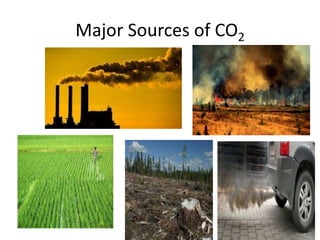
Major Sources of CO2
Introduction
• Emissions of greenhouse gasses (GHG) will increase the
average global temperature by 1.1 to 6.4 oC by the end of the
21st century .
• A global warming of more than 2 oC increase in global
average temperature will lead to serious consequences.
• Global GHG emissions should be reduced by 50 to 80 percent
by 2050. [IPCC]
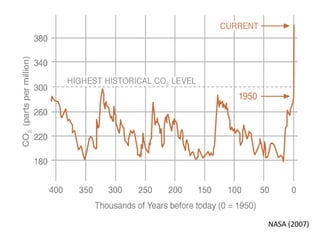
• CO2 level has increased more than 39%, from 280 ppm
during pre-industrial time to the record high level of 400 ppm
in May 2013 .[IPCC fourth assessment report: climate change 2007 ]
•
NASA (2007)
• To keep the temperature rise less than 2 °C relative to
preindustrial levels and that CO2 emissions should be
reduced globally by 41–72% by 2050.
• Enhanced energy efficiency and increased renewable
energy production will reduce CO2 emissions.
• It does not have the potential to reduce global CO2
emissions as much as IPCC’s target.
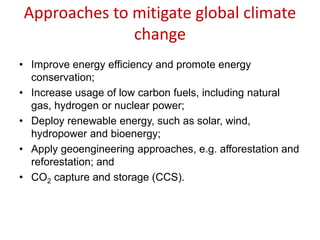
Approaches to mitigate global climate
change
• Improve energy efficiency and promote energy
conservation;
• Increase usage of low carbon fuels, including natural
gas, hydrogen or nuclear power;
• Deploy renewable energy, such as solar, wind,
hydropower and bioenergy;
• Apply geoengineering approaches, e.g. afforestation and
reforestation; and
• CO2 capture and storage (CCS).
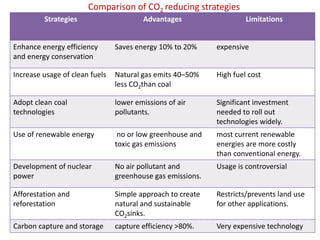
Comparison of CO2 reducing strategies
Strategies Advantages Limitations
Enhance energy efficiency
and energy conservation
Saves energy 10% to 20% expensive
Increase usage of clean fuels Natural gas emits 40–50%
less CO2than coal
High fuel cost
Adopt clean coal
technologies
lower emissions of air
pollutants.
Significant investment
needed to roll out
technologies widely.
Use of renewable energy no or low greenhouse and
toxic gas emissions
most current renewable
energies are more costly
than conventional energy.
Development of nuclear
power
No air pollutant and
greenhouse gas emissions.
Usage is controversial
Afforestation and
reforestation
Simple approach to create
natural and sustainable
CO2sinks.
Restricts/prevents land use
for other applications.
Carbon capture and storage capture efficiency >80%. Very expensive technology
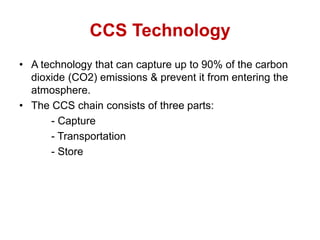
CCS Technology
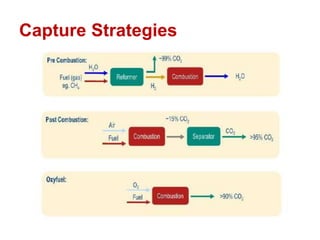
• A technology that can capture up to 90% of the carbon
dioxide (CO2) emissions & prevent it from entering the
atmosphere.
• The CCS chain consists of three parts:
- Capture
- Transportation
- Store
Capture Strategies
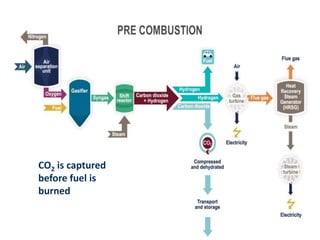
CO2 is captured
before fuel is
burned
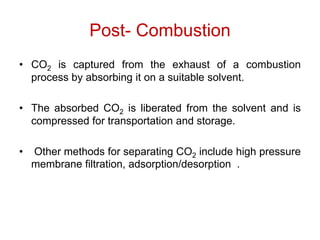
Post- Combustion
• CO2 is captured from the exhaust of a combustion
process by absorbing it on a suitable solvent.
• The absorbed CO2 is liberated from the solvent and is
compressed for transportation and storage.
• Other methods for separating CO2 include high pressure
membrane filtration, adsorption/desorption .
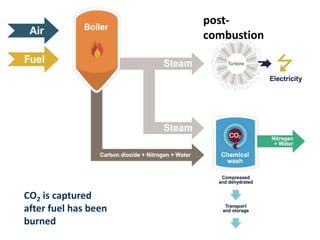
CO2 is captured
after fuel has been
burned
post-
combustion
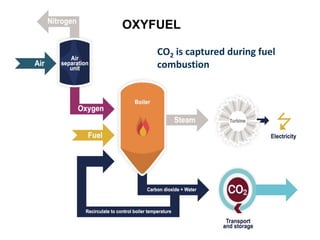
CO2 is captured during fuel
combustion
OXYFUEL
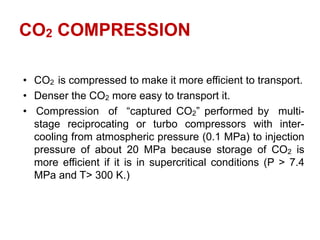
CO2 COMPRESSION
• CO2 is compressed to make it more efficient to transport.
• Denser the CO2 more easy to transport it.
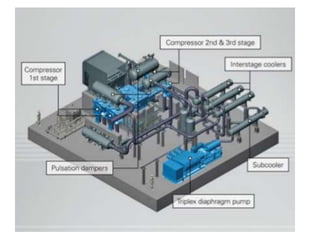
• Compression of “captured CO2” performed by multi-
stage reciprocating or turbo compressors with inter-
cooling from atmospheric pressure (0.1 MPa) to injection
pressure of about 20 MPa because storage of CO2 is
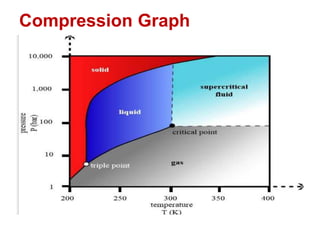
more efficient if it is in supercritical conditions (P > 7.4
MPa and T> 300 K.)
Compression Graph
CO2 Transport
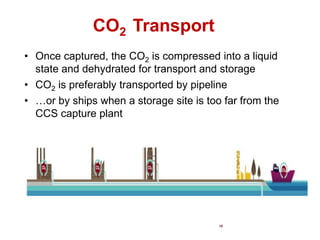
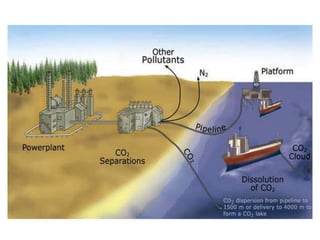
• Once captured, the CO2 is compressed into a liquid
state and dehydrated for transport and storage
• CO2 is preferably transported by pipeline
• …or by ships when a storage site is too far from the
CCS capture plant
18
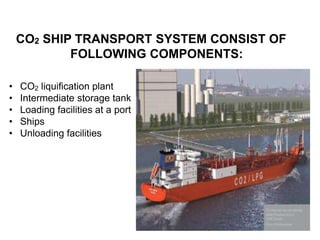
CO2 SHIP TRANSPORT SYSTEM CONSIST OF
FOLLOWING COMPONENTS:
• CO2 liquification plant
• Intermediate storage tank
• Loading facilities at a port
• Ships
• Unloading facilities
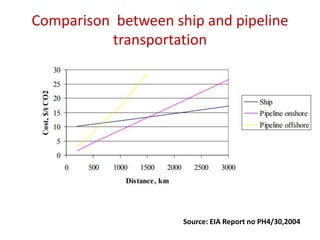
Comparison between ship and pipeline
transportation
Source: EIA Report no PH4/30,2004
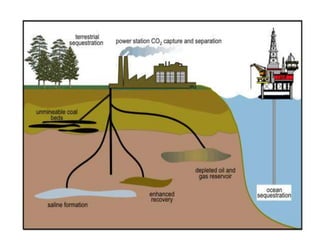
Carbon Sequestration
• Also known as “carbon capture”
• A geo-engineering technique for the long-term storage of
carbon dioxide (or other forms of carbon) for the mitigation
of global warming.
• Ways that carbon can be stored (sequestered):
– In plants and soil “terrestrial sequestration” (“carbon
sinks”)
– Underground “geological sequestration”
– Deep in ocean “ocean sequestration”
– As a solid material (still in development)
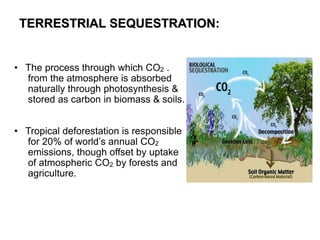
TERRESTRIAL SEQUESTRATION:
• The process through which CO2 .
from the atmosphere is absorbed
naturally through photosynthesis &
stored as carbon in biomass & soils.
• Tropical deforestation is responsible
for 20% of world’s annual CO2
emissions, though offset by uptake
of atmospheric CO2 by forests and
agriculture.
Ways to reduce greenhouse gases:
• Avoiding emissions by maintaining existing
carbon storage in trees and soils
• Increasing carbon storage by tree planting or
conversion
• From conventional to conservation tillage
practices on agricultural lands
(Gambolati et al. ,2005)
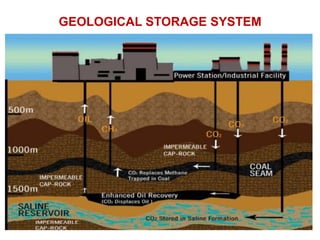
• Storing of CO2 underground in rock formations in small
pore spaces (have held oil and natural gas for millions of
years)
• CO2 injected at pressure into pore space at depths below
and isolated (sequestered) from potable water.
• Underground storage includes injecting CO2 into:
 Oil fields
 Gas fields
 Saline formations (Sleipner in North sea) i the North Sea
 Sandstone reservoirs
GEOLOGICAL SEQUESTRATION
GEOLOGICAL STORAGE SYSTEM
BENEFITS OF GEOLOGICAL SEQUESTRATION
 Less erosion
Increased soil fertility
Improved soil structure
Healthier ecology
Improved agricultural performance
Ocean Sequestration
• Ocean is a large sink of carbon dioxide
• Ocean has 50 times more carbon than the atmosphere
• 1/3 of CO2 emitted a year already enters the ocean
• There are three approaches for engineering the
storage of additional carbon in the ocean.
 Direct injection.
 Increase the alkalinity of the ocean
 Enhanced photosynthesis
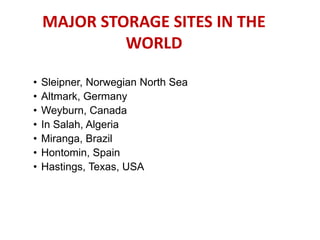
MAJOR STORAGE SITES IN THE
WORLD
• Sleipner, Norwegian North Sea
• Altmark, Germany
• Weyburn, Canada
• In Salah, Algeria
• Miranga, Brazil
• Hontomin, Spain
• Hastings, Texas, USA
Negative Impacts of CCS
• Can damage environment if leaked.
• The technology used in CCS can also increase certain
aspects of air pollution.
• Technology is very expensive and largely unproven.
• Ocean sequestration can lead to ocean acidification and
thus lead to Coral bleaching.
Barriers......
• CCS involves high cost of infrastructure, skilled labour
etc.
• Public opposition
• Property Rights, Liability, Monitoring verification etc act
as regulatory and legal barrier.
• Risk of CCS is failure of Storage scheme in in form of
CO2 leakage.
Conclusion
• The overall cost of using current CCS procedures is still
high and must be substantially reduced before it can be
widely deployed.
• There is a need of more research which help in securing
the storage and other protection technique
• Success of CCS project depends on encouraging other
nation in developing and using CCS technologies
incentive mechanism and regulatory framework for
providing sufficient support for deployment of CCS
technologies.
References
• IPCC fourth assessment report: climate change 2007(AR4) from
IPCC website
[〈http://ipcc.ch/publications_and_data/publications_and_data_re
ports.shtml/〉; 2007.
• Elwell LC ,Grant WS. Technology options for capturing CO2 – special
reports. Power2006;150:60–5.
• "Introduction to Carbon Capture and Storage - Carbon storage and
ocean acidification activity“. Commonwealth Scientific and
Industrial Research Organisation (CSIRO) and the Global CCS
Institute. Retrieved 2013-07-03.
• G. Gambolati, M. Putti, P. Teatini, M. Camporese, S.Ferraris, G. Gas
parettoStori, et al. Peatland oxidation enhances subsidence in the
Venice watershed Eos, Transactions of the American Geophysical
Union, 86 (2005), pp. 217-220
THANKYOU

Carbon capturing

  • 1.
    CARBON CAPTURING AND STORAGE SYSTEM Presentedby: Iqura Malik (17WM60R02) SCHOOL OF WATER RESOURCES INDIAN INSTITUTE OF TECHNOLOGY, KHARAGPUR
  • 2.
  • 4.
    Introduction • Emissions ofgreenhouse gasses (GHG) will increase the average global temperature by 1.1 to 6.4 oC by the end of the 21st century . • A global warming of more than 2 oC increase in global average temperature will lead to serious consequences. • Global GHG emissions should be reduced by 50 to 80 percent by 2050. [IPCC] • CO2 level has increased more than 39%, from 280 ppm during pre-industrial time to the record high level of 400 ppm in May 2013 .[IPCC fourth assessment report: climate change 2007 ] •
  • 5.
  • 6.
    • To keepthe temperature rise less than 2 °C relative to preindustrial levels and that CO2 emissions should be reduced globally by 41–72% by 2050. • Enhanced energy efficiency and increased renewable energy production will reduce CO2 emissions. • It does not have the potential to reduce global CO2 emissions as much as IPCC’s target.
  • 7.
    Approaches to mitigateglobal climate change • Improve energy efficiency and promote energy conservation; • Increase usage of low carbon fuels, including natural gas, hydrogen or nuclear power; • Deploy renewable energy, such as solar, wind, hydropower and bioenergy; • Apply geoengineering approaches, e.g. afforestation and reforestation; and • CO2 capture and storage (CCS).
  • 8.
    Comparison of CO2reducing strategies Strategies Advantages Limitations Enhance energy efficiency and energy conservation Saves energy 10% to 20% expensive Increase usage of clean fuels Natural gas emits 40–50% less CO2than coal High fuel cost Adopt clean coal technologies lower emissions of air pollutants. Significant investment needed to roll out technologies widely. Use of renewable energy no or low greenhouse and toxic gas emissions most current renewable energies are more costly than conventional energy. Development of nuclear power No air pollutant and greenhouse gas emissions. Usage is controversial Afforestation and reforestation Simple approach to create natural and sustainable CO2sinks. Restricts/prevents land use for other applications. Carbon capture and storage capture efficiency >80%. Very expensive technology
  • 9.
    CCS Technology • Atechnology that can capture up to 90% of the carbon dioxide (CO2) emissions & prevent it from entering the atmosphere. • The CCS chain consists of three parts: - Capture - Transportation - Store
  • 10.
  • 11.
    CO2 is captured beforefuel is burned
  • 12.
    Post- Combustion • CO2is captured from the exhaust of a combustion process by absorbing it on a suitable solvent. • The absorbed CO2 is liberated from the solvent and is compressed for transportation and storage. • Other methods for separating CO2 include high pressure membrane filtration, adsorption/desorption .
  • 13.
    CO2 is captured afterfuel has been burned post- combustion
  • 14.
    CO2 is capturedduring fuel combustion OXYFUEL
  • 15.
    CO2 COMPRESSION • CO2is compressed to make it more efficient to transport. • Denser the CO2 more easy to transport it. • Compression of “captured CO2” performed by multi- stage reciprocating or turbo compressors with inter- cooling from atmospheric pressure (0.1 MPa) to injection pressure of about 20 MPa because storage of CO2 is more efficient if it is in supercritical conditions (P > 7.4 MPa and T> 300 K.)
  • 16.
  • 18.
    CO2 Transport • Oncecaptured, the CO2 is compressed into a liquid state and dehydrated for transport and storage • CO2 is preferably transported by pipeline • …or by ships when a storage site is too far from the CCS capture plant 18
  • 19.
    CO2 SHIP TRANSPORTSYSTEM CONSIST OF FOLLOWING COMPONENTS: • CO2 liquification plant • Intermediate storage tank • Loading facilities at a port • Ships • Unloading facilities
  • 20.
    Comparison between shipand pipeline transportation Source: EIA Report no PH4/30,2004
  • 21.
    Carbon Sequestration • Alsoknown as “carbon capture” • A geo-engineering technique for the long-term storage of carbon dioxide (or other forms of carbon) for the mitigation of global warming. • Ways that carbon can be stored (sequestered): – In plants and soil “terrestrial sequestration” (“carbon sinks”) – Underground “geological sequestration” – Deep in ocean “ocean sequestration” – As a solid material (still in development)
  • 23.
    TERRESTRIAL SEQUESTRATION: • Theprocess through which CO2 . from the atmosphere is absorbed naturally through photosynthesis & stored as carbon in biomass & soils. • Tropical deforestation is responsible for 20% of world’s annual CO2 emissions, though offset by uptake of atmospheric CO2 by forests and agriculture.
  • 24.
    Ways to reducegreenhouse gases: • Avoiding emissions by maintaining existing carbon storage in trees and soils • Increasing carbon storage by tree planting or conversion • From conventional to conservation tillage practices on agricultural lands (Gambolati et al. ,2005)
  • 25.
    • Storing ofCO2 underground in rock formations in small pore spaces (have held oil and natural gas for millions of years) • CO2 injected at pressure into pore space at depths below and isolated (sequestered) from potable water. • Underground storage includes injecting CO2 into:  Oil fields  Gas fields  Saline formations (Sleipner in North sea) i the North Sea  Sandstone reservoirs GEOLOGICAL SEQUESTRATION
  • 26.
  • 27.
    BENEFITS OF GEOLOGICALSEQUESTRATION  Less erosion Increased soil fertility Improved soil structure Healthier ecology Improved agricultural performance
  • 28.
    Ocean Sequestration • Oceanis a large sink of carbon dioxide • Ocean has 50 times more carbon than the atmosphere • 1/3 of CO2 emitted a year already enters the ocean • There are three approaches for engineering the storage of additional carbon in the ocean.  Direct injection.  Increase the alkalinity of the ocean  Enhanced photosynthesis
  • 30.
    MAJOR STORAGE SITESIN THE WORLD • Sleipner, Norwegian North Sea • Altmark, Germany • Weyburn, Canada • In Salah, Algeria • Miranga, Brazil • Hontomin, Spain • Hastings, Texas, USA
  • 31.
    Negative Impacts ofCCS • Can damage environment if leaked. • The technology used in CCS can also increase certain aspects of air pollution. • Technology is very expensive and largely unproven. • Ocean sequestration can lead to ocean acidification and thus lead to Coral bleaching.
  • 32.
    Barriers...... • CCS involveshigh cost of infrastructure, skilled labour etc. • Public opposition • Property Rights, Liability, Monitoring verification etc act as regulatory and legal barrier. • Risk of CCS is failure of Storage scheme in in form of CO2 leakage.
  • 33.
    Conclusion • The overallcost of using current CCS procedures is still high and must be substantially reduced before it can be widely deployed. • There is a need of more research which help in securing the storage and other protection technique • Success of CCS project depends on encouraging other nation in developing and using CCS technologies incentive mechanism and regulatory framework for providing sufficient support for deployment of CCS technologies.
  • 34.
    References • IPCC fourthassessment report: climate change 2007(AR4) from IPCC website [〈http://ipcc.ch/publications_and_data/publications_and_data_re ports.shtml/〉; 2007. • Elwell LC ,Grant WS. Technology options for capturing CO2 – special reports. Power2006;150:60–5. • "Introduction to Carbon Capture and Storage - Carbon storage and ocean acidification activity“. Commonwealth Scientific and Industrial Research Organisation (CSIRO) and the Global CCS Institute. Retrieved 2013-07-03. • G. Gambolati, M. Putti, P. Teatini, M. Camporese, S.Ferraris, G. Gas parettoStori, et al. Peatland oxidation enhances subsidence in the Venice watershed Eos, Transactions of the American Geophysical Union, 86 (2005), pp. 217-220
  • 35.