How do we estimate soil carbon levels?  Making best use of existing science and knowledge Brian Murphy Cowra November 2008
Soil science knowledge that can help measuring and estimating soil carbon Use known or developed relationships for soil properties to predict soil carbon levels Relationships between soil properties Relationships between soil properties and land management activities / practices
Gaunaut report “ A comprehensive mitigation strategy will also require government intervention to promote abatement activity in sectors not covered by the emissions trading scheme. ……………………………………………………………….. The most significant opportunities may be in the area of improved carbon sequestration through better management of soil carbon.” Measurement / estimate of soil carbon levels is required for this to become effective
1.  Percentage soil carbon (C%) g carbon/100g soil No volume taken into account cannot be used for carbon accounting alone 2.  Carbon density (CD)  CD = C% x BD x soil depth t/ha can be used for carbon accounting requires measure of bulk density requires depth to be specified 30 cm is the standard Kyoto depth . Measuring soil carbon
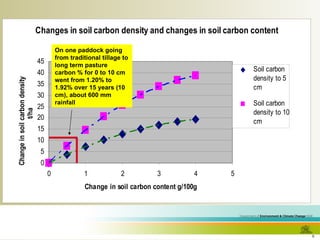
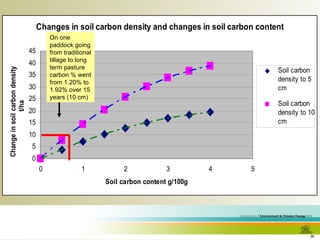
On one paddock going from traditional tillage to long term pasture carbon % for 0 to 10 cm went from 1.20% to 1.92% over 15 years (10 cm), about 600 mm rainfall
Bulk Density Mass of soil solids per unit volume of soil Usually taken as oven dry weight Does not include the mass of water or air in the density calculation
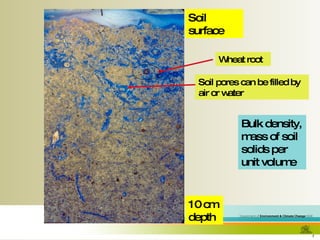
Soil surface 10 cm depth Wheat root Bulk density, mass of soil solids per unit volume Soil pores can be filled by air or water
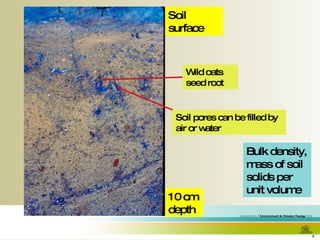
Soil surface Soil pores can be filled by air or water Bulk density, mass of soil solids per unit volume 10 cm depth Wild oats seed root
Measuring Soil Carbon Where to sample in the field _what do we know? What to measure in the field, how deep?_ _what do we know? What to measure in the laboratory_ _what do we know?
Where to sample in the field_ Measuring Soil Carbon for Different Purposes Scientific References Sites Monitoring soil condition, testing or calibrating soil carbon models 25 m grid or quadrat has many advantages from a scientific viewpoint Estimating the soil carbon density of a paddock Needs a different approach
Soil analysed for soil carbon 1500 t soil/ha 10 kg soil collected? 0.1 to 0.5 kg sent to lab? 0.001 kg tested Needs to be representative
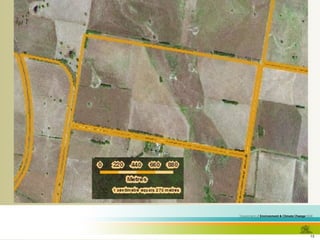
Selecting a representative sample in the field (based on fertiliser handbook) Check target area for notable features that can influence soil type –   slope, drainage, soil colour, management history etc Draw a sketch map and identify “individual areas” to be sampled.  “Individual areas” should be uniform based on the above features.  Satellite imagery and aerial photos can be very helpful Avoid sampling across soil types and when soils are very wet Take a number of cores and make into a composite sample for each “individual area”. Numbers of cores for a composite sample and the number of composite samples to characterise a paddock need to be determined.
 
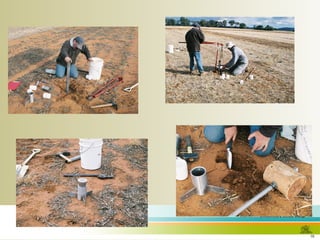
What to measure in the field, how deep? _ what do we know? 30 cm is the standard depth for carbon density. Need to sample soils with a standard core so bulk density can be calculated Care needs to be taken so that organic matter does not contaminate the soil samples below the surface
 
What to measure in the laboratory _ what do we know? Measure carbon content – treat with acid if carbonate present LECO furnace – standard MIR spectrophotometer – quick and cheaper??? Measure soil moisture and weight to get bulk density. Calculate carbon density (C% x bulk density) –  a slight buffer to storing carbon / unit depth?
Using Knowledge of Soil Relationships   What accuracy for soil carbon density, soil carbon % is acceptable ?  ± 10t/ha,   ± 1t/ha, ± 0.1 t/ha, ± 0.01 t/ha  _  costs tend to increase exponentially with increased accuracy. Use known or developed relationships for soil properties to predict soil carbon levels Relationships between soil properties Relationships between soil properties and land management activities
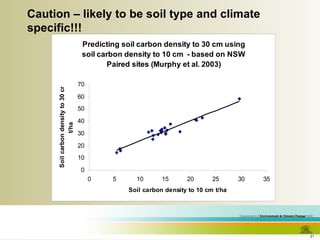
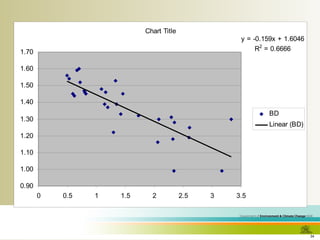
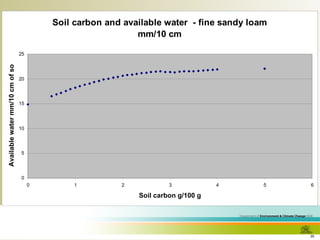
Relationships between soil properties Bulk density v soil texture, soil carbon and soil type Soil carbon density to 10 cm and soil carbon density to 30 cm Using soil carbon depth functions Other???? MIR in the field Soil colour
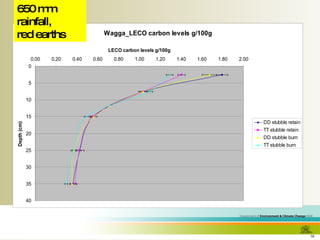
650 mm rainfall,  red earths
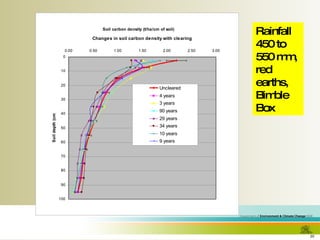
Rainfall 450 to 550 mm, red earths, Bimble Box
Caution – likely to be soil type and climate specific!!!
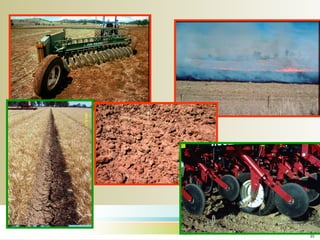
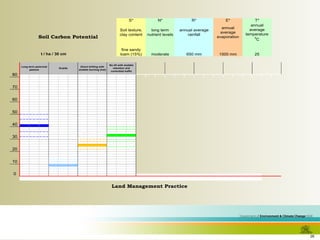
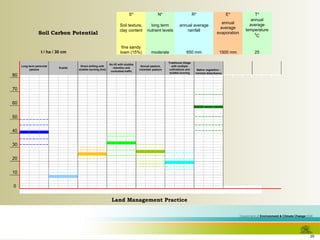
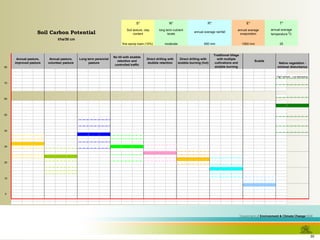
Relationships between soil carbon levels and land management practices Many known relationships between land management practices and soil carbon levels. Problem of continual developing and improving land management practices Available data is scattered and does not include all permutations and combinations However, modelling can be used to fill in the gaps, with real data providing the benchmarks to work around


Extra Information about land management practices to predict soil carbon levels. Biomass and yields – use of fertilisers? Stubble management – amount of stubble retained – not burnt (early hot v late cold burn), grazing Soil disturbance, amount and type of tillage – threshold of tillage to start reducing soil carbon Grazing intensity and timing of resting pasture – impact on biomass and plant growth Species, grasses v herbaceous dicots Perennial v annual – some knowledge yet to be gained.
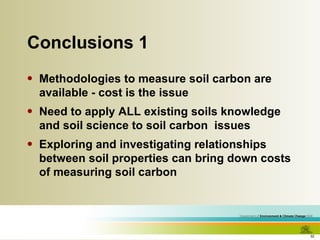
Conclusions 1 Methodologies to measure soil carbon are available - cost is the issue Need to apply ALL existing soils knowledge and soil science to soil carbon  issues Exploring and investigating relationships between soil properties can bring down costs of measuring soil carbon
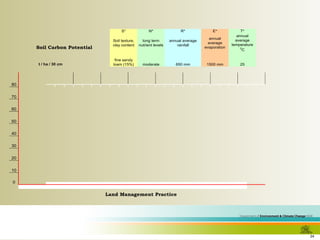
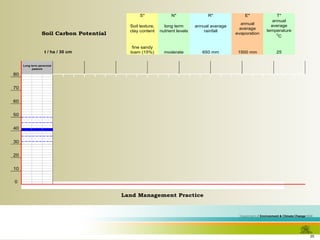
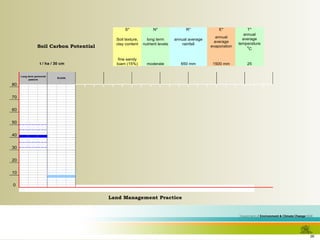
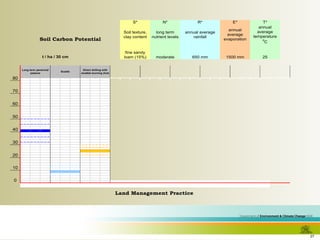
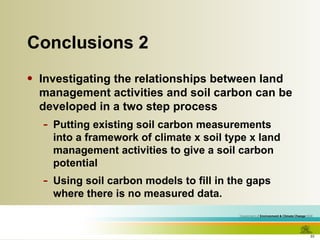
Conclusions 2 Investigating the relationships between land management activities and soil carbon can be developed in a two step process Putting existing soil carbon measurements into a framework of climate x soil type x land management activities to give a soil carbon potential Using soil carbon models to fill in the gaps where there is no measured data.
 
Department of  Environment & Climate Change  NSW   First level dot point Second level dot point Third level dot point First level dot point
On one paddock going from traditional tillage to long term pasture carbon % went from 1.20% to 1.92% over 15 years (10 cm)

How do we estimate soil carbon levels

  • 1.
    How do weestimate soil carbon levels? Making best use of existing science and knowledge Brian Murphy Cowra November 2008
  • 2.
    Soil science knowledgethat can help measuring and estimating soil carbon Use known or developed relationships for soil properties to predict soil carbon levels Relationships between soil properties Relationships between soil properties and land management activities / practices
  • 3.
    Gaunaut report “A comprehensive mitigation strategy will also require government intervention to promote abatement activity in sectors not covered by the emissions trading scheme. ……………………………………………………………….. The most significant opportunities may be in the area of improved carbon sequestration through better management of soil carbon.” Measurement / estimate of soil carbon levels is required for this to become effective
  • 4.
    1. Percentagesoil carbon (C%) g carbon/100g soil No volume taken into account cannot be used for carbon accounting alone 2. Carbon density (CD) CD = C% x BD x soil depth t/ha can be used for carbon accounting requires measure of bulk density requires depth to be specified 30 cm is the standard Kyoto depth . Measuring soil carbon
  • 5.
    On one paddockgoing from traditional tillage to long term pasture carbon % for 0 to 10 cm went from 1.20% to 1.92% over 15 years (10 cm), about 600 mm rainfall
  • 6.
    Bulk Density Massof soil solids per unit volume of soil Usually taken as oven dry weight Does not include the mass of water or air in the density calculation
  • 7.
    Soil surface 10cm depth Wheat root Bulk density, mass of soil solids per unit volume Soil pores can be filled by air or water
  • 8.
    Soil surface Soilpores can be filled by air or water Bulk density, mass of soil solids per unit volume 10 cm depth Wild oats seed root
  • 9.
    Measuring Soil CarbonWhere to sample in the field _what do we know? What to measure in the field, how deep?_ _what do we know? What to measure in the laboratory_ _what do we know?
  • 10.
    Where to samplein the field_ Measuring Soil Carbon for Different Purposes Scientific References Sites Monitoring soil condition, testing or calibrating soil carbon models 25 m grid or quadrat has many advantages from a scientific viewpoint Estimating the soil carbon density of a paddock Needs a different approach
  • 11.
    Soil analysed forsoil carbon 1500 t soil/ha 10 kg soil collected? 0.1 to 0.5 kg sent to lab? 0.001 kg tested Needs to be representative
  • 12.
    Selecting a representativesample in the field (based on fertiliser handbook) Check target area for notable features that can influence soil type – slope, drainage, soil colour, management history etc Draw a sketch map and identify “individual areas” to be sampled. “Individual areas” should be uniform based on the above features. Satellite imagery and aerial photos can be very helpful Avoid sampling across soil types and when soils are very wet Take a number of cores and make into a composite sample for each “individual area”. Numbers of cores for a composite sample and the number of composite samples to characterise a paddock need to be determined.
  • 13.
  • 14.
    What to measurein the field, how deep? _ what do we know? 30 cm is the standard depth for carbon density. Need to sample soils with a standard core so bulk density can be calculated Care needs to be taken so that organic matter does not contaminate the soil samples below the surface
  • 15.
  • 16.
    What to measurein the laboratory _ what do we know? Measure carbon content – treat with acid if carbonate present LECO furnace – standard MIR spectrophotometer – quick and cheaper??? Measure soil moisture and weight to get bulk density. Calculate carbon density (C% x bulk density) – a slight buffer to storing carbon / unit depth?
  • 17.
    Using Knowledge ofSoil Relationships What accuracy for soil carbon density, soil carbon % is acceptable ? ± 10t/ha, ± 1t/ha, ± 0.1 t/ha, ± 0.01 t/ha _ costs tend to increase exponentially with increased accuracy. Use known or developed relationships for soil properties to predict soil carbon levels Relationships between soil properties Relationships between soil properties and land management activities
  • 18.
    Relationships between soilproperties Bulk density v soil texture, soil carbon and soil type Soil carbon density to 10 cm and soil carbon density to 30 cm Using soil carbon depth functions Other???? MIR in the field Soil colour
  • 19.
    650 mm rainfall, red earths
  • 20.
    Rainfall 450 to550 mm, red earths, Bimble Box
  • 21.
    Caution – likelyto be soil type and climate specific!!!
  • 22.
    Relationships between soilcarbon levels and land management practices Many known relationships between land management practices and soil carbon levels. Problem of continual developing and improving land management practices Available data is scattered and does not include all permutations and combinations However, modelling can be used to fill in the gaps, with real data providing the benchmarks to work around
  • 23.
  • 24.
  • 25.
  • 26.
  • 27.
  • 28.
  • 29.
  • 30.
  • 31.
    Extra Information aboutland management practices to predict soil carbon levels. Biomass and yields – use of fertilisers? Stubble management – amount of stubble retained – not burnt (early hot v late cold burn), grazing Soil disturbance, amount and type of tillage – threshold of tillage to start reducing soil carbon Grazing intensity and timing of resting pasture – impact on biomass and plant growth Species, grasses v herbaceous dicots Perennial v annual – some knowledge yet to be gained.
  • 32.
    Conclusions 1 Methodologiesto measure soil carbon are available - cost is the issue Need to apply ALL existing soils knowledge and soil science to soil carbon issues Exploring and investigating relationships between soil properties can bring down costs of measuring soil carbon
  • 33.
    Conclusions 2 Investigatingthe relationships between land management activities and soil carbon can be developed in a two step process Putting existing soil carbon measurements into a framework of climate x soil type x land management activities to give a soil carbon potential Using soil carbon models to fill in the gaps where there is no measured data.
  • 34.
  • 35.
    Department of Environment & Climate Change NSW First level dot point Second level dot point Third level dot point First level dot point
  • 36.
    On one paddockgoing from traditional tillage to long term pasture carbon % went from 1.20% to 1.92% over 15 years (10 cm)