Introductory Chemistry
Language
of
Chemistry
Chapter 5
Chapter 7 2
IUPAC
• The International Union of Pure and Applied
Chemistry, IUPAC, has set rules for naming
compounds.
• IUPAC set the rules for the naming and
classification of inorganic compounds in 1940.
• These rules are still in use today.
Introduction
SYMBOL- Of an element
Matter - maybe pure or impure in nature.
Pure substances are further classified into -
elements & compound.
Element - Is a pure substance - made up of
one kind of atoms only.
Atom - It is the basic unit of an element which
may or may not exist on its own.
Symbol - An atom of any element is denoted
by a symbol.
Symbol is a short form or abbreviated name of the
element.
It represents a specific element or one atom of an element. e.g.
'H’ represents one atom of the element - hydrogen.
It also represents the weight of the element equal to its atomic
weight.
It distinguishes one element from another & is characteristic of
that element.
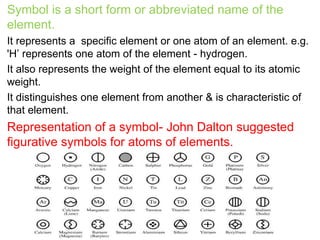
Representation of a symbol- John Dalton suggested
figurative symbols for atoms of elements.
REPRESENTATION - Of a Symbol
Jacob Berzelius [1814] suggested - a simple
approach to representing elements.
The first letter of the name of an element - was taken
as the symbol of that element. e.g. Carbon -
method not approved since two elements can
have same first letter.
The first two letters of the name of an element - was
taken as the symbol e.g. Calcium- method
approved since many symbols could be written
accordingly.
Latin name of the element - was taken,& the symbol
derived from the latin name e.g. Cuprum
Hydrogen
chloride
HCL One atom of hydrogen combines
with one atom of chlorine
Valency of
chlorine = 1
Water H2O Two atoms of hydrogen combine
with one atom of oxygen
Valency of
oxygen = 2
Ammonia NH3 Three atoms of hydrogen
combine with one atom of
nitrogen
Valency of
nitrogen = 3
Metals donate
electrons
Na[2,8,1]
Na Nearest noble gas
Neon [Ne] (2,8)
+1
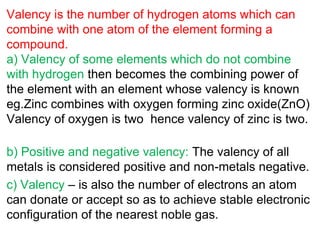
Valency is the number of hydrogen atoms which can
combine with one atom of the element forming a
compound.
a) Valency of some elements which do not combine
with hydrogen then becomes the combining power of
the element with an element whose valency is known
eg.Zinc combines with oxygen forming zinc oxide(ZnO)
Valency of oxygen is two hence valency of zinc is two.
b) Positive and negative valency: The valency of all
metals is considered positive and non-metals negative.
c) Valency – is also the number of electrons an atom
can donate or accept so as to achieve stable electronic
configuration of the nearest noble gas.
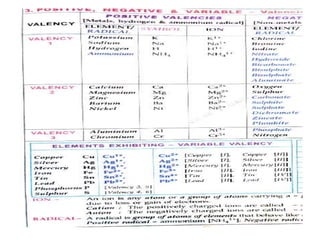
Variable valency
Term: Certain elements exhibit more than one
valency showing variable valency
Reason: Valency is the number of electrons lost
or gained from the outer shell of an atom of an
element during a chemical reaction Variation in
this loss or gain results in ‘Variable valency’.
Example: Copper exhibits valency ‘1’ and ‘2’
Nomenclature Valency - 1 Valency - 2
Old system of
naming
Cuprous
Cuprous chloride CuCl
Cupric
Cupric chloride
CuCl2
I.U.P.A.C Copper [1] copper chloride
CuCl
Copper [II] Copper[II]
chloride- CuCl2
Chapter 7 9
Classification of Ions
• Recall, an ion is an atom or group of atoms with a
charge.
• A positively charged ion is called a cation.
• A negatively charged ion is called an anion.
• A group of atoms bound together which has an
overall charge is a polyatomic ion.
Chapter 7 10
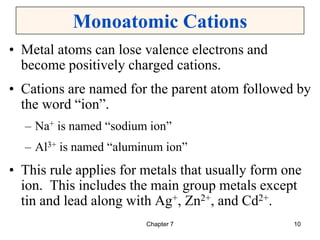
Monoatomic Cations
• Metal atoms can lose valence electrons and
become positively charged cations.
• Cations are named for the parent atom followed by
the word “ion”.
– Na+ is named “sodium ion”
– Al3+ is named “aluminum ion”
• This rule applies for metals that usually form one
ion. This includes the main group metals except
tin and lead along with Ag+, Zn2+, and Cd2+.
Chapter 7 11
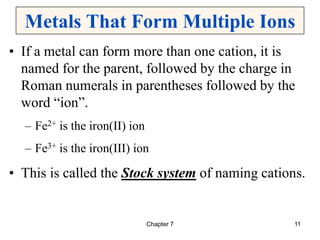
Metals That Form Multiple Ions
• If a metal can form more than one cation, it is
named for the parent, followed by the charge in
Roman numerals in parentheses followed by the
word “ion”.
– Fe2+ is the iron(II) ion
– Fe3+ is the iron(III) ion
• This is called the Stock system of naming cations.
Chapter 7 12
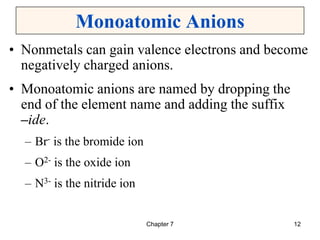
Monoatomic Anions
• Nonmetals can gain valence electrons and become
negatively charged anions.
• Monoatomic anions are named by dropping the
end of the element name and adding the suffix
–ide.
– Br- is the bromide ion
– O2- is the oxide ion
– N3- is the nitride ion
Chapter 7 13
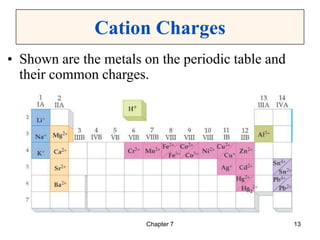
Cation Charges
• Shown are the metals on the periodic table and
their common charges.
Chapter 7 15
Chapter 7 16
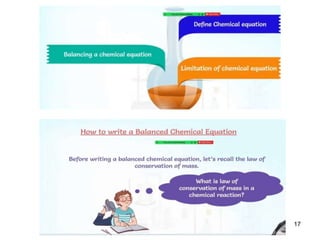
Chapter 7 17
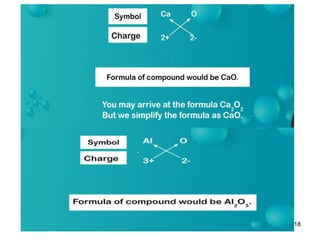
Chapter 7 18

Language of Chemistry.ppt

  • 1.
  • 2.
    Chapter 7 2 IUPAC •The International Union of Pure and Applied Chemistry, IUPAC, has set rules for naming compounds. • IUPAC set the rules for the naming and classification of inorganic compounds in 1940. • These rules are still in use today.
  • 3.
    Introduction SYMBOL- Of anelement Matter - maybe pure or impure in nature. Pure substances are further classified into - elements & compound. Element - Is a pure substance - made up of one kind of atoms only. Atom - It is the basic unit of an element which may or may not exist on its own. Symbol - An atom of any element is denoted by a symbol.
  • 4.
    Symbol is ashort form or abbreviated name of the element. It represents a specific element or one atom of an element. e.g. 'H’ represents one atom of the element - hydrogen. It also represents the weight of the element equal to its atomic weight. It distinguishes one element from another & is characteristic of that element. Representation of a symbol- John Dalton suggested figurative symbols for atoms of elements.
  • 5.
    REPRESENTATION - Ofa Symbol Jacob Berzelius [1814] suggested - a simple approach to representing elements. The first letter of the name of an element - was taken as the symbol of that element. e.g. Carbon - method not approved since two elements can have same first letter. The first two letters of the name of an element - was taken as the symbol e.g. Calcium- method approved since many symbols could be written accordingly. Latin name of the element - was taken,& the symbol derived from the latin name e.g. Cuprum
  • 6.
    Hydrogen chloride HCL One atomof hydrogen combines with one atom of chlorine Valency of chlorine = 1 Water H2O Two atoms of hydrogen combine with one atom of oxygen Valency of oxygen = 2 Ammonia NH3 Three atoms of hydrogen combine with one atom of nitrogen Valency of nitrogen = 3 Metals donate electrons Na[2,8,1] Na Nearest noble gas Neon [Ne] (2,8) +1
  • 7.
    Valency is thenumber of hydrogen atoms which can combine with one atom of the element forming a compound. a) Valency of some elements which do not combine with hydrogen then becomes the combining power of the element with an element whose valency is known eg.Zinc combines with oxygen forming zinc oxide(ZnO) Valency of oxygen is two hence valency of zinc is two. b) Positive and negative valency: The valency of all metals is considered positive and non-metals negative. c) Valency – is also the number of electrons an atom can donate or accept so as to achieve stable electronic configuration of the nearest noble gas.
  • 8.
    Variable valency Term: Certainelements exhibit more than one valency showing variable valency Reason: Valency is the number of electrons lost or gained from the outer shell of an atom of an element during a chemical reaction Variation in this loss or gain results in ‘Variable valency’. Example: Copper exhibits valency ‘1’ and ‘2’ Nomenclature Valency - 1 Valency - 2 Old system of naming Cuprous Cuprous chloride CuCl Cupric Cupric chloride CuCl2 I.U.P.A.C Copper [1] copper chloride CuCl Copper [II] Copper[II] chloride- CuCl2
  • 9.
    Chapter 7 9 Classificationof Ions • Recall, an ion is an atom or group of atoms with a charge. • A positively charged ion is called a cation. • A negatively charged ion is called an anion. • A group of atoms bound together which has an overall charge is a polyatomic ion.
  • 10.
    Chapter 7 10 MonoatomicCations • Metal atoms can lose valence electrons and become positively charged cations. • Cations are named for the parent atom followed by the word “ion”. – Na+ is named “sodium ion” – Al3+ is named “aluminum ion” • This rule applies for metals that usually form one ion. This includes the main group metals except tin and lead along with Ag+, Zn2+, and Cd2+.
  • 11.
    Chapter 7 11 MetalsThat Form Multiple Ions • If a metal can form more than one cation, it is named for the parent, followed by the charge in Roman numerals in parentheses followed by the word “ion”. – Fe2+ is the iron(II) ion – Fe3+ is the iron(III) ion • This is called the Stock system of naming cations.
  • 12.
    Chapter 7 12 MonoatomicAnions • Nonmetals can gain valence electrons and become negatively charged anions. • Monoatomic anions are named by dropping the end of the element name and adding the suffix –ide. – Br- is the bromide ion – O2- is the oxide ion – N3- is the nitride ion
  • 13.
    Chapter 7 13 CationCharges • Shown are the metals on the periodic table and their common charges.
  • 15.
  • 16.
  • 17.
  • 18.