Organic molecules
(Biological molecules)
Carbohydrates, proteins, lipids
and nucleic acids
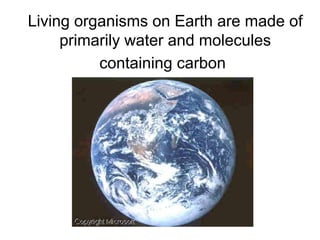
Living organisms on Earth are made of
primarily water and molecules
containing carbon
Vocab word

Definition

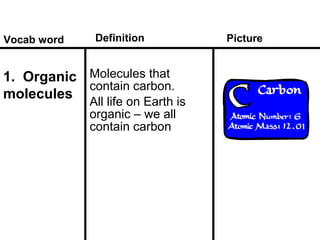
1. Organic Molecules that
contain carbon.
molecules

All life on Earth is
organic – we all
contain carbon

Picture
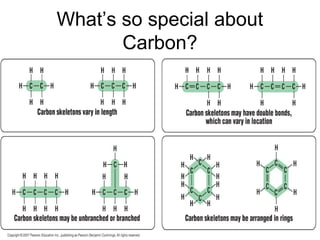
What’s so special about
Carbon?
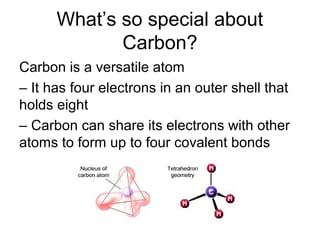
Carbon is a versatile atom
– It has four electrons in an outer shell that
holds eight
– Carbon can share its electrons with other
atoms to form up to four covalent bonds
What’s so special about
Carbon?
Carbon can use its bonds to
– Attach to other carbons
– Form an endless diversity of carbon
skeletons
Four Basic Types of Organic
Molecule
1. carbohydrates (sugars and starches)
2. lipids (fats)
3. Proteins (enzymes and antibodies)
4. nucleic acids (DNA and RNA).
– Because they are large, these
molecules are called macromolecules.
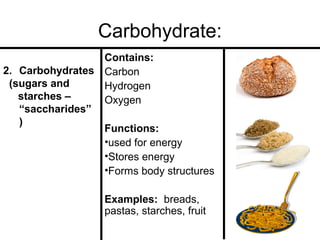
Carbohydrate:
Contains:
2. Carbohydrates Carbon
(sugars and
Hydrogen
starches –
Oxygen
“saccharides”
)
Functions:
•used for energy
•Stores energy
•Forms body structures
Examples: breads,
pastas, starches, fruit
There are three types of
carbohydrates!
1. Monosaccharides
2. Disaccharides
3. Polysaccharides
3 types of Carbohydrates
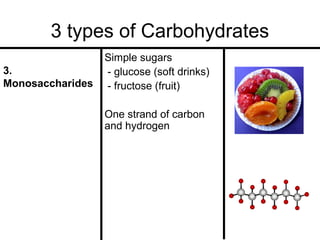
3.
Monosaccharides

Simple sugars
- glucose (soft drinks)
- fructose (fruit)
One strand of carbon
and hydrogen
3 types of Carbohydrates
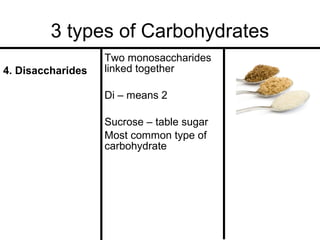
4. Disaccharides

Two monosaccharides
linked together
Di – means 2
Sucrose – table sugar
Most common type of
carbohydrate
3 types of Carbohydrates
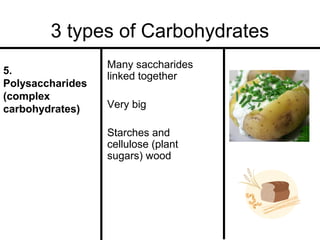
5.
Polysaccharides
(complex
carbohydrates)

Many saccharides
linked together
Very big
Starches and
cellulose (plant
sugars) wood
Lipids!
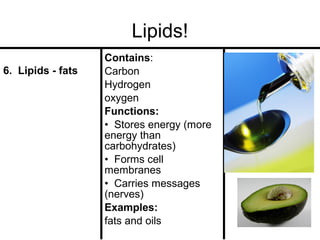
6. Lipids - fats

Contains:
Carbon
Hydrogen
oxygen
Functions:
• Stores energy (more
energy than
carbohydrates)
• Forms cell
membranes
• Carries messages
(nerves)
Examples:
fats and oils
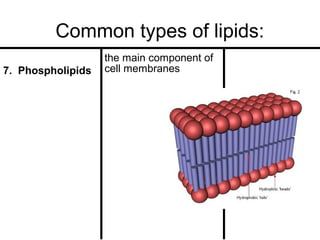
Common types of lipids:
7. Phospholipids

the main component of
cell membranes
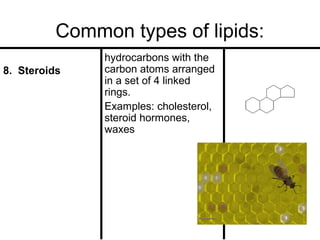
Common types of lipids:
8. Steroids

hydrocarbons with the
carbon atoms arranged
in a set of 4 linked
rings.
Examples: cholesterol,
steroid hormones,
waxes
Proteins:
9. Proteins

Contains:
Carbon
Hydrogen
Oxygen
Nitrogen and sulfur
Functions:
•Helps cells keep their shape
•Makes up muscles
•speeds up chemical
reactions
•Carries messages and
materials
Examples: enzymes,
antibodies, amino acids
Types of proteins:
subunits of proteins,
10. Amino Acids
There are 20 different kinds
of amino acids in proteins.
Proteins:
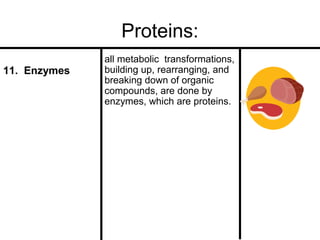
11. Enzymes

all metabolic transformations,
building up, rearranging, and
breaking down of organic
compounds, are done by
enzymes, which are proteins.
Nucleic Acids:
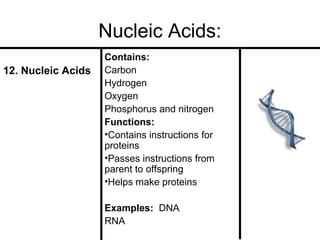
12. Nucleic Acids

Contains:
Carbon
Hydrogen
Oxygen
Phosphorus and nitrogen
Functions:
•Contains instructions for
proteins
•Passes instructions from
parent to offspring
•Helps make proteins
Examples: DNA
RNA
Two types of nucleic Acids:
13. DNA

Contains: four bases
adenine, guanine, thymine,
and cytosine.
The order of these bases in
a chain of DNA determines
the genetic information.
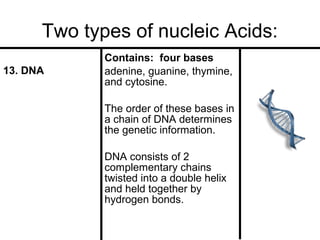
DNA consists of 2
complementary chains
twisted into a double helix
and held together by
hydrogen bonds.
Two types of nucleic Acids:
14. RNA

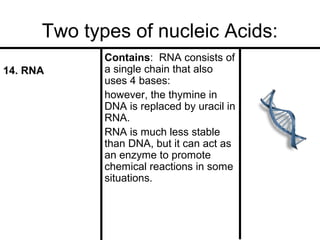
Contains: RNA consists of
a single chain that also
uses 4 bases:
however, the thymine in
DNA is replaced by uracil in
RNA.
RNA is much less stable
than DNA, but it can act as
an enzyme to promote
chemical reactions in some
situations.
Exit slip
1. List and give and example of the four
types of organic molecules.
2. What is carbon and why is it important for
life on Earth?

Organic compounds

  • 1.
  • 2.
    Living organisms onEarth are made of primarily water and molecules containing carbon
  • 3.
    Vocab word Definition 1. OrganicMolecules that contain carbon. molecules All life on Earth is organic – we all contain carbon Picture
  • 4.
    What’s so specialabout Carbon? Carbon is a versatile atom – It has four electrons in an outer shell that holds eight – Carbon can share its electrons with other atoms to form up to four covalent bonds
  • 5.
    What’s so specialabout Carbon? Carbon can use its bonds to – Attach to other carbons – Form an endless diversity of carbon skeletons
  • 6.
    Four Basic Typesof Organic Molecule 1. carbohydrates (sugars and starches) 2. lipids (fats) 3. Proteins (enzymes and antibodies) 4. nucleic acids (DNA and RNA). – Because they are large, these molecules are called macromolecules.
  • 7.
    Carbohydrate: Contains: 2. Carbohydrates Carbon (sugarsand Hydrogen starches – Oxygen “saccharides” ) Functions: •used for energy •Stores energy •Forms body structures Examples: breads, pastas, starches, fruit
  • 8.
    There are threetypes of carbohydrates! 1. Monosaccharides 2. Disaccharides 3. Polysaccharides
  • 9.
    3 types ofCarbohydrates 3. Monosaccharides Simple sugars - glucose (soft drinks) - fructose (fruit) One strand of carbon and hydrogen
  • 10.
    3 types ofCarbohydrates 4. Disaccharides Two monosaccharides linked together Di – means 2 Sucrose – table sugar Most common type of carbohydrate
  • 11.
    3 types ofCarbohydrates 5. Polysaccharides (complex carbohydrates) Many saccharides linked together Very big Starches and cellulose (plant sugars) wood
  • 12.
    Lipids! 6. Lipids -fats Contains: Carbon Hydrogen oxygen Functions: • Stores energy (more energy than carbohydrates) • Forms cell membranes • Carries messages (nerves) Examples: fats and oils
  • 13.
    Common types oflipids: 7. Phospholipids the main component of cell membranes
  • 14.
    Common types oflipids: 8. Steroids hydrocarbons with the carbon atoms arranged in a set of 4 linked rings. Examples: cholesterol, steroid hormones, waxes
  • 15.
    Proteins: 9. Proteins Contains: Carbon Hydrogen Oxygen Nitrogen andsulfur Functions: •Helps cells keep their shape •Makes up muscles •speeds up chemical reactions •Carries messages and materials Examples: enzymes, antibodies, amino acids
  • 16.
    Types of proteins: subunitsof proteins, 10. Amino Acids There are 20 different kinds of amino acids in proteins.
  • 17.
    Proteins: 11. Enzymes all metabolictransformations, building up, rearranging, and breaking down of organic compounds, are done by enzymes, which are proteins.
  • 18.
    Nucleic Acids: 12. NucleicAcids Contains: Carbon Hydrogen Oxygen Phosphorus and nitrogen Functions: •Contains instructions for proteins •Passes instructions from parent to offspring •Helps make proteins Examples: DNA RNA
  • 19.
    Two types ofnucleic Acids: 13. DNA Contains: four bases adenine, guanine, thymine, and cytosine. The order of these bases in a chain of DNA determines the genetic information. DNA consists of 2 complementary chains twisted into a double helix and held together by hydrogen bonds.
  • 20.
    Two types ofnucleic Acids: 14. RNA Contains: RNA consists of a single chain that also uses 4 bases: however, the thymine in DNA is replaced by uracil in RNA. RNA is much less stable than DNA, but it can act as an enzyme to promote chemical reactions in some situations.
  • 21.
    Exit slip 1. Listand give and example of the four types of organic molecules. 2. What is carbon and why is it important for life on Earth?