1
Carbon and its
Compounds
ONE SHOT
CLASS - 10th
2
Carbon and its
Compounds
Atomic number of CARBON is 6 (6p and 6e)
Also it has 6 neutrons.
Mass number = 12 (6p + 6n).
Electronic configuration is 2,4
Valency is 4 so it is Tetravalent.
About CARBON
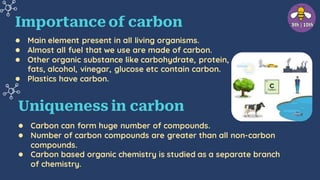
Importance of carbon
● Main element present in all living organisms.
● Almost all fuel that we use are made of carbon.
● Other organic substance like carbohydrate, protein,
fats, alcohol, vinegar, glucose etc contain carbon.
● Plastics have carbon.
Uniqueness in carbon
● Carbon can form huge number of compounds.
● Number of carbon compounds are greater than all non-carbon
compounds.
● Carbon based organic chemistry is studied as a separate branch
of chemistry.
● Catenation
● Tetra-Covalency
● Polymerisation
● Isomerism
Why CARBON is Unique?
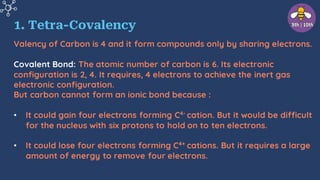
1. Tetra-Covalency
Valency of Carbon is 4 and it form compounds only by sharing electrons.
Covalent Bond: The atomic number of carbon is 6. Its electronic
configuration is 2, 4. It requires, 4 electrons to achieve the inert gas
electronic configuration.
But carbon cannot form an ionic bond because :
• It could gain four electrons forming C4- cation. But it would be difficult
for the nucleus with six protons to hold on to ten electrons.
• It could lose four electrons forming C4+ cations. But it requires a large
amount of energy to remove four electrons.
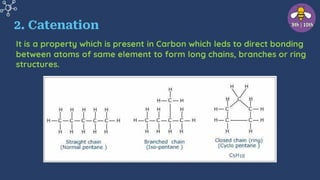
2. Catenation
It is a property which is present in Carbon which leds to direct bonding
between atoms of same element to form long chains, branches or ring
structures.
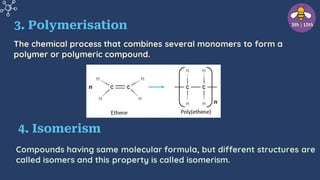
3. Polymerisation
The chemical process that combines several monomers to form a
polymer or polymeric compound.
4. Isomerism
Compounds having same molecular formula, but different structures are
called isomers and this property is called isomerism.
Types of covalent bond
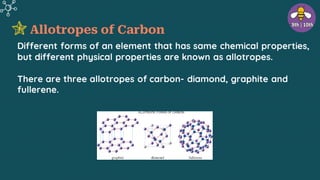
Allotropes of Carbon
Different forms of an element that has same chemical properties,
but different physical properties are known as allotropes.
There are three allotropes of carbon- diamond, graphite and
fullerene.
Diamond
It exists as a three-dimensional network
with strong carbon-carbon covalent
bonds. Diamond is hard in nature with high
melting points.
It shines in presence of light and it is a bad
conductor of electricity. The most common
use of diamond is in making jewellery. It is
also used in cutting and drilling tools.
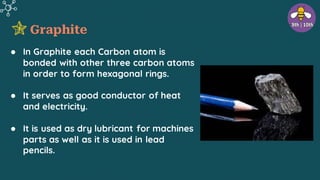
Graphite
● In Graphite each Carbon atom is
bonded with other three carbon atoms
in order to form hexagonal rings.
● It serves as good conductor of heat
and electricity.
● It is used as dry lubricant for machines
parts as well as it is used in lead
pencils.
Fullerene
● Fullerence is the hollow cage which
exists in the form of sphere. It
resembles the structure of fullerene.
● But along with hexagonal rings,
sometimes pentagonal or heptagonal
rings are also present.
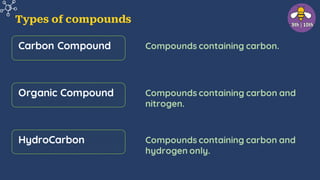
Types of compounds
Carbon Compound Compounds containing carbon.
Organic Compound Compounds containing carbon and
nitrogen.
HydroCarbon Compounds containing carbon and
hydrogen only.
Classification of Hydrocarbons
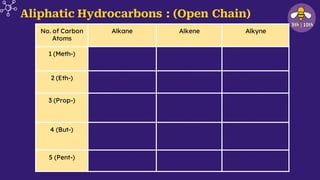
Aliphatic Hydrocarbons : (Open Chain)
No. of Carbon
Atoms
Alkane Alkene Alkyne
1 (Meth-)
2 (Eth-)
3 (Prop-)
4 (But-)
5 (Pent-)
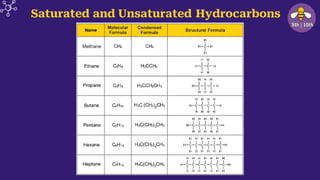
Saturated and Unsaturated Hydrocarbons
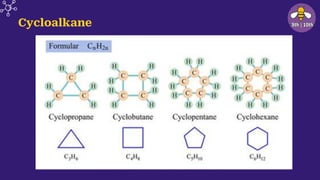
Cycloalkane
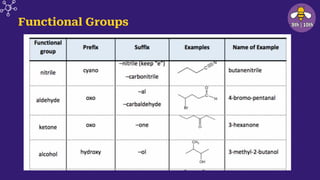
Functional Groups
Functional Groups
Functional Groups
IUPAC Nomenclature
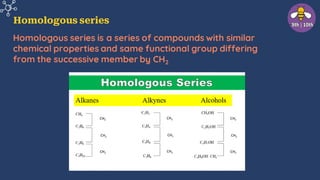
Homologous series
Homologous series is a series of compounds with similar
chemical properties and same functional group differing
from the successive member by CH2
Lewis dot Structure
CH4
Lewis dot Structure
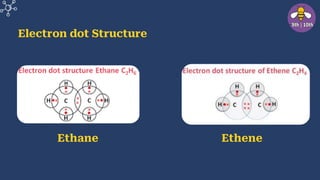
Electron dot Structure
Ethane Ethene
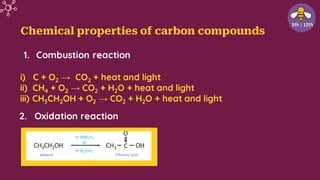
Chemical properties of carbon compounds
1. Combustion reaction
i) C + O2 → CO2 + heat and light
ii) CH4 + O2 → CO2 + H2O + heat and light
iii) CH3CH2OH + O2 → CO2 + H2O + heat and light
2. Oxidation reaction
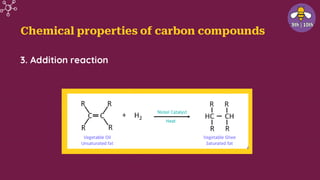
Chemical properties of carbon compounds
3. Addition reaction
Chemical properties of carbon compounds
4. Substitution reaction
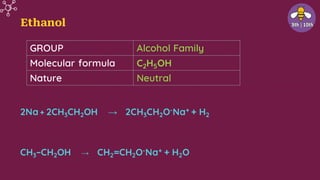
Ethanol
2Na + 2CH3CH2OH → 2CH3CH2O-Na+ + H2
CH3–CH2OH → CH2=CH2O-Na+ + H2O
GROUP Alcohol Family
Molecular formula C2H5OH
Nature Neutral
Ethanoic Acid
GROUP Carboxylic Acid Family
Molecular formula CH3OOH
Nature Acidic
Distinguish between Soap and Detergent
Soap Detergent
● Soaps work well in soft water.
● Biodegradable.
● They have relatively weak cleansing
action.
● They are Na or potassium salts of
long chain fatty acids.
● Detergents work well both in soft
and hard water.
● Non-biodegradable.
● They have strong cleansing action.
● They are sodium salts of long chain
benzene sulphonic acids.
Cleansing action of Soap
Carbon and its compounds study materials

Carbon and its compounds study materials

  • 1.
  • 2.
  • 3.
    Atomic number ofCARBON is 6 (6p and 6e) Also it has 6 neutrons. Mass number = 12 (6p + 6n). Electronic configuration is 2,4 Valency is 4 so it is Tetravalent. About CARBON
  • 4.
    Importance of carbon ●Main element present in all living organisms. ● Almost all fuel that we use are made of carbon. ● Other organic substance like carbohydrate, protein, fats, alcohol, vinegar, glucose etc contain carbon. ● Plastics have carbon. Uniqueness in carbon ● Carbon can form huge number of compounds. ● Number of carbon compounds are greater than all non-carbon compounds. ● Carbon based organic chemistry is studied as a separate branch of chemistry.
  • 5.
    ● Catenation ● Tetra-Covalency ●Polymerisation ● Isomerism Why CARBON is Unique?
  • 6.
    1. Tetra-Covalency Valency ofCarbon is 4 and it form compounds only by sharing electrons. Covalent Bond: The atomic number of carbon is 6. Its electronic configuration is 2, 4. It requires, 4 electrons to achieve the inert gas electronic configuration. But carbon cannot form an ionic bond because : • It could gain four electrons forming C4- cation. But it would be difficult for the nucleus with six protons to hold on to ten electrons. • It could lose four electrons forming C4+ cations. But it requires a large amount of energy to remove four electrons.
  • 7.
    2. Catenation It isa property which is present in Carbon which leds to direct bonding between atoms of same element to form long chains, branches or ring structures.
  • 8.
    3. Polymerisation The chemicalprocess that combines several monomers to form a polymer or polymeric compound. 4. Isomerism Compounds having same molecular formula, but different structures are called isomers and this property is called isomerism.
  • 9.
  • 10.
    Allotropes of Carbon Differentforms of an element that has same chemical properties, but different physical properties are known as allotropes. There are three allotropes of carbon- diamond, graphite and fullerene.
  • 11.
    Diamond It exists asa three-dimensional network with strong carbon-carbon covalent bonds. Diamond is hard in nature with high melting points. It shines in presence of light and it is a bad conductor of electricity. The most common use of diamond is in making jewellery. It is also used in cutting and drilling tools.
  • 12.
    Graphite ● In Graphiteeach Carbon atom is bonded with other three carbon atoms in order to form hexagonal rings. ● It serves as good conductor of heat and electricity. ● It is used as dry lubricant for machines parts as well as it is used in lead pencils.
  • 13.
    Fullerene ● Fullerence isthe hollow cage which exists in the form of sphere. It resembles the structure of fullerene. ● But along with hexagonal rings, sometimes pentagonal or heptagonal rings are also present.
  • 14.
    Types of compounds CarbonCompound Compounds containing carbon. Organic Compound Compounds containing carbon and nitrogen. HydroCarbon Compounds containing carbon and hydrogen only.
  • 15.
  • 16.
    Aliphatic Hydrocarbons :(Open Chain) No. of Carbon Atoms Alkane Alkene Alkyne 1 (Meth-) 2 (Eth-) 3 (Prop-) 4 (But-) 5 (Pent-)
  • 17.
  • 18.
  • 19.
  • 20.
  • 21.
  • 22.
  • 23.
    Homologous series Homologous seriesis a series of compounds with similar chemical properties and same functional group differing from the successive member by CH2
  • 24.
  • 25.
  • 26.
  • 27.
    Chemical properties ofcarbon compounds 1. Combustion reaction i) C + O2 → CO2 + heat and light ii) CH4 + O2 → CO2 + H2O + heat and light iii) CH3CH2OH + O2 → CO2 + H2O + heat and light 2. Oxidation reaction
  • 28.
    Chemical properties ofcarbon compounds 3. Addition reaction
  • 29.
    Chemical properties ofcarbon compounds 4. Substitution reaction
  • 30.
    Ethanol 2Na + 2CH3CH2OH→ 2CH3CH2O-Na+ + H2 CH3–CH2OH → CH2=CH2O-Na+ + H2O GROUP Alcohol Family Molecular formula C2H5OH Nature Neutral
  • 31.
    Ethanoic Acid GROUP CarboxylicAcid Family Molecular formula CH3OOH Nature Acidic
  • 32.
    Distinguish between Soapand Detergent Soap Detergent ● Soaps work well in soft water. ● Biodegradable. ● They have relatively weak cleansing action. ● They are Na or potassium salts of long chain fatty acids. ● Detergents work well both in soft and hard water. ● Non-biodegradable. ● They have strong cleansing action. ● They are sodium salts of long chain benzene sulphonic acids. Cleansing action of Soap