→ Compounds areof two types:
(i) Organic Compounds
(ii) Inorganic Compounds
→ Organic Compounds are made up of
Carbons and form the basis of all living
organisms.
3.
Carbon belongs tothe 14th
group of the periodic table.
Carbon forms organic as well as inorganic compounds.
Originally compounds like urea, sugars, fats, oils, dyes,
proteins, vitamins etc, which were isolated directly or
indirectly from living organisms such as animals and
plants were called organic compounds.
In contrast, compounds like common salt, marble,
alums, nitre, blue and green vitriols etc. which are
isolated from non−living sources such as rocks and
minerals were called inorganic compounds.
4.
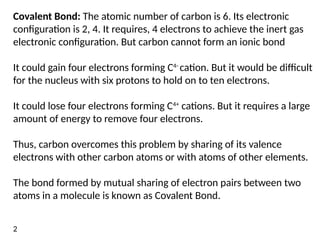
Covalent Bond: Theatomic number of carbon is 6. Its electronic
configuration is 2, 4. It requires, 4 electrons to achieve the inert gas
electronic configuration. But carbon cannot form an ionic bond
It could gain four electrons forming C4-
cation. But it would be difficult
for the nucleus with six protons to hold on to ten electrons.
It could lose four electrons forming C4+
cations. But it requires a large
amount of energy to remove four electrons.
Thus, carbon overcomes this problem by sharing of its valence
electrons with other carbon atoms or with atoms of other elements.
The bond formed by mutual sharing of electron pairs between two
atoms in a molecule is known as Covalent Bond.
2
5.
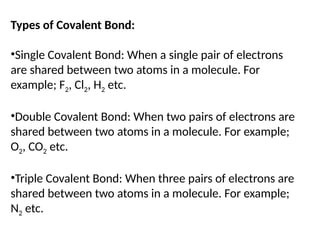
Types of CovalentBond:
•Single Covalent Bond: When a single pair of electrons
are shared between two atoms in a molecule. For
example; F2, Cl2, H2 etc.
•Double Covalent Bond: When two pairs of electrons are
shared between two atoms in a molecule. For example;
O2, CO2 etc.
•Triple Covalent Bond: When three pairs of electrons are
shared between two atoms in a molecule. For example;
N2 etc.
6.
Physical Properties ofCovalent Compounds
→ Covalent compounds have low melting and boiling
points as they have weak intermolecular force.
→ They are generally poor conductor of electricity as
electrons are shared between atoms and no charged
particles are formed.
7.
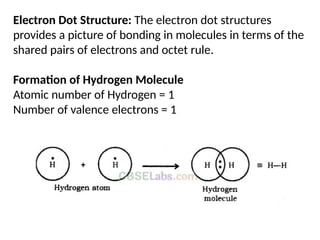
Electron Dot Structure:The electron dot structures
provides a picture of bonding in molecules in terms of the
shared pairs of electrons and octet rule.
Formation of Hydrogen Molecule
Atomic number of Hydrogen = 1
Number of valence electrons = 1
8.
Formation of CH4Molecule
Atomic number of Carbon = 6 [2, 4]
Number of valence electrons = 4
Atomic number of Hydrogen = 1
Number of valence electrons = 1
9.
Formation of CO2Molecule
Atomic number of Carbon = 6 [2, 4]
Number of valence electrons = 4
Atomic number of Oxygen = 8 [2, 6]
Number of valence electrons = 6
10.
Formation of H2SMolecule
Atomic number of Sulphur = 16 [2, 8, 6]
Number of valence electrons = 6
11.
Allotropes of Carbon
Allotropy:The phenomenon in which the
element exists in two or more different physical
states with similar chemical properties are called
Allotropy
12.
Carbon has ThreeMain Allotropes
Diamond: In this, carbon, an atom is bonded to four other
atoms of carbon forming three-dimensional structures. It
is the hardest substance and an insulator. It is used for
drilling rocks and cutting. It is also used for making
jewellery.
Graphite: In this, each carbon atom is bonded to three
other carbon atoms. It is a good conductor of electricity
and used as a lubricant.
Buckminster Fullerene: It is an allotrope of the carbon-
containing cluster of 60 carbon atoms joined together to
form spherical molecules. It is dark solid at room
temperature.
13.
Versatile Nature ofCarbon: The
existence of such a large number of
organic compounds is due to the
following nature of carbon,
•Catenation
•Tetravalent nature.
14.
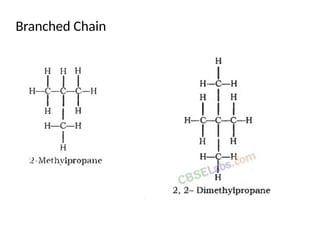
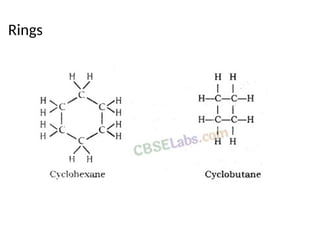
(i) Catenation: Theself linking property of an
element mainly carbon atom through
covalent bonds to form long straight,
branched and rings of different sizes are
called Catenation.
This property is due to
•The small size of the carbon atom.
•The great strength of the carbon-carbon bond.
15.
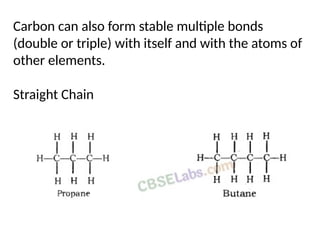
Carbon can alsoform stable multiple bonds
(double or triple) with itself and with the atoms of
other elements.
Straight Chain
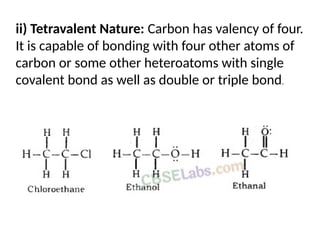
ii) Tetravalent Nature:Carbon has valency of four.
It is capable of bonding with four other atoms of
carbon or some other heteroatoms with single
covalent bond as well as double or triple bond.
19.
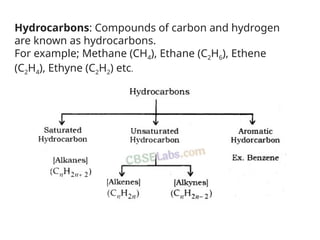
Hydrocarbons: Compounds ofcarbon and hydrogen
are known as hydrocarbons.
For example; Methane (CH4), Ethane (C2H6), Ethene
(C2H4), Ethyne (C2H2) etc.
20.
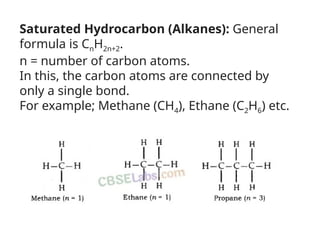
Saturated Hydrocarbon (Alkanes):General
formula is CnH2n+2.
n = number of carbon atoms.
In this, the carbon atoms are connected by
only a single bond.
For example; Methane (CH4), Ethane (C2H6) etc.
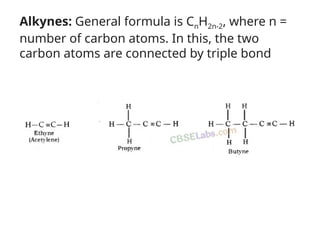
Alkynes: General formulais CnH2n-2, where n =
number of carbon atoms. In this, the two
carbon atoms are connected by triple bond
23.
Isomerism:
Compounds having thesame molecular formula
but different structural formula and properties
are known as Isomers and this phenomenon is
known as Isomerism.
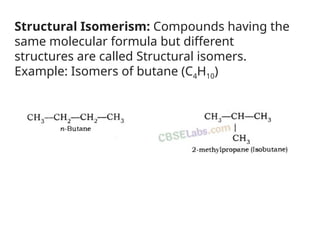
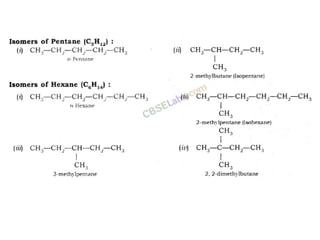
24.
Structural Isomerism: Compoundshaving the
same molecular formula but different
structures are called Structural isomers.
Example: Isomers of butane (C4H10)
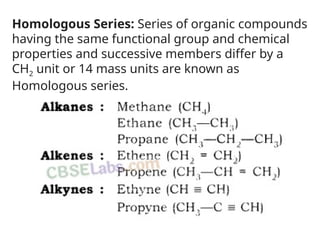
26.
Homologous Series: Seriesof organic compounds
having the same functional group and chemical
properties and successive members differ by a
CH2 unit or 14 mass units are known as
Homologous series.
27.
Characteristic of HomologousSeries
•The successive members in homologous series differ
by CH2 unit or 14 mass unit.
•Members of given homologous series have the same
functional group.
•All the members of homologous series shows similar
chemical properties.
28.
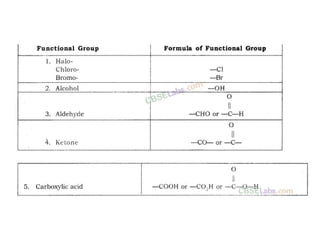
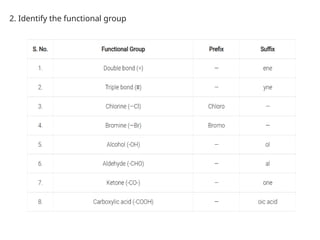
Functional Group: Anatom or group of atoms
present in a molecule which largely determines
its chemical properties are called Functional
Group.
30.
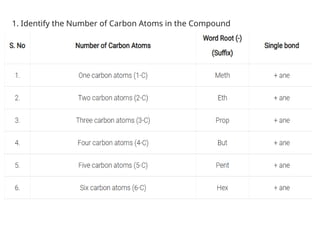
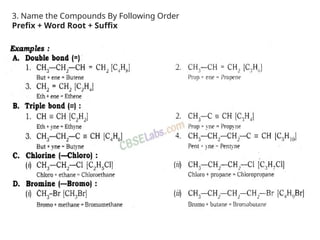
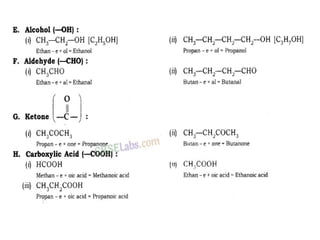
Nomenclature of OrganicCompounds: It
is difficult to remember millions of
compounds by their individual common
name. Thus, to systematize the
nomenclature of organic compounds
IUPAC (International Union of Pure and
Applied Chemistry) has given certain rule
which is as follows:
3. Name theCompounds By Following Order
Prefix + Word Root + Suffix
35.
Chemical Properties ofCarbon Compounds: The important
chemical properties are as follows:
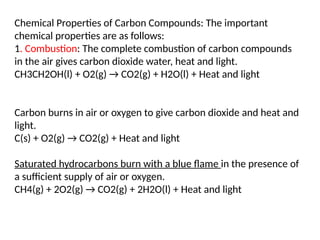
1. Combustion: The complete combustion of carbon compounds
in the air gives carbon dioxide water, heat and light.
CH3CH2OH(l) + O2(g) → CO2(g) + H2O(l) + Heat and light
Carbon burns in air or oxygen to give carbon dioxide and heat and
light.
C(s) + O2(g) → CO2(g) + Heat and light
Saturated hydrocarbons burn with a blue flame in the presence of
a sufficient supply of air or oxygen.
CH4(g) + 2O2(g) → CO2(g) + 2H2O(l) + Heat and light
36.
In presence oflimited supply of air, saturated
hydrocarbon forms a sooty flame.
Unsaturated hydrocarbons burn with a yellow smoky
flame.
The gas and kerosene stove used at home has inlet for
air so that, burnt to given clean blue flame.
Due to presence of small amount of nitrogen and
sulphur, coal and petroleum produces carbon dioxide
with oxides of nitrogen and sulphur which are major
pollutant.
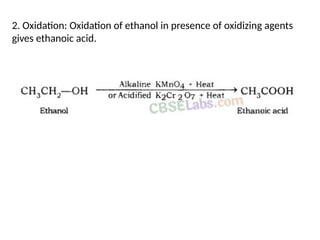
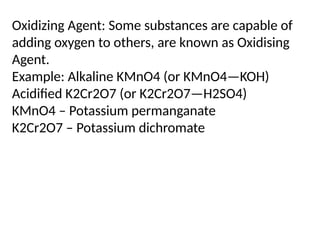
Oxidizing Agent: Somesubstances are capable of
adding oxygen to others, are known as Oxidising
Agent.
Example: Alkaline KMnO4 (or KMnO4—KOH)
Acidified K2Cr2O7 (or K2Cr2O7—H2SO4)
KMnO4 – Potassium permanganate
K2Cr2O7 – Potassium dichromate
39.
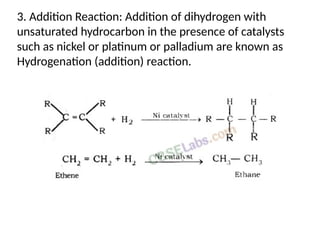
3. Addition Reaction:Addition of dihydrogen with
unsaturated hydrocarbon in the presence of catalysts
such as nickel or platinum or palladium are known as
Hydrogenation (addition) reaction.
40.
Catalyst: Substances thatcause a reaction to occur or
proceeds to different rate without consuming in it are
called a catalyst. For example; Ni, Pt, Pd, etc.
Process of converting vegetable oil into
solid fat (vegetable ghee) is called
Hydrogenation of Oil.
Vegetable fats are saturated fats which are
harmful for health.
Vegetable oil containing unsaturated fatty
acids are good for health.
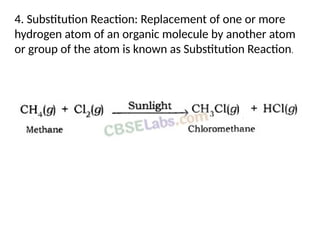
41.
4. Substitution Reaction:Replacement of one or more
hydrogen atom of an organic molecule by another atom
or group of the atom is known as Substitution Reaction.
42.
Some Important CarbonCompounds :
Ethanol (CH3CH2—OH): Commonly known as Ethyl
Alcohol.
Physical Properties
It is colourless, inflammable liquid.
It is miscible with water in all proportions.
It has no effect on the litmus paper.
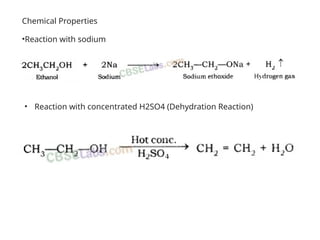
Dehydrating agent: Substances
whichremoves water from ethanol
(alcohols) is known as Dehydrating
agent. For example; Cone. H2SO4.
Uses: As solvent, as antiseptic
(tincture iodine), as anti-freeze in
automobiles.
45.
Ethanoic Acid (CH3COOH):Commonly known as Acetic
acid. 5-8% of ethanoic acid in water is called Vinegar.
The melting point of pure ethanoic acid is 290 K and
hence, it often freezes in cold climate so named as
glacial acetic acid.
Physical Properties
•It is a colourless, pungent-smelling liquid.
•Miscible with water in all proportions.
•Turns blue litmus to red.
46.
Chemical Properties
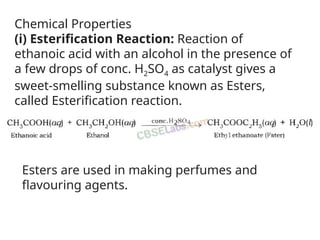
(i) EsterificationReaction: Reaction of
ethanoic acid with an alcohol in the presence of
a few drops of conc. H2SO4 as catalyst gives a
sweet-smelling substance known as Esters,
called Esterification reaction.
Esters are used in making perfumes and
flavouring agents.
47.
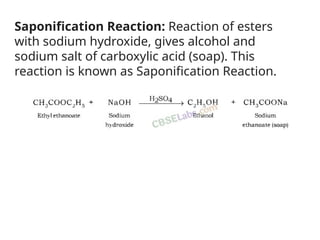
Saponification Reaction: Reactionof esters
with sodium hydroxide, gives alcohol and
sodium salt of carboxylic acid (soap). This
reaction is known as Saponification Reaction.
48.
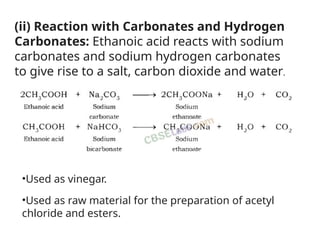
(ii) Reaction withCarbonates and Hydrogen
Carbonates: Ethanoic acid reacts with sodium
carbonates and sodium hydrogen carbonates
to give rise to a salt, carbon dioxide and water.
•Used as vinegar.
•Used as raw material for the preparation of acetyl
chloride and esters.
49.
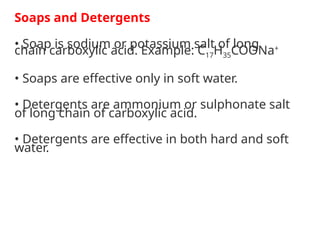
Soaps and Detergents
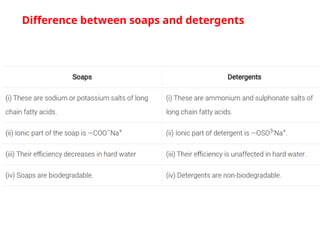
•Soap is sodium or potassium salt of long
chain carboxylic acid. Example: C17H35COONa+
• Soaps are effective only in soft water.
• Detergents are ammonium or sulphonate salt
of long chain of carboxylic acid.
• Detergents are effective in both hard and soft
water.
50.
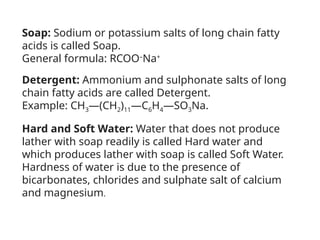
Soap: Sodium orpotassium salts of long chain fatty
acids is called Soap.
General formula: RCOO–
Na+
Detergent: Ammonium and sulphonate salts of long
chain fatty acids are called Detergent.
Example: CH3—(CH2)11—C6H4—SO3Na.
Hard and Soft Water: Water that does not produce
lather with soap readily is called Hard water and
which produces lather with soap is called Soft Water.
Hardness of water is due to the presence of
bicarbonates, chlorides and sulphate salt of calcium
and magnesium.
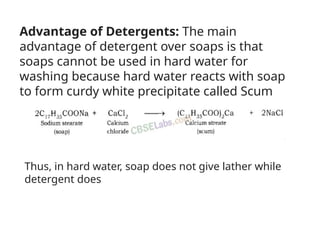
Advantage of Detergents:The main
advantage of detergent over soaps is that
soaps cannot be used in hard water for
washing because hard water reacts with soap
to form curdy white precipitate called Scum
Thus, in hard water, soap does not give lather while
detergent does
53.
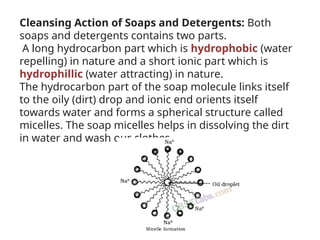
Cleansing Action ofSoaps and Detergents: Both
soaps and detergents contains two parts.
A long hydrocarbon part which is hydrophobic (water
repelling) in nature and a short ionic part which is
hydrophillic (water attracting) in nature.
The hydrocarbon part of the soap molecule links itself
to the oily (dirt) drop and ionic end orients itself
towards water and forms a spherical structure called
micelles. The soap micelles helps in dissolving the dirt
in water and wash our clothes.

![Formation of CH4 Molecule
Atomic number of Carbon = 6 [2, 4]
Number of valence electrons = 4
Atomic number of Hydrogen = 1
Number of valence electrons = 1](https://image.slidesharecdn.com/carbonanditscompounds-250221160419-a4ab5163/85/CARBON-AND-ITS-COMPOUNDS-pptx-class-10-cbse-8-320.jpg)
![Formation of CO2 Molecule
Atomic number of Carbon = 6 [2, 4]
Number of valence electrons = 4
Atomic number of Oxygen = 8 [2, 6]
Number of valence electrons = 6](https://image.slidesharecdn.com/carbonanditscompounds-250221160419-a4ab5163/85/CARBON-AND-ITS-COMPOUNDS-pptx-class-10-cbse-9-320.jpg)
![Formation of H2S Molecule
Atomic number of Sulphur = 16 [2, 8, 6]
Number of valence electrons = 6](https://image.slidesharecdn.com/carbonanditscompounds-250221160419-a4ab5163/85/CARBON-AND-ITS-COMPOUNDS-pptx-class-10-cbse-10-320.jpg)