1
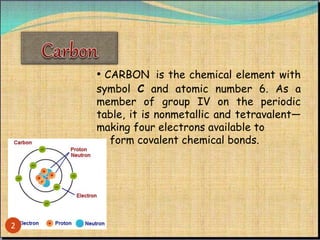
• CARBON is the chemical element with 
symbol C and atomic number 6. As a 
member of group IV on the periodic 
table, it is nonmetallic and tetravalent— 
making four electrons available to 
• form covalent chemical bonds. 
2
Some Physical Properties of 
Carbon 
 Atomic number: 6 
 Atomic mass: 12.0107 amu 
 Melting Point: 3,823 K 
 Boiling Point: 4,098 K 
 Density: 2.2670 g/cm3 
 Phase (room temp.): Solid 
3
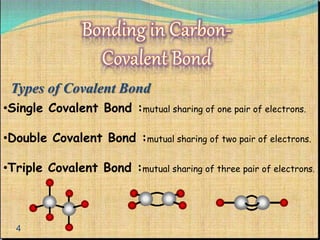
Types of Covalent Bond 
•Single Covalent Bond :mutual sharing of one pair of electrons. 
•Double Covalent Bond :mutual sharing of two pair of electrons. 
•Triple Covalent Bond :mutual sharing of three pair of electrons. 
4
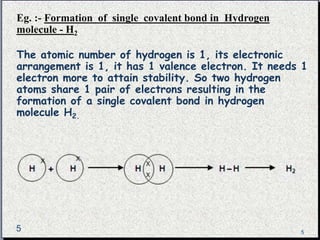
Eg. :- Formation of single covalent bond in Hydrogen 
molecule - H2 
The atomic number of hydrogen is 1, its electronic 
arrangement is 1, it has 1 valence electron. It needs 1 
electron more to attain stability. So two hydrogen 
atoms share 1 pair of electrons resulting in the 
formation of a single covalent bond in hydrogen 
molecule H2. 
5 5
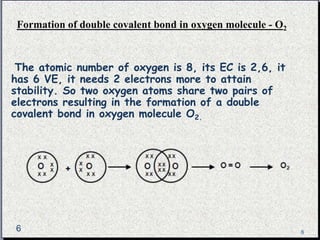
Formation of double covalent bond in oxygen molecule - O2 
The atomic number of oxygen is 8, its EC is 2,6, it 
has 6 VE, it needs 2 electrons more to attain 
stability. So two oxygen atoms share two pairs of 
electrons resulting in the formation of a double 
covalent bond in oxygen molecule O2. 
6 6
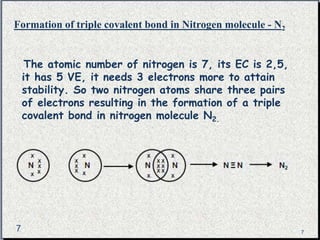
Formation of triple covalent bond in Nitrogen molecule - N2 
The atomic number of nitrogen is 7, its EC is 2,5, 
it has 5 VE, it needs 3 electrons more to attain 
stability. So two nitrogen atoms share three pairs 
of electrons resulting in the formation of a triple 
covalent bond in nitrogen molecule N2. 
7 7
• Low Melting and boiling point. 
• Physical State (liquid or gas) 
• Low Density. 
• Solubility. 
• Bad Conductor of Electricity. 
8 8
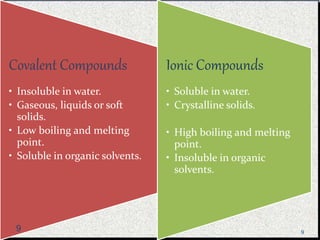
Covalent Compounds 
• Insoluble in water. 
• Gaseous, liquids or soft 
solids. 
• Low boiling and melting 
point. 
• Soluble in organic solvents. 
Ionic Compounds 
• Soluble in water. 
• Crystalline solids. 
• High boiling and melting 
point. 
• Insoluble in organic 
solvents. 
9 9
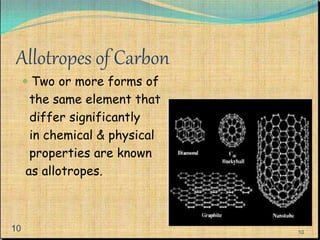
Allotropes of Carbon 
 Two or more forms of 
the same element that 
differ significantly 
in chemical & physical 
properties are known 
as allotropes. 
10 10
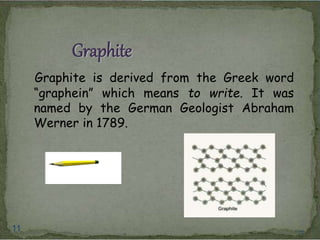
Graphite 
Graphite is derived from the Greek word 
“graphein” which means to write. It was 
named by the German Geologist Abraham 
Werner in 1789. 
11 11
Diamond 
In diamond, each carbon atom 
is tetra headedly attached to four other 
carbon atoms forming a rigid three 
dimensional structure. 
Thus it is the hardest substance known. 
12 12
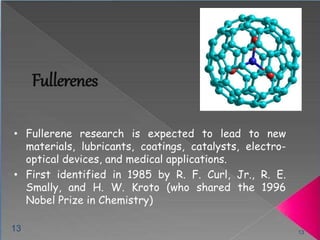
Fullerenes 
• Fullerene research is expected to lead to new 
materials, lubricants, coatings, catalysts, electro-optical 
devices, and medical applications. 
• First identified in 1985 by R. F. Curl, Jr., R. E. 
Smally, and H. W. Kroto (who shared the 1996 
Nobel Prize in Chemistry) 
13 13
 Organic Chemistry: The branch of chemistry dealing 
with carbon compounds, other than CO , CO2 and 
carbonates, is called Organic Chemistry. 
 Organic compounds: The compounds of carbon, other 
than CO , CO2 and carbonates, are called Organic 
Compounds 
14 14
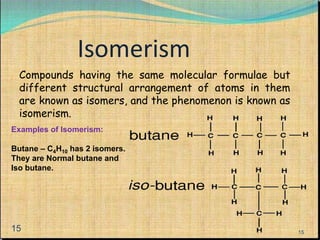
Isomerism 
Compounds having the same molecular formulae but 
different structural arrangement of atoms in them 
are known as isomers, and the phenomenon is known as 
isomerism. 
Examples of Isomerism: 
Butane – C4H10 has 2 isomers. 
They are Normal butane and 
Iso butane. 
15 15
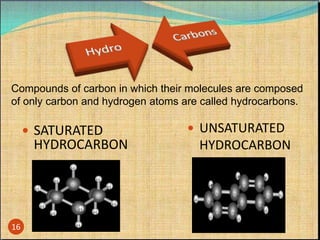
Compounds of carbon in which their molecules are composed 
of only carbon and hydrogen atoms are called hydrocarbons. 
 SATURATED 
HYDROCARBON 
 UNSATURATED 
HYDROCARBON 
16
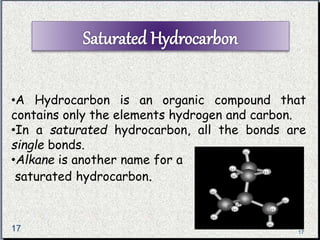
•A Hydrocarbon is an organic compound that 
contains only the elements hydrogen and carbon. 
•In a saturated hydrocarbon, all the bonds are 
single bonds. 
•Alkane is another name for a 
saturated hydrocarbon. 
17 17
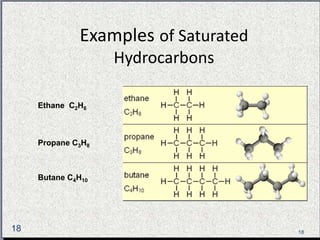
Examples of Saturated 
Hydrocarbons 
Examples of Saturated 
Ethane C2H6 
Propane C3H8 
Butane C4H10 
Hydrocarbons 
18 18
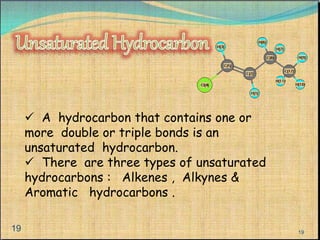
 A hydrocarbon that contains one or 
more double or triple bonds is an 
unsaturated hydrocarbon. 
 There are three types of unsaturated 
hydrocarbons : Alkenes , Alkynes & 
Aromatic hydrocarbons . 
19 19
Examples of Unsaturated 
Hydrocarbons 
Ethene C2H4 
Propane C3H6 
20
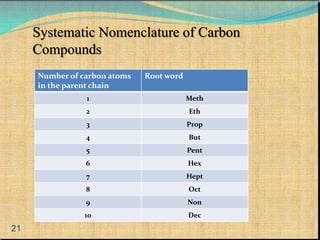
Systematic Nomenclature of Carbon 
Compounds 
Number of carbon atoms 
in the parent chain 
Root word 
1 Meth 
2 Eth 
3 Prop 
4 But 
5 Pent 
6 Hex 
7 Hept 
8 Oct 
9 Non 
10 Dec 
21
Homologous series 
A homologous series is a group of organic 
compounds having similar structures and 
similar chemical properties in which the 
successive compounds differ by CH2 group 
22
Characteristics 
-) All members of homologous series can be 
represented by the same general formula . 
-) All compound show similar chemical properties . 
-) The members of homologous series show a 
gradual change in their physical properties with 
increase in molecular mass . 
-) Any two adjacent homologues differ by 1 carbon 
atom and 2 hydrogen atom in their molecular 
formulae ... 
23
Alkanes 
The general formula of alkanes is CnH2n+2 where n is 
no. of carbon atoms in 1 molecule of alkanes. 
Single Bond…… 
ALKANE MOLECULAR 
FORMULA 
Methane CH4 
Ethane C2H6 
Propane C3H8 
Butane C4H10 
pentane C5H 24 12
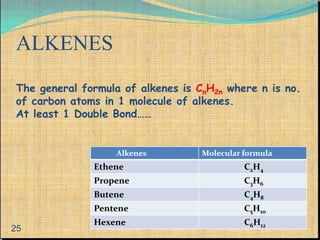
The general formula of alkenes is CnH2n where n is no. 
of carbon atoms in 1 molecule of alkenes. 
At least 1 Double Bond…… 
Alkenes Molecular formula 
ALKENES 
Ethene C2H4 
Propene C3H6 
Butene C4H8 
Pentene C5H10 
Hexene C6H12 
25
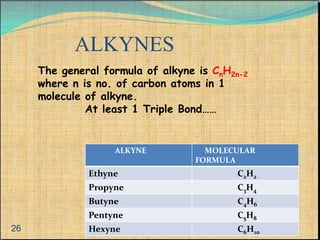
ALKYNES 
The general formula of alkyne is CnH2n-2 
where n is no. of carbon atoms in 1 
molecule of alkyne. 
At least 1 Triple Bond…… 
ALKYNE MOLECULAR 
FORMULA 
Ethyne C2H2 
Propyne C3H4 
Butyne C4H6 
Pentyne C5H8 
Hexyne C6H10 
26
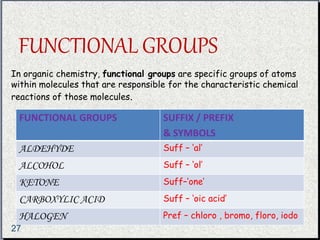
FUNCTIONAL GROUPS 
In organic chemistry, functional groups are specific groups of atoms 
within molecules that are responsible for the characteristic chemical 
reactions of those molecules. 
FUNCTIONAL GROUPS SUFFIX / PREFIX 
& SYMBOLS 
ALDEHYDE Suff – ‘al’ 
ALCOHOL Suff – ‘ol’ 
KETONE Suff–‘one’ 
CARBOXYLIC ACID Suff – ‘oic acid’ 
HALOGEN Pref – chloro , bromo, floro, iodo 
27
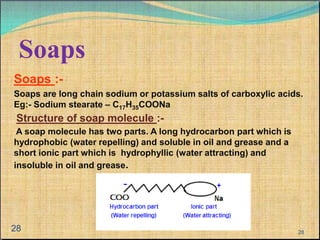
Soaps 
Soaps :- 
Soaps are long chain sodium or potassium salts of carboxylic acids. 
Eg:- Sodium stearate – C17H35COONa 
Structure of soap molecule :- 
A soap molecule has two parts. A long hydrocarbon part which is 
hydrophobic (water repelling) and soluble in oil and grease and a 
short ionic part which is hydrophyllic (water attracting) and 
insoluble in oil and grease. 
28 28
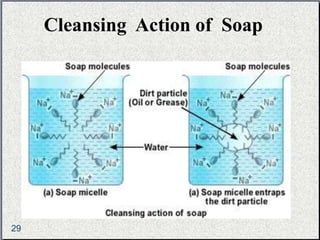
Cleansing Action of Soap 
29
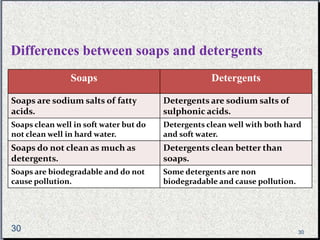
Differences between soaps and detergents 
Soaps Detergents 
Soaps are sodium salts of fatty 
acids. 
Detergents are sodium salts of 
sulphonic acids. 
Soaps clean well in soft water but do 
not clean well in hard water. 
Detergents clean well with both hard 
and soft water. 
Soaps do not clean as much as 
detergents. 
Detergents clean better than 
soaps. 
Soaps are biodegradable and do not 
cause pollution. 
Some detergents are non 
biodegradable and cause pollution. 
30 30
31 31

Carbon and its compounds

  • 1.
  • 2.
    • CARBON isthe chemical element with symbol C and atomic number 6. As a member of group IV on the periodic table, it is nonmetallic and tetravalent— making four electrons available to • form covalent chemical bonds. 2
  • 3.
    Some Physical Propertiesof Carbon  Atomic number: 6  Atomic mass: 12.0107 amu  Melting Point: 3,823 K  Boiling Point: 4,098 K  Density: 2.2670 g/cm3  Phase (room temp.): Solid 3
  • 4.
    Types of CovalentBond •Single Covalent Bond :mutual sharing of one pair of electrons. •Double Covalent Bond :mutual sharing of two pair of electrons. •Triple Covalent Bond :mutual sharing of three pair of electrons. 4
  • 5.
    Eg. :- Formationof single covalent bond in Hydrogen molecule - H2 The atomic number of hydrogen is 1, its electronic arrangement is 1, it has 1 valence electron. It needs 1 electron more to attain stability. So two hydrogen atoms share 1 pair of electrons resulting in the formation of a single covalent bond in hydrogen molecule H2. 5 5
  • 6.
    Formation of doublecovalent bond in oxygen molecule - O2 The atomic number of oxygen is 8, its EC is 2,6, it has 6 VE, it needs 2 electrons more to attain stability. So two oxygen atoms share two pairs of electrons resulting in the formation of a double covalent bond in oxygen molecule O2. 6 6
  • 7.
    Formation of triplecovalent bond in Nitrogen molecule - N2 The atomic number of nitrogen is 7, its EC is 2,5, it has 5 VE, it needs 3 electrons more to attain stability. So two nitrogen atoms share three pairs of electrons resulting in the formation of a triple covalent bond in nitrogen molecule N2. 7 7
  • 8.
    • Low Meltingand boiling point. • Physical State (liquid or gas) • Low Density. • Solubility. • Bad Conductor of Electricity. 8 8
  • 9.
    Covalent Compounds •Insoluble in water. • Gaseous, liquids or soft solids. • Low boiling and melting point. • Soluble in organic solvents. Ionic Compounds • Soluble in water. • Crystalline solids. • High boiling and melting point. • Insoluble in organic solvents. 9 9
  • 10.
    Allotropes of Carbon  Two or more forms of the same element that differ significantly in chemical & physical properties are known as allotropes. 10 10
  • 11.
    Graphite Graphite isderived from the Greek word “graphein” which means to write. It was named by the German Geologist Abraham Werner in 1789. 11 11
  • 12.
    Diamond In diamond,each carbon atom is tetra headedly attached to four other carbon atoms forming a rigid three dimensional structure. Thus it is the hardest substance known. 12 12
  • 13.
    Fullerenes • Fullereneresearch is expected to lead to new materials, lubricants, coatings, catalysts, electro-optical devices, and medical applications. • First identified in 1985 by R. F. Curl, Jr., R. E. Smally, and H. W. Kroto (who shared the 1996 Nobel Prize in Chemistry) 13 13
  • 14.
     Organic Chemistry:The branch of chemistry dealing with carbon compounds, other than CO , CO2 and carbonates, is called Organic Chemistry.  Organic compounds: The compounds of carbon, other than CO , CO2 and carbonates, are called Organic Compounds 14 14
  • 15.
    Isomerism Compounds havingthe same molecular formulae but different structural arrangement of atoms in them are known as isomers, and the phenomenon is known as isomerism. Examples of Isomerism: Butane – C4H10 has 2 isomers. They are Normal butane and Iso butane. 15 15
  • 16.
    Compounds of carbonin which their molecules are composed of only carbon and hydrogen atoms are called hydrocarbons.  SATURATED HYDROCARBON  UNSATURATED HYDROCARBON 16
  • 17.
    •A Hydrocarbon isan organic compound that contains only the elements hydrogen and carbon. •In a saturated hydrocarbon, all the bonds are single bonds. •Alkane is another name for a saturated hydrocarbon. 17 17
  • 18.
    Examples of Saturated Hydrocarbons Examples of Saturated Ethane C2H6 Propane C3H8 Butane C4H10 Hydrocarbons 18 18
  • 19.
     A hydrocarbonthat contains one or more double or triple bonds is an unsaturated hydrocarbon.  There are three types of unsaturated hydrocarbons : Alkenes , Alkynes & Aromatic hydrocarbons . 19 19
  • 20.
    Examples of Unsaturated Hydrocarbons Ethene C2H4 Propane C3H6 20
  • 21.
    Systematic Nomenclature ofCarbon Compounds Number of carbon atoms in the parent chain Root word 1 Meth 2 Eth 3 Prop 4 But 5 Pent 6 Hex 7 Hept 8 Oct 9 Non 10 Dec 21
  • 22.
    Homologous series Ahomologous series is a group of organic compounds having similar structures and similar chemical properties in which the successive compounds differ by CH2 group 22
  • 23.
    Characteristics -) Allmembers of homologous series can be represented by the same general formula . -) All compound show similar chemical properties . -) The members of homologous series show a gradual change in their physical properties with increase in molecular mass . -) Any two adjacent homologues differ by 1 carbon atom and 2 hydrogen atom in their molecular formulae ... 23
  • 24.
    Alkanes The generalformula of alkanes is CnH2n+2 where n is no. of carbon atoms in 1 molecule of alkanes. Single Bond…… ALKANE MOLECULAR FORMULA Methane CH4 Ethane C2H6 Propane C3H8 Butane C4H10 pentane C5H 24 12
  • 25.
    The general formulaof alkenes is CnH2n where n is no. of carbon atoms in 1 molecule of alkenes. At least 1 Double Bond…… Alkenes Molecular formula ALKENES Ethene C2H4 Propene C3H6 Butene C4H8 Pentene C5H10 Hexene C6H12 25
  • 26.
    ALKYNES The generalformula of alkyne is CnH2n-2 where n is no. of carbon atoms in 1 molecule of alkyne. At least 1 Triple Bond…… ALKYNE MOLECULAR FORMULA Ethyne C2H2 Propyne C3H4 Butyne C4H6 Pentyne C5H8 Hexyne C6H10 26
  • 27.
    FUNCTIONAL GROUPS Inorganic chemistry, functional groups are specific groups of atoms within molecules that are responsible for the characteristic chemical reactions of those molecules. FUNCTIONAL GROUPS SUFFIX / PREFIX & SYMBOLS ALDEHYDE Suff – ‘al’ ALCOHOL Suff – ‘ol’ KETONE Suff–‘one’ CARBOXYLIC ACID Suff – ‘oic acid’ HALOGEN Pref – chloro , bromo, floro, iodo 27
  • 28.
    Soaps Soaps :- Soaps are long chain sodium or potassium salts of carboxylic acids. Eg:- Sodium stearate – C17H35COONa Structure of soap molecule :- A soap molecule has two parts. A long hydrocarbon part which is hydrophobic (water repelling) and soluble in oil and grease and a short ionic part which is hydrophyllic (water attracting) and insoluble in oil and grease. 28 28
  • 29.
  • 30.
    Differences between soapsand detergents Soaps Detergents Soaps are sodium salts of fatty acids. Detergents are sodium salts of sulphonic acids. Soaps clean well in soft water but do not clean well in hard water. Detergents clean well with both hard and soft water. Soaps do not clean as much as detergents. Detergents clean better than soaps. Soaps are biodegradable and do not cause pollution. Some detergents are non biodegradable and cause pollution. 30 30
  • 31.