Mithilesh Trivedi

1
Training, Career
&
Talent Management
2
TRAINING
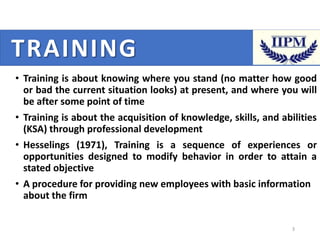
• Training is about knowing where you stand (no matter how good
or bad the current situation looks) at present, and where you will
be after some point of time
• Training is about the acquisition of knowledge, skills, and abilities
(KSA) through professional development
• Hesselings (1971), Training is a sequence of experiences or
opportunities designed to modify behavior in order to attain a
stated objective
• A procedure for providing new employees with basic information
about the firm
3
“SYSTEM MODEL” OF TRAINING
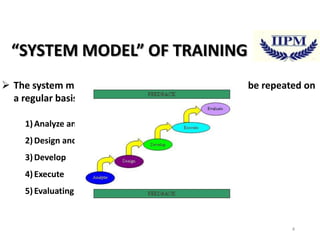
 The system model consists of five phases and should be repeated on
a regular basis to make further improvements…..
1) Analyze and identify
2) Design and provide training
3) Develop
4) Execute
5) Evaluating

4
METHODS OF
TRAINING
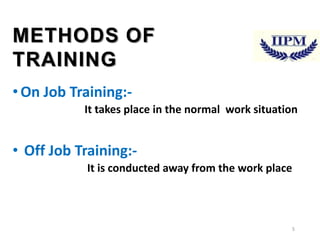
• On Job Training:It takes place in the normal work situation

• Off Job Training:It is conducted away from the work place

5
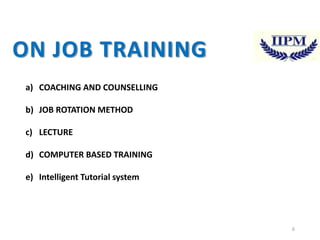
ON JOB TRAINING
a) COACHING AND COUNSELLING
b) JOB ROTATION METHOD

c) LECTURE
d) COMPUTER BASED TRAINING
e) Intelligent Tutorial system

6
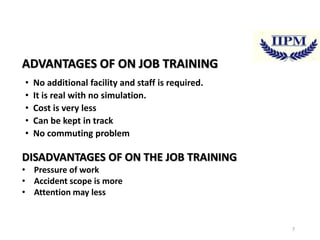
ADVANTAGES OF ON JOB TRAINING
•
•
•
•
•

No additional facility and staff is required.
It is real with no simulation.
Cost is very less
Can be kept in track
No commuting problem

DISADVANTAGES OF ON THE JOB TRAINING
• Pressure of work
• Accident scope is more
• Attention may less

7
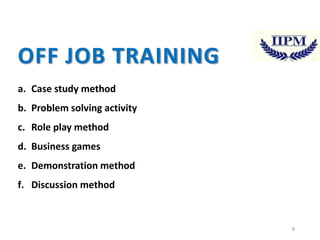
OFF JOB TRAINING
a. Case study method
b. Problem solving activity
c. Role play method
d. Business games
e. Demonstration method
f. Discussion method

8
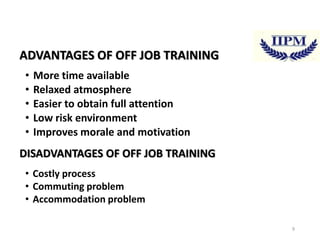
ADVANTAGES OF OFF JOB TRAINING
•
•
•
•
•

More time available
Relaxed atmosphere
Easier to obtain full attention
Low risk environment
Improves morale and motivation

DISADVANTAGES OF OFF JOB TRAINING
• Costly process
• Commuting problem
• Accommodation problem
9
Careers
Management
10
CAREER
MANAGEMENT
Carrier Management is the process through which employees

• Become aware of their own
interests, values, strengths, and weaknesses
• Obtain information about job opportunities within the
company
• Identify career goals

11
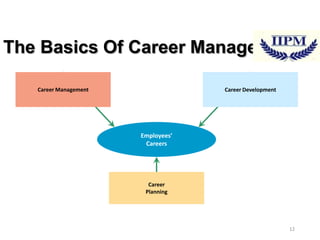
The Basics Of Career Management
Career Management

Career Development

Employees’
Careers

Career
Planning

12
CAREERS AND CAREER
PLANNING
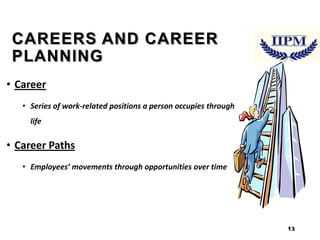
• Career
• Series of work-related positions a person occupies through
life

• Career Paths
• Employees’ movements through opportunities over time

13
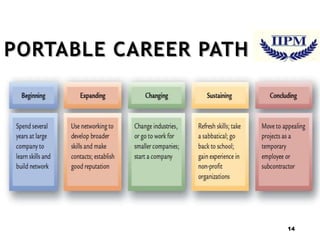
PORTABLE CAREER PATH

14
TALENT
MANAGEME
NT

15
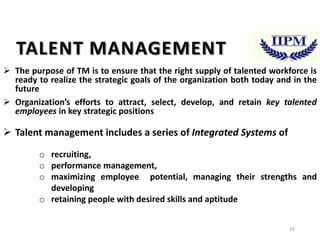
TALENT MANAGEMENT
 The purpose of TM is to ensure that the right supply of talented workforce is
ready to realize the strategic goals of the organization both today and in the
future
 Organization’s efforts to attract, select, develop, and retain key talented
employees in key strategic positions

 Talent management includes a series of Integrated Systems of
o recruiting,
o performance management,
o maximizing employee potential, managing their strengths and
developing
o retaining people with desired skills and aptitude
16
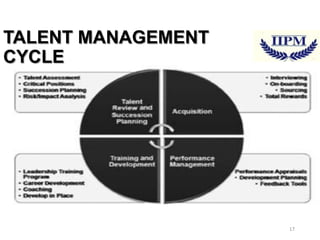
TALENT MANAGEMENT
CYCLE

17
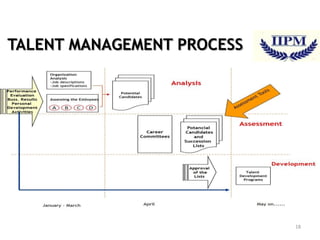
TALENT MANAGEMENT PROCESS

18
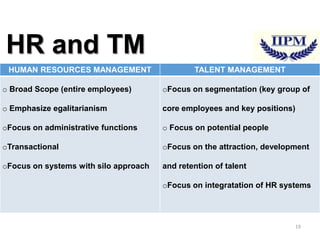
HR and TM
HUMAN RESOURCES MANAGEMENT

TALENT MANAGEMENT

o Broad Scope (entire employees)

oFocus on segmentation (key group of

o Emphasize egalitarianism

core employees and key positions)

oFocus on administrative functions

o Focus on potential people

oTransactional

oFocus on the attraction, development

oFocus on systems with silo approach

and retention of talent
oFocus on integratation of HR systems

19
20
Questions?
21

Training and talent management in HRM

  • 1.
  • 2.
  • 3.
    TRAINING • Training isabout knowing where you stand (no matter how good or bad the current situation looks) at present, and where you will be after some point of time • Training is about the acquisition of knowledge, skills, and abilities (KSA) through professional development • Hesselings (1971), Training is a sequence of experiences or opportunities designed to modify behavior in order to attain a stated objective • A procedure for providing new employees with basic information about the firm 3
  • 4.
    “SYSTEM MODEL” OFTRAINING  The system model consists of five phases and should be repeated on a regular basis to make further improvements….. 1) Analyze and identify 2) Design and provide training 3) Develop 4) Execute 5) Evaluating 4
  • 5.
    METHODS OF TRAINING • OnJob Training:It takes place in the normal work situation • Off Job Training:It is conducted away from the work place 5
  • 6.
    ON JOB TRAINING a)COACHING AND COUNSELLING b) JOB ROTATION METHOD c) LECTURE d) COMPUTER BASED TRAINING e) Intelligent Tutorial system 6
  • 7.
    ADVANTAGES OF ONJOB TRAINING • • • • • No additional facility and staff is required. It is real with no simulation. Cost is very less Can be kept in track No commuting problem DISADVANTAGES OF ON THE JOB TRAINING • Pressure of work • Accident scope is more • Attention may less 7
  • 8.
    OFF JOB TRAINING a.Case study method b. Problem solving activity c. Role play method d. Business games e. Demonstration method f. Discussion method 8
  • 9.
    ADVANTAGES OF OFFJOB TRAINING • • • • • More time available Relaxed atmosphere Easier to obtain full attention Low risk environment Improves morale and motivation DISADVANTAGES OF OFF JOB TRAINING • Costly process • Commuting problem • Accommodation problem 9
  • 10.
  • 11.
    CAREER MANAGEMENT Carrier Management isthe process through which employees • Become aware of their own interests, values, strengths, and weaknesses • Obtain information about job opportunities within the company • Identify career goals 11
  • 12.
    The Basics OfCareer Management Career Management Career Development Employees’ Careers Career Planning 12
  • 13.
    CAREERS AND CAREER PLANNING •Career • Series of work-related positions a person occupies through life • Career Paths • Employees’ movements through opportunities over time 13
  • 14.
  • 15.
  • 16.
    TALENT MANAGEMENT  Thepurpose of TM is to ensure that the right supply of talented workforce is ready to realize the strategic goals of the organization both today and in the future  Organization’s efforts to attract, select, develop, and retain key talented employees in key strategic positions  Talent management includes a series of Integrated Systems of o recruiting, o performance management, o maximizing employee potential, managing their strengths and developing o retaining people with desired skills and aptitude 16
  • 17.
  • 18.
  • 19.
    HR and TM HUMANRESOURCES MANAGEMENT TALENT MANAGEMENT o Broad Scope (entire employees) oFocus on segmentation (key group of o Emphasize egalitarianism core employees and key positions) oFocus on administrative functions o Focus on potential people oTransactional oFocus on the attraction, development oFocus on systems with silo approach and retention of talent oFocus on integratation of HR systems 19
  • 20.
  • 21.