






Mithilesh Trivedi
planning
&
recruitment
2
Why?

3
Objectives

• Recruit and Retain
• Foresee employee turnover
• Meet the needs of expansions, diversification , etc
• Impact of technology on work, employees and future human resources
requirement
• Improve standards, skill, knowledge, ability, discipline, etc.
• Assess the surplus or shortage of human resources
• Provide human resources of right kind, right number in right time and right
place
• Make the best use of human resources
• Estimate the cost of human resources
4
Succession Planning
 A deliberate and systematic effort by an organization to ensure leadership
continuity in key positions, retain and develop intellectual and knowledge
capital for the future, and encourage individual advancement

 Ensures that employees are recruited and/or developed to fill
each key role
 Ensures that we operate effectively when individuals occupying
critical positions depart
 May be used for managerial positions or unique or hard-to fill
roles
 Align bench strength for replacing critical positions
5
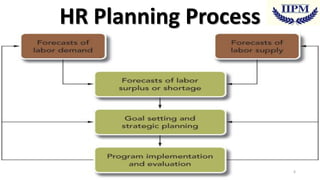
HR Planning Process

6
7
 Recruitment is the process of finding and hiring suitable

candidates ( from within internal or external of an organization )
to fill the positions

 The process involves searching, sourcing and selecting right
candidates for the roles to the organization

8
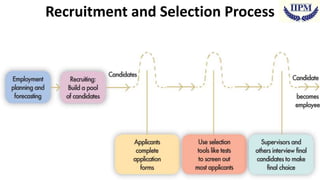
Recruitment and Selection Process

9
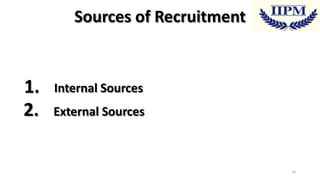
Sources of Recruitment

1.
2.

Internal Sources
External Sources

10
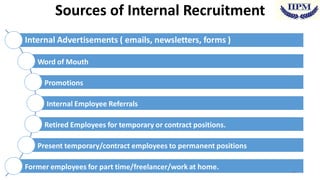
Sources of Internal Recruitment
Internal Advertisements ( emails, newsletters, forms )
Word of Mouth
Promotions

Internal Employee Referrals
Retired Employees for temporary or contract positions.
Present temporary/contract employees to permanent positions
Former employees for part time/freelancer/work at home.

11
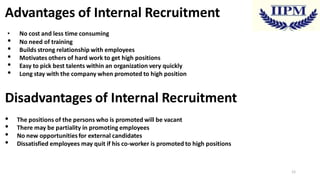
Advantages of Internal Recruitment
•

•
•
•
•
•

No cost and less time consuming
No need of training
Builds strong relationship with employees
Motivates others of hard work to get high positions
Easy to pick best talents within an organization very quickly
Long stay with the company when promoted to high position

Disadvantages of Internal Recruitment
•
•
•
•

The positions of the persons who is promoted will be vacant
There may be partiality in promoting employees
No new opportunities for external candidates
Dissatisfied employees may quit if his co-worker is promoted to high positions

12
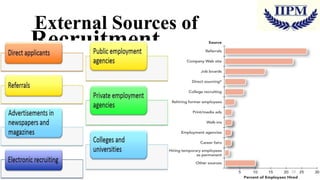
External Sources of

Recruitment

13







•

•
•
•
•

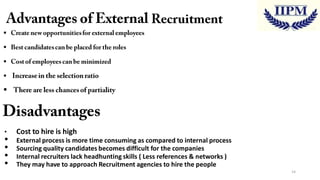
Cost to hire is high
External process is more time consuming as compared to internal process
Sourcing quality candidates becomes difficult for the companies
Internal recruiters lack headhunting skills ( Less references & networks )
They may have to approach Recruitment agencies to hire the people
14
15
Questions?

Planning & recruitment for HRM

  • 1.
  • 2.
  • 3.
  • 4.
    Objectives • Recruit andRetain • Foresee employee turnover • Meet the needs of expansions, diversification , etc • Impact of technology on work, employees and future human resources requirement • Improve standards, skill, knowledge, ability, discipline, etc. • Assess the surplus or shortage of human resources • Provide human resources of right kind, right number in right time and right place • Make the best use of human resources • Estimate the cost of human resources 4
  • 5.
    Succession Planning  Adeliberate and systematic effort by an organization to ensure leadership continuity in key positions, retain and develop intellectual and knowledge capital for the future, and encourage individual advancement  Ensures that employees are recruited and/or developed to fill each key role  Ensures that we operate effectively when individuals occupying critical positions depart  May be used for managerial positions or unique or hard-to fill roles  Align bench strength for replacing critical positions 5
  • 6.
  • 7.
  • 8.
     Recruitment isthe process of finding and hiring suitable candidates ( from within internal or external of an organization ) to fill the positions  The process involves searching, sourcing and selecting right candidates for the roles to the organization 8
  • 9.
  • 10.
    Sources of Recruitment 1. 2. InternalSources External Sources 10
  • 11.
    Sources of InternalRecruitment Internal Advertisements ( emails, newsletters, forms ) Word of Mouth Promotions Internal Employee Referrals Retired Employees for temporary or contract positions. Present temporary/contract employees to permanent positions Former employees for part time/freelancer/work at home. 11
  • 12.
    Advantages of InternalRecruitment • • • • • • No cost and less time consuming No need of training Builds strong relationship with employees Motivates others of hard work to get high positions Easy to pick best talents within an organization very quickly Long stay with the company when promoted to high position Disadvantages of Internal Recruitment • • • • The positions of the persons who is promoted will be vacant There may be partiality in promoting employees No new opportunities for external candidates Dissatisfied employees may quit if his co-worker is promoted to high positions 12
  • 13.
  • 14.
         • • • • • Cost to hireis high External process is more time consuming as compared to internal process Sourcing quality candidates becomes difficult for the companies Internal recruiters lack headhunting skills ( Less references & networks ) They may have to approach Recruitment agencies to hire the people 14
  • 15.
  • 16.