Capital Budgeting Process,
Investment Criteria and
Comparison
Fundamentals of Financial
Management
Learning Outcomes
• Capital budgeting techniques:
• NPV
– Single Cash inflow
– Many Cash inflow
• Payback periods
– Cumulative net cash flows based approach
– Discounted net cash flows based approach
• Profitability index
• NPV Versus IRR
Definition
• Capital budgeting is the decision process that
managers use to identify those projects that
are profitable and add value to the company.
• In simple words, a capital budgeting consist of
some techniques that screen out the projects
for those that add value to the company.
Importance of capital budgeting
technique
• Capital budgeting decisions define company's
strategic decision
• Eg: Entering into new market required capital expenditure
• Poor capital budgeting leads to financial loss
• Therefore good capital budgeting technique
will help the company to become more
competitive and profitable.
• Capital budgeting decisions increase
shareholder wealth. How?
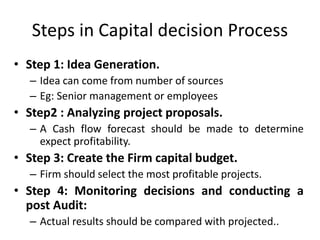
Steps in Capital decision Process
• Step 1: Idea Generation.
– Idea can come from number of sources
– Eg: Senior management or employees
• Step2 : Analyzing project proposals.
– A Cash flow forecast should be made to determine
expect profitability.
• Step 3: Create the Firm capital budget.
– Firm should select the most profitable projects.
• Step 4: Monitoring decisions and conducting a
post Audit:
– Actual results should be compared with projected..
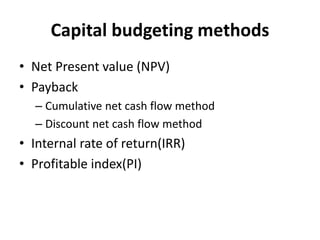
Capital budgeting methods
• Net Present value (NPV)
• Payback
– Cumulative net cash flow method
– Discount net cash flow method
• Internal rate of return(IRR)
• Profitable index(PI)
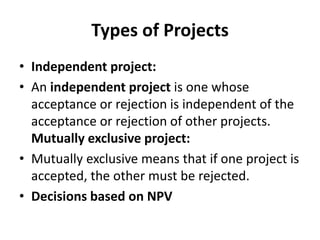
Types of Projects
• Independent project:
• An independent project is one whose
acceptance or rejection is independent of the
acceptance or rejection of other projects.
Mutually exclusive project:
• Mutually exclusive means that if one project is
accepted, the other must be rejected.
• Decisions based on NPV
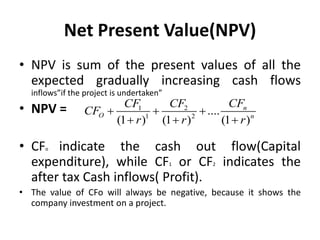
Net Present Value(NPV)
• NPV is sum of the present values of all the
expected gradually increasing cash flows
inflows”if the project is undertaken”
• NPV =
• CFo indicate the cash out flow(Capital
expenditure), while CF1 or CF2 indicates the
after tax Cash inflows( Profit).
• The value of CFo will always be negative, because it shows the
company investment on a project.
1 2
1 2
....
(1 ) (1 ) (1 )
n
O n
CF
CF CF
CF
r r r
  
  
Net Present Value(NPV)
• Positive NPV indicates Profit( Accept the
project) :
• A positive NPV project is expected to increase share holder wealth
• Negative NPV indicates Loss (Reject the
project):
• A negative NPV project is expected to decrease share holder wealth
• NPV uses cash flows. Cash flows from a
project can be used for other corporate
• NPV uses all the cash flows of the project.
Other approaches ignore cash flows beyond a
particular date.
• NPV discounts the cash flows properly. Other
approaches may ignore the time value of
money when handling cash flows
Payback Period
• Payback period:
• It is defined as the expected number of years
required to recover the original investment or
initial investment.
Payback periods ( Con’t)
• There are two approach for Payback period
approaches:
• Cumulative/Ordinary net cash flows based
approach:
• When payback period is calculated without discounting the future cash
inflows or in other words, when time value of money concept is excluded.
• Discounted net cash flows based approach:
• When payback period is calculated by discounting the future cash inflows
1st or
• In other words, when time value of money is considered.
• The payback method is often used by large,
sophisticated companies when making
relatively small decisions.
• The payback method also has some desirable
features for managerial control.
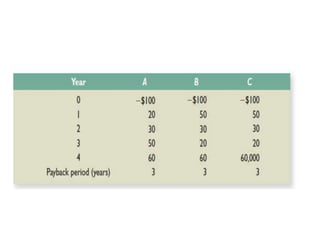
Problems with Payback Period
• Problem 1: Payments after the Payback
Period
• Problem 2: Arbitrary Standard for Payback
Profitability Index
• Profitability Index(PI):
• The PI is the present value of a project’s future cash flows divided by the initial
investments .Present value of (future cash flows) per $ or Rs of initial Cost.
• Accept the project: PI>1.00
• Reject the project : PI<1.00
1 (
1 )
N
t
t
o
CF
r
PI
CF
 


Internal Rate of Return(IRR)
• The most important alternative to the NPV
method: The internal rate of return, universally
known as the IRR.
• The basic rationale behind the IRR method is that
it provides a single number summarizing the
merits of a project.
• That number does not depend on the interest
rate prevailing in the capital market.
• Accept the project if the IRR is greater than the
discount rate. Reject the project if the IRR is less
than the discount rate.
Internal Rate of Return(IRR)
• Internal rate of return
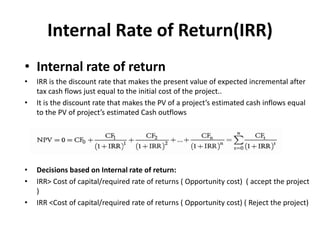
• IRR is the discount rate that makes the present value of expected incremental after
tax cash flows just equal to the initial cost of the project..
• It is the discount rate that makes the PV of a project’s estimated cash inflows equal
to the PV of project’s estimated Cash outflows
• Decisions based on Internal rate of return:
• IRR> Cost of capital/required rate of returns ( Opportunity cost) ( accept the project
)
• IRR <Cost of capital/required rate of returns ( Opportunity cost) ( Reject the project)
Internal Rate of Return(IRR) Con’t
• IRR rate of return is generally calculated
through trial and error method.
• IRR through this method is calculated either
through manually, financial calculator or Excel
function= IRR
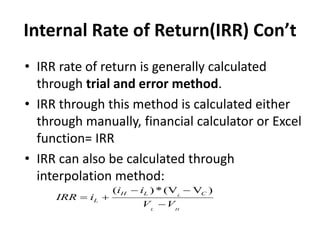
• IRR can also be calculated through
interpolation method:
( ) *(V V )
L
L H
H L C
L
i i
IRR i
V V
 
 

Initail Investment PKR 100,000
Years CIF PV at 15% PV at 20%
1 34,432 29940 28693.33
2 39,530 29890 27451.39
3 39,359 25879 22777.2
4 32,219 18421 15537.71
104130 94459.63
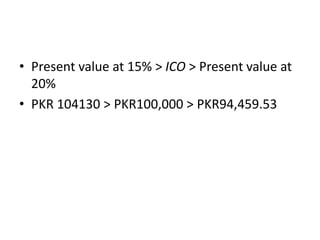
• Present value at 15% > ICO > Present value at
20%
• PKR 104130 > PKR100,000 > PKR94,459.53
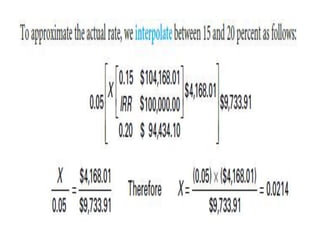
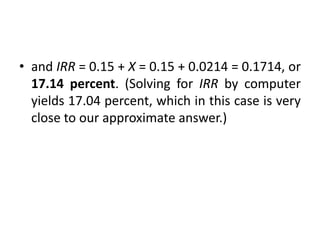
• and IRR = 0.15 + X = 0.15 + 0.0214 = 0.1714, or
17.14 percent. (Solving for IRR by computer
yields 17.04 percent, which in this case is very
close to our approximate answer.)
Example of IRR
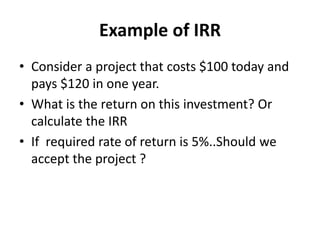
• Consider a project that costs $100 today and
pays $120 in one year.
• What is the return on this investment? Or
calculate the IRR
• If required rate of return is 5%..Should we
accept the project ?
Example
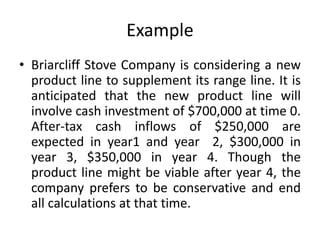
• Briarcliff Stove Company is considering a new
product line to supplement its range line. It is
anticipated that the new product line will
involve cash investment of $700,000 at time 0.
After-tax cash inflows of $250,000 are
expected in year1 and year 2, $300,000 in
year 3, $350,000 in year 4. Though the
product line might be viable after year 4, the
company prefers to be conservative and end
all calculations at that time.
Example….
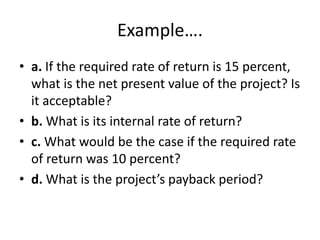
• a. If the required rate of return is 15 percent,
what is the net present value of the project? Is
it acceptable?
• b. What is its internal rate of return?
• c. What would be the case if the required rate
of return was 10 percent?
• d. What is the project’s payback period?
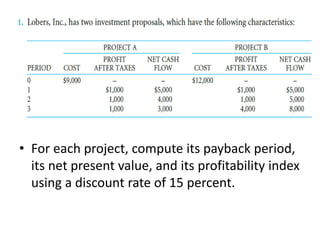
• For each project, compute its payback period,
its net present value, and its profitability index
using a discount rate of 15 percent.
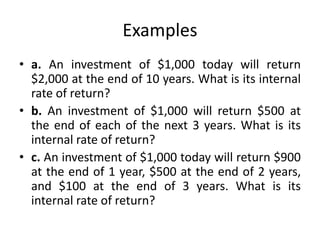
Examples
• a. An investment of $1,000 today will return
$2,000 at the end of 10 years. What is its internal
rate of return?
• b. An investment of $1,000 will return $500 at
the end of each of the next 3 years. What is its
internal rate of return?
• c. An investment of $1,000 today will return $900
at the end of 1 year, $500 at the end of 2 years,
and $100 at the end of 3 years. What is its
internal rate of return?
IRR and NPV rules always lead to
identical decisions. If …
• IRR and NPV rules always lead to identical decisions.
If …
• The project’s cash flows is conventional( first cash flow
negative and the rest cash flows are positive)
• The projects are independent of each other and not
mutually exclusive.
• Then IRR and NPV rules will lead to same the results.
Example # 1 of IRR and NPV
(independent and conventional cash flows projects)
• An investment costs $100 and has a cash flow
of $60 per year for two years.
• Calculate the Internal rate of return
• Calculate the NPV if required rate of return is 10%.
•
IRR and NPV rules always lead to different or
confusing decisions. If …
• IRR and NPV rules always lead to different or
confusing decisions. If …
• The project has unconventional cash flow
• The projects are mutually exclusive
Mutually Exclusive Projects
• In evaluating a group of investment proposals,
some of them may be mutually exclusive. A
mutually exclusive project is one whose
acceptance precludes the acceptance of one
or more alternative proposals.
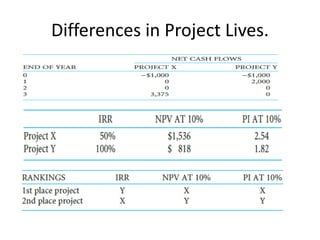
Ranking Problems
• When two or more investment proposals are
mutually exclusive, so that we can select only
one, ranking proposals on the basis of the IRR,
NPV, and PI methods may give contradictory
results.
• Scale of investment
• Project life
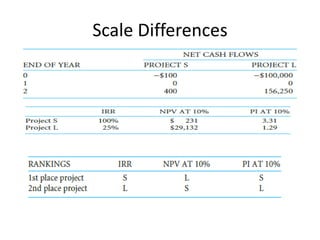
Scale Differences
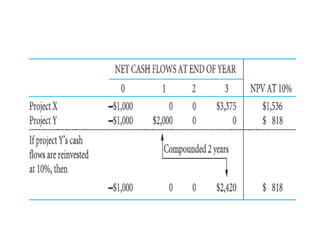
Differences in Project Lives.
capital budgeting process investment rules.pptx

capital budgeting process investment rules.pptx

  • 1.
    Capital Budgeting Process, InvestmentCriteria and Comparison Fundamentals of Financial Management
  • 2.
    Learning Outcomes • Capitalbudgeting techniques: • NPV – Single Cash inflow – Many Cash inflow • Payback periods – Cumulative net cash flows based approach – Discounted net cash flows based approach • Profitability index • NPV Versus IRR
  • 3.
    Definition • Capital budgetingis the decision process that managers use to identify those projects that are profitable and add value to the company. • In simple words, a capital budgeting consist of some techniques that screen out the projects for those that add value to the company.
  • 4.
    Importance of capitalbudgeting technique • Capital budgeting decisions define company's strategic decision • Eg: Entering into new market required capital expenditure • Poor capital budgeting leads to financial loss • Therefore good capital budgeting technique will help the company to become more competitive and profitable. • Capital budgeting decisions increase shareholder wealth. How?
  • 5.
    Steps in Capitaldecision Process • Step 1: Idea Generation. – Idea can come from number of sources – Eg: Senior management or employees • Step2 : Analyzing project proposals. – A Cash flow forecast should be made to determine expect profitability. • Step 3: Create the Firm capital budget. – Firm should select the most profitable projects. • Step 4: Monitoring decisions and conducting a post Audit: – Actual results should be compared with projected..
  • 6.
    Capital budgeting methods •Net Present value (NPV) • Payback – Cumulative net cash flow method – Discount net cash flow method • Internal rate of return(IRR) • Profitable index(PI)
  • 7.
    Types of Projects •Independent project: • An independent project is one whose acceptance or rejection is independent of the acceptance or rejection of other projects. Mutually exclusive project: • Mutually exclusive means that if one project is accepted, the other must be rejected. • Decisions based on NPV
  • 8.
    Net Present Value(NPV) •NPV is sum of the present values of all the expected gradually increasing cash flows inflows”if the project is undertaken” • NPV = • CFo indicate the cash out flow(Capital expenditure), while CF1 or CF2 indicates the after tax Cash inflows( Profit). • The value of CFo will always be negative, because it shows the company investment on a project. 1 2 1 2 .... (1 ) (1 ) (1 ) n O n CF CF CF CF r r r      
  • 9.
    Net Present Value(NPV) •Positive NPV indicates Profit( Accept the project) : • A positive NPV project is expected to increase share holder wealth • Negative NPV indicates Loss (Reject the project): • A negative NPV project is expected to decrease share holder wealth
  • 10.
    • NPV usescash flows. Cash flows from a project can be used for other corporate • NPV uses all the cash flows of the project. Other approaches ignore cash flows beyond a particular date. • NPV discounts the cash flows properly. Other approaches may ignore the time value of money when handling cash flows
  • 11.
    Payback Period • Paybackperiod: • It is defined as the expected number of years required to recover the original investment or initial investment.
  • 12.
    Payback periods (Con’t) • There are two approach for Payback period approaches: • Cumulative/Ordinary net cash flows based approach: • When payback period is calculated without discounting the future cash inflows or in other words, when time value of money concept is excluded. • Discounted net cash flows based approach: • When payback period is calculated by discounting the future cash inflows 1st or • In other words, when time value of money is considered.
  • 13.
    • The paybackmethod is often used by large, sophisticated companies when making relatively small decisions. • The payback method also has some desirable features for managerial control.
  • 14.
    Problems with PaybackPeriod • Problem 1: Payments after the Payback Period • Problem 2: Arbitrary Standard for Payback
  • 16.
    Profitability Index • ProfitabilityIndex(PI): • The PI is the present value of a project’s future cash flows divided by the initial investments .Present value of (future cash flows) per $ or Rs of initial Cost. • Accept the project: PI>1.00 • Reject the project : PI<1.00 1 ( 1 ) N t t o CF r PI CF    
  • 17.
    Internal Rate ofReturn(IRR) • The most important alternative to the NPV method: The internal rate of return, universally known as the IRR. • The basic rationale behind the IRR method is that it provides a single number summarizing the merits of a project. • That number does not depend on the interest rate prevailing in the capital market. • Accept the project if the IRR is greater than the discount rate. Reject the project if the IRR is less than the discount rate.
  • 18.
    Internal Rate ofReturn(IRR) • Internal rate of return • IRR is the discount rate that makes the present value of expected incremental after tax cash flows just equal to the initial cost of the project.. • It is the discount rate that makes the PV of a project’s estimated cash inflows equal to the PV of project’s estimated Cash outflows • Decisions based on Internal rate of return: • IRR> Cost of capital/required rate of returns ( Opportunity cost) ( accept the project ) • IRR <Cost of capital/required rate of returns ( Opportunity cost) ( Reject the project)
  • 19.
    Internal Rate ofReturn(IRR) Con’t • IRR rate of return is generally calculated through trial and error method. • IRR through this method is calculated either through manually, financial calculator or Excel function= IRR • IRR can also be calculated through interpolation method: ( ) *(V V ) L L H H L C L i i IRR i V V     
  • 20.
    Initail Investment PKR100,000 Years CIF PV at 15% PV at 20% 1 34,432 29940 28693.33 2 39,530 29890 27451.39 3 39,359 25879 22777.2 4 32,219 18421 15537.71 104130 94459.63
  • 21.
    • Present valueat 15% > ICO > Present value at 20% • PKR 104130 > PKR100,000 > PKR94,459.53
  • 23.
    • and IRR= 0.15 + X = 0.15 + 0.0214 = 0.1714, or 17.14 percent. (Solving for IRR by computer yields 17.04 percent, which in this case is very close to our approximate answer.)
  • 24.
    Example of IRR •Consider a project that costs $100 today and pays $120 in one year. • What is the return on this investment? Or calculate the IRR • If required rate of return is 5%..Should we accept the project ?
  • 25.
    Example • Briarcliff StoveCompany is considering a new product line to supplement its range line. It is anticipated that the new product line will involve cash investment of $700,000 at time 0. After-tax cash inflows of $250,000 are expected in year1 and year 2, $300,000 in year 3, $350,000 in year 4. Though the product line might be viable after year 4, the company prefers to be conservative and end all calculations at that time.
  • 26.
    Example…. • a. Ifthe required rate of return is 15 percent, what is the net present value of the project? Is it acceptable? • b. What is its internal rate of return? • c. What would be the case if the required rate of return was 10 percent? • d. What is the project’s payback period?
  • 27.
    • For eachproject, compute its payback period, its net present value, and its profitability index using a discount rate of 15 percent.
  • 28.
    Examples • a. Aninvestment of $1,000 today will return $2,000 at the end of 10 years. What is its internal rate of return? • b. An investment of $1,000 will return $500 at the end of each of the next 3 years. What is its internal rate of return? • c. An investment of $1,000 today will return $900 at the end of 1 year, $500 at the end of 2 years, and $100 at the end of 3 years. What is its internal rate of return?
  • 29.
    IRR and NPVrules always lead to identical decisions. If … • IRR and NPV rules always lead to identical decisions. If … • The project’s cash flows is conventional( first cash flow negative and the rest cash flows are positive) • The projects are independent of each other and not mutually exclusive. • Then IRR and NPV rules will lead to same the results.
  • 30.
    Example # 1of IRR and NPV (independent and conventional cash flows projects) • An investment costs $100 and has a cash flow of $60 per year for two years. • Calculate the Internal rate of return • Calculate the NPV if required rate of return is 10%. •
  • 31.
    IRR and NPVrules always lead to different or confusing decisions. If … • IRR and NPV rules always lead to different or confusing decisions. If … • The project has unconventional cash flow • The projects are mutually exclusive
  • 32.
    Mutually Exclusive Projects •In evaluating a group of investment proposals, some of them may be mutually exclusive. A mutually exclusive project is one whose acceptance precludes the acceptance of one or more alternative proposals.
  • 33.
    Ranking Problems • Whentwo or more investment proposals are mutually exclusive, so that we can select only one, ranking proposals on the basis of the IRR, NPV, and PI methods may give contradictory results. • Scale of investment • Project life
  • 34.
  • 35.