MARKETING MIX
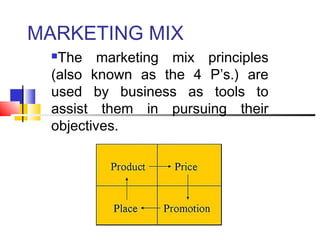
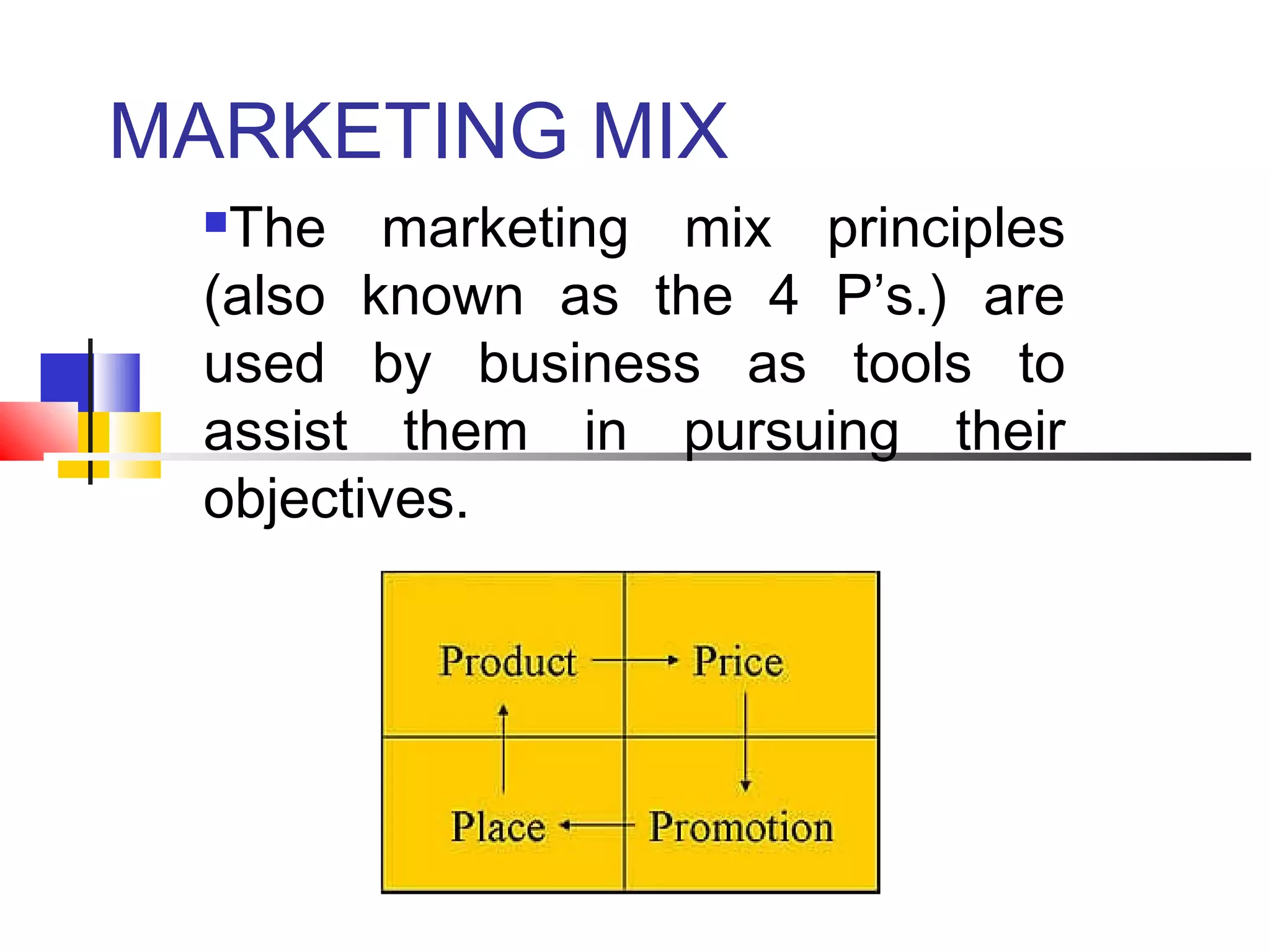
The marketing mix principles
(also known as the 4 P’s.) are
used by business as tools to
assist them in pursuing their
objectives.
Price
 The price is the amount a customer
pays for the product.
 It is determined by a number of factors
including market share, competition,
material costs, product identity and the
customer's perceived value of the
product.
 The business may increase or
decrease the price of product if other
stores have the same product.
Price
 List Price
 Discounts
 Allowances
 Payment Period
 Credit Terms
List Price
 In retail, price regularly quoted to
customers before applying discounts.
List prices are usually the prices printed
on dealer lists, invoices, price tags,
catalogs, or dealer purchase orders.
Price Lists
Discounts & Allowances
 Discounting is a financial mechanism
in which a debtor obtains the right to
delay payments to a creditor, for a
defined period of time, in exchange for
a charge or fee
 Discounts and allowances are
reductions to a basic price of goods or
services.
Innovative Discounts
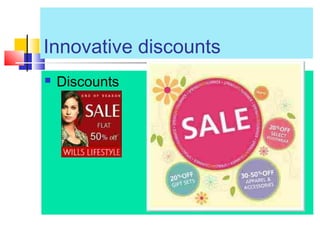
 Discount sales in shopping malls
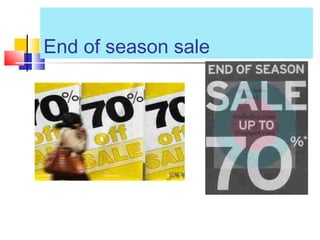
 Off season sales
 Closing down sales
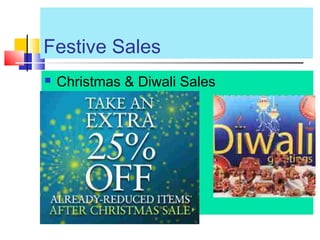
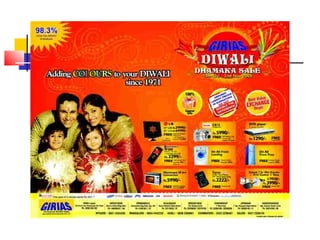
 Festival sales
 Credit points
 Exchange offers – mobiles, cookers,
cars
Festive Sales
 Christmas & Diwali Sales
Innovative discounts
 Discounts
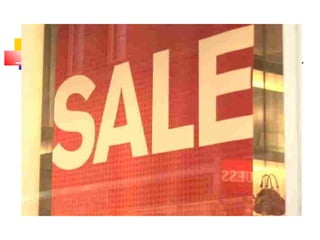
End of season sale
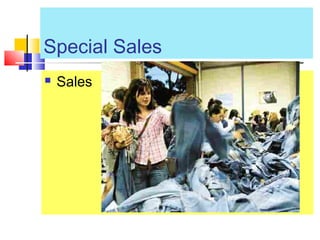
Special Sales
 Sales
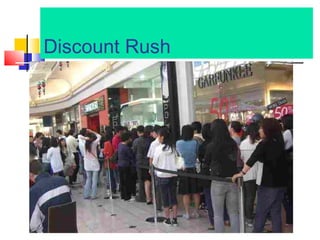
Discount Rush
Payment Period & Credit
Terms
 The stipulation by a business as to
when it should be paid for goods or
services supplied, for example, cash
with order, payment on delivery, or
within a particular number of days of the
invoice date.
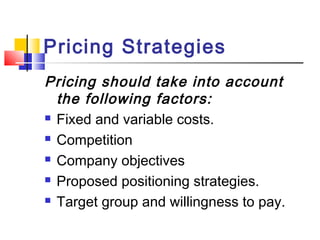
Pricing Strategies
Pricing should take into account
the following factors:
 Fixed and variable costs.
 Competition
 Company objectives
 Proposed positioning strategies.
 Target group and willingness to pay.
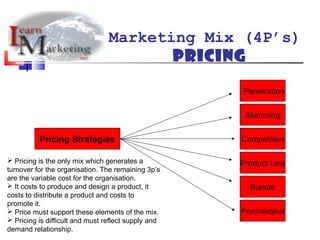
Marketing Mix (4P’s)
Pricing
Pricing Strategies
Penetration
Skimming
Competition
Product Line
Bundle
Psychological
 Pricing is the only mix which generates a
turnover for the organisation. The remaining 3p’s
are the variable cost for the organisation.
 It costs to produce and design a product, it
costs to distribute a product and costs to
promote it.
 Price must support these elements of the mix.
 Pricing is difficult and must reflect supply and
demand relationship.
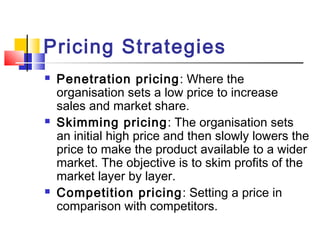
Pricing Strategies
 Penetration pricing: Where the
organisation sets a low price to increase
sales and market share.
 Skimming pricing: The organisation sets
an initial high price and then slowly lowers the
price to make the product available to a wider
market. The objective is to skim profits of the
market layer by layer.
 Competition pricing: Setting a price in
comparison with competitors.
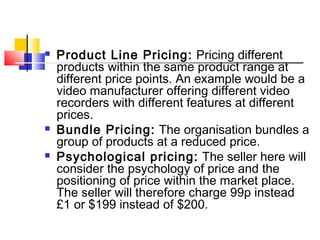
 Product Line Pricing: Pricing different
products within the same product range at
different price points. An example would be a
video manufacturer offering different video
recorders with different features at different
prices.
 Bundle Pricing: The organisation bundles a
group of products at a reduced price.
 Psychological pricing: The seller here will
consider the psychology of price and the
positioning of price within the market place.
The seller will therefore charge 99p instead
£1 or $199 instead of $200.
 Premium pricing: The price set is high to
reflect the exclusiveness of the product. An
example of products using this strategy would
be Harrods, first class airline services.
 Optional pricing: The organisation sells
optional extras along with the product to
maximise its turnover. This strategy is used
commonly within the car industry.

Marketing mix pricing

  • 1.
    MARKETING MIX The marketingmix principles (also known as the 4 P’s.) are used by business as tools to assist them in pursuing their objectives.
  • 2.
    Price  The priceis the amount a customer pays for the product.  It is determined by a number of factors including market share, competition, material costs, product identity and the customer's perceived value of the product.  The business may increase or decrease the price of product if other stores have the same product.
  • 3.
    Price  List Price Discounts  Allowances  Payment Period  Credit Terms
  • 4.
    List Price  Inretail, price regularly quoted to customers before applying discounts. List prices are usually the prices printed on dealer lists, invoices, price tags, catalogs, or dealer purchase orders.
  • 5.
  • 6.
    Discounts & Allowances Discounting is a financial mechanism in which a debtor obtains the right to delay payments to a creditor, for a defined period of time, in exchange for a charge or fee  Discounts and allowances are reductions to a basic price of goods or services.
  • 7.
    Innovative Discounts  Discountsales in shopping malls  Off season sales  Closing down sales  Festival sales  Credit points  Exchange offers – mobiles, cookers, cars
  • 8.
  • 10.
  • 11.
  • 13.
  • 14.
  • 15.
    Payment Period &Credit Terms  The stipulation by a business as to when it should be paid for goods or services supplied, for example, cash with order, payment on delivery, or within a particular number of days of the invoice date.
  • 16.
    Pricing Strategies Pricing shouldtake into account the following factors:  Fixed and variable costs.  Competition  Company objectives  Proposed positioning strategies.  Target group and willingness to pay.
  • 17.
    Marketing Mix (4P’s) Pricing PricingStrategies Penetration Skimming Competition Product Line Bundle Psychological  Pricing is the only mix which generates a turnover for the organisation. The remaining 3p’s are the variable cost for the organisation.  It costs to produce and design a product, it costs to distribute a product and costs to promote it.  Price must support these elements of the mix.  Pricing is difficult and must reflect supply and demand relationship.
  • 18.
    Pricing Strategies  Penetrationpricing: Where the organisation sets a low price to increase sales and market share.  Skimming pricing: The organisation sets an initial high price and then slowly lowers the price to make the product available to a wider market. The objective is to skim profits of the market layer by layer.  Competition pricing: Setting a price in comparison with competitors.
  • 19.
     Product LinePricing: Pricing different products within the same product range at different price points. An example would be a video manufacturer offering different video recorders with different features at different prices.  Bundle Pricing: The organisation bundles a group of products at a reduced price.  Psychological pricing: The seller here will consider the psychology of price and the positioning of price within the market place. The seller will therefore charge 99p instead £1 or $199 instead of $200.
  • 20.
     Premium pricing:The price set is high to reflect the exclusiveness of the product. An example of products using this strategy would be Harrods, first class airline services.  Optional pricing: The organisation sells optional extras along with the product to maximise its turnover. This strategy is used commonly within the car industry.