Payback Period,
Time Value of
Money &
Internal Rate of
Return
Presented By:SUBHASH ROHIT
Payback Period
Def i ni t i on:
The Payback
peri od i s t he amount
of t i me t hat i t t ake
t o recover your cos t s
i n a proj ect .
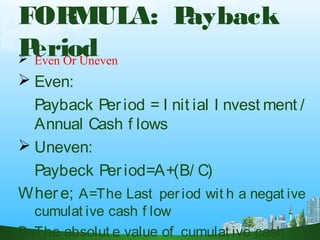
FORMULA: Payback
Period Even Or Uneven
 Even:
Payback Period = I nit ial I nvest ment /
Annual Cash f lows
 Uneven:
Paybeck Period=A+(B/ C)
Where; A=The Last period wit h a negat ive
cumulat ive cash f low
B=The absolut e value of cumulat ive cash
Example
Even Cash Flow:
Company Cis planning to undertake a project requiring initial
investmentof$105million. Theprojectisexpectedtogenerate
$25millionperyearfor7years. Calculatethepaybackperiodof
theproject.
Cont..
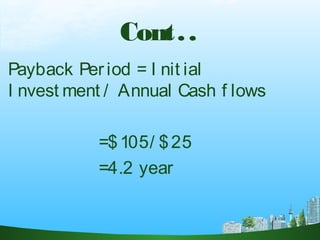
Payback Period = I nit ial
I nvest ment / Annual Cash f lows
=$105/ $25
=4.2 year
Cont..
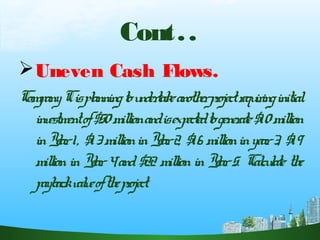
Uneven Cash Flows.
CompanyCisplanningtoundertakeanotherprojectrequiringinitial
investmentof$50millionandisexpectedtogenerate$10million
inYear1, $13millioninYear2, $16 millioninyear3, $19
millioninYear4and$22 millioninYear5. Calculate the
paybackvalueoftheproject.
Cont..
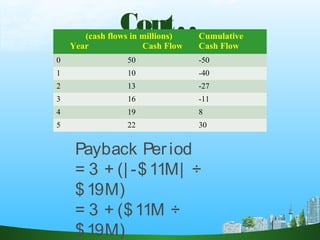
Payback Period
= 3 + (| -$11M| ÷
$19M)
= 3 + ($11M ÷
$19M)
(cash flows in millions)
Year Cash Flow
Cumulative
Cash Flow
0 50 -50
1 10 -40
2 13 -27
3 16 -11
4 19 8
5 22 30
Payback Period Rule
The Decision Rule: t he act ual
payback is compared wit h a
predet ermined pay back, t hat
is, t he pay back set by t he
management in t erms of t he
maximum period during which
t he invest ment must
recovered. 
Advantage of
Payback PeriodI t is very simple. I t is easy t o
underst and and apply
 I t is cost ef f ect ive
The payback per iod measures
t he direct relat ionship bet ween
annual cash inf lows f rom
Proposal and t he net invest ment
r equir ed
Disadvantage Of
Payback Period
The pay back period ent irely
ignores t he cash inf lows t hat
occur af t er t he pay back
period
The pay back period also
ignores salvage value and
t ot al economic lif e of t he
Drawbacks of
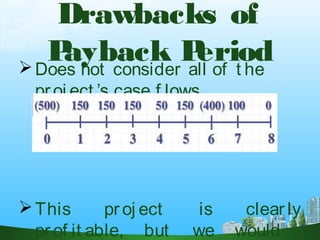
Payback PeriodDoes not consider all of t he
proj ect ’s case f lows.
This proj ect is clearly
prof it able, but we would
Time Value Of Money
The concept modern f inance
and management .
We say t hat money has a t ime
value because t hat money can
be invest ed wit h t he
expect at ion of earning a
posit ive rat e of ret urn
Calculations based on the
time value of money
Present Value - An amount of
money t oday, or t he cur rent
value of a f ut ure cash f low
Future Value - An amount of
money at some f ut ure t ime
per iod
‘n’ is t he number of periods
‘r ’ is t he rat e at which t he
Cont…
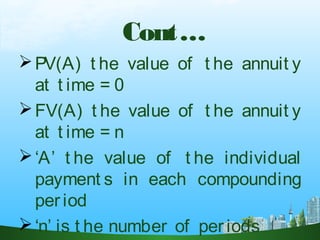
PV(A) t he value of t he annuit y
at t ime = 0
FV(A) t he value of t he annuit y
at t ime = n
‘A’ t he value of t he individual
payment s in each compounding
per iod
‘n’ is t he number of periods
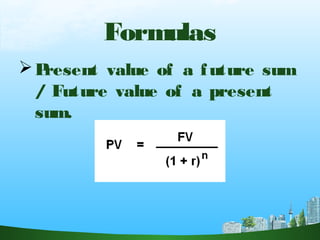
Formulas
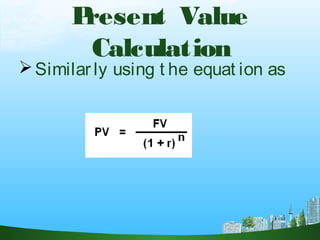
Present value of a future sum
/ Future value of a present
sum.
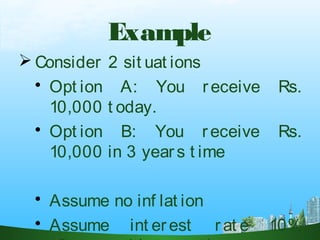
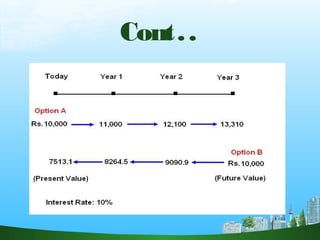
Example
 Consider 2 sit uat ions
 Opt ion A: You receive Rs.
10,000 t oday.
 Opt ion B: You receive Rs.
10,000 in 3 years t ime
 Assume no inf lat ion
 Assume int erest rat e 10%
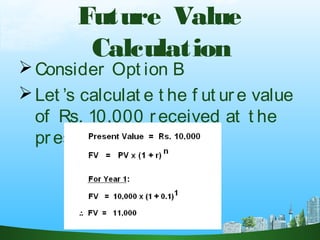
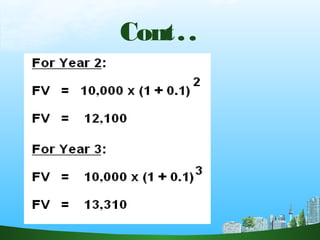
Future Value
Calculation
Consider Opt ion B
Let ’s calculat e t he f ut ure value
of Rs. 10,000 received at t he
present t ime.
Cont..
Present Value
Calculation
Similarly using t he equat ion as
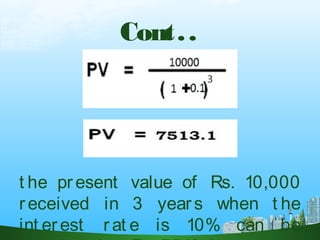
Cont..
t he present value of Rs. 10,000
received in 3 years when t he
int erest r at e is 10% can be
Cont..
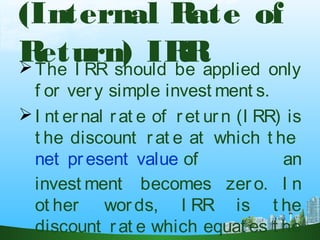
(Internal Rate of
Return) IRRThe I RR should be applied only
f or very simple invest ment s.
I nt ernal rat e of r et urn (I RR) is
t he discount rat e at which t he 
net present value of an
invest ment becomes zero. I n
ot her words, I RR is t he
discount rat e which equat es t he
Cont…
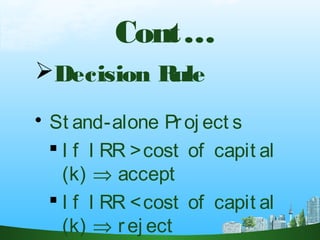
Decision Rule
 St and-alone Proj ect s
 I f I RR >cost of capit al
(k) ⇒ accept
 I f I RR <cost of capit al
(k) ⇒ rej ect
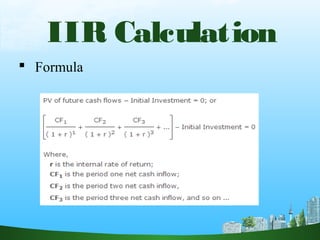
IIR Calculation
 Formula
Cont..
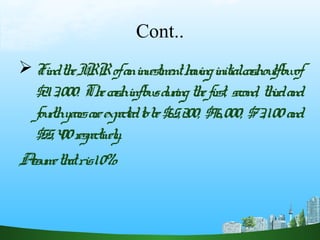
FindtheIRRofaninvestmenthavinginitialcashoutflowof
$213,000. Thecashinflowsduringthefirst, second, thirdand
fourthyearsareexpectedtobe$65,200, $96,000, $73,100and
$55,400respectively.
Assumethatris10%.
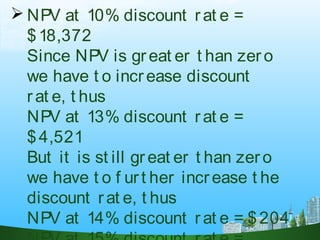
 NPV at 10% discount rat e =
$18,372
Since NPV is great er t han zero
we have t o increase discount
rat e, t hus
NPV at 13% discount rat e =
$4,521
But it is st ill great er t han zero
we have t o f urt her increase t he
discount rat e, t hus
NPV at 14% discount rat e = $204
Cont…
First , imagine a sit uat ion in
which you invest $1 million
t oday and t hen receive
$500,000 per year f or t he next
4 years. That invest ment gives
an I RR of 35%, which would be
pret t y good by t oday’s
st andards. Now let ’s change
I f inst ead you had t o invest only
$500,000 up f ront f or t he same
amount of ret urn, t he I RR
improves t o 93%.For t hose of you
unf amiliar wit h t he t erminology, a
proj ect wit h an I RR of 93% is bot h
r ar e and ver y desirable t o pursue.
The reduct ion in t he up-f r ont
invest ment caused t he ret urn t o
skyrocket .
CONCLUSION
Any t ime you ar e evaluat ing an
invest ment over t ime, use t ime-
value-of -money.
I n f inancial modelling, allow f or
bot h t ime-value-of money
calculat ions as well as
uncert aint y t o impr ove your
proj ect ions and t he decisions on
Thank
You…!

Payback period time value of money ad internal rate ofreturn

  • 1.
    Payback Period, Time Valueof Money & Internal Rate of Return Presented By:SUBHASH ROHIT
  • 2.
    Payback Period Def ini t i on: The Payback peri od i s t he amount of t i me t hat i t t ake t o recover your cos t s i n a proj ect .
  • 3.
    FORMULA: Payback Period EvenOr Uneven  Even: Payback Period = I nit ial I nvest ment / Annual Cash f lows  Uneven: Paybeck Period=A+(B/ C) Where; A=The Last period wit h a negat ive cumulat ive cash f low B=The absolut e value of cumulat ive cash
  • 4.
    Example Even Cash Flow: CompanyCis planning to undertake a project requiring initial investmentof$105million. Theprojectisexpectedtogenerate $25millionperyearfor7years. Calculatethepaybackperiodof theproject.
  • 5.
    Cont.. Payback Period =I nit ial I nvest ment / Annual Cash f lows =$105/ $25 =4.2 year
  • 6.
    Cont.. Uneven Cash Flows. CompanyCisplanningtoundertakeanotherprojectrequiringinitial investmentof$50millionandisexpectedtogenerate$10million inYear1,$13millioninYear2, $16 millioninyear3, $19 millioninYear4and$22 millioninYear5. Calculate the paybackvalueoftheproject.
  • 7.
    Cont.. Payback Period = 3+ (| -$11M| ÷ $19M) = 3 + ($11M ÷ $19M) (cash flows in millions) Year Cash Flow Cumulative Cash Flow 0 50 -50 1 10 -40 2 13 -27 3 16 -11 4 19 8 5 22 30
  • 8.
    Payback Period Rule TheDecision Rule: t he act ual payback is compared wit h a predet ermined pay back, t hat is, t he pay back set by t he management in t erms of t he maximum period during which t he invest ment must recovered. 
  • 9.
    Advantage of Payback PeriodIt is very simple. I t is easy t o underst and and apply  I t is cost ef f ect ive The payback per iod measures t he direct relat ionship bet ween annual cash inf lows f rom Proposal and t he net invest ment r equir ed
  • 10.
    Disadvantage Of Payback Period Thepay back period ent irely ignores t he cash inf lows t hat occur af t er t he pay back period The pay back period also ignores salvage value and t ot al economic lif e of t he
  • 11.
    Drawbacks of Payback PeriodDoesnot consider all of t he proj ect ’s case f lows. This proj ect is clearly prof it able, but we would
  • 12.
    Time Value OfMoney The concept modern f inance and management . We say t hat money has a t ime value because t hat money can be invest ed wit h t he expect at ion of earning a posit ive rat e of ret urn
  • 13.
    Calculations based onthe time value of money Present Value - An amount of money t oday, or t he cur rent value of a f ut ure cash f low Future Value - An amount of money at some f ut ure t ime per iod ‘n’ is t he number of periods ‘r ’ is t he rat e at which t he
  • 14.
    Cont… PV(A) t hevalue of t he annuit y at t ime = 0 FV(A) t he value of t he annuit y at t ime = n ‘A’ t he value of t he individual payment s in each compounding per iod ‘n’ is t he number of periods
  • 15.
    Formulas Present value ofa future sum / Future value of a present sum.
  • 16.
    Example  Consider 2sit uat ions  Opt ion A: You receive Rs. 10,000 t oday.  Opt ion B: You receive Rs. 10,000 in 3 years t ime  Assume no inf lat ion  Assume int erest rat e 10%
  • 17.
    Future Value Calculation Consider Option B Let ’s calculat e t he f ut ure value of Rs. 10,000 received at t he present t ime.
  • 18.
  • 19.
  • 20.
    Cont.. t he presentvalue of Rs. 10,000 received in 3 years when t he int erest r at e is 10% can be
  • 21.
  • 22.
    (Internal Rate of Return)IRRThe I RR should be applied only f or very simple invest ment s. I nt ernal rat e of r et urn (I RR) is t he discount rat e at which t he  net present value of an invest ment becomes zero. I n ot her words, I RR is t he discount rat e which equat es t he
  • 23.
    Cont… Decision Rule  Stand-alone Proj ect s  I f I RR >cost of capit al (k) ⇒ accept  I f I RR <cost of capit al (k) ⇒ rej ect
  • 24.
  • 25.
    Cont.. FindtheIRRofaninvestmenthavinginitialcashoutflowof $213,000. Thecashinflowsduringthefirst, second,thirdand fourthyearsareexpectedtobe$65,200, $96,000, $73,100and $55,400respectively. Assumethatris10%.
  • 26.
     NPV at10% discount rat e = $18,372 Since NPV is great er t han zero we have t o increase discount rat e, t hus NPV at 13% discount rat e = $4,521 But it is st ill great er t han zero we have t o f urt her increase t he discount rat e, t hus NPV at 14% discount rat e = $204
  • 27.
    Cont… First , imaginea sit uat ion in which you invest $1 million t oday and t hen receive $500,000 per year f or t he next 4 years. That invest ment gives an I RR of 35%, which would be pret t y good by t oday’s st andards. Now let ’s change
  • 28.
    I f instead you had t o invest only $500,000 up f ront f or t he same amount of ret urn, t he I RR improves t o 93%.For t hose of you unf amiliar wit h t he t erminology, a proj ect wit h an I RR of 93% is bot h r ar e and ver y desirable t o pursue. The reduct ion in t he up-f r ont invest ment caused t he ret urn t o skyrocket .
  • 29.
    CONCLUSION Any t imeyou ar e evaluat ing an invest ment over t ime, use t ime- value-of -money. I n f inancial modelling, allow f or bot h t ime-value-of money calculat ions as well as uncert aint y t o impr ove your proj ect ions and t he decisions on
  • 30.