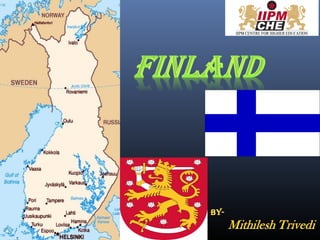
LOCATION
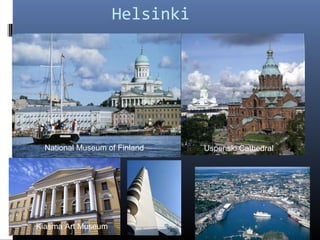
Helsinki

National Museum of Finland

Kiasma Art Museum

Uspenski Cathedral
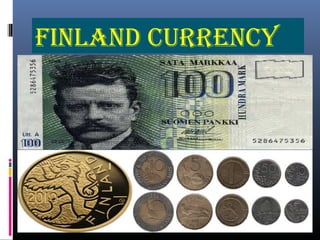
FINLAND CURRENCY
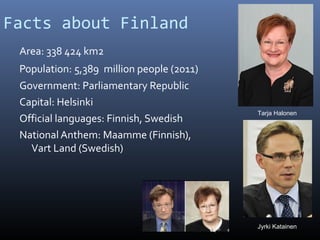
Facts about Finland
Area: 338 424 km2
Population: 5,389 million people (2011)
Government: Parliamentary Republic
Capital: Helsinki
Official languages: Finnish, Swedish
National Anthem: Maamme (Finnish),
Vart Land (Swedish)

Tarja Halonen

Jyrki Katainen
Prehistory
 The area was settled 8500

BCE (Stone Age)
 First people were huntergatherers
 Used stone tools
 The first verifiable written

documents appeared in the
12th century.
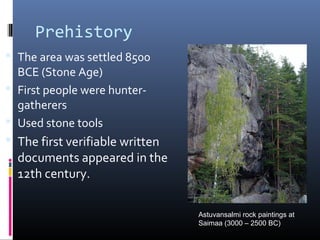
Astuvansalmi rock paintings at
Saimaa (3000 – 2500 BC)
The 20th century
 December 6, 1917 Finland got








independence
Civil war 1918
First president Kaarlo Juho Stahlberg
1920 Finnish-Russian border is
formed by the treaty of Tartu
1939 – 1940 Winter War
1941 – 1942 World War II
1944 – 1945 Lapland War
1950 - around 1977 Cold War
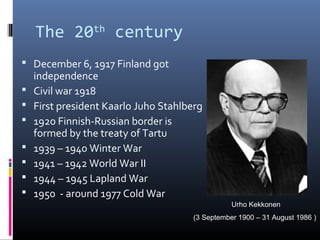
Urho Kekkonen
(3 September 1900 – 31 August 1986 )
Recent History
 Late 1980s Finland

liberalized economy
 1999 Finland joined
Eurozone
 2002 euro becomes the
currency (before that it
was Finnish Markka)
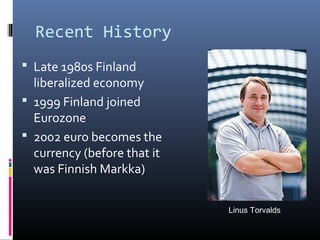
Linus Torvalds
Social EtiquEttE
 Bring flowers , chocolates or wine when





invited to a finish home
Flowers should not be given in even numbers
Avoid giving potted plants
Avoid giving whit or yellow flowers as they
are associated with funerals.
Gifts are opened when received.
FinniSh MEEting EtiquEttE
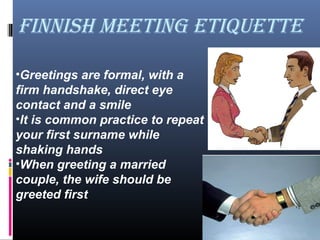
•Greetings are formal, with a

firm handshake, direct eye
contact and a smile
•It is common practice to repeat
your first surname while
shaking hands
•When greeting a married
couple, the wife should be
greeted first
BuSinESS EtiquEttE
 Finns often build or maintain

business relationship in a
restaurant or the sauna
 Never reject an invitation to
use the sauna
 It is an appreciated part of
the Finnish culture
 Appointments are necessary
BuSinESS EtiquEttE
 . The basic business style is formal - i.e. there is

relatively little small talk and Finns prefer
people to speak succinctly and to focus purely
on business.
 Finns do not require face-to- face contact and,
in fact, are quite comfortable using e- mail.
 Finns are excellent time managers who prefer
to organize their workday in order to
accomplish as much as possible.
 Finns are interested in long- term
relationships.
 Relationship building often takes place

outside the office: in a restaurant or the
sauna.
 Never turn down an invitation to use the
sauna, as it is an entrenched part of the
Finnish culture.
 Finns place a great value on speaking plainly
and openly.
 What someone says is accepted at face value
and this is a culture where "a man's word is
his bond" and will be treated as seriously as a
written contract, so verbal commitments are
considered agreements.
Table Manners
•Wait to be told where to sit
•Hold the fork in the left

hand and knife in right while
eating
•Always keep your hand
visible when eating
•Do not begin eating until
the hostess invites you to
start
•Finish everything on your
plate . Finns do not
appreciate waste.
What is Finland famous for?








Nokia phones
Sauna
“Black candies”
Snow and cold
Santa Claus
Reindeers
Ice Hockey
Music
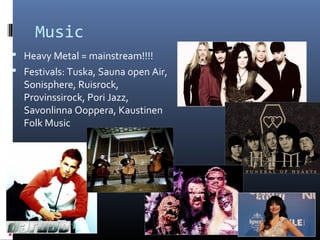
 Heavy Metal = mainstream!!!!
 Festivals: Tuska, Sauna open Air,

Sonisphere, Ruisrock,
Provinssirock, Pori Jazz,
Savonlinna Ooppera, Kaustinen
Folk Music
lanGUaGes In FInlanD
 Finnish -93%
 Swedish -6%
 Sami – 0.3%
 Other -0.7%
ClIMaTe 0F FInlanD
 Finland has a humid and cool

semi-continental climate
 Winters of southern Finland are
usually 4 months long, and the
snow typically covers the land
Ethnic makE-up
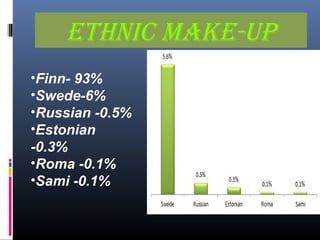
•Finn- 93%
•Swede-6%
•Russian -0.5%
•Estonian

-0.3%
•Roma -0.1%
•Sami -0.1%
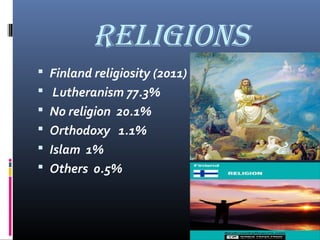
RELiGiOnS
 Finland religiosity (2011)
 Lutheranism 77.3%
 No religion 20.1%
 Orthodoxy 1.1%  
 Islam 1%
 Others 0.5%
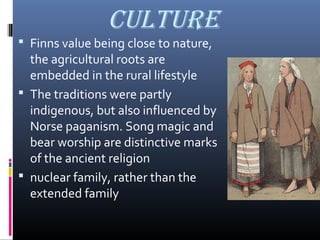
cuLtuRE
 Finns value being close to nature,

the agricultural roots are
embedded in the rural lifestyle
 The traditions were partly
indigenous, but also influenced by
Norse paganism. Song magic and
bear worship are distinctive marks
of the ancient religion
 nuclear family, rather than the
extended family
FinSka FOLkdancER
Y
k
n
a
h
t

u
O

Finland

  • 2.
  • 3.
    Helsinki National Museum ofFinland Kiasma Art Museum Uspenski Cathedral
  • 4.
  • 5.
    Facts about Finland Area:338 424 km2 Population: 5,389 million people (2011) Government: Parliamentary Republic Capital: Helsinki Official languages: Finnish, Swedish National Anthem: Maamme (Finnish), Vart Land (Swedish) Tarja Halonen Jyrki Katainen
  • 6.
    Prehistory  The areawas settled 8500 BCE (Stone Age)  First people were huntergatherers  Used stone tools  The first verifiable written documents appeared in the 12th century. Astuvansalmi rock paintings at Saimaa (3000 – 2500 BC)
  • 7.
    The 20th century December 6, 1917 Finland got        independence Civil war 1918 First president Kaarlo Juho Stahlberg 1920 Finnish-Russian border is formed by the treaty of Tartu 1939 – 1940 Winter War 1941 – 1942 World War II 1944 – 1945 Lapland War 1950 - around 1977 Cold War Urho Kekkonen (3 September 1900 – 31 August 1986 )
  • 8.
    Recent History  Late1980s Finland liberalized economy  1999 Finland joined Eurozone  2002 euro becomes the currency (before that it was Finnish Markka) Linus Torvalds
  • 9.
    Social EtiquEttE  Bringflowers , chocolates or wine when     invited to a finish home Flowers should not be given in even numbers Avoid giving potted plants Avoid giving whit or yellow flowers as they are associated with funerals. Gifts are opened when received.
  • 10.
    FinniSh MEEting EtiquEttE •Greetingsare formal, with a firm handshake, direct eye contact and a smile •It is common practice to repeat your first surname while shaking hands •When greeting a married couple, the wife should be greeted first
  • 11.
    BuSinESS EtiquEttE  Finnsoften build or maintain business relationship in a restaurant or the sauna  Never reject an invitation to use the sauna  It is an appreciated part of the Finnish culture  Appointments are necessary
  • 12.
    BuSinESS EtiquEttE  .The basic business style is formal - i.e. there is relatively little small talk and Finns prefer people to speak succinctly and to focus purely on business.  Finns do not require face-to- face contact and, in fact, are quite comfortable using e- mail.  Finns are excellent time managers who prefer to organize their workday in order to accomplish as much as possible.  Finns are interested in long- term relationships.
  • 13.
     Relationship buildingoften takes place outside the office: in a restaurant or the sauna.  Never turn down an invitation to use the sauna, as it is an entrenched part of the Finnish culture.  Finns place a great value on speaking plainly and openly.  What someone says is accepted at face value and this is a culture where "a man's word is his bond" and will be treated as seriously as a written contract, so verbal commitments are considered agreements.
  • 14.
    Table Manners •Wait tobe told where to sit •Hold the fork in the left hand and knife in right while eating •Always keep your hand visible when eating •Do not begin eating until the hostess invites you to start •Finish everything on your plate . Finns do not appreciate waste.
  • 15.
    What is Finlandfamous for?        Nokia phones Sauna “Black candies” Snow and cold Santa Claus Reindeers Ice Hockey
  • 16.
    Music  Heavy Metal= mainstream!!!!  Festivals: Tuska, Sauna open Air, Sonisphere, Ruisrock, Provinssirock, Pori Jazz, Savonlinna Ooppera, Kaustinen Folk Music
  • 17.
    lanGUaGes In FInlanD Finnish -93%  Swedish -6%  Sami – 0.3%  Other -0.7%
  • 18.
    ClIMaTe 0F FInlanD Finland has a humid and cool semi-continental climate  Winters of southern Finland are usually 4 months long, and the snow typically covers the land
  • 19.
    Ethnic makE-up •Finn- 93% •Swede-6% •Russian-0.5% •Estonian -0.3% •Roma -0.1% •Sami -0.1%
  • 20.
    RELiGiOnS  Finland religiosity(2011)  Lutheranism 77.3%  No religion 20.1%  Orthodoxy 1.1%    Islam 1%  Others 0.5%
  • 21.
    cuLtuRE  Finns valuebeing close to nature, the agricultural roots are embedded in the rural lifestyle  The traditions were partly indigenous, but also influenced by Norse paganism. Song magic and bear worship are distinctive marks of the ancient religion  nuclear family, rather than the extended family
  • 22.
  • 23.