BUSINES
S&MANA
GEMENT
Investment Appraisal
by: Shadi A. Razak 1
Accounts
and Finance
Objectives
• Understand what investment means.
• Recognize the importance of investment
appraisal to the business.
• Explain different techniques to apprise an
investment and calculate its payback period
• Evaluate the net value of an investment and
its impact on the appraisal process.
by: Shadi A. Razak 2
Structure
• Introduction
• Investment Appraisal
• Quantitative Techniques
• Qualitative Techniques
by: Shadi A. Razak 3
Finance
by: Shadi A. Razak 4
INTRODUCTION
Finance
by: Shadi A. Razak 5
INTRODUCTION
The management of the business
capital, investment and assets to
inform stakeholders about the
business performance and
monetary profile
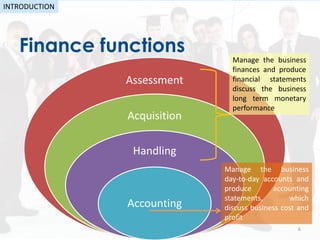
Finance functions
by: Shadi A. Razak 6
INTRODUCTION
Assessment
Acquisition
Handling
Accounting
Manage the business
finances and produce
financial statements
discuss the business
long term monetary
performance
Manage the business
day-to-day accounts and
produce accounting
statements, which
discuss business cost and
profit
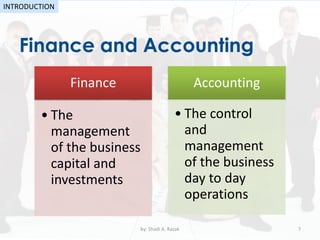
Finance and Accounting
by: Shadi A. Razak 7
INTRODUCTION
Finance
• The
management
of the business
capital and
investments
Accounting
• The control
and
management
of the business
day to day
operations
•
Finance and Accounting
by: Shadi A. Razak 8
INTRODUCTION
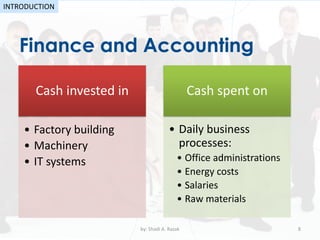
Cash invested in
• Factory building
• Machinery
• IT systems
Cash spent on
• Daily business
processes:
• Office administrations
• Energy costs
• Salaries
• Raw materials
Finance and Accounting
by: Shadi A. Razak 9
INTRODUCTION
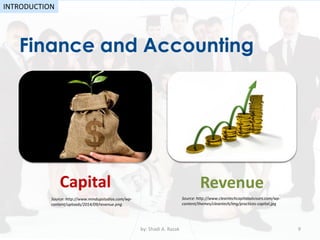
Capital Revenue
Source: http://www.cleantechcapitaladvisors.com/wp-
content/themes/cleantech/img/practices-capital.jpg
Source: http://www.mindupstudios.com/wp-
content/uploads/2014/09/revenue.png
• Long term non-current assets, which have an
economic life in business.
• These assets are acquired with intend to be
kept and not transformed into products or
sales.
Capital
by: Shadi A. Razak 10
INTRODUCTION
• Business try to use their capital to:
– Increase production capacity
– Replace outdated, broken, or worn out
equipments
– Deploy improved process or technology
– Comply with changing regulations and quality
standards
Capital
by: Shadi A. Razak 11
INTRODUCTION
• Has to address:
– Scarcity of finance in business
– Availability and viability of different sources of
finance
– Assess the risk of the investment
– Assess the investment return
Capital expenditure decision
by: Shadi A. Razak 12
INTRODUCTION
Investment appraisal
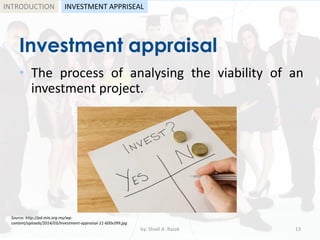
• The process of analysing the viability of an
investment project.
by: Shadi A. Razak 13
INTRODUCTION INVESTMENT APPRISEAL
Source: http://pd.mia.org.my/wp-
content/uploads/2014/03/Investment-appraisal-21-600x399.jpg
Investment appraisal
• Quantitative techniques: assess financial
feasibility of the project.
• Qualitative techniques: assess the non-
financial issues that impacts the investment
by: Shadi A. Razak 14
INTRODUCTION INVESTMENT APPRISEAL
Source: http://pd.mia.org.my/wp-
content/uploads/2014/03/Investment-
appraisal-21-600x399.jpg
Types of quantitative techniques
• Payback Period
• Average Rate of Return (ARR)
• Internal Rate of Return (IRR)
• Profitability Index
• Net Present Value (discounted cash flow)
by: Shadi A. Razak 15
INTRODUCTION INVESTMENT APPRIASAL QUANTITATIVE TECHNIQUES
Required information
• Initial capital cost investment
• Estimated life expectancy: life time in years or months
• Residual value of investment: what the assets cost at
the end of their life cycle
• Forecasted net returns or net cash flow from the
project: expected returns of investment – annual running
cost
by: Shadi A. Razak 16
INTRODUCTION INVESTMENT APPRIASAL QUANTITATIVE TECHNIQUES
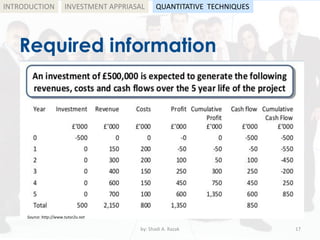
Required information
by: Shadi A. Razak 17
INTRODUCTION
Source: http://www.tutor2u.net
INVESTMENT APPRIASAL QUANTITATIVE TECHNIQUES
Payback period
by: Shadi A. Razak 18
INTRODUCTION
The length of time taken
to pay back the original
capital cost of the
investment
Requires information
on the returns the
investment generates
INVESTMENT APPRIASAL QUANTITATIVE TECHNIQUES
Payback period
• Could occur during the year.
• Can be calculated
by: Shadi A. Razak 19
INTRODUCTION
Duration x Initial Investment
Payback = ------------------------------------------
Total Cash Received
INVESTMENT APPRIASAL QUANTITATIVE TECHNIQUES
Payback period
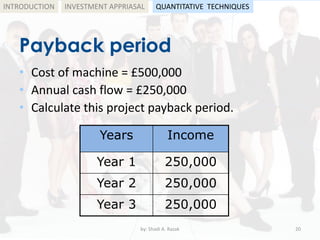
• Cost of machine = £500,000
• Annual cash flow = £250,000
• Calculate this project payback period.
by: Shadi A. Razak 20
INTRODUCTION
Years Income
Year 1 250,000
Year 2 250,000
Year 3 250,000
INVESTMENT APPRIASAL QUANTITATIVE TECHNIQUES
Payback period
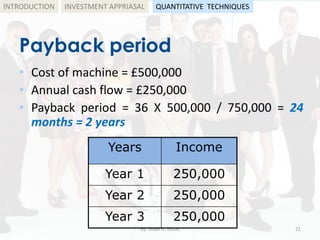
• Cost of machine = £500,000
• Annual cash flow = £250,000
• Payback period = 36 X 500,000 / 750,000 = 24
months = 2 years
by: Shadi A. Razak 21
INTRODUCTION
Years Income
Year 1 250,000
Year 2 250,000
Year 3 250,000
INVESTMENT APPRIASAL QUANTITATIVE TECHNIQUES
Payback period
by: Shadi A. Razak 22
INTRODUCTION
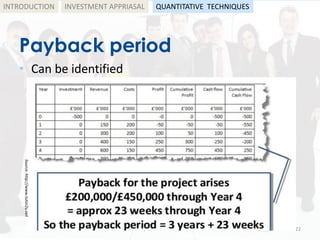
• Can be identified
Source:http://www.tutor2u.net
INVESTMENT APPRIASAL QUANTITATIVE TECHNIQUES
Payback period
by: Shadi A. Razak 23
INTRODUCTION
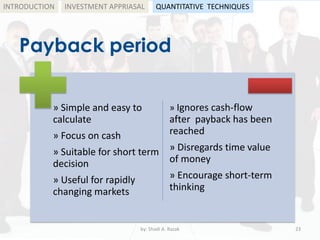
» Simple and easy to
calculate
» Focus on cash
» Suitable for short term
decision
» Useful for rapidly
changing markets
» Ignores cash-flow
after payback has been
reached
» Disregards time value
of money
» Encourage short-term
thinking
INVESTMENT APPRIASAL QUANTITATIVE TECHNIQUES
Average rate of return (ARR)
by: Shadi A. Razak 24
INTRODUCTION
Compares the return (profit) generated
by the investment with the cost of the
investment
Source: http://cnafinance.com/wp-content/uploads/2015/03/Average-Rate-of-Return.jpg
INVESTMENT APPRIASAL QUANTITATIVE TECHNIQUES
Average rate of return (ARR)
by: Shadi A. Razak 25
INTRODUCTION
Source: http://cnafinance.com/wp-content/uploads/2015/03/Average-Rate-of-Return.jpg
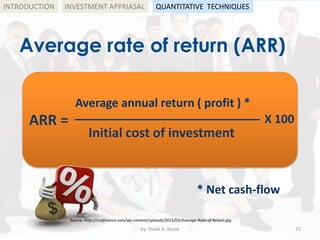
ARR =
Initial cost of investment
Average annual return ( profit ) *
* Net cash-flow
X 100
INVESTMENT APPRIASAL QUANTITATIVE TECHNIQUES
Average rate of return (ARR)
• Investment (Live) is expected to yield an annual
cash-flow of £10,000 for the next 5 years
• Initial cost of (Live) is £20,000
• Total profit is £30,000
• Calculate the average rate of return.
by: Shadi A. Razak 26
INTRODUCTION INVESTMENT APPRIASAL QUANTITATIVE TECHNIQUES
Average rate of return (ARR)
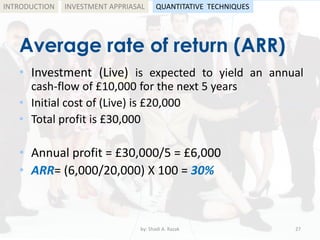
• Investment (Live) is expected to yield an annual
cash-flow of £10,000 for the next 5 years
• Initial cost of (Live) is £20,000
• Total profit is £30,000
• Annual profit = £30,000/5 = £6,000
• ARR= (6,000/20,000) X 100 = 30%
by: Shadi A. Razak 27
INTRODUCTION INVESTMENT APPRIASAL QUANTITATIVE TECHNIQUES
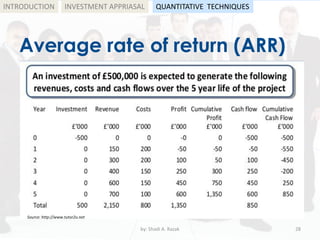
Average rate of return (ARR)
by: Shadi A. Razak 28
INTRODUCTION
Source: http://www.tutor2u.net
INVESTMENT APPRIASAL QUANTITATIVE TECHNIQUES
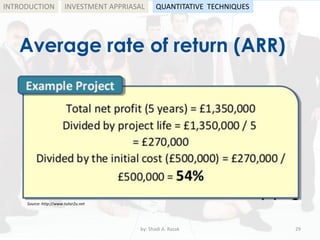
Average rate of return (ARR)
by: Shadi A. Razak 29
INTRODUCTION
Source: http://www.tutor2u.net
INVESTMENT APPRIASAL QUANTITATIVE TECHNIQUES
Average rate of return (ARR)
by: Shadi A. Razak 30
INTRODUCTION
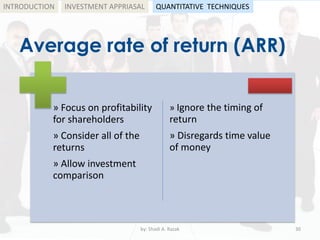
» Focus on profitability
for shareholders
» Consider all of the
returns
» Allow investment
comparison
» Ignore the timing of
return
» Disregards time value
of money
INVESTMENT APPRIASAL QUANTITATIVE TECHNIQUES
Net present value (NPV)
by: Shadi A. Razak 31
INTRODUCTION
Calculates the monetary value today
of the investments future cash-flow
Source: http://www.or-as.be/sites/default/files/images/blog_pics/npv.jpg
INVESTMENT APPRIASAL QUANTITATIVE TECHNIQUES
HL
Net present value (NPV)
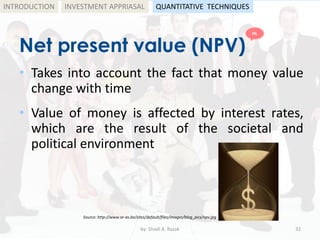
• Takes into account the fact that money value
change with time
• Value of money is affected by interest rates,
which are the result of the societal and
political environment
by: Shadi A. Razak 32
INTRODUCTION
Source: http://www.or-as.be/sites/default/files/images/blog_pics/npv.jpg
INVESTMENT APPRIASAL QUANTITATIVE TECHNIQUES
HL
Net present value (NPV)
by: Shadi A. Razak 33
INTRODUCTION
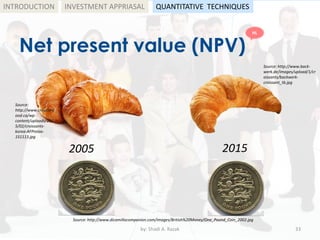
Source: http://www.dicamillocompanion.com/images/British%20Money/One_Pound_Coin_2002.jpg
Source: http://www.back-
werk.de/images/upload/1/cr
oissants/backwerk-
croissant_tb.jpg
Source:
http://www.creationf
ood.ca/wp-
content/uploads/201
5/02/croissants-
korea-AFPrelax-
151113.jpg
2005 2015
INVESTMENT APPRIASAL QUANTITATIVE TECHNIQUES
HL
Net present value (NPV)
by: Shadi A. Razak 34
INTRODUCTION
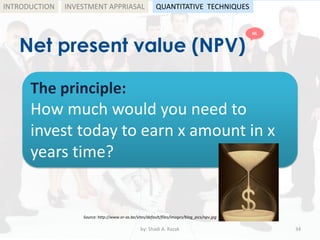
The principle:
How much would you need to
invest today to earn x amount in x
years time?
Source: http://www.or-as.be/sites/default/files/images/blog_pics/npv.jpg
INVESTMENT APPRIASAL QUANTITATIVE TECHNIQUES
HL
Net present value (NPV)
by: Shadi A. Razak 35
INTRODUCTION
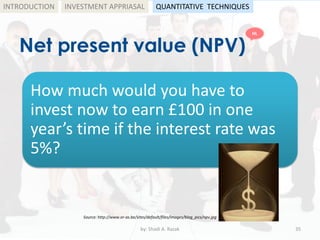
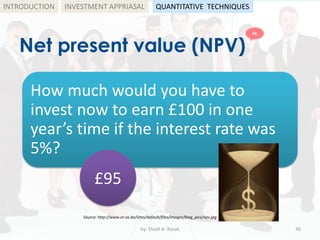
How much would you have to
invest now to earn £100 in one
year’s time if the interest rate was
5%?
Source: http://www.or-as.be/sites/default/files/images/blog_pics/npv.jpg
INVESTMENT APPRIASAL QUANTITATIVE TECHNIQUES
HL
Net present value (NPV)
by: Shadi A. Razak 36
INTRODUCTION
How much would you have to
invest now to earn £100 in one
year’s time if the interest rate was
5%?
Source: http://www.or-as.be/sites/default/files/images/blog_pics/npv.jpg
£95
INVESTMENT APPRIASAL QUANTITATIVE TECHNIQUES
HL
Net present value (NPV)
• Project (Happy) costs £1,000,000
• After 5 years the cash returns is 10% = 100,000
• A bank offered you an interest of 12% if you invested
the £1 million into them.
• Which one would you consider ?
by: Shadi A. Razak 37
INTRODUCTION INVESTMENT APPRIASAL QUANTITATIVE TECHNIQUES
HL
Net present value (NPV)
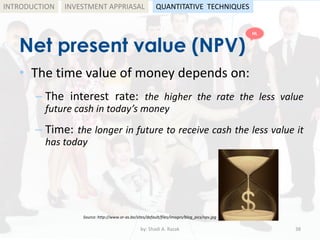
• The time value of money depends on:
– The interest rate: the higher the rate the less value
future cash in today’s money
– Time: the longer in future to receive cash the less value it
has today
by: Shadi A. Razak 38
INTRODUCTION
Source: http://www.or-as.be/sites/default/files/images/blog_pics/npv.jpg
INVESTMENT APPRIASAL QUANTITATIVE TECHNIQUES
HL
Net present value (NPV)
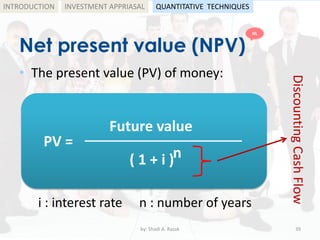
• The present value (PV) of money:
by: Shadi A. Razak 39
INTRODUCTION
i : interest rate
PV =
( 1 + i )
Future value
n
n : number of years
DiscountingCashFlow
INVESTMENT APPRIASAL QUANTITATIVE TECHNIQUES
HL
Net present value (NPV)
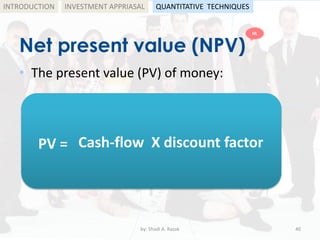
• The present value (PV) of money:
by: Shadi A. Razak 40
INTRODUCTION
PV = Cash-flow X discount factor
INVESTMENT APPRIASAL QUANTITATIVE TECHNIQUES
HL
Net present value (NPV)
by: Shadi A. Razak 41
INTRODUCTION
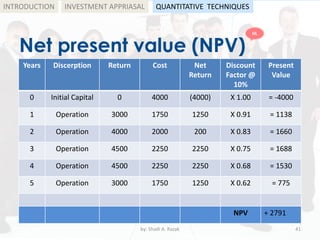
Years Discerption Return Cost Net
Return
Discount
Factor @
10%
Present
Value
0 Initial Capital 0 4000 (4000) X 1.00 = -4000
1 Operation 3000 1750 1250 X 0.91 = 1138
2 Operation 4000 2000 200 X 0.83 = 1660
3 Operation 4500 2250 2250 X 0.75 = 1688
4 Operation 4500 2250 2250 X 0.68 = 1530
5 Operation 3000 1750 1250 X 0.62 = 775
NPV + 2791
INVESTMENT APPRIASAL QUANTITATIVE TECHNIQUES
HL
Net present value (NPV)
by: Shadi A. Razak 42
INTRODUCTION
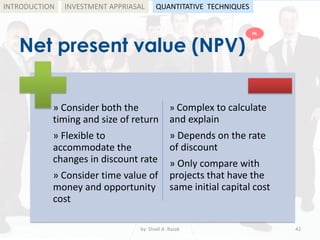
» Consider both the
timing and size of return
» Flexible to
accommodate the
changes in discount rate
» Consider time value of
money and opportunity
cost
» Complex to calculate
and explain
» Depends on the rate
of discount
» Only compare with
projects that have the
same initial capital cost
INVESTMENT APPRIASAL QUANTITATIVE TECHNIQUES
HL
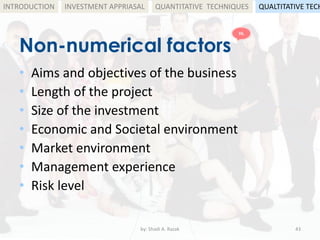
Non-numerical factors
• Aims and objectives of the business
• Length of the project
• Size of the investment
• Economic and Societal environment
• Market environment
• Management experience
• Risk level
by: Shadi A. Razak 43
INTRODUCTION INVESTMENT APPRIASAL QUANTITATIVE TECHNIQUES QUALTITATIVE TECH
HL
Summary
• Explained what investment means in business
• Discussed the importance of investment appraisal
to the business
• Explained the different techniques to apprise an
investment and calculate its payback period,
Average rate of return, and Net value return
• Understand the impact of non-financial factors on
business investment decision
by: Shadi A. Razak 44
INTRODUCTION INVESTMENT APPRIASAL QUANTITATIVE TECHNIQUES QUALTITATIVE TECH

Investment Apprasial

  • 1.
  • 2.
    Objectives • Understand whatinvestment means. • Recognize the importance of investment appraisal to the business. • Explain different techniques to apprise an investment and calculate its payback period • Evaluate the net value of an investment and its impact on the appraisal process. by: Shadi A. Razak 2
  • 3.
    Structure • Introduction • InvestmentAppraisal • Quantitative Techniques • Qualitative Techniques by: Shadi A. Razak 3
  • 4.
    Finance by: Shadi A.Razak 4 INTRODUCTION
  • 5.
    Finance by: Shadi A.Razak 5 INTRODUCTION The management of the business capital, investment and assets to inform stakeholders about the business performance and monetary profile
  • 6.
    Finance functions by: ShadiA. Razak 6 INTRODUCTION Assessment Acquisition Handling Accounting Manage the business finances and produce financial statements discuss the business long term monetary performance Manage the business day-to-day accounts and produce accounting statements, which discuss business cost and profit
  • 7.
    Finance and Accounting by:Shadi A. Razak 7 INTRODUCTION Finance • The management of the business capital and investments Accounting • The control and management of the business day to day operations
  • 8.
    • Finance and Accounting by:Shadi A. Razak 8 INTRODUCTION Cash invested in • Factory building • Machinery • IT systems Cash spent on • Daily business processes: • Office administrations • Energy costs • Salaries • Raw materials
  • 9.
    Finance and Accounting by:Shadi A. Razak 9 INTRODUCTION Capital Revenue Source: http://www.cleantechcapitaladvisors.com/wp- content/themes/cleantech/img/practices-capital.jpg Source: http://www.mindupstudios.com/wp- content/uploads/2014/09/revenue.png
  • 10.
    • Long termnon-current assets, which have an economic life in business. • These assets are acquired with intend to be kept and not transformed into products or sales. Capital by: Shadi A. Razak 10 INTRODUCTION
  • 11.
    • Business tryto use their capital to: – Increase production capacity – Replace outdated, broken, or worn out equipments – Deploy improved process or technology – Comply with changing regulations and quality standards Capital by: Shadi A. Razak 11 INTRODUCTION
  • 12.
    • Has toaddress: – Scarcity of finance in business – Availability and viability of different sources of finance – Assess the risk of the investment – Assess the investment return Capital expenditure decision by: Shadi A. Razak 12 INTRODUCTION
  • 13.
    Investment appraisal • Theprocess of analysing the viability of an investment project. by: Shadi A. Razak 13 INTRODUCTION INVESTMENT APPRISEAL Source: http://pd.mia.org.my/wp- content/uploads/2014/03/Investment-appraisal-21-600x399.jpg
  • 14.
    Investment appraisal • Quantitativetechniques: assess financial feasibility of the project. • Qualitative techniques: assess the non- financial issues that impacts the investment by: Shadi A. Razak 14 INTRODUCTION INVESTMENT APPRISEAL Source: http://pd.mia.org.my/wp- content/uploads/2014/03/Investment- appraisal-21-600x399.jpg
  • 15.
    Types of quantitativetechniques • Payback Period • Average Rate of Return (ARR) • Internal Rate of Return (IRR) • Profitability Index • Net Present Value (discounted cash flow) by: Shadi A. Razak 15 INTRODUCTION INVESTMENT APPRIASAL QUANTITATIVE TECHNIQUES
  • 16.
    Required information • Initialcapital cost investment • Estimated life expectancy: life time in years or months • Residual value of investment: what the assets cost at the end of their life cycle • Forecasted net returns or net cash flow from the project: expected returns of investment – annual running cost by: Shadi A. Razak 16 INTRODUCTION INVESTMENT APPRIASAL QUANTITATIVE TECHNIQUES
  • 17.
    Required information by: ShadiA. Razak 17 INTRODUCTION Source: http://www.tutor2u.net INVESTMENT APPRIASAL QUANTITATIVE TECHNIQUES
  • 18.
    Payback period by: ShadiA. Razak 18 INTRODUCTION The length of time taken to pay back the original capital cost of the investment Requires information on the returns the investment generates INVESTMENT APPRIASAL QUANTITATIVE TECHNIQUES
  • 19.
    Payback period • Couldoccur during the year. • Can be calculated by: Shadi A. Razak 19 INTRODUCTION Duration x Initial Investment Payback = ------------------------------------------ Total Cash Received INVESTMENT APPRIASAL QUANTITATIVE TECHNIQUES
  • 20.
    Payback period • Costof machine = £500,000 • Annual cash flow = £250,000 • Calculate this project payback period. by: Shadi A. Razak 20 INTRODUCTION Years Income Year 1 250,000 Year 2 250,000 Year 3 250,000 INVESTMENT APPRIASAL QUANTITATIVE TECHNIQUES
  • 21.
    Payback period • Costof machine = £500,000 • Annual cash flow = £250,000 • Payback period = 36 X 500,000 / 750,000 = 24 months = 2 years by: Shadi A. Razak 21 INTRODUCTION Years Income Year 1 250,000 Year 2 250,000 Year 3 250,000 INVESTMENT APPRIASAL QUANTITATIVE TECHNIQUES
  • 22.
    Payback period by: ShadiA. Razak 22 INTRODUCTION • Can be identified Source:http://www.tutor2u.net INVESTMENT APPRIASAL QUANTITATIVE TECHNIQUES
  • 23.
    Payback period by: ShadiA. Razak 23 INTRODUCTION » Simple and easy to calculate » Focus on cash » Suitable for short term decision » Useful for rapidly changing markets » Ignores cash-flow after payback has been reached » Disregards time value of money » Encourage short-term thinking INVESTMENT APPRIASAL QUANTITATIVE TECHNIQUES
  • 24.
    Average rate ofreturn (ARR) by: Shadi A. Razak 24 INTRODUCTION Compares the return (profit) generated by the investment with the cost of the investment Source: http://cnafinance.com/wp-content/uploads/2015/03/Average-Rate-of-Return.jpg INVESTMENT APPRIASAL QUANTITATIVE TECHNIQUES
  • 25.
    Average rate ofreturn (ARR) by: Shadi A. Razak 25 INTRODUCTION Source: http://cnafinance.com/wp-content/uploads/2015/03/Average-Rate-of-Return.jpg ARR = Initial cost of investment Average annual return ( profit ) * * Net cash-flow X 100 INVESTMENT APPRIASAL QUANTITATIVE TECHNIQUES
  • 26.
    Average rate ofreturn (ARR) • Investment (Live) is expected to yield an annual cash-flow of £10,000 for the next 5 years • Initial cost of (Live) is £20,000 • Total profit is £30,000 • Calculate the average rate of return. by: Shadi A. Razak 26 INTRODUCTION INVESTMENT APPRIASAL QUANTITATIVE TECHNIQUES
  • 27.
    Average rate ofreturn (ARR) • Investment (Live) is expected to yield an annual cash-flow of £10,000 for the next 5 years • Initial cost of (Live) is £20,000 • Total profit is £30,000 • Annual profit = £30,000/5 = £6,000 • ARR= (6,000/20,000) X 100 = 30% by: Shadi A. Razak 27 INTRODUCTION INVESTMENT APPRIASAL QUANTITATIVE TECHNIQUES
  • 28.
    Average rate ofreturn (ARR) by: Shadi A. Razak 28 INTRODUCTION Source: http://www.tutor2u.net INVESTMENT APPRIASAL QUANTITATIVE TECHNIQUES
  • 29.
    Average rate ofreturn (ARR) by: Shadi A. Razak 29 INTRODUCTION Source: http://www.tutor2u.net INVESTMENT APPRIASAL QUANTITATIVE TECHNIQUES
  • 30.
    Average rate ofreturn (ARR) by: Shadi A. Razak 30 INTRODUCTION » Focus on profitability for shareholders » Consider all of the returns » Allow investment comparison » Ignore the timing of return » Disregards time value of money INVESTMENT APPRIASAL QUANTITATIVE TECHNIQUES
  • 31.
    Net present value(NPV) by: Shadi A. Razak 31 INTRODUCTION Calculates the monetary value today of the investments future cash-flow Source: http://www.or-as.be/sites/default/files/images/blog_pics/npv.jpg INVESTMENT APPRIASAL QUANTITATIVE TECHNIQUES HL
  • 32.
    Net present value(NPV) • Takes into account the fact that money value change with time • Value of money is affected by interest rates, which are the result of the societal and political environment by: Shadi A. Razak 32 INTRODUCTION Source: http://www.or-as.be/sites/default/files/images/blog_pics/npv.jpg INVESTMENT APPRIASAL QUANTITATIVE TECHNIQUES HL
  • 33.
    Net present value(NPV) by: Shadi A. Razak 33 INTRODUCTION Source: http://www.dicamillocompanion.com/images/British%20Money/One_Pound_Coin_2002.jpg Source: http://www.back- werk.de/images/upload/1/cr oissants/backwerk- croissant_tb.jpg Source: http://www.creationf ood.ca/wp- content/uploads/201 5/02/croissants- korea-AFPrelax- 151113.jpg 2005 2015 INVESTMENT APPRIASAL QUANTITATIVE TECHNIQUES HL
  • 34.
    Net present value(NPV) by: Shadi A. Razak 34 INTRODUCTION The principle: How much would you need to invest today to earn x amount in x years time? Source: http://www.or-as.be/sites/default/files/images/blog_pics/npv.jpg INVESTMENT APPRIASAL QUANTITATIVE TECHNIQUES HL
  • 35.
    Net present value(NPV) by: Shadi A. Razak 35 INTRODUCTION How much would you have to invest now to earn £100 in one year’s time if the interest rate was 5%? Source: http://www.or-as.be/sites/default/files/images/blog_pics/npv.jpg INVESTMENT APPRIASAL QUANTITATIVE TECHNIQUES HL
  • 36.
    Net present value(NPV) by: Shadi A. Razak 36 INTRODUCTION How much would you have to invest now to earn £100 in one year’s time if the interest rate was 5%? Source: http://www.or-as.be/sites/default/files/images/blog_pics/npv.jpg £95 INVESTMENT APPRIASAL QUANTITATIVE TECHNIQUES HL
  • 37.
    Net present value(NPV) • Project (Happy) costs £1,000,000 • After 5 years the cash returns is 10% = 100,000 • A bank offered you an interest of 12% if you invested the £1 million into them. • Which one would you consider ? by: Shadi A. Razak 37 INTRODUCTION INVESTMENT APPRIASAL QUANTITATIVE TECHNIQUES HL
  • 38.
    Net present value(NPV) • The time value of money depends on: – The interest rate: the higher the rate the less value future cash in today’s money – Time: the longer in future to receive cash the less value it has today by: Shadi A. Razak 38 INTRODUCTION Source: http://www.or-as.be/sites/default/files/images/blog_pics/npv.jpg INVESTMENT APPRIASAL QUANTITATIVE TECHNIQUES HL
  • 39.
    Net present value(NPV) • The present value (PV) of money: by: Shadi A. Razak 39 INTRODUCTION i : interest rate PV = ( 1 + i ) Future value n n : number of years DiscountingCashFlow INVESTMENT APPRIASAL QUANTITATIVE TECHNIQUES HL
  • 40.
    Net present value(NPV) • The present value (PV) of money: by: Shadi A. Razak 40 INTRODUCTION PV = Cash-flow X discount factor INVESTMENT APPRIASAL QUANTITATIVE TECHNIQUES HL
  • 41.
    Net present value(NPV) by: Shadi A. Razak 41 INTRODUCTION Years Discerption Return Cost Net Return Discount Factor @ 10% Present Value 0 Initial Capital 0 4000 (4000) X 1.00 = -4000 1 Operation 3000 1750 1250 X 0.91 = 1138 2 Operation 4000 2000 200 X 0.83 = 1660 3 Operation 4500 2250 2250 X 0.75 = 1688 4 Operation 4500 2250 2250 X 0.68 = 1530 5 Operation 3000 1750 1250 X 0.62 = 775 NPV + 2791 INVESTMENT APPRIASAL QUANTITATIVE TECHNIQUES HL
  • 42.
    Net present value(NPV) by: Shadi A. Razak 42 INTRODUCTION » Consider both the timing and size of return » Flexible to accommodate the changes in discount rate » Consider time value of money and opportunity cost » Complex to calculate and explain » Depends on the rate of discount » Only compare with projects that have the same initial capital cost INVESTMENT APPRIASAL QUANTITATIVE TECHNIQUES HL
  • 43.
    Non-numerical factors • Aimsand objectives of the business • Length of the project • Size of the investment • Economic and Societal environment • Market environment • Management experience • Risk level by: Shadi A. Razak 43 INTRODUCTION INVESTMENT APPRIASAL QUANTITATIVE TECHNIQUES QUALTITATIVE TECH HL
  • 44.
    Summary • Explained whatinvestment means in business • Discussed the importance of investment appraisal to the business • Explained the different techniques to apprise an investment and calculate its payback period, Average rate of return, and Net value return • Understand the impact of non-financial factors on business investment decision by: Shadi A. Razak 44 INTRODUCTION INVESTMENT APPRIASAL QUANTITATIVE TECHNIQUES QUALTITATIVE TECH