


Camera Model
Advanced Computer Graphics
By
Fatima Radi
Kufa University
College of Computer Science and mathematics
CAMERA MODEL
A camera model simulates the capture of light from a
three-dimensional scene in object space onto a two
dimensional image, or image space. Most models
contain or approximate a system of parallel lenses
such as that of a camera or the eye.
Goal:
To model basic geometry of projection of 3D points,
curves, and surfaces onto a 2D surface, the view
plane or image plane.
Fatima Radi
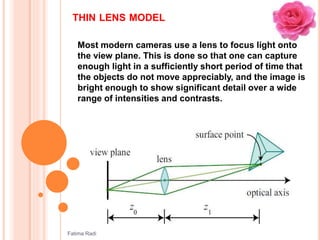
THIN LENS MODEL
Most modern cameras use a lens to focus light onto
the view plane. This is done so that one can capture
enough light in a sufficiently short period of time that
the objects do not move appreciably, and the image is
bright enough to show significant detail over a wide
range of intensities and contrasts.
Fatima Radi
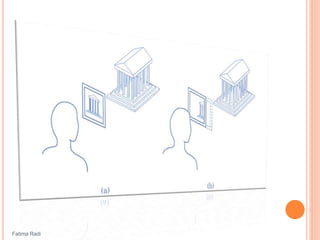
SYNTHETIC CAMERA MODEL
 In computer graphics we use a synthetic
camera model to mimic the behaviour of a real
camera.
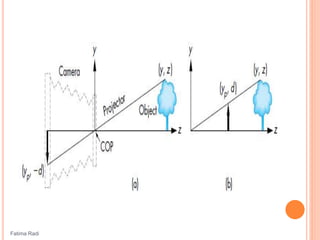
 In the synthetic camera model we avoid the
inversion by placing the film plane, called the
projection plane, in front of the lens.
 The clipping rectangle or clipping window
determines the size of the image.
Fatima Radi
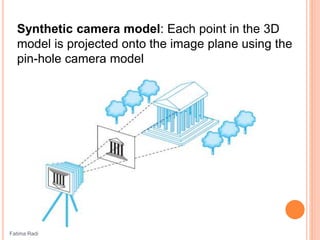
Synthetic camera model: Each point in the 3D
model is projected onto the image plane using the
pin-hole camera model
Fatima Radi
Fatima Radi
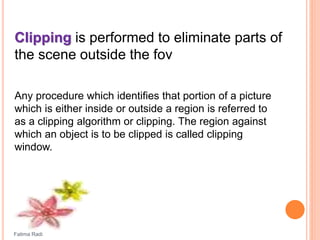
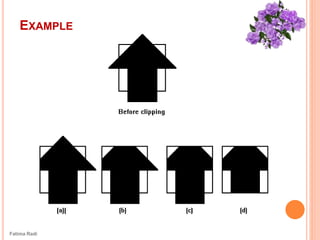
Clipping is performed to eliminate parts of
the scene outside the fov
Any procedure which identifies that portion of a picture
which is either inside or outside a region is referred to
as a clipping algorithm or clipping. The region against
which an object is to be clipped is called clipping
window.
Fatima Radi
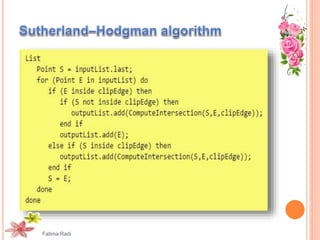
Sutherland–Hodgman algorithm
The Sutherland–Hodgman algorithm is used for
clipping polygons. It works by extending each line of the
convex clip polygon in turn and selecting only vertices
from the subject polygon that are on the visible side
Fatima Radi
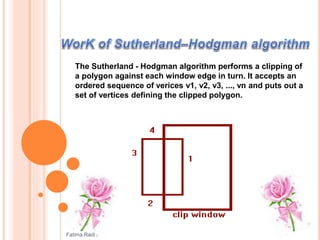
The Sutherland - Hodgman algorithm performs a clipping of
a polygon against each window edge in turn. It accepts an
ordered sequence of verices v1, v2, v3, ..., vn and puts out a
set of vertices defining the clipped polygon.
Fatima Radi
EXAMPLE
Fatima Radi
Fatima Radi
CAMERA OBSCURA (PINHOLE CAMERA)
 box with a small hole in it
 A pinhole camera is a simple camera without
a lens and with a single small aperture, a
pinhole – effectively a light-proof box with a
small hole in one side. Light from a scene
passes through this single point and projects
an inverted image on the opposite side of the
box.
 the size of the aperture should be 1/100 or
less of the distance between it and the
projected image.
Fatima Radi
 A common use of the pinhole camera is to
capture the movement of the sun over a long
period of time. This type of photography is
called solargraphy.
 Pinhole devices provide safety for the eyes
when viewing solar eclipses because the
event is observed indirectly, the diminished
intensity of the pinhole image being harmless
compared with the full glare of the Sun itself.
Fatima Radi
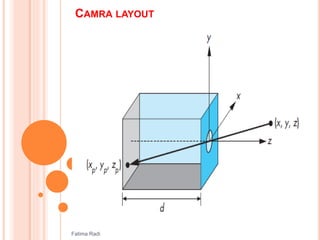
CAMRA LAYOUT
Fatima Radi
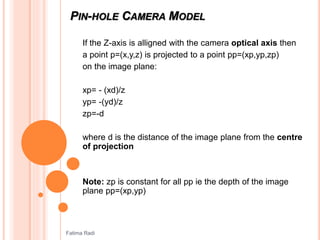
PIN-HOLE CAMERA MODEL
If the Z-axis is alligned with the camera optical axis then
a point p=(x,y,z) is projected to a point pp=(xp,yp,zp)
on the image plane:
xp= - (xd)/z
yp= -(yd)/z
zp=-d
where d is the distance of the image plane from the centre
of projection
Note: zp is constant for all pp ie the depth of the image
plane pp=(xp,yp)
Fatima Radi
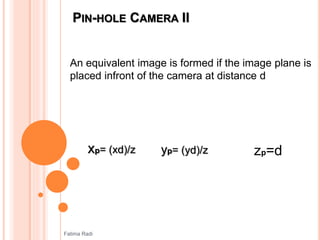
PIN-HOLE CAMERA II
An equivalent image is formed if the image plane is
placed infront of the camera at distance d
xp= (xd)/z yp= (yd)/z zp=d
Fatima Radi
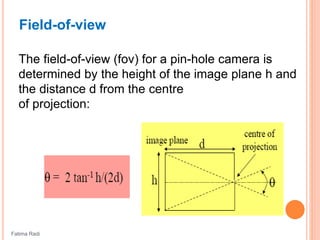
Field-of-view
The field-of-view (fov) for a pin-hole camera is
determined by the height of the image plane h and
the distance d from the centre
of projection:
Fatima Radi
Fatima Radi
Camera model ‫‬

Camera model ‫‬

  • 2.
    Camera Model Advanced ComputerGraphics By Fatima Radi Kufa University College of Computer Science and mathematics
  • 3.
    CAMERA MODEL A cameramodel simulates the capture of light from a three-dimensional scene in object space onto a two dimensional image, or image space. Most models contain or approximate a system of parallel lenses such as that of a camera or the eye. Goal: To model basic geometry of projection of 3D points, curves, and surfaces onto a 2D surface, the view plane or image plane. Fatima Radi
  • 4.
    THIN LENS MODEL Mostmodern cameras use a lens to focus light onto the view plane. This is done so that one can capture enough light in a sufficiently short period of time that the objects do not move appreciably, and the image is bright enough to show significant detail over a wide range of intensities and contrasts. Fatima Radi
  • 5.
    SYNTHETIC CAMERA MODEL In computer graphics we use a synthetic camera model to mimic the behaviour of a real camera.  In the synthetic camera model we avoid the inversion by placing the film plane, called the projection plane, in front of the lens.  The clipping rectangle or clipping window determines the size of the image. Fatima Radi
  • 6.
    Synthetic camera model:Each point in the 3D model is projected onto the image plane using the pin-hole camera model Fatima Radi
  • 7.
  • 8.
    Clipping is performedto eliminate parts of the scene outside the fov Any procedure which identifies that portion of a picture which is either inside or outside a region is referred to as a clipping algorithm or clipping. The region against which an object is to be clipped is called clipping window. Fatima Radi
  • 9.
    Sutherland–Hodgman algorithm The Sutherland–Hodgmanalgorithm is used for clipping polygons. It works by extending each line of the convex clip polygon in turn and selecting only vertices from the subject polygon that are on the visible side Fatima Radi
  • 10.
    The Sutherland -Hodgman algorithm performs a clipping of a polygon against each window edge in turn. It accepts an ordered sequence of verices v1, v2, v3, ..., vn and puts out a set of vertices defining the clipped polygon. Fatima Radi
  • 11.
  • 12.
  • 13.
    CAMERA OBSCURA (PINHOLECAMERA)  box with a small hole in it  A pinhole camera is a simple camera without a lens and with a single small aperture, a pinhole – effectively a light-proof box with a small hole in one side. Light from a scene passes through this single point and projects an inverted image on the opposite side of the box.  the size of the aperture should be 1/100 or less of the distance between it and the projected image. Fatima Radi
  • 14.
     A commonuse of the pinhole camera is to capture the movement of the sun over a long period of time. This type of photography is called solargraphy.  Pinhole devices provide safety for the eyes when viewing solar eclipses because the event is observed indirectly, the diminished intensity of the pinhole image being harmless compared with the full glare of the Sun itself. Fatima Radi
  • 15.
  • 16.
    PIN-HOLE CAMERA MODEL Ifthe Z-axis is alligned with the camera optical axis then a point p=(x,y,z) is projected to a point pp=(xp,yp,zp) on the image plane: xp= - (xd)/z yp= -(yd)/z zp=-d where d is the distance of the image plane from the centre of projection Note: zp is constant for all pp ie the depth of the image plane pp=(xp,yp) Fatima Radi
  • 17.
    PIN-HOLE CAMERA II Anequivalent image is formed if the image plane is placed infront of the camera at distance d xp= (xd)/z yp= (yd)/z zp=d Fatima Radi
  • 18.
    Field-of-view The field-of-view (fov)for a pin-hole camera is determined by the height of the image plane h and the distance d from the centre of projection: Fatima Radi
  • 19.