International Research Journal of Engineering and Technology (IRJET) e-ISSN: 2395-0056
Volume: 06 Issue: 04 | Apr 2019 www.irjet.net p-ISSN: 2395-0072
© 2019, IRJET | Impact Factor value: 7.211 | ISO 9001:2008 Certified Journal | Page 640
OBJECT RECOGNIZATION FROM STRUCTURAL INFORMATION USING
PERCEPTION
K. Vindhya Gupta1, B. Akshitha2, Samhita. A.S.S3, K Radha4
1,2,3B.TECH III-Year, CSE, GITAM UNIVERSITY, Rudraram, Hyderabad
4Asst Professor, CSE, Rudraram, GITAM UNIVERSITY
---------------------------------------------------------------------***----------------------------------------------------------------------
Abstract - Machine perception is the ability to use input from
sensors such as cameras visible spectrum or infrared,
microphones, wireless signals, and active sonar, radar, and
tactile sensors to deduce aspects of the world. Applications
include speech recognition, facial recognition, and object
recognition. Computer vision is the ability to analyze visual
input. Such input is usually ambiguous, agiant, fifty-meter-tall
pedestrian far away may produce exactly the same pixels as a
nearby normal-sized pedestrian, requiring the AI to judge the
relative likelihood and reasonableness of different
interpretations, for example by using itsobjectmodeltoassess
that fifty-meter pedestrians do not exist. Classifiers are
functions that use pattern matching to determine a closest
match. They can be tunedaccordingtoexamples, makingthem
very attractive for useinArtificialIntelligence. Theseexamples
are known as observations or patterns. In supervisedlearning,
each pattern belongs to a certain predefined class. A class can
be seen as a decision that has to be made. All the observations
combined with their class labels are known as a data set.
When a new observation is received, that observation is
classified based on previous experience.
Key Words: Image formation, object recognition, 3D world,
object recognition, structural information.
1. INTRODUCTION
By the interpretation of response of sensors, perception
provides the information about the world. A sensor can be
used as an input for an agent programandcouldbeassimple
as switch. There are varieties of sensory modalities which
are available to artificial agents. Modalities which are
available to human include vision, hearing and touch
whereas modalities which are not available to the unaided
human include radio, GPS, infrared and wireless signals.
Active sensing is performed by some robots which send
signals such as ultrasound or radar.
A sensor model consists of two components: Object model
and Rendering model. Object model describes the objects
that reside in visual world such as people, buildings, trees,
cars etc. It includes a accurate 3D geometric model and
indistinguishable constraints. Rendering models are quite
accurate but ambiguous which describes the physical,
geometric and statistical processes that produce the
stimulus from the world.
A vision-capable agent problem is: Which aspects should be
considered to help the agent make good action choices and
which are to be ignored? Thereare3approachestoovercome
this problem: Feature extraction, Recognition,
Reconstruction. The feature extraction emphasizes simple
computations which apply to the sensor observations, as
exhibited by drosophila (fruit flies). The Recognition
approach an agent draws distinction among the objects,
encounters based on visual and other information. The
reconstruction approaches an agent builds a geometric
model of the world from an image or set of images.
2. IMAGE FORMATION
Imaging distorts the appearance of objects. For example, if
you hold your hand infront of your eye, youcanblock outthe
moon, which is not smaller than your hand. As you move
your hand back and forth or tilt it, your hand will seem to
shrink and grow in the image, but it is not doing so in reality.
2.1 Images without Lenses
The pinhole camera Image sensors gather light that are
scattered from objects in a scene and create a 2D image. The
image is formed on retina which consists of two types of
cells: about 100million rods and 5million cones. Cones are
essential for colour vision. In cameras, the image is formed
on an image plane which can be a rectangular grid of a few
million photosensitive pixels, each a complementary metal
oxide semiconductor or charge-coupled device. When a
photon arrives at the sensor, it produces an effect whose
strength depends on the wavelengthonthephoton. Through
a pinhole camera, we can view stationary objects which
helps to form a focused image. It consists of a pinhole
opening, O, at the front of a box and an image plane at the
back of the box. If the photons are small enough to pass
through pinhole, then nearby photons in the scene will be
nearby in the image plane, and the image will be in focus.
2.2 Lens Systems
A drawback in the pinhole camera is that we need a small
pinhole to keep the image in focus. If we gather more
photons by keeping the pinhole open longer it will get
motion blur. If we can’t keep the pinholeopenanylonger, we
can try to make it bigger. A large opening is covered with a
lens that focuses light from nearby object locations down to
nearby locations in the image plane. The lens systems have
International Research Journal of Engineering and Technology (IRJET) e-ISSN: 2395-0056
Volume: 06 Issue: 04 | Apr 2019 www.irjet.net p-ISSN: 2395-0072
© 2019, IRJET | Impact Factor value: 7.211 | ISO 9001:2008 Certified Journal | Page 641
limited depth of field which can focus light that lies within
the range. Objects outside this range will be out of focus in
the image.
2.3 Light and Shading
The 3 main causes of varying brightness are overall
intensity,reflectandshading.Overall intensityoflight:Awhite
object in shadow may be less brighter than the black object
in direct sunlight but the eye can distinguish the relative
brightness and perceive the white object as white.
Reflect: Due to different points in the scene, it may reflect
moreorlessofthelight.
Shading: This effect is caused when surface patches facing
the light are brighter than the surface patches tilted away
fromthelight.Most of the surfaces reflect light bya process of
diffuse reflection. It scatters the light evenly across the
directions leaving a surface, so the brightness of diffused
surface doesn’t depend on the viewing direction.Paints,
cloths,rough stone, vegetation and rough wooden surfaces
are diffuse. In case of mirrors, it depends on the way or
direction you look at the mirror and hence are not diffuse.
The behavior of a perfect mirror is known as specular
reflection. On some surfaces like brushed metal, plastic and
wet floor, we observe small patches where specular
reflection has occurred known as specularities.
Distant point light source is defined as the parallel rays
travelling from the main source of illumination i.e sun. The
angle theta describes the amount of light collected by the
surface patch. A part of light collected is reflected by diffuse
surface patch known as diffuse albedo.Shadowisthesurface
which cannot be reached by light. The constant ambient
illumination is used to predict intensity by using effects like
inter reflections and shadows.
2.4.Color
The principle of trichromacy states that for any spectral
energy density there can be another spectral energy density
constructed using a mixture of 3 colors (usually red, green
and blue) so that humans can’t differentiatethem. Theabove
principle helps making computer algorithms easier. The 3
different albedos R/G/B helps inmodelingeverysurfaceand
similarly every light source. The humans are able to identify
the color of the surface under the white light ignoring the
effects of different coloured lights, this is known as color
constance.
3. OBJECT RECOGNITION BY APPEARANCE
Appearance means what an object tends to look like. For
example, football is rather round in shape. It is important to
know every class of images with a classifier. Taking the
example of faces, looking at the camera-every face looks
similar under good light and perfect resolution. A strategy
called sliding window includes computing features for an
object and present it to a classifier. One strategy is to
estimate and correct the illumination in each image window
and another is to build features out of gradient orientations.
To find faces of different sizes, repeat the sweep over larger
or smaller versions of the image. Then, we post process the
responses across scales and location to produce the final set
of detections. Postprocessing have several overlapping
windows that each report a match for a face.Toyielda single
high quality match, we can combine these partial
overlapping matches at nearby locations. Therefore, it gives
a face detector that can search over locations and scales.
3.1 Complex appearance and pattern elements
Since, several effects can move features around in an image
of the object, many objects produce much more complex
patterns than faces do. Effects include: Foreshortening:
which causes a pattern viewed at a slant to be significantly
distorted
Aspect: which causes objects to look different when seen
from different directions.
Occlusion: when some parts are hidden from some viewing
directions. Self-occlusion can be defined as objects can
occlude one another or parts of an object can occlude other
parts.
Deformation: where internal degrees of freedom of the
object change its appearance. An object recognizer is then a
collection of features that can tell whether the pattern
elements are present, and whether they are in about the
right place. With a histogram of the pattern elements that
appear can be considered as the most obvious approach to
represent the image window. This approach does not work
particularly well, because too many patterns get confused
with one another.
3.2 Pedestrian detection with HOG features
Each year car accidents kill about 1.2 million people, and to
avoid this problem cars should be provided with sensors
which detect pedestrians and result in saving many lives.
The most usual cases are lateral or frontal views ofa walk.In
these cases, we see either a “lollipop” shape-the torser is
wider than the legs, which are together in the stance phase
of the walk-or a “scissor” shape-where the legs are swinging
in the walk. Therefore, we need to build a useful moving-
window pedestrian detector. To represent the image
window, it is better to use orientations than edges because
there isn’t always a strong contrast between a pedestrian
and the background. Pedestrians can move their arms and
legs around, so we should use a histogram to suppress some
spatial detail in the feature. When breaking up
the window into cells, overlapping occurs and hence, build
an orientation histogram in each cell. Through this feature,
we can determine whether head-and-shoulders curve is at
the top of the window or at the bottom, but will not change,
if the head is moved bit slightly.
International Research Journal of Engineering and Technology (IRJET) e-ISSN: 2395-0056
Volume: 06 Issue: 04 | Apr 2019 www.irjet.net p-ISSN: 2395-0072
© 2019, IRJET | Impact Factor value: 7.211 | ISO 9001:2008 Certified Journal | Page 642
As orientation features are not affected by illumination
brightness, we cannot treathighcontrastedgesspecially.We
can recover contrast information by counting gradient
orientations with weights that reflect how significant the
gradient is compared to other gradients in the same cell.
HOG feature (Histogram of Gradient Orientations): This
feature compares the gradient magnitude to others in the
cell, so gradients that arelargecomparedtotheirneighbours
get a large weight. This feature construction is the main way
in which pedestrian detection differs from face detection.
The detector sweeps a window across the image, computes
features for that window and present it to a classifier.
4. RECONSTRUCTITING THE 3D WORLD
This section shows how to go from 2D image to a 3D
representation of the scene. A fundamental question arises
which is how do we recover 3D information when given all
the points in the scene that fall along a ray to pinhole are
projected to the same point in the image? The two solutions
are,
 If we have two or more images from different
camera positions, then we can triangulate to find
the position of a point in the scene.
 We can exploit background knowledge about the
physical scene that gave rise to the image. Given an
object model P(scene) and a redering model
P(image |scene).We can compute a posterior
distribution P(scene|image).
For a scene reconstruction, we survey 8 commonly used
visual cues because there is no single unified theory for it.
4.1 Motion Parallax:
We state an equation understanding the concept of relation
among the optical flow velocity and depth in the scene.
The point in the scene corresponding to the point in the
image at (x,y).Both components of the optical flow,vx(x,y)
and vy(x,y), are zero at the point x=Tx/Tz ,y=Ty/Tz .Thispoint
is called focus of expansion of the flow field.
If we change the origin in the x-y plane to lie at the focus of
expansion, then the expressions for optical flow take on a
particularly simple form. Let (x’,y’) be the new coordinates
defined by x’=x-Tx/Tz ,y’=y-Ty/Tz. Then,
4.2 Binocular Stereopsis
This idea is similar to motion parallax, but we use two or
more images separated in space. Binocular stereopsis
enables a wilder field of vision for the predators who have
eyes in the front. If we super pose the two images there will
be a disparity in the location of the image feature in the two
images as a given feature in the scene will be in a different
place relative to the Z-axis of each image plane. Usingoptical
flow equations vector T acting for time δt, with Tx=b/ δt and
Ty=Tz=0. Horizontal disparity is equal totheratioofbaseline
to the depth, and vertical disparity is zero i.e,H=b/Z,V=0.
Humans fixate at a point in the scene at which the optical
axes of the two eyes intersect nder normal viewing
conditions. The actual disparity is δθ, we have
disparity=bδZ/Z2.
In humans, b(the base line distance between the eyes) is
about 6cm. So for Z=30cm we get small value δZ=0.036mm
which means at a distance of 30cm humans can differentiate
the depths which differ by a little length as 0.036mm.
4.3 Multiple views
Most of the techniques that have been developed had make
the use of the information available in multiple views, even
from hundreds or thousands of cameras. There are few
problems in multiple views which can be solved
algorithmically:
 Correspondence problem: In the 3D world,
identifying features in the different images that are
projections of the same feature.
 Relative orientation problem: Finding out the
transformation between the coordinate systems
fixed to the different cameras.
 Depth estimation problem: Finding out the depths
of various points in the world forwhichimageplane
projections were available in at least two views.
International Research Journal of Engineering and Technology (IRJET) e-ISSN: 2395-0056
Volume: 06 Issue: 04 | Apr 2019 www.irjet.net p-ISSN: 2395-0072
© 2019, IRJET | Impact Factor value: 7.211 | ISO 9001:2008 Certified Journal | Page 643
Fig.1. Binocular Stereopsis
Using numerically stable algorithms for solving relative
orientations and scene depth and the developmentofrobust
matching procedures for the correspondenceproblemisone
of the successful attempts in computer vision.
4.4 Texture
Texture is used to estimate distances and for segmenting
objects. The texture elements are also known as texels.
Fig.2. Texture
As shown in the above figure, the paving tiles are identical in
the scene but appear different in the image for 2 reasons.
 Differences in the distances of the texels from the
camera.
 Differences in the foreshortening of the texels.
Various algorithms have been developed to make use of
variation in the appearance of the projected texels as a basis
for finding out the surface normals but they were not
accurate as much as the algorithms which were used for
multiple views.
4.5 Shading
From different portions of a surface in a scene, we receive
variation in the intensity of light called shading. It is
determined by the geometry of the scene and by the
reflectance properties of the surfaces. It has been proved to
be difficult to invert the process i.e to recover the geometry
and reflectance properties given the image brightness.
If a surface normal points towards the light source, the
surface is brighter and if it points away,thesurfaceisdarker.
The surface might have low albedo because it changes
quickly in images rather than shading whichchangesslowly.
The solution for this problem is whenweassumethatalbedo
is known at every surface point.one of the measurement is
brightness and another is normal. We cannot solve for
normal, therefore we can consider that the nearby normal
might be similar as most surfaces are smooth.
There is a quite difficulty with theinterreflectionsbecauseof
mutual illumination, when consider an indoor scene, makes
it difficult to predict the relation between the normal and
image brightness.Twosurfacepatcheswiththesamenormal
might have quite different brightness’s as one receives light
reflected and other facesonly a dark scene.
4.6 Contour
Fig.3. Contour
Considering the above line drawing, we get 3D shape and
layout which is the combination of recognition of familiar
objects in the scene and the application of generic
constraints such as following:
 Figure-ground-problem:figuringoutwhichsideof
the contour is nearer and which is farther. At an
occluding contour, the line of sight is tangential to
the surface in the scene.
 T-junction: It results in image when one object
occludes another, by which the nearer ones look
opaque and farther one is interrupted.
International Research Journal of Engineering and Technology (IRJET) e-ISSN: 2395-0056
Volume: 06 Issue: 04 | Apr 2019 www.irjet.net p-ISSN: 2395-0072
© 2019, IRJET | Impact Factor value: 7.211 | ISO 9001:2008 Certified Journal | Page 644
Considering a scenario, the projection of objects of different
heights is at different locationsonthegroundplane.Suppose
an eye or a camera is at a height hc,, above the ground plane.
Consider an object of height δY resting on the ground plane,
whose bottom is (X,-hC,Z) and top is at (X,δY-hc,Z).The
bottom projects to the image point(f X/Z,-fhC/Z) and the top
to (f X/Z,f(δY-hC/Z).The bottoms of nearer objects project to
points lower in the image plane, farther objects have
bottoms closer to the horizon.
5. OBJECT RECOGNIZATION FROM STRUCTURAL
INFORMATION
Human body parts are very small in images and vary in
color, texture among individuals and hence it is difficult to
detect them using moving window method. Some parts are
very small to a size of two to three pixels wide.
As the layout of body describes the movement, it is
important to conclude layout of body in the images.
whether the configuration are acceptable or not it can be
described by a model called deformable template. The
simplest deformable template model of a person connects
lower arms to upper arms, upper arms to torso, and so on.
5.1 The geometry of bodies: finding arms and legs
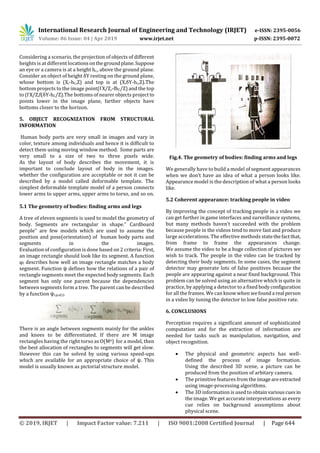
A tree of eleven segments is used to model the geometry of
body. Segments are rectangular in shape.” Cardboard
people” are few models which are used to assume the
position and pose(orientation) of human body parts and
segments in the images.
Evaluation of configuration is done based on 2 criteria: First,
an image rectangle should look like its segment. A function
φi describes how well an image rectangle matches a body
segment. Function ψ defines how the relations of a pair of
rectangle segments meet the expected body segments. Each
segment has only one parent because the dependencies
between segments form a tree. The parent can be described
by a function ψi,p,a(i).
There is an angle between segments mainly for the ankles
and knees to be differentiated. If there are M image
rectangles having the right torso as O(M6) for a model, then
the best allocation of rectangles to segments will get slow.
However this can be solved by using various speed-ups
which are available for an appropriate choice of ψ. This
model is usually known as pictorial structure model.
Fig.4. The geometry of bodies: finding arms and legs
We generally have to build a model of segment appearances
when we don’t have an idea of what a person looks like.
Appearance model is the description of what a person looks
like.
5.2 Coherent appearance: tracking people in video
By improving the concept of tracking people in a video we
can get further in game interfaces and surveillance systems,
but many methods haven’t succeeded with the problem
because people in the videos tend to move fast and produce
large accelerations. The effective methods statethefactthat,
from frame to frame the appearances change.
We assume the video to be a huge collection of pictures we
wish to track. The people in the video can be tracked by
detecting their body segments. In some cases, the segment
detector may generate lots of false positives because the
people are appearing against a near fixed background. This
problem can be solved using an alternative which is quite in
practice, by applying a detector to a fixed bodyconfiguration
for all the frames. We can know when wefounda real person
in a video by tuning the detector to low false positive rate.
6. CONCLUSIONS
Perception requires a significant amount of sophisticated
computation and for the extraction of information are
needed for tasks such as manipulation, navigation, and
object recognition.
 The physical and geometric aspects has well-
defined the process of image formation.
Using the described 3D scene, a picture can be
produced from the position of arbitary camera.
 The primitive features from the imageareextracted
using image-processing algorithms.
 The 3D information is used to obtainvariouscuesin
the image. We get accurate interpretations as every
cue relies on background assumptions about
physical scene.
International Research Journal of Engineering and Technology (IRJET) e-ISSN: 2395-0056
Volume: 06 Issue: 04 | Apr 2019 www.irjet.net p-ISSN: 2395-0072
© 2019, IRJET | Impact Factor value: 7.211 | ISO 9001:2008 Certified Journal | Page 645
REFERENCES
[1] Artificial intelligence, a modern approach(third edition)
by Stuart J.Russell, Peter Norvig
[2] Wikipedia:https://en.wikipedia.org/wiki/Computer_visi
on
[3] https://en.wikipedia.org/wiki/Speech_recognition

IRJET- Object Recognization from Structural Information using Perception

  • 1.
    International Research Journalof Engineering and Technology (IRJET) e-ISSN: 2395-0056 Volume: 06 Issue: 04 | Apr 2019 www.irjet.net p-ISSN: 2395-0072 © 2019, IRJET | Impact Factor value: 7.211 | ISO 9001:2008 Certified Journal | Page 640 OBJECT RECOGNIZATION FROM STRUCTURAL INFORMATION USING PERCEPTION K. Vindhya Gupta1, B. Akshitha2, Samhita. A.S.S3, K Radha4 1,2,3B.TECH III-Year, CSE, GITAM UNIVERSITY, Rudraram, Hyderabad 4Asst Professor, CSE, Rudraram, GITAM UNIVERSITY ---------------------------------------------------------------------***---------------------------------------------------------------------- Abstract - Machine perception is the ability to use input from sensors such as cameras visible spectrum or infrared, microphones, wireless signals, and active sonar, radar, and tactile sensors to deduce aspects of the world. Applications include speech recognition, facial recognition, and object recognition. Computer vision is the ability to analyze visual input. Such input is usually ambiguous, agiant, fifty-meter-tall pedestrian far away may produce exactly the same pixels as a nearby normal-sized pedestrian, requiring the AI to judge the relative likelihood and reasonableness of different interpretations, for example by using itsobjectmodeltoassess that fifty-meter pedestrians do not exist. Classifiers are functions that use pattern matching to determine a closest match. They can be tunedaccordingtoexamples, makingthem very attractive for useinArtificialIntelligence. Theseexamples are known as observations or patterns. In supervisedlearning, each pattern belongs to a certain predefined class. A class can be seen as a decision that has to be made. All the observations combined with their class labels are known as a data set. When a new observation is received, that observation is classified based on previous experience. Key Words: Image formation, object recognition, 3D world, object recognition, structural information. 1. INTRODUCTION By the interpretation of response of sensors, perception provides the information about the world. A sensor can be used as an input for an agent programandcouldbeassimple as switch. There are varieties of sensory modalities which are available to artificial agents. Modalities which are available to human include vision, hearing and touch whereas modalities which are not available to the unaided human include radio, GPS, infrared and wireless signals. Active sensing is performed by some robots which send signals such as ultrasound or radar. A sensor model consists of two components: Object model and Rendering model. Object model describes the objects that reside in visual world such as people, buildings, trees, cars etc. It includes a accurate 3D geometric model and indistinguishable constraints. Rendering models are quite accurate but ambiguous which describes the physical, geometric and statistical processes that produce the stimulus from the world. A vision-capable agent problem is: Which aspects should be considered to help the agent make good action choices and which are to be ignored? Thereare3approachestoovercome this problem: Feature extraction, Recognition, Reconstruction. The feature extraction emphasizes simple computations which apply to the sensor observations, as exhibited by drosophila (fruit flies). The Recognition approach an agent draws distinction among the objects, encounters based on visual and other information. The reconstruction approaches an agent builds a geometric model of the world from an image or set of images. 2. IMAGE FORMATION Imaging distorts the appearance of objects. For example, if you hold your hand infront of your eye, youcanblock outthe moon, which is not smaller than your hand. As you move your hand back and forth or tilt it, your hand will seem to shrink and grow in the image, but it is not doing so in reality. 2.1 Images without Lenses The pinhole camera Image sensors gather light that are scattered from objects in a scene and create a 2D image. The image is formed on retina which consists of two types of cells: about 100million rods and 5million cones. Cones are essential for colour vision. In cameras, the image is formed on an image plane which can be a rectangular grid of a few million photosensitive pixels, each a complementary metal oxide semiconductor or charge-coupled device. When a photon arrives at the sensor, it produces an effect whose strength depends on the wavelengthonthephoton. Through a pinhole camera, we can view stationary objects which helps to form a focused image. It consists of a pinhole opening, O, at the front of a box and an image plane at the back of the box. If the photons are small enough to pass through pinhole, then nearby photons in the scene will be nearby in the image plane, and the image will be in focus. 2.2 Lens Systems A drawback in the pinhole camera is that we need a small pinhole to keep the image in focus. If we gather more photons by keeping the pinhole open longer it will get motion blur. If we can’t keep the pinholeopenanylonger, we can try to make it bigger. A large opening is covered with a lens that focuses light from nearby object locations down to nearby locations in the image plane. The lens systems have
  • 2.
    International Research Journalof Engineering and Technology (IRJET) e-ISSN: 2395-0056 Volume: 06 Issue: 04 | Apr 2019 www.irjet.net p-ISSN: 2395-0072 © 2019, IRJET | Impact Factor value: 7.211 | ISO 9001:2008 Certified Journal | Page 641 limited depth of field which can focus light that lies within the range. Objects outside this range will be out of focus in the image. 2.3 Light and Shading The 3 main causes of varying brightness are overall intensity,reflectandshading.Overall intensityoflight:Awhite object in shadow may be less brighter than the black object in direct sunlight but the eye can distinguish the relative brightness and perceive the white object as white. Reflect: Due to different points in the scene, it may reflect moreorlessofthelight. Shading: This effect is caused when surface patches facing the light are brighter than the surface patches tilted away fromthelight.Most of the surfaces reflect light bya process of diffuse reflection. It scatters the light evenly across the directions leaving a surface, so the brightness of diffused surface doesn’t depend on the viewing direction.Paints, cloths,rough stone, vegetation and rough wooden surfaces are diffuse. In case of mirrors, it depends on the way or direction you look at the mirror and hence are not diffuse. The behavior of a perfect mirror is known as specular reflection. On some surfaces like brushed metal, plastic and wet floor, we observe small patches where specular reflection has occurred known as specularities. Distant point light source is defined as the parallel rays travelling from the main source of illumination i.e sun. The angle theta describes the amount of light collected by the surface patch. A part of light collected is reflected by diffuse surface patch known as diffuse albedo.Shadowisthesurface which cannot be reached by light. The constant ambient illumination is used to predict intensity by using effects like inter reflections and shadows. 2.4.Color The principle of trichromacy states that for any spectral energy density there can be another spectral energy density constructed using a mixture of 3 colors (usually red, green and blue) so that humans can’t differentiatethem. Theabove principle helps making computer algorithms easier. The 3 different albedos R/G/B helps inmodelingeverysurfaceand similarly every light source. The humans are able to identify the color of the surface under the white light ignoring the effects of different coloured lights, this is known as color constance. 3. OBJECT RECOGNITION BY APPEARANCE Appearance means what an object tends to look like. For example, football is rather round in shape. It is important to know every class of images with a classifier. Taking the example of faces, looking at the camera-every face looks similar under good light and perfect resolution. A strategy called sliding window includes computing features for an object and present it to a classifier. One strategy is to estimate and correct the illumination in each image window and another is to build features out of gradient orientations. To find faces of different sizes, repeat the sweep over larger or smaller versions of the image. Then, we post process the responses across scales and location to produce the final set of detections. Postprocessing have several overlapping windows that each report a match for a face.Toyielda single high quality match, we can combine these partial overlapping matches at nearby locations. Therefore, it gives a face detector that can search over locations and scales. 3.1 Complex appearance and pattern elements Since, several effects can move features around in an image of the object, many objects produce much more complex patterns than faces do. Effects include: Foreshortening: which causes a pattern viewed at a slant to be significantly distorted Aspect: which causes objects to look different when seen from different directions. Occlusion: when some parts are hidden from some viewing directions. Self-occlusion can be defined as objects can occlude one another or parts of an object can occlude other parts. Deformation: where internal degrees of freedom of the object change its appearance. An object recognizer is then a collection of features that can tell whether the pattern elements are present, and whether they are in about the right place. With a histogram of the pattern elements that appear can be considered as the most obvious approach to represent the image window. This approach does not work particularly well, because too many patterns get confused with one another. 3.2 Pedestrian detection with HOG features Each year car accidents kill about 1.2 million people, and to avoid this problem cars should be provided with sensors which detect pedestrians and result in saving many lives. The most usual cases are lateral or frontal views ofa walk.In these cases, we see either a “lollipop” shape-the torser is wider than the legs, which are together in the stance phase of the walk-or a “scissor” shape-where the legs are swinging in the walk. Therefore, we need to build a useful moving- window pedestrian detector. To represent the image window, it is better to use orientations than edges because there isn’t always a strong contrast between a pedestrian and the background. Pedestrians can move their arms and legs around, so we should use a histogram to suppress some spatial detail in the feature. When breaking up the window into cells, overlapping occurs and hence, build an orientation histogram in each cell. Through this feature, we can determine whether head-and-shoulders curve is at the top of the window or at the bottom, but will not change, if the head is moved bit slightly.
  • 3.
    International Research Journalof Engineering and Technology (IRJET) e-ISSN: 2395-0056 Volume: 06 Issue: 04 | Apr 2019 www.irjet.net p-ISSN: 2395-0072 © 2019, IRJET | Impact Factor value: 7.211 | ISO 9001:2008 Certified Journal | Page 642 As orientation features are not affected by illumination brightness, we cannot treathighcontrastedgesspecially.We can recover contrast information by counting gradient orientations with weights that reflect how significant the gradient is compared to other gradients in the same cell. HOG feature (Histogram of Gradient Orientations): This feature compares the gradient magnitude to others in the cell, so gradients that arelargecomparedtotheirneighbours get a large weight. This feature construction is the main way in which pedestrian detection differs from face detection. The detector sweeps a window across the image, computes features for that window and present it to a classifier. 4. RECONSTRUCTITING THE 3D WORLD This section shows how to go from 2D image to a 3D representation of the scene. A fundamental question arises which is how do we recover 3D information when given all the points in the scene that fall along a ray to pinhole are projected to the same point in the image? The two solutions are,  If we have two or more images from different camera positions, then we can triangulate to find the position of a point in the scene.  We can exploit background knowledge about the physical scene that gave rise to the image. Given an object model P(scene) and a redering model P(image |scene).We can compute a posterior distribution P(scene|image). For a scene reconstruction, we survey 8 commonly used visual cues because there is no single unified theory for it. 4.1 Motion Parallax: We state an equation understanding the concept of relation among the optical flow velocity and depth in the scene. The point in the scene corresponding to the point in the image at (x,y).Both components of the optical flow,vx(x,y) and vy(x,y), are zero at the point x=Tx/Tz ,y=Ty/Tz .Thispoint is called focus of expansion of the flow field. If we change the origin in the x-y plane to lie at the focus of expansion, then the expressions for optical flow take on a particularly simple form. Let (x’,y’) be the new coordinates defined by x’=x-Tx/Tz ,y’=y-Ty/Tz. Then, 4.2 Binocular Stereopsis This idea is similar to motion parallax, but we use two or more images separated in space. Binocular stereopsis enables a wilder field of vision for the predators who have eyes in the front. If we super pose the two images there will be a disparity in the location of the image feature in the two images as a given feature in the scene will be in a different place relative to the Z-axis of each image plane. Usingoptical flow equations vector T acting for time δt, with Tx=b/ δt and Ty=Tz=0. Horizontal disparity is equal totheratioofbaseline to the depth, and vertical disparity is zero i.e,H=b/Z,V=0. Humans fixate at a point in the scene at which the optical axes of the two eyes intersect nder normal viewing conditions. The actual disparity is δθ, we have disparity=bδZ/Z2. In humans, b(the base line distance between the eyes) is about 6cm. So for Z=30cm we get small value δZ=0.036mm which means at a distance of 30cm humans can differentiate the depths which differ by a little length as 0.036mm. 4.3 Multiple views Most of the techniques that have been developed had make the use of the information available in multiple views, even from hundreds or thousands of cameras. There are few problems in multiple views which can be solved algorithmically:  Correspondence problem: In the 3D world, identifying features in the different images that are projections of the same feature.  Relative orientation problem: Finding out the transformation between the coordinate systems fixed to the different cameras.  Depth estimation problem: Finding out the depths of various points in the world forwhichimageplane projections were available in at least two views.
  • 4.
    International Research Journalof Engineering and Technology (IRJET) e-ISSN: 2395-0056 Volume: 06 Issue: 04 | Apr 2019 www.irjet.net p-ISSN: 2395-0072 © 2019, IRJET | Impact Factor value: 7.211 | ISO 9001:2008 Certified Journal | Page 643 Fig.1. Binocular Stereopsis Using numerically stable algorithms for solving relative orientations and scene depth and the developmentofrobust matching procedures for the correspondenceproblemisone of the successful attempts in computer vision. 4.4 Texture Texture is used to estimate distances and for segmenting objects. The texture elements are also known as texels. Fig.2. Texture As shown in the above figure, the paving tiles are identical in the scene but appear different in the image for 2 reasons.  Differences in the distances of the texels from the camera.  Differences in the foreshortening of the texels. Various algorithms have been developed to make use of variation in the appearance of the projected texels as a basis for finding out the surface normals but they were not accurate as much as the algorithms which were used for multiple views. 4.5 Shading From different portions of a surface in a scene, we receive variation in the intensity of light called shading. It is determined by the geometry of the scene and by the reflectance properties of the surfaces. It has been proved to be difficult to invert the process i.e to recover the geometry and reflectance properties given the image brightness. If a surface normal points towards the light source, the surface is brighter and if it points away,thesurfaceisdarker. The surface might have low albedo because it changes quickly in images rather than shading whichchangesslowly. The solution for this problem is whenweassumethatalbedo is known at every surface point.one of the measurement is brightness and another is normal. We cannot solve for normal, therefore we can consider that the nearby normal might be similar as most surfaces are smooth. There is a quite difficulty with theinterreflectionsbecauseof mutual illumination, when consider an indoor scene, makes it difficult to predict the relation between the normal and image brightness.Twosurfacepatcheswiththesamenormal might have quite different brightness’s as one receives light reflected and other facesonly a dark scene. 4.6 Contour Fig.3. Contour Considering the above line drawing, we get 3D shape and layout which is the combination of recognition of familiar objects in the scene and the application of generic constraints such as following:  Figure-ground-problem:figuringoutwhichsideof the contour is nearer and which is farther. At an occluding contour, the line of sight is tangential to the surface in the scene.  T-junction: It results in image when one object occludes another, by which the nearer ones look opaque and farther one is interrupted.
  • 5.
    International Research Journalof Engineering and Technology (IRJET) e-ISSN: 2395-0056 Volume: 06 Issue: 04 | Apr 2019 www.irjet.net p-ISSN: 2395-0072 © 2019, IRJET | Impact Factor value: 7.211 | ISO 9001:2008 Certified Journal | Page 644 Considering a scenario, the projection of objects of different heights is at different locationsonthegroundplane.Suppose an eye or a camera is at a height hc,, above the ground plane. Consider an object of height δY resting on the ground plane, whose bottom is (X,-hC,Z) and top is at (X,δY-hc,Z).The bottom projects to the image point(f X/Z,-fhC/Z) and the top to (f X/Z,f(δY-hC/Z).The bottoms of nearer objects project to points lower in the image plane, farther objects have bottoms closer to the horizon. 5. OBJECT RECOGNIZATION FROM STRUCTURAL INFORMATION Human body parts are very small in images and vary in color, texture among individuals and hence it is difficult to detect them using moving window method. Some parts are very small to a size of two to three pixels wide. As the layout of body describes the movement, it is important to conclude layout of body in the images. whether the configuration are acceptable or not it can be described by a model called deformable template. The simplest deformable template model of a person connects lower arms to upper arms, upper arms to torso, and so on. 5.1 The geometry of bodies: finding arms and legs A tree of eleven segments is used to model the geometry of body. Segments are rectangular in shape.” Cardboard people” are few models which are used to assume the position and pose(orientation) of human body parts and segments in the images. Evaluation of configuration is done based on 2 criteria: First, an image rectangle should look like its segment. A function φi describes how well an image rectangle matches a body segment. Function ψ defines how the relations of a pair of rectangle segments meet the expected body segments. Each segment has only one parent because the dependencies between segments form a tree. The parent can be described by a function ψi,p,a(i). There is an angle between segments mainly for the ankles and knees to be differentiated. If there are M image rectangles having the right torso as O(M6) for a model, then the best allocation of rectangles to segments will get slow. However this can be solved by using various speed-ups which are available for an appropriate choice of ψ. This model is usually known as pictorial structure model. Fig.4. The geometry of bodies: finding arms and legs We generally have to build a model of segment appearances when we don’t have an idea of what a person looks like. Appearance model is the description of what a person looks like. 5.2 Coherent appearance: tracking people in video By improving the concept of tracking people in a video we can get further in game interfaces and surveillance systems, but many methods haven’t succeeded with the problem because people in the videos tend to move fast and produce large accelerations. The effective methods statethefactthat, from frame to frame the appearances change. We assume the video to be a huge collection of pictures we wish to track. The people in the video can be tracked by detecting their body segments. In some cases, the segment detector may generate lots of false positives because the people are appearing against a near fixed background. This problem can be solved using an alternative which is quite in practice, by applying a detector to a fixed bodyconfiguration for all the frames. We can know when wefounda real person in a video by tuning the detector to low false positive rate. 6. CONCLUSIONS Perception requires a significant amount of sophisticated computation and for the extraction of information are needed for tasks such as manipulation, navigation, and object recognition.  The physical and geometric aspects has well- defined the process of image formation. Using the described 3D scene, a picture can be produced from the position of arbitary camera.  The primitive features from the imageareextracted using image-processing algorithms.  The 3D information is used to obtainvariouscuesin the image. We get accurate interpretations as every cue relies on background assumptions about physical scene.
  • 6.
    International Research Journalof Engineering and Technology (IRJET) e-ISSN: 2395-0056 Volume: 06 Issue: 04 | Apr 2019 www.irjet.net p-ISSN: 2395-0072 © 2019, IRJET | Impact Factor value: 7.211 | ISO 9001:2008 Certified Journal | Page 645 REFERENCES [1] Artificial intelligence, a modern approach(third edition) by Stuart J.Russell, Peter Norvig [2] Wikipedia:https://en.wikipedia.org/wiki/Computer_visi on [3] https://en.wikipedia.org/wiki/Speech_recognition