
Lecture 10: Cameras
CSCI 455: Computer Vision
Source: S. Lazebnik
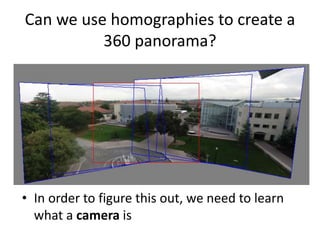
Can we use homographies to create a
360 panorama?
• In order to figure this out, we need to learn
what a camera is
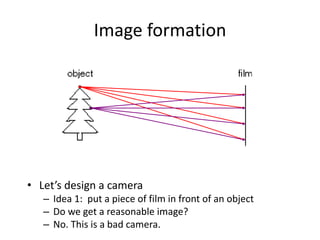
Image formation
• Let’s design a camera
– Idea 1: put a piece of film in front of an object
– Do we get a reasonable image?
– No. This is a bad camera.
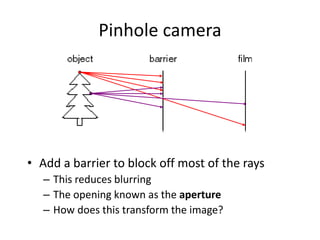
Pinhole camera
• Add a barrier to block off most of the rays
– This reduces blurring
– The opening known as the aperture
– How does this transform the image?
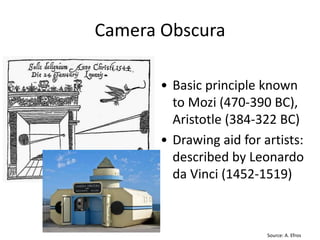
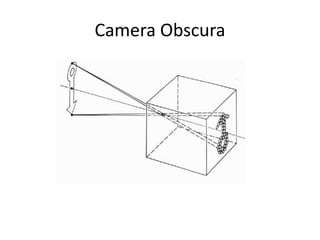
Camera Obscura
• Basic principle known
to Mozi (470-390 BC),
Aristotle (384-322 BC)
• Drawing aid for artists:
described by Leonardo
da Vinci (1452-1519)
Gemma Frisius, 1558
Source: A. Efros
Camera Obscura
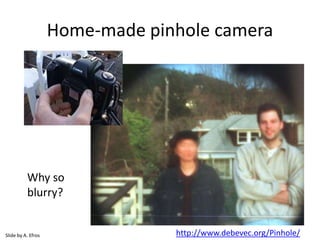
Home-made pinhole camera
http://www.debevec.org/Pinhole/
Why so
blurry?
Slide by A. Efros
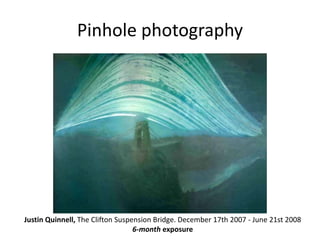
Pinhole photography
Justin Quinnell, The Clifton Suspension Bridge. December 17th 2007 - June 21st 2008
6-month exposure
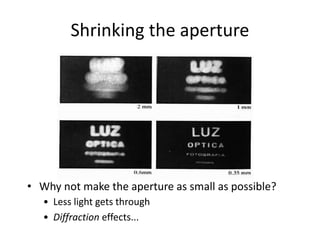
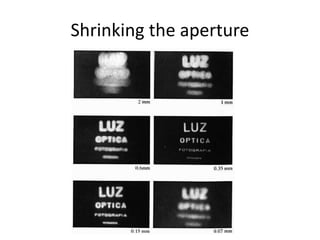
Shrinking the aperture
• Why not make the aperture as small as possible?
• Less light gets through
• Diffraction effects...
Shrinking the aperture
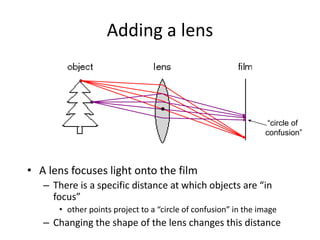
Adding a lens
• A lens focuses light onto the film
– There is a specific distance at which objects are “in
focus”
• other points project to a “circle of confusion” in the image
– Changing the shape of the lens changes this distance
“circle of
confusion”
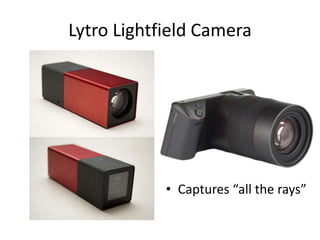
Lytro Lightfield Camera
• Captures “all the rays”
Lenses
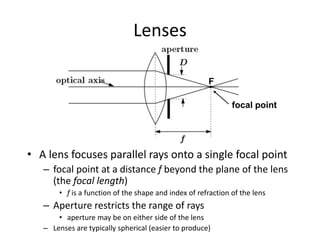
• A lens focuses parallel rays onto a single focal point
– focal point at a distance f beyond the plane of the lens
(the focal length)
• f is a function of the shape and index of refraction of the lens
– Aperture restricts the range of rays
• aperture may be on either side of the lens
– Lenses are typically spherical (easier to produce)
focal point
F
The eye
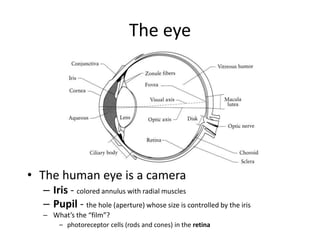
• The human eye is a camera
– Iris - colored annulus with radial muscles
– Pupil - the hole (aperture) whose size is controlled by the iris
– What’s the “film”?
– photoreceptor cells (rods and cones) in the retina
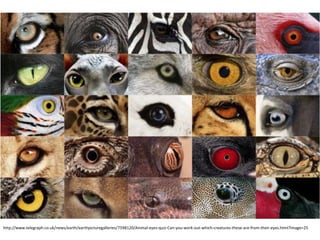
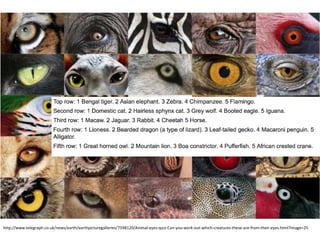
http://www.telegraph.co.uk/news/earth/earthpicturegalleries/7598120/Animal-eyes-quiz-Can-you-work-out-which-creatures-these-are-from-their-eyes.html?image=25
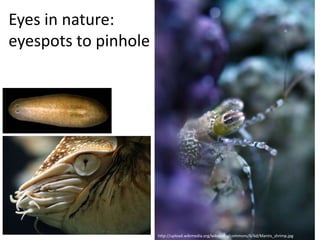
Eyes in nature:
eyespots to pinhole camera
http://upload.wikimedia.org/wikipedia/commons/6/6d/Mantis_shrimp.jpg
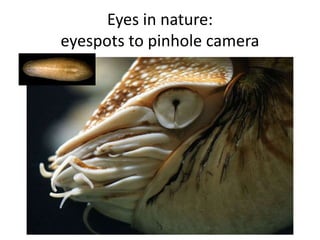
Eyes in nature:
eyespots to pinhole camera
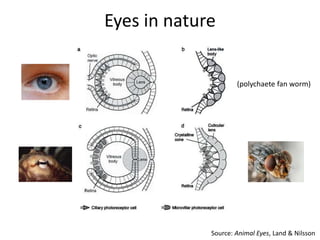
Eyes in nature
Source: Animal Eyes, Land & Nilsson
(polychaete fan worm)
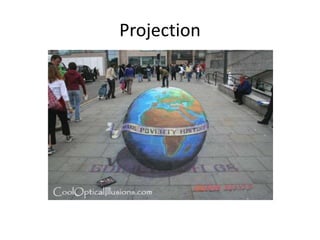
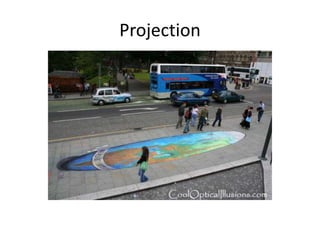
Projection
Projection
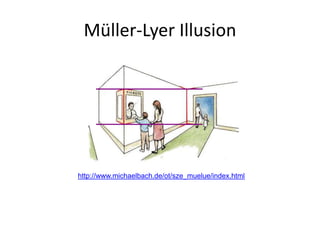
Müller-Lyer Illusion
http://www.michaelbach.de/ot/sze_muelue/index.html
Modeling projection
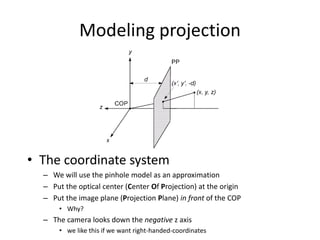
• The coordinate system
– We will use the pinhole model as an approximation
– Put the optical center (Center Of Projection) at the origin
– Put the image plane (Projection Plane) in front of the COP
• Why?
– The camera looks down the negative z axis
• we like this if we want right-handed-coordinates
Modeling projection
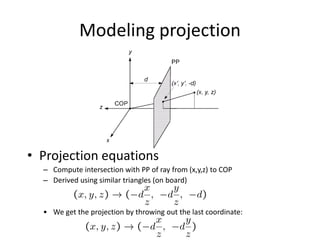
• Projection equations
– Compute intersection with PP of ray from (x,y,z) to COP
– Derived using similar triangles (on board)
• We get the projection by throwing out the last coordinate:
Modeling projection
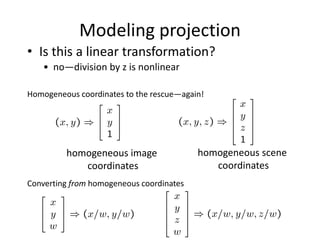
• Is this a linear transformation?
Homogeneous coordinates to the rescue—again!
homogeneous image
coordinates
homogeneous scene
coordinates
Converting from homogeneous coordinates
• no—division by z is nonlinear
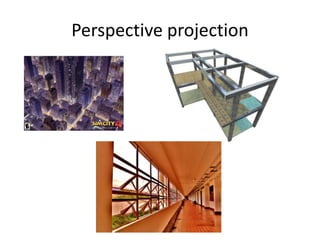
Perspective Projection
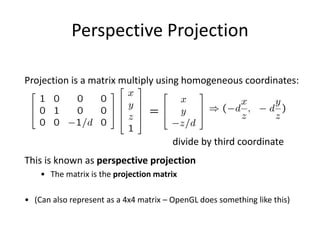
Projection is a matrix multiply using homogeneous coordinates:
divide by third coordinate
This is known as perspective projection
• The matrix is the projection matrix
• (Can also represent as a 4x4 matrix – OpenGL does something like this)
Perspective Projection
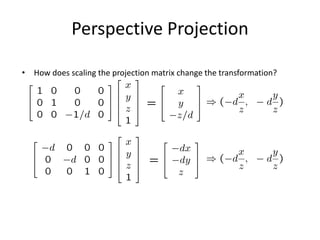
• How does scaling the projection matrix change the transformation?
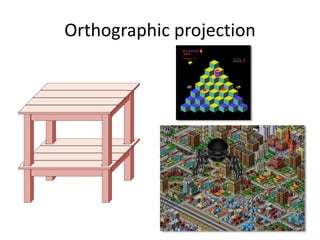
Orthographic projection
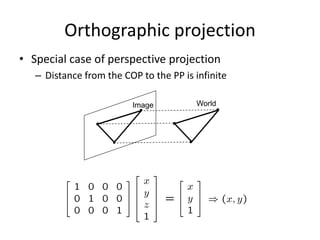
• Special case of perspective projection
– Distance from the COP to the PP is infinite
– Good approximation for telephoto optics
– Also called “parallel projection”: (x, y, z) → (x, y)
– What’s the projection matrix?
Image World
Orthographic projection
Perspective projection
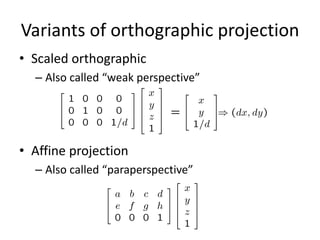
Variants of orthographic projection
• Scaled orthographic
– Also called “weak perspective”
• Affine projection
– Also called “paraperspective”
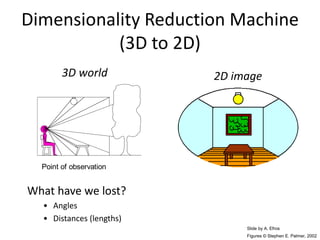
Point of observation
Figures © Stephen E. Palmer, 2002
Dimensionality Reduction Machine
(3D to 2D)
3D world 2D image
What have we lost?
• Angles
• Distances (lengths)
Slide by A. Efros
Projection properties
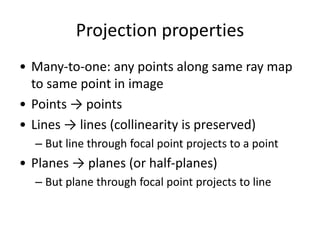
• Many-to-one: any points along same ray map
to same point in image
• Points → points
• Lines → lines (collinearity is preserved)
– But line through focal point projects to a point
• Planes → planes (or half-planes)
– But plane through focal point projects to line
Projection properties
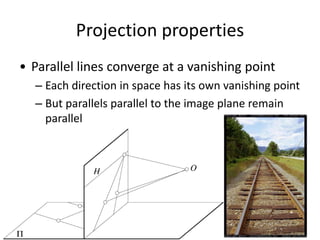
• Parallel lines converge at a vanishing point
– Each direction in space has its own vanishing point
– But parallels parallel to the image plane remain
parallel
Questions?
Camera parameters
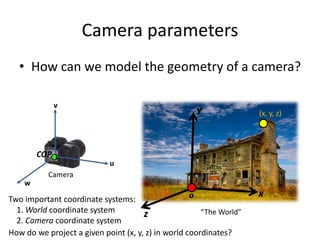
• How can we model the geometry of a camera?
“The World”
Camera
x
y
z
v
w
u
o
COP
Two important coordinate systems:
1. World coordinate system
2. Camera coordinate system
(x, y, z)
How do we project a given point (x, y, z) in world coordinates?
Camera parameters
• To project a point (x,y,z) in world coordinates
into a camera
• First transform (x,y,z) into camera coordinates
• Need to know
– Camera position (in world coordinates)
– Camera orientation (in world coordinates)
• Then project into the image plane to get a
pixel coordinate
– Need to know camera intrinsics
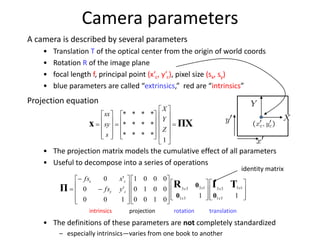
Projection equation
• The projection matrix models the cumulative effect of all parameters
• Useful to decompose into a series of operations
ΠXx 


































1
****
****
****
Z
Y
X
s
sy
sx







































11
0100
0010
0001
100
'0
'0
31
1333
31
1333
x
xx
x
xx
cy
cx
yfs
xfs
00
0 TIRΠ
projectionintrinsics rotation translation
identity matrix
Camera parameters
A camera is described by several parameters
• Translation T of the optical center from the origin of world coords
• Rotation R of the image plane
• focal length f, principal point (x’c, y’c), pixel size (sx, sy)
• blue parameters are called “extrinsics,” red are “intrinsics”
• The definitions of these parameters are not completely standardized
– especially intrinsics—varies from one book to another
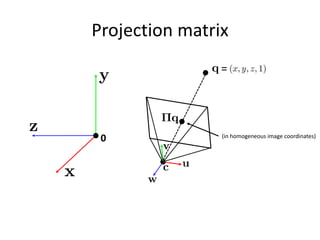
Projection matrix
0
=
(in homogeneous image coordinates)
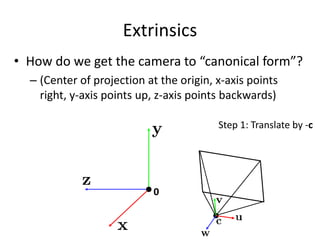
Extrinsics
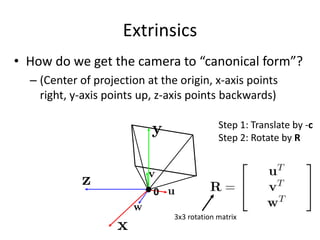
• How do we get the camera to “canonical form”?
– (Center of projection at the origin, x-axis points
right, y-axis points up, z-axis points backwards)
0
Step 1: Translate by -c
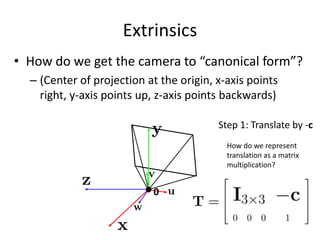
Extrinsics
• How do we get the camera to “canonical form”?
– (Center of projection at the origin, x-axis points
right, y-axis points up, z-axis points backwards)
0
Step 1: Translate by -c
How do we represent
translation as a matrix
multiplication?
Extrinsics
• How do we get the camera to “canonical form”?
– (Center of projection at the origin, x-axis points
right, y-axis points up, z-axis points backwards)
0
Step 1: Translate by -c
Step 2: Rotate by R
3x3 rotation matrix
Extrinsics
• How do we get the camera to “canonical form”?
– (Center of projection at the origin, x-axis points
right, y-axis points up, z-axis points backwards)
0
Step 1: Translate by -c
Step 2: Rotate by R
(with extra row/column of [0 0 0 1])
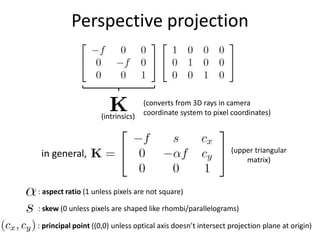
Perspective projection
(intrinsics)
in general,
: aspect ratio (1 unless pixels are not square)
: skew (0 unless pixels are shaped like rhombi/parallelograms)
: principal point ((0,0) unless optical axis doesn’t intersect projection plane at origin)
(upper triangular
matrix)
(converts from 3D rays in camera
coordinate system to pixel coordinates)
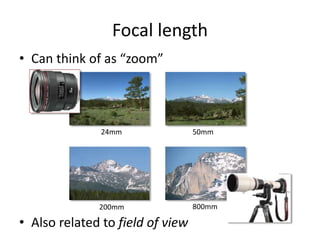
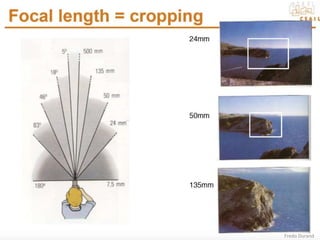
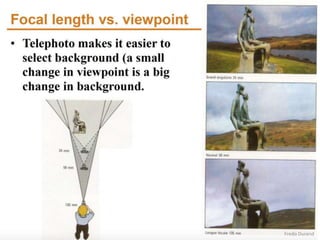
Focal length
• Can think of as “zoom”
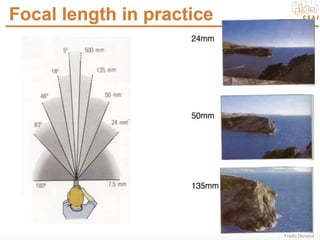
• Also related to field of view
24mm 50mm
200mm 800mm
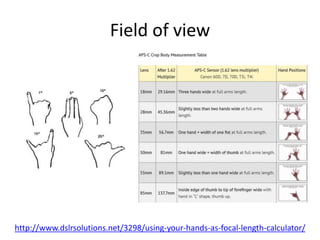
Field of view
http://www.dslrsolutions.net/3298/using-your-hands-as-focal-length-calculator/
Fredo Durand
Fredo Durand
Fredo Durand
Fredo Durand
Fredo Durand
http://petapixel.com/2013/01/11/how-focal-length-affects-your-subjects-apparent-weight-as-seen-with-a-cat/
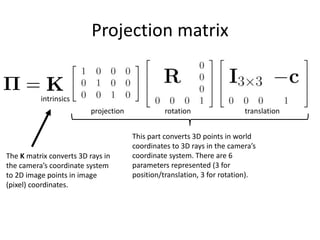
Projection matrix
translationrotationprojection
intrinsics
This part converts 3D points in world
coordinates to 3D rays in the camera’s
coordinate system. There are 6
parameters represented (3 for
position/translation, 3 for rotation).
The K matrix converts 3D rays in
the camera’s coordinate system
to 2D image points in image
(pixel) coordinates.
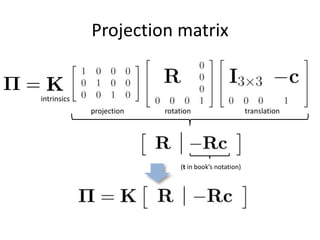
Projection matrix
(t in book’s notation)
translationrotationprojection
intrinsics
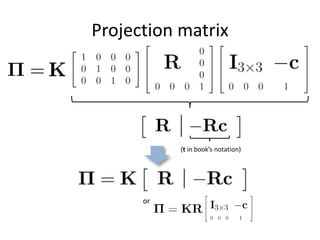
Projection matrix
(t in book’s notation)
or
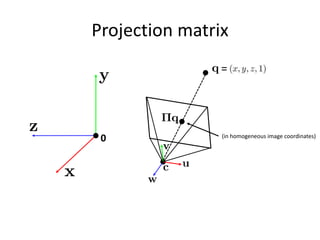
Projection matrix
0
=
(in homogeneous image coordinates)
Questions?
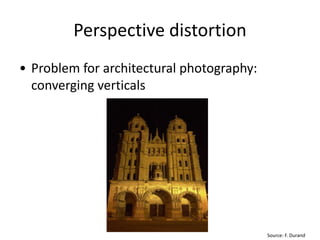
Perspective distortion
• Problem for architectural photography:
converging verticals
Source: F. Durand
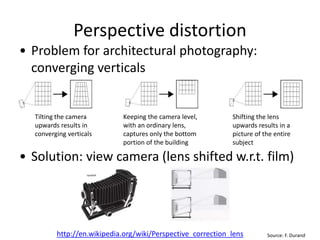
Perspective distortion
• Problem for architectural photography:
converging verticals
• Solution: view camera (lens shifted w.r.t. film)
Source: F. Durand
Tilting the camera
upwards results in
converging verticals
Keeping the camera level,
with an ordinary lens,
captures only the bottom
portion of the building
Shifting the lens
upwards results in a
picture of the entire
subject
http://en.wikipedia.org/wiki/Perspective_correction_lens
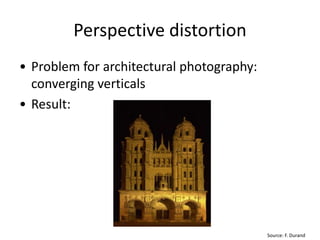
Perspective distortion
• Problem for architectural photography:
converging verticals
• Result:
Source: F. Durand
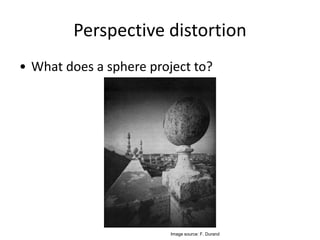
Perspective distortion
• What does a sphere project to?
Image source: F. Durand
Perspective distortion
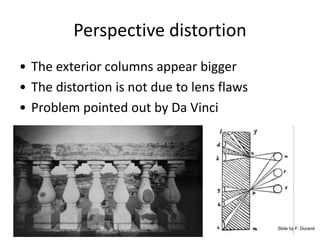
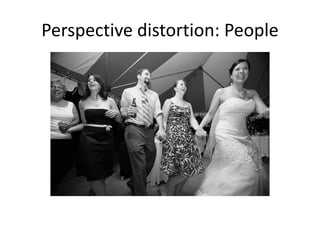
• The exterior columns appear bigger
• The distortion is not due to lens flaws
• Problem pointed out by Da Vinci
Slide by F. Durand
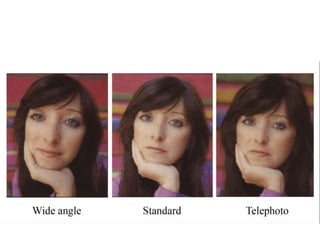
Perspective distortion: People
Distortion
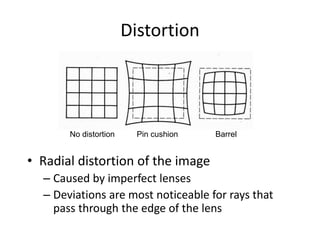
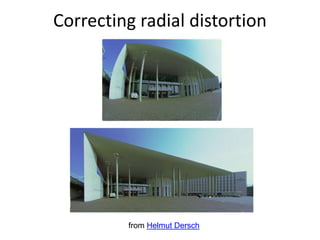
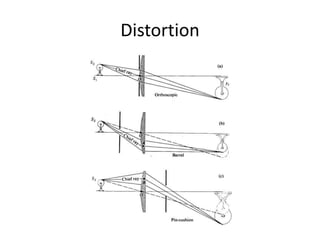
• Radial distortion of the image
– Caused by imperfect lenses
– Deviations are most noticeable for rays that
pass through the edge of the lens
No distortion Pin cushion Barrel
Correcting radial distortion
from Helmut Dersch
Distortion
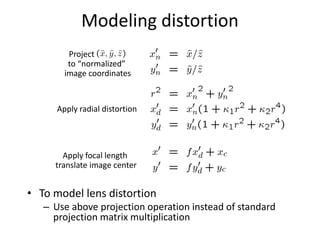
Modeling distortion
• To model lens distortion
– Use above projection operation instead of standard
projection matrix multiplication
Apply radial distortion
Apply focal length
translate image center
Project
to “normalized”
image coordinates
Other types of projection
• Lots of intriguing variants…
• (I’ll just mention a few fun ones)
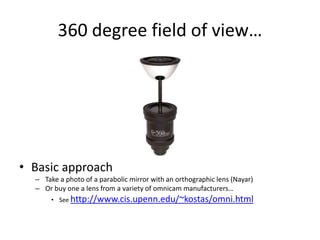
360 degree field of view…
• Basic approach
– Take a photo of a parabolic mirror with an orthographic lens (Nayar)
– Or buy one a lens from a variety of omnicam manufacturers…
• See http://www.cis.upenn.edu/~kostas/omni.html
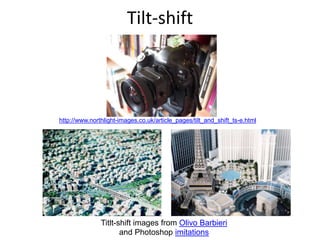
Tilt-shift
Titlt-shift images from Olivo Barbieri
and Photoshop imitations
http://www.northlight-images.co.uk/article_pages/tilt_and_shift_ts-e.html
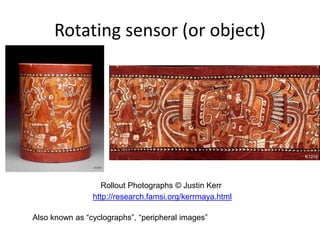
Rollout Photographs © Justin Kerr
http://research.famsi.org/kerrmaya.html
Rotating sensor (or object)
Also known as “cyclographs”, “peripheral images”

Computer Vision - cameras