The Calamitous 14th century
The Little Ice Age,
The Hundred Years’ War,
The Black Death,
The Great Schism
Mini Ice Age (1250-1850)
► Climate change- growth of
the ice sheets
• Too much rain
• Some summers with snow in
every month
• Crops failed
• Animals died
• People weakened from lack
of food
► More susceptible todisease
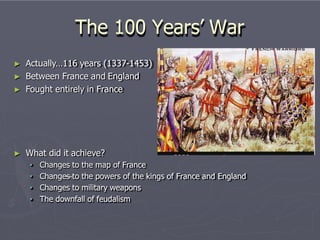
The 100 Years’ War
► Actually…116 years (1337-1453)
► Between France and England
► Fought entirely in France
► What did it achieve?
• Changes to the map of France
• Changes to the powers of the kings of France and England
• Changes to military weapons
• The downfall of feudalism
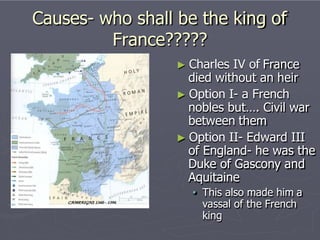
Causes- who shall be the king of
France?????
► Charles IV of France
died without an heir
► Option I- a French
nobles but…. Civil war
between them
► Option II- Edward III
of England- he was the
Duke of Gascony and
Aquitaine
• This also made him a
vassal of the French
king
Major Battles and Figures-
Round I
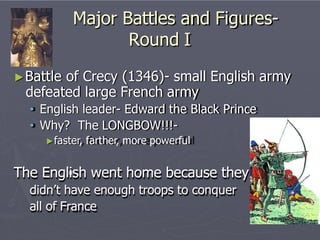
►Battle of Crecy (1346)- small English army
defeated large French army
• English leader- Edward the Black Prince
• Why? The LONGBOW!!!-
►faster, farther, more powerful
The English went home because they
didn’t have enough troops to conquer
all of France
Interlude…..
►The Black Death!!!
(1346-1352)
►The Great Schism!
(1378-1415)
Okay…. Back to war
England and France stopped fighting several times
during the Hundred Years War because of other
factors like plague and religious conflict. Also,
most warfare was conducted in the summer. It
was not 117 years of total war.
Major Battles and Figures-
Round II
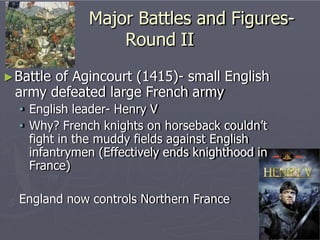
►Battle of Agincourt (1415)- small English
army defeated large French army
• English leader- Henry V
• Why? French knights on horseback couldn’t
fight in the muddy fields against English
infantrymen (Effectively ends knighthood in
France)
England now controls Northern France
Major Battles and Figures- Round III
► The Battle of Orleans (1429)- French troops
defeated the English trying to capture the city
• French hero- Joan of Arc- young girl who had visions of
saving France, got approval of French prince, dressed
as a man and led the French troops
• She is later captured by the English, burned as a
heretic and then made the patron saint of France
French begin to push out the English
Major Battles and Figures- Round IV
►Battle of Castillon, Bourdeaux (1453)-
French victory over the English
• Why? Use of cannon!!!
England gives up all territory in
France except for Calais
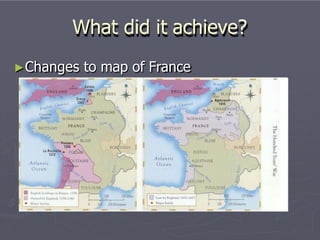
What did it achieve?
►Changes to map of France
Changes to the power of the kings
France
Kings become more powerful
-civil war between nobles
ends
- uses the taille [tax] to
increase his treasury
support of the king
England
Rise of French nationalism in Kings become less powerful
- 1341 law states that
Parliament (a council of nobles)
has to approve all taxes
Nobles become more powerful->
leads to civil war- War of the
Roses (ended 1485 by Henry
VII)
Weaponry: the downfall of Feudalism
Longbow:
can kill from a distance thus neutralizing the
power of the knight on horseback
Cannons:
can blow holes through castle walls
Therefore…No more knights? No more castles?
No more feudalism!!!!!
Switch to professional armies loyal to the king,
or whomever paid them – no feudal loyalties
The Black Death (overview)
► 1346-1352
► Spread from Asia to Europe
► Killed 1/3 to 1/2 of the
population (50 - 75 million)
► Up to 50% of some cities
and entire towns and villages
ESPN Effects
►E: manorial/agricultural base
begins to shift to cities and
craftsmen due to loss of serfs
►S: Serfdom ends, the Catholic
Church loses power
►P: kings gain power over noble
and the Church
►N: urban centers [cities] rise,
less dependency on the land
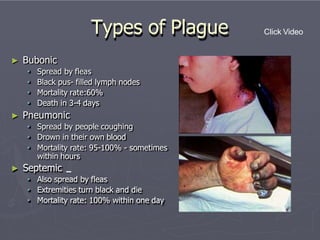
Types of Plague
► Bubonic
• Spread by fleas
• Black pus- filled lymph nodes
• Mortality rate:60%
• Death in 3-4 days
► Pneumonic
• Spread by people coughing
• Drown in their own blood
• Mortality rate: 95-100% - sometimes
within hours
► Septemic
• Also spread by fleas
• Extremities turn black and die
• Mortality rate: 100% within one day
Click Video
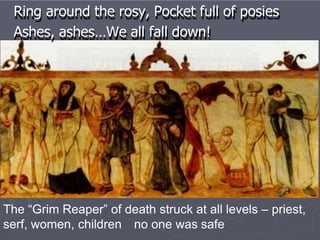
Ring around the rosy, Pocket full of posies
Ashes, ashes…We all fall down!
The “Grim Reaper” of death struck at all levels – priest,
serf, women, children no one was safe
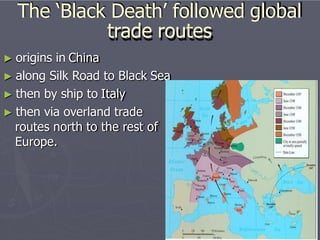
The ‘Black Death’ followed global
trade routes
► origins in China
► along Silk Road to Black Sea
► then by ship to Italy
► then via overland trade
routes north to the rest of
Europe.
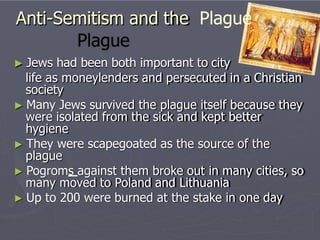
Anti-Semitism and the Plague
► Jews had been both important to city
life as moneylenders and persecuted in a Christian
society
► Many Jews survived the plague itself because they
were isolated from the sick and kept better
hygiene
► They were scapegoated as the source of the
plague
► Pogroms against them broke out in many cities, so
many moved to Poland and Lithuania
► Up to 200 were burned at the stake in one day
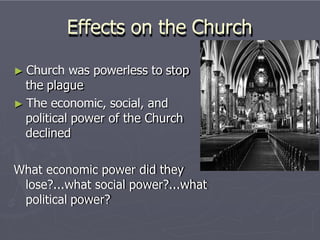
Effects on the Church
► Church was powerless to stop
the plague
► The economic, social, and
political power of the Church
declined
What economic power did they
lose?...what social power?...what
political power?
The Great Schism [split]
(1378- 1417)
► Began as an argument between the King of France
and the Pope- Who has more power and authority?
► 1305- old pope dies, new one is French-> moves
from Rome to Avignon, France where the Popes
stay until 1377…advantage France
► 1377- Pope Urban VI is elected in Rome –
advantage the Catholic Church
► French Cardinals refuse to recognize Urban VI and
elect their own Pope
• Now there are 2 Popes!!! (one in Rome, one in Avignon)
► 1408 Kings call a Council to elect a new Pope.
However, both old Popes refuse to step down, now
there are three popes!!!!!
► 1417 a Council removes all three popes and selected
Pope Martin V which ends the Great Schism.
► The Pope would never again be able to successfully
challenge the power of the kings in Europe.
The Great Schism Continues
► The two Popes excommunicated each other along
with the people who followed them. Now all
Catholic Christians [throughout Europe] were going
to Hell….Advantage: other power structures - kings
14th Century Economic Effects
Peasants:
Smaller labor supply: as farm
workers decreased, wages
increased
Per capita income increased:
there were fewer people
[Black Death].
Cost of food decreased due to
decreased demand
Serfs left land -,went to cities
and craftsmen [artisans]
Wages soared
Nobles:
land is worth less
serfs leave land reducing
the workforce
fewer crops to harvest
and sales were at low
prices – less income
rising prices for newly
manufactured goods
Political Effects
Peasants:
► revolts in France, England, Spain and Holy Roman Empire as
new laws forced them to stay on the land and froze wages-
laws failed
Nobles:
► Nobles lost military and political power as kings gained power
► As professional, paid armies loyal to the king grow the power
and usefulness of the knight/noble as a feudal ‘army’ declines
Cities:
► Charters allow cities to govern themselves
► City governments gave more voice to craft guilds as demand
for their goods increased
The End Result of the Calamitous
14th Century
► By the mid 15th century, largely due to plague and
warfare Western Europe lost 1/3 of its population
► Rural economies were destroyed
► Cities recover more quickly and craftsmen emerge
poised to embark on the industrial revolution
► Kings emerge as the dominant political force with
the nobles and Church trying to find their footing.
• The seeds which will grow into the English parliamentary
system are rooted.
• The power and role of the Church is drastically changed.

Calamitous 14th century (2)

  • 1.
    The Calamitous 14thcentury The Little Ice Age, The Hundred Years’ War, The Black Death, The Great Schism
  • 2.
    Mini Ice Age(1250-1850) ► Climate change- growth of the ice sheets • Too much rain • Some summers with snow in every month • Crops failed • Animals died • People weakened from lack of food ► More susceptible todisease
  • 3.
    The 100 Years’War ► Actually…116 years (1337-1453) ► Between France and England ► Fought entirely in France ► What did it achieve? • Changes to the map of France • Changes to the powers of the kings of France and England • Changes to military weapons • The downfall of feudalism
  • 4.
    Causes- who shallbe the king of France????? ► Charles IV of France died without an heir ► Option I- a French nobles but…. Civil war between them ► Option II- Edward III of England- he was the Duke of Gascony and Aquitaine • This also made him a vassal of the French king
  • 5.
    Major Battles andFigures- Round I ►Battle of Crecy (1346)- small English army defeated large French army • English leader- Edward the Black Prince • Why? The LONGBOW!!!- ►faster, farther, more powerful The English went home because they didn’t have enough troops to conquer all of France
  • 6.
    Interlude….. ►The Black Death!!! (1346-1352) ►TheGreat Schism! (1378-1415) Okay…. Back to war England and France stopped fighting several times during the Hundred Years War because of other factors like plague and religious conflict. Also, most warfare was conducted in the summer. It was not 117 years of total war.
  • 7.
    Major Battles andFigures- Round II ►Battle of Agincourt (1415)- small English army defeated large French army • English leader- Henry V • Why? French knights on horseback couldn’t fight in the muddy fields against English infantrymen (Effectively ends knighthood in France) England now controls Northern France
  • 8.
    Major Battles andFigures- Round III ► The Battle of Orleans (1429)- French troops defeated the English trying to capture the city • French hero- Joan of Arc- young girl who had visions of saving France, got approval of French prince, dressed as a man and led the French troops • She is later captured by the English, burned as a heretic and then made the patron saint of France French begin to push out the English
  • 9.
    Major Battles andFigures- Round IV ►Battle of Castillon, Bourdeaux (1453)- French victory over the English • Why? Use of cannon!!! England gives up all territory in France except for Calais
  • 10.
    What did itachieve? ►Changes to map of France
  • 11.
    Changes to thepower of the kings France Kings become more powerful -civil war between nobles ends - uses the taille [tax] to increase his treasury support of the king England Rise of French nationalism in Kings become less powerful - 1341 law states that Parliament (a council of nobles) has to approve all taxes Nobles become more powerful-> leads to civil war- War of the Roses (ended 1485 by Henry VII)
  • 12.
    Weaponry: the downfallof Feudalism Longbow: can kill from a distance thus neutralizing the power of the knight on horseback Cannons: can blow holes through castle walls Therefore…No more knights? No more castles? No more feudalism!!!!! Switch to professional armies loyal to the king, or whomever paid them – no feudal loyalties
  • 14.
    The Black Death(overview) ► 1346-1352 ► Spread from Asia to Europe ► Killed 1/3 to 1/2 of the population (50 - 75 million) ► Up to 50% of some cities and entire towns and villages ESPN Effects ►E: manorial/agricultural base begins to shift to cities and craftsmen due to loss of serfs ►S: Serfdom ends, the Catholic Church loses power ►P: kings gain power over noble and the Church ►N: urban centers [cities] rise, less dependency on the land
  • 15.
    Types of Plague ►Bubonic • Spread by fleas • Black pus- filled lymph nodes • Mortality rate:60% • Death in 3-4 days ► Pneumonic • Spread by people coughing • Drown in their own blood • Mortality rate: 95-100% - sometimes within hours ► Septemic • Also spread by fleas • Extremities turn black and die • Mortality rate: 100% within one day Click Video
  • 16.
    Ring around therosy, Pocket full of posies Ashes, ashes…We all fall down! The “Grim Reaper” of death struck at all levels – priest, serf, women, children no one was safe
  • 17.
    The ‘Black Death’followed global trade routes ► origins in China ► along Silk Road to Black Sea ► then by ship to Italy ► then via overland trade routes north to the rest of Europe.
  • 18.
    Anti-Semitism and thePlague ► Jews had been both important to city life as moneylenders and persecuted in a Christian society ► Many Jews survived the plague itself because they were isolated from the sick and kept better hygiene ► They were scapegoated as the source of the plague ► Pogroms against them broke out in many cities, so many moved to Poland and Lithuania ► Up to 200 were burned at the stake in one day
  • 19.
    Effects on theChurch ► Church was powerless to stop the plague ► The economic, social, and political power of the Church declined What economic power did they lose?...what social power?...what political power?
  • 20.
    The Great Schism[split] (1378- 1417) ► Began as an argument between the King of France and the Pope- Who has more power and authority? ► 1305- old pope dies, new one is French-> moves from Rome to Avignon, France where the Popes stay until 1377…advantage France ► 1377- Pope Urban VI is elected in Rome – advantage the Catholic Church ► French Cardinals refuse to recognize Urban VI and elect their own Pope • Now there are 2 Popes!!! (one in Rome, one in Avignon)
  • 21.
    ► 1408 Kingscall a Council to elect a new Pope. However, both old Popes refuse to step down, now there are three popes!!!!! ► 1417 a Council removes all three popes and selected Pope Martin V which ends the Great Schism. ► The Pope would never again be able to successfully challenge the power of the kings in Europe. The Great Schism Continues ► The two Popes excommunicated each other along with the people who followed them. Now all Catholic Christians [throughout Europe] were going to Hell….Advantage: other power structures - kings
  • 22.
    14th Century EconomicEffects Peasants: Smaller labor supply: as farm workers decreased, wages increased Per capita income increased: there were fewer people [Black Death]. Cost of food decreased due to decreased demand Serfs left land -,went to cities and craftsmen [artisans] Wages soared Nobles: land is worth less serfs leave land reducing the workforce fewer crops to harvest and sales were at low prices – less income rising prices for newly manufactured goods
  • 23.
    Political Effects Peasants: ► revoltsin France, England, Spain and Holy Roman Empire as new laws forced them to stay on the land and froze wages- laws failed Nobles: ► Nobles lost military and political power as kings gained power ► As professional, paid armies loyal to the king grow the power and usefulness of the knight/noble as a feudal ‘army’ declines Cities: ► Charters allow cities to govern themselves ► City governments gave more voice to craft guilds as demand for their goods increased
  • 24.
    The End Resultof the Calamitous 14th Century ► By the mid 15th century, largely due to plague and warfare Western Europe lost 1/3 of its population ► Rural economies were destroyed ► Cities recover more quickly and craftsmen emerge poised to embark on the industrial revolution ► Kings emerge as the dominant political force with the nobles and Church trying to find their footing. • The seeds which will grow into the English parliamentary system are rooted. • The power and role of the Church is drastically changed.