Ways of the World
A Brief Global History with Sources
2nd Edition
CHAPTER 7
Commerce and Culture
500–1500
Copyright © 2011 by Bedford/St. Martin’s
Robert Strayer
How Is Trade Significant?
What spreads along trade
routes that changes lives?
Margin Review Questions
1 thru 5
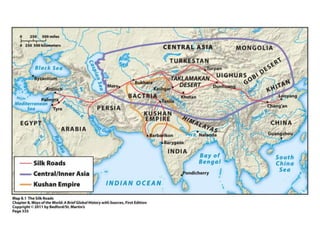
Silk Roads
Q1 - pg 318 - What lay behind the
emergence of Silk Road commerce, and
what kept it going for so many centuries?
Warm climate and demand for goods from outer Eurasia,
Classical civilizations and their imperial states during the last
five centuries B.C.E.
Classical civilizations invaded the territory of pastoral
peoples, securing sections of the Silk Roads and providing
security for merchants and travelers.
The Silk Road had the continued support of later states,
including the Byzantine, Abbasid, and Mongol empires, which
also benefited from the trade.
There was a continuing demand for hard-to- find luxury
goods among elites across Eurasia.
Q2 - pg. 320 - What made silk such a
highly desired commodity across
Eurasia?
Silk was used as currency and as a means of
accumulating wealth in Central Asia.
It became a symbol of high status in China and
the Byzantine Empire.
It became associated with the sacred in the
expanding world religions of Buddhism and
Christianity.
Q3 – pg. 321 - What were the major
economic, social, and cultural
consequences of Silk Road commerce?
• Peasant farmers in the Yangzi River delta of
southern China sometimes gave up the cultivation
of food crops, choosing to focus instead on
producing silk, paper, porcelain, lacquerware, or
iron tools, much of which was destined for the
markets of the Silk Roads.
• Favorably placed individuals could benefit
enormously from long-distance trade; some
merchants accumulated considerable fortunes.
• Religions depended on beautiful and elaborate
silk decorations manufactured in the Muslim world
Q4 – pg. 322 - What accounted for the
spread of Buddhism along the silk roads?
• Buddhism appealed to Indian merchants, who preferred its
universal message to that of a Brahmin- dominated
Hinduism that privileged the higher castes.
• Many inhabitants of the sophisticated and prosperous oasis
cities of Central Asia that engaged in long-distance trade
found in Buddhism a link to the larger, wealthy, and
prestigious civilization of India. This resulted in many
voluntary conversions.
• Well-to-do Buddhist merchants built monasteries and
supported monks to earn religious merit. These monasteries
in turn provided convenient and culturally familiar places of
rest and resupply for merchants making the trek across
Central Asia.
Q4 – pg. 322 - What accounted for the
spread of Buddhism along the silk roads?
• Buddhism progressed only slowly among
pastoral peoples of Central Asia. It had its
greatest success when pastoralists engaged in
long-distance trade or came to rule settled
peoples.
• In China, Buddhism remained for many
centuries a religion of foreign merchants or
foreign rulers. Only slowly did it become
popular among the Chinese themselves.
Q4 – pg. 322 - What accounted for the
spread of Buddhism along the silk roads?
• As it spread, Buddhism changed, and some of these
changes may have made it more appealing to local
populations. In particular, the Mahayana form of
Buddhism flourished, its emphasis on compassion and
the possibility of earning merit making it more appealing
than the more austere psychological teachings of the
original Buddha.
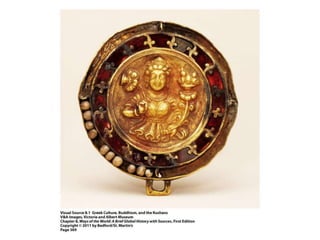
• As it spread, Buddhism picked up elements of other
cultures, including Greek influences,and the gods of
many peoples along the Silk Roads were incorporated
into Buddhist practice as bodhisattvas.
Trade and the Silk Road
worksheet
How Was Trade Significant along
Silk Road from 500-1500 CE?
a.Economically
a.Import salt from distant mines in
Sahara in exchange for gold
b.Specialize in producing products
for trade rather than for personal
use
c.Diminished economic self-
sufficiency of local societies
How Was Trade Significant along
Silk Road from 500-1500 CE?
a.Politically
a.Wealth from controlling and
taxing trade motivated creation
of states, nations
b. Problem: should trade be
controlled by the state, as in the
Inca empire? Or left in private
hands, like in the Aztec Empire?
How Was Trade Significant along
Silk Road from 500-1500 CE?
a.Socially
a.Traders became distinct social group
b.Migrant traders became suspicious by
accumulating wealth
c.Rise in social status, Chinese merchants
buying land, becoming wealthy
d.Social status high if you acquired
prestigious goods from a distance - silk,
tortoiseshells, rhino horn, feathers
e.Rise is status due to contact with foreign
lands and their elite
How Was Trade Significant along
Silk Road from 500-1500 CE?
a.Religion
a.Spread of religious ideas:
b.Buddhism from India to
Central and East Asia
c.Islam from Arabia to Egypt and
Sahara all the way to West
Africa
How Was Trade Significant along
Silk Road from 500-1500 CE?
a.Disease
a.Pathogens (bacteria, virus or
microorganism that can cause
disease) devastated much of
Eurasia during Black death in
1300’s
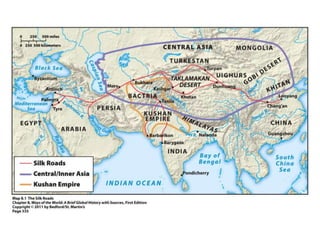
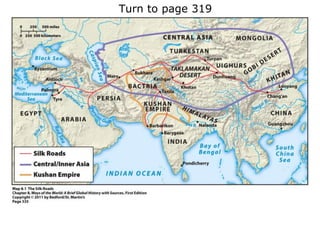
Turn to page 319
Margin Review Questions
6 thru 9
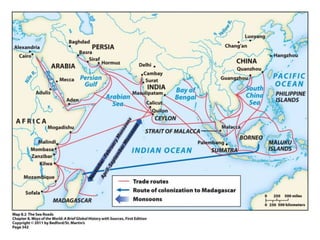
Sea Roads
Activities:
1.Margin Review Questions 6-9
2.Map activity 8.1 online
3.MC review questions
Q5 – pg. 323 - What was the impact of
disease along the Silk Roads?
• Contact led to peoples being exposed to unfamiliar diseases to
which they had little immunity or effective methods of coping
• The spread of some particularly virulent epidemic diseases led
to deaths on a large scale.
• Worst example: 14th century Black Death killed 1/3 of the
population in Europe, China, and the Middle East.
• In the long run, exchange of diseases gave Europeans the
advantage when after 1500, they confronted the peoples of the
Western Hemisphere, who had little natural protection from the
diseases of the Eastern Hemisphere.
Sea Roads – comparisons between kinds
of goods traded along the Silk Roads and
the Indian Ocean network.
• Transportation costs were lower on the Sea Roads than on the
Silk Roads
• Ships were larger and could accommodate heavier cargoes than
camels
• Sea Roads could carry more bulk goods and products for mass
markets
• Silk Roads were limited to luxury goods for the few
• Sea Roads relied on wind currents known as Monsoons
• India was center of Sea Roads but not the Silk Roads
Q6 – pg. 327 - What lay behind the
flourishing of Indian Ocean commerce in
the post-classical (500-1450 CE)
millennium?
• China
• Economic and political revival of China during the Tang and Song
dynasties (618-1279 CE)
• China supplied and consumed products for Indian Ocean trading
• China provided great technologically advanced ships
• Islam
• Rise of Islam from 600 CE and its spread
• Islam friendly to business life
• Merchants from Arab Empire established communities in East Africa to
Chinese coast
• Conversion to Islam created international maritime culture that was
business-friendly
pg. 328 - What is the relationship between
the rise of Srivijaya and the world of India
Ocean commerce?
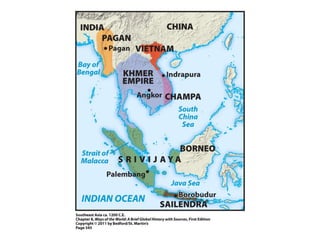
• Straight of Malacca became critical choke point of Indian Ocean commerce
• Srivijaya
• controlled the straights, the key all-sea area between India and China
• plentiful supply of good, spices,
• taxes to fund military navy
• taxes to fund sophisticated government
• monarchs used Buddhism and Indian political ideas, which gave it
acceptance among merchants
• capital city of Palembang was cosmopolitan (like Houston) with lots of fun
activities, attracting people
• created images of Buddha so the city became a major center of Buddhist
observance and teaching
Q9 p. 332 - What was the role of Swahili
civilization in the world of Indian Ocean
commerce?
• Economically
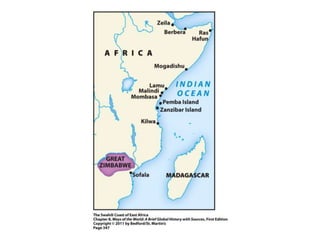
• Swahili cities provided business centers
• traded goods from sub-Saharan Africa to Indian
Ocean
• Culturally:
• Swahili civilization became Islamic
• Arabs came and settled here, also Persian merchants
• Swahili rulers claimed Arab or Persian origins to
bolster their authority
• Swahili was a Bantu African language, but written
Turn to page 319 for a map
activity
http://bcs.bedfordstmartins.com/strayer1e/default.asp?
Map Activity 7.1 Sea Roads
http://bcs.bedfordstmartins.com/strayer1e/default.asp?
Margin Review Questions
10 thru 11
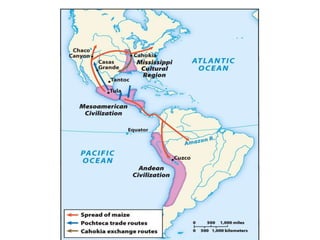
Sand Roads/Americas
Activities:
1.Margin Review Questions 10-11
2.Map activity 7.2 online
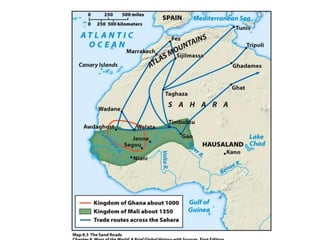
Q10 p. 335 - What changes did trans-
Saharan trade bring to West Africa?
• It provided both incentives and resources for the
construction of new and larger political structures,
• including the city-states of the Hausa people and the
empires of Ghana, Mali, Songhay, and Kanem.
• These Sudanic states established substantial urban and
commercial centers where traders congregated and goods
were exchanged.
• Some also became manufacturing centers, creating finely
wrought beads, iron tools, or cotton textiles for trade.
• Islam accompanied trade and became an important element
in the urban culture of West Africa.
• The spread of agricultural products was slower than in
Eurasia
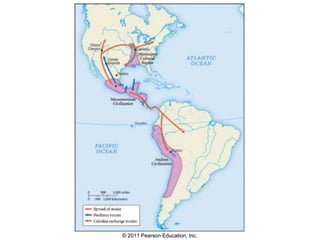
• North/South orientation of the Americas meant
agricultural practices adapted to distinct climate and
vegetation zones
• East/West orientation of Eurasia same climate and
vegetation zones
• Americas had no equivalent to spread of distinct cultural
traditions like Buddhism, Christianity, or Islam that
helped to integrate distant peoples in Afro-Eurasian Web
Q11 - In what ways did networks of interaction in
the Western Hemisphere differ from those in the
Eastern Hemisphere?
Q11 - In what ways did networks of interaction in
the Western Hemisphere differ from those in the
Eastern Hemisphere?
• In the Americas, the most active and dense trading
and communication networks lay within, rather than
between...
• Mesoamerica and the Andes regions of two great
civilizations
Map Activity 7.2 Sand Roads
© 2011 Pearson Education, Inc.© 2011 Pearson Education, Inc.
Strayer chapter 7 ppt.

Strayer chapter 7 ppt.

  • 1.
    Ways of theWorld A Brief Global History with Sources 2nd Edition CHAPTER 7 Commerce and Culture 500–1500 Copyright © 2011 by Bedford/St. Martin’s Robert Strayer
  • 2.
    How Is TradeSignificant? What spreads along trade routes that changes lives?
  • 4.
    Margin Review Questions 1thru 5 Silk Roads
  • 5.
    Q1 - pg318 - What lay behind the emergence of Silk Road commerce, and what kept it going for so many centuries? Warm climate and demand for goods from outer Eurasia, Classical civilizations and their imperial states during the last five centuries B.C.E. Classical civilizations invaded the territory of pastoral peoples, securing sections of the Silk Roads and providing security for merchants and travelers. The Silk Road had the continued support of later states, including the Byzantine, Abbasid, and Mongol empires, which also benefited from the trade. There was a continuing demand for hard-to- find luxury goods among elites across Eurasia.
  • 6.
    Q2 - pg.320 - What made silk such a highly desired commodity across Eurasia? Silk was used as currency and as a means of accumulating wealth in Central Asia. It became a symbol of high status in China and the Byzantine Empire. It became associated with the sacred in the expanding world religions of Buddhism and Christianity.
  • 7.
    Q3 – pg.321 - What were the major economic, social, and cultural consequences of Silk Road commerce? • Peasant farmers in the Yangzi River delta of southern China sometimes gave up the cultivation of food crops, choosing to focus instead on producing silk, paper, porcelain, lacquerware, or iron tools, much of which was destined for the markets of the Silk Roads. • Favorably placed individuals could benefit enormously from long-distance trade; some merchants accumulated considerable fortunes. • Religions depended on beautiful and elaborate silk decorations manufactured in the Muslim world
  • 8.
    Q4 – pg.322 - What accounted for the spread of Buddhism along the silk roads? • Buddhism appealed to Indian merchants, who preferred its universal message to that of a Brahmin- dominated Hinduism that privileged the higher castes. • Many inhabitants of the sophisticated and prosperous oasis cities of Central Asia that engaged in long-distance trade found in Buddhism a link to the larger, wealthy, and prestigious civilization of India. This resulted in many voluntary conversions. • Well-to-do Buddhist merchants built monasteries and supported monks to earn religious merit. These monasteries in turn provided convenient and culturally familiar places of rest and resupply for merchants making the trek across Central Asia.
  • 9.
    Q4 – pg.322 - What accounted for the spread of Buddhism along the silk roads? • Buddhism progressed only slowly among pastoral peoples of Central Asia. It had its greatest success when pastoralists engaged in long-distance trade or came to rule settled peoples. • In China, Buddhism remained for many centuries a religion of foreign merchants or foreign rulers. Only slowly did it become popular among the Chinese themselves.
  • 10.
    Q4 – pg.322 - What accounted for the spread of Buddhism along the silk roads? • As it spread, Buddhism changed, and some of these changes may have made it more appealing to local populations. In particular, the Mahayana form of Buddhism flourished, its emphasis on compassion and the possibility of earning merit making it more appealing than the more austere psychological teachings of the original Buddha. • As it spread, Buddhism picked up elements of other cultures, including Greek influences,and the gods of many peoples along the Silk Roads were incorporated into Buddhist practice as bodhisattvas.
  • 11.
    Trade and theSilk Road worksheet
  • 12.
    How Was TradeSignificant along Silk Road from 500-1500 CE? a.Economically a.Import salt from distant mines in Sahara in exchange for gold b.Specialize in producing products for trade rather than for personal use c.Diminished economic self- sufficiency of local societies
  • 13.
    How Was TradeSignificant along Silk Road from 500-1500 CE? a.Politically a.Wealth from controlling and taxing trade motivated creation of states, nations b. Problem: should trade be controlled by the state, as in the Inca empire? Or left in private hands, like in the Aztec Empire?
  • 14.
    How Was TradeSignificant along Silk Road from 500-1500 CE? a.Socially a.Traders became distinct social group b.Migrant traders became suspicious by accumulating wealth c.Rise in social status, Chinese merchants buying land, becoming wealthy d.Social status high if you acquired prestigious goods from a distance - silk, tortoiseshells, rhino horn, feathers e.Rise is status due to contact with foreign lands and their elite
  • 15.
    How Was TradeSignificant along Silk Road from 500-1500 CE? a.Religion a.Spread of religious ideas: b.Buddhism from India to Central and East Asia c.Islam from Arabia to Egypt and Sahara all the way to West Africa
  • 16.
    How Was TradeSignificant along Silk Road from 500-1500 CE? a.Disease a.Pathogens (bacteria, virus or microorganism that can cause disease) devastated much of Eurasia during Black death in 1300’s
  • 18.
  • 19.
    Margin Review Questions 6thru 9 Sea Roads Activities: 1.Margin Review Questions 6-9 2.Map activity 8.1 online 3.MC review questions
  • 21.
    Q5 – pg.323 - What was the impact of disease along the Silk Roads? • Contact led to peoples being exposed to unfamiliar diseases to which they had little immunity or effective methods of coping • The spread of some particularly virulent epidemic diseases led to deaths on a large scale. • Worst example: 14th century Black Death killed 1/3 of the population in Europe, China, and the Middle East. • In the long run, exchange of diseases gave Europeans the advantage when after 1500, they confronted the peoples of the Western Hemisphere, who had little natural protection from the diseases of the Eastern Hemisphere.
  • 22.
    Sea Roads –comparisons between kinds of goods traded along the Silk Roads and the Indian Ocean network. • Transportation costs were lower on the Sea Roads than on the Silk Roads • Ships were larger and could accommodate heavier cargoes than camels • Sea Roads could carry more bulk goods and products for mass markets • Silk Roads were limited to luxury goods for the few • Sea Roads relied on wind currents known as Monsoons • India was center of Sea Roads but not the Silk Roads
  • 23.
    Q6 – pg.327 - What lay behind the flourishing of Indian Ocean commerce in the post-classical (500-1450 CE) millennium? • China • Economic and political revival of China during the Tang and Song dynasties (618-1279 CE) • China supplied and consumed products for Indian Ocean trading • China provided great technologically advanced ships • Islam • Rise of Islam from 600 CE and its spread • Islam friendly to business life • Merchants from Arab Empire established communities in East Africa to Chinese coast • Conversion to Islam created international maritime culture that was business-friendly
  • 25.
    pg. 328 -What is the relationship between the rise of Srivijaya and the world of India Ocean commerce? • Straight of Malacca became critical choke point of Indian Ocean commerce • Srivijaya • controlled the straights, the key all-sea area between India and China • plentiful supply of good, spices, • taxes to fund military navy • taxes to fund sophisticated government • monarchs used Buddhism and Indian political ideas, which gave it acceptance among merchants • capital city of Palembang was cosmopolitan (like Houston) with lots of fun activities, attracting people • created images of Buddha so the city became a major center of Buddhist observance and teaching
  • 27.
    Q9 p. 332- What was the role of Swahili civilization in the world of Indian Ocean commerce? • Economically • Swahili cities provided business centers • traded goods from sub-Saharan Africa to Indian Ocean • Culturally: • Swahili civilization became Islamic • Arabs came and settled here, also Persian merchants • Swahili rulers claimed Arab or Persian origins to bolster their authority • Swahili was a Bantu African language, but written
  • 28.
    Turn to page319 for a map activity http://bcs.bedfordstmartins.com/strayer1e/default.asp?
  • 29.
    Map Activity 7.1Sea Roads http://bcs.bedfordstmartins.com/strayer1e/default.asp?
  • 30.
    Margin Review Questions 10thru 11 Sand Roads/Americas Activities: 1.Margin Review Questions 10-11 2.Map activity 7.2 online
  • 32.
    Q10 p. 335- What changes did trans- Saharan trade bring to West Africa? • It provided both incentives and resources for the construction of new and larger political structures, • including the city-states of the Hausa people and the empires of Ghana, Mali, Songhay, and Kanem. • These Sudanic states established substantial urban and commercial centers where traders congregated and goods were exchanged. • Some also became manufacturing centers, creating finely wrought beads, iron tools, or cotton textiles for trade. • Islam accompanied trade and became an important element in the urban culture of West Africa.
  • 34.
    • The spreadof agricultural products was slower than in Eurasia • North/South orientation of the Americas meant agricultural practices adapted to distinct climate and vegetation zones • East/West orientation of Eurasia same climate and vegetation zones • Americas had no equivalent to spread of distinct cultural traditions like Buddhism, Christianity, or Islam that helped to integrate distant peoples in Afro-Eurasian Web Q11 - In what ways did networks of interaction in the Western Hemisphere differ from those in the Eastern Hemisphere?
  • 35.
    Q11 - Inwhat ways did networks of interaction in the Western Hemisphere differ from those in the Eastern Hemisphere? • In the Americas, the most active and dense trading and communication networks lay within, rather than between... • Mesoamerica and the Andes regions of two great civilizations
  • 36.
    Map Activity 7.2Sand Roads
  • 37.
    © 2011 PearsonEducation, Inc.© 2011 Pearson Education, Inc.