The Home Front, 1917-1918
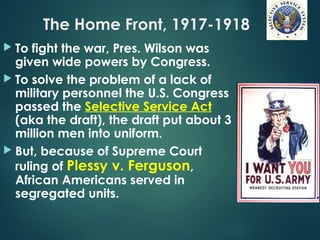
 To fight the war, Pres. Wilson was
given wide powers by Congress.
 To solve the problem of a lack of
military personnel the U.S. Congress
passed the Selective Service Act
(aka the draft), the draft put about 3
million men into uniform.
 But, because of Supreme Court
ruling of Plessy v. Ferguson,
African Americans served in
segregated units.
The Home Front, 1917-1918
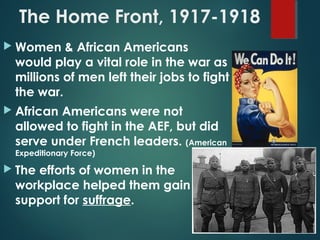
 Women & African Americans
would play a vital role in the war as
millions of men left their jobs to fight
the war.
 African Americans were not
allowed to fight in the AEF, but did
serve under French leaders. (American
Expeditionary Force)
 The efforts of women in the
workplace helped them gain
support for suffrage.
The Home Front, 1917-1918
 Almost 2 million men would serve in
Europe.
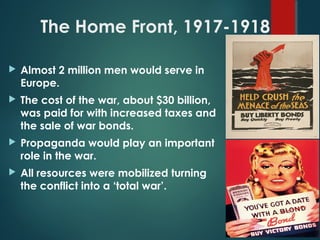
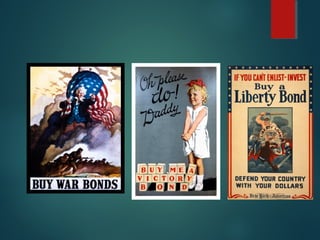
 The cost of the war, about $30 billion,
was paid for with increased taxes and
the sale of war bonds.
 Propaganda would play an important
role in the war.
 All resources were mobilized turning
the conflict into a ‘total war’.
The Home Front, 1917-1918
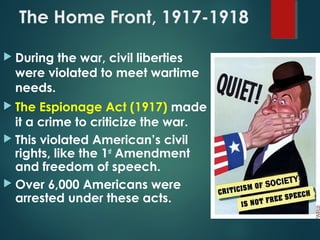
 During the war, civil liberties
were violated to meet wartime
needs.
 The Espionage Act (1917) made
it a crime to criticize the war.
 This violated American’s civil
rights, like the 1st
Amendment
and freedom of speech.
 Over 6,000 Americans were
arrested under these acts.
Heroes of the War
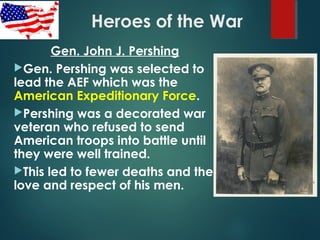
Gen. John J. Pershing
Gen. Pershing was selected to
lead the AEF which was the
American Expeditionary Force.
Pershing was a decorated war
veteran who refused to send
American troops into battle until
they were well trained.
This led to fewer deaths and the
love and respect of his men.
Heroes of the War
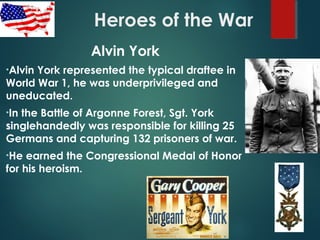
Alvin York
•Alvin York represented the typical draftee in
World War 1, he was underprivileged and
uneducated.
•In the Battle of Argonne Forest, Sgt. York
singlehandedly was responsible for killing 25
Germans and capturing 132 prisoners of war.
•He earned the Congressional Medal of Honor
for his heroism.
Battle of Argonne Forest
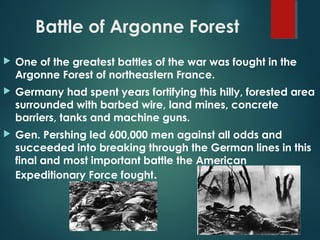
 One of the greatest battles of the war was fought in the
Argonne Forest of northeastern France.
 Germany had spent years fortifying this hilly, forested area
surrounded with barbed wire, land mines, concrete
barriers, tanks and machine guns.
 Gen. Pershing led 600,000 men against all odds and
succeeded into breaking through the German lines in this
final and most important battle the American
Expeditionary Force fought.
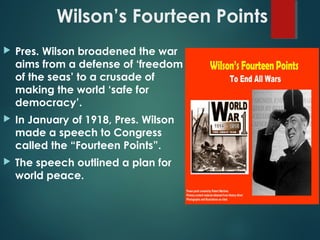
Wilson’s Fourteen Points
 Pres. Wilson broadened the war
aims from a defense of ‘freedom
of the seas’ to a crusade of
making the world ‘safe for
democracy’.
 In January of 1918, Pres. Wilson
made a speech to Congress
called the “Fourteen Points”.
 The speech outlined a plan for
world peace.
Wilson’s Fourteen Points
The Fourteen Points
Major European nationalities would be given right of self-
determination about their own country and governments.
Austria-Hungary and the Ottoman Empire would be
divided into smaller nations.
Wilson called for a reduction in arms, removal of trade
barriers, and an end to secret diplomacy.
The most important of all to Wilson was his plan
called the “League of Nation”, an organization to
mediate international disputes to avoid war.
The League of Nations
 Pres. Wilson campaigned across America and
with European leaders to gain support for his
League of Nations plan.
 But, Americans were not interested in giving
others the power to decide whether the USA
would go to war or not.
 European leaders argued with Wilson, because
they wanted a harsher punishment on Germany
than he did.
 Wilson’s plan was in jeopardy.
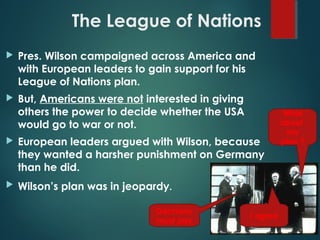
Germany
must pay
I agree
What
about
my
plan ?
The Treaty of Versailles
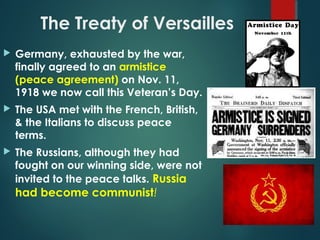
 Germany, exhausted by the war,
finally agreed to an armistice
(peace agreement) on Nov. 11,
1918 we now call this Veteran’s Day.
 The USA met with the French, British,
& the Italians to discuss peace
terms.
 The Russians, although they had
fought on our winning side, were not
invited to the peace talks. Russia
had become communist!
Terms of Treaty of Versailles
 Terms of the Treaty were very harsh, especially
on Germany.
 Germany:
Lost land they had taken
Lost their overseas colonies.
Demilitarization, reduce military size.
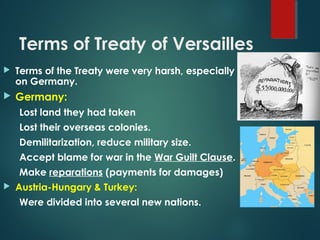
Accept blame for war in the War Guilt Clause.
Make reparations (payments for damages)
 Austria-Hungary & Turkey:
Were divided into several new nations.
Rejection of League of NationsRejection of League of Nations
 Opponents of the League of Nations
argued that it would drag the USA into
unwanted military commitments.
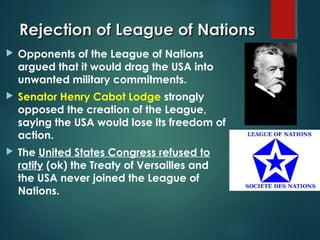
 Senator Henry Cabot Lodge strongly
opposed the creation of the League,
saying the USA would lose its freedom of
action.
 The United States Congress refused to
ratify (ok) the Treaty of Versailles and
the USA never joined the League of
Nations.
America Retreats to Isolationism
 By 1919, the American people hadBy 1919, the American people had
become disillusioned by world affairs.become disillusioned by world affairs.
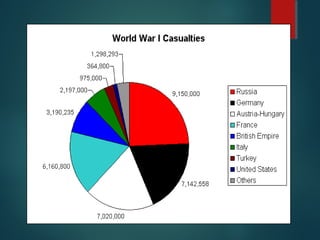
 Victory in WWI had come at a high priceVictory in WWI had come at a high price
in lives and dollars.in lives and dollars.
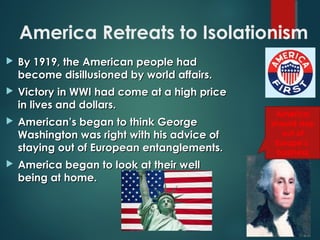
 American’s began to think GeorgeAmerican’s began to think George
Washington was right with his advice ofWashington was right with his advice of
staying out of European entanglements.staying out of European entanglements.
 America began to look at their wellAmerica began to look at their well
being at home.being at home.
America
should stay
out of
Europe’s
business
American Isolationism
• America turned to a policy of isolationism –
‘separating themselves from other countries’ affairs’.
• America turned its back on Europe by:
•Raising tariffs on imports to protect US businesses
•Restricting European immigration, especially from
Eastern and Southern Europe. (The New Immigrant)
•Rejecting the Treaty of Versailles.
•Refusing to join the League of Nations.
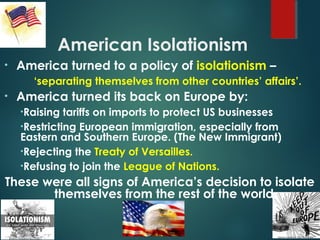
These were all signs of America’s decision to isolate
themselves from the rest of the world.
WWI part 2

WWI part 2

  • 2.
    The Home Front,1917-1918  To fight the war, Pres. Wilson was given wide powers by Congress.  To solve the problem of a lack of military personnel the U.S. Congress passed the Selective Service Act (aka the draft), the draft put about 3 million men into uniform.  But, because of Supreme Court ruling of Plessy v. Ferguson, African Americans served in segregated units.
  • 3.
    The Home Front,1917-1918  Women & African Americans would play a vital role in the war as millions of men left their jobs to fight the war.  African Americans were not allowed to fight in the AEF, but did serve under French leaders. (American Expeditionary Force)  The efforts of women in the workplace helped them gain support for suffrage.
  • 4.
    The Home Front,1917-1918  Almost 2 million men would serve in Europe.  The cost of the war, about $30 billion, was paid for with increased taxes and the sale of war bonds.  Propaganda would play an important role in the war.  All resources were mobilized turning the conflict into a ‘total war’.
  • 6.
    The Home Front,1917-1918  During the war, civil liberties were violated to meet wartime needs.  The Espionage Act (1917) made it a crime to criticize the war.  This violated American’s civil rights, like the 1st Amendment and freedom of speech.  Over 6,000 Americans were arrested under these acts.
  • 7.
    Heroes of theWar Gen. John J. Pershing Gen. Pershing was selected to lead the AEF which was the American Expeditionary Force. Pershing was a decorated war veteran who refused to send American troops into battle until they were well trained. This led to fewer deaths and the love and respect of his men.
  • 8.
    Heroes of theWar Alvin York •Alvin York represented the typical draftee in World War 1, he was underprivileged and uneducated. •In the Battle of Argonne Forest, Sgt. York singlehandedly was responsible for killing 25 Germans and capturing 132 prisoners of war. •He earned the Congressional Medal of Honor for his heroism.
  • 9.
    Battle of ArgonneForest  One of the greatest battles of the war was fought in the Argonne Forest of northeastern France.  Germany had spent years fortifying this hilly, forested area surrounded with barbed wire, land mines, concrete barriers, tanks and machine guns.  Gen. Pershing led 600,000 men against all odds and succeeded into breaking through the German lines in this final and most important battle the American Expeditionary Force fought.
  • 10.
    Wilson’s Fourteen Points Pres. Wilson broadened the war aims from a defense of ‘freedom of the seas’ to a crusade of making the world ‘safe for democracy’.  In January of 1918, Pres. Wilson made a speech to Congress called the “Fourteen Points”.  The speech outlined a plan for world peace.
  • 11.
    Wilson’s Fourteen Points TheFourteen Points Major European nationalities would be given right of self- determination about their own country and governments. Austria-Hungary and the Ottoman Empire would be divided into smaller nations. Wilson called for a reduction in arms, removal of trade barriers, and an end to secret diplomacy. The most important of all to Wilson was his plan called the “League of Nation”, an organization to mediate international disputes to avoid war.
  • 12.
    The League ofNations  Pres. Wilson campaigned across America and with European leaders to gain support for his League of Nations plan.  But, Americans were not interested in giving others the power to decide whether the USA would go to war or not.  European leaders argued with Wilson, because they wanted a harsher punishment on Germany than he did.  Wilson’s plan was in jeopardy. Germany must pay I agree What about my plan ?
  • 13.
    The Treaty ofVersailles  Germany, exhausted by the war, finally agreed to an armistice (peace agreement) on Nov. 11, 1918 we now call this Veteran’s Day.  The USA met with the French, British, & the Italians to discuss peace terms.  The Russians, although they had fought on our winning side, were not invited to the peace talks. Russia had become communist!
  • 14.
    Terms of Treatyof Versailles  Terms of the Treaty were very harsh, especially on Germany.  Germany: Lost land they had taken Lost their overseas colonies. Demilitarization, reduce military size. Accept blame for war in the War Guilt Clause. Make reparations (payments for damages)  Austria-Hungary & Turkey: Were divided into several new nations.
  • 15.
    Rejection of Leagueof NationsRejection of League of Nations  Opponents of the League of Nations argued that it would drag the USA into unwanted military commitments.  Senator Henry Cabot Lodge strongly opposed the creation of the League, saying the USA would lose its freedom of action.  The United States Congress refused to ratify (ok) the Treaty of Versailles and the USA never joined the League of Nations.
  • 16.
    America Retreats toIsolationism  By 1919, the American people hadBy 1919, the American people had become disillusioned by world affairs.become disillusioned by world affairs.  Victory in WWI had come at a high priceVictory in WWI had come at a high price in lives and dollars.in lives and dollars.  American’s began to think GeorgeAmerican’s began to think George Washington was right with his advice ofWashington was right with his advice of staying out of European entanglements.staying out of European entanglements.  America began to look at their wellAmerica began to look at their well being at home.being at home. America should stay out of Europe’s business
  • 17.
    American Isolationism • Americaturned to a policy of isolationism – ‘separating themselves from other countries’ affairs’. • America turned its back on Europe by: •Raising tariffs on imports to protect US businesses •Restricting European immigration, especially from Eastern and Southern Europe. (The New Immigrant) •Rejecting the Treaty of Versailles. •Refusing to join the League of Nations. These were all signs of America’s decision to isolate themselves from the rest of the world.

Editor's Notes