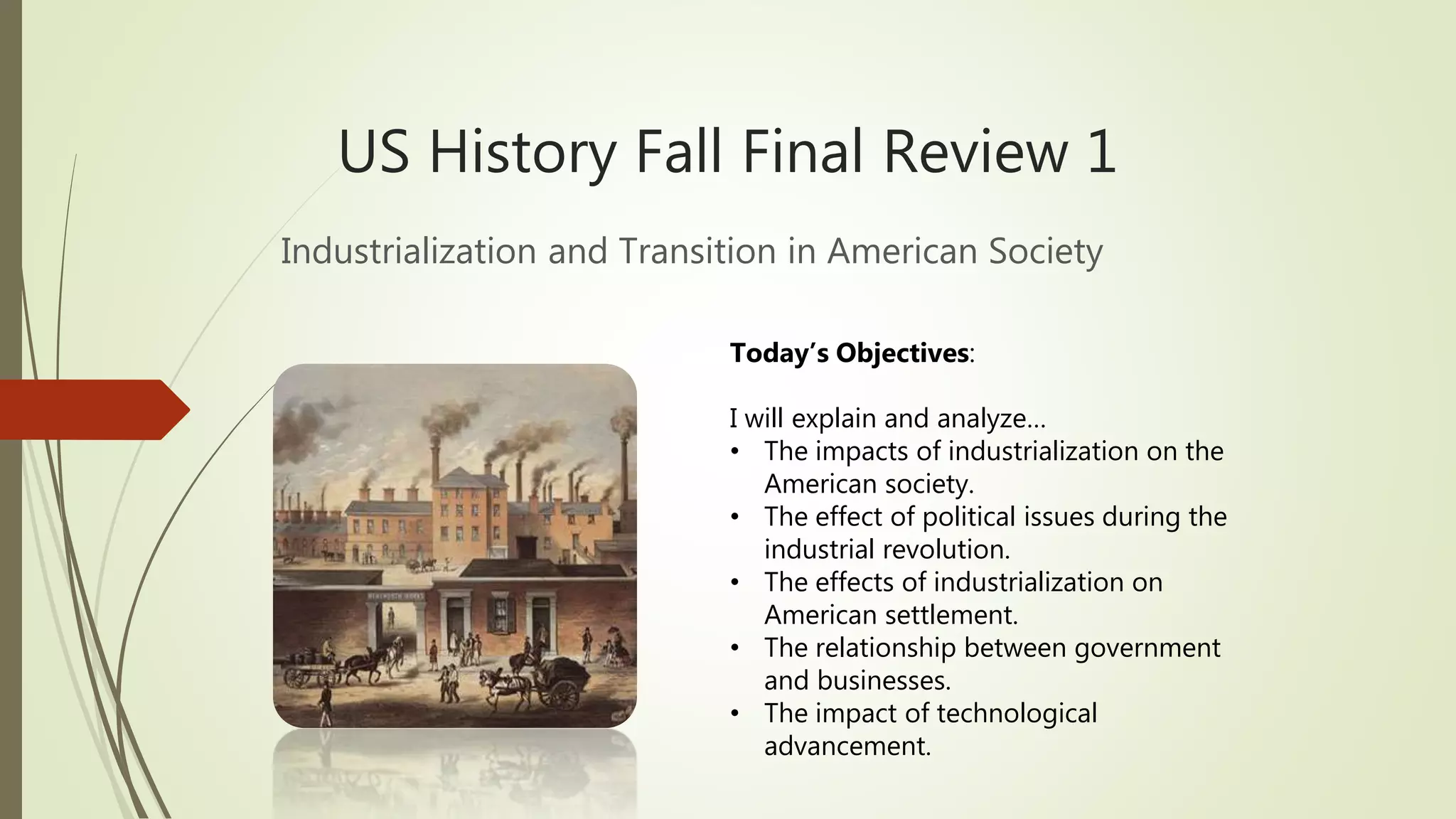
US History Fall Final Review 1
Industrialization and Transition in American Society
Today’s Objectives:
I will explain and analyze…
• The impacts of industrialization on the
American society.
• The effect of political issues during the
industrial revolution.
• The effects of industrialization on
American settlement.
• The relationship between government
and businesses.
• The impact of technological
advancement.
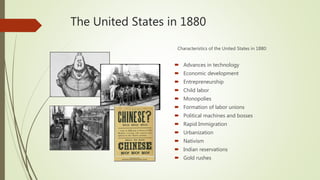
The United States in 1880
Characteristics of the United States in 1880:
 Advances in technology
 Economic development
 Entrepreneurship
 Child labor
 Monopolies
 Formation of labor unions
 Political machines and bosses
 Rapid Immigration
 Urbanization
 Nativism
 Indian reservations
 Gold rushes
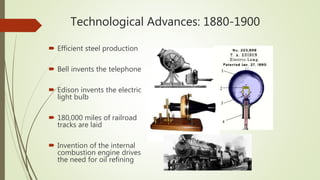
Technological Advances: 1880-1900
 Efficient steel production
 Bell invents the telephone
 Edison invents the electric
light bulb
 180,000 miles of railroad
tracks are laid
 Invention of the internal
combustion engine drives
the need for oil refining
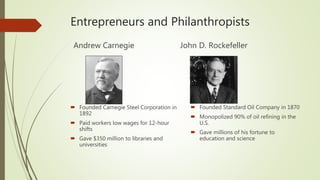
Entrepreneurs and Philanthropists
Andrew Carnegie
 Founded Carnegie Steel Corporation in
1892
 Paid workers low wages for 12-hour
shifts
 Gave $350 million to libraries and
universities
John D. Rockefeller
 Founded Standard Oil Company in 1870
 Monopolized 90% of oil refining in the
U.S.
 Gave millions of his fortune to
education and science
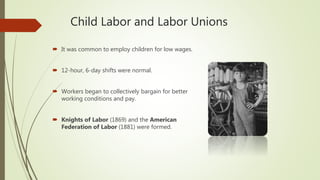
Child Labor and Labor Unions
 It was common to employ children for low wages.
 12-hour, 6-day shifts were normal.
 Workers began to collectively bargain for better
working conditions and pay.
 Knights of Labor (1869) and the American
Federation of Labor (1881) were formed.
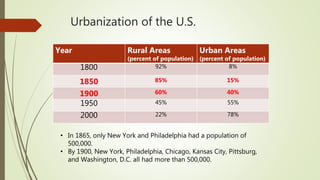
Urbanization of the U.S.
Year Rural Areas
(percent of population)
Urban Areas
(percent of population)
1800 92% 8%
1850 85% 15%
1900 60% 40%
1950 45% 55%
2000 22% 78%
• In 1865, only New York and Philadelphia had a population of
500,000.
• By 1900, New York, Philadelphia, Chicago, Kansas City, Pittsburg,
and Washington, D.C. all had more than 500,000.
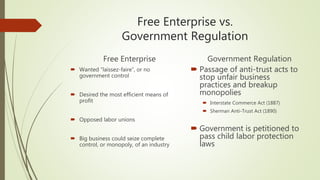
Free Enterprise vs.
Government Regulation
Free Enterprise
 Wanted “laissez-faire”, or no
government control
 Desired the most efficient means of
profit
 Opposed labor unions
 Big business could seize complete
control, or monopoly, of an industry
Government Regulation
 Passage of anti-trust acts to
stop unfair business
practices and breakup
monopolies
 Interstate Commerce Act (1887)
 Sherman Anti-Trust Act (1890)
 Government is petitioned to
pass child labor protection
laws
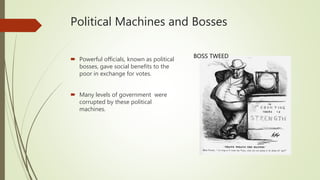
Political Machines and Bosses
 Powerful officials, known as political
bosses, gave social benefits to the
poor in exchange for votes.
 Many levels of government were
corrupted by these political
machines.
BOSS TWEED
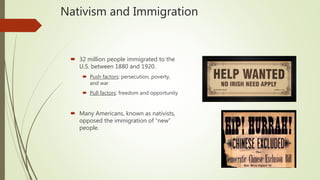
Nativism and Immigration
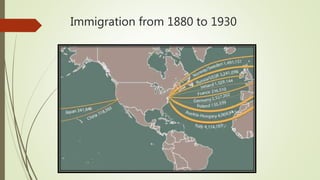
 32 million people immigrated to the
U.S. between 1880 and 1920.
 Push factors: persecution, poverty,
and war
 Pull factors: freedom and opportunity
 Many Americans, known as nativists,
opposed the immigration of “new”
people.
Immigration from 1880 to 1930
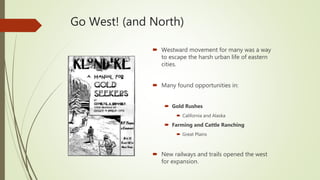
Go West! (and North)
 Westward movement for many was a way
to escape the harsh urban life of eastern
cities.
 Many found opportunities in:
 Gold Rushes
 California and Alaska
 Farming and Cattle Ranching
 Great Plains
 New railways and trails opened the west
for expansion.
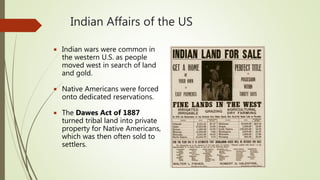
Indian Affairs of the US
 Indian wars were common in
the western U.S. as people
moved west in search of land
and gold.
 Native Americans were forced
onto dedicated reservations.
 The Dawes Act of 1887
turned tribal land into private
property for Native Americans,
which was then often sold to
settlers.
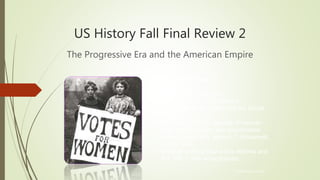
US History Fall Final Review 2
The Progressive Era and the American Empire
© Hedgehog Learning
Today’s Objectives:
I will explain and analyze…
• Service reform and Populism.
• Issues affecting women and the Social
Gospel.
• Significance of the Spanish-American
War, expansionism, and missionaries
• Contributions of A. Mahan, T. Roosevelt,
and S. Dole.
• Impacts of Progressive Era reforms and
the 16th – 19th amendments.
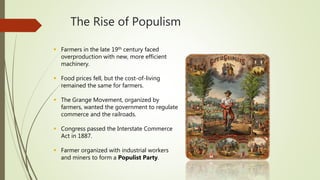
The Rise of Populism
 Farmers in the late 19th century faced
overproduction with new, more efficient
machinery.
 Food prices fell, but the cost-of-living
remained the same for farmers.
 The Grange Movement, organized by
farmers, wanted the government to regulate
commerce and the railroads.
 Congress passed the Interstate Commerce
Act in 1887.
 Farmer organized with industrial workers
and miners to form a Populist Party.
The Populist Party  The Populist Party believed that a shortage
of currency was the cause of failing prices
and campaigned for the free coinage of
silver.
 Although the Populist Party lost the 1890,
many of the political views were absorbed
by the Democratic Party in the 1896
election.
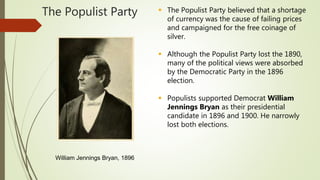
 Populists supported Democrat William
Jennings Bryan as their presidential
candidate in 1896 and 1900. He narrowly
lost both elections.
William Jennings Bryan, 1896
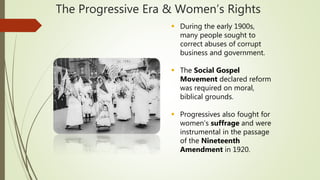
The Progressive Era & Women’s Rights
 During the early 1900s,
many people sought to
correct abuses of corrupt
business and government.
 The Social Gospel
Movement declared reform
was required on moral,
biblical grounds.
 Progressives also fought for
women’s suffrage and were
instrumental in the passage
of the Nineteenth
Amendment in 1920.
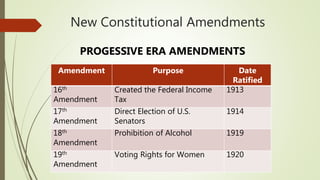
New Constitutional Amendments
PROGESSIVE ERA AMENDMENTS
Amendment Purpose Date
Ratified
16th
Amendment
Created the Federal Income
Tax
1913
17th
Amendment
Direct Election of U.S.
Senators
1914
18th
Amendment
Prohibition of Alcohol 1919
19th
Amendment
Voting Rights for Women 1920
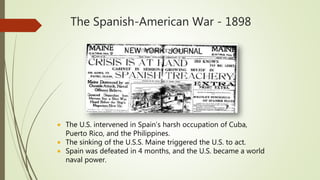
The Spanish-American War - 1898
 The U.S. intervened in Spain’s harsh occupation of Cuba,
Puerto Rico, and the Philippines.
 The sinking of the U.S.S. Maine triggered the U.S. to act.
 Spain was defeated in 4 months, and the U.S. became a world
naval power.
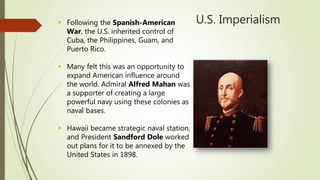
U.S. Imperialism Following the Spanish-American
War, the U.S. inherited control of
Cuba, the Philippines, Guam, and
Puerto Rico.
 Many felt this was an opportunity to
expand American influence around
the world. Admiral Alfred Mahan was
a supporter of creating a large
powerful navy using these colonies as
naval bases.
 Hawaii became strategic naval station,
and President Sandford Dole worked
out plans for it to be annexed by the
United States in 1898.
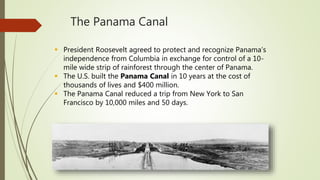
The Panama Canal
 President Roosevelt agreed to protect and recognize Panama’s
independence from Columbia in exchange for control of a 10-
mile wide strip of rainforest through the center of Panama.
 The U.S. built the Panama Canal in 10 years at the cost of
thousands of lives and $400 million.
 The Panama Canal reduced a trip from New York to San
Francisco by 10,000 miles and 50 days.
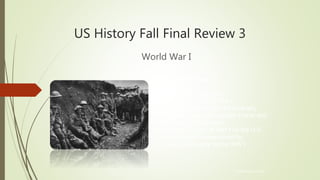
US History Fall Final Review 3
World War I
© Hedgehog Learning
Today’s Objectives:
I will explain and analyze…
• The causes of World War I
• Issues of isolationism and neutrality
• Woodrow Wilson’s Fourteen Points and
the Treaty of Versailles
• Economic impact of WW I on the U.S.
• Constitutional issues raised by
government policy during WW I
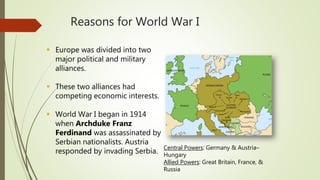
Reasons for World War I
 Europe was divided into two
major political and military
alliances.
 These two alliances had
competing economic interests.
 World War I began in 1914
when Archduke Franz
Ferdinand was assassinated by
Serbian nationalists. Austria
responded by invading Serbia.
Central Powers: Germany & Austria–
Hungary
Allied Powers: Great Britain, France, &
Russia
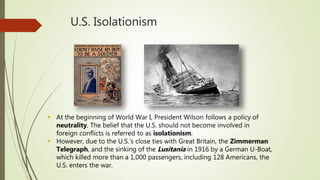
U.S. Isolationism
 At the beginning of World War I, President Wilson follows a policy of
neutrality. The belief that the U.S. should not become involved in
foreign conflicts is referred to as isolationism.
 However, due to the U.S.’s close ties with Great Britain, the Zimmerman
Telegraph, and the sinking of the Lusitania in 1916 by a German U-Boat,
which killed more than a 1,000 passengers, including 128 Americans, the
U.S. enters the war.
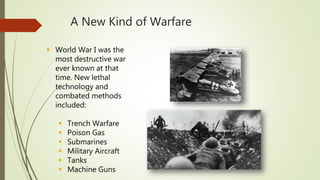
A New Kind of Warfare
 World War I was the
most destructive war
ever known at that
time. New lethal
technology and
combated methods
included:
 Trench Warfare
 Poison Gas
 Submarines
 Military Aircraft
 Tanks
 Machine Guns
Impact of WWI in the U.S.
 Wartime production spurred U.S. industries and lead economy
into the “Roaring Twenties”.
 Civil Liberties were curtailed during the war under the
Espionage Act of 1917.
 Millions of American men were required to register for draft
under the new Selective Service Act in 1917.
 American war heroes were created, such as Alvin York and
General John Pershing of the American Expeditionary
Force. Congress awarded more than 3,400 Medals of Honor.
Wilson’s Fourteen Points
 American troops broke the deadlock in Europe and the Allied
Forces prevailed in 1918. President Wilson proposed Fourteen
Points as a bases for a peace treaty, including:
 An end to secret diplomacy
 Removal of trade barriers
 Freedom of sea navigation
 Reduction in armaments
 Independent Polish state
 Division of Austria-Hungary and Ottoman Empire
 Formation of a League of Nations
 Opposition to U.S. membership in the League of Nation was
led by Henry Cabot Lodge. The U.S. never joined the League
of Nations.
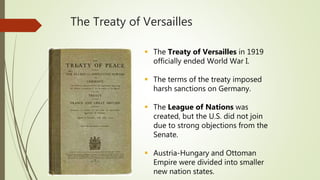
The Treaty of Versailles
 The Treaty of Versailles in 1919
officially ended World War I.
 The terms of the treaty imposed
harsh sanctions on Germany.
 The League of Nations was
created, but the U.S. did not join
due to strong objections from the
Senate.
 Austria-Hungary and Ottoman
Empire were divided into smaller
new nation states.
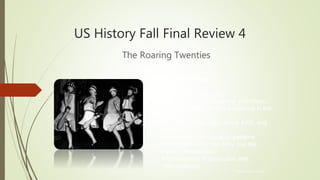
US History Fall Final Review 4
The Roaring Twenties
© Hedgehog Learning
Today’s Objectives:
I will explain and analyze…
• Social Darwinism, eugenics, prohibition,
women’s issues, and race relations in the
1920s
• The effects of the Red Scare, KKK, and
Nativism
• Immigration and migration patterns
• The impact of Tin Pan Alley and the
Harlem Renaissance
• Improvements in production and
manufacturing
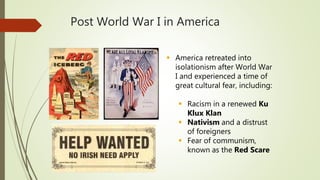
Post World War I in America
 America retreated into
isolationism after World War
I and experienced a time of
great cultural fear, including:
 Racism in a renewed Ku
Klux Klan
 Nativism and a distrust
of foreigners
 Fear of communism,
known as the Red Scare
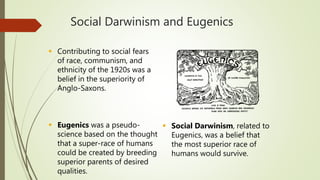
Social Darwinism and Eugenics
 Contributing to social fears
of race, communism, and
ethnicity of the 1920s was a
belief in the superiority of
Anglo-Saxons.
 Eugenics was a pseudo-
science based on the thought
that a super-race of humans
could be created by breeding
superior parents of desired
qualities.
 Social Darwinism, related to
Eugenics, was a belief that
the most superior race of
humans would survive.
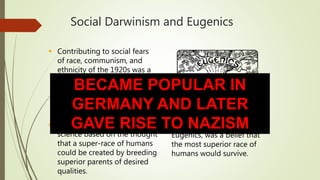
Social Darwinism and Eugenics
 Contributing to social fears
of race, communism, and
ethnicity of the 1920s was a
belief in the superiority of
Anglo-Saxons.
 Eugenics was a pseudo-
science based on the thought
that a super-race of humans
could be created by breeding
superior parents of desired
qualities.
 Social Darwinism, related to
Eugenics, was a belief that
the most superior race of
humans would survive.
BECAME POPULAR IN
GERMANY AND LATER
GAVE RISE TO NAZISM
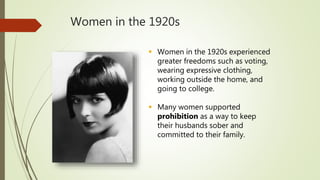
Women in the 1920s
 Women in the 1920s experienced
greater freedoms such as voting,
wearing expressive clothing,
working outside the home, and
going to college.
 Many women supported
prohibition as a way to keep
their husbands sober and
committed to their family.
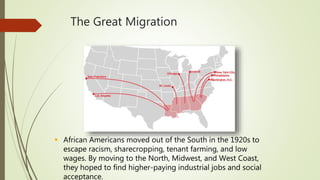
The Great Migration
 African Americans moved out of the South in the 1920s to
escape racism, sharecropping, tenant farming, and low
wages. By moving to the North, Midwest, and West Coast,
they hoped to find higher-paying industrial jobs and social
acceptance.
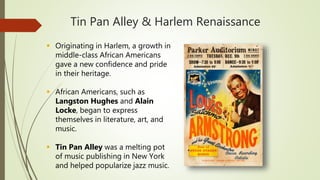
Tin Pan Alley & Harlem Renaissance
 Originating in Harlem, a growth in
middle-class African Americans
gave a new confidence and pride
in their heritage.
 African Americans, such as
Langston Hughes and Alain
Locke, began to express
themselves in literature, art, and
music.
 Tin Pan Alley was a melting pot
of music publishing in New York
and helped popularize jazz music.
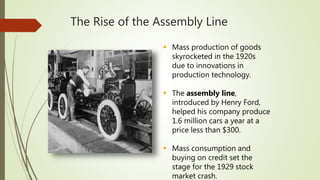
The Rise of the Assembly Line
 Mass production of goods
skyrocketed in the 1920s
due to innovations in
production technology.
 The assembly line,
introduced by Henry Ford,
helped his company produce
1.6 million cars a year at a
price less than $300.
 Mass consumption and
buying on credit set the
stage for the 1929 stock
market crash.
US History Fall Review
The Great Depression and the New Deal
© Hedgehog Learning
Today’s Objectives:
I will explain and analyze…
• The causes of the Great Depression
• The effect of the Great Depression on
the economy
• The impact of New Deal legislation
• Issues raised by government policies
during the Great Depression
• Impact of the Dust Bowl
• FDR’s attempt to increase the number of
Supreme Court justices
Setting the Stage for 1929
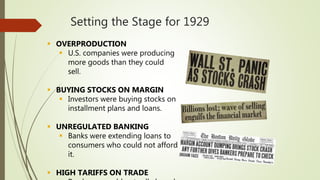
 OVERPRODUCTION
 U.S. companies were producing
more goods than they could
sell.
 BUYING STOCKS ON MARGIN
 Investors were buying stocks on
installment plans and loans.
 UNREGULATED BANKING
 Banks were extending loans to
consumers who could not afford
it.
 HIGH TARIFFS ON TRADE
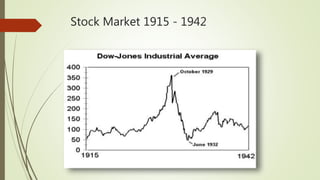
Stock Market 1915 - 1942
The Great Depression under Hoover
 President Hoover initially practiced laissez-
faire capitalism and rejected government
bailouts and economic safety nets.
 Housing prices tumbled because people
could not pay their rent or mortgage.
 Hundreds of thousands of homeless
Americans
 25% unemployment rate
 Nearly 1 out of 2 banks failed in the U.S.
 Shanty towns of homeless called
“Hoovervilles” sprang up on the outskirts of
U.S. cities
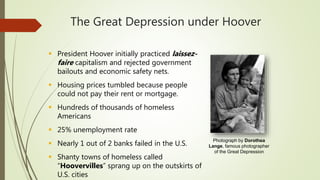
Photograph by Dorothea
Lange, famous photographer
of the Great Depression
Mexican Repatriation Act
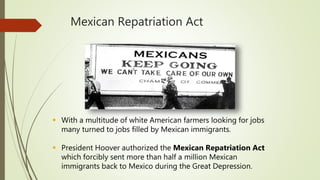
 With a multitude of white American farmers looking for jobs
many turned to jobs filled by Mexican immigrants.
 President Hoover authorized the Mexican Repatriation Act
which forcibly sent more than half a million Mexican
immigrants back to Mexico during the Great Depression.
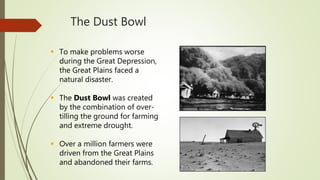
The Dust Bowl
 To make problems worse
during the Great Depression,
the Great Plains faced a
natural disaster.
 The Dust Bowl was created
by the combination of over-
tilling the ground for farming
and extreme drought.
 Over a million farmers were
driven from the Great Plains
and abandoned their farms.
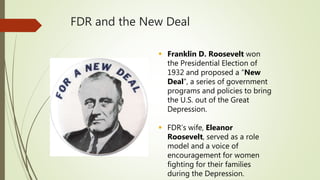
FDR and the New Deal
 Franklin D. Roosevelt won
the Presidential Election of
1932 and proposed a “New
Deal”, a series of government
programs and policies to bring
the U.S. out of the Great
Depression.
 FDR’s wife, Eleanor
Roosevelt, served as a role
model and a voice of
encouragement for women
fighting for their families
during the Depression.
The New Deal and the 3 R’s
 FDR summarized his New Deal in terms of three R’s:
 RELIEF – Closed banks until they are found to be
financially sound; provided emergency loans to
homeowners; provided public jobs through the CCC, PWA,
and WPA.
 RECOVERY – Pumped money into the economy by
increasing government spending; purchased crops from
farmers and stored them to raise crop prices
 REFORM – Established the FDIC to insure bank deposits;
established the Tennessee Valley Authority to built dams;
created the Securities and Exchange Commission to
regulate the stock market; passed the Social Security Act to
provide insurance and pensions
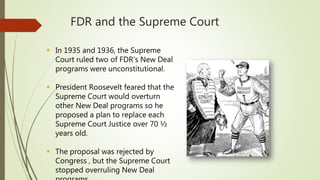
FDR and the Supreme Court
 In 1935 and 1936, the Supreme
Court ruled two of FDR’s New Deal
programs were unconstitutional.
 President Roosevelt feared that the
Supreme Court would overturn
other New Deal programs so he
proposed a plan to replace each
Supreme Court Justice over 70 ½
years old.
 The proposal was rejected by
Congress , but the Supreme Court
stopped overruling New Deal
US History Fall Final Review 5
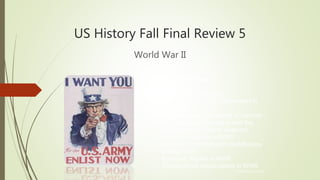
World War II
© Hedgehog Learning
Today’s Objectives:
I will explain and analyze…
• The reasons for U.S. involvement in
World War II
• The Holocaust, internment of German
and Japanese Americans, and the
development of atomic weapons
• The role of women in WWII
• American patriotism and contributions
during WWII
• Economic impact of WWII
• Constitutional issues raised in WWII
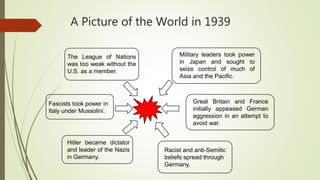
A Picture of the World in 1939
The League of Nations
was too weak without the
U.S. as a member.
Fascists took power in
Italy under Mussolini.
Hitler became dictator
and leader of the Nazis
in Germany.
Military leaders took power
in Japan and sought to
seize control of much of
Asia and the Pacific.
Great Britain and France
initially appeased German
aggression in an attempt to
avoid war.
Racist and anti-Semitic
beliefs spread through
Germany.
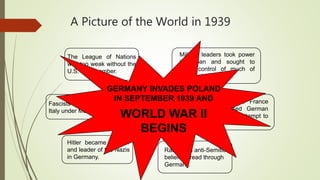
A Picture of the World in 1939
The League of Nations
was too weak without the
U.S. as a member.
Fascists took power in
Italy under Mussolini.
Hitler became dictator
and leader of the Nazis
in Germany.
Military leaders took power
in Japan and sought to
seize control of much of
Asia and the Pacific.
Great Britain and France
initially appeased German
aggression in an attempt to
avoid war.
Racist and anti-Semitic
beliefs spread through
Germany.
GERMANY INVADES POLAND
IN SEPTEMBER 1939 AND
WORLD WAR II
BEGINS
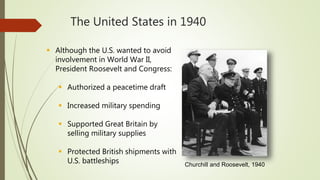
The United States in 1940
 Although the U.S. wanted to avoid
involvement in World War II,
President Roosevelt and Congress:
 Authorized a peacetime draft
 Increased military spending
 Supported Great Britain by
selling military supplies
 Protected British shipments with
U.S. battleships Churchill and Roosevelt, 1940
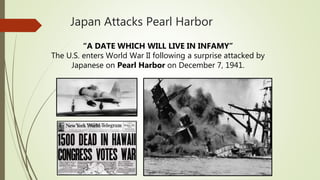
Japan Attacks Pearl Harbor
“A DATE WHICH WILL LIVE IN INFAMY”
The U.S. enters World War II following a surprise attacked by
Japanese on Pearl Harbor on December 7, 1941.
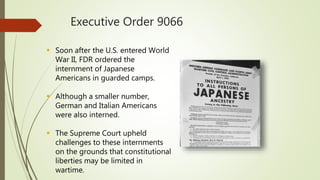
Executive Order 9066
 Soon after the U.S. entered World
War II, FDR ordered the
internment of Japanese
Americans in guarded camps.
 Although a smaller number,
German and Italian Americans
were also interned.
 The Supreme Court upheld
challenges to these internments
on the grounds that constitutional
liberties may be limited in
wartime.
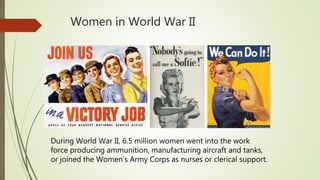
Women in World War II
During World War II, 6.5 million women went into the work
force producing ammunition, manufacturing aircraft and tanks,
or joined the Women’s Army Corps as nurses or clerical support.
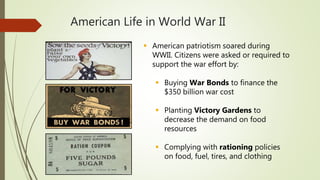
American Life in World War II
 American patriotism soared during
WWII. Citizens were asked or required to
support the war effort by:
 Buying War Bonds to finance the
$350 billion war cost
 Planting Victory Gardens to
decrease the demand on food
resources
 Complying with rationing policies
on food, fuel, tires, and clothing
Stories of Heroism in World War II
 THE TUSKEGEE AIRMEN
 The first African American fighter pilots in the U.S.
Armed Forces who escorted Allied bombers in WWII.
 FLYING TIGERS
 This group of volunteer pilots bravely fought the
Japanese to protect British supply routes on the Burma
Road
 NAVAJO CODE TALKERS
 Navajo Americans were used to communicate military
messages in their native language to prevent the
Japanese from deciphering.
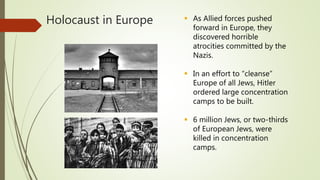
Holocaust in Europe  As Allied forces pushed
forward in Europe, they
discovered horrible
atrocities committed by the
Nazis.
 In an effort to “cleanse”
Europe of all Jews, Hitler
ordered large concentration
camps to be built.
 6 million Jews, or two-thirds
of European Jews, were
killed in concentration
camps.
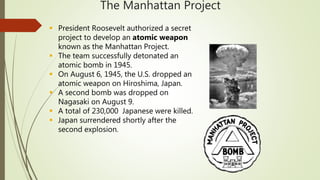
The Manhattan Project
 President Roosevelt authorized a secret
project to develop an atomic weapon
known as the Manhattan Project.
 The team successfully detonated an
atomic bomb in 1945.
 On August 6, 1945, the U.S. dropped an
atomic weapon on Hiroshima, Japan.
 A second bomb was dropped on
Nagasaki on August 9.
 A total of 230,000 Japanese were killed.
 Japan surrendered shortly after the
second explosion.
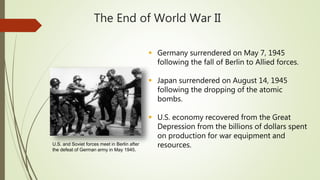
The End of World War II
 Germany surrendered on May 7, 1945
following the fall of Berlin to Allied forces.
 Japan surrendered on August 14, 1945
following the dropping of the atomic
bombs.
 U.S. economy recovered from the Great
Depression from the billions of dollars spent
on production for war equipment and
resources.U.S. and Soviet forces meet in Berlin after
the defeat of German army in May 1945.

Us history fall final review week 16

  • 1.
    US History FallFinal Review 1 Industrialization and Transition in American Society Today’s Objectives: I will explain and analyze… • The impacts of industrialization on the American society. • The effect of political issues during the industrial revolution. • The effects of industrialization on American settlement. • The relationship between government and businesses. • The impact of technological advancement.
  • 2.
    The United Statesin 1880 Characteristics of the United States in 1880:  Advances in technology  Economic development  Entrepreneurship  Child labor  Monopolies  Formation of labor unions  Political machines and bosses  Rapid Immigration  Urbanization  Nativism  Indian reservations  Gold rushes
  • 3.
    Technological Advances: 1880-1900 Efficient steel production  Bell invents the telephone  Edison invents the electric light bulb  180,000 miles of railroad tracks are laid  Invention of the internal combustion engine drives the need for oil refining
  • 4.
    Entrepreneurs and Philanthropists AndrewCarnegie  Founded Carnegie Steel Corporation in 1892  Paid workers low wages for 12-hour shifts  Gave $350 million to libraries and universities John D. Rockefeller  Founded Standard Oil Company in 1870  Monopolized 90% of oil refining in the U.S.  Gave millions of his fortune to education and science
  • 5.
    Child Labor andLabor Unions  It was common to employ children for low wages.  12-hour, 6-day shifts were normal.  Workers began to collectively bargain for better working conditions and pay.  Knights of Labor (1869) and the American Federation of Labor (1881) were formed.
  • 6.
    Urbanization of theU.S. Year Rural Areas (percent of population) Urban Areas (percent of population) 1800 92% 8% 1850 85% 15% 1900 60% 40% 1950 45% 55% 2000 22% 78% • In 1865, only New York and Philadelphia had a population of 500,000. • By 1900, New York, Philadelphia, Chicago, Kansas City, Pittsburg, and Washington, D.C. all had more than 500,000.
  • 7.
    Free Enterprise vs. GovernmentRegulation Free Enterprise  Wanted “laissez-faire”, or no government control  Desired the most efficient means of profit  Opposed labor unions  Big business could seize complete control, or monopoly, of an industry Government Regulation  Passage of anti-trust acts to stop unfair business practices and breakup monopolies  Interstate Commerce Act (1887)  Sherman Anti-Trust Act (1890)  Government is petitioned to pass child labor protection laws
  • 8.
    Political Machines andBosses  Powerful officials, known as political bosses, gave social benefits to the poor in exchange for votes.  Many levels of government were corrupted by these political machines. BOSS TWEED
  • 9.
    Nativism and Immigration 32 million people immigrated to the U.S. between 1880 and 1920.  Push factors: persecution, poverty, and war  Pull factors: freedom and opportunity  Many Americans, known as nativists, opposed the immigration of “new” people.
  • 10.
  • 11.
    Go West! (andNorth)  Westward movement for many was a way to escape the harsh urban life of eastern cities.  Many found opportunities in:  Gold Rushes  California and Alaska  Farming and Cattle Ranching  Great Plains  New railways and trails opened the west for expansion.
  • 12.
    Indian Affairs ofthe US  Indian wars were common in the western U.S. as people moved west in search of land and gold.  Native Americans were forced onto dedicated reservations.  The Dawes Act of 1887 turned tribal land into private property for Native Americans, which was then often sold to settlers.
  • 13.
    US History FallFinal Review 2 The Progressive Era and the American Empire © Hedgehog Learning Today’s Objectives: I will explain and analyze… • Service reform and Populism. • Issues affecting women and the Social Gospel. • Significance of the Spanish-American War, expansionism, and missionaries • Contributions of A. Mahan, T. Roosevelt, and S. Dole. • Impacts of Progressive Era reforms and the 16th – 19th amendments.
  • 14.
    The Rise ofPopulism  Farmers in the late 19th century faced overproduction with new, more efficient machinery.  Food prices fell, but the cost-of-living remained the same for farmers.  The Grange Movement, organized by farmers, wanted the government to regulate commerce and the railroads.  Congress passed the Interstate Commerce Act in 1887.  Farmer organized with industrial workers and miners to form a Populist Party.
  • 15.
    The Populist Party The Populist Party believed that a shortage of currency was the cause of failing prices and campaigned for the free coinage of silver.  Although the Populist Party lost the 1890, many of the political views were absorbed by the Democratic Party in the 1896 election.  Populists supported Democrat William Jennings Bryan as their presidential candidate in 1896 and 1900. He narrowly lost both elections. William Jennings Bryan, 1896
  • 16.
    The Progressive Era& Women’s Rights  During the early 1900s, many people sought to correct abuses of corrupt business and government.  The Social Gospel Movement declared reform was required on moral, biblical grounds.  Progressives also fought for women’s suffrage and were instrumental in the passage of the Nineteenth Amendment in 1920.
  • 17.
    New Constitutional Amendments PROGESSIVEERA AMENDMENTS Amendment Purpose Date Ratified 16th Amendment Created the Federal Income Tax 1913 17th Amendment Direct Election of U.S. Senators 1914 18th Amendment Prohibition of Alcohol 1919 19th Amendment Voting Rights for Women 1920
  • 18.
    The Spanish-American War- 1898  The U.S. intervened in Spain’s harsh occupation of Cuba, Puerto Rico, and the Philippines.  The sinking of the U.S.S. Maine triggered the U.S. to act.  Spain was defeated in 4 months, and the U.S. became a world naval power.
  • 19.
    U.S. Imperialism Followingthe Spanish-American War, the U.S. inherited control of Cuba, the Philippines, Guam, and Puerto Rico.  Many felt this was an opportunity to expand American influence around the world. Admiral Alfred Mahan was a supporter of creating a large powerful navy using these colonies as naval bases.  Hawaii became strategic naval station, and President Sandford Dole worked out plans for it to be annexed by the United States in 1898.
  • 20.
    The Panama Canal President Roosevelt agreed to protect and recognize Panama’s independence from Columbia in exchange for control of a 10- mile wide strip of rainforest through the center of Panama.  The U.S. built the Panama Canal in 10 years at the cost of thousands of lives and $400 million.  The Panama Canal reduced a trip from New York to San Francisco by 10,000 miles and 50 days.
  • 21.
    US History FallFinal Review 3 World War I © Hedgehog Learning Today’s Objectives: I will explain and analyze… • The causes of World War I • Issues of isolationism and neutrality • Woodrow Wilson’s Fourteen Points and the Treaty of Versailles • Economic impact of WW I on the U.S. • Constitutional issues raised by government policy during WW I
  • 22.
    Reasons for WorldWar I  Europe was divided into two major political and military alliances.  These two alliances had competing economic interests.  World War I began in 1914 when Archduke Franz Ferdinand was assassinated by Serbian nationalists. Austria responded by invading Serbia. Central Powers: Germany & Austria– Hungary Allied Powers: Great Britain, France, & Russia
  • 23.
    U.S. Isolationism  Atthe beginning of World War I, President Wilson follows a policy of neutrality. The belief that the U.S. should not become involved in foreign conflicts is referred to as isolationism.  However, due to the U.S.’s close ties with Great Britain, the Zimmerman Telegraph, and the sinking of the Lusitania in 1916 by a German U-Boat, which killed more than a 1,000 passengers, including 128 Americans, the U.S. enters the war.
  • 24.
    A New Kindof Warfare  World War I was the most destructive war ever known at that time. New lethal technology and combated methods included:  Trench Warfare  Poison Gas  Submarines  Military Aircraft  Tanks  Machine Guns
  • 25.
    Impact of WWIin the U.S.  Wartime production spurred U.S. industries and lead economy into the “Roaring Twenties”.  Civil Liberties were curtailed during the war under the Espionage Act of 1917.  Millions of American men were required to register for draft under the new Selective Service Act in 1917.  American war heroes were created, such as Alvin York and General John Pershing of the American Expeditionary Force. Congress awarded more than 3,400 Medals of Honor.
  • 26.
    Wilson’s Fourteen Points American troops broke the deadlock in Europe and the Allied Forces prevailed in 1918. President Wilson proposed Fourteen Points as a bases for a peace treaty, including:  An end to secret diplomacy  Removal of trade barriers  Freedom of sea navigation  Reduction in armaments  Independent Polish state  Division of Austria-Hungary and Ottoman Empire  Formation of a League of Nations  Opposition to U.S. membership in the League of Nation was led by Henry Cabot Lodge. The U.S. never joined the League of Nations.
  • 27.
    The Treaty ofVersailles  The Treaty of Versailles in 1919 officially ended World War I.  The terms of the treaty imposed harsh sanctions on Germany.  The League of Nations was created, but the U.S. did not join due to strong objections from the Senate.  Austria-Hungary and Ottoman Empire were divided into smaller new nation states.
  • 28.
    US History FallFinal Review 4 The Roaring Twenties © Hedgehog Learning Today’s Objectives: I will explain and analyze… • Social Darwinism, eugenics, prohibition, women’s issues, and race relations in the 1920s • The effects of the Red Scare, KKK, and Nativism • Immigration and migration patterns • The impact of Tin Pan Alley and the Harlem Renaissance • Improvements in production and manufacturing
  • 29.
    Post World WarI in America  America retreated into isolationism after World War I and experienced a time of great cultural fear, including:  Racism in a renewed Ku Klux Klan  Nativism and a distrust of foreigners  Fear of communism, known as the Red Scare
  • 30.
    Social Darwinism andEugenics  Contributing to social fears of race, communism, and ethnicity of the 1920s was a belief in the superiority of Anglo-Saxons.  Eugenics was a pseudo- science based on the thought that a super-race of humans could be created by breeding superior parents of desired qualities.  Social Darwinism, related to Eugenics, was a belief that the most superior race of humans would survive.
  • 31.
    Social Darwinism andEugenics  Contributing to social fears of race, communism, and ethnicity of the 1920s was a belief in the superiority of Anglo-Saxons.  Eugenics was a pseudo- science based on the thought that a super-race of humans could be created by breeding superior parents of desired qualities.  Social Darwinism, related to Eugenics, was a belief that the most superior race of humans would survive. BECAME POPULAR IN GERMANY AND LATER GAVE RISE TO NAZISM
  • 32.
    Women in the1920s  Women in the 1920s experienced greater freedoms such as voting, wearing expressive clothing, working outside the home, and going to college.  Many women supported prohibition as a way to keep their husbands sober and committed to their family.
  • 33.
    The Great Migration African Americans moved out of the South in the 1920s to escape racism, sharecropping, tenant farming, and low wages. By moving to the North, Midwest, and West Coast, they hoped to find higher-paying industrial jobs and social acceptance.
  • 34.
    Tin Pan Alley& Harlem Renaissance  Originating in Harlem, a growth in middle-class African Americans gave a new confidence and pride in their heritage.  African Americans, such as Langston Hughes and Alain Locke, began to express themselves in literature, art, and music.  Tin Pan Alley was a melting pot of music publishing in New York and helped popularize jazz music.
  • 35.
    The Rise ofthe Assembly Line  Mass production of goods skyrocketed in the 1920s due to innovations in production technology.  The assembly line, introduced by Henry Ford, helped his company produce 1.6 million cars a year at a price less than $300.  Mass consumption and buying on credit set the stage for the 1929 stock market crash.
  • 36.
    US History FallReview The Great Depression and the New Deal © Hedgehog Learning Today’s Objectives: I will explain and analyze… • The causes of the Great Depression • The effect of the Great Depression on the economy • The impact of New Deal legislation • Issues raised by government policies during the Great Depression • Impact of the Dust Bowl • FDR’s attempt to increase the number of Supreme Court justices
  • 37.
    Setting the Stagefor 1929  OVERPRODUCTION  U.S. companies were producing more goods than they could sell.  BUYING STOCKS ON MARGIN  Investors were buying stocks on installment plans and loans.  UNREGULATED BANKING  Banks were extending loans to consumers who could not afford it.  HIGH TARIFFS ON TRADE
  • 38.
  • 39.
    The Great Depressionunder Hoover  President Hoover initially practiced laissez- faire capitalism and rejected government bailouts and economic safety nets.  Housing prices tumbled because people could not pay their rent or mortgage.  Hundreds of thousands of homeless Americans  25% unemployment rate  Nearly 1 out of 2 banks failed in the U.S.  Shanty towns of homeless called “Hoovervilles” sprang up on the outskirts of U.S. cities Photograph by Dorothea Lange, famous photographer of the Great Depression
  • 40.
    Mexican Repatriation Act With a multitude of white American farmers looking for jobs many turned to jobs filled by Mexican immigrants.  President Hoover authorized the Mexican Repatriation Act which forcibly sent more than half a million Mexican immigrants back to Mexico during the Great Depression.
  • 41.
    The Dust Bowl To make problems worse during the Great Depression, the Great Plains faced a natural disaster.  The Dust Bowl was created by the combination of over- tilling the ground for farming and extreme drought.  Over a million farmers were driven from the Great Plains and abandoned their farms.
  • 42.
    FDR and theNew Deal  Franklin D. Roosevelt won the Presidential Election of 1932 and proposed a “New Deal”, a series of government programs and policies to bring the U.S. out of the Great Depression.  FDR’s wife, Eleanor Roosevelt, served as a role model and a voice of encouragement for women fighting for their families during the Depression.
  • 43.
    The New Dealand the 3 R’s  FDR summarized his New Deal in terms of three R’s:  RELIEF – Closed banks until they are found to be financially sound; provided emergency loans to homeowners; provided public jobs through the CCC, PWA, and WPA.  RECOVERY – Pumped money into the economy by increasing government spending; purchased crops from farmers and stored them to raise crop prices  REFORM – Established the FDIC to insure bank deposits; established the Tennessee Valley Authority to built dams; created the Securities and Exchange Commission to regulate the stock market; passed the Social Security Act to provide insurance and pensions
  • 44.
    FDR and theSupreme Court  In 1935 and 1936, the Supreme Court ruled two of FDR’s New Deal programs were unconstitutional.  President Roosevelt feared that the Supreme Court would overturn other New Deal programs so he proposed a plan to replace each Supreme Court Justice over 70 ½ years old.  The proposal was rejected by Congress , but the Supreme Court stopped overruling New Deal
  • 45.
    US History FallFinal Review 5 World War II © Hedgehog Learning Today’s Objectives: I will explain and analyze… • The reasons for U.S. involvement in World War II • The Holocaust, internment of German and Japanese Americans, and the development of atomic weapons • The role of women in WWII • American patriotism and contributions during WWII • Economic impact of WWII • Constitutional issues raised in WWII
  • 46.
    A Picture ofthe World in 1939 The League of Nations was too weak without the U.S. as a member. Fascists took power in Italy under Mussolini. Hitler became dictator and leader of the Nazis in Germany. Military leaders took power in Japan and sought to seize control of much of Asia and the Pacific. Great Britain and France initially appeased German aggression in an attempt to avoid war. Racist and anti-Semitic beliefs spread through Germany.
  • 47.
    A Picture ofthe World in 1939 The League of Nations was too weak without the U.S. as a member. Fascists took power in Italy under Mussolini. Hitler became dictator and leader of the Nazis in Germany. Military leaders took power in Japan and sought to seize control of much of Asia and the Pacific. Great Britain and France initially appeased German aggression in an attempt to avoid war. Racist and anti-Semitic beliefs spread through Germany. GERMANY INVADES POLAND IN SEPTEMBER 1939 AND WORLD WAR II BEGINS
  • 48.
    The United Statesin 1940  Although the U.S. wanted to avoid involvement in World War II, President Roosevelt and Congress:  Authorized a peacetime draft  Increased military spending  Supported Great Britain by selling military supplies  Protected British shipments with U.S. battleships Churchill and Roosevelt, 1940
  • 49.
    Japan Attacks PearlHarbor “A DATE WHICH WILL LIVE IN INFAMY” The U.S. enters World War II following a surprise attacked by Japanese on Pearl Harbor on December 7, 1941.
  • 50.
    Executive Order 9066 Soon after the U.S. entered World War II, FDR ordered the internment of Japanese Americans in guarded camps.  Although a smaller number, German and Italian Americans were also interned.  The Supreme Court upheld challenges to these internments on the grounds that constitutional liberties may be limited in wartime.
  • 51.
    Women in WorldWar II During World War II, 6.5 million women went into the work force producing ammunition, manufacturing aircraft and tanks, or joined the Women’s Army Corps as nurses or clerical support.
  • 52.
    American Life inWorld War II  American patriotism soared during WWII. Citizens were asked or required to support the war effort by:  Buying War Bonds to finance the $350 billion war cost  Planting Victory Gardens to decrease the demand on food resources  Complying with rationing policies on food, fuel, tires, and clothing
  • 53.
    Stories of Heroismin World War II  THE TUSKEGEE AIRMEN  The first African American fighter pilots in the U.S. Armed Forces who escorted Allied bombers in WWII.  FLYING TIGERS  This group of volunteer pilots bravely fought the Japanese to protect British supply routes on the Burma Road  NAVAJO CODE TALKERS  Navajo Americans were used to communicate military messages in their native language to prevent the Japanese from deciphering.
  • 54.
    Holocaust in Europe As Allied forces pushed forward in Europe, they discovered horrible atrocities committed by the Nazis.  In an effort to “cleanse” Europe of all Jews, Hitler ordered large concentration camps to be built.  6 million Jews, or two-thirds of European Jews, were killed in concentration camps.
  • 55.
    The Manhattan Project President Roosevelt authorized a secret project to develop an atomic weapon known as the Manhattan Project.  The team successfully detonated an atomic bomb in 1945.  On August 6, 1945, the U.S. dropped an atomic weapon on Hiroshima, Japan.  A second bomb was dropped on Nagasaki on August 9.  A total of 230,000 Japanese were killed.  Japan surrendered shortly after the second explosion.
  • 56.
    The End ofWorld War II  Germany surrendered on May 7, 1945 following the fall of Berlin to Allied forces.  Japan surrendered on August 14, 1945 following the dropping of the atomic bombs.  U.S. economy recovered from the Great Depression from the billions of dollars spent on production for war equipment and resources.U.S. and Soviet forces meet in Berlin after the defeat of German army in May 1945.