

Presented by:
Dr. S. S. Harak
Gokhale Education Society’s
Sir Dr. M.S. Gosavi College of Pharmaceutical Education &
Research, Nashik
COMPUTER AIDED DRUG DESIGN
Rational Drug Design
*In the fast pace world fast pace development of drug is
essential.
*This has been boosted by Computer aided drug design(CADD).
*The methodology has been cost-effective reducing the labour
and time of design and discovery by almost fifty percent.
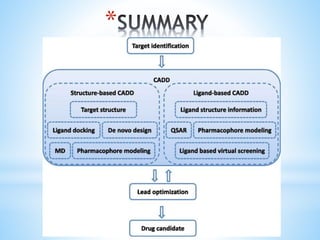
*The paper discusses mainly those approaches of CADD mainly
developed based the structure of macromolecule protein.
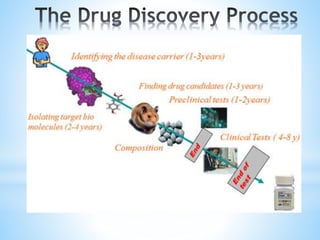
Drug Discovery
The Steps
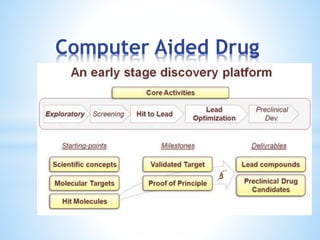
Computer Aided Drug
Discovery
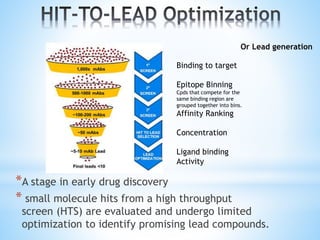
*A stage in early drug discovery
* small molecule hits from a high throughput
screen (HTS) are evaluated and undergo limited
optimization to identify promising lead compounds.
Or Lead generation
Binding to target
Epitope Binning
Cpds that compete for the
same binding region are
grouped together into bins.
Affinity Ranking
Concentration
Ligand binding
Activity
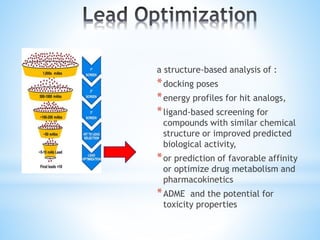
a structure-based analysis of :
*docking poses
*energy profiles for hit analogs,
*ligand-based screening for
compounds with similar chemical
structure or improved predicted
biological activity,
*or prediction of favorable affinity
or optimize drug metabolism and
pharmacokinetics
*ADME and the potential for
toxicity properties
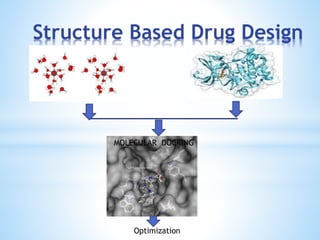
Structure Based Drug Design
Optimization
MOLECULAR DOCKING
SBDD
Examples:
Saquinavir and Amprenavir which were developed
targeting HIV-1 protease based on SBDD.
Dorzolamide is a carbonic anhydrase II inhibitor was also
sought on SBDD approach.
*HIV protease inhibitors – now a key component of
multidrug HIV treatments – are a prime example of
structure-based drug design
*HIV’s protease enzymes were validated as a
potential drug target in 1985, sparking a race to
unravel the enzyme’s structure
*X-ray crystal structures of the enzyme began
appearing in 1989 –and the first drugs designed to
inhibit it were licensed for use just six years later
*Structure-based drug design has since become an
established drug discovery tool
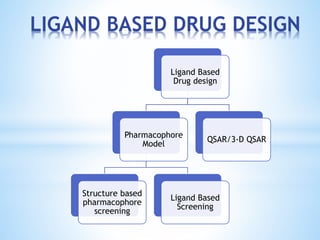
LIGAND BASED DRUG DESIGN
Ligand Based
Drug design
Pharmacophore
Model
Structure based
pharmacophore
screening
Ligand Based
Screening
QSAR/3-D QSAR
LIGAND BASED DRUG DESIGN
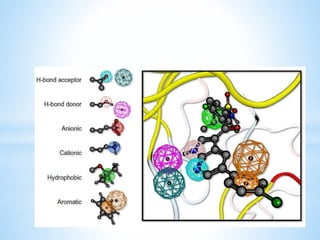
Pharmacophore-Based Drug Design: IUPAC defines pharmacophore as:
“the ensemble of steric and electronic features that is necessary to
ensure the optimal supramolecular interactions with a specific biological
target structure and to trigger (or toblock) its biological response.
A pharmacophore does not represent a real molecule or a real
association of functional groups, but a purely abstract concept that
accounts for the common molecular interaction capacities of a group of
compounds towards their target structure.
Quantitative Structure-Activity Relationships (QSAR) is an example of a
method, which can be applied regardless of whether the structure is
known or unknown.
The active ligands must bind to the receptor in an analogous manner. 3D-
QSAR is a variant of the classical QSAR method (sometimes referred to as
2D-QSAR), in which the descriptors are based on the 3D-structure of the
compounds instead of macro properties like weight and volume.
This method involves the use of 3D-QSAR programs such as CoMFA, Apex-
3D, CATALYST, DISCO,MSA, etc.
LIGAND BASED DRUG
DESIGN
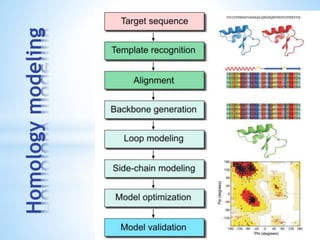
Homologymodeling
Homology Modeling
Examples:
•Homology modeling of HIV protease from a distantly-
related structure has been used in the design of
inhibitors for this structure.
•Also, structure prediction of M antigen by homology
modeling has given insights into its function by
revealing that the structures and domains are similar
to fungal catalases.
*
*
*
*
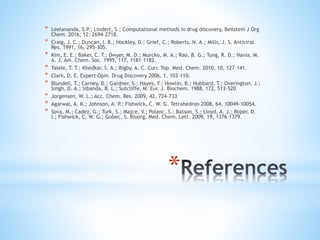
* Leelananda, S.P.; Lindert, S.; Computational methods in drug discovery, Beilstein J Org
Chem. 2016; 12: 2694–2718.
* Craig, J. C.; Duncan, I. B.; Hockley, D.; Grief, C.; Roberts, N. A.; Mills, J. S. Antiviral
Res. 1991, 16, 295–305.
* Kim, E. E.; Baker, C. T.; Dwyer, M. D.; Murcko, M. A.; Rao, B. G.; Tung, R. D.; Navia, M.
A. J. Am. Chem. Soc. 1995, 117, 1181–1182.
* Talele, T. T.; Khedkar, S. A.; Rigby, A. C. Curr. Top. Med. Chem. 2010, 10, 127–141.
* Clark, D. E. Expert Opin. Drug Discovery 2006, 1, 103–110.
* Blundell, T.; Carney, D.; Gardner, S.; Hayes, F.; Howlin, B.; Hubbard, T.; Overington, J.;
Singh, D. A.; Sibanda, B. L.; Sutcliffe, M. Eur. J. Biochem. 1988, 172, 513–520
* Jorgensen, W. L.; Acc. Chem. Res. 2009, 42, 724–733
* Agarwal, A. K.; Johnson, A. P.; Fishwick, C. W. G. Tetrahedron 2008, 64, 10049–10054.
* Sova, M.; Cadez, G.; Turk, S.; Majce, V.; Polanc, S.; Batson, S.; Lloyd, A. J.; Roper, D.
I.; Fishwick, C. W. G.; Gobec, S. Bioorg. Med. Chem. Lett. 2009, 19, 1376–1379.
Cadd

Cadd

  • 1.
    Presented by: Dr. S.S. Harak Gokhale Education Society’s Sir Dr. M.S. Gosavi College of Pharmaceutical Education & Research, Nashik COMPUTER AIDED DRUG DESIGN Rational Drug Design
  • 2.
    *In the fastpace world fast pace development of drug is essential. *This has been boosted by Computer aided drug design(CADD). *The methodology has been cost-effective reducing the labour and time of design and discovery by almost fifty percent. *The paper discusses mainly those approaches of CADD mainly developed based the structure of macromolecule protein.
  • 3.
  • 6.
  • 7.
    *A stage inearly drug discovery * small molecule hits from a high throughput screen (HTS) are evaluated and undergo limited optimization to identify promising lead compounds. Or Lead generation Binding to target Epitope Binning Cpds that compete for the same binding region are grouped together into bins. Affinity Ranking Concentration Ligand binding Activity
  • 8.
    a structure-based analysisof : *docking poses *energy profiles for hit analogs, *ligand-based screening for compounds with similar chemical structure or improved predicted biological activity, *or prediction of favorable affinity or optimize drug metabolism and pharmacokinetics *ADME and the potential for toxicity properties
  • 9.
    Structure Based DrugDesign Optimization MOLECULAR DOCKING
  • 10.
    SBDD Examples: Saquinavir and Amprenavirwhich were developed targeting HIV-1 protease based on SBDD. Dorzolamide is a carbonic anhydrase II inhibitor was also sought on SBDD approach.
  • 11.
    *HIV protease inhibitors– now a key component of multidrug HIV treatments – are a prime example of structure-based drug design *HIV’s protease enzymes were validated as a potential drug target in 1985, sparking a race to unravel the enzyme’s structure *X-ray crystal structures of the enzyme began appearing in 1989 –and the first drugs designed to inhibit it were licensed for use just six years later *Structure-based drug design has since become an established drug discovery tool
  • 12.
    LIGAND BASED DRUGDESIGN Ligand Based Drug design Pharmacophore Model Structure based pharmacophore screening Ligand Based Screening QSAR/3-D QSAR
  • 13.
    LIGAND BASED DRUGDESIGN Pharmacophore-Based Drug Design: IUPAC defines pharmacophore as: “the ensemble of steric and electronic features that is necessary to ensure the optimal supramolecular interactions with a specific biological target structure and to trigger (or toblock) its biological response. A pharmacophore does not represent a real molecule or a real association of functional groups, but a purely abstract concept that accounts for the common molecular interaction capacities of a group of compounds towards their target structure. Quantitative Structure-Activity Relationships (QSAR) is an example of a method, which can be applied regardless of whether the structure is known or unknown. The active ligands must bind to the receptor in an analogous manner. 3D- QSAR is a variant of the classical QSAR method (sometimes referred to as 2D-QSAR), in which the descriptors are based on the 3D-structure of the compounds instead of macro properties like weight and volume. This method involves the use of 3D-QSAR programs such as CoMFA, Apex- 3D, CATALYST, DISCO,MSA, etc.
  • 14.
  • 15.
  • 16.
    Homology Modeling Examples: •Homology modelingof HIV protease from a distantly- related structure has been used in the design of inhibitors for this structure. •Also, structure prediction of M antigen by homology modeling has given insights into its function by revealing that the structures and domains are similar to fungal catalases.
  • 17.
  • 20.
  • 21.
  • 22.
    * * Leelananda, S.P.;Lindert, S.; Computational methods in drug discovery, Beilstein J Org Chem. 2016; 12: 2694–2718. * Craig, J. C.; Duncan, I. B.; Hockley, D.; Grief, C.; Roberts, N. A.; Mills, J. S. Antiviral Res. 1991, 16, 295–305. * Kim, E. E.; Baker, C. T.; Dwyer, M. D.; Murcko, M. A.; Rao, B. G.; Tung, R. D.; Navia, M. A. J. Am. Chem. Soc. 1995, 117, 1181–1182. * Talele, T. T.; Khedkar, S. A.; Rigby, A. C. Curr. Top. Med. Chem. 2010, 10, 127–141. * Clark, D. E. Expert Opin. Drug Discovery 2006, 1, 103–110. * Blundell, T.; Carney, D.; Gardner, S.; Hayes, F.; Howlin, B.; Hubbard, T.; Overington, J.; Singh, D. A.; Sibanda, B. L.; Sutcliffe, M. Eur. J. Biochem. 1988, 172, 513–520 * Jorgensen, W. L.; Acc. Chem. Res. 2009, 42, 724–733 * Agarwal, A. K.; Johnson, A. P.; Fishwick, C. W. G. Tetrahedron 2008, 64, 10049–10054. * Sova, M.; Cadez, G.; Turk, S.; Majce, V.; Polanc, S.; Batson, S.; Lloyd, A. J.; Roper, D. I.; Fishwick, C. W. G.; Gobec, S. Bioorg. Med. Chem. Lett. 2009, 19, 1376–1379.