Dr.ShilpaSudhakarHarak
Asst.Prof.,Pharm.Chem.,
GESSirDr.M.S.GosaviCollegeofPharmaceuticalEducationandResearch,Nashik
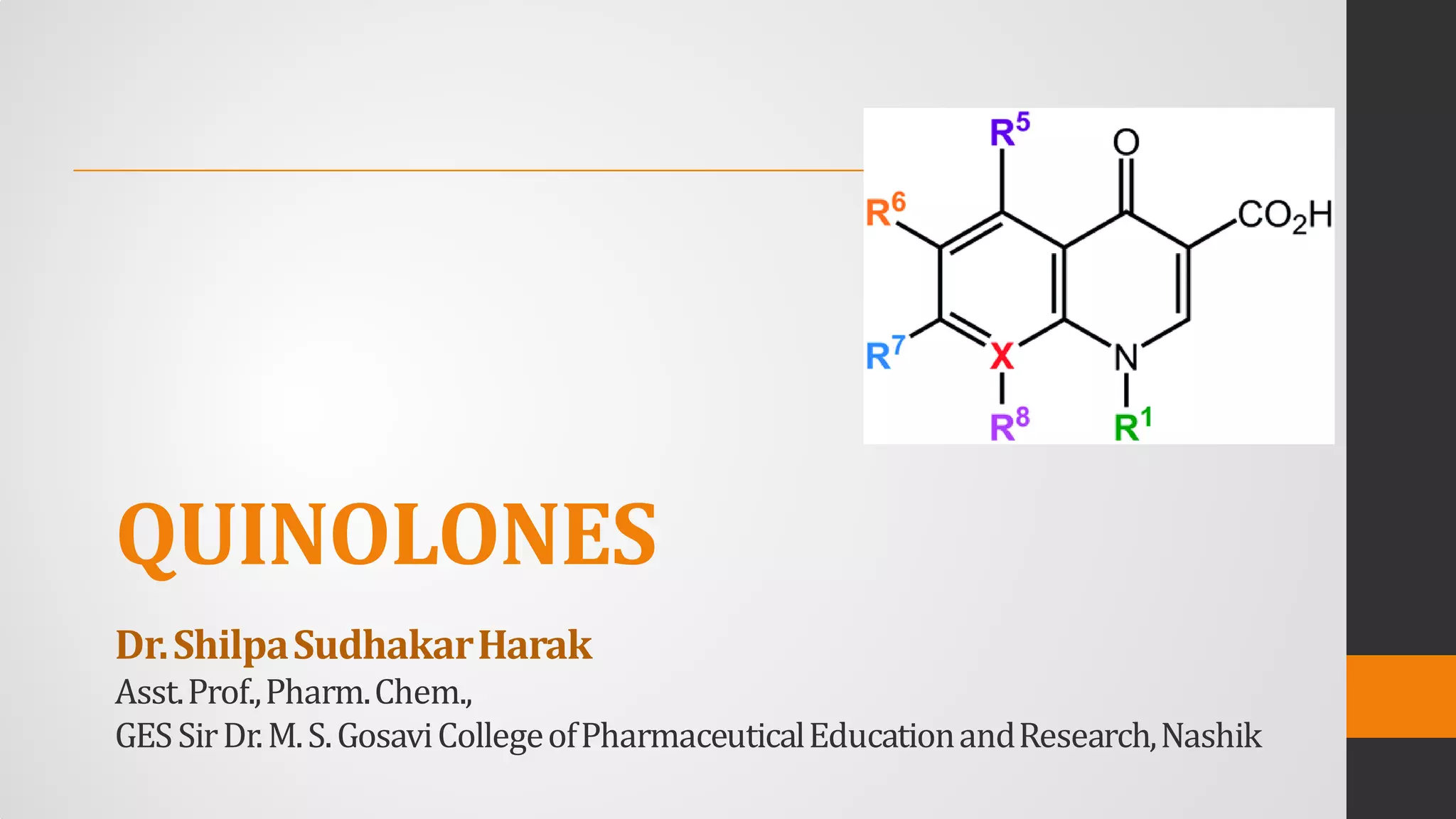
QUINOLONES
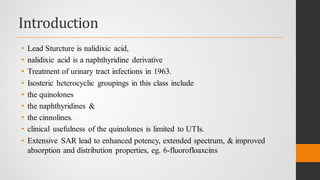
Introduction
• Lead Sturcture is nalidixic acid,
• nalidixic acid is a naphthyridine derivative
• Treatment of urinary tract infections in 1963.
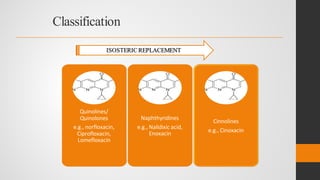
• Isosteric heterocyclic groupings in this class include
• the quinolones
• the naphthyridines &
• the cinnolines.
• clinical usefulness of the quinolones is limited to UTIs.
• Extensive SAR lead to enhanced potency, extended spectrum, & improved
absorption and distribution properties, eg. 6-fluorofloaxcins
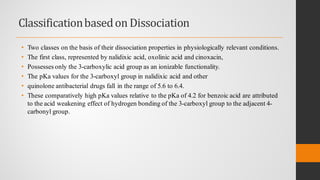
Classificationbasedon Dissociation
• Two classes on the basis of their dissociation properties in physiologically relevant conditions.
• The first class, represented by nalidixic acid, oxolinic acid and cinoxacin,
• Possesses only the 3-carboxylic acid group as an ionizable functionality.
• The pKa values for the 3-carboxyl group in nalidixic acid and other
• quinolone antibacterial drugs fall in the range of 5.6 to 6.4.
• These comparatively high pKa values relative to the pKa of 4.2 for benzoic acid are attributed
to the acid weakening effect of hydrogen bonding of the 3-carboxyl group to the adjacent 4-
carbonyl group.
Classificationbasedon Dissociation
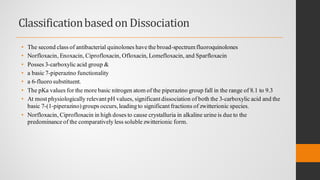
• The second class of antibacterial quinolones have the broad-spectrumfluoroquinolones
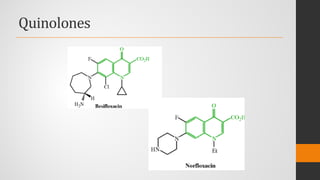
• Norfloxacin, Enoxacin, Ciprofloxacin, Ofloxacin, Lomefloxacin, and Sparfloxacin
• Posses 3-carboxylic acid group &
• a basic 7-piperazino functionality
• a 6-fluoro substituent.
• The pKa values for the more basic nitrogen atom of the piperazino group fall in the range of 8.1 to 9.3
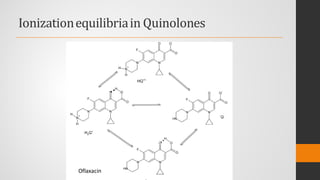
• At most physiologically relevant pH values, significant dissociation of both the 3-carboxylic acid and the
basic 7-(1-piperazino)groups occurs,leading to significant fractions of zwitterionic species.
• Norfloxacin, Ciprofloxacin in high doses to cause crystalluria in alkaline urine is due to the
predominance of the comparatively less soluble zwitterionic form.
Ionizationequilibriain Quinolones
Oflaxacin
Classification
Quinolines/
Quinolones
e.g., norfloxacin,
Ciprofloxacin,
Lomefloxacin
Naphthyridines
e.g., Nalidixic acid,
Enoxacin
Cinnolines
e.g., Cinoxacin
ISOSTERIC REPLACEMENT
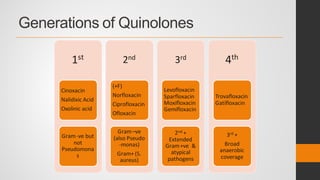
Generations of Quinolones
1st
Cinoxacin
Nalidixic Acid
Oxolinic acid
Gram-ve but
not
Pseudomona
s
2nd
(+F)
Norfloxacin
Ciprofloxacin
Ofloxacin
Gram–ve
(also Pseudo
-monas)
Gram+ (S.
aureus)
3rd
Levofloxacin
Sparfloxacin
Moxifloxacin
Gemifloxacin
2nd +
Extended
Gram+ve &
atypical
pathogens
4th
Trovafloxacin
Gatifloxacin
3rd +
Broad
anaerobic
coverage
Mechanism of Action
Dual MOA:
• Inhibition of bacterial DNA Gyrase (Topoisomerase II)
1.Formation of quinolone-DNA-Gyrase complex
2.Induced cleavage of DNA
• Inhibition of bacterial Topoisomerase IV
1.Mechanism poorly understood Mechanism of DNA Gyrase
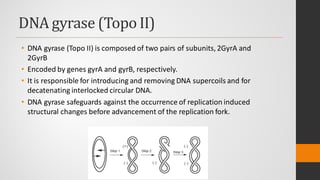
DNA gyrase (Topo II)
• DNA gyrase (Topo II) is composed of two pairs of subunits,2GyrA and
2GyrB
• Encoded by genes gyrA and gyrB, respectively.
• It is responsible for introducing and removing DNA supercoils and for
decatenating interlocked circular DNA.
• DNA gyrase safeguards against the occurrence of replication induced
structural changes before advancement of the replication fork.
DNA gyrase(TopoII)
• Quinolonesblock the reaction and trap gyrase or topoisomeraseIV as a drug-
enzyme-DNAcomplex,with subsequentreleaseof lethal, double- stranded DNA
breaks.
• Thesestrands breaksleads to SOS responsewhich leads to DNA repair mechanisms
involvinglow fidelity DNA pol. which causelethal mutations leading to genomic
toxicity and finally cell death
TopoisomeraseIV
• Topoisomerase IV In E. coli, it has two ParC and two ParE subunits
• Encoded by genes parC and parE genes.
• Removal of DNA supercoils and separation of newly built daughter DNA after
replication is complete.
• Topo II work before the replication fork and topo IV works after the replication fork
on newly formed DNA
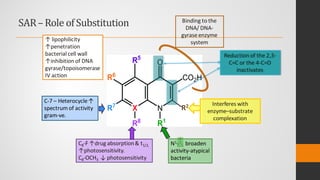
R2
Binding to the
DNA/ DNA-
gyrase enzyme
system
SAR–Role ofSubstitution
Reduction of the 2,3-
C=C or the 4-C=O
inactivates
Interferes with
enzyme–substrate
complexation
↑ lipophilicity
↑penetration
bacterial cell wall
↑inhibition of DNA
gyrase/topoisomerase
IV action
C8-F↑drug absorption& t1/2,
↑photosensitivity.
C8-OCH3 ↓ photosensitivity
C-7 – Heterocycle↑
spectrum of activity
gram-ve.
N1- broaden
activity-atypical
bacteria
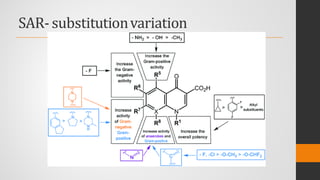
SAR- substitutionvariation
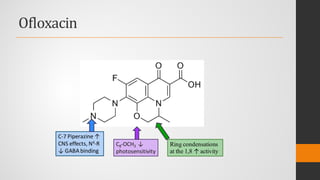
Ofloxacin
C8-OCH3 ↓
photosensitivity
C-7 Piperazine ↑
CNS effects, N4-R
↓ GABA binding
Ring condensations
at the 1,8 ↑ activity
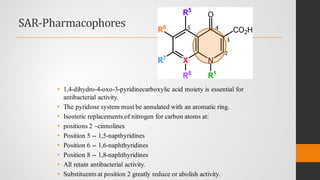
SAR-Pharmacophores
• 1,4-dihydro-4-oxo-3-pyridinecarboxylic acid moiety is essential for
antibacterial activity.
• The pyridone system must be annulated with an aromatic ring.
• Isosteric replacements of nitrogen for carbon atoms at:
• positions 2 –cinnolines
• Position 5 -- 1,5-napthyridines
• Position 6 -- 1,6-naphthyridines
• Position 8 -- 1,8-naphthyridines
• All retain antibacterial activity.
• Substituents at position 2 greatly reduce or abolish activity.
2
3
45
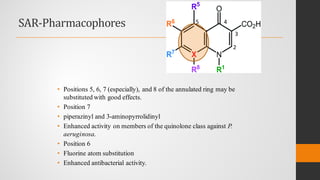
SAR-Pharmacophores
• Positions 5, 6, 7 (especially), and 8 of the annulated ring may be
substituted with good effects.
• Position 7
• piperazinyl and 3-aminopyrrolidinyl
• Enhanced activity on members of the quinolone class against P.
aeruginosa.
• Position 6
• Fluorine atom substitution
• Enhanced antibacterial activity.
2
3
45
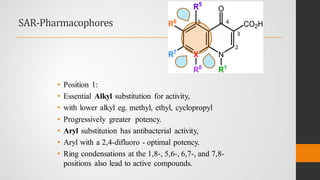
SAR-Pharmacophores
• Position 1:
• Essential Alkyl substitution for activity,
• with lower alkyl eg. methyl, ethyl, cyclopropyl
• Progressively greater potency.
• Aryl substitution has antibacterial activity,
• Aryl with a 2,4-difluoro - optimal potency.
• Ring condensations at the 1,8-, 5,6-, 6,7-, and 7,8-
positions also lead to active compounds.
2
3
45
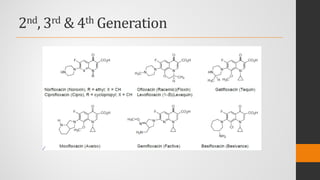
2nd, 3rd & 4th Generation
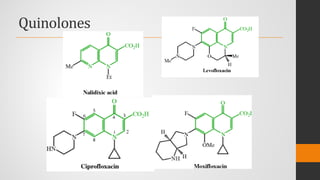
Quinolones
Quinolones
Quinolones
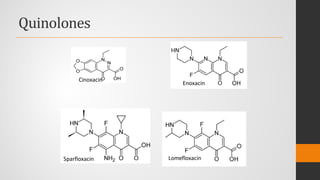
LomefloxacinSparfloxacin
Enoxacin
Cinoxacin
Quinolones
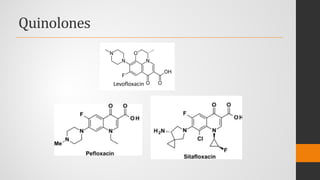
Levofloxacin
Cinoxacin
• 1-Ethyl-1,4-dihydro-4-oxo[1,3]dioxolo[4,5g]cinnoline-3-carboxylic
acid (Cinobac) is a close congener (isostere) of oxolinic acid and
• Has antibacterial properties similar to those of nalidixic and oxolinic
acids.
• Urinary tract infections caused by strains of Gram-negative bacteria
• Possesses pharmacokinetic properties superior to those of either of its
predecessors.
• oral administration,
• higher urinary concentrations of cinoxacin than of nalidixic acid or
oxolinic acid are achieved.
• Cinoxacin appears to be more completely absorbed and less protein
• bound than nalidixic acid.
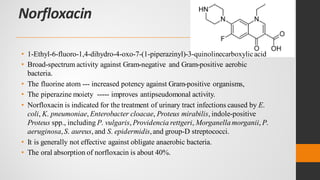
Norfloxacin
• 1-Ethyl-6-fluoro-1,4-dihydro-4-oxo-7-(1-piperazinyl)-3-quinolinecarboxylicacid
• Broad-spectrum activity against Gram-negative and Gram-positive aerobic
bacteria.
• The fluorine atom --- increased potency against Gram-positive organisms,
• The piperazine moiety ----- improves antipseudomonal activity.
• Norfloxacin is indicated for the treatment of urinary tract infections caused by E.
coli, K. pneumoniae, Enterobacter cloacae, Proteus mirabilis, indole-positive
Proteus spp., including P. vulgaris, Providencia rettgeri, Morganellamorganii, P.
aeruginosa,S. aureus, and S. epidermidis,and group-D streptococci.
• It is generally not effective against obligate anaerobic bacteria.
• The oral absorption of norfloxacin is about 40%.
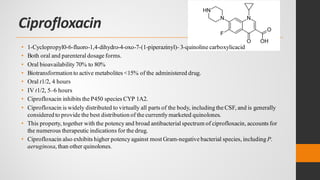
Ciprofloxacin
• 1-Cyclopropyl0-6-fluoro-1,4-dihydro-4-oxo-7-(1-piperazinyl)- 3-quinoline carboxylicacid
• Both oral and parenteral dosage forms.
• Oral bioavailability 70% to 80%
• Biotransformation to active metabolites <15% of the administered drug.
• Oral t1/2, 4 hours
• IV t1/2, 5–6 hours
• Ciprofloxacin inhibits the P450 species CYP 1A2.
• Ciprofloxacin is widely distributed to virtually all parts of the body, including the CSF, and is generally
considered to provide the best distribution of the currently marketed quinolones.
• This property, together with the potency and broad antibacterial spectrum of ciprofloxacin, accounts for
the numerous therapeutic indications for the drug.
• Ciprofloxacin also exhibits higher potency against most Gram-negative bacterial species, including P.
aeruginosa, than other quinolones.
PHARMACOKINETICS
• The fluoroquinolonesare well absorbed on oral administration, with excellent
bioavailability.
• Plasma max is reached in few hours
• moderately bound to plasma protein,
• Comparatively long half-lives
• Earlier quinolones were rapidly excreted into the urine, therefore useful only
in UTIs.
• Newer drugs distributed to alveolar macrophages, bronchial mucosa,
epithelial lining fluid, and saliva, improving the use in various systemic
infections.
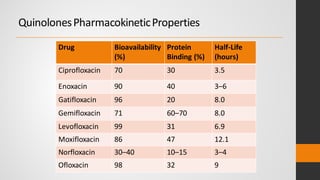
QuinolonesPharmacokineticProperties
Drug Bioavailability
(%)
Protein
Binding (%)
Half-Life
(hours)
Ciprofloxacin 70 30 3.5
Enoxacin 90 40 3–6
Gatifloxacin 96 20 8.0
Gemifloxacin 71 60–70 8.0
Levofloxacin 99 31 6.9
Moxifloxacin 86 47 12.1
Norfloxacin 30–40 10–15 3–4
Ofloxacin 98 32 9
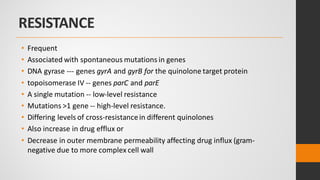
RESISTANCE
• Frequent
• Associated with spontaneous mutations in genes
• DNA gyrase --- genes gyrA and gyrB for the quinolone target protein
• topoisomerase IV -- genes parC and parE
• A single mutation -- low-level resistance
• Mutations >1 gene -- high-level resistance.
• Differing levels of cross-resistancein different quinolones
• Also increase in drug efflux or
• Decrease in outer membrane permeability affecting drug influx (gram-
negative due to more complex cell wall

Quinolones

  • 1.
  • 2.
    Introduction • Lead Sturctureis nalidixic acid, • nalidixic acid is a naphthyridine derivative • Treatment of urinary tract infections in 1963. • Isosteric heterocyclic groupings in this class include • the quinolones • the naphthyridines & • the cinnolines. • clinical usefulness of the quinolones is limited to UTIs. • Extensive SAR lead to enhanced potency, extended spectrum, & improved absorption and distribution properties, eg. 6-fluorofloaxcins
  • 3.
    Classificationbasedon Dissociation • Twoclasses on the basis of their dissociation properties in physiologically relevant conditions. • The first class, represented by nalidixic acid, oxolinic acid and cinoxacin, • Possesses only the 3-carboxylic acid group as an ionizable functionality. • The pKa values for the 3-carboxyl group in nalidixic acid and other • quinolone antibacterial drugs fall in the range of 5.6 to 6.4. • These comparatively high pKa values relative to the pKa of 4.2 for benzoic acid are attributed to the acid weakening effect of hydrogen bonding of the 3-carboxyl group to the adjacent 4- carbonyl group.
  • 4.
    Classificationbasedon Dissociation • Thesecond class of antibacterial quinolones have the broad-spectrumfluoroquinolones • Norfloxacin, Enoxacin, Ciprofloxacin, Ofloxacin, Lomefloxacin, and Sparfloxacin • Posses 3-carboxylic acid group & • a basic 7-piperazino functionality • a 6-fluoro substituent. • The pKa values for the more basic nitrogen atom of the piperazino group fall in the range of 8.1 to 9.3 • At most physiologically relevant pH values, significant dissociation of both the 3-carboxylic acid and the basic 7-(1-piperazino)groups occurs,leading to significant fractions of zwitterionic species. • Norfloxacin, Ciprofloxacin in high doses to cause crystalluria in alkaline urine is due to the predominance of the comparatively less soluble zwitterionic form.
  • 5.
  • 6.
  • 7.
    Generations of Quinolones 1st Cinoxacin NalidixicAcid Oxolinic acid Gram-ve but not Pseudomona s 2nd (+F) Norfloxacin Ciprofloxacin Ofloxacin Gram–ve (also Pseudo -monas) Gram+ (S. aureus) 3rd Levofloxacin Sparfloxacin Moxifloxacin Gemifloxacin 2nd + Extended Gram+ve & atypical pathogens 4th Trovafloxacin Gatifloxacin 3rd + Broad anaerobic coverage
  • 8.
    Mechanism of Action DualMOA: • Inhibition of bacterial DNA Gyrase (Topoisomerase II) 1.Formation of quinolone-DNA-Gyrase complex 2.Induced cleavage of DNA • Inhibition of bacterial Topoisomerase IV 1.Mechanism poorly understood Mechanism of DNA Gyrase
  • 9.
    DNA gyrase (TopoII) • DNA gyrase (Topo II) is composed of two pairs of subunits,2GyrA and 2GyrB • Encoded by genes gyrA and gyrB, respectively. • It is responsible for introducing and removing DNA supercoils and for decatenating interlocked circular DNA. • DNA gyrase safeguards against the occurrence of replication induced structural changes before advancement of the replication fork.
  • 10.
    DNA gyrase(TopoII) • Quinolonesblockthe reaction and trap gyrase or topoisomeraseIV as a drug- enzyme-DNAcomplex,with subsequentreleaseof lethal, double- stranded DNA breaks. • Thesestrands breaksleads to SOS responsewhich leads to DNA repair mechanisms involvinglow fidelity DNA pol. which causelethal mutations leading to genomic toxicity and finally cell death
  • 11.
    TopoisomeraseIV • Topoisomerase IVIn E. coli, it has two ParC and two ParE subunits • Encoded by genes parC and parE genes. • Removal of DNA supercoils and separation of newly built daughter DNA after replication is complete. • Topo II work before the replication fork and topo IV works after the replication fork on newly formed DNA
  • 12.
    R2 Binding to the DNA/DNA- gyrase enzyme system SAR–Role ofSubstitution Reduction of the 2,3- C=C or the 4-C=O inactivates Interferes with enzyme–substrate complexation ↑ lipophilicity ↑penetration bacterial cell wall ↑inhibition of DNA gyrase/topoisomerase IV action C8-F↑drug absorption& t1/2, ↑photosensitivity. C8-OCH3 ↓ photosensitivity C-7 – Heterocycle↑ spectrum of activity gram-ve. N1- broaden activity-atypical bacteria
  • 13.
  • 14.
    Ofloxacin C8-OCH3 ↓ photosensitivity C-7 Piperazine↑ CNS effects, N4-R ↓ GABA binding Ring condensations at the 1,8 ↑ activity
  • 15.
    SAR-Pharmacophores • 1,4-dihydro-4-oxo-3-pyridinecarboxylic acidmoiety is essential for antibacterial activity. • The pyridone system must be annulated with an aromatic ring. • Isosteric replacements of nitrogen for carbon atoms at: • positions 2 –cinnolines • Position 5 -- 1,5-napthyridines • Position 6 -- 1,6-naphthyridines • Position 8 -- 1,8-naphthyridines • All retain antibacterial activity. • Substituents at position 2 greatly reduce or abolish activity. 2 3 45
  • 16.
    SAR-Pharmacophores • Positions 5,6, 7 (especially), and 8 of the annulated ring may be substituted with good effects. • Position 7 • piperazinyl and 3-aminopyrrolidinyl • Enhanced activity on members of the quinolone class against P. aeruginosa. • Position 6 • Fluorine atom substitution • Enhanced antibacterial activity. 2 3 45
  • 17.
    SAR-Pharmacophores • Position 1: •Essential Alkyl substitution for activity, • with lower alkyl eg. methyl, ethyl, cyclopropyl • Progressively greater potency. • Aryl substitution has antibacterial activity, • Aryl with a 2,4-difluoro - optimal potency. • Ring condensations at the 1,8-, 5,6-, 6,7-, and 7,8- positions also lead to active compounds. 2 3 45
  • 18.
    2nd, 3rd &4th Generation
  • 19.
  • 20.
  • 21.
  • 22.
  • 23.
    Cinoxacin • 1-Ethyl-1,4-dihydro-4-oxo[1,3]dioxolo[4,5g]cinnoline-3-carboxylic acid (Cinobac)is a close congener (isostere) of oxolinic acid and • Has antibacterial properties similar to those of nalidixic and oxolinic acids. • Urinary tract infections caused by strains of Gram-negative bacteria • Possesses pharmacokinetic properties superior to those of either of its predecessors. • oral administration, • higher urinary concentrations of cinoxacin than of nalidixic acid or oxolinic acid are achieved. • Cinoxacin appears to be more completely absorbed and less protein • bound than nalidixic acid.
  • 24.
    Norfloxacin • 1-Ethyl-6-fluoro-1,4-dihydro-4-oxo-7-(1-piperazinyl)-3-quinolinecarboxylicacid • Broad-spectrumactivity against Gram-negative and Gram-positive aerobic bacteria. • The fluorine atom --- increased potency against Gram-positive organisms, • The piperazine moiety ----- improves antipseudomonal activity. • Norfloxacin is indicated for the treatment of urinary tract infections caused by E. coli, K. pneumoniae, Enterobacter cloacae, Proteus mirabilis, indole-positive Proteus spp., including P. vulgaris, Providencia rettgeri, Morganellamorganii, P. aeruginosa,S. aureus, and S. epidermidis,and group-D streptococci. • It is generally not effective against obligate anaerobic bacteria. • The oral absorption of norfloxacin is about 40%.
  • 25.
    Ciprofloxacin • 1-Cyclopropyl0-6-fluoro-1,4-dihydro-4-oxo-7-(1-piperazinyl)- 3-quinolinecarboxylicacid • Both oral and parenteral dosage forms. • Oral bioavailability 70% to 80% • Biotransformation to active metabolites <15% of the administered drug. • Oral t1/2, 4 hours • IV t1/2, 5–6 hours • Ciprofloxacin inhibits the P450 species CYP 1A2. • Ciprofloxacin is widely distributed to virtually all parts of the body, including the CSF, and is generally considered to provide the best distribution of the currently marketed quinolones. • This property, together with the potency and broad antibacterial spectrum of ciprofloxacin, accounts for the numerous therapeutic indications for the drug. • Ciprofloxacin also exhibits higher potency against most Gram-negative bacterial species, including P. aeruginosa, than other quinolones.
  • 26.
    PHARMACOKINETICS • The fluoroquinolonesarewell absorbed on oral administration, with excellent bioavailability. • Plasma max is reached in few hours • moderately bound to plasma protein, • Comparatively long half-lives • Earlier quinolones were rapidly excreted into the urine, therefore useful only in UTIs. • Newer drugs distributed to alveolar macrophages, bronchial mucosa, epithelial lining fluid, and saliva, improving the use in various systemic infections.
  • 27.
    QuinolonesPharmacokineticProperties Drug Bioavailability (%) Protein Binding (%) Half-Life (hours) Ciprofloxacin70 30 3.5 Enoxacin 90 40 3–6 Gatifloxacin 96 20 8.0 Gemifloxacin 71 60–70 8.0 Levofloxacin 99 31 6.9 Moxifloxacin 86 47 12.1 Norfloxacin 30–40 10–15 3–4 Ofloxacin 98 32 9
  • 28.
    RESISTANCE • Frequent • Associatedwith spontaneous mutations in genes • DNA gyrase --- genes gyrA and gyrB for the quinolone target protein • topoisomerase IV -- genes parC and parE • A single mutation -- low-level resistance • Mutations >1 gene -- high-level resistance. • Differing levels of cross-resistancein different quinolones • Also increase in drug efflux or • Decrease in outer membrane permeability affecting drug influx (gram- negative due to more complex cell wall