NITROFURANS
Dr. Shilpa Sudhakar Harak
Asst. Prof., Pharm. Chem.,
GES Sir Dr. M. S. Gosavi College of Pharmaceutical Education and Research, Nasik
Introduction
• first Nitro-heterocyclic compounds to be introduced into chemotherapy
• 3 compounds used for the treatment of bacterial infections vastly for nearly 50
years:
i. Nitrofurazone,
ii. Furazolidone, and
iii. Nitrofurantoin
• Fourth nitrofuran is nifurtimox - used as an antiprotozoal agent to treat
trypanosomiasis and leishmaniasis.
• 5th Metronidazole, which is an amebicide (a trichomonicide) and is used for
the treatment of systemic infections caused by anaerobic bacteria.
Chemistry
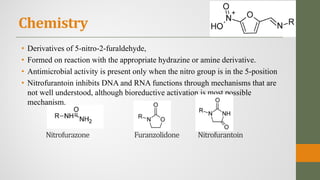
• Derivatives of 5-nitro-2-furaldehyde,
• Formed on reaction with the appropriate hydrazine or amine derivative.
• Antimicrobial activity is present only when the nitro group is in the 5-position
• Nitrofurantoin inhibits DNA and RNA functions through mechanisms that are
not well understood, although bioreductive activation is most possible
mechanism.
Nitrofurazone Furanzolidone Nitrofurantoin
Nitrofurazone
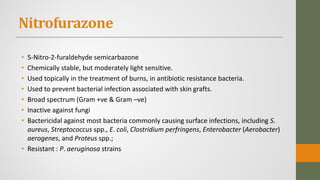
• 5-Nitro-2-furaldehyde semicarbazone
• Chemically stable, but moderately light sensitive.
• Used topically in the treatment of burns, in antibiotic resistance bacteria.
• Used to prevent bacterial infection associated with skin grafts.
• Broad spectrum (Gram +ve & Gram –ve)
• Inactive against fungi
• Bactericidal against most bacteria commonly causing surface infections, including S.
aureus, Streptococcus spp., E. coli, Clostridium perfringens, Enterobacter (Aerobacter)
aerogenes, and Proteus spp.;
• Resistant : P. aeruginosa strains
Furazolidone
• 3-[(5-Nitrofurylidene)amino]-2-oxazolidinone (Furoxone)
• Bactericidal activity against a relatively broad range of intestinal pathogens,
including S. aureus, E. coli, Salmonella, Shigella, Proteus spp., Enterobacter,
and Vibrio cholerae.
• It is also active against the protozoan Giardia lamblia.
• Oral treatment of bacterial or protozoal diarrhea caused by susceptible
organisms.
• Approximately 5% of the oral dose is detectable in the urine in the form of
several metabolites.
• Contra-indicated with Alcohol as it can inhibit aldehyde dehydrogenase.
Nitrofurantoin
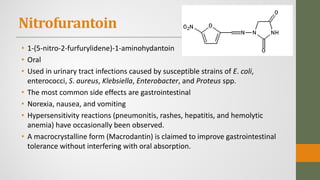
• 1-(5-nitro-2-furfurylidene)-1-aminohydantoin
• Oral
• Used in urinary tract infections caused by susceptible strains of E. coli,
enterococci, S. aureus, Klebsiella, Enterobacter, and Proteus spp.
• The most common side effects are gastrointestinal
• Norexia, nausea, and vomiting
• Hypersensitivity reactions (pneumonitis, rashes, hepatitis, and hemolytic
anemia) have occasionally been observed.
• A macrocrystalline form (Macrodantin) is claimed to improve gastrointestinal
tolerance without interfering with oral absorption.
Methenamine
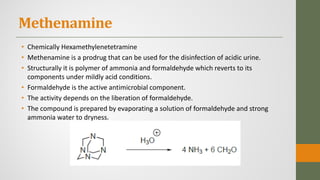
• Chemically Hexamethylenetetramine
• Methenamine is a prodrug that can be used for the disinfection of acidic urine.
• Structurally it is polymer of ammonia and formaldehyde which reverts to its
components under mildly acid conditions.
• Formaldehyde is the active antimicrobial component.
• The activity depends on the liberation of formaldehyde.
• The compound is prepared by evaporating a solution of formaldehyde and strong
ammonia water to dryness.
Methenamine
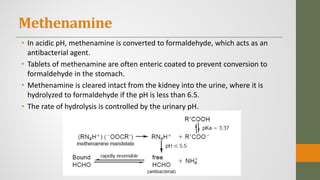
• In acidic pH, methenamine is converted to formaldehyde, which acts as an
antibacterial agent.
• Tablets of methenamine are often enteric coated to prevent conversion to
formaldehyde in the stomach.
• Methenamine is cleared intact from the kidney into the urine, where it is
hydrolyzed to formaldehyde if the pH is less than 6.5.
• The rate of hydrolysis is controlled by the urinary pH.
Methenamine
• To optimize the antibacterial effect, an acidifying agent such as sodium
biphosphate or ammonium chloride generally accompanies the administration
of methenamine.
• Certain bacterial strains are resistant to the action of methenamine because
they elaborate urease, an enzyme that hydrolyzes urea to form ammonia.
• The resultant high urinary pH prevents the activation of methenamine,
rendering it ineffective.
• This problem can be overcome by the coadministration of the urease inhibitor
acetohydroxamic acid (Lithostat).
Methenamine Mandelate
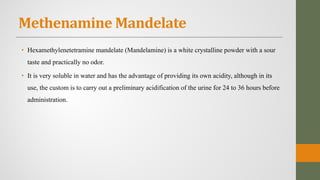
• Hexamethylenetetramine mandelate (Mandelamine) is a white crystalline powder with a sour
taste and practically no odor.
• It is very soluble in water and has the advantage of providing its own acidity, although in its
use, the custom is to carry out a preliminary acidification of the urine for 24 to 36 hours before
administration.
Methenamine Hippurate
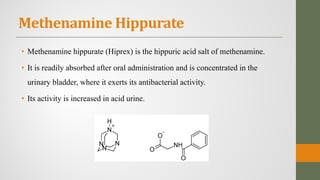
• Methenamine hippurate (Hiprex) is the hippuric acid salt of methenamine.
• It is readily absorbed after oral administration and is concentrated in the
urinary bladder, where it exerts its antibacterial activity.
• Its activity is increased in acid urine.
FOSFOMYCIN
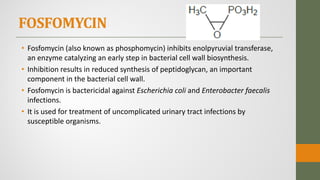
• Fosfomycin (also known as phosphomycin) inhibits enolpyruvial transferase,
an enzyme catalyzing an early step in bacterial cell wall biosynthesis.
• Inhibition results in reduced synthesis of peptidoglycan, an important
component in the bacterial cell wall.
• Fosfomycin is bactericidal against Escherichia coli and Enterobacter faecalis
infections.
• It is used for treatment of uncomplicated urinary tract infections by
susceptible organisms.
Phenazopyridine
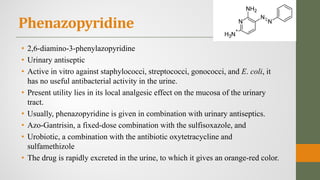
• 2,6-diamino-3-phenylazopyridine
• Urinary antiseptic
• Active in vitro against staphylococci, streptococci, gonococci, and E. coli, it
has no useful antibacterial activity in the urine.
• Present utility lies in its local analgesic effect on the mucosa of the urinary
tract.
• Usually, phenazopyridine is given in combination with urinary antiseptics.
• Azo-Gantrisin, a fixed-dose combination with the sulfisoxazole, and
• Urobiotic, a combination with the antibiotic oxytetracycline and
sulfamethizole
• The drug is rapidly excreted in the urine, to which it gives an orange-red color.

Nitrofurans

  • 1.
    NITROFURANS Dr. Shilpa SudhakarHarak Asst. Prof., Pharm. Chem., GES Sir Dr. M. S. Gosavi College of Pharmaceutical Education and Research, Nasik
  • 2.
    Introduction • first Nitro-heterocycliccompounds to be introduced into chemotherapy • 3 compounds used for the treatment of bacterial infections vastly for nearly 50 years: i. Nitrofurazone, ii. Furazolidone, and iii. Nitrofurantoin • Fourth nitrofuran is nifurtimox - used as an antiprotozoal agent to treat trypanosomiasis and leishmaniasis. • 5th Metronidazole, which is an amebicide (a trichomonicide) and is used for the treatment of systemic infections caused by anaerobic bacteria.
  • 3.
    Chemistry • Derivatives of5-nitro-2-furaldehyde, • Formed on reaction with the appropriate hydrazine or amine derivative. • Antimicrobial activity is present only when the nitro group is in the 5-position • Nitrofurantoin inhibits DNA and RNA functions through mechanisms that are not well understood, although bioreductive activation is most possible mechanism. Nitrofurazone Furanzolidone Nitrofurantoin
  • 4.
    Nitrofurazone • 5-Nitro-2-furaldehyde semicarbazone •Chemically stable, but moderately light sensitive. • Used topically in the treatment of burns, in antibiotic resistance bacteria. • Used to prevent bacterial infection associated with skin grafts. • Broad spectrum (Gram +ve & Gram –ve) • Inactive against fungi • Bactericidal against most bacteria commonly causing surface infections, including S. aureus, Streptococcus spp., E. coli, Clostridium perfringens, Enterobacter (Aerobacter) aerogenes, and Proteus spp.; • Resistant : P. aeruginosa strains
  • 5.
    Furazolidone • 3-[(5-Nitrofurylidene)amino]-2-oxazolidinone (Furoxone) •Bactericidal activity against a relatively broad range of intestinal pathogens, including S. aureus, E. coli, Salmonella, Shigella, Proteus spp., Enterobacter, and Vibrio cholerae. • It is also active against the protozoan Giardia lamblia. • Oral treatment of bacterial or protozoal diarrhea caused by susceptible organisms. • Approximately 5% of the oral dose is detectable in the urine in the form of several metabolites. • Contra-indicated with Alcohol as it can inhibit aldehyde dehydrogenase.
  • 6.
    Nitrofurantoin • 1-(5-nitro-2-furfurylidene)-1-aminohydantoin • Oral •Used in urinary tract infections caused by susceptible strains of E. coli, enterococci, S. aureus, Klebsiella, Enterobacter, and Proteus spp. • The most common side effects are gastrointestinal • Norexia, nausea, and vomiting • Hypersensitivity reactions (pneumonitis, rashes, hepatitis, and hemolytic anemia) have occasionally been observed. • A macrocrystalline form (Macrodantin) is claimed to improve gastrointestinal tolerance without interfering with oral absorption.
  • 7.
    Methenamine • Chemically Hexamethylenetetramine •Methenamine is a prodrug that can be used for the disinfection of acidic urine. • Structurally it is polymer of ammonia and formaldehyde which reverts to its components under mildly acid conditions. • Formaldehyde is the active antimicrobial component. • The activity depends on the liberation of formaldehyde. • The compound is prepared by evaporating a solution of formaldehyde and strong ammonia water to dryness.
  • 8.
    Methenamine • In acidicpH, methenamine is converted to formaldehyde, which acts as an antibacterial agent. • Tablets of methenamine are often enteric coated to prevent conversion to formaldehyde in the stomach. • Methenamine is cleared intact from the kidney into the urine, where it is hydrolyzed to formaldehyde if the pH is less than 6.5. • The rate of hydrolysis is controlled by the urinary pH.
  • 9.
    Methenamine • To optimizethe antibacterial effect, an acidifying agent such as sodium biphosphate or ammonium chloride generally accompanies the administration of methenamine. • Certain bacterial strains are resistant to the action of methenamine because they elaborate urease, an enzyme that hydrolyzes urea to form ammonia. • The resultant high urinary pH prevents the activation of methenamine, rendering it ineffective. • This problem can be overcome by the coadministration of the urease inhibitor acetohydroxamic acid (Lithostat).
  • 10.
    Methenamine Mandelate • Hexamethylenetetraminemandelate (Mandelamine) is a white crystalline powder with a sour taste and practically no odor. • It is very soluble in water and has the advantage of providing its own acidity, although in its use, the custom is to carry out a preliminary acidification of the urine for 24 to 36 hours before administration.
  • 11.
    Methenamine Hippurate • Methenaminehippurate (Hiprex) is the hippuric acid salt of methenamine. • It is readily absorbed after oral administration and is concentrated in the urinary bladder, where it exerts its antibacterial activity. • Its activity is increased in acid urine.
  • 12.
    FOSFOMYCIN • Fosfomycin (alsoknown as phosphomycin) inhibits enolpyruvial transferase, an enzyme catalyzing an early step in bacterial cell wall biosynthesis. • Inhibition results in reduced synthesis of peptidoglycan, an important component in the bacterial cell wall. • Fosfomycin is bactericidal against Escherichia coli and Enterobacter faecalis infections. • It is used for treatment of uncomplicated urinary tract infections by susceptible organisms.
  • 13.
    Phenazopyridine • 2,6-diamino-3-phenylazopyridine • Urinaryantiseptic • Active in vitro against staphylococci, streptococci, gonococci, and E. coli, it has no useful antibacterial activity in the urine. • Present utility lies in its local analgesic effect on the mucosa of the urinary tract. • Usually, phenazopyridine is given in combination with urinary antiseptics. • Azo-Gantrisin, a fixed-dose combination with the sulfisoxazole, and • Urobiotic, a combination with the antibiotic oxytetracycline and sulfamethizole • The drug is rapidly excreted in the urine, to which it gives an orange-red color.