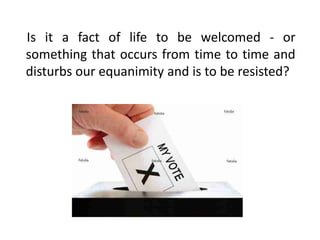
Is it a fact of life to be welcomed - or
something that occurs from time to time and
disturbs our equanimity and is to be resisted?
RESISTANCE to
 Change????
• Fear of failure, of unknown &
  that new way may not be
  better
• Creatures of habit
• No obvious need
• Concern about support system
• Closed minded
• Unwillingness to learn
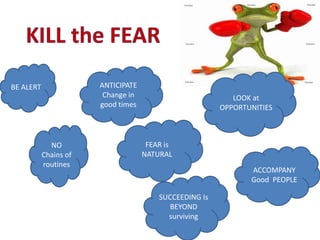
BE ALERT               ANTICIPATE
                        Change in                          LOOK at
                       good times                       OPPORTUNITIES


             NO                      FEAR is
           Chains of                NATURAL
           routines
                                                               ACCOMPANY
                                                               Good PEOPLE

                                        SUCCEEDING Is
                                           BEYOND
                                          surviving
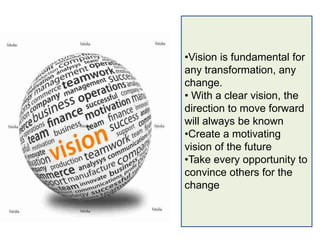
•Vision is fundamental for
any transformation, any
change.
• With a clear vision, the
direction to move forward
will always be known
•Create a motivating
vision of the future
•Take every opportunity to
convince others for the
change
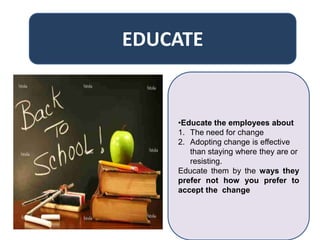
EDUCATE


    •Educate the employees about
    1. The need for change
    2. Adopting change is effective
       than staying where they are or
       resisting.
    Educate them by the ways they
    prefer not how you prefer to
    accept the change
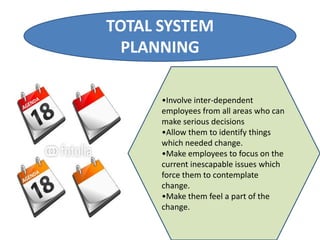
TOTAL SYSTEM
  PLANNING

      •Involve inter-dependent
      employees from all areas who can
      make serious decisions
      •Allow them to identify things
      which needed change.
      •Make employees to focus on the
      current inescapable issues which
      force them to contemplate
      change.
      •Make them feel a part of the
      change.
•Be clear about the proposed change.
Break down the change into distinct
smaller set of activities.


•When one set of activities is
completed, integrate it with previous steps
and make the change homogeneous up to
that stage, before starting the next set of
activities.
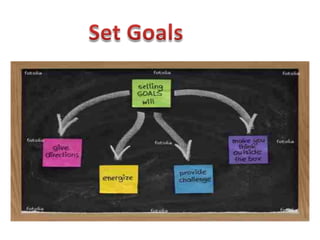
• Goal setting by itself is introducing a change
  for the organization and employees
• Consistent with the organizational goal,
  prepare a set of goals (in other words
  ‘change’) to be achieved for each employee.
• Make him focussed on one goal at a time
  before making him move on to his next goal.
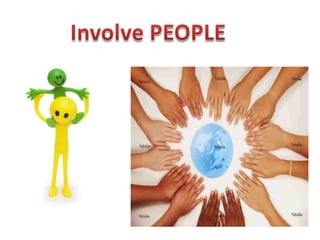
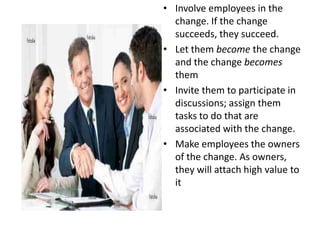
• Involve employees in the
  change. If the change
  succeeds, they succeed.
• Let them become the change
  and the change becomes
  them
• Invite them to participate in
  discussions; assign them
  tasks to do that are
  associated with the change.
• Make employees the owners
  of the change. As owners,
  they will attach high value to
  it
• Identify employees who can stand up to be
  counted rather than hide behind the group. Make
  them lead the change.
• Make the employees believe that they can
  succeed, and their efforts will take them to the
  goal.

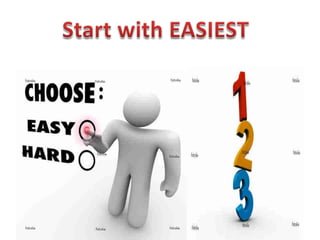
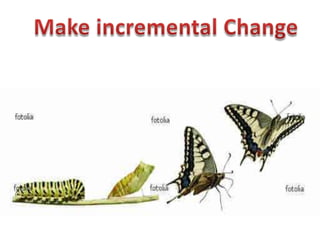
• Half the ‘change’ is done when you make a
  beginning
• Make the first steps of change to be the
  easiest and let the employees do the most
  obvious thing.

• Make remaining steps relatively easy.
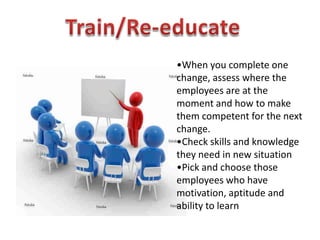
•When you complete one
change, assess where the
employees are at the
moment and how to make
them competent for the next
change.
•Check skills and knowledge
they need in new situation
•Pick and choose those
employees who have
motivation, aptitude and
ability to learn
• After the changes
1. Pause to make sure the
   whole system is still
   working, like before.
2. Tie loose ends if any, and
   ensure the integrity of the
   whole system is intact
   before introducing the next
   change
3. Use the pause-period to
   prepare the employees
   ready for next change
• Institutionalize and
  standardise the change.
  Make it a part of the
  system or standards which
  employees follow.
• System is not optional in
  any organization.
  Employees have to follow
  it. If they do not
  follow, they can be taken
  to task.
• Once standardised, review
  periodically that there is
  no deviation or slippage.
•In their 'comfort zone', employees do
not feel need for change. Make the
employees understand that their comfort
zone has become unsafe now.
•Create instability and make them realize
the need for immediate change
•Announce the change; assure
employees that their safety security and
growth would be improved with the
change
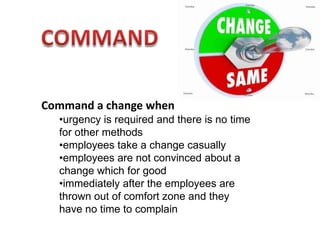
Command a change when
  •urgency is required and there is no time
  for other methods
  •employees take a change casually
  •employees are not convinced about a
  change which for good
  •immediately after the employees are
  thrown out of comfort zone and they
  have no time to complain
"Change is the Only thing that will Never change. So better adapt to it."

   "Change is Universal.
   Change is Permanent..
   Be ever willing to Change...
   For, change alone leads you to
   Success and happiness!!!"


   "If one desires a change, one must be that change before
   that change can take place"
Change management ppt

Change management ppt

  • 4.
    Is it afact of life to be welcomed - or something that occurs from time to time and disturbs our equanimity and is to be resisted?
  • 7.
  • 8.
    • Fear offailure, of unknown & that new way may not be better • Creatures of habit • No obvious need • Concern about support system • Closed minded • Unwillingness to learn
  • 9.
    BE ALERT ANTICIPATE Change in LOOK at good times OPPORTUNITIES NO FEAR is Chains of NATURAL routines ACCOMPANY Good PEOPLE SUCCEEDING Is BEYOND surviving
  • 11.
    •Vision is fundamentalfor any transformation, any change. • With a clear vision, the direction to move forward will always be known •Create a motivating vision of the future •Take every opportunity to convince others for the change
  • 12.
    EDUCATE •Educate the employees about 1. The need for change 2. Adopting change is effective than staying where they are or resisting. Educate them by the ways they prefer not how you prefer to accept the change
  • 13.
    TOTAL SYSTEM PLANNING •Involve inter-dependent employees from all areas who can make serious decisions •Allow them to identify things which needed change. •Make employees to focus on the current inescapable issues which force them to contemplate change. •Make them feel a part of the change.
  • 15.
    •Be clear aboutthe proposed change. Break down the change into distinct smaller set of activities. •When one set of activities is completed, integrate it with previous steps and make the change homogeneous up to that stage, before starting the next set of activities.
  • 17.
    • Goal settingby itself is introducing a change for the organization and employees • Consistent with the organizational goal, prepare a set of goals (in other words ‘change’) to be achieved for each employee. • Make him focussed on one goal at a time before making him move on to his next goal.
  • 19.
    • Involve employeesin the change. If the change succeeds, they succeed. • Let them become the change and the change becomes them • Invite them to participate in discussions; assign them tasks to do that are associated with the change. • Make employees the owners of the change. As owners, they will attach high value to it
  • 21.
    • Identify employeeswho can stand up to be counted rather than hide behind the group. Make them lead the change. • Make the employees believe that they can succeed, and their efforts will take them to the goal.
  • 23.
    • Half the‘change’ is done when you make a beginning • Make the first steps of change to be the easiest and let the employees do the most obvious thing. • Make remaining steps relatively easy.
  • 24.
    •When you completeone change, assess where the employees are at the moment and how to make them competent for the next change. •Check skills and knowledge they need in new situation •Pick and choose those employees who have motivation, aptitude and ability to learn
  • 25.
    • After thechanges 1. Pause to make sure the whole system is still working, like before. 2. Tie loose ends if any, and ensure the integrity of the whole system is intact before introducing the next change 3. Use the pause-period to prepare the employees ready for next change
  • 27.
    • Institutionalize and standardise the change. Make it a part of the system or standards which employees follow. • System is not optional in any organization. Employees have to follow it. If they do not follow, they can be taken to task. • Once standardised, review periodically that there is no deviation or slippage.
  • 30.
    •In their 'comfortzone', employees do not feel need for change. Make the employees understand that their comfort zone has become unsafe now. •Create instability and make them realize the need for immediate change •Announce the change; assure employees that their safety security and growth would be improved with the change
  • 33.
    Command a changewhen •urgency is required and there is no time for other methods •employees take a change casually •employees are not convinced about a change which for good •immediately after the employees are thrown out of comfort zone and they have no time to complain
  • 36.
    "Change is theOnly thing that will Never change. So better adapt to it." "Change is Universal. Change is Permanent.. Be ever willing to Change... For, change alone leads you to Success and happiness!!!" "If one desires a change, one must be that change before that change can take place"

Editor's Notes

  • #6 Eagle at 40– long & flexible talons can’t grab prey, long & sharp beak becomes bent and old aged- long and heavy wings due to thick features become stuck to its chest
  • #12 Grasshopper and eagle
  • #13 River creatures & current
  • #14 Saint, followers & problems--- do in the form of activity…
  • #15 Farmer and rock--- ask in the form question
  • #17 ObeseMonkey story
  • #19 Body parts story- tell as the example of our own body…
  • #21 Valley people and mountain people– mountain people kidnapped kid of one of the families of valley…
  • #23 Fox and the crow story---
  • #25 Ambassador monkey got watermelon for king elephant.. Instead fox received it, couldn’t not pick it up and ended up broken melon felling on his feet
  • #26 Coconut merchant bought large number of coconuts and loaded them at his cart
  • #27 Three guys- STATUS QUO, NONONSENSE & NO GOING BACK- all marooned on an island,,
  • #28 Teacher and student story– bullock cart..
  • #30 Wrestler lifting the calf--- or mother carrying baby
  • #31 Eagle egg being hatched by hen– farmer teaching eagle to fly
  • #32 Three Fishes example--
  • #33 Hell and heaven example-
  • #34 Group of doves trapped in net– commanded by their king to fly
  • #36 Monkeys and monkey trainer example