By Sourabh , 10HM30ERP IMplementation
Introduction to ERP systems and implementationERP Implementation stagesGuidelines for successful ERP implementationA case study : ERP implementation at OmanTelConclusion
INTRODUCTION TO ERP SYSTEMS AND IMPLEMENTATIONERP provides the managers with a comprehensive overview of the complete business executionERP thus influences their decisions in a productive way.
INTRODUCTION TO ERP SYSTEMS AND IMPLEMENTATIONImplementing an ERP system in an organization is an extremely complex process.
It may even take years to implement in a large organization.
Eventually necessitate significant changes on staff and work processes. INTRODUCTION TO ERP SYSTEMS AND IMPLEMENTATIONFirms implement ERP mainly for following reasons :1.Integrate Financial Information	2.Integrate Customer Order Information	3.Standardise and speed up     manufacturing processes	4.Reduce inventory	5.Standardise HR information
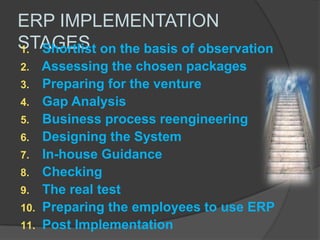
ERP IMPLEMENTATION STAGES  Shortlist on the basis of observation  Assessing the chosen packages Preparing for the venture Gap Analysis Business process reengineering Designing the System In-house Guidance Checking The real test Preparing the employees to use ERP Post Implementation
01.SHORTLISTING VENDORInvolves choosing few applications suitable for the company from the whole many
Selecting ERP software does not happen all on a sudden or as a result of an overnight's discussion
Things to be considered include :01.SHORTLISTING VENDORFlexible , scalable and reliable .
Promptness , accuracy .
Compatibility amongst the softwares
Credibility
Training  provided02.ASSESSING THE CHOSEN PACKAGESA team of experts will test and assess the package on 2 parameters :1. Is it apt for the range of application   	in their field ?	2. What is the level of coordination 	 that the software will help to 	  	 achieve in working with other		 departments ?
03.PREPARING FOR THE VENTUREThis stage is aimed at defining the implementation of ERP in all measures.
A team of officers will lay down the stipulations and criteria to be met and will report to the person of the highest hierarchy in the organization.
Some guidelines are mentioned :04.GAP ANALYSISGap analysis basically identifies analyses and as well suggests a sequence of steps to be followed after taking into account "What ought to be "and "what actually exists".
It provides to overcome /bridge the gap.05.BUSINESS PROCESS REENGINEERINGBPR analyses and suggests the structural changes. It’s a crucial  step .
BPR is taken to conduct feasibility study and other restructuring exercises
The company can either restructure the business process itself or customize the ERP system so that it suits the business process.05.BUSINESS PROCESS REENGINEERINGImplementing ERP Software to Suit Business Needs	1. A very costly affair for the firm . 2. Needs persons with greater working knowledge to design the systems. 	3. The process will also require frequent updations. Restructuring the business process to be ERP Friendly	1. Requires lots of monetary outlay	2. Employees may also face problems	3. The customers may face problems
06.DESIGNING THE SYSTEMThis step helps to decide and conclude the areas where restructuring have to be carried on.
When modifications in ERP software is required, design work is critical.
The programmer has to be ready to make design changes during construction. 06.DESIGNING THE SYSTEMFactors to consider while designing : 1) Recruit qualified consultants.  2) Document the existing processes3) Diagram all the data flows in the system4)Design the new system and compare with requirements .5) Identify hardware and software.
07.IN-HOUSE GUIDANCEThe employees in the company are trained to face crisis and make minor corrections as well The trainers employed in the company must be trained on ERP before taking it to the other set of employees. ERP training should be a continual process and not a one day affair.
07.IN-HOUSE GUIDANCESome common mistakes that take place in ERP training :	1)Too much emphasis on technical aspects	2)Does not address business issues 	3)Less importance to training 	4)Errors in administration 	5)Lack of operational awareness
08.CHECKINGThe system is subjected to the wildest tests possible so that it ensures proper usage and justifies the costs incurred. ERP Testing is a procedure that usually occurs before a company fully implements an ERP software package and the software goes live. It can help identify problem scenarios and training needs .
08.CHECKING1)Preparations of evaluation metrics 	2)Evaluating the work periodically	3)Following contracts terms 	4)Evaluating ERP performance	5)Accurate Quantification to facilitate correct measure
09.THE REAL TESTOnce development is completed, the true unit testing occurs. The designer  must do integrated testing on all possible scenarios that may come out of the business process (different variations of the same process)Once unit testing is approved, then the solution can be delivered to the client for the ‘ go-live ‘phase .
10.PREPARING THE EMPLOYEES TO USE ERPThe employees in the organization will be taught to make use of the system in the day to day and regular basis so as to make sure that it becomes a part of the system in the organization .The firm must be prepared to look for alternatives to vendor supplied training.
11.POST IMPLEMENTATIONThe process of implementation will find meaning only when there is regular follow up and proper instruction flow thereafter and through the lifetime of ERP .This will include all efforts and steps taken to update and attain better benefits once the system is implemented.Also conduct a post – implementation audit
11.POST IMPLEMENTATIONERP Software Limitations1. Earlier best practices lost .2. Firm now constrained to ERP system3. ERP costs may be too much to bear4. Takes away decision making power from employees5. toy box effect
GUIDELINES FOR SUCCESSFUL ERP IMPLEMENTATION1.Implement changes in the firm for ERP properly2.Understand that ERP is a tool , not a cure-all3.ERP gap analysis and BPR should be performed properly4.IT facilities in the organization should be capable 5.The process should be carried on by competent personnel 6.ERP should become a part of the daily routine 
ERP IMPLEMENTATION AT OMANTELOmantel commissioned the ERP project for two major reasons.1. To ensure that it was ready for the anticipated liberalisation of the Omani telecommunications industry by upgrading its capabilities .2. A need to position itself to be able to meet national development requirements as identified by the United Nations .

ERP implementation

  • 1.
    By Sourabh ,10HM30ERP IMplementation
  • 2.
    Introduction to ERPsystems and implementationERP Implementation stagesGuidelines for successful ERP implementationA case study : ERP implementation at OmanTelConclusion
  • 3.
    INTRODUCTION TO ERPSYSTEMS AND IMPLEMENTATIONERP provides the managers with a comprehensive overview of the complete business executionERP thus influences their decisions in a productive way.
  • 4.
    INTRODUCTION TO ERPSYSTEMS AND IMPLEMENTATIONImplementing an ERP system in an organization is an extremely complex process.
  • 5.
    It may eventake years to implement in a large organization.
  • 6.
    Eventually necessitate significantchanges on staff and work processes. INTRODUCTION TO ERP SYSTEMS AND IMPLEMENTATIONFirms implement ERP mainly for following reasons :1.Integrate Financial Information 2.Integrate Customer Order Information 3.Standardise and speed up manufacturing processes 4.Reduce inventory 5.Standardise HR information
  • 7.
    ERP IMPLEMENTATION STAGES Shortlist on the basis of observation  Assessing the chosen packages Preparing for the venture Gap Analysis Business process reengineering Designing the System In-house Guidance Checking The real test Preparing the employees to use ERP Post Implementation
  • 8.
    01.SHORTLISTING VENDORInvolves choosingfew applications suitable for the company from the whole many
  • 9.
    Selecting ERP softwaredoes not happen all on a sudden or as a result of an overnight's discussion
  • 10.
    Things to beconsidered include :01.SHORTLISTING VENDORFlexible , scalable and reliable .
  • 11.
  • 12.
  • 13.
  • 14.
    Training provided02.ASSESSINGTHE CHOSEN PACKAGESA team of experts will test and assess the package on 2 parameters :1. Is it apt for the range of application in their field ? 2. What is the level of coordination that the software will help to achieve in working with other departments ?
  • 15.
    03.PREPARING FOR THEVENTUREThis stage is aimed at defining the implementation of ERP in all measures.
  • 16.
    A team ofofficers will lay down the stipulations and criteria to be met and will report to the person of the highest hierarchy in the organization.
  • 17.
    Some guidelines arementioned :04.GAP ANALYSISGap analysis basically identifies analyses and as well suggests a sequence of steps to be followed after taking into account "What ought to be "and "what actually exists".
  • 18.
    It provides toovercome /bridge the gap.05.BUSINESS PROCESS REENGINEERINGBPR analyses and suggests the structural changes. It’s a crucial step .
  • 19.
    BPR is takento conduct feasibility study and other restructuring exercises
  • 20.
    The company caneither restructure the business process itself or customize the ERP system so that it suits the business process.05.BUSINESS PROCESS REENGINEERINGImplementing ERP Software to Suit Business Needs 1. A very costly affair for the firm . 2. Needs persons with greater working knowledge to design the systems. 3. The process will also require frequent updations. Restructuring the business process to be ERP Friendly 1. Requires lots of monetary outlay 2. Employees may also face problems 3. The customers may face problems
  • 21.
    06.DESIGNING THE SYSTEMThisstep helps to decide and conclude the areas where restructuring have to be carried on.
  • 22.
    When modifications inERP software is required, design work is critical.
  • 23.
    The programmer hasto be ready to make design changes during construction. 06.DESIGNING THE SYSTEMFactors to consider while designing : 1) Recruit qualified consultants.  2) Document the existing processes3) Diagram all the data flows in the system4)Design the new system and compare with requirements .5) Identify hardware and software.
  • 24.
    07.IN-HOUSE GUIDANCEThe employeesin the company are trained to face crisis and make minor corrections as well The trainers employed in the company must be trained on ERP before taking it to the other set of employees. ERP training should be a continual process and not a one day affair.
  • 25.
    07.IN-HOUSE GUIDANCESome commonmistakes that take place in ERP training : 1)Too much emphasis on technical aspects 2)Does not address business issues 3)Less importance to training 4)Errors in administration 5)Lack of operational awareness
  • 26.
    08.CHECKINGThe system issubjected to the wildest tests possible so that it ensures proper usage and justifies the costs incurred. ERP Testing is a procedure that usually occurs before a company fully implements an ERP software package and the software goes live. It can help identify problem scenarios and training needs .
  • 27.
    08.CHECKING1)Preparations of evaluationmetrics 2)Evaluating the work periodically 3)Following contracts terms  4)Evaluating ERP performance 5)Accurate Quantification to facilitate correct measure
  • 28.
    09.THE REAL TESTOncedevelopment is completed, the true unit testing occurs. The designer must do integrated testing on all possible scenarios that may come out of the business process (different variations of the same process)Once unit testing is approved, then the solution can be delivered to the client for the ‘ go-live ‘phase .
  • 29.
    10.PREPARING THE EMPLOYEESTO USE ERPThe employees in the organization will be taught to make use of the system in the day to day and regular basis so as to make sure that it becomes a part of the system in the organization .The firm must be prepared to look for alternatives to vendor supplied training.
  • 30.
    11.POST IMPLEMENTATIONThe processof implementation will find meaning only when there is regular follow up and proper instruction flow thereafter and through the lifetime of ERP .This will include all efforts and steps taken to update and attain better benefits once the system is implemented.Also conduct a post – implementation audit
  • 31.
    11.POST IMPLEMENTATIONERP SoftwareLimitations1. Earlier best practices lost .2. Firm now constrained to ERP system3. ERP costs may be too much to bear4. Takes away decision making power from employees5. toy box effect
  • 32.
    GUIDELINES FOR SUCCESSFULERP IMPLEMENTATION1.Implement changes in the firm for ERP properly2.Understand that ERP is a tool , not a cure-all3.ERP gap analysis and BPR should be performed properly4.IT facilities in the organization should be capable 5.The process should be carried on by competent personnel 6.ERP should become a part of the daily routine 
  • 33.
    ERP IMPLEMENTATION ATOMANTELOmantel commissioned the ERP project for two major reasons.1. To ensure that it was ready for the anticipated liberalisation of the Omani telecommunications industry by upgrading its capabilities .2. A need to position itself to be able to meet national development requirements as identified by the United Nations .