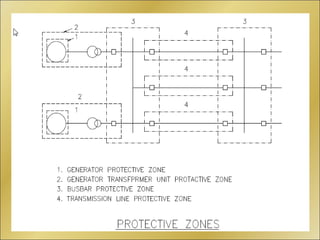
BUS BAR PROTECTION
Sumeet Ratnawat
NCA Indore
OBJECTIVE OF STATION PROTECTION
 To protect all such elements or sections in
a substation which are not covered either
under line protection or equipment
protection
Station protection include
 Bus Bar protection
 LBB(Local Breaker back-Up) protection
CT CORES
 CORE 1  BUS BAR CHECK ZONE
 CORE 2  BUS BAR MAIN ZONE
 CORE 3  METERING
 CORE 4  MAIN I LINE PROTECTION
 CORE 5  LBB & MAIN II LINE
PROTECTION
 In Absence Of BUSBAR Protection,
Fault Clearance takes place
in Zone II of Distance Relay by
Remote End Tripping
 This Means Slow & Unselective Tripping
and wide spread blackout
NEED FOR BUS BAR PROTECTION
 Minimizing damage at fault location
 Maintaining system stability
 Localizing isolation to avoid wide
spread disruption
 Delayed clearance create shock to inter
connected equipment like Generator shaft
and windings of Transformer
NEED FOR BUS BAR PROTECTION
 High speed operation
 Selectivity – shall isolate the faulty bus bar only
 Stability – stable for through faults upto 40 KA
fault level
 Reliability – Check feature
 Applicable for any type of bus bar protection
 Shall provide zone indication
REQUIREMENT OF BUS BAR PROTECTION
 Continuous supervision for CT Secondaries
against any possible Open Ckt.
 In case of detection of any Open Circuiting of CT
secondary, after a time delay, the affected zone
of protection shall be rendered(provide) in-
operative and an alarm initiated.
REQUIREMENT OF BUS BAR PROTECTION
 Bus bar protection must be provided in all new 400kV and
220kV Substations as well as Generation Switch Yards
 For existing substations, provision of bus bar protection is
considered a must at 400kV level and for 220kV level it is
essential at substations having multiple feed.
 In case of radially fed 220kv substations, having more
than one bus it is desirable to have bus bar protection but
is not a must
RECOMMENDATIONS FOR PROVIDING BUS BAR
PROTECTION
BASICS OF BUSBAR PROTECTION
NEED FOR BUSBAR PROTECTION
In Its Absence Fault Clearing Takes Place In Zone-2 Of Distance Relay By Remote End Tripping. this means
slow and unselective tripping and wide spread blackout.
EFFECT OF DELAYED CLEARENCE
 Greater damage at fault point.
 Indirect shock to connected equipment like shafts of generator and windings of transformer.
BASIC THEORY
Kirchoff’s current law states that the sum of the currents entering a given node must be equal to the currents
leaving at that node.
TYPES OF BUS BAR PROTECTION
 Low Impedance
 High Impedance
Both use Circulating Current Differential
Principle - To isolate the entire bus bar section
by disconnecting all the feeders connected to
the bus.
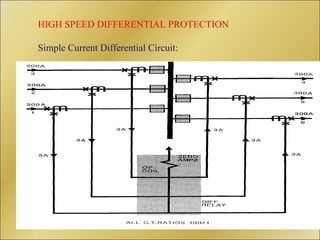
HIGH SPEED DIFFERENTIAL PROTECTION
Simple Current Differential Circuit:
Simple Current Differential Circuit with Bus Fault
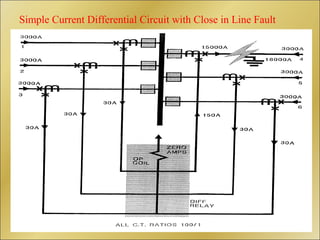
Simple Current Differential Circuit with Close in Line Fault
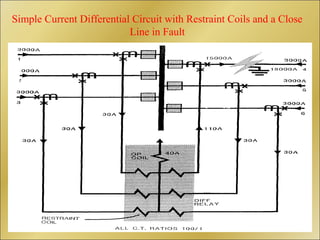
Simple Current Differential Circuit with Restraint Coils and a Close
Line in Fault
Simple
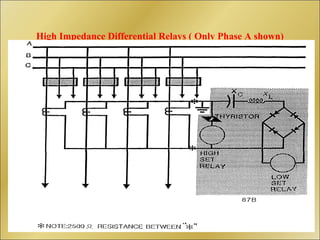
High Impedance Differential Relays ( Only Phase A shown)
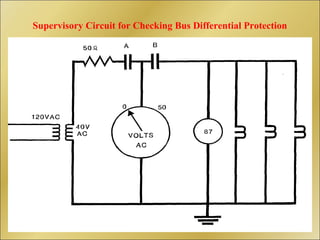
Supervisory Circuit for Checking Bus Differential Protection
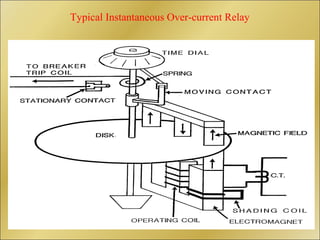
Typical Instantaneous Over-current Relay
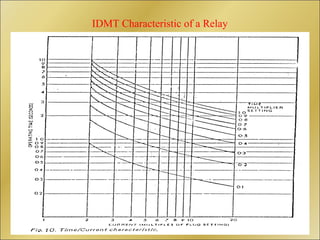
IDMT Characteristic of a Relay
Bus Bar Protection

Bus Bar Protection

  • 1.
    BUS BAR PROTECTION SumeetRatnawat NCA Indore
  • 3.
    OBJECTIVE OF STATIONPROTECTION  To protect all such elements or sections in a substation which are not covered either under line protection or equipment protection Station protection include  Bus Bar protection  LBB(Local Breaker back-Up) protection
  • 4.
    CT CORES  CORE1  BUS BAR CHECK ZONE  CORE 2  BUS BAR MAIN ZONE  CORE 3  METERING  CORE 4  MAIN I LINE PROTECTION  CORE 5  LBB & MAIN II LINE PROTECTION
  • 5.
     In AbsenceOf BUSBAR Protection, Fault Clearance takes place in Zone II of Distance Relay by Remote End Tripping  This Means Slow & Unselective Tripping and wide spread blackout NEED FOR BUS BAR PROTECTION
  • 6.
     Minimizing damageat fault location  Maintaining system stability  Localizing isolation to avoid wide spread disruption  Delayed clearance create shock to inter connected equipment like Generator shaft and windings of Transformer NEED FOR BUS BAR PROTECTION
  • 7.
     High speedoperation  Selectivity – shall isolate the faulty bus bar only  Stability – stable for through faults upto 40 KA fault level  Reliability – Check feature  Applicable for any type of bus bar protection  Shall provide zone indication REQUIREMENT OF BUS BAR PROTECTION
  • 8.
     Continuous supervisionfor CT Secondaries against any possible Open Ckt.  In case of detection of any Open Circuiting of CT secondary, after a time delay, the affected zone of protection shall be rendered(provide) in- operative and an alarm initiated. REQUIREMENT OF BUS BAR PROTECTION
  • 9.
     Bus barprotection must be provided in all new 400kV and 220kV Substations as well as Generation Switch Yards  For existing substations, provision of bus bar protection is considered a must at 400kV level and for 220kV level it is essential at substations having multiple feed.  In case of radially fed 220kv substations, having more than one bus it is desirable to have bus bar protection but is not a must RECOMMENDATIONS FOR PROVIDING BUS BAR PROTECTION
  • 10.
    BASICS OF BUSBARPROTECTION NEED FOR BUSBAR PROTECTION In Its Absence Fault Clearing Takes Place In Zone-2 Of Distance Relay By Remote End Tripping. this means slow and unselective tripping and wide spread blackout. EFFECT OF DELAYED CLEARENCE  Greater damage at fault point.  Indirect shock to connected equipment like shafts of generator and windings of transformer. BASIC THEORY Kirchoff’s current law states that the sum of the currents entering a given node must be equal to the currents leaving at that node.
  • 11.
    TYPES OF BUSBAR PROTECTION  Low Impedance  High Impedance Both use Circulating Current Differential Principle - To isolate the entire bus bar section by disconnecting all the feeders connected to the bus.
  • 12.
    HIGH SPEED DIFFERENTIALPROTECTION Simple Current Differential Circuit:
  • 13.
    Simple Current DifferentialCircuit with Bus Fault
  • 14.
    Simple Current DifferentialCircuit with Close in Line Fault
  • 15.
    Simple Current DifferentialCircuit with Restraint Coils and a Close Line in Fault Simple
  • 16.
    High Impedance DifferentialRelays ( Only Phase A shown)
  • 17.
    Supervisory Circuit forChecking Bus Differential Protection
  • 18.
  • 19.