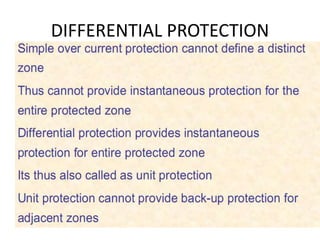
DIFFERENTIAL PROTECTION
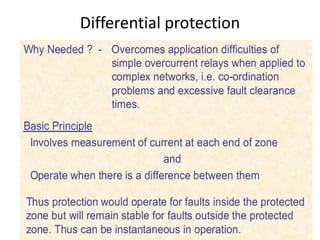
Differential protection
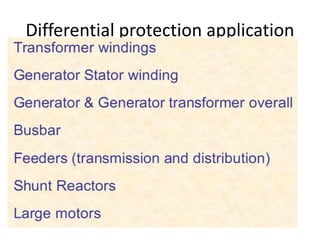
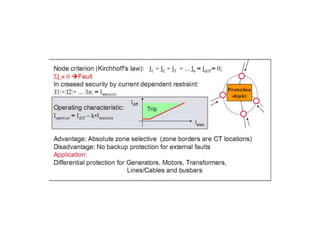
Differential protection application
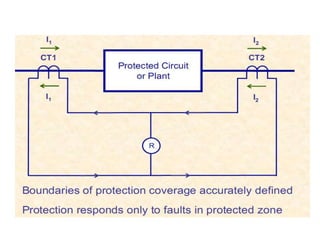
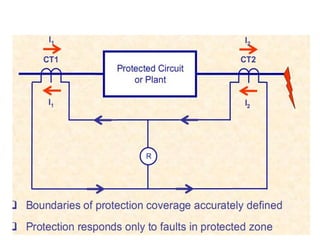
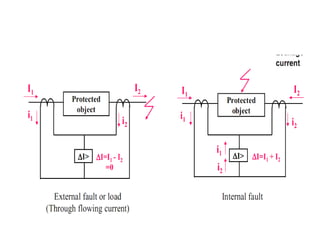
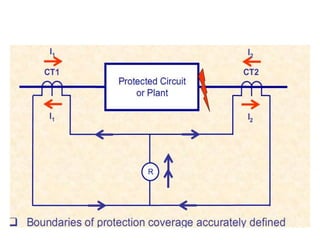
Differential Relay – Operating
Principle
PLANT TO BE
PROTECTED
I1 I2
I1 = I2  Healthy; no trip
| I1 - I2 | > Limit  Fault; trip
“Balanced beam” type of relay – difference current trips beam;
through current restrains it.
Modern relays do the comparison by microprocessor
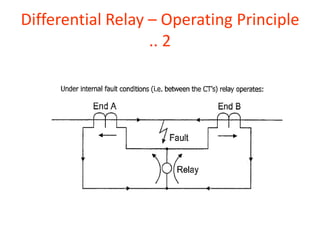
Differential Relay – Operating Principle
.. 2
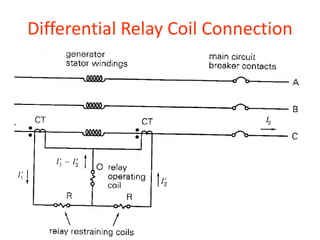
Differential Relay Coil Connection
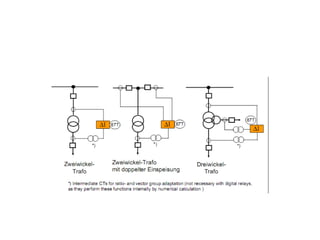
Differential Relay – Transformer
Application
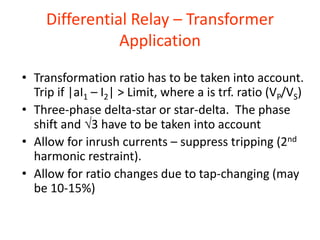
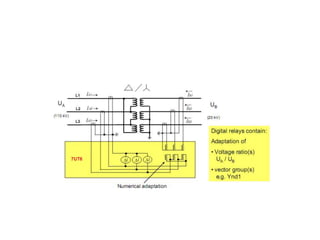
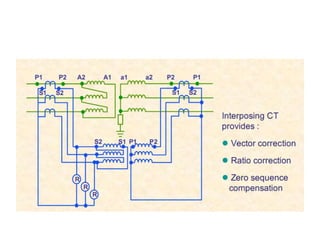
• Transformation ratio has to be taken into account.
Trip if |aI1 – I2| > Limit, where a is trf. ratio (VP/VS)
• Three-phase delta-star or star-delta. The phase
shift and 3 have to be taken into account
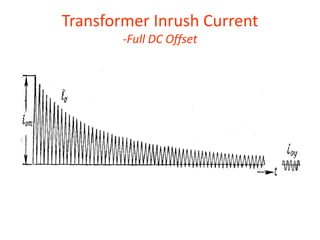
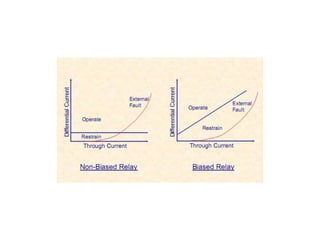
• Allow for inrush currents – suppress tripping (2nd
harmonic restraint).
• Allow for ratio changes due to tap-changing (may
be 10-15%)
Differential Relay – Transformer
Application .. 2
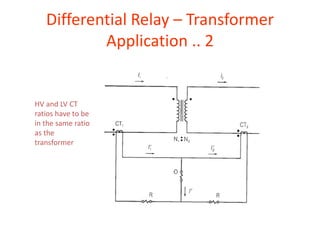
HV and LV CT
ratios have to be
in the same ratio
as the
transformer
Transformer Inrush Current
-Full DC Offset
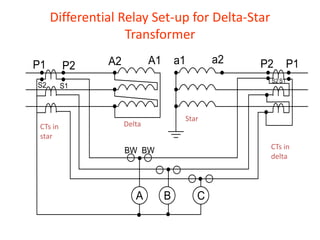
Differential Relay Set-up for Delta-Star
Transformer
CTs in
delta
CTs in
star
Delta
Star
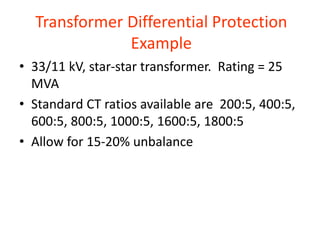
Transformer Differential Protection
Example
• 33/11 kV, star-star transformer. Rating = 25
MVA
• Standard CT ratios available are 200:5, 400:5,
600:5, 800:5, 1000:5, 1600:5, 1800:5
• Allow for 15-20% unbalance
Transformer Differential Protection
Example .. 2
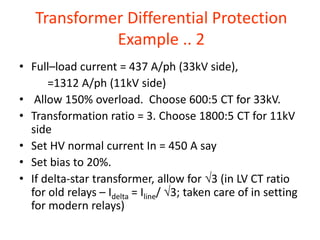
• Full–load current = 437 A/ph (33kV side),
=1312 A/ph (11kV side)
• Allow 150% overload. Choose 600:5 CT for 33kV.
• Transformation ratio = 3. Choose 1800:5 CT for 11kV
side
• Set HV normal current In = 450 A say
• Set bias to 20%.
• If delta-star transformer, allow for 3 (in LV CT ratio
for old relays – Idelta = Iline/ 3; taken care of in setting
for modern relays)
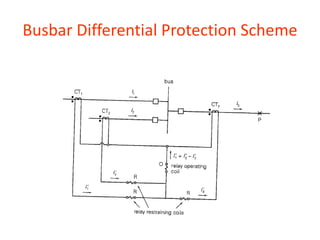
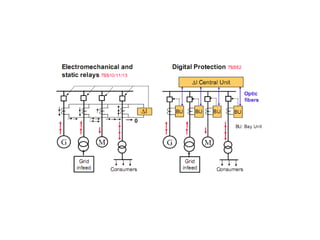
Busbar Differential Protection Scheme
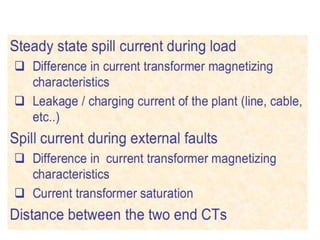
Problems
with CT
Saturation in
B-bar Prot’n
Schemes
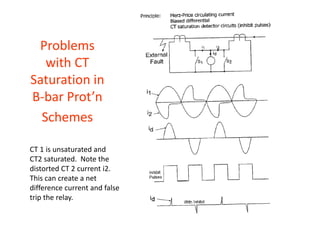
CT 1 is unsaturated and
CT2 saturated. Note the
distorted CT 2 current i2.
This can create a net
difference current and false
trip the relay.
CT
Saturation
Detector
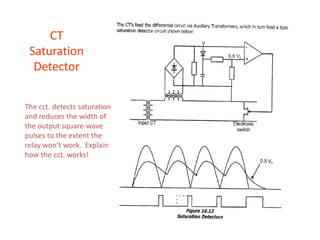
The cct. detects saturation
and reduces the width of
the output square-wave
pulses to the extent the
relay won’t work. Explain
how the cct. works!
Limitations with OC Protection in
Transformers
• A simple overcurrent and earth fault relay
will not provide adequate protection for
winding earth faults.
• Need some earth fault protection.
• Degree of earth fault protection is very
much improved by the application of unit
differential or restricted earth fault
systems.
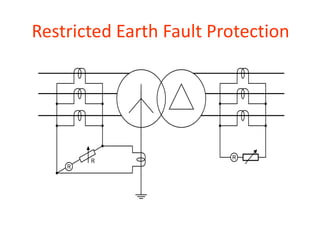
Restricted Earth Fault Protection
Restricted Earth Fault - How it Works
• On the HV side, the residual current of the 3 line CT’s
is balanced against the output current of the CT in the
neutral conductor.
• For the LV side, earth faults occurring on the delta
winding may also result in a level of fault current of
less than full load. HV overcurrent relays will not
provide adequate protection.
• A relay connected to monitor residual current will
provide restricted earth fault protection since the
delta winding cannot supply zero-sequence current to
the system.
Restricted Earth Fault - How it Works ..
2
• Both windings of the transformer can thus
be protected separately with restricted
earth fault.
• Provide high speed protection against
earth faults over the whole of the
transformer windings.
• Relay used is an instantaneous high
impedance type.
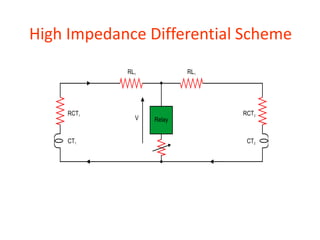
High Impedance Differential Scheme
High Impedance Scheme - How it
Works
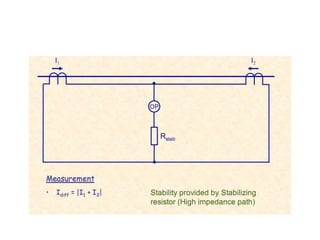
The CTs generate currents that create a high voltage across the relay (which
has a high burden).
CTs must generate 2 times the trip voltage to work on an internal fault
If one only CT saturates for through fault, not enough voltage is generated
to trip relay.
High Impedance Scheme -
Requirements
• CTs must have identical turns ratios, knee-
point voltages 2 times relay operating voltage,
high accuracy, low reactance (‘PX’ class)
• High internal faults can generate high voltage
across relay - some form of voltage dependent
resistor (“metrosil”) is required to avoid this.
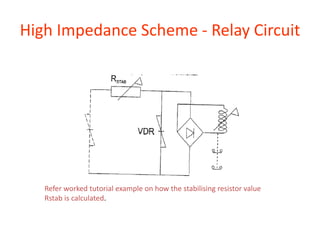
High Impedance Scheme - Relay Circuit
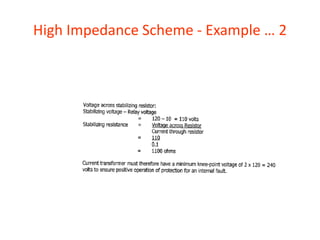
Refer worked tutorial example on how the stabilising resistor value
Rstab is calculated.
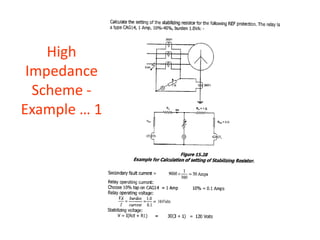
High
Impedance
Scheme -
Example … 1
High Impedance Scheme - Example … 2
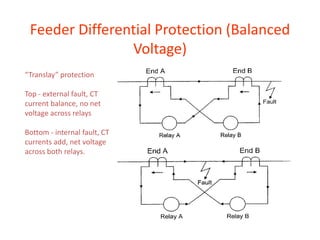
Feeder Differential Protection (Balanced
Voltage)
“Translay” protection
Top - external fault, CT
current balance, no net
voltage across relays
Bottom - internal fault, CT
currents add, net voltage
across both relays.
47526172-DIFFERENTIAL-PROTECTION-8.pptx

47526172-DIFFERENTIAL-PROTECTION-8.pptx

  • 1.
  • 2.
  • 3.
  • 10.
    Differential Relay –Operating Principle PLANT TO BE PROTECTED I1 I2 I1 = I2  Healthy; no trip | I1 - I2 | > Limit  Fault; trip “Balanced beam” type of relay – difference current trips beam; through current restrains it. Modern relays do the comparison by microprocessor
  • 11.
    Differential Relay –Operating Principle .. 2
  • 12.
  • 13.
    Differential Relay –Transformer Application • Transformation ratio has to be taken into account. Trip if |aI1 – I2| > Limit, where a is trf. ratio (VP/VS) • Three-phase delta-star or star-delta. The phase shift and 3 have to be taken into account • Allow for inrush currents – suppress tripping (2nd harmonic restraint). • Allow for ratio changes due to tap-changing (may be 10-15%)
  • 14.
    Differential Relay –Transformer Application .. 2 HV and LV CT ratios have to be in the same ratio as the transformer
  • 15.
  • 16.
    Differential Relay Set-upfor Delta-Star Transformer CTs in delta CTs in star Delta Star
  • 17.
    Transformer Differential Protection Example •33/11 kV, star-star transformer. Rating = 25 MVA • Standard CT ratios available are 200:5, 400:5, 600:5, 800:5, 1000:5, 1600:5, 1800:5 • Allow for 15-20% unbalance
  • 18.
    Transformer Differential Protection Example.. 2 • Full–load current = 437 A/ph (33kV side), =1312 A/ph (11kV side) • Allow 150% overload. Choose 600:5 CT for 33kV. • Transformation ratio = 3. Choose 1800:5 CT for 11kV side • Set HV normal current In = 450 A say • Set bias to 20%. • If delta-star transformer, allow for 3 (in LV CT ratio for old relays – Idelta = Iline/ 3; taken care of in setting for modern relays)
  • 19.
  • 20.
    Problems with CT Saturation in B-barProt’n Schemes CT 1 is unsaturated and CT2 saturated. Note the distorted CT 2 current i2. This can create a net difference current and false trip the relay.
  • 21.
    CT Saturation Detector The cct. detectssaturation and reduces the width of the output square-wave pulses to the extent the relay won’t work. Explain how the cct. works!
  • 22.
    Limitations with OCProtection in Transformers • A simple overcurrent and earth fault relay will not provide adequate protection for winding earth faults. • Need some earth fault protection. • Degree of earth fault protection is very much improved by the application of unit differential or restricted earth fault systems.
  • 23.
  • 24.
    Restricted Earth Fault- How it Works • On the HV side, the residual current of the 3 line CT’s is balanced against the output current of the CT in the neutral conductor. • For the LV side, earth faults occurring on the delta winding may also result in a level of fault current of less than full load. HV overcurrent relays will not provide adequate protection. • A relay connected to monitor residual current will provide restricted earth fault protection since the delta winding cannot supply zero-sequence current to the system.
  • 25.
    Restricted Earth Fault- How it Works .. 2 • Both windings of the transformer can thus be protected separately with restricted earth fault. • Provide high speed protection against earth faults over the whole of the transformer windings. • Relay used is an instantaneous high impedance type.
  • 26.
  • 27.
    High Impedance Scheme- How it Works The CTs generate currents that create a high voltage across the relay (which has a high burden). CTs must generate 2 times the trip voltage to work on an internal fault If one only CT saturates for through fault, not enough voltage is generated to trip relay.
  • 28.
    High Impedance Scheme- Requirements • CTs must have identical turns ratios, knee- point voltages 2 times relay operating voltage, high accuracy, low reactance (‘PX’ class) • High internal faults can generate high voltage across relay - some form of voltage dependent resistor (“metrosil”) is required to avoid this.
  • 29.
    High Impedance Scheme- Relay Circuit Refer worked tutorial example on how the stabilising resistor value Rstab is calculated.
  • 30.
  • 31.
    High Impedance Scheme- Example … 2
  • 32.
    Feeder Differential Protection(Balanced Voltage) “Translay” protection Top - external fault, CT current balance, no net voltage across relays Bottom - internal fault, CT currents add, net voltage across both relays.