M.Nageswar Rao,
Sr.Manager (Engg.)
NESCL, Noida
Date: 16.08.13
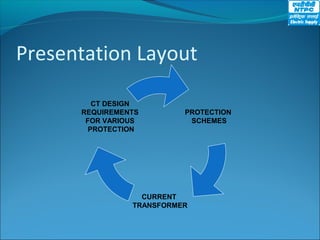
Presentation Layout
PROTECTION
SCHEMES
CURRENT
TRANSFORMER
CT DESIGN
REQUIREMENTS
FOR VARIOUS
PROTECTION
Protection schemes
Over current protection
Unit Protection
Differential protection
REF protection
Line differential (Pilot wire)
Distance Protection
Diff. protection
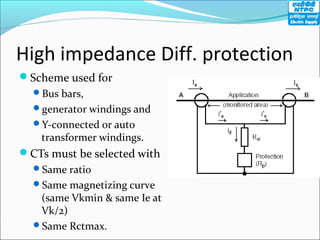
Monitors an area limited by CTs which measure
incoming & outgoing currents
Types
High impedance
Low impedance (Biased diff.)
High impedance Diff. protection
Scheme used for
Bus bars,
generator windings and
Y-connected or auto
transformer windings.
CTs must be selected with
Same ratio
Same magnetizing curve
(same Vkmin & same Ie at
Vk/2)
Same Rctmax.
High impedance Diff. protection
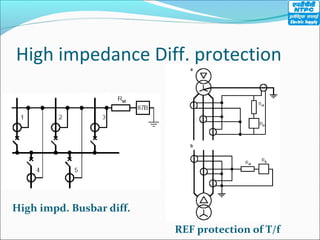
High impd. Busbar diff.
REF protection of T/f
High impedance Diff. protection
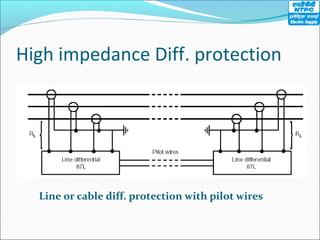
Line or cable diff. protection with pilot wires
Low impedance Diff. protection
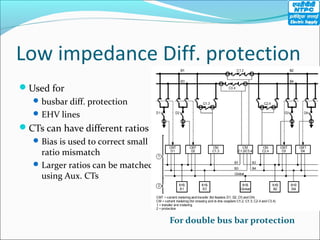
For double bus bar protection
Used for
busbar diff. protection
EHV lines
CTs can have different ratios
Bias is used to correct small
ratio mismatch
Larger ratios can be matched
using Aux. CTs
Low impedance Diff.
– slope characteristics
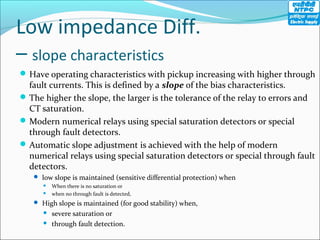
Have operating characteristics with pickup increasing with higher through
fault currents. This is defined by a slope of the bias characteristics.
The higher the slope, the larger is the tolerance of the relay to errors and
CT saturation.
Modern numerical relays using special saturation detectors or special
through fault detectors.
Automatic slope adjustment is achieved with the help of modern
numerical relays using special saturation detectors or special through fault
detectors.
 low slope is maintained (sensitive differential protection) when
 When there is no saturation or
 when no through fault is detected,
 High slope is maintained (for good stability) when,
 severe saturation or
 through fault detection.
High & Low impedance diff. protection
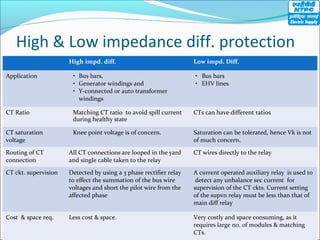
High impd. diff. Low impd. Diff.
Application • Bus bars,
• Generator windings and
• Y-connected or auto transformer
windings
• Bus bars
• EHV lines
CT Ratio Matching CT ratio to avoid spill current
during healthy state
CTs can have different ratios
CT saturation
voltage
Knee point voltage is of concern. Saturation can be tolerated, hence Vk is not
of much concern.
Routing of CT
connection
All CT connections are looped in the yard
and single cable taken to the relay
CT wires directly to the relay
CT ckt. supervision Detected by using a 3 phase rectifier relay
to effect the summation of the bus wire
voltages and short the pilot wire from the
affected phase
A current operated auxiliary relay is used to
detect any unbalance sec current for
supervision of the CT ckts. Current setting
of the supvn relay must be less than that of
main diff relay
Cost & space req. Less cost & space. Very costly and space consuming, as it
requires large no. of modules & matching
CTs.
Current Transformer
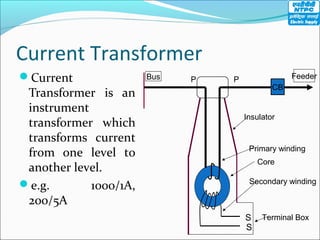
Current
Transformer is an
instrument
transformer which
transforms current
from one level to
another level.
e.g. 1000/1A,
200/5A
Terminal Box
PP
S
S
Insulator
Secondary winding
Primary winding
Core
CB
Bus Feeder
CTs – windings & cores
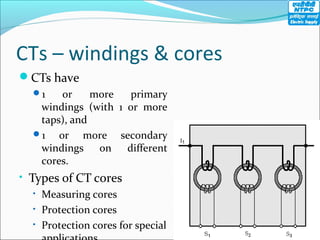
CTs have
1 or more primary
windings (with 1 or more
taps), and
1 or more secondary
windings on different
cores.
• Types of CT cores
• Measuring cores
• Protection cores
• Protection cores for special
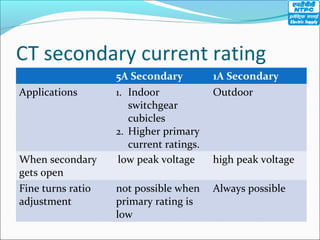
CT secondary current rating
5A Secondary 1A Secondary
Applications 1. Indoor
switchgear
cubicles
2. Higher primary
current ratings.
Outdoor
When secondary
gets open
low peak voltage high peak voltage
Fine turns ratio
adjustment
not possible when
primary rating is
low
Always possible
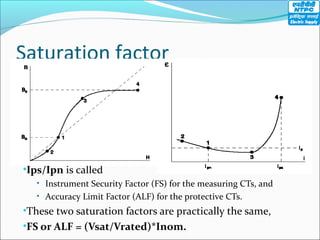
Saturation factor
•Ips/Ipn is called
• Instrument Security Factor (FS) for the measuring CTs, and
• Accuracy Limit Factor (ALF) for the protective CTs.
•These two saturation factors are practically the same,
•FS or ALF = (Vsat/Vrated)*Inom.
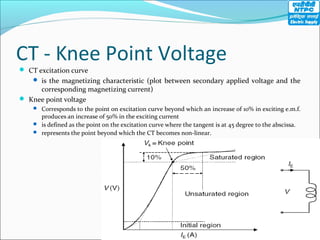
CT - Knee Point Voltage
 CT excitation curve
 is the magnetizing characteristic (plot between secondary applied voltage and the
corresponding magnetizing current)
 Knee point voltage
 Corresponds to the point on excitation curve beyond which an increase of 10% in exciting e.m.f.
produces an increase of 50% in the exciting current
 is defined as the point on the excitation curve where the tangent is at 45 degree to the abscissa.
 represents the point beyond which the CT becomes non-linear.
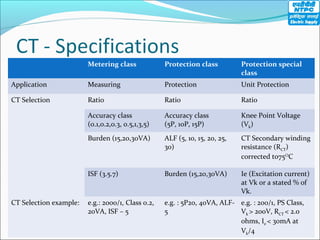
Metering class Protection class Protection special
class
Application Measuring Protection Unit Protection
CT Selection Ratio Ratio Ratio
Accuracy class
(0.1,0.2,0.3, 0.5,1,3,5)
Accuracy class
(5P, 10P, 15P)
Knee Point Voltage
(Vk)
Burden (15,20,30VA) ALF (5, 10, 15, 20, 25,
30)
CT Secondary winding
resistance (RCT)
corrected to75O
C
ISF (3.5.7) Burden (15,20,30VA) Ie (Excitation current)
at Vk or a stated % of
Vk.
CT Selection example: e.g.: 2000/1, Class 0.2,
20VA, ISF – 5
e.g. : 5P20, 40VA, ALF-
5
e.g. : 200/1, PS Class,
Vk > 200V, RCT < 2.0
ohms, Ie < 30mA at
Vk/4
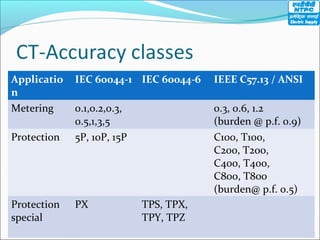
Applicatio
n
IEC 60044-1 IEC 60044-6 IEEE C57.13 / ANSI
Metering 0.1,0.2,0.3,
0.5,1,3,5
0.3, 0.6, 1.2
(burden @ p.f. 0.9)
Protection 5P, 10P, 15P C100, T100,
C200, T200,
C400, T400,
C800, T800
(burden@ p.f. 0.5)
Protection
special
PX TPS, TPX,
TPY, TPZ
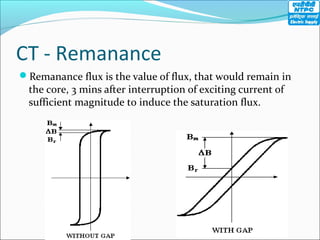
CT - Remanance
Remanance flux is the value of flux, that would remain in
the core, 3 mins after interruption of exciting current of
sufficient magnitude to induce the saturation flux.
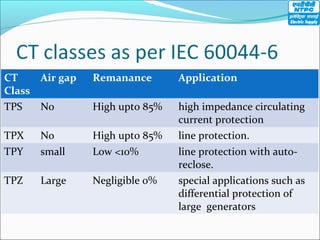
CT
Class
Air gap Remanance Application
TPS No High upto 85% high impedance circulating
current protection
TPX No High upto 85% line protection.
TPY small Low <10% line protection with auto-
reclose.
TPZ Large Negligible 0% special applications such as
differential protection of
large generators
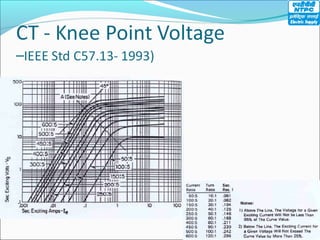
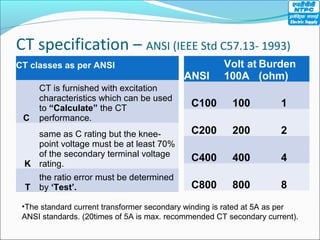
CT specification – ANSI (IEEE Std C57.13- 1993)
CT classes as per ANSI
 
C
CT is furnished with excitation 
characteristics which can be used 
to “Calculate” the CT 
performance.
K
same as C rating but the knee-
point voltage must be at least 70% 
of the secondary terminal voltage 
rating.
T
the ratio error must be determined 
by ‘Test’.
ANSI
Volt at
100A
Burden
(ohm)
C100 100 1
C200 200 2
C400 400 4
C800 800 8
•The standard current transformer secondary winding is rated at 5A as per        
ANSI standards. (20times of 5A is max. recommended CT secondary current).
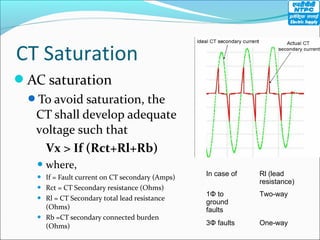
CT Saturation
In case of  Rl (lead 
resistance)
1Φ to 
ground 
faults
Two-way
3Φ faults One-way
AC saturation
To avoid saturation, the
CT shall develop adequate
voltage such that
Vx > If (Rct+Rl+Rb)
 where,
 If = Fault current on CT secondary (Amps)
 Rct = CT Secondary resistance (Ohms)
 Rl = CT Secondary total lead resistance
(Ohms)
 Rb =CT secondary connected burden
(Ohms)
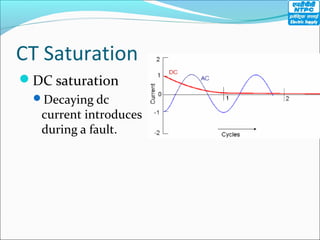
CT Saturation
DC saturation
Decaying dc
current introduces
during a fault.
CT Saturation - Excursion of flux waveform Φ
Is well within the saturation
limits with AC current waveforms
shoots past the saturation limits
quickly with DC transients
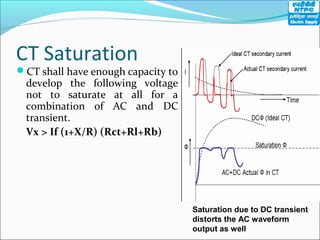
CT Saturation
CT shall have enough capacity to
develop the following voltage
not to saturate at all for a
combination of AC and DC
transient.
Vx > If (1+X/R) (Rct+Rl+Rb)
Saturation due to DC transient
distorts the AC waveform
output as well
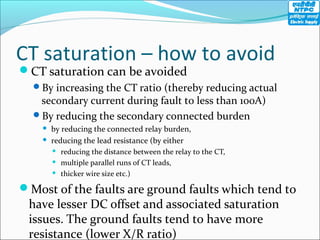
CT saturation – how to avoid
CT saturation can be avoided
By increasing the CT ratio (thereby reducing actual
secondary current during fault to less than 100A)
By reducing the secondary connected burden
 by reducing the connected relay burden,
 reducing the lead resistance (by either
 reducing the distance between the relay to the CT,
 multiple parallel runs of CT leads,
 thicker wire size etc.)
Most of the faults are ground faults which tend to
have lesser DC offset and associated saturation
issues. The ground faults tend to have more
resistance (lower X/R ratio)
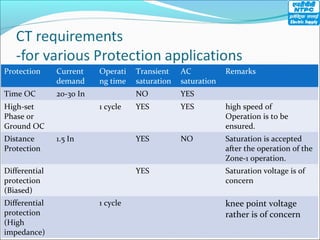
Protection Current
demand
Operati
ng time
Transient
saturation
AC
saturation
Remarks
Time OC 20-30 In NO YES
High-set
Phase or
Ground OC
1 cycle YES YES high speed of
Operation is to be
ensured.
Distance
Protection
1.5 In YES NO Saturation is accepted
after the operation of the
Zone-1 operation.
Differential
protection
(Biased)
YES Saturation voltage is of
concern
Differential
protection
(High
impedance)
1 cycle knee point voltage
rather is of concern
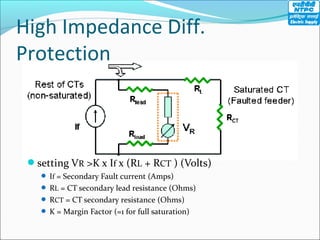
High Impedance Diff.
Protection
setting VR >K x If x (RL + RCT ) (Volts)
 If = Secondary Fault current (Amps)
 RL = CT secondary lead resistance (Ohms)
 RCT = CT secondary resistance (Ohms)
 K = Margin Factor (=1 for full saturation)
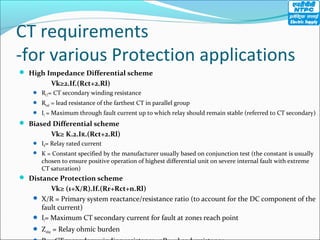
CT requirements
-for various Protection applications
 High Impedance Differential scheme
Vk≥2.If.(Rct+2.Rl)
 RCT= CT secondary winding resistance
 Rlead = lead resistance of the farthest CT in parallel group
 If = Maximum through fault current up to which relay should remain stable (referred to CT secondary)
 Biased Differential scheme
Vk≥ K.2.IR.(Rct+2.Rl)
 IR= Relay rated current
 K = Constant specified by the manufacturer usually based on conjunction test (the constant is usually
chosen to ensure positive operation of highest differential unit on severe internal fault with extreme
CT saturation)
 Distance Protection scheme
Vk≥ (1+X/R).If.(Rr+Rct+n.Rl)
 X/R = Primary system reactance/resistance ratio (to account for the DC component of the
fault current)
 If= Maximum CT secondary current for fault at zone1 reach point
 Zrelay = Relay ohmic burden
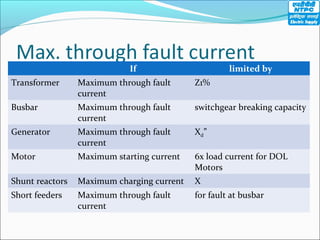
If limited by
Transformer Maximum through fault
current
Z1%
Busbar Maximum through fault
current
switchgear breaking capacity
Generator Maximum through fault
current
Xd”
Motor Maximum starting current 6x load current for DOL
Motors
Shunt reactors Maximum charging current X
Short feeders Maximum through fault
current
for fault at busbar

CT design aspects - Nageswar-6

  • 1.
  • 2.
  • 4.
    Protection schemes Over currentprotection Unit Protection Differential protection REF protection Line differential (Pilot wire) Distance Protection
  • 5.
    Diff. protection Monitors anarea limited by CTs which measure incoming & outgoing currents Types High impedance Low impedance (Biased diff.)
  • 6.
    High impedance Diff.protection Scheme used for Bus bars, generator windings and Y-connected or auto transformer windings. CTs must be selected with Same ratio Same magnetizing curve (same Vkmin & same Ie at Vk/2) Same Rctmax.
  • 7.
    High impedance Diff.protection High impd. Busbar diff. REF protection of T/f
  • 8.
    High impedance Diff.protection Line or cable diff. protection with pilot wires
  • 9.
    Low impedance Diff.protection For double bus bar protection Used for busbar diff. protection EHV lines CTs can have different ratios Bias is used to correct small ratio mismatch Larger ratios can be matched using Aux. CTs
  • 10.
    Low impedance Diff. –slope characteristics Have operating characteristics with pickup increasing with higher through fault currents. This is defined by a slope of the bias characteristics. The higher the slope, the larger is the tolerance of the relay to errors and CT saturation. Modern numerical relays using special saturation detectors or special through fault detectors. Automatic slope adjustment is achieved with the help of modern numerical relays using special saturation detectors or special through fault detectors.  low slope is maintained (sensitive differential protection) when  When there is no saturation or  when no through fault is detected,  High slope is maintained (for good stability) when,  severe saturation or  through fault detection.
  • 11.
    High & Lowimpedance diff. protection High impd. diff. Low impd. Diff. Application • Bus bars, • Generator windings and • Y-connected or auto transformer windings • Bus bars • EHV lines CT Ratio Matching CT ratio to avoid spill current during healthy state CTs can have different ratios CT saturation voltage Knee point voltage is of concern. Saturation can be tolerated, hence Vk is not of much concern. Routing of CT connection All CT connections are looped in the yard and single cable taken to the relay CT wires directly to the relay CT ckt. supervision Detected by using a 3 phase rectifier relay to effect the summation of the bus wire voltages and short the pilot wire from the affected phase A current operated auxiliary relay is used to detect any unbalance sec current for supervision of the CT ckts. Current setting of the supvn relay must be less than that of main diff relay Cost & space req. Less cost & space. Very costly and space consuming, as it requires large no. of modules & matching CTs.
  • 13.
    Current Transformer Current Transformer isan instrument transformer which transforms current from one level to another level. e.g. 1000/1A, 200/5A Terminal Box PP S S Insulator Secondary winding Primary winding Core CB Bus Feeder
  • 15.
    CTs – windings& cores CTs have 1 or more primary windings (with 1 or more taps), and 1 or more secondary windings on different cores. • Types of CT cores • Measuring cores • Protection cores • Protection cores for special
  • 16.
    CT secondary currentrating 5A Secondary 1A Secondary Applications 1. Indoor switchgear cubicles 2. Higher primary current ratings. Outdoor When secondary gets open low peak voltage high peak voltage Fine turns ratio adjustment not possible when primary rating is low Always possible
  • 17.
    Saturation factor •Ips/Ipn iscalled • Instrument Security Factor (FS) for the measuring CTs, and • Accuracy Limit Factor (ALF) for the protective CTs. •These two saturation factors are practically the same, •FS or ALF = (Vsat/Vrated)*Inom.
  • 18.
    CT - KneePoint Voltage  CT excitation curve  is the magnetizing characteristic (plot between secondary applied voltage and the corresponding magnetizing current)  Knee point voltage  Corresponds to the point on excitation curve beyond which an increase of 10% in exciting e.m.f. produces an increase of 50% in the exciting current  is defined as the point on the excitation curve where the tangent is at 45 degree to the abscissa.  represents the point beyond which the CT becomes non-linear.
  • 20.
    Metering class Protectionclass Protection special class Application Measuring Protection Unit Protection CT Selection Ratio Ratio Ratio Accuracy class (0.1,0.2,0.3, 0.5,1,3,5) Accuracy class (5P, 10P, 15P) Knee Point Voltage (Vk) Burden (15,20,30VA) ALF (5, 10, 15, 20, 25, 30) CT Secondary winding resistance (RCT) corrected to75O C ISF (3.5.7) Burden (15,20,30VA) Ie (Excitation current) at Vk or a stated % of Vk. CT Selection example: e.g.: 2000/1, Class 0.2, 20VA, ISF – 5 e.g. : 5P20, 40VA, ALF- 5 e.g. : 200/1, PS Class, Vk > 200V, RCT < 2.0 ohms, Ie < 30mA at Vk/4
  • 21.
    Applicatio n IEC 60044-1 IEC60044-6 IEEE C57.13 / ANSI Metering 0.1,0.2,0.3, 0.5,1,3,5 0.3, 0.6, 1.2 (burden @ p.f. 0.9) Protection 5P, 10P, 15P C100, T100, C200, T200, C400, T400, C800, T800 (burden@ p.f. 0.5) Protection special PX TPS, TPX, TPY, TPZ
  • 22.
    CT - Remanance Remananceflux is the value of flux, that would remain in the core, 3 mins after interruption of exciting current of sufficient magnitude to induce the saturation flux.
  • 23.
    CT Class Air gap RemananceApplication TPS No High upto 85% high impedance circulating current protection TPX No High upto 85% line protection. TPY small Low <10% line protection with auto- reclose. TPZ Large Negligible 0% special applications such as differential protection of large generators
  • 24.
    CT specification –ANSI (IEEE Std C57.13- 1993) CT classes as per ANSI   C CT is furnished with excitation  characteristics which can be used  to “Calculate” the CT  performance. K same as C rating but the knee- point voltage must be at least 70%  of the secondary terminal voltage  rating. T the ratio error must be determined  by ‘Test’. ANSI Volt at 100A Burden (ohm) C100 100 1 C200 200 2 C400 400 4 C800 800 8 •The standard current transformer secondary winding is rated at 5A as per         ANSI standards. (20times of 5A is max. recommended CT secondary current).
  • 25.
    CT Saturation In case of  Rl (lead  resistance) 1Φ to  ground  faults Two-way 3Φ faultsOne-way AC saturation To avoid saturation, the CT shall develop adequate voltage such that Vx > If (Rct+Rl+Rb)  where,  If = Fault current on CT secondary (Amps)  Rct = CT Secondary resistance (Ohms)  Rl = CT Secondary total lead resistance (Ohms)  Rb =CT secondary connected burden (Ohms)
  • 26.
    CT Saturation DC saturation Decayingdc current introduces during a fault.
  • 27.
    CT Saturation -Excursion of flux waveform Φ Is well within the saturation limits with AC current waveforms shoots past the saturation limits quickly with DC transients
  • 28.
    CT Saturation CT shallhave enough capacity to develop the following voltage not to saturate at all for a combination of AC and DC transient. Vx > If (1+X/R) (Rct+Rl+Rb) Saturation due to DC transient distorts the AC waveform output as well
  • 29.
    CT saturation –how to avoid CT saturation can be avoided By increasing the CT ratio (thereby reducing actual secondary current during fault to less than 100A) By reducing the secondary connected burden  by reducing the connected relay burden,  reducing the lead resistance (by either  reducing the distance between the relay to the CT,  multiple parallel runs of CT leads,  thicker wire size etc.) Most of the faults are ground faults which tend to have lesser DC offset and associated saturation issues. The ground faults tend to have more resistance (lower X/R ratio)
  • 31.
    Protection Current demand Operati ng time Transient saturation AC saturation Remarks TimeOC 20-30 In NO YES High-set Phase or Ground OC 1 cycle YES YES high speed of Operation is to be ensured. Distance Protection 1.5 In YES NO Saturation is accepted after the operation of the Zone-1 operation. Differential protection (Biased) YES Saturation voltage is of concern Differential protection (High impedance) 1 cycle knee point voltage rather is of concern
  • 32.
    High Impedance Diff. Protection settingVR >K x If x (RL + RCT ) (Volts)  If = Secondary Fault current (Amps)  RL = CT secondary lead resistance (Ohms)  RCT = CT secondary resistance (Ohms)  K = Margin Factor (=1 for full saturation)
  • 33.
    CT requirements -for variousProtection applications  High Impedance Differential scheme Vk≥2.If.(Rct+2.Rl)  RCT= CT secondary winding resistance  Rlead = lead resistance of the farthest CT in parallel group  If = Maximum through fault current up to which relay should remain stable (referred to CT secondary)  Biased Differential scheme Vk≥ K.2.IR.(Rct+2.Rl)  IR= Relay rated current  K = Constant specified by the manufacturer usually based on conjunction test (the constant is usually chosen to ensure positive operation of highest differential unit on severe internal fault with extreme CT saturation)  Distance Protection scheme Vk≥ (1+X/R).If.(Rr+Rct+n.Rl)  X/R = Primary system reactance/resistance ratio (to account for the DC component of the fault current)  If= Maximum CT secondary current for fault at zone1 reach point  Zrelay = Relay ohmic burden
  • 34.
    If limited by TransformerMaximum through fault current Z1% Busbar Maximum through fault current switchgear breaking capacity Generator Maximum through fault current Xd” Motor Maximum starting current 6x load current for DOL Motors Shunt reactors Maximum charging current X Short feeders Maximum through fault current for fault at busbar

Editor's Notes

  • #2 In order to properly apply protection and other devices in the sub-stations, a thorough understanding of the application is necessary. Application of CTs and cable and wire sizes based on previous existing practices may take care of most of the applications but do not necessarily guarantee correct application of the devices in all situations. Too big CTs and wire sizes for an application where it is not warranted would mean wasted resources. Standardized CTs, cable and wire size do not always guarantee correct application. A check of the application in detail, especially for critical installations is highly recommended.
  • #11 resulting in very.
  • #18 Core start to saturate at Point 3. A further increase of current will result in a rapid increase of the error. At a certain current Ips (4) the error reaches a limit stated in the current transformer standards.
  • #21 0.1 class : High precision testing 0.2 class : Laboratory class 0.5 class : industrial metering 1.0 class : First grade indicating wattmeter 3.0 &amp; 5.0 class : For general use/WTI ISF (Instrument Security Factor) ALF (Accuracy Limit Factor) In PS Class: The turn ratio error are limited to +0.25%
  • #22 Typical examples of high remanence type CTs are class P, PX, TPS, TPX according to IEC and class C and K according to ANSI/IEEE.
  • #24 HIGH REMANENCE CTs WILL SATURATE FASTER.
  • #26 In case of single phase to ground faults, the current from the CT secondary flows through the phase connection and returns through the neutral wire. Hence twice the ‘one-way’ lead resistance shall be considered. In case of multi-phase faults, the phase currents cancel out with negligible current in the common neutral return lead. Hence the lead resistance for such faults will be just that of the ‘one-way’ lead. Special cases arise with delta connected CTs.
  • #28 In the first case, the flux excursion involves increasing as well as decreasing flux. Thus the saturation flux limits are not reached. However, in the latter case, integration of the unidirectional DC waveform involves excursion of the flux only in the increasing direction. The longer the DC transient, the larger will be the excursion of the flux level, resulting in exceeding the saturation limits of the iron core, causing total distortion of the output waveform.
  • #30 In a few occasions when higher CT ratios are not possible in the main CTs, auxiliary CTs close to the CT location to step down the current flowing through the lead and hence effectively reducing the net lead resistance, as seen by the CTs, have been successfully applied. Where X/R ratios are high, they have to be accounted for by a combination of higher C rating, lower fault current, and lower CT secondary loop resistance.
  • #32 Once the CT specifications are known, it is necessary to match against the requirements of the protections. The following highlight some of the most often used protections and how CTs are matched for proper performance.
  • #33 In this scheme CTs on all the incoming and outgoing circuits are paralleled together, the junction point is formed in the switchyard. The idea is to limit the lead resistance between the CTs to the minimum. A high impedance voltage operated relay is connected across the junction point. The lead resistance from the junction point to the relay is not critical, and in fact, as will see further actually helps in stability of the relay for external faults. During external fault, the CT on the faulted feeder may saturate during DC transients. However since the equivalent circuit of the concerned CT gets reduced to that of just the CT secondary resistance, currents from the other healthy CT get pushed into the saturated CT (rather than the relay path because of relatively higher impedance) so the relay remains stable. The relay pickup voltage is set just above the voltage created across the saturated CT circuit to make it operate. During internal fault, there is a period during each cycle of the power system when all CTs do not saturate and push currents through the high impedance relay to make it operate just about in a cycle. The CT knee point voltage must be high enough to do that. Figure 9 indicates the CT requirements of a high impedance scheme.