Improving Learning: Agreeing on Consistent Practices across all Subjects
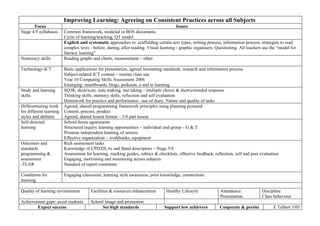
       Focus                                                                            Issues
Stage 4/5 syllabuses     Common framework, modeled in BOS documents
                         Cycle of learning/teaching, QT model
                         Explicit and systematic approaches to: scaffolding certain text types, writing process, information process, strategies to read
                         complex texts - before, during, after reading. Visual learning - graphic organisers. Questioning. All teachers use the “model for
                         literacy learning”
Numeracy skills          Reading graphs and charts, measurement – other

Technology-ICT           Basic applications for presentation, agreed formatting standards, research and information process
                         Subject-related ICT content – routine class use
                         Year 10 Computing Skills Assessment 2006
                         Emerging: smartboards, blogs, podcasts, e and m learning
Study and learning       SQ3R, skim/scan, note making, test taking – multiple choice & short/extended response
skills                   Thinking skills, memory skills, reflection and self evaluation
                         Homework for practice and performance –use of diary. Nature and quality of tasks
Differentiating work     Agreed, shared programming framework principles using planning pyramid
for different learning   Content, process, product
styles and abilities     Agreed, shared lesson format – 3/4 part lesson
Self-directed            School-home agreements
learning                 Structured inquiry learning opportunities – individual and group – G & T
                         Promote independent learning of seniors
                         Effective organization – workbooks, equipment
Outcomes and             Rich assessment tasks
standards                Knowledge of CPD/DLAs and Band descriptors – Stage 5/6
programming &            Assessment for learning, marking guides, rubrics & checklists, effective feedback, reflection, self and peer evaluation
assessment               Engaging, motivating and monitoring across subjects
-TLAR                    Standard of report comments

Conditions for           Engaging classroom, learning style awareness, prior knowledge, connections
learning

Quality of learning environment        Facilities & resources enhancement        Healthy Lifestyle             Attendance              Discipline
                                                                                                               Presentation            Class behaviour
Achievement gaps: assist students      School image and promotion
        Expect success                      Set high standards                  Support low achievers          Cooperate & persist           E Talbert 5/05
What works in the classroom? Implications for Teaching and Improving Student Learning
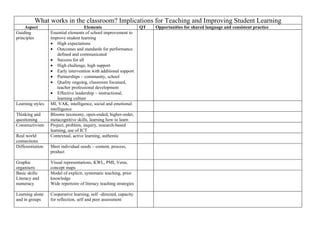
     Aspect                          Elements                       QT   Opportunities for shared language and consistent practice
Guiding           Essential elements of school improvement to
principles        improve student learning
                  • High expectations
                  • Outcomes and standards for performance
                      defined and communicated
                  • Success for all
                  • High challenge, high support
                  • Early intervention with additional support
                  • Partnerships – community, school
                  • Quality ongoing, classroom focussed,
                      teacher professional development
                  • Effective leadership – instructional,
                      learning culture
Learning styles   MI, VAK, intelligence, social and emotional
                  intelligence
Thinking and      Blooms taxonomy, open-ended, higher-order,
questioning       metacognitive skills, learning how to learn
Constructivism    Project, problem, inquiry, research-based
                  learning, use of ICT
Real world        Contextual, active learning, authentic
connections
Differentiation   Meet individual needs – content, process,
                  product

Graphic           Visual representations, KWL, PMI, Venn,
organisers        concept maps
Basic skills:     Model of explicit, systematic teaching, prior
Literacy and      knowledge
numeracy          Wide repertoire of literacy teaching strategies

Learning alone    Cooperative learning, self –directed, capacity
and in groups     for reflection, self and peer assessment
Elaine Talbert. June 2005 and reviewed February 2010
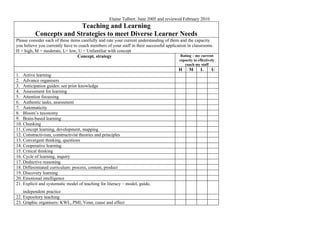
                         Teaching and Learning
          Concepts and Strategies to meet Diverse Learner Needs
Please consider each of these items carefully and rate your current understanding of them and the capacity
you believe you currently have to coach members of your staff in their successful application in classrooms.
H = high, M = moderate, L= low, U = Unfamiliar with concept
                                  Concept, strategy                                       Rating – my current
                                                                                          capacity to effectively
                                                                                             coach my staff
                                                                                         H      M      L       U
1. Active learning
2. Advance organisers
3. Anticipation guides: see prior knowledge
4. Assessment for learning
5. Attention focussing
6. Authentic tasks, assessment
7. Automaticity
8. Bloom’s taxonomy
9. Brain-based learning
10. Chunking
11. Concept learning, development, mapping
12. Constructivism, constructivist theories and principles
13. Convergent thinking, questions
14. Cooperative learning
15. Critical thinking
16. Cycle of learning, inquiry
17. Deductive reasoning
18. Differentiated curriculum: process, content, product
19. Discovery learning
20. Emotional intelligence
21. Explicit and systematic model of teaching for literacy – model, guide,
    independent practice
22. Expository teaching
23. Graphic organisers: KWL, PMI, Venn, cause and effect
24. Higher – order thinking skills (HOTS)
25. Information literacy and process skills
26. Inquiry learning
27. Integrated curriculum
28. Instructional models, design: direct, interactive, inquiry
29. Knowledge – declarative, procedural, conditional
30. Learning how to learn
31. Learning logs/journals
32. Learning styles: inventories
33. Literacy strategies: three level guide, planning pyramid
34. Memory: nature of, schemas, skills and techniques, mnemonics, short, long
35. Metacognition, metacognitive skills
36. Modelling
37. Motivation: theories, approaches, to learn
38. Multiple intelligences theory
39. Multisensory teaching: VAK, visual, auditory, kinesthetic
40. Outcomes focused teaching and assessment – standards framework
41. Note making, taking: Cornell,
42. Peer assessment
43. Prior knowledge - anticipation guides
44. Portfolios for learning
45. Problem solving, finding
46. Project, problem, inquiry, research based learning
47. Questioning: open-ended, fat v skinny,
48. Reading processes and skills: SQ3R, word attack
49. Real life connections: practical applications of authenticity
50. Rubrics: performance criteria and marking guides
51. Scaffolding learning
52. Self direction and assessment – planning, goal setting, reflection
53. Self-regulation, self-evaluation, self-monitoring
54. Study skills: note- making, summarising, reading texts,
55. Structured overview
56. Test taking skills
57. Text types for writing
58. Thinking skills: critical, creative, 6 hats
59. Writing process
60. Zone of proximal development

Qt Consistent Plans 2006 Update2010

  • 1.
    Improving Learning: Agreeingon Consistent Practices across all Subjects Focus Issues Stage 4/5 syllabuses Common framework, modeled in BOS documents Cycle of learning/teaching, QT model Explicit and systematic approaches to: scaffolding certain text types, writing process, information process, strategies to read complex texts - before, during, after reading. Visual learning - graphic organisers. Questioning. All teachers use the “model for literacy learning” Numeracy skills Reading graphs and charts, measurement – other Technology-ICT Basic applications for presentation, agreed formatting standards, research and information process Subject-related ICT content – routine class use Year 10 Computing Skills Assessment 2006 Emerging: smartboards, blogs, podcasts, e and m learning Study and learning SQ3R, skim/scan, note making, test taking – multiple choice & short/extended response skills Thinking skills, memory skills, reflection and self evaluation Homework for practice and performance –use of diary. Nature and quality of tasks Differentiating work Agreed, shared programming framework principles using planning pyramid for different learning Content, process, product styles and abilities Agreed, shared lesson format – 3/4 part lesson Self-directed School-home agreements learning Structured inquiry learning opportunities – individual and group – G & T Promote independent learning of seniors Effective organization – workbooks, equipment Outcomes and Rich assessment tasks standards Knowledge of CPD/DLAs and Band descriptors – Stage 5/6 programming & Assessment for learning, marking guides, rubrics & checklists, effective feedback, reflection, self and peer evaluation assessment Engaging, motivating and monitoring across subjects -TLAR Standard of report comments Conditions for Engaging classroom, learning style awareness, prior knowledge, connections learning Quality of learning environment Facilities & resources enhancement Healthy Lifestyle Attendance Discipline Presentation Class behaviour Achievement gaps: assist students School image and promotion Expect success Set high standards Support low achievers Cooperate & persist E Talbert 5/05
  • 2.
    What works inthe classroom? Implications for Teaching and Improving Student Learning Aspect Elements QT Opportunities for shared language and consistent practice Guiding Essential elements of school improvement to principles improve student learning • High expectations • Outcomes and standards for performance defined and communicated • Success for all • High challenge, high support • Early intervention with additional support • Partnerships – community, school • Quality ongoing, classroom focussed, teacher professional development • Effective leadership – instructional, learning culture Learning styles MI, VAK, intelligence, social and emotional intelligence Thinking and Blooms taxonomy, open-ended, higher-order, questioning metacognitive skills, learning how to learn Constructivism Project, problem, inquiry, research-based learning, use of ICT Real world Contextual, active learning, authentic connections Differentiation Meet individual needs – content, process, product Graphic Visual representations, KWL, PMI, Venn, organisers concept maps Basic skills: Model of explicit, systematic teaching, prior Literacy and knowledge numeracy Wide repertoire of literacy teaching strategies Learning alone Cooperative learning, self –directed, capacity and in groups for reflection, self and peer assessment
  • 3.
    Elaine Talbert. June2005 and reviewed February 2010 Teaching and Learning Concepts and Strategies to meet Diverse Learner Needs Please consider each of these items carefully and rate your current understanding of them and the capacity you believe you currently have to coach members of your staff in their successful application in classrooms. H = high, M = moderate, L= low, U = Unfamiliar with concept Concept, strategy Rating – my current capacity to effectively coach my staff H M L U 1. Active learning 2. Advance organisers 3. Anticipation guides: see prior knowledge 4. Assessment for learning 5. Attention focussing 6. Authentic tasks, assessment 7. Automaticity 8. Bloom’s taxonomy 9. Brain-based learning 10. Chunking 11. Concept learning, development, mapping 12. Constructivism, constructivist theories and principles 13. Convergent thinking, questions 14. Cooperative learning 15. Critical thinking 16. Cycle of learning, inquiry 17. Deductive reasoning 18. Differentiated curriculum: process, content, product 19. Discovery learning 20. Emotional intelligence 21. Explicit and systematic model of teaching for literacy – model, guide, independent practice 22. Expository teaching 23. Graphic organisers: KWL, PMI, Venn, cause and effect
  • 4.
    24. Higher –order thinking skills (HOTS) 25. Information literacy and process skills 26. Inquiry learning 27. Integrated curriculum 28. Instructional models, design: direct, interactive, inquiry 29. Knowledge – declarative, procedural, conditional 30. Learning how to learn 31. Learning logs/journals 32. Learning styles: inventories 33. Literacy strategies: three level guide, planning pyramid 34. Memory: nature of, schemas, skills and techniques, mnemonics, short, long 35. Metacognition, metacognitive skills 36. Modelling 37. Motivation: theories, approaches, to learn 38. Multiple intelligences theory 39. Multisensory teaching: VAK, visual, auditory, kinesthetic 40. Outcomes focused teaching and assessment – standards framework 41. Note making, taking: Cornell, 42. Peer assessment 43. Prior knowledge - anticipation guides 44. Portfolios for learning 45. Problem solving, finding 46. Project, problem, inquiry, research based learning 47. Questioning: open-ended, fat v skinny, 48. Reading processes and skills: SQ3R, word attack 49. Real life connections: practical applications of authenticity 50. Rubrics: performance criteria and marking guides 51. Scaffolding learning 52. Self direction and assessment – planning, goal setting, reflection 53. Self-regulation, self-evaluation, self-monitoring 54. Study skills: note- making, summarising, reading texts, 55. Structured overview 56. Test taking skills 57. Text types for writing 58. Thinking skills: critical, creative, 6 hats
  • 5.
    59. Writing process 60.Zone of proximal development