Changing the way we teach today

          7 March 2012
My Mother’s Classroom is not
    like My Classroom
     Michael Gordon Robinson
  AST 2nd Outstanding-Educator-In-
          Residence (OEIR)
Abstract
In this article, he shares his reflection on how
teaching requires a combination of old and new
teaching techniques in order to engage the
students in the learning process. He believes
that teachers must be willing to embrace change
and continue to develop their teaching
strategies to incorporate within them the latest
technology and information available.
My mother’s classroom
•   Mother a Third Grade teacher
•   No computers and no multimedia projectors
•   Internet non-existent
•   Set of 1980s encyclopedias on a bookshelf
•   Mother taught with textbook and chalk-filled
    blackboard
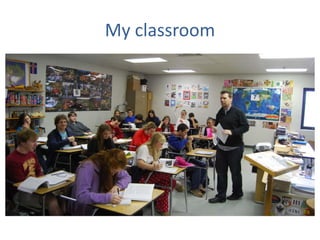
My classroom
Teaching is challenging
• Teaching is an art form that you perfect over
  time. You do not just start out as a great
  teacher…Teaching can be at times a thankless
  and frustrating ordeal, but you stick with it
  because the reward of seeing your students
  learn and the satisfaction of knowing what
  you do matters more than most professions. It
  makes teaching worth it.
My classroom then
• 1994 – no computers in the room, no email,
  no cell phones; overhead projector and notes
  written on clear transparencies
• 1997 – email address and one computer in the
  classroom
• One computer would change my entire
  approach to my lesson preparation
• My mantra then “Why change what works?”
My classroom now
• A good lesson on world climates becomes a
  great lesson by the resources now available on
  the internet
• It is no longer now a matter of choice for a
  teacher to use the internet in the classroom. It
  is a NECESSITY.
• What I must now learn is how to best use the
  internet and teach my students how to best
  use it. The key word again is “TEACH”.
Preparing for the unknown
• Teachers have a new job when it comes to
  preparing students for the 21st century.
• It has become necessary for teachers to focus on
  “learning how to learn”.
• The challenge for teachers is to focus on how
  their students can learn beyond the classroom.
• Students need critical thinking skills so that they
  can problem solve and be innovative and
  creative.
Living in a shrinking world
• The human experience is an increasingly
  globalized phenomenon in which people are
  constantly being influenced by transnational,
  cross-cultural, multi-cultural and multi-ethnic
  interactions.
• We must embrace CHANGE and, enrich and
  equip our students to meet the challenges of
  the changing world.
Do we teach today as we taught
         yesterday?
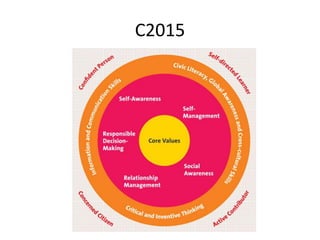
C2015
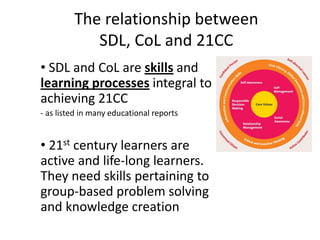
The relationship between
            SDL, CoL and 21CC
• SDL and CoL are skills and
learning processes integral to
achieving 21CC
- as listed in many educational reports


• 21st century learners are
active and life-long learners.
They need skills pertaining to
group-based problem solving
and knowledge creation
                                          13
Self-directed Learning (SDL)
SDL is intricately linked to lifelong learning.

The salient aspects of SDL are: ownership
of learning, management and monitoring
of own learning and extension of own
learning.


                                              14
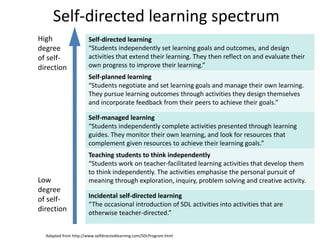
Self-directed learning spectrum
High                   Self-directed learning
degree                 “Students independently set learning goals and outcomes, and design
of self-               activities that extend their learning. They then reflect on and evaluate their
direction              own progress to improve their learning.”
                       Self-planned learning
                       “Students negotiate and set learning goals and manage their own learning.
                       They pursue learning outcomes through activities they design themselves
                       and incorporate feedback from their peers to achieve their goals.”

                       Self-managed learning
                       “Students independently complete activities presented through learning
                       guides. They monitor their own learning, and look for resources that
                       complement given resources to achieve their learning goals.”
                       Teaching students to think independently
                       “Students work on teacher-facilitated learning activities that develop them
                       to think independently. The activities emphasise the personal pursuit of
Low                    meaning through exploration, inquiry, problem solving and creative activity.
degree
                       Incidental self-directed learning
of self-
                       “The occasional introduction of SDL activities into activities that are
direction              otherwise teacher-directed.”

                                                                                                 15
  Adapted from http://www.selfdirectedlearning.com/SDLProgram.html
Collaborative Learning (CoL)
CoL is also defined as social interactions that
  are targeted at deeper knowing.

When students interact for the purpose of
  achieving better understanding of a
  concept, a problem, a phenomenon or to
  create a novel piece of knowledge or
  solution that they do not previously know,
  they are engaged in collaborative learning.
Simply defined, CoL is where students work in
  pairs or groups to solve a problem or to
  achieve a common learning objective.
                                    (Barkley et al., 2005).
                                                         16
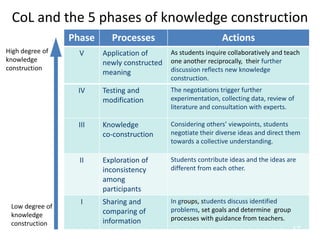
CoL and the 5 phases of knowledge construction
                 Phase     Processes                          Actions
High degree of     V     Application of      As students inquire collaboratively and teach
knowledge                newly constructed   one another reciprocally, their further
construction                                 discussion reflects new knowledge
                         meaning
                                             construction.
                  IV     Testing and         The negotiations trigger further
                         modification        experimentation, collecting data, review of
                                             literature and consultation with experts.

                  III    Knowledge           Considering others’ viewpoints, students
                         co-construction     negotiate their diverse ideas and direct them
                                             towards a collective understanding.

                   II    Exploration of      Students contribute ideas and the ideas are
                         inconsistency       different from each other.
                         among
                         participants
                   I     Sharing and         In groups, students discuss identified
 Low degree of                               problems, set goals and determine group
 knowledge               comparing of
                         information         processes with guidance from teachers.
 construction
                                                                                       17
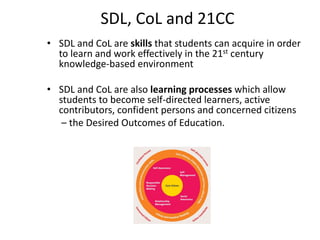
SDL, CoL and 21CC
• SDL and CoL are skills that students can acquire in order
  to learn and work effectively in the 21st century
  knowledge-based environment

• SDL and CoL are also learning processes which allow
  students to become self-directed learners, active
  contributors, confident persons and concerned citizens
   – the Desired Outcomes of Education.


                                                        18
“If we teach today as we taught
yesterday, we rob our children of
           tomorrow.”
           John Dewey
2 fundamental questions
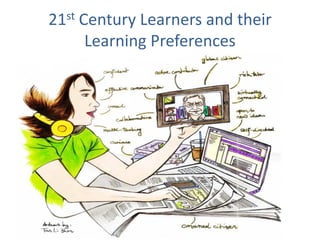
• Who are the 21st Century Learners and what
  are their learning preferences?
• What do they need to know to confidently
  handle the challenges of the changing world?
21st Century Learners and their
      Learning Preferences
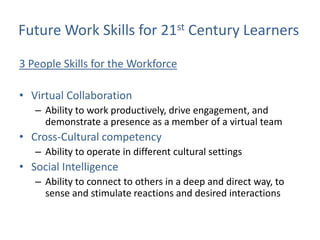
Future Work Skills for 21st Century Learners

3 People Skills for the Workforce

• Virtual Collaboration
   – Ability to work productively, drive engagement, and
     demonstrate a presence as a member of a virtual team
• Cross-Cultural competency
   – Ability to operate in different cultural settings
• Social Intelligence
   – Ability to connect to others in a deep and direct way, to
     sense and stimulate reactions and desired interactions
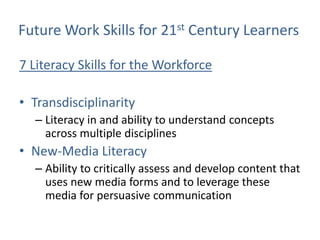
Future Work Skills for 21st Century Learners

7 Literacy Skills for the Workforce

• Transdisciplinarity
  – Literacy in and ability to understand concepts
    across multiple disciplines
• New-Media Literacy
  – Ability to critically assess and develop content that
    uses new media forms and to leverage these
    media for persuasive communication
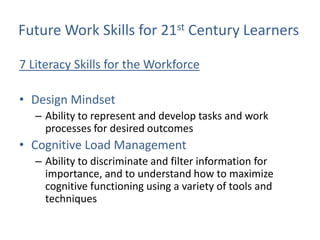
Future Work Skills for 21st Century Learners

7 Literacy Skills for the Workforce

• Design Mindset
   – Ability to represent and develop tasks and work
     processes for desired outcomes
• Cognitive Load Management
   – Ability to discriminate and filter information for
     importance, and to understand how to maximize
     cognitive functioning using a variety of tools and
     techniques
Future Work Skills for 21st Century Learners

7 Literacy Skills for the Workforce

• Computational Thinking
   – Ability to translate vast amounts of data into abstract
     concepts and to understand data-based reasoning
• Novel and Adaptive Thinking
   – Proficiency at thinking and coming up with solutions
     and responses beyond that which is rote or rule-based
• Sense Making
   – Ability to determine the deeper meaning or
     significance of what is being expressed
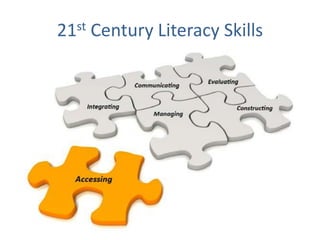
21st Century Literacy Skills
6 processes PIACC identifies as Critical
Components of Literacy
• Accessing
  – Knowing about and know how to collect and/or
    retrieve information
• Managing
  – Organising information into existing classification
    schemes
21st Century Literacy Skills
6 processes PIACC identifies as Critical
Components of Literacy
• Integrating
  – Interpreting, summarising, comparing and
    contrasting information using similar or different
    forms of representation
• Evaluating
  – Reflecting to make judgments about the quality,
    relevance, usefulness or efficiency of information
21st Century Literacy Skills
6 processes PIACC identifies as Critical
Components of Literacy
• Constructing
  – Generating new information and knowledge by
    adapting, applying, designing, inventing,
    representing or authoring information
• Communicating
  – Conveying information and knowledge to various
    individuals
Discussion Time
• How can educators meet the needs of the 21st
  Century Learner?
• How can we re-evaluate the practice of
  teaching and learning and equip students with
  the necessary tools to help them advance in
  this digital age?


                                     20 min

Changing the way we teach today

  • 1.
    Changing the waywe teach today 7 March 2012
  • 2.
    My Mother’s Classroomis not like My Classroom Michael Gordon Robinson AST 2nd Outstanding-Educator-In- Residence (OEIR)
  • 3.
    Abstract In this article,he shares his reflection on how teaching requires a combination of old and new teaching techniques in order to engage the students in the learning process. He believes that teachers must be willing to embrace change and continue to develop their teaching strategies to incorporate within them the latest technology and information available.
  • 4.
    My mother’s classroom • Mother a Third Grade teacher • No computers and no multimedia projectors • Internet non-existent • Set of 1980s encyclopedias on a bookshelf • Mother taught with textbook and chalk-filled blackboard
  • 5.
  • 6.
    Teaching is challenging •Teaching is an art form that you perfect over time. You do not just start out as a great teacher…Teaching can be at times a thankless and frustrating ordeal, but you stick with it because the reward of seeing your students learn and the satisfaction of knowing what you do matters more than most professions. It makes teaching worth it.
  • 7.
    My classroom then •1994 – no computers in the room, no email, no cell phones; overhead projector and notes written on clear transparencies • 1997 – email address and one computer in the classroom • One computer would change my entire approach to my lesson preparation • My mantra then “Why change what works?”
  • 8.
    My classroom now •A good lesson on world climates becomes a great lesson by the resources now available on the internet • It is no longer now a matter of choice for a teacher to use the internet in the classroom. It is a NECESSITY. • What I must now learn is how to best use the internet and teach my students how to best use it. The key word again is “TEACH”.
  • 9.
    Preparing for theunknown • Teachers have a new job when it comes to preparing students for the 21st century. • It has become necessary for teachers to focus on “learning how to learn”. • The challenge for teachers is to focus on how their students can learn beyond the classroom. • Students need critical thinking skills so that they can problem solve and be innovative and creative.
  • 10.
    Living in ashrinking world • The human experience is an increasingly globalized phenomenon in which people are constantly being influenced by transnational, cross-cultural, multi-cultural and multi-ethnic interactions. • We must embrace CHANGE and, enrich and equip our students to meet the challenges of the changing world.
  • 11.
    Do we teachtoday as we taught yesterday?
  • 12.
  • 13.
    The relationship between SDL, CoL and 21CC • SDL and CoL are skills and learning processes integral to achieving 21CC - as listed in many educational reports • 21st century learners are active and life-long learners. They need skills pertaining to group-based problem solving and knowledge creation 13
  • 14.
    Self-directed Learning (SDL) SDLis intricately linked to lifelong learning. The salient aspects of SDL are: ownership of learning, management and monitoring of own learning and extension of own learning. 14
  • 15.
    Self-directed learning spectrum High Self-directed learning degree “Students independently set learning goals and outcomes, and design of self- activities that extend their learning. They then reflect on and evaluate their direction own progress to improve their learning.” Self-planned learning “Students negotiate and set learning goals and manage their own learning. They pursue learning outcomes through activities they design themselves and incorporate feedback from their peers to achieve their goals.” Self-managed learning “Students independently complete activities presented through learning guides. They monitor their own learning, and look for resources that complement given resources to achieve their learning goals.” Teaching students to think independently “Students work on teacher-facilitated learning activities that develop them to think independently. The activities emphasise the personal pursuit of Low meaning through exploration, inquiry, problem solving and creative activity. degree Incidental self-directed learning of self- “The occasional introduction of SDL activities into activities that are direction otherwise teacher-directed.” 15 Adapted from http://www.selfdirectedlearning.com/SDLProgram.html
  • 16.
    Collaborative Learning (CoL) CoLis also defined as social interactions that are targeted at deeper knowing. When students interact for the purpose of achieving better understanding of a concept, a problem, a phenomenon or to create a novel piece of knowledge or solution that they do not previously know, they are engaged in collaborative learning. Simply defined, CoL is where students work in pairs or groups to solve a problem or to achieve a common learning objective. (Barkley et al., 2005). 16
  • 17.
    CoL and the5 phases of knowledge construction Phase Processes Actions High degree of V Application of As students inquire collaboratively and teach knowledge newly constructed one another reciprocally, their further construction discussion reflects new knowledge meaning construction. IV Testing and The negotiations trigger further modification experimentation, collecting data, review of literature and consultation with experts. III Knowledge Considering others’ viewpoints, students co-construction negotiate their diverse ideas and direct them towards a collective understanding. II Exploration of Students contribute ideas and the ideas are inconsistency different from each other. among participants I Sharing and In groups, students discuss identified Low degree of problems, set goals and determine group knowledge comparing of information processes with guidance from teachers. construction 17
  • 18.
    SDL, CoL and21CC • SDL and CoL are skills that students can acquire in order to learn and work effectively in the 21st century knowledge-based environment • SDL and CoL are also learning processes which allow students to become self-directed learners, active contributors, confident persons and concerned citizens – the Desired Outcomes of Education. 18
  • 19.
    “If we teachtoday as we taught yesterday, we rob our children of tomorrow.” John Dewey
  • 20.
    2 fundamental questions •Who are the 21st Century Learners and what are their learning preferences? • What do they need to know to confidently handle the challenges of the changing world?
  • 21.
    21st Century Learnersand their Learning Preferences
  • 22.
    Future Work Skillsfor 21st Century Learners 3 People Skills for the Workforce • Virtual Collaboration – Ability to work productively, drive engagement, and demonstrate a presence as a member of a virtual team • Cross-Cultural competency – Ability to operate in different cultural settings • Social Intelligence – Ability to connect to others in a deep and direct way, to sense and stimulate reactions and desired interactions
  • 23.
    Future Work Skillsfor 21st Century Learners 7 Literacy Skills for the Workforce • Transdisciplinarity – Literacy in and ability to understand concepts across multiple disciplines • New-Media Literacy – Ability to critically assess and develop content that uses new media forms and to leverage these media for persuasive communication
  • 24.
    Future Work Skillsfor 21st Century Learners 7 Literacy Skills for the Workforce • Design Mindset – Ability to represent and develop tasks and work processes for desired outcomes • Cognitive Load Management – Ability to discriminate and filter information for importance, and to understand how to maximize cognitive functioning using a variety of tools and techniques
  • 25.
    Future Work Skillsfor 21st Century Learners 7 Literacy Skills for the Workforce • Computational Thinking – Ability to translate vast amounts of data into abstract concepts and to understand data-based reasoning • Novel and Adaptive Thinking – Proficiency at thinking and coming up with solutions and responses beyond that which is rote or rule-based • Sense Making – Ability to determine the deeper meaning or significance of what is being expressed
  • 26.
  • 27.
    21st Century LiteracySkills 6 processes PIACC identifies as Critical Components of Literacy • Accessing – Knowing about and know how to collect and/or retrieve information • Managing – Organising information into existing classification schemes
  • 28.
    21st Century LiteracySkills 6 processes PIACC identifies as Critical Components of Literacy • Integrating – Interpreting, summarising, comparing and contrasting information using similar or different forms of representation • Evaluating – Reflecting to make judgments about the quality, relevance, usefulness or efficiency of information
  • 29.
    21st Century LiteracySkills 6 processes PIACC identifies as Critical Components of Literacy • Constructing – Generating new information and knowledge by adapting, applying, designing, inventing, representing or authoring information • Communicating – Conveying information and knowledge to various individuals
  • 30.
    Discussion Time • Howcan educators meet the needs of the 21st Century Learner? • How can we re-evaluate the practice of teaching and learning and equip students with the necessary tools to help them advance in this digital age? 20 min