Webinar Series – Session 2

  Outcome-based Learning
       Opportunities
Michael Derntl1, Jad Najjar2 and Susanne Neumann1
          1 University of Vienna, Austria
                2 WU Vienna, Austria
Webinar overview

Background and motivation for outcome-based education
Formulating learning outcomes
Learning outcome based teaching methods and learning
designs
Models and standards for learning outcomes and
opportunities
Learning outcome motivated assessment
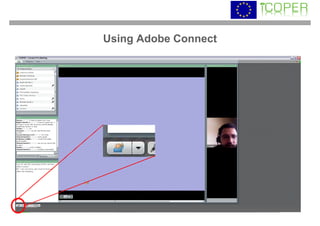
Using Adobe Connect
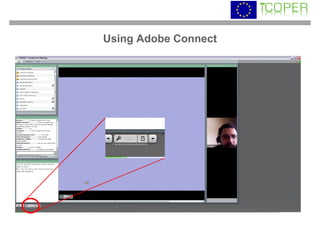
Using Adobe Connect
Background and motivation


      Why outcome-oriented teaching and learning?

   The Bologna Process
      quality assurance in higher education
      a unified educational system (mobility, transparency and mutual
      recognition of qualification)

   Revise curricula  integrate student centeredness and
   learning outcome orientation

   Pedagogical issues became central: Alignment of teaching
   and assessment methods in accordance with learning
   outcomes
Background and motivation


                    What is your background?

   Please shortly state in the chat:

    1. Your background.
       (e.g. higher education, PhD student, vocational training, consulting,
       instructional design, other…)

    2. Your position or relation to teaching (if any).

    3. Subject(s) you teach / PhD topic.
Formulating learning outcomes


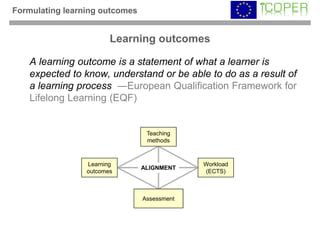
                        Learning outcomes

   A learning outcome is a statement of what a learner is
   expected to know, understand or be able to do as a result of
   a learning process ―European Qualification Framework for
   Lifelong Learning (EQF)


                                 Teaching
                                 methods


                 Learning                    Workload
                                ALIGNMENT
                 outcomes                    (ECTS)


                                Assessment
Formulating learning outcomes


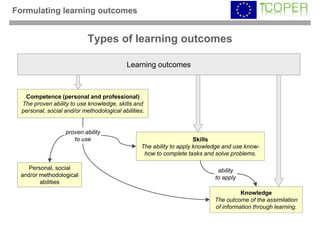
                            Types of learning outcomes

                                            Learning outcomes


   Competence (personal and professional)
  The proven ability to use knowledge, skills and
  personal, social and/or methodological abilities.


                   proven ability
                      to use                                          Skills
                                                 The ability to apply knowledge and use know-
                                                  how to complete tasks and solve problems.

   Personal, social                                                          ability
 and/or methodological                                                      to apply
        abilities
                                                                                      Knowledge
                                                                            The outcome of the assimilation
                                                                            of information through learning.
Formulating learning outcomes


         Intended vs. achieved learning outcomes

   The teacher defines the intended learning outcomes for a
   learning opportunity
   The teacher assesses and learners demonstrate the
   achievement of intended learning outcomes
Formulating learning outcomes


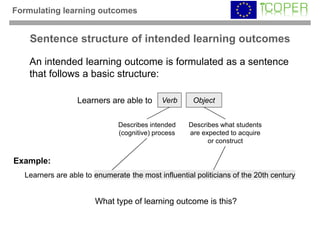
    Sentence structure of intended learning outcomes

   An intended learning outcome is formulated as a sentence
   that follows a basic structure:

                  Learners are able to      Verb     Object


                              Describes intended    Describes what students
                              (cognitive) process   are expected to acquire
                                                          or construct


Example:
  Learners are able to enumerate the most influential politicians of the 20th century


                       What type of learning outcome is this?
Formulating learning outcomes


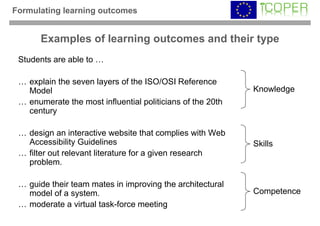
       Examples of learning outcomes and their type
 Students are able to …

 … explain the seven layers of the ISO/OSI Reference
   Model                                                    Knowledge
 … enumerate the most influential politicians of the 20th
   century

 … design an interactive website that complies with Web
   Accessibility Guidelines                                 Skills
 … filter out relevant literature for a given research
   problem.

 … guide their team mates in improving the architectural
   model of a system.                                       Competence
 … moderate a virtual task-force meeting
Formulating learning outcomes


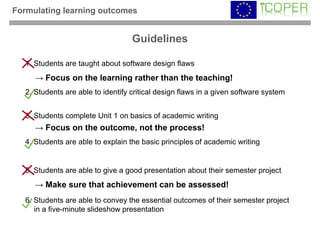
                                    Guidelines

   1. Students are taught about software design flaws
     → Focus on the learning rather than the teaching!
   2. Students are able to identify critical design flaws in a given software system


   3. Students complete Unit 1 on basics of academic writing
     → Focus on the outcome, not the process!
   4. Students are able to explain the basic principles of academic writing


   5. Students are able to give a good presentation about their semester project
     → Make sure that achievement can be assessed!
   6. Students are able to convey the essential outcomes of their semester project
      in a five-minute slideshow presentation
Formulating learning outcomes


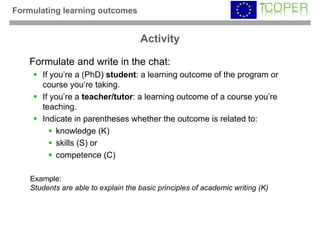
                                     Activity

   Formulate and write in the chat:
       If you’re a (PhD) student: a learning outcome of the program or
       course you‘re taking.
       If you’re a teacher/tutor: a learning outcome of a course you’re
       teaching.
       Indicate in parentheses whether the outcome is related to:
           knowledge (K)
           skills (S) or
           competence (C)

    Example:
    Students are able to explain the basic principles of academic writing (K)
Teaching methods and learning designs


                              Problem outline

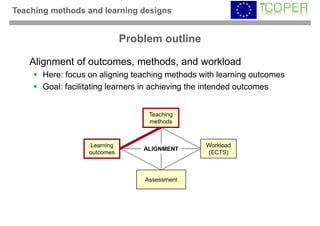
    Alignment of outcomes, methods, and workload
       Here: focus on aligning teaching methods with learning outcomes
       Goal: facilitating learners in achieving the intended outcomes


                                   Teaching
                                   methods


                   Learning                      Workload
                                  ALIGNMENT
                   outcomes                      (ECTS)


                                  Assessment
Key concepts


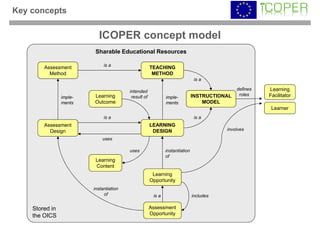
                           ICOPER concept model
                          Sharable Educational Resources

                              is a
        Assessment                                    TEACHING
          Method                                       METHOD
                                                                               is a

                                         intended                                             defines   Learning
                         Learning         result of                           INSTRUCTIONAL    roles    Facilitator
                imple-                                        imple-
                ments    Outcome                              ments               MODEL
                                                                                                         Learner
                              is a                                             is a
        Assessment                                    LEARNING
          Design                                       DESIGN                            involves

                             uses

                                         uses                 instantiation
                                                              of
                          Learning
                          Content
                                                       Learning
                                                      Opportunity
                         instantiation
                              of                       is a                   includes

    Stored in                                         Assessment
    the OICS                                          Opportunity
Teaching methods and learning designs


             Examples of Teaching Methods 1/5

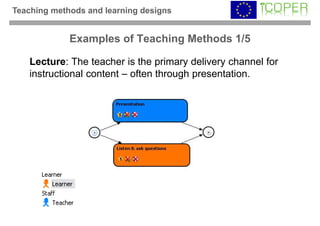
    Lecture: The teacher is the primary delivery channel for
    instructional content – often through presentation.
Teaching methods and learning designs


             Examples of Teaching Methods 2/5

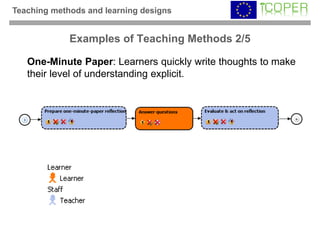
   One-Minute Paper: Learners quickly write thoughts to make
   their level of understanding explicit.
Teaching methods and learning designs


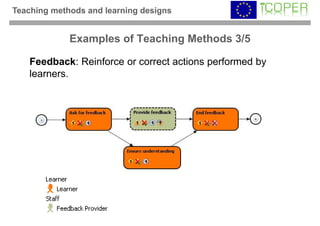
             Examples of Teaching Methods 3/5

    Feedback: Reinforce or correct actions performed by
    learners.
Teaching methods and learning designs


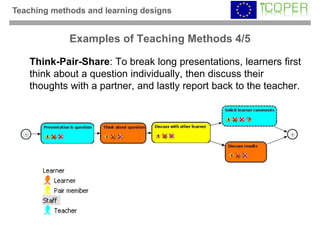
             Examples of Teaching Methods 4/5

    Think-Pair-Share: To break long presentations, learners first
    think about a question individually, then discuss their
    thoughts with a partner, and lastly report back to the teacher.
Teaching methods and learning designs


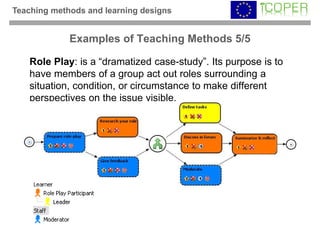
             Examples of Teaching Methods 5/5

    Role Play: is a “dramatized case-study”. Its purpose is to
    have members of a group act out roles surrounding a
    situation, condition, or circumstance to make different
    perspectives on the issue visible.
Teaching methods and learning designs


              Description of instructional models

    ICOPER researched description elements that practitioners
    require for browsing, selecting and implementing
    instructional models.
       General description: title, summary, rationale, subject, learning
       outcomes, learner characteristics, group size, duration, setting,
       author/licensing
       Detailed description: graphical representation, sequence of activities,
       roles, assessment method, resources, variations, implementations,
       references
       Comments: teacher reflections, student feedback, peer review


    This allows for a structured human-readable description
Teaching methods and learning designs


             Description of instructional models

    To describe instructional models in an interoperable
    machine-readable format, there are several existing
    standards and specifications, e.g.:
       IMS Learning Design (LD)
       SCORM
       IMS Simple Sequencing (SS)


    In ICOPER:
       Instructional models described with IMS LD (other formats allowed),
       with LOM metadata record(s) on top
       Storage in the Open ICOPER Content Space (OICS)
          for OICS/LOM introduction see the replay of Webinar 1; for IMS LD
       the upcoming Webinar 3; for application demos Webinar 5.
Teaching methods and learning designs


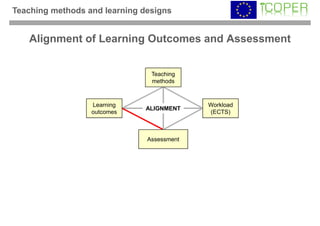
   Alignment of Learning Outcomes and Assessment


                                Teaching
                                methods


                  Learning                  Workload
                               ALIGNMENT
                  outcomes                  (ECTS)


                               Assessment
Teaching methods and learning designs


   Alignment of Learning Outcomes and Assessment

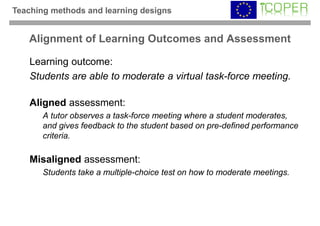
    Learning outcome:
    Students are able to moderate a virtual task-force meeting.

    Aligned assessment:
       A tutor observes a task-force meeting where a student moderates,
       and gives feedback to the student based on pre-defined performance
       criteria.

    Misaligned assessment:
       Students take a multiple-choice test on how to moderate meetings.
Teaching methods and learning designs

     Alignment of Learning Outcomes and Teaching
                   Methods: General
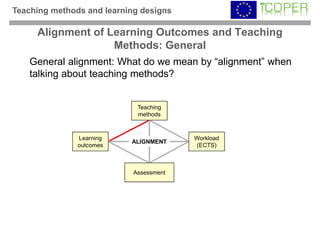
    General alignment: What do we mean by “alignment” when
    talking about teaching methods?


                             Teaching
                             methods


               Learning                  Workload
                           ALIGNMENT
               outcomes                  (ECTS)


                            Assessment
Teaching methods and learning designs

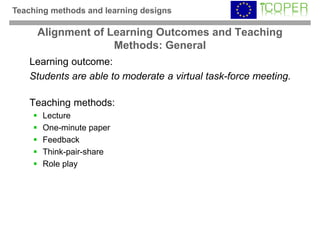
     Alignment of Learning Outcomes and Teaching
                   Methods: General
    Learning outcome:
    Students are able to moderate a virtual task-force meeting.

    Teaching methods:
       Lecture
       One-minute paper
       Feedback
       Think-pair-share
       Role play
Teaching methods and learning designs


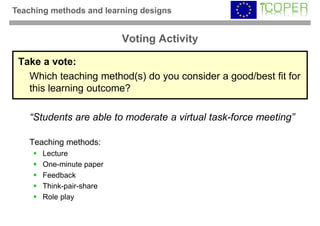
                          Voting Activity

 Take a vote:
   Which teaching method(s) do you consider a good/best fit for
   this learning outcome?

    “Students are able to moderate a virtual task-force meeting”

    Teaching methods:
       Lecture
       One-minute paper
       Feedback
       Think-pair-share
       Role play
Teaching methods and learning designs

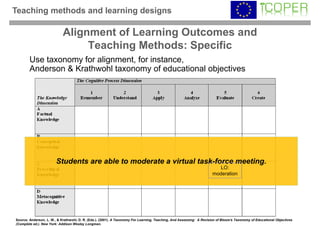
                            Alignment of Learning Outcomes and
                                 Teaching Methods: Specific
        Use taxonomy for alignment, for instance,
        Anderson & Krathwohl taxonomy of educational objectives


                        Students are able to moderate a virtual task-force meeting.
                                                                                                                         LO:
                                                                                                                      moderation


Source: Anderson, L. W., & Krathwohl, D. R. (Eds.). (2001). A Taxonomy For Learning, Teaching, And Assessing: A Revision of Bloom's Taxonomy of Educational Objectives
(Complete ed.). New York: Addison Wesley Longman.
Teaching methods and learning designs

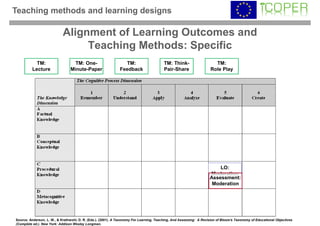
                            Alignment of Learning Outcomes and
                                 Teaching Methods: Specific
           TM:                    TM: One-                      TM:                     TM: Think-                    TM:
         Lecture                Minute-Paper                  Feedback                  Pair-Share                  Role Play


                                                                                                                        LO:
                                                                                                                    Moderation
                                                                                                                    Assessment:
                                                                                                                     Moderation


Source: Anderson, L. W., & Krathwohl, D. R. (Eds.). (2001). A Taxonomy For Learning, Teaching, And Assessing: A Revision of Bloom's Taxonomy of Educational Objectives
(Complete ed.). New York: Addison Wesley Longman.
Teaching methods and learning designs


                          Teaching methods

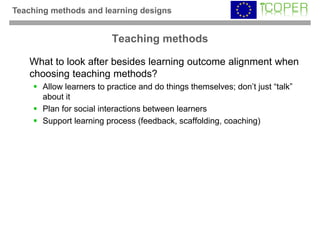
    What to look after besides learning outcome alignment when
    choosing teaching methods?
       Allow learners to practice and do things themselves; don’t just “talk”
       about it
       Plan for social interactions between learners
       Support learning process (feedback, scaffolding, coaching)
Teaching methods and learning designs


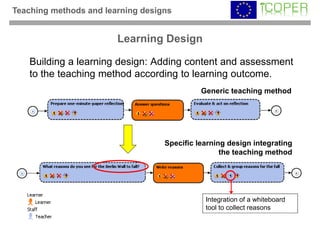
                        Learning Design

    Building a learning design: Adding content and assessment
    to the teaching method according to learning outcome.
                                             Generic teaching method


                                   Specific learning design integrating
                                                   the teaching method


                                              Integration of a whiteboard
                                              tool to collect reasons
Models and standards


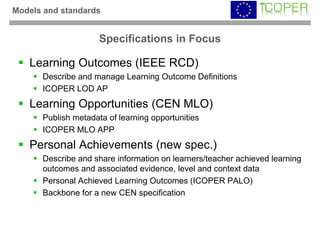
                     Specifications in Focus

   Learning Outcomes (IEEE RCD)
      Describe and manage Learning Outcome Definitions
      ICOPER LOD AP
   Learning Opportunities (CEN MLO)
      Publish metadata of learning opportunities
      ICOPER MLO APP
   Personal Achievements (new spec.)
      Describe and share information on learners/teacher achieved learning
      outcomes and associated evidence, level and context data
      Personal Achieved Learning Outcomes (ICOPER PALO)
      Backbone for a new CEN specification
Models and standards


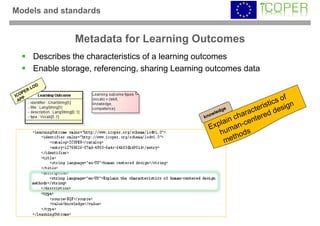
              Metadata for Learning Outcomes
    Describes the characteristics of a learning outcomes
    Enable storage, referencing, sharing Learning outcomes data
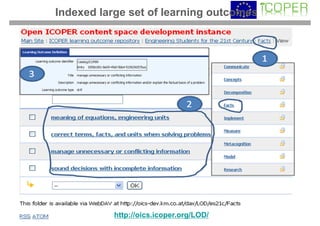
Indexed large set of learning outcomes


           http://oics.icoper.org/LOD/
Models and standards

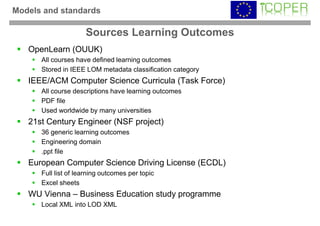
                     Sources Learning Outcomes
   OpenLearn (OUUK)
      All courses have defined learning outcomes
      Stored in IEEE LOM metadata classification category
   IEEE/ACM Computer Science Curricula (Task Force)
      All course descriptions have learning outcomes
      PDF file
      Used worldwide by many universities
   21st Century Engineer (NSF project)
      36 generic learning outcomes
      Engineering domain
      .ppt file
   European Computer Science Driving License (ECDL)
      Full list of learning outcomes per topic
      Excel sheets
   WU Vienna – Business Education study programme
      Local XML into LOD XML
Models and standards


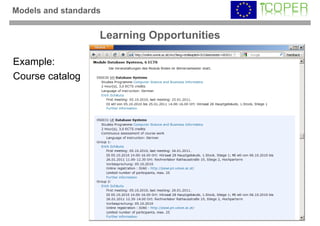
                   Learning Opportunities

Example:
Course catalog
Models and standards

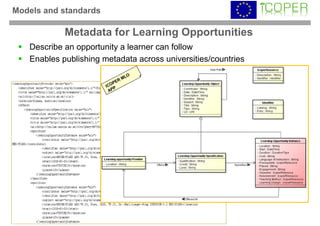
            Metadata for Learning Opportunities
   Describe an opportunity a learner can follow
   Enables publishing metadata across universities/countries
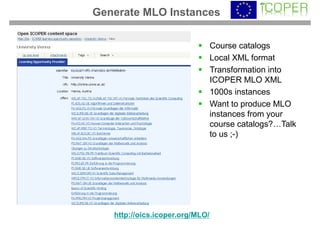
Generate MLO Instances

                                 Course catalogs
                                 Local XML format
                                 Transformation into
                                 ICOPER MLO XML
                                 1000s instances
                                 Want to produce MLO
                                 instances from your
                                 course catalogs?…Talk
                                 to us ;-)


   http://oics.icoper.org/MLO/
Models and standards

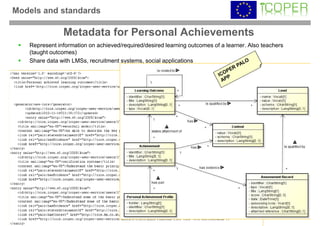
               Metadata for Personal Achievements
   Represent information on achieved/required/desired learning outcomes of a learner. Also teachers
   (taught outcomes)
   Share data with LMSs, recruitment systems, social applications
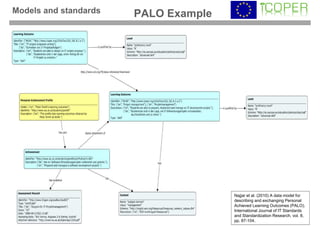
Models and standards   PALO Example


                                      Najjar et al. (2010) A data model for
                                      describing and exchanging Personal
                                      Achieved Learning Outcomes (PALO).
                                      International Journal of IT Standards
                                      and Standardization Research, vol. 8,
                                      pp. 87-104.
Models and standards


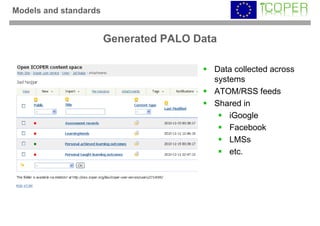
                       Generated PALO Data

                                         Data collected across
                                         systems
                                         ATOM/RSS feeds
                                         Shared in
                                             iGoogle
                                             Facebook
                                             LMSs
                                             etc.
Learning outcome motivated assessment


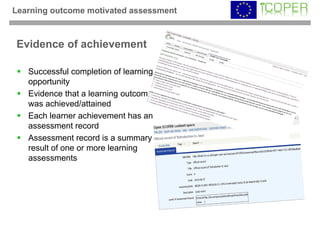
Evidence of achievement

   Successful completion of learning
   opportunity
   Evidence that a learning outcome
   was achieved/attained
   Each learner achievement has an
   assessment record
   Assessment record is a summary
   result of one or more learning
   assessments
Learning outcome motivated assessment

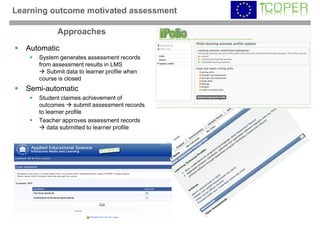
            Approaches
   Automatic
      System generates assessment records
      from assessment results in LMS
         Submit data to learner profile when
      course is closed
   Semi-automatic
      Student claimes achievement of
      outcomes      submit assessment records
      to learner profile
      Teacher approves assessment records
          data submitted to learner profile
Closing


                 More Resources & Feedback
 ICOPER Training Infrastructure:
      Learning Outcome Course:
      http://training.icoper.org/moodle/mod/resource/view.php?id=269
      Instructional Modeling Course:
      http://training.icoper.org/moodle/mod/resource/view.php?id=270


 Your feedback:
   What do you take home from this webinar?
   Please share via the chat window or raise your hand to
   speak.

 Feedback form:
   http://tinyurl.com/28gjny2
ICOPER Webinar Series


                        Upcoming Webinars
 Webinar 3: “eContent for designing and delivering
  outcome-based learning opportunities”
  February 3, 2011 (next Thursday)
  16.00-17.30

 Webinar 4: “Learning outcome-based assessment and
  applications”
  February 10, 2011
  16.00-17.30

 Webinar 5: “Applications for outcome-based learning”
  February 17, 2011
  16.00-17.30

Outcome-based Learning Opportunities - Webinar

  • 1.
    Webinar Series –Session 2 Outcome-based Learning Opportunities Michael Derntl1, Jad Najjar2 and Susanne Neumann1 1 University of Vienna, Austria 2 WU Vienna, Austria
  • 2.
    Webinar overview Background andmotivation for outcome-based education Formulating learning outcomes Learning outcome based teaching methods and learning designs Models and standards for learning outcomes and opportunities Learning outcome motivated assessment
  • 3.
  • 4.
  • 5.
    Background and motivation Why outcome-oriented teaching and learning? The Bologna Process quality assurance in higher education a unified educational system (mobility, transparency and mutual recognition of qualification) Revise curricula integrate student centeredness and learning outcome orientation Pedagogical issues became central: Alignment of teaching and assessment methods in accordance with learning outcomes
  • 6.
    Background and motivation What is your background? Please shortly state in the chat: 1. Your background. (e.g. higher education, PhD student, vocational training, consulting, instructional design, other…) 2. Your position or relation to teaching (if any). 3. Subject(s) you teach / PhD topic.
  • 7.
    Formulating learning outcomes Learning outcomes A learning outcome is a statement of what a learner is expected to know, understand or be able to do as a result of a learning process ―European Qualification Framework for Lifelong Learning (EQF) Teaching methods Learning Workload ALIGNMENT outcomes (ECTS) Assessment
  • 8.
    Formulating learning outcomes Types of learning outcomes Learning outcomes Competence (personal and professional) The proven ability to use knowledge, skills and personal, social and/or methodological abilities. proven ability to use Skills The ability to apply knowledge and use know- how to complete tasks and solve problems. Personal, social ability and/or methodological to apply abilities Knowledge The outcome of the assimilation of information through learning.
  • 9.
    Formulating learning outcomes Intended vs. achieved learning outcomes The teacher defines the intended learning outcomes for a learning opportunity The teacher assesses and learners demonstrate the achievement of intended learning outcomes
  • 10.
    Formulating learning outcomes Sentence structure of intended learning outcomes An intended learning outcome is formulated as a sentence that follows a basic structure: Learners are able to Verb Object Describes intended Describes what students (cognitive) process are expected to acquire or construct Example: Learners are able to enumerate the most influential politicians of the 20th century What type of learning outcome is this?
  • 11.
    Formulating learning outcomes Examples of learning outcomes and their type Students are able to … … explain the seven layers of the ISO/OSI Reference Model Knowledge … enumerate the most influential politicians of the 20th century … design an interactive website that complies with Web Accessibility Guidelines Skills … filter out relevant literature for a given research problem. … guide their team mates in improving the architectural model of a system. Competence … moderate a virtual task-force meeting
  • 12.
    Formulating learning outcomes Guidelines 1. Students are taught about software design flaws → Focus on the learning rather than the teaching! 2. Students are able to identify critical design flaws in a given software system 3. Students complete Unit 1 on basics of academic writing → Focus on the outcome, not the process! 4. Students are able to explain the basic principles of academic writing 5. Students are able to give a good presentation about their semester project → Make sure that achievement can be assessed! 6. Students are able to convey the essential outcomes of their semester project in a five-minute slideshow presentation
  • 13.
    Formulating learning outcomes Activity Formulate and write in the chat: If you’re a (PhD) student: a learning outcome of the program or course you‘re taking. If you’re a teacher/tutor: a learning outcome of a course you’re teaching. Indicate in parentheses whether the outcome is related to: knowledge (K) skills (S) or competence (C) Example: Students are able to explain the basic principles of academic writing (K)
  • 14.
    Teaching methods andlearning designs Problem outline Alignment of outcomes, methods, and workload Here: focus on aligning teaching methods with learning outcomes Goal: facilitating learners in achieving the intended outcomes Teaching methods Learning Workload ALIGNMENT outcomes (ECTS) Assessment
  • 15.
    Key concepts ICOPER concept model Sharable Educational Resources is a Assessment TEACHING Method METHOD is a intended defines Learning Learning result of INSTRUCTIONAL roles Facilitator imple- imple- ments Outcome ments MODEL Learner is a is a Assessment LEARNING Design DESIGN involves uses uses instantiation of Learning Content Learning Opportunity instantiation of is a includes Stored in Assessment the OICS Opportunity
  • 16.
    Teaching methods andlearning designs Examples of Teaching Methods 1/5 Lecture: The teacher is the primary delivery channel for instructional content – often through presentation.
  • 17.
    Teaching methods andlearning designs Examples of Teaching Methods 2/5 One-Minute Paper: Learners quickly write thoughts to make their level of understanding explicit.
  • 18.
    Teaching methods andlearning designs Examples of Teaching Methods 3/5 Feedback: Reinforce or correct actions performed by learners.
  • 19.
    Teaching methods andlearning designs Examples of Teaching Methods 4/5 Think-Pair-Share: To break long presentations, learners first think about a question individually, then discuss their thoughts with a partner, and lastly report back to the teacher.
  • 20.
    Teaching methods andlearning designs Examples of Teaching Methods 5/5 Role Play: is a “dramatized case-study”. Its purpose is to have members of a group act out roles surrounding a situation, condition, or circumstance to make different perspectives on the issue visible.
  • 21.
    Teaching methods andlearning designs Description of instructional models ICOPER researched description elements that practitioners require for browsing, selecting and implementing instructional models. General description: title, summary, rationale, subject, learning outcomes, learner characteristics, group size, duration, setting, author/licensing Detailed description: graphical representation, sequence of activities, roles, assessment method, resources, variations, implementations, references Comments: teacher reflections, student feedback, peer review This allows for a structured human-readable description
  • 22.
    Teaching methods andlearning designs Description of instructional models To describe instructional models in an interoperable machine-readable format, there are several existing standards and specifications, e.g.: IMS Learning Design (LD) SCORM IMS Simple Sequencing (SS) In ICOPER: Instructional models described with IMS LD (other formats allowed), with LOM metadata record(s) on top Storage in the Open ICOPER Content Space (OICS) for OICS/LOM introduction see the replay of Webinar 1; for IMS LD the upcoming Webinar 3; for application demos Webinar 5.
  • 23.
    Teaching methods andlearning designs Alignment of Learning Outcomes and Assessment Teaching methods Learning Workload ALIGNMENT outcomes (ECTS) Assessment
  • 24.
    Teaching methods andlearning designs Alignment of Learning Outcomes and Assessment Learning outcome: Students are able to moderate a virtual task-force meeting. Aligned assessment: A tutor observes a task-force meeting where a student moderates, and gives feedback to the student based on pre-defined performance criteria. Misaligned assessment: Students take a multiple-choice test on how to moderate meetings.
  • 25.
    Teaching methods andlearning designs Alignment of Learning Outcomes and Teaching Methods: General General alignment: What do we mean by “alignment” when talking about teaching methods? Teaching methods Learning Workload ALIGNMENT outcomes (ECTS) Assessment
  • 26.
    Teaching methods andlearning designs Alignment of Learning Outcomes and Teaching Methods: General Learning outcome: Students are able to moderate a virtual task-force meeting. Teaching methods: Lecture One-minute paper Feedback Think-pair-share Role play
  • 27.
    Teaching methods andlearning designs Voting Activity Take a vote: Which teaching method(s) do you consider a good/best fit for this learning outcome? “Students are able to moderate a virtual task-force meeting” Teaching methods: Lecture One-minute paper Feedback Think-pair-share Role play
  • 28.
    Teaching methods andlearning designs Alignment of Learning Outcomes and Teaching Methods: Specific Use taxonomy for alignment, for instance, Anderson & Krathwohl taxonomy of educational objectives Students are able to moderate a virtual task-force meeting. LO: moderation Source: Anderson, L. W., & Krathwohl, D. R. (Eds.). (2001). A Taxonomy For Learning, Teaching, And Assessing: A Revision of Bloom's Taxonomy of Educational Objectives (Complete ed.). New York: Addison Wesley Longman.
  • 29.
    Teaching methods andlearning designs Alignment of Learning Outcomes and Teaching Methods: Specific TM: TM: One- TM: TM: Think- TM: Lecture Minute-Paper Feedback Pair-Share Role Play LO: Moderation Assessment: Moderation Source: Anderson, L. W., & Krathwohl, D. R. (Eds.). (2001). A Taxonomy For Learning, Teaching, And Assessing: A Revision of Bloom's Taxonomy of Educational Objectives (Complete ed.). New York: Addison Wesley Longman.
  • 30.
    Teaching methods andlearning designs Teaching methods What to look after besides learning outcome alignment when choosing teaching methods? Allow learners to practice and do things themselves; don’t just “talk” about it Plan for social interactions between learners Support learning process (feedback, scaffolding, coaching)
  • 31.
    Teaching methods andlearning designs Learning Design Building a learning design: Adding content and assessment to the teaching method according to learning outcome. Generic teaching method Specific learning design integrating the teaching method Integration of a whiteboard tool to collect reasons
  • 32.
    Models and standards Specifications in Focus Learning Outcomes (IEEE RCD) Describe and manage Learning Outcome Definitions ICOPER LOD AP Learning Opportunities (CEN MLO) Publish metadata of learning opportunities ICOPER MLO APP Personal Achievements (new spec.) Describe and share information on learners/teacher achieved learning outcomes and associated evidence, level and context data Personal Achieved Learning Outcomes (ICOPER PALO) Backbone for a new CEN specification
  • 33.
    Models and standards Metadata for Learning Outcomes Describes the characteristics of a learning outcomes Enable storage, referencing, sharing Learning outcomes data
  • 34.
    Indexed large setof learning outcomes http://oics.icoper.org/LOD/
  • 35.
    Models and standards Sources Learning Outcomes OpenLearn (OUUK) All courses have defined learning outcomes Stored in IEEE LOM metadata classification category IEEE/ACM Computer Science Curricula (Task Force) All course descriptions have learning outcomes PDF file Used worldwide by many universities 21st Century Engineer (NSF project) 36 generic learning outcomes Engineering domain .ppt file European Computer Science Driving License (ECDL) Full list of learning outcomes per topic Excel sheets WU Vienna – Business Education study programme Local XML into LOD XML
  • 36.
    Models and standards Learning Opportunities Example: Course catalog
  • 37.
    Models and standards Metadata for Learning Opportunities Describe an opportunity a learner can follow Enables publishing metadata across universities/countries
  • 38.
    Generate MLO Instances Course catalogs Local XML format Transformation into ICOPER MLO XML 1000s instances Want to produce MLO instances from your course catalogs?…Talk to us ;-) http://oics.icoper.org/MLO/
  • 39.
    Models and standards Metadata for Personal Achievements Represent information on achieved/required/desired learning outcomes of a learner. Also teachers (taught outcomes) Share data with LMSs, recruitment systems, social applications
  • 40.
    Models and standards PALO Example Najjar et al. (2010) A data model for describing and exchanging Personal Achieved Learning Outcomes (PALO). International Journal of IT Standards and Standardization Research, vol. 8, pp. 87-104.
  • 41.
    Models and standards Generated PALO Data Data collected across systems ATOM/RSS feeds Shared in iGoogle Facebook LMSs etc.
  • 42.
    Learning outcome motivatedassessment Evidence of achievement Successful completion of learning opportunity Evidence that a learning outcome was achieved/attained Each learner achievement has an assessment record Assessment record is a summary result of one or more learning assessments
  • 43.
    Learning outcome motivatedassessment Approaches Automatic System generates assessment records from assessment results in LMS Submit data to learner profile when course is closed Semi-automatic Student claimes achievement of outcomes submit assessment records to learner profile Teacher approves assessment records data submitted to learner profile
  • 44.
    Closing More Resources & Feedback ICOPER Training Infrastructure: Learning Outcome Course: http://training.icoper.org/moodle/mod/resource/view.php?id=269 Instructional Modeling Course: http://training.icoper.org/moodle/mod/resource/view.php?id=270 Your feedback: What do you take home from this webinar? Please share via the chat window or raise your hand to speak. Feedback form: http://tinyurl.com/28gjny2
  • 45.
    ICOPER Webinar Series Upcoming Webinars Webinar 3: “eContent for designing and delivering outcome-based learning opportunities” February 3, 2011 (next Thursday) 16.00-17.30 Webinar 4: “Learning outcome-based assessment and applications” February 10, 2011 16.00-17.30 Webinar 5: “Applications for outcome-based learning” February 17, 2011 16.00-17.30