














Mind the Gap: (re)Examining
Schooling, Assessing
and the
Theory / Practice Divide
Presented by: Jonathan Vervaet
@jonathanvervaet
January 28th, 2015
“Stories matter. Many stories
matter.”
- Chimamanda Ngozi Adichie
“If students have not been told
where they are going, it is
unlikely that they will arrive.”
– Shirley Clark
Learning Intentions
“I can find evidence of current
assessment research
in my practice.”
Learning Intentions
“I can identify ways to use
assessment to inform my
instructional decisions .”
Learning Intentions
“I can become curious about
something in the research I
want to inquire further into.”
“Assessment is the beginning and the end
of my teaching. It defines my culture, my
relationships, my learning community, my
values, and my beliefs about teaching and
learning.” - Matt Rosati
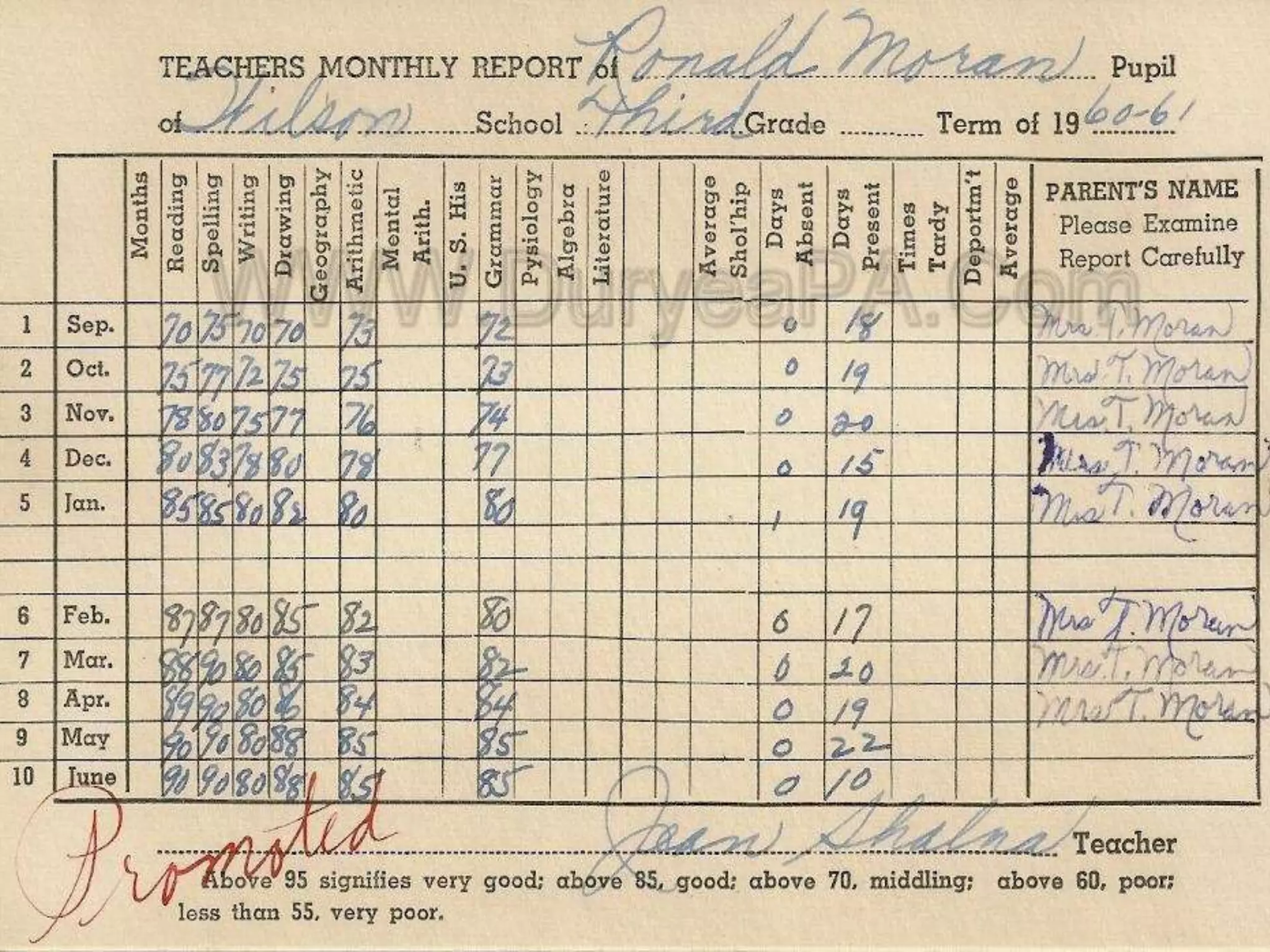
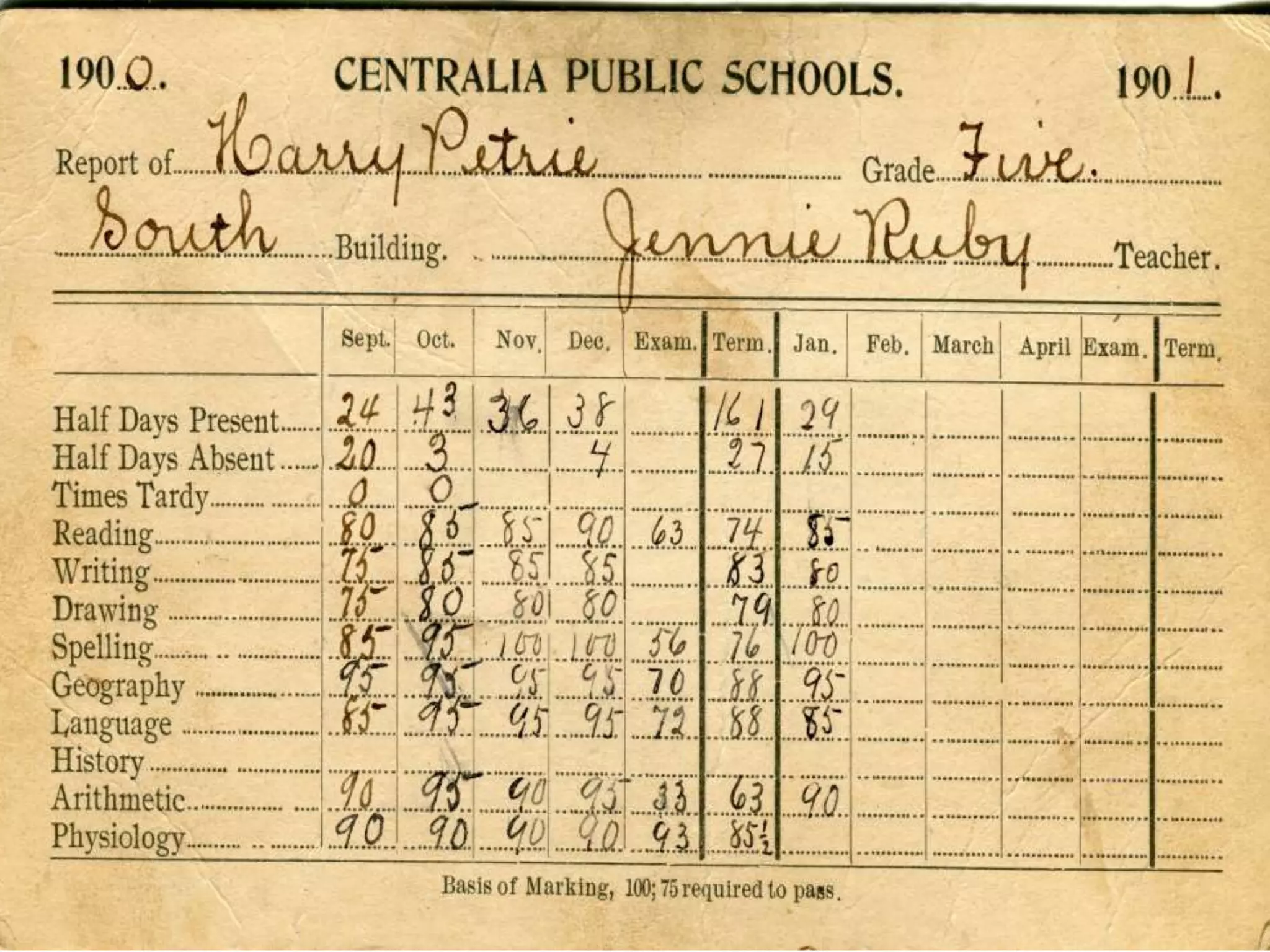
Our Traditional System
• Students are penalized if the don’t learn
fast enough... Even though we know
learning is an individual / developmental
process.
• What you do at the beginning of the course
will always count against you... Despite the
fact the student might now understand
what they did wrong and how to prevent it
in the future.
• Grades include all student attributes... Even
though we know grades should reflect the
The Paradigm Shift
• Learning vs. Teaching
• Outcomes / Standards vs. Tasks
• Quality vs. Quantity
• If students learn vs. When students learn
• Confidence vs. Anxiety
• Practice vs. One Chance
• Improvement vs. Coverage
Tom Schimmer
Reflection: How
is seeing
ourselves as
learners
important for
us as teachers?
Instructional Design
The Science of Learning
Instructional Design
90% of what we know about the brain we have
learned in approximately the last 2 years
Instructional Design
The same will be true 10 years from now
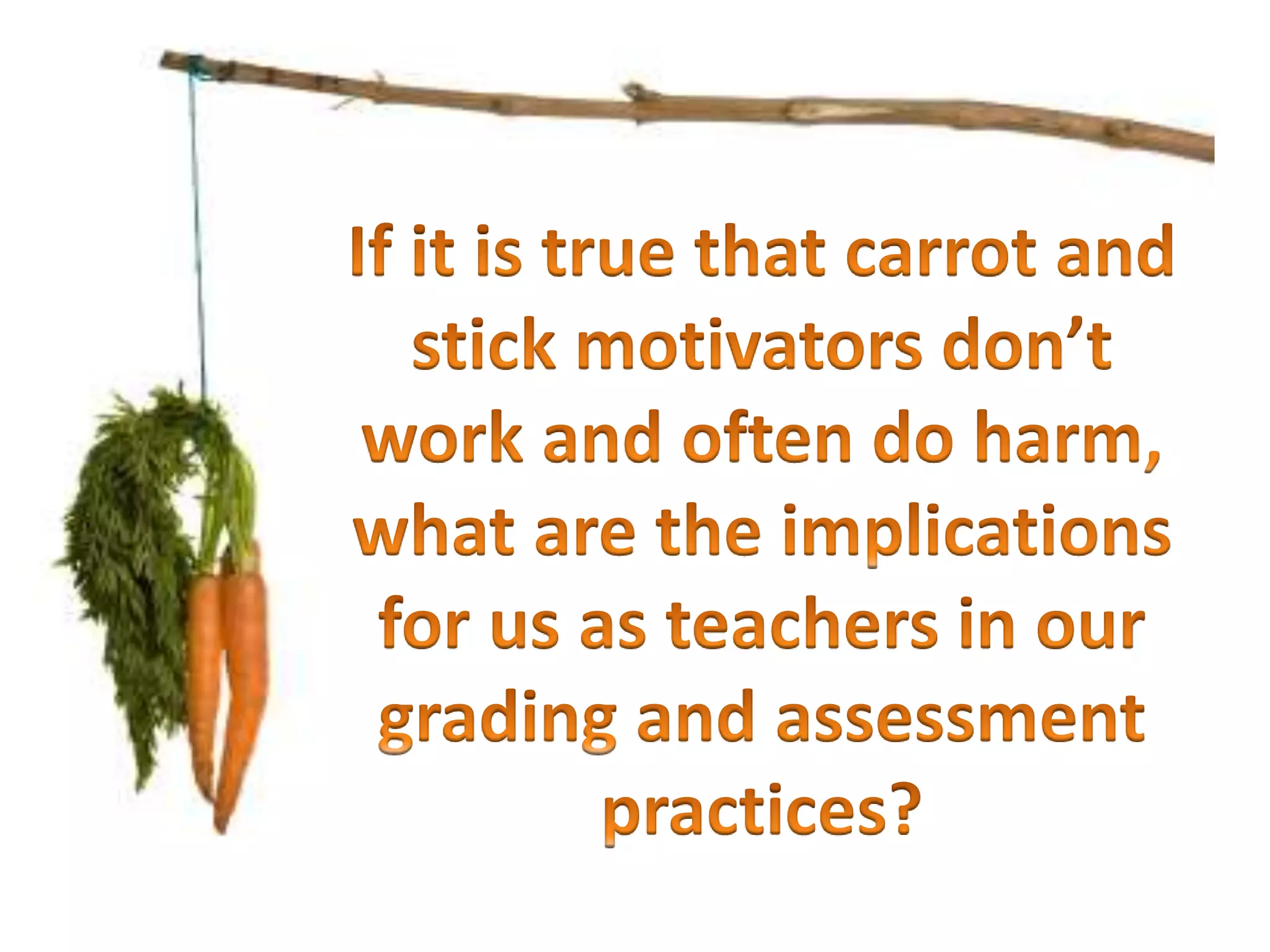
Motivation 2.0
True or False:
Rewarding an
activity will get you
more of it. Punishing
an activity will get
you less of it.
Harlow (1949)
Radical finding, there was a third drive.
The performance of the task provided
intrinsic reward.
The monkeys solved the problem simply
because they found it gratifying to solve
the puzzle.
2
Harlow (1949)
Rewarded the monkey with raisons.
“Introduction of food in the present experiment
served to disrupt performance, a phenomena not
reported in the literature.”
The monkeys made more errors and
solved the puzzles less frequently.
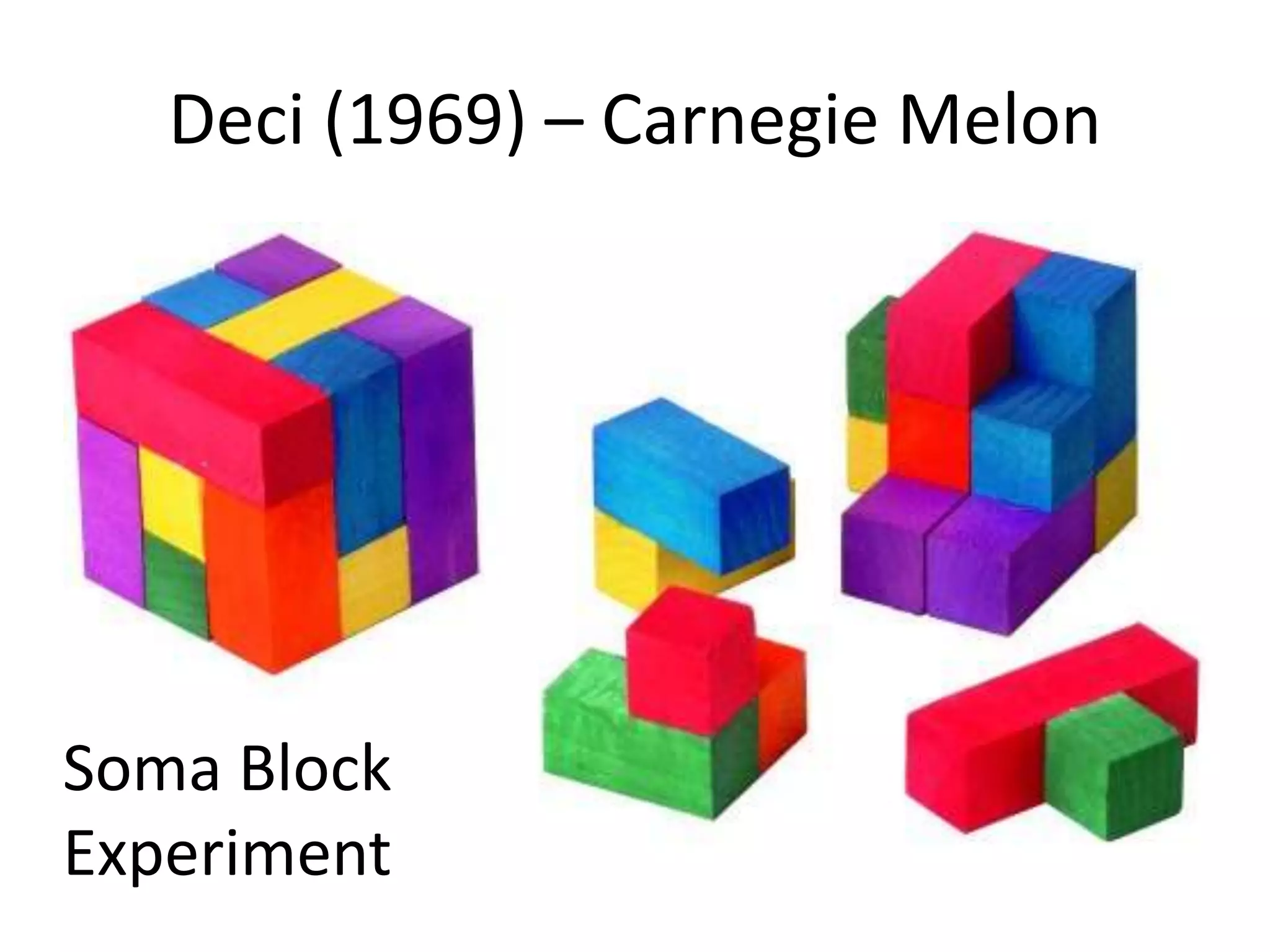
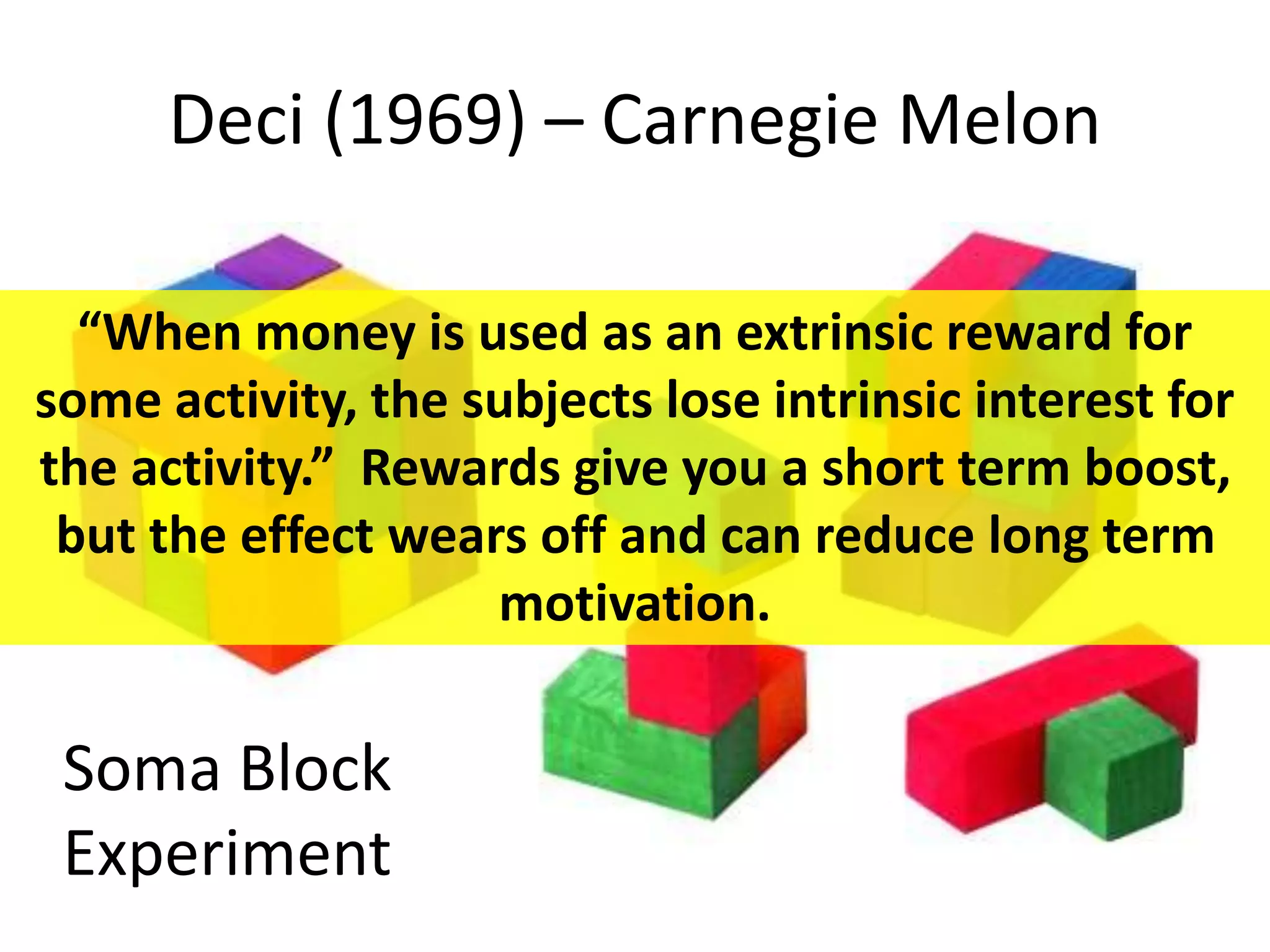
Deci (1969) – Carnegie Melon
Soma Block
Experiment
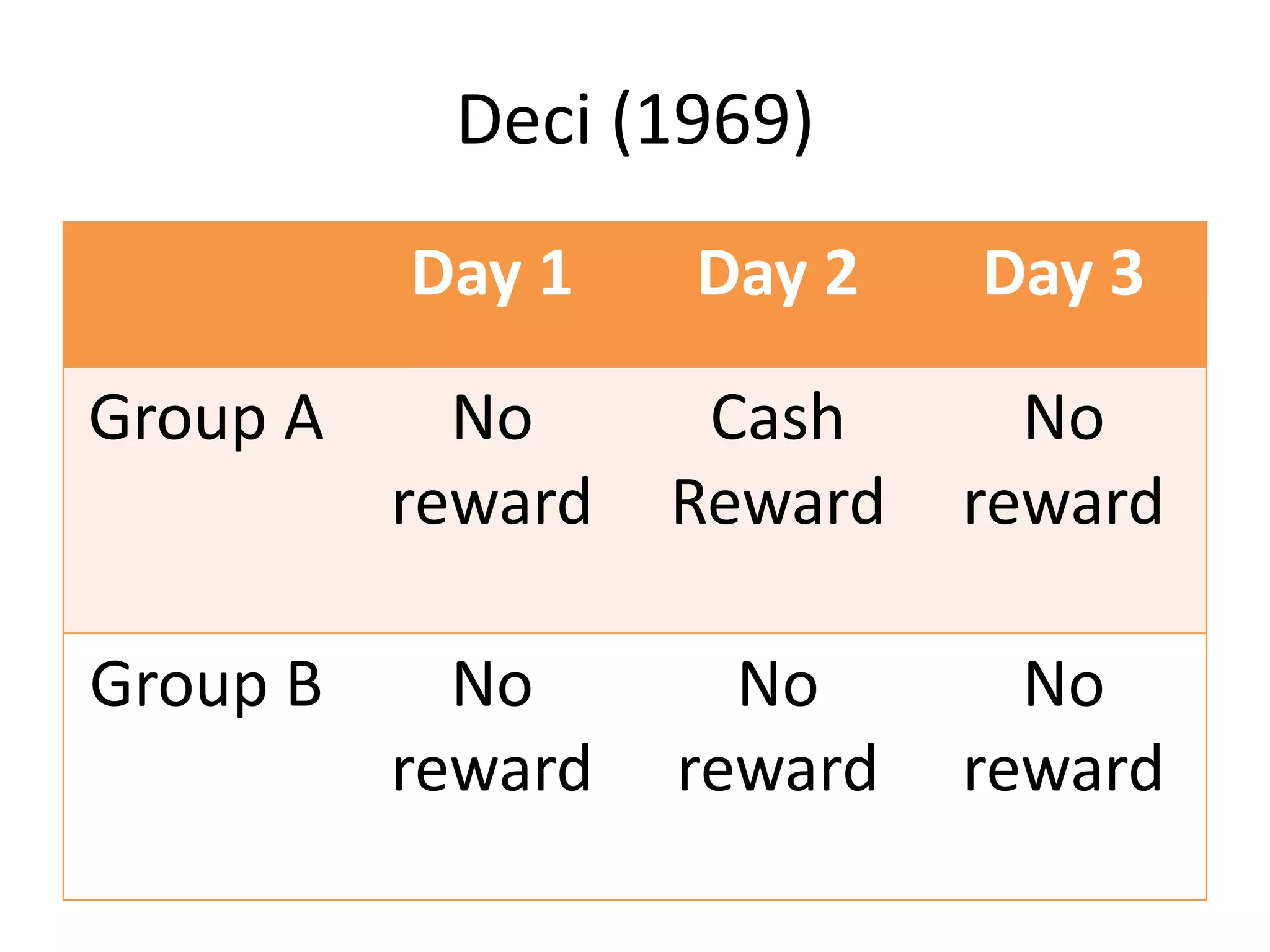
Deci (1969)
Day 1 Day 2 Day 3
Group A No
reward
Cash
Reward
No
reward
Group B No
reward
No
reward
No
reward
Deci (1969) – Carnegie Melon
Soma Block
Experiment
“When money is used as an extrinsic reward for
some activity, the subjects lose intrinsic interest for
the activity.” Rewards give you a short term boost,
but the effect wears off and can reduce long term
motivation.
Commissioned
vs.
Non-
Commissioned
Art
Rewards transform
interesting tasks
into drudgery.
Offering an award
signals that the
task is undesirable.
Focus on Short Term vs.
Long Term Benefits
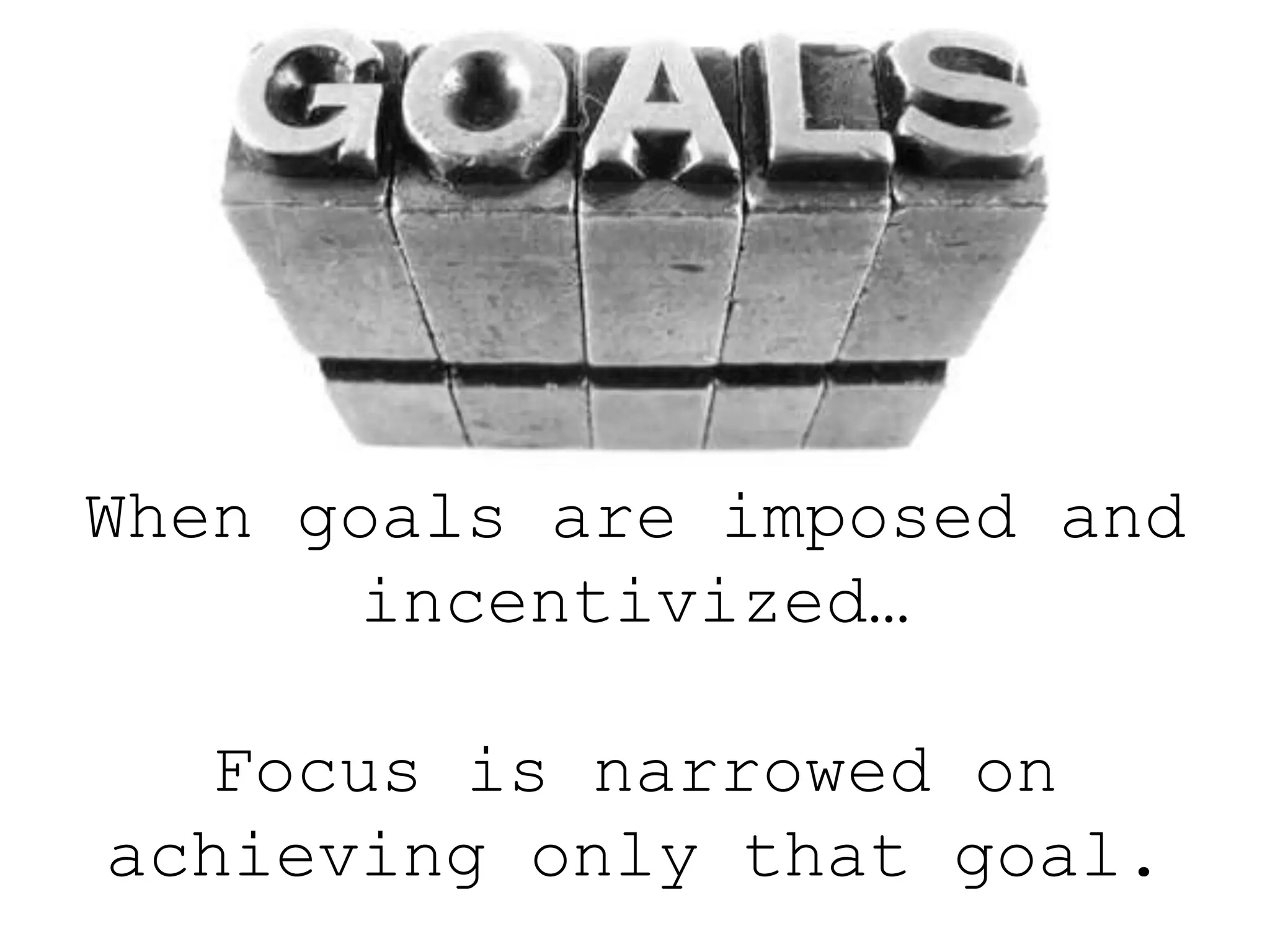
When goals are imposed and
incentivized…
Focus is narrowed on
achieving only that goal.
and…
Here’s the kicker…
It leads to unethical
behaviour in an attempt to
reach the goal.
aka..
Cheating…
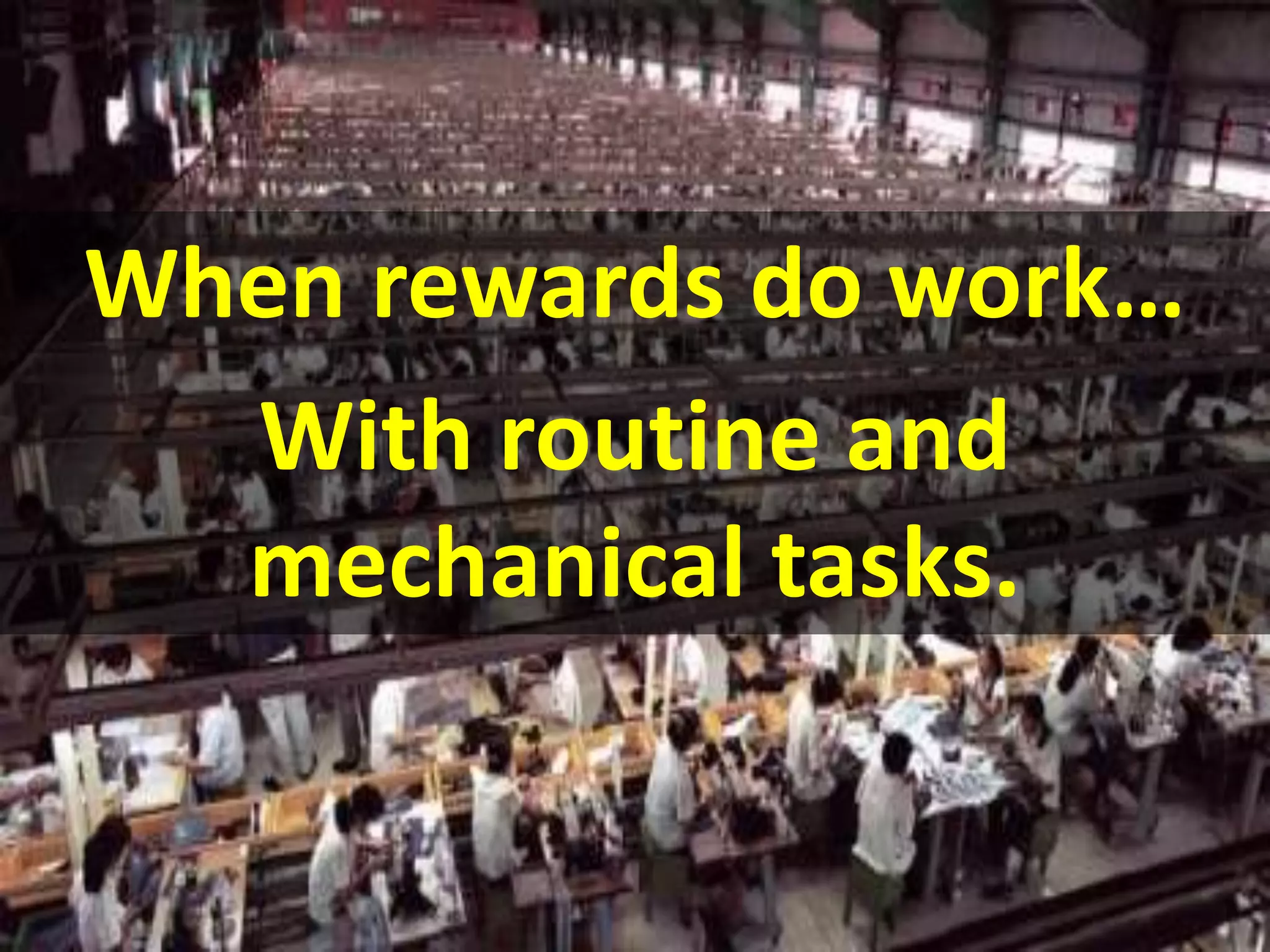
When rewards do work…
With routine and
mechanical tasks.
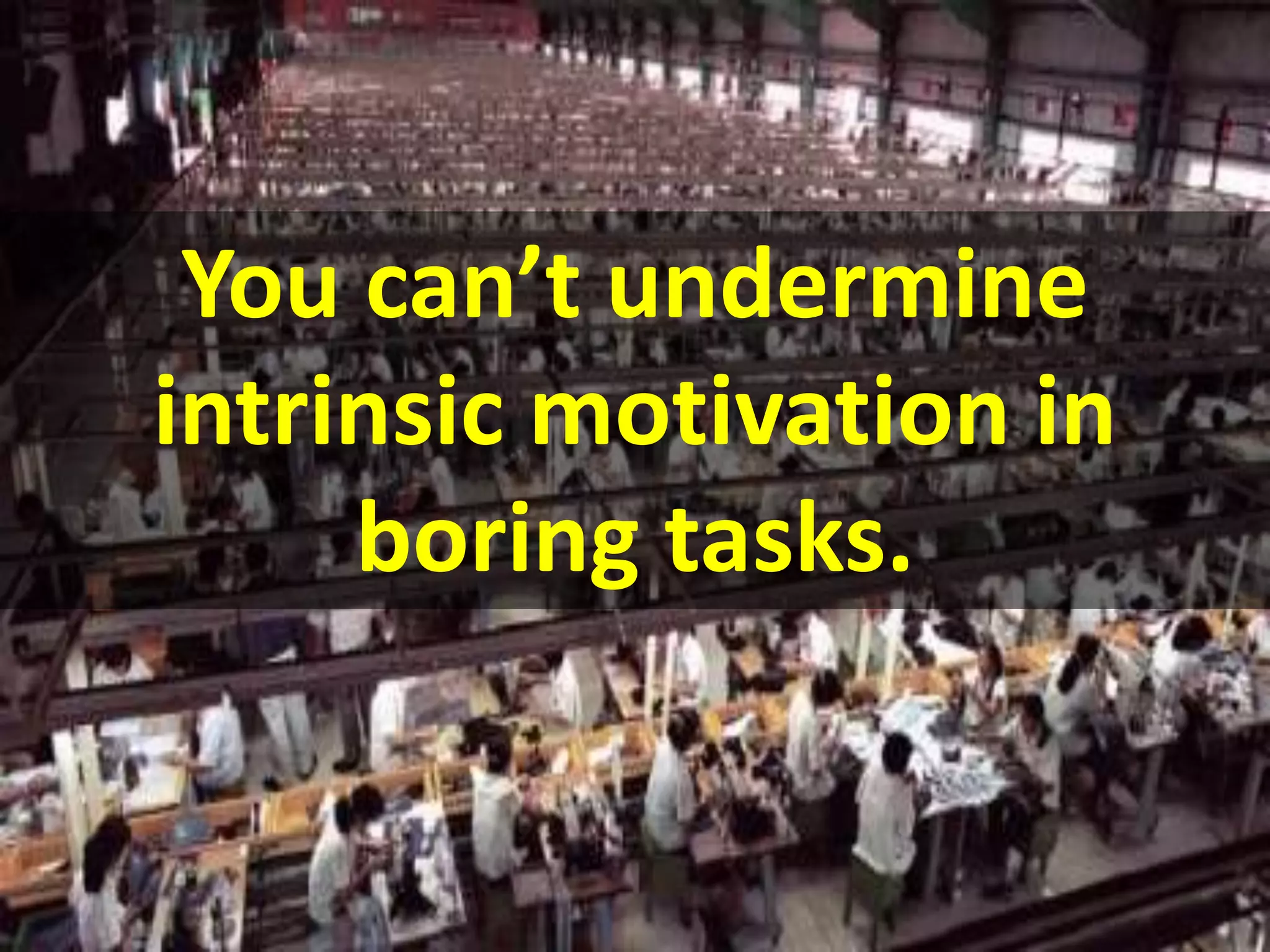
You can’t undermine
intrinsic motivation in
boring tasks.
Formative Assessment:
5 Key Strategies…
sometimes 6!
Dylan Wiliam “Embedded Formative
Assessment” (2011)
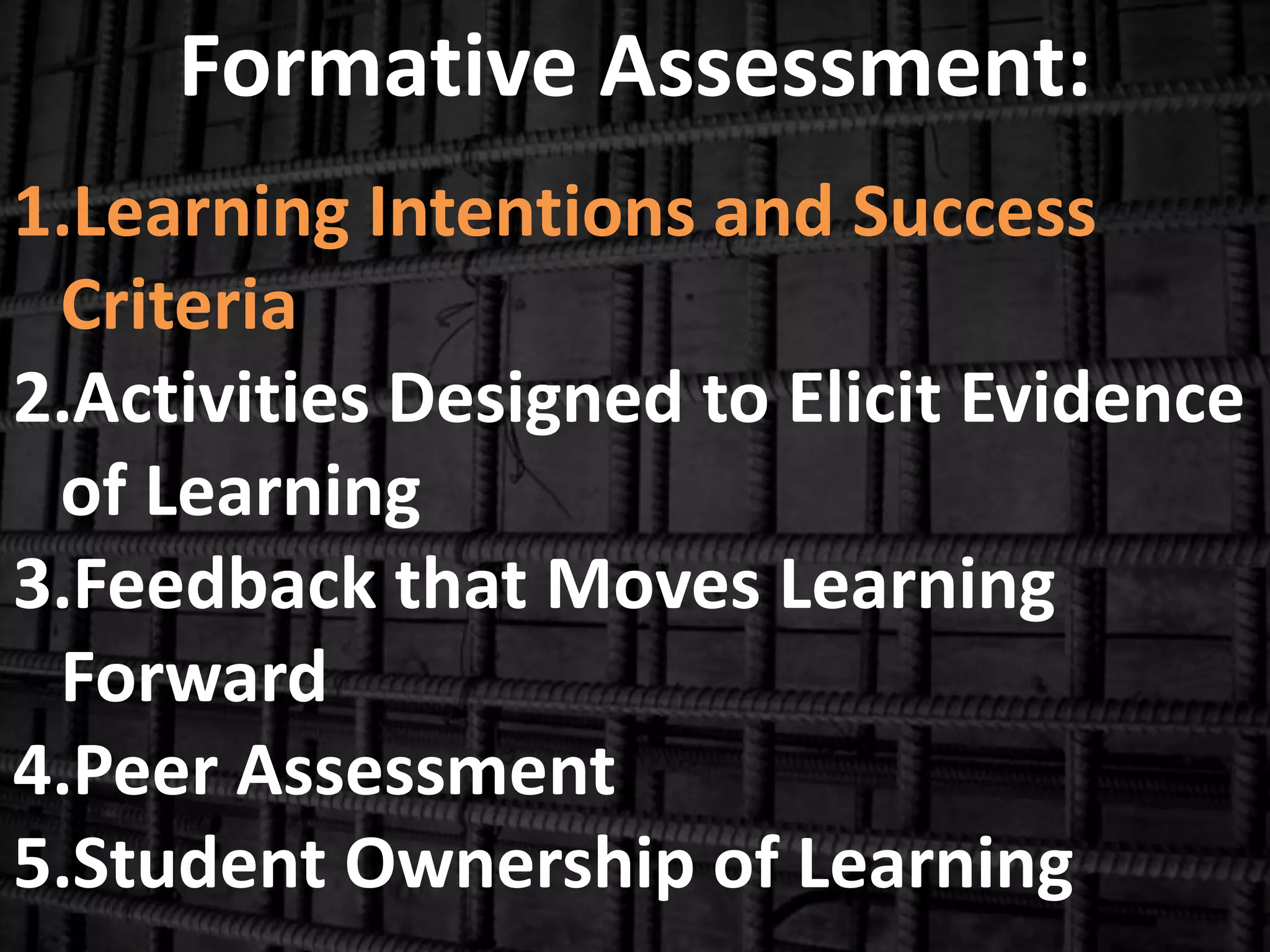
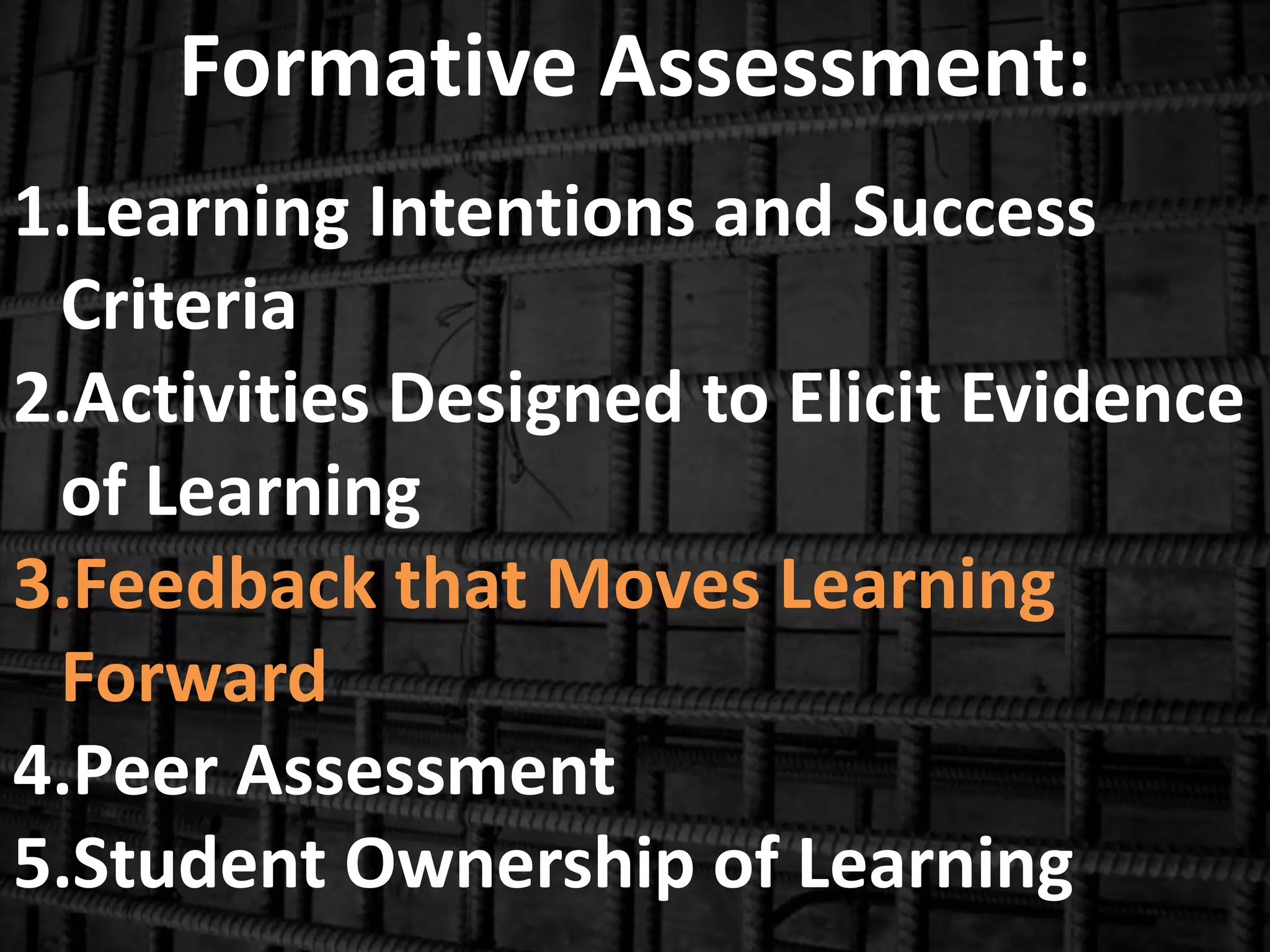
Formative Assessment:
1.Learning Intentions and Success
Criteria
2.Activities Designed to Elicit Evidence
of Learning
3.Feedback that Moves Learning
Forward
4.Peer Assessment
5.Student Ownership of Learning
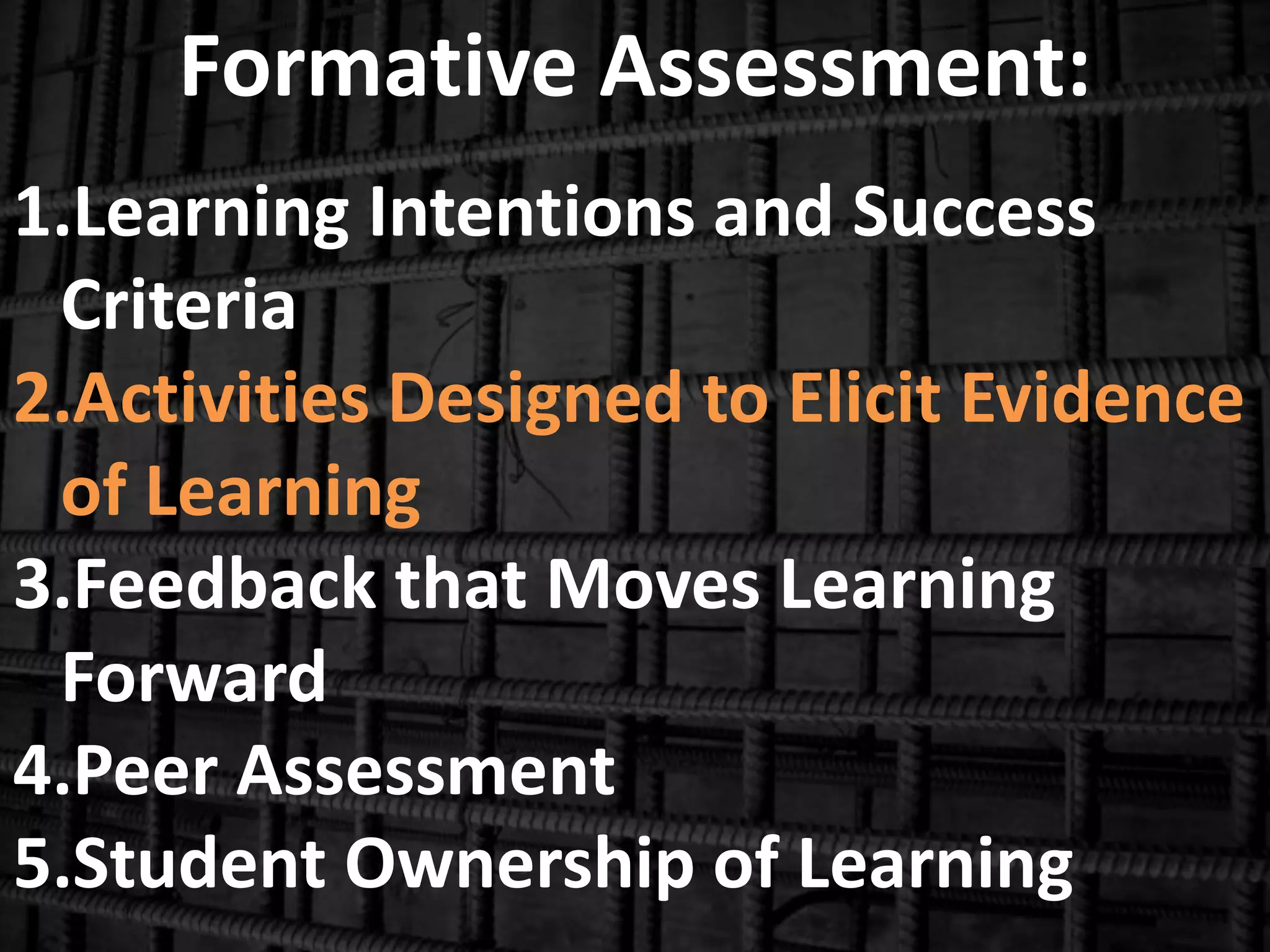
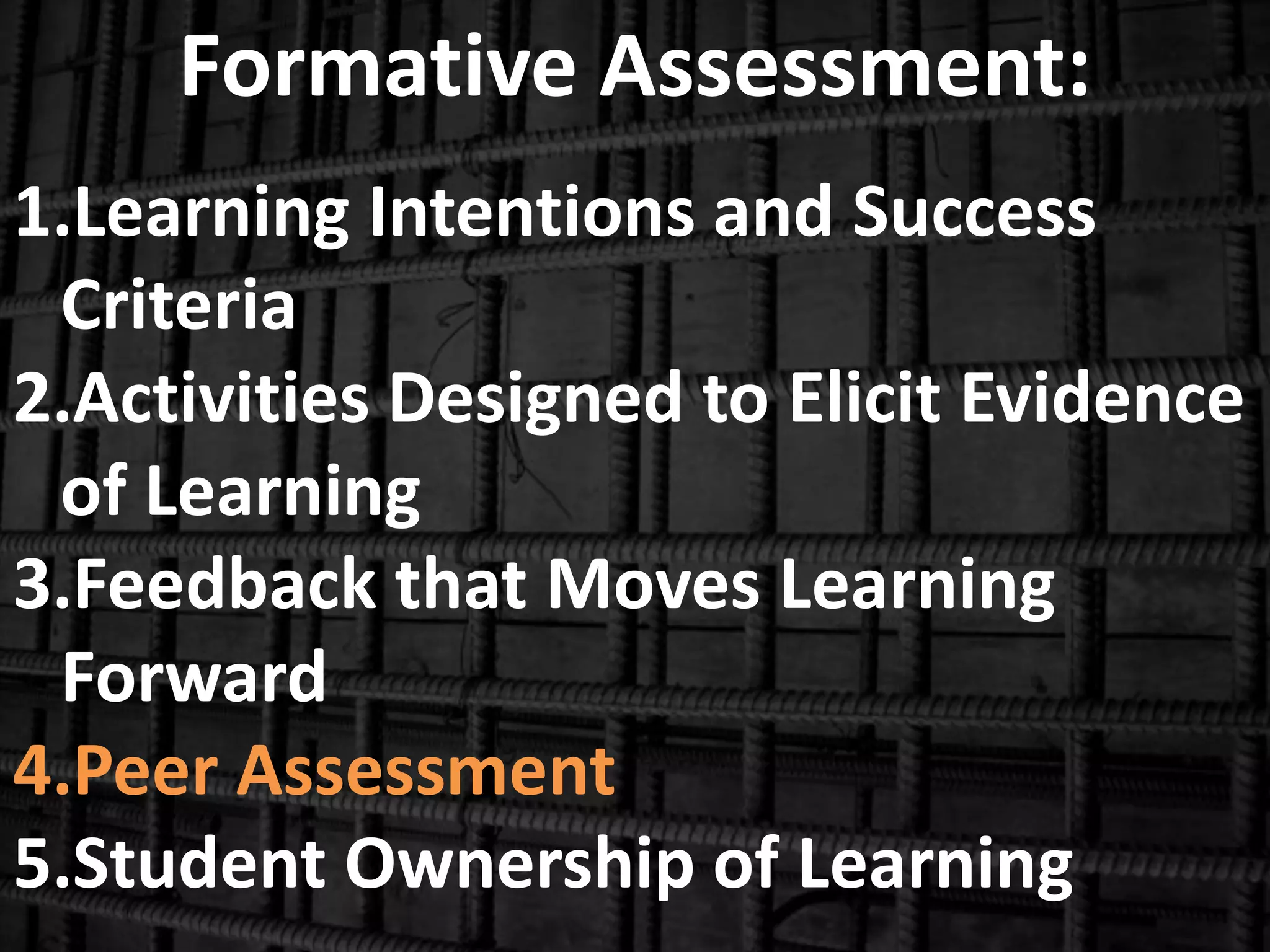
Formative Assessment:
1.Learning Intentions and Success
Criteria
2.Activities Designed to Elicit Evidence
of Learning
3.Feedback that Moves Learning
Forward
4.Peer Assessment
5.Student Ownership of Learning
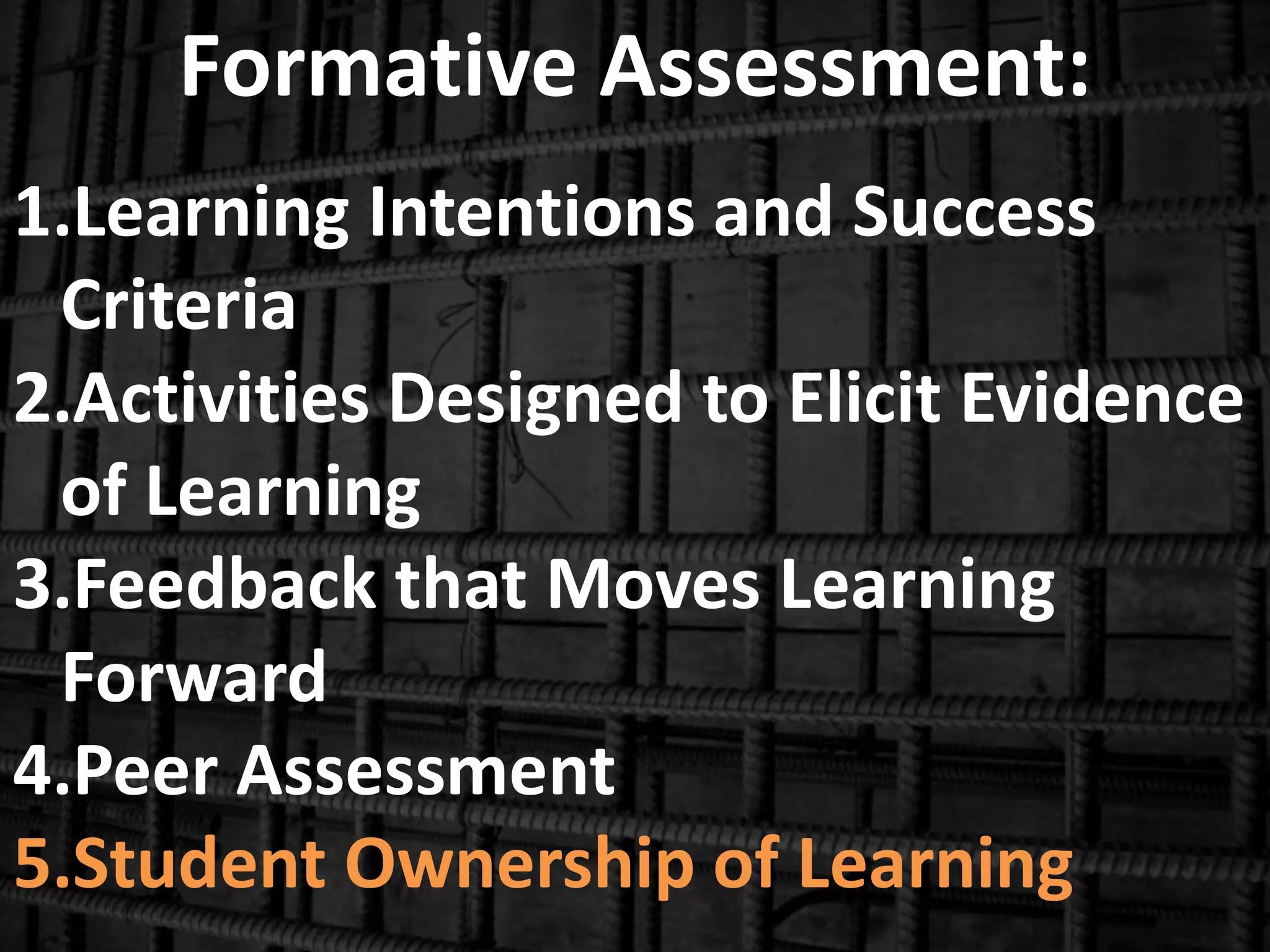
Formative Assessment:
1.Learning Intentions and Success
Criteria
2.Activities Designed to Elicit Evidence
of Learning
3.Feedback that Moves Learning
Forward
4.Peer Assessment
5.Student Ownership of Learning
Formative Assessment:
1.Learning Intentions and Success
Criteria
2.Activities Designed to Elicit Evidence
of Learning
3.Feedback that Moves Learning
Forward
4.Peer Assessment
5.Student Ownership of Learning
Formative Assessment:
1.Learning Intentions and Success
Criteria
2.Activities Designed to Elicit Evidence
of Learning
3.Feedback that Moves Learning
Forward
4.Peer Assessment
5.Student Ownership of Learning
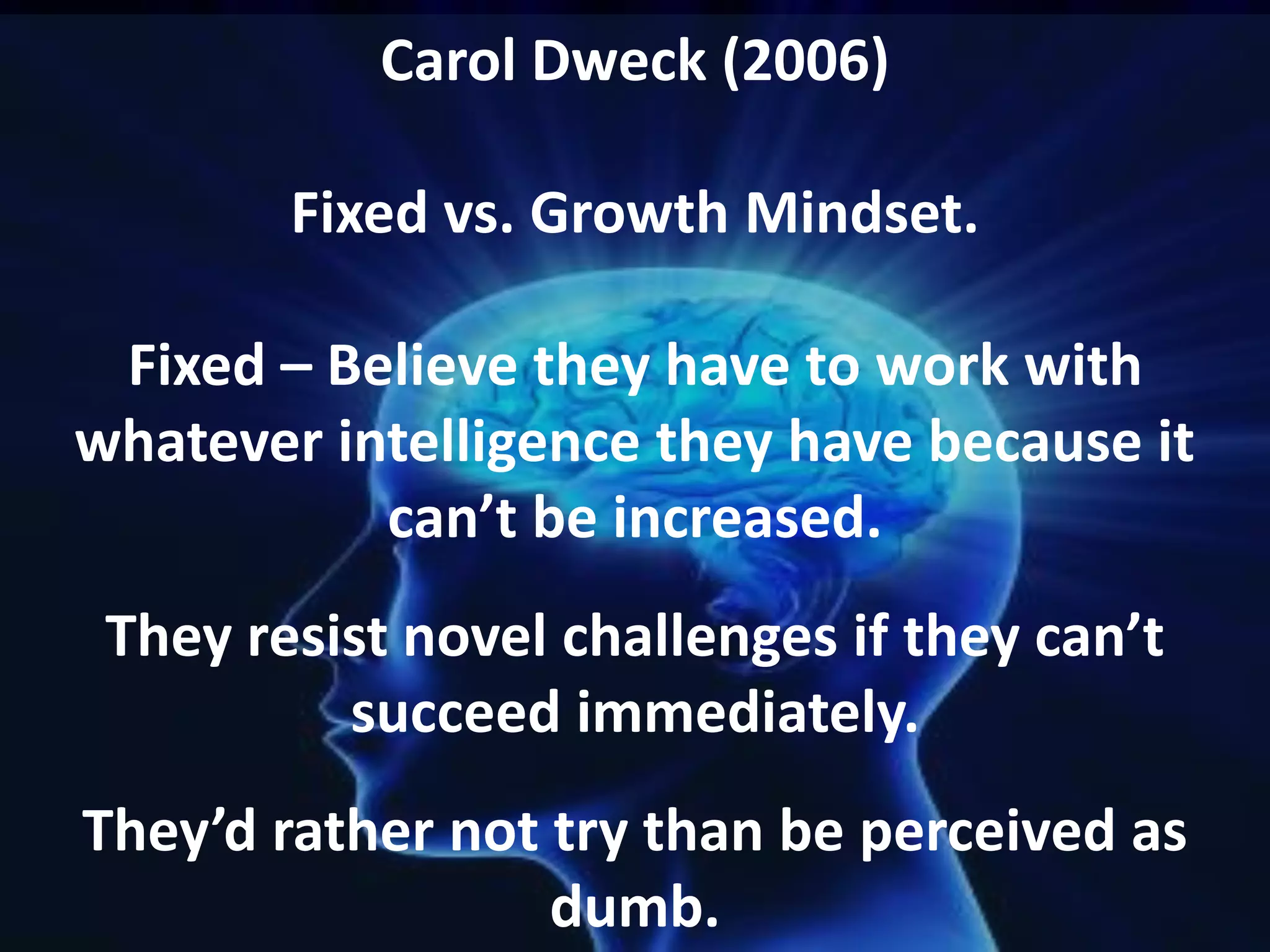
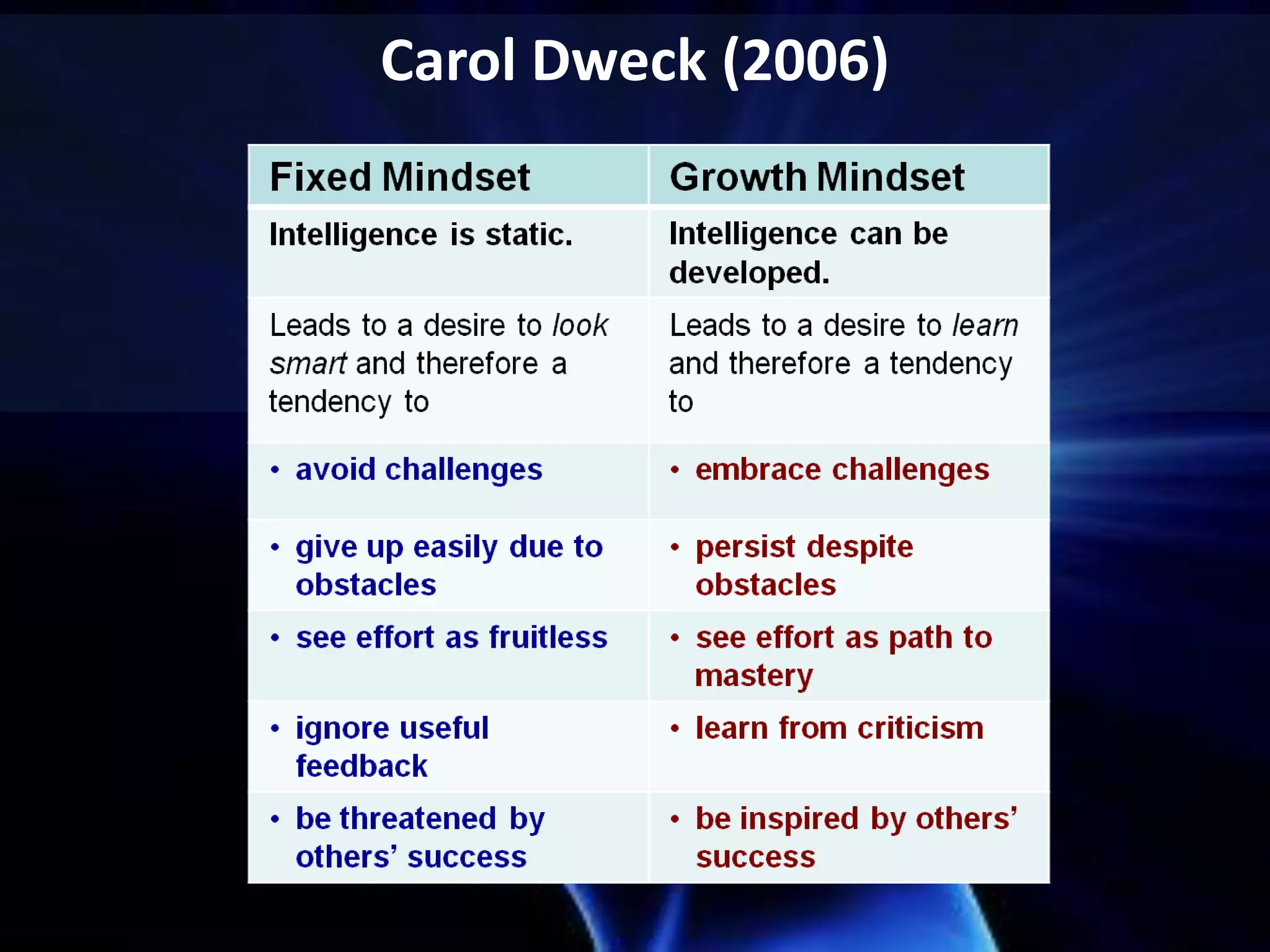
Carol Dweck (2006)
Fixed vs. Growth Mindset.
Fixed – Believe they have to work with
whatever intelligence they have because it
can’t be increased.
They resist novel challenges if they can’t
succeed immediately.
They’d rather not try than be perceived as
dumb.
Carol Dweck (2006)
Fixed vs. Growth Mindset.
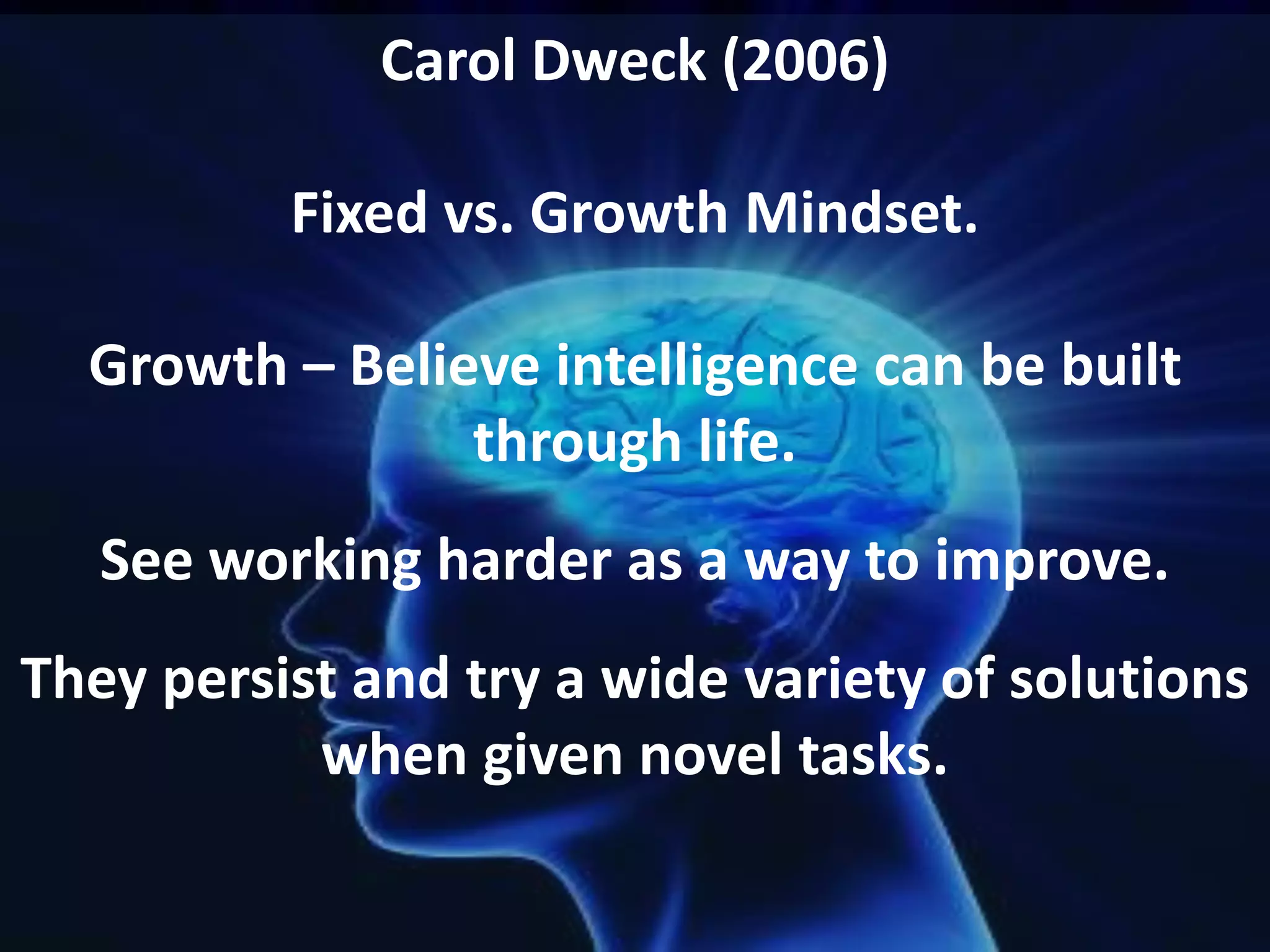
Growth – Believe intelligence can be built
through life.
See working harder as a way to improve.
They persist and try a wide variety of solutions
when given novel tasks.
Carol Dweck (2006)
Csikzentmihalyi (1990)
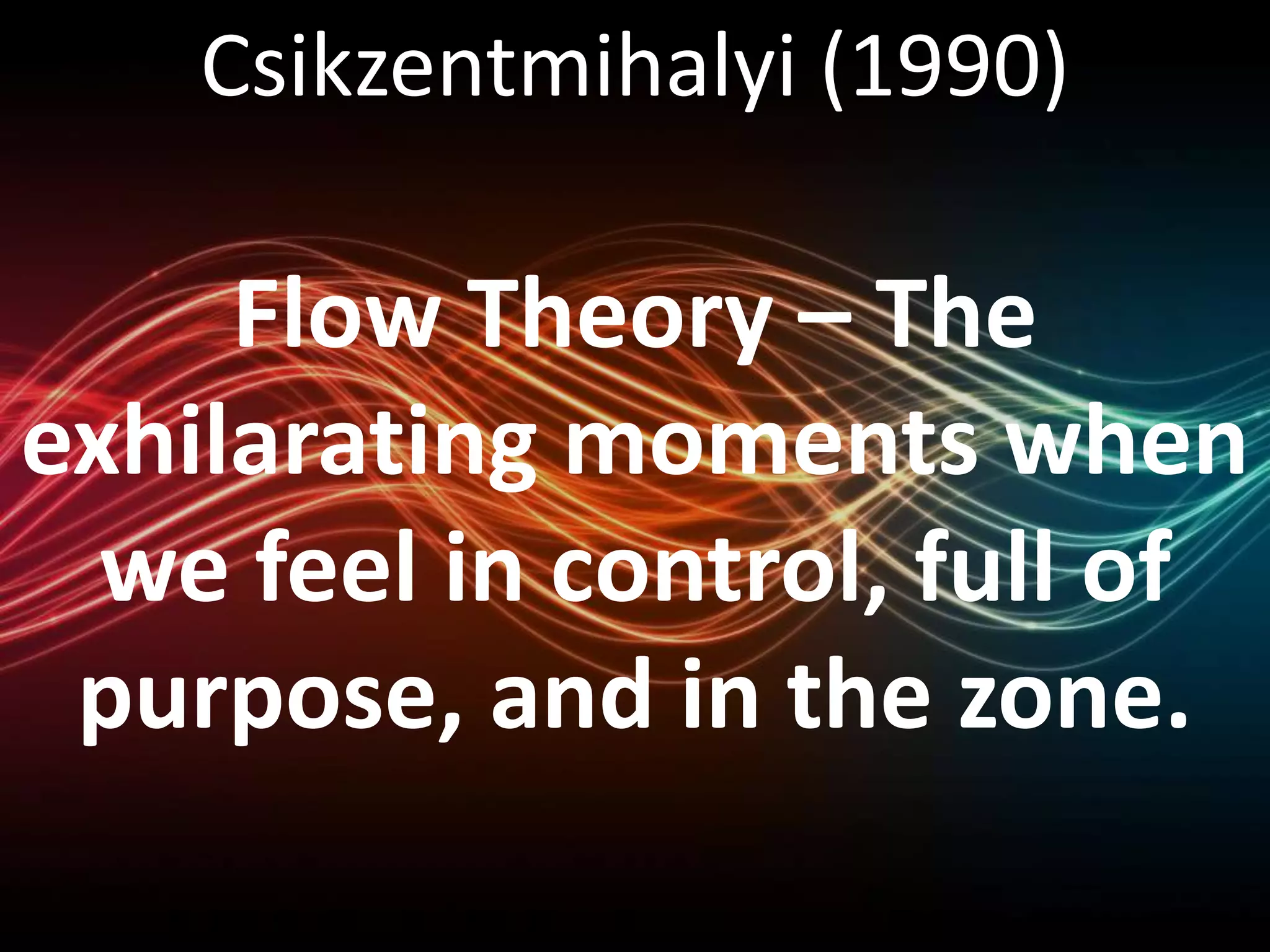
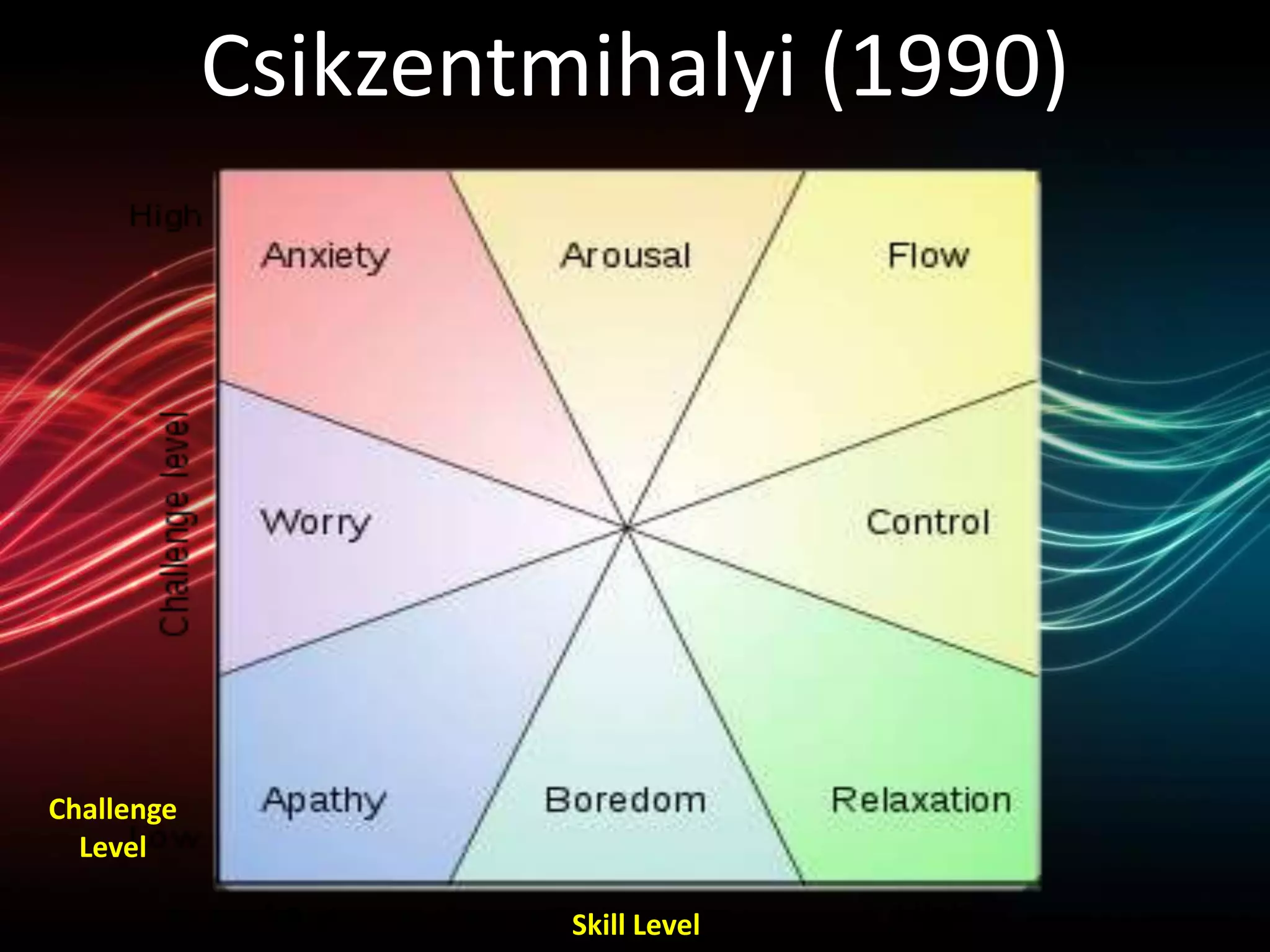
Flow Theory – The
exhilarating moments when
we feel in control, full of
purpose, and in the zone.
Csikzentmihalyi (1990)
Skill Level
Challenge
Level
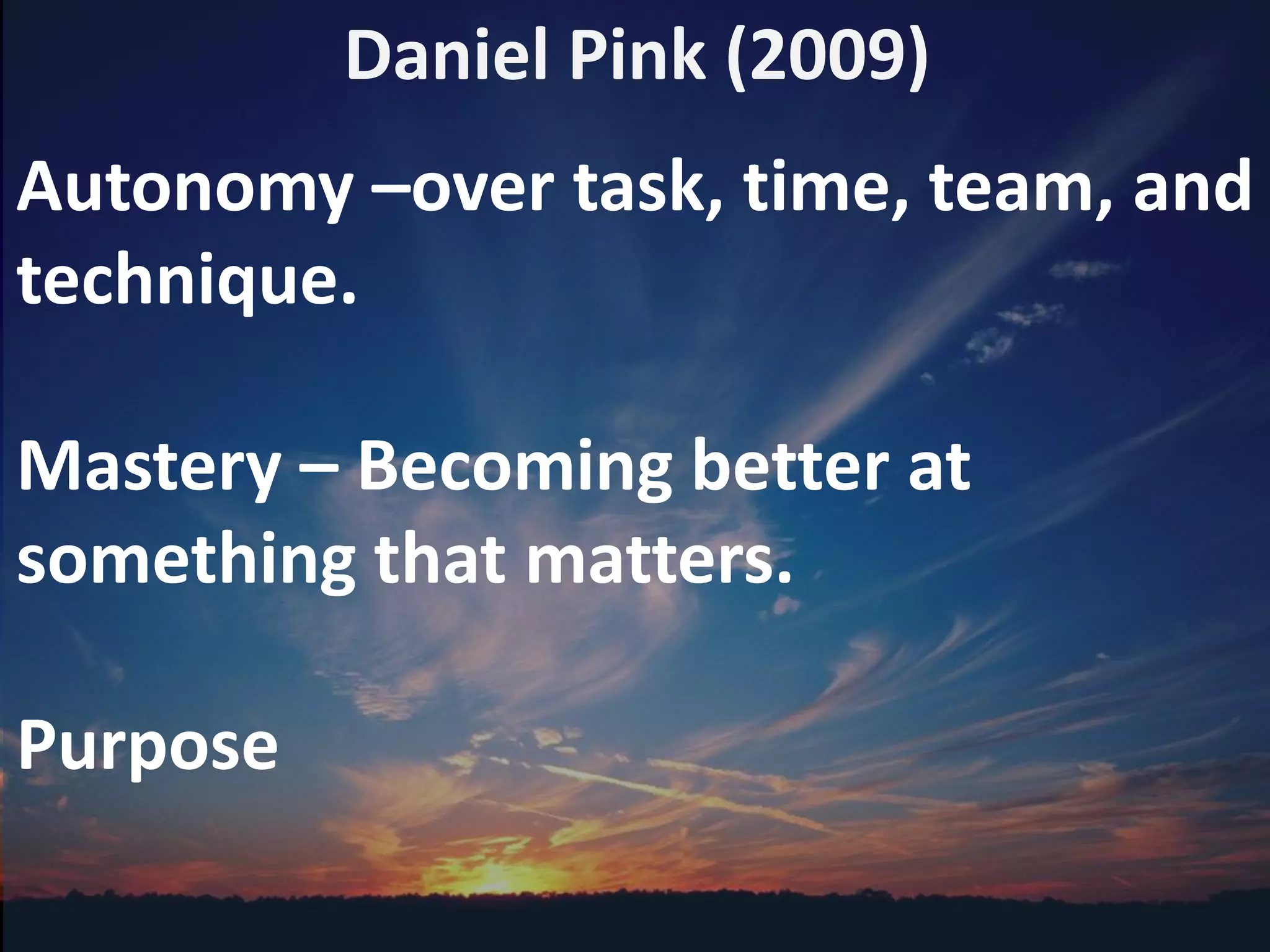
Daniel Pink (2009)
Autonomy –over task, time, team, and
technique.
Mastery – Becoming better at
something that matters.
Purpose
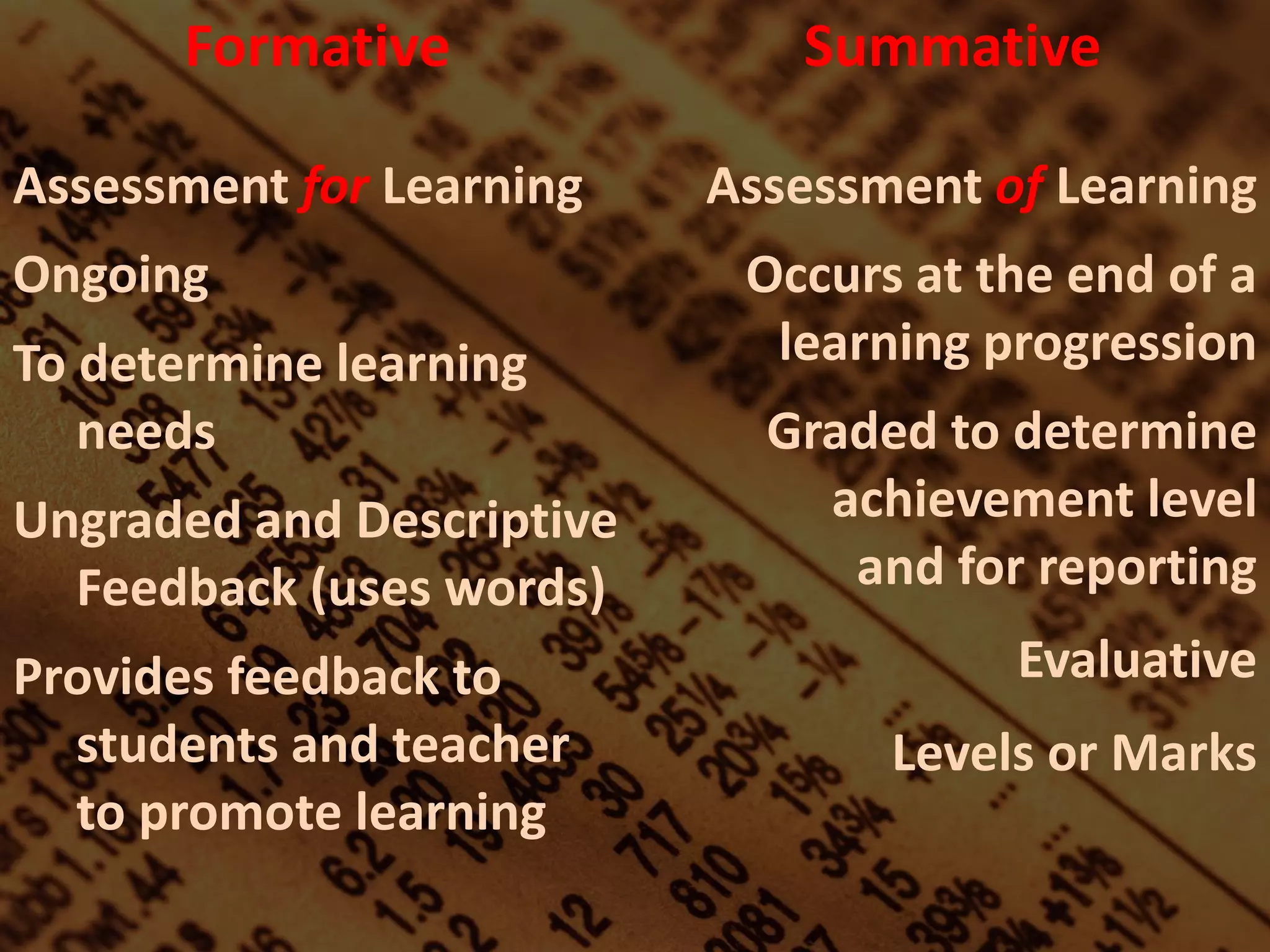
Formative
Assessment for Learning
Ongoing
To determine learning
needs
Ungraded and Descriptive
Feedback (uses words)
Provides feedback to
students and teacher
to promote learning
Summative
Assessment of Learning
Occurs at the end of a
learning progression
Graded to determine
achievement level
and for reporting
Evaluative
Levels or Marks
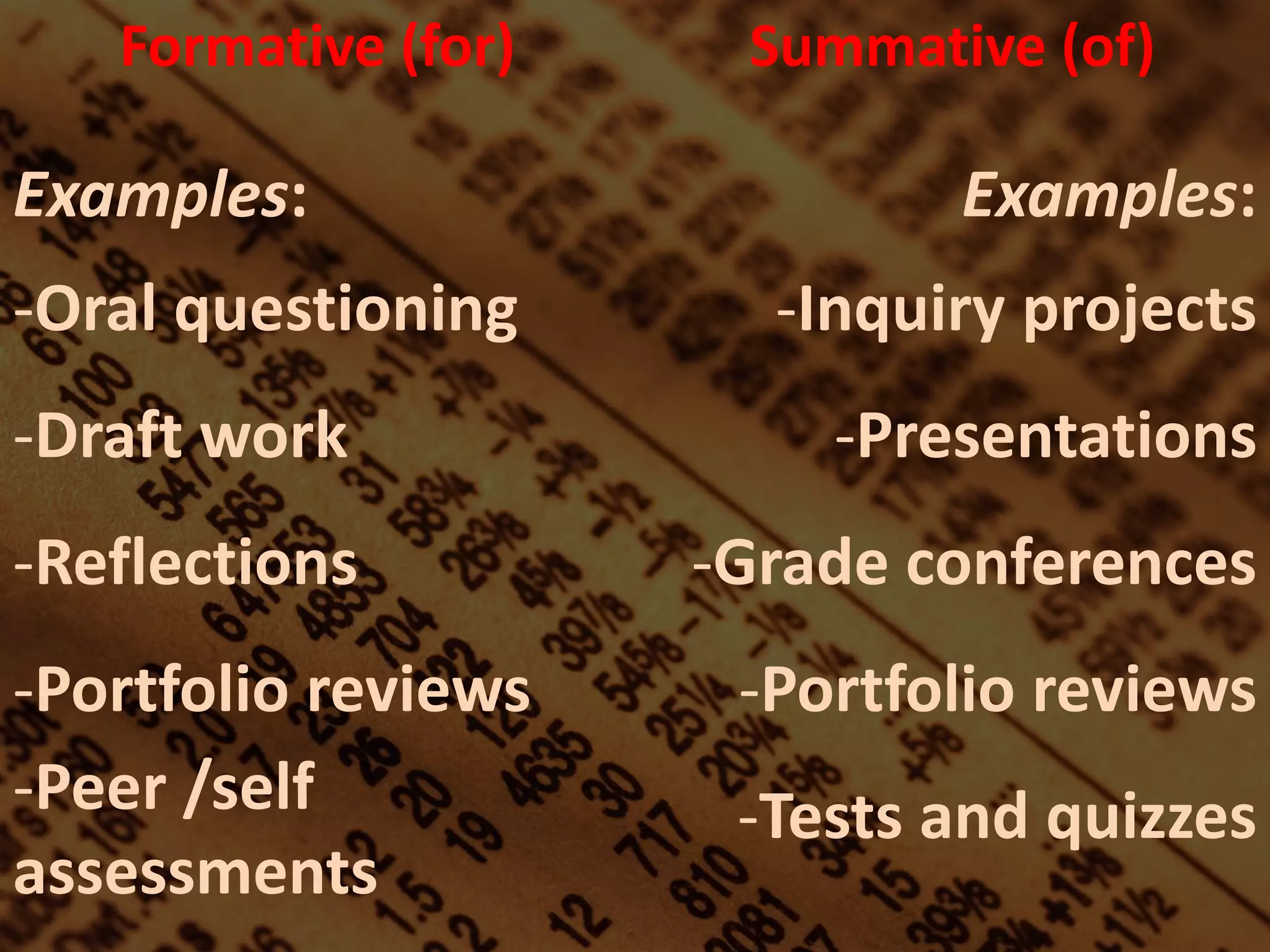
Formative (for)
Examples:
-Oral questioning
-Draft work
-Reflections
-Portfolio reviews
-Peer /self
assessments
Summative (of)
Examples:
-Inquiry projects
-Presentations
-Grade conferences
-Portfolio reviews
-Tests and quizzes
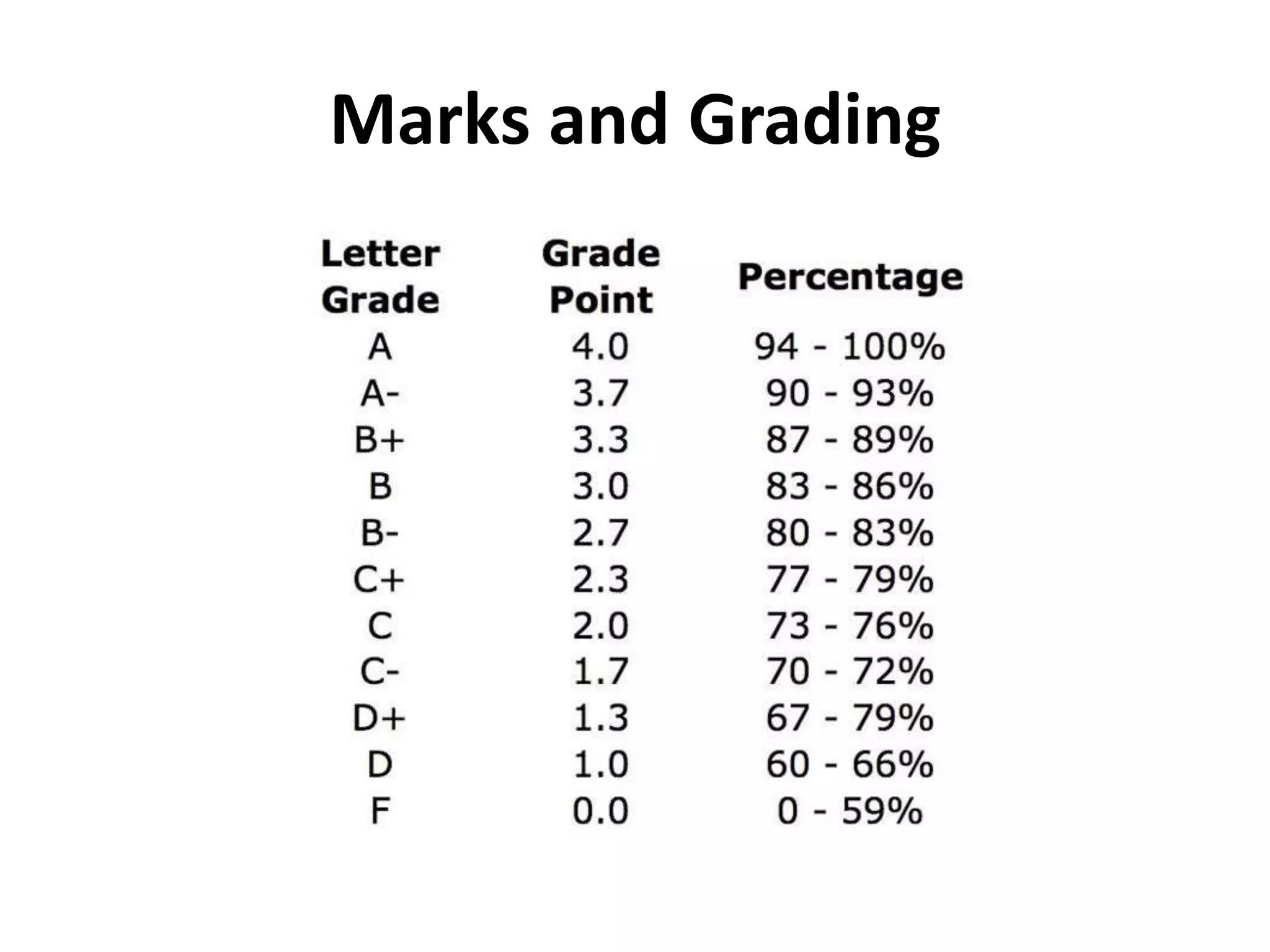
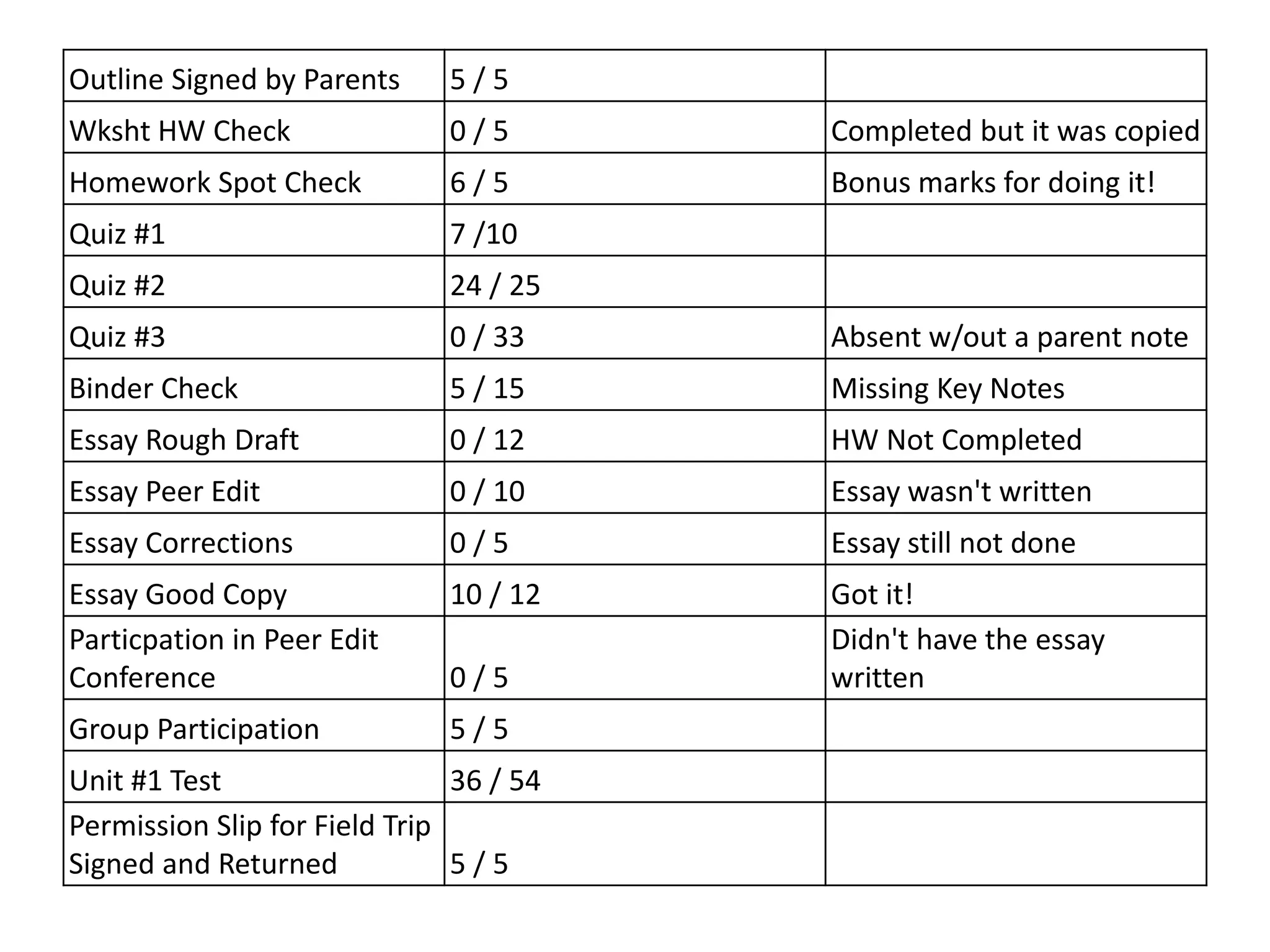
Marks and Grading
Outline Signed by Parents 5 / 5
Wksht HW Check 0 / 5 Completed but it was copied
Homework Spot Check 6 / 5 Bonus marks for doing it!
Quiz #1 7 /10
Quiz #2 24 / 25
Quiz #3 0 / 33 Absent w/out a parent note
Binder Check 5 / 15 Missing Key Notes
Essay Rough Draft 0 / 12 HW Not Completed
Essay Peer Edit 0 / 10 Essay wasn't written
Essay Corrections 0 / 5 Essay still not done
Essay Good Copy 10 / 12 Got it!
Particpation in Peer Edit
Conference 0 / 5
Didn't have the essay
written
Group Participation 5 / 5
Unit #1 Test 36 / 54
Permission Slip for Field Trip
Signed and Returned 5 / 5
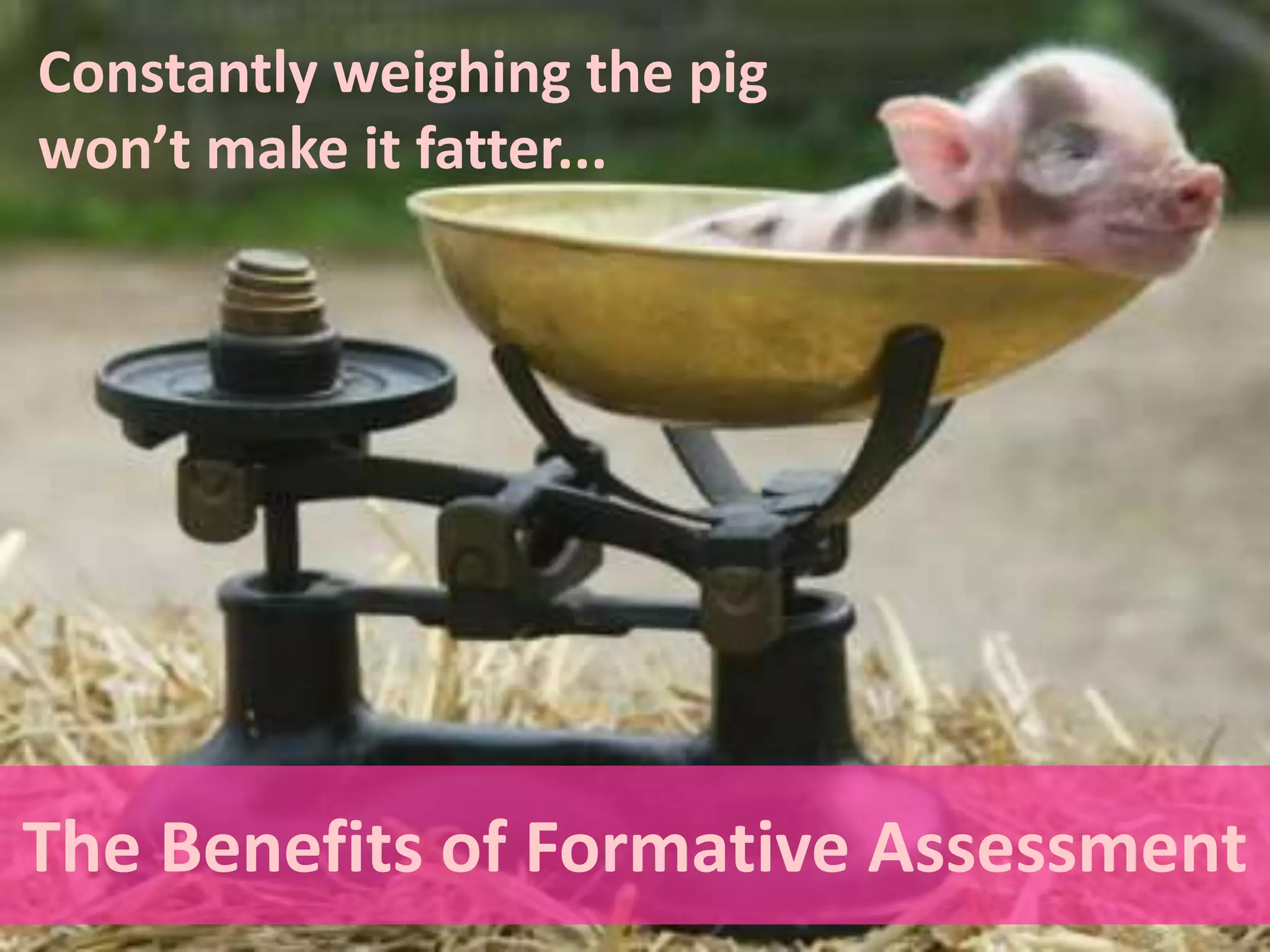
The Benefits of Formative Assessment
Constantly weighing the pig
won’t make it fatter...
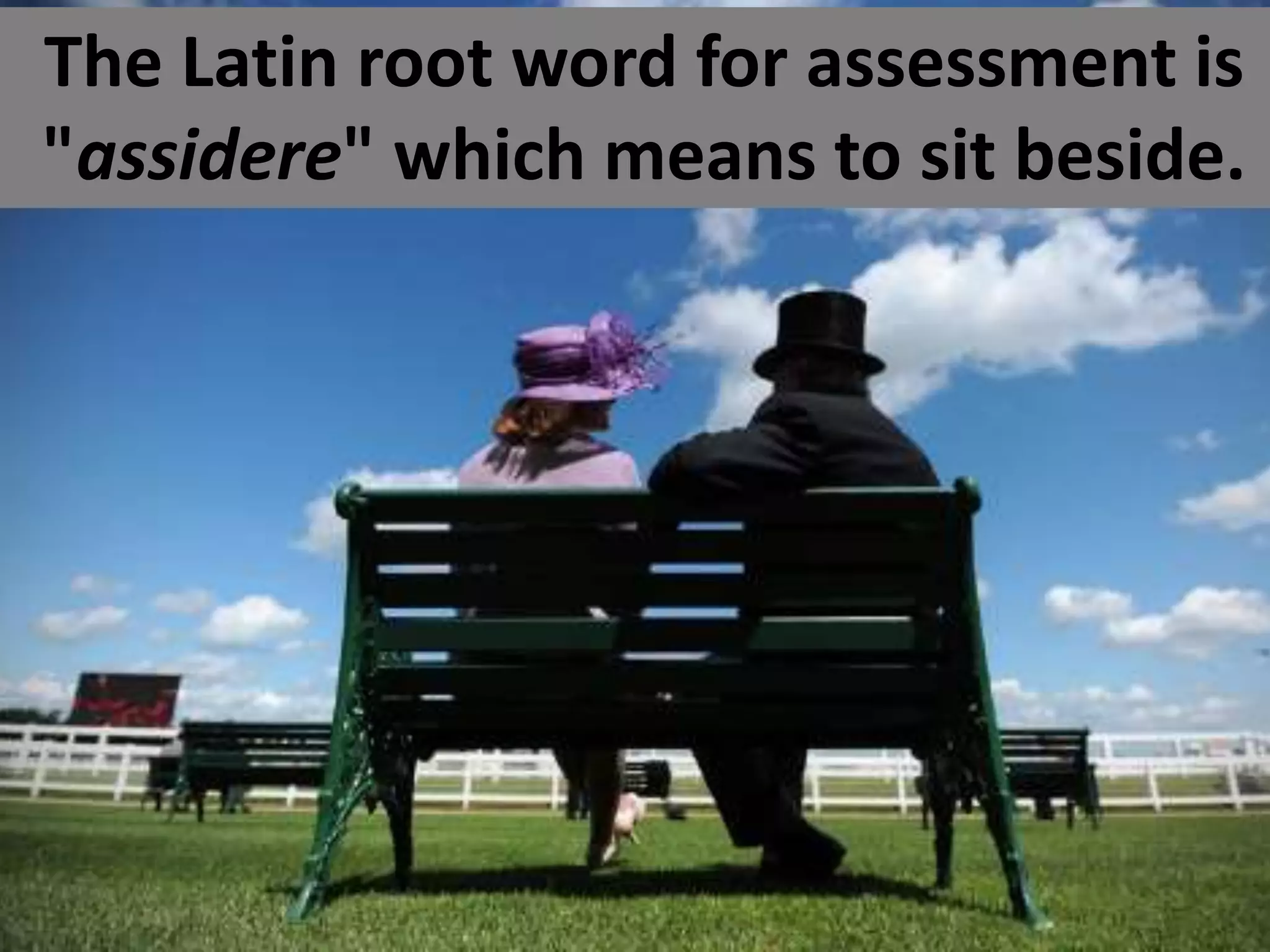
The Latin root word for assessment is
"assidere" which means to sit beside.
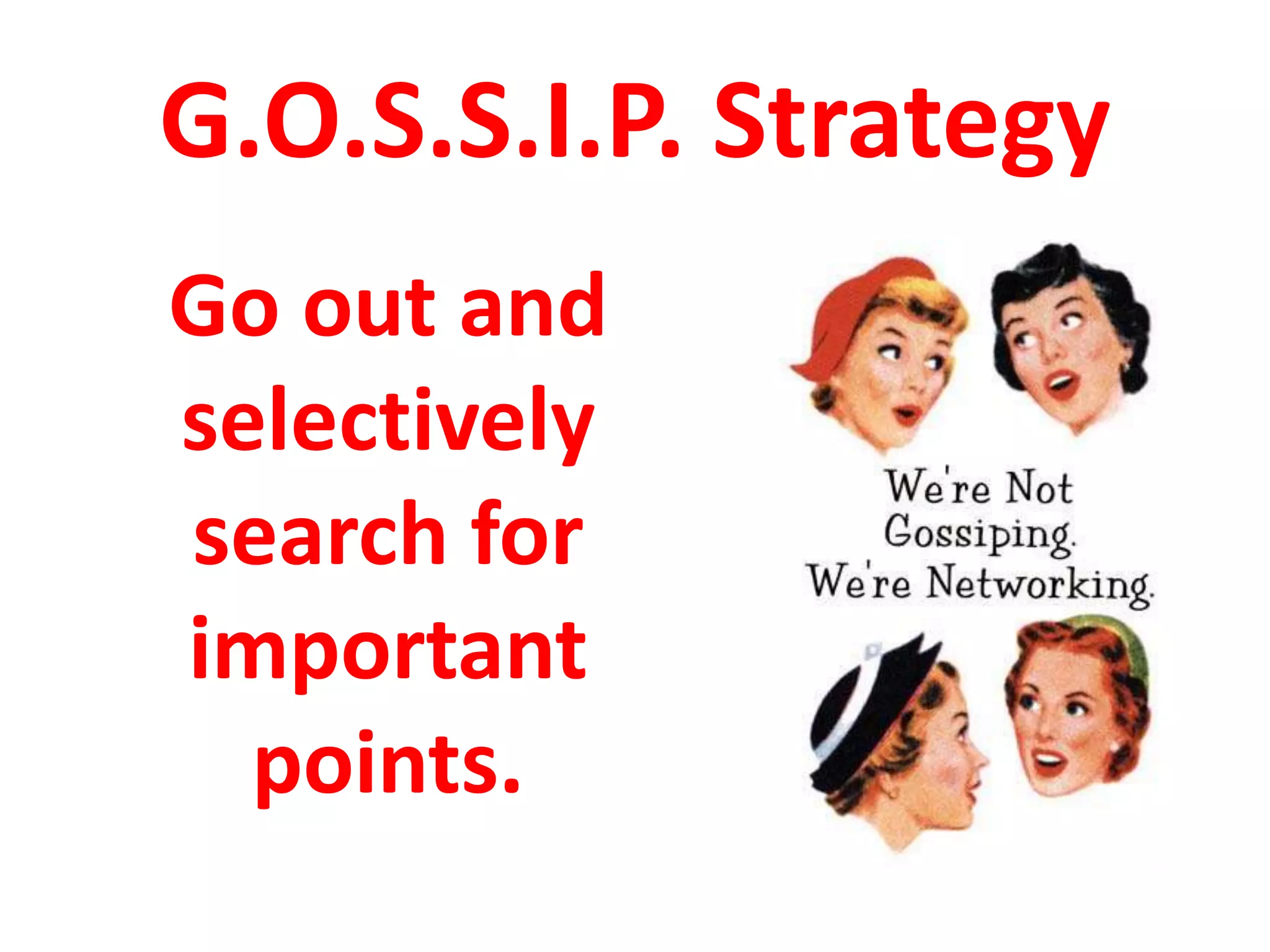
G.O.S.S.I.P. Strategy
Go out and
selectively
search for
important
points.
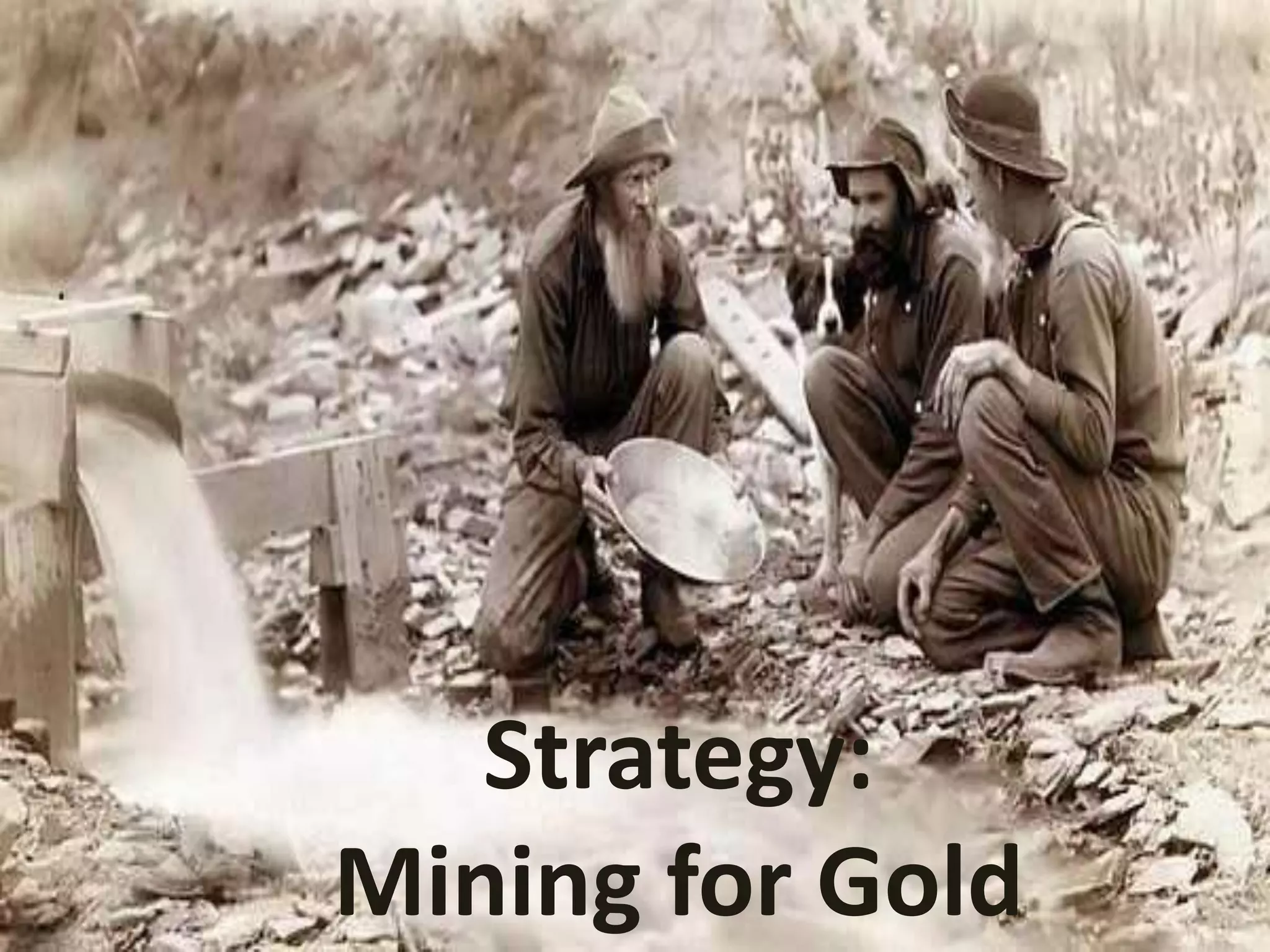
Strategy:
Mining for Gold
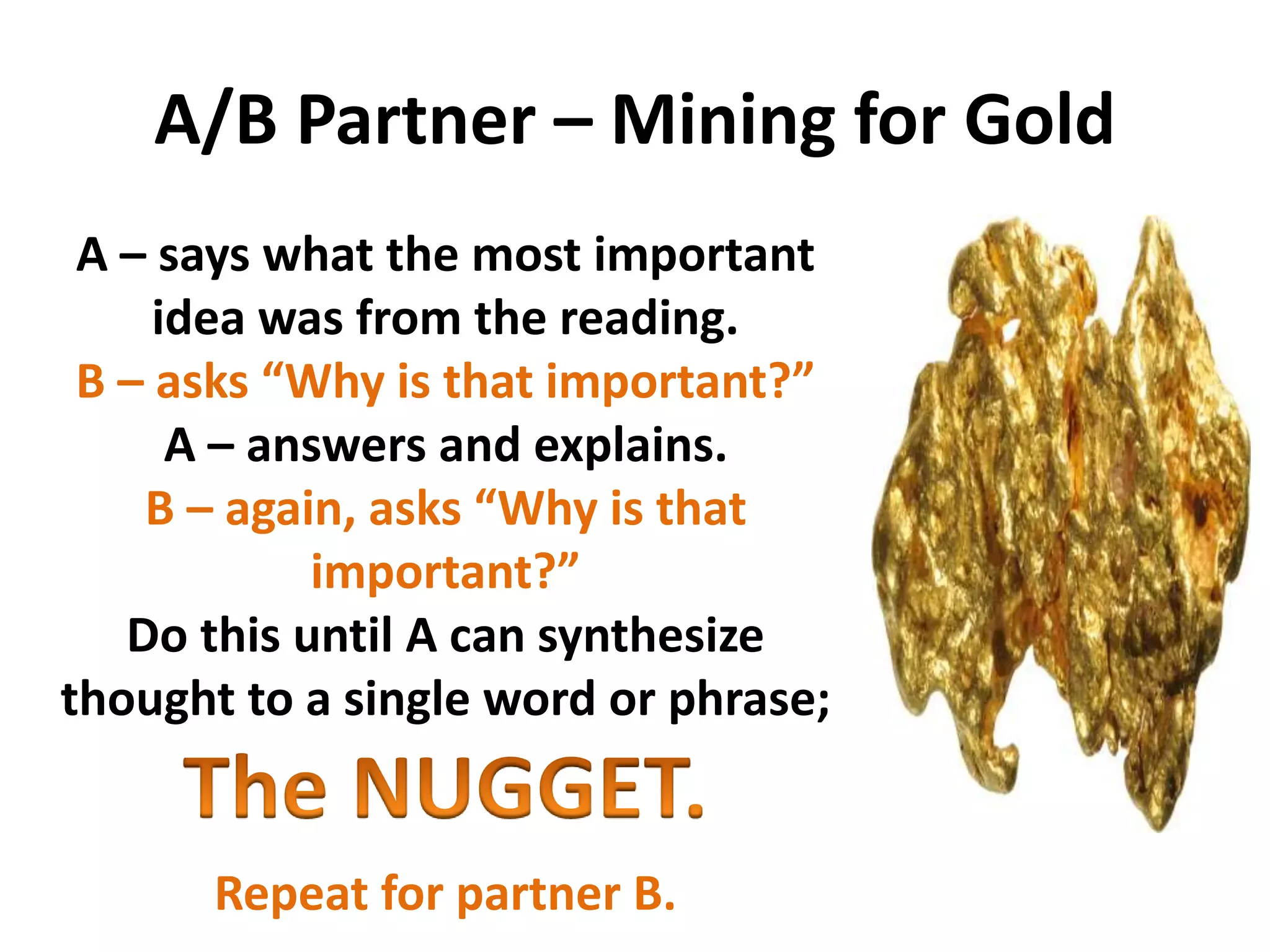
A/B Partner – Mining for Gold
A – says what the most important
idea was from the reading.
B – asks “Why is that important?”
A – answers and explains.
B – again, asks “Why is that
important?”
Do this until A can synthesize
thought to a single word or phrase;
Repeat for partner B.
Whip Around…
Principles for Classroom
Assessment
Students should be part
of the assessment
process and involved in
setting criteria, setting
their own learning goals
and designing
demonstrations.
)
"We must constantly remind
ourselves that the ultimate
purpose of evaluation is to
have students become self
evaluating. If students
graduate from our schools
still dependent upon others
to tell them when they are
adequate, good, or
excellent, then we’ve
missed the whole point of
what education is about.”
- Costa and Kallick (1992)
Relationships are all there is. Everything in
the universe only exists because it is in
relationship to everything else. Nothing
exists in isolation. We have to stop
pretending we are individuals who can go it
alone.
- M. Wheatley
“I’m still learning.”
- Michelangelo, Age 87
You must use the research to support
your practice to avoid being a well
intentioned “Enthusiastic Amateur.”
- Fullan and Hargraeves “Professional Capital”
Don’t come into the profession to
replicate current practice. Strive for
excellence.
Teaching is not rocket science. It is, in
fact, far more complex and demanding
work than rocket science.
- Richard Elmore (Professor of Education Leadership at Harvard
Graduate School of Education)
Contact Information
Jonathan Vervaet
Email: jonathanvervaet@gmail.com
Twitter: @jonathanvervaet
Blog: jonathanvervaet.wordpress.com

Mind the Gap: (re)Examining Schooling, Assessment and the Theory/Practice Divide

  • 1.
    Mind the Gap:(re)Examining Schooling, Assessing and the Theory / Practice Divide Presented by: Jonathan Vervaet @jonathanvervaet January 28th, 2015
  • 2.
    “Stories matter. Manystories matter.” - Chimamanda Ngozi Adichie
  • 3.
    “If students havenot been told where they are going, it is unlikely that they will arrive.” – Shirley Clark
  • 4.
    Learning Intentions “I canfind evidence of current assessment research in my practice.”
  • 5.
    Learning Intentions “I canidentify ways to use assessment to inform my instructional decisions .”
  • 6.
    Learning Intentions “I canbecome curious about something in the research I want to inquire further into.”
  • 7.
    “Assessment is thebeginning and the end of my teaching. It defines my culture, my relationships, my learning community, my values, and my beliefs about teaching and learning.” - Matt Rosati
  • 8.
    Our Traditional System •Students are penalized if the don’t learn fast enough... Even though we know learning is an individual / developmental process. • What you do at the beginning of the course will always count against you... Despite the fact the student might now understand what they did wrong and how to prevent it in the future. • Grades include all student attributes... Even though we know grades should reflect the
  • 9.
    The Paradigm Shift •Learning vs. Teaching • Outcomes / Standards vs. Tasks • Quality vs. Quantity • If students learn vs. When students learn • Confidence vs. Anxiety • Practice vs. One Chance • Improvement vs. Coverage Tom Schimmer
  • 13.
    Reflection: How is seeing ourselvesas learners important for us as teachers?
  • 14.
  • 15.
    Instructional Design 90% ofwhat we know about the brain we have learned in approximately the last 2 years
  • 16.
    Instructional Design The samewill be true 10 years from now
  • 17.
    Motivation 2.0 True orFalse: Rewarding an activity will get you more of it. Punishing an activity will get you less of it.
  • 18.
    Harlow (1949) Radical finding,there was a third drive. The performance of the task provided intrinsic reward. The monkeys solved the problem simply because they found it gratifying to solve the puzzle.
  • 19.
    2 Harlow (1949) Rewarded themonkey with raisons. “Introduction of food in the present experiment served to disrupt performance, a phenomena not reported in the literature.” The monkeys made more errors and solved the puzzles less frequently.
  • 20.
    Deci (1969) –Carnegie Melon Soma Block Experiment
  • 21.
    Deci (1969) Day 1Day 2 Day 3 Group A No reward Cash Reward No reward Group B No reward No reward No reward
  • 22.
    Deci (1969) –Carnegie Melon Soma Block Experiment “When money is used as an extrinsic reward for some activity, the subjects lose intrinsic interest for the activity.” Rewards give you a short term boost, but the effect wears off and can reduce long term motivation.
  • 23.
  • 25.
  • 26.
    Offering an award signalsthat the task is undesirable.
  • 27.
    Focus on ShortTerm vs. Long Term Benefits
  • 28.
    When goals areimposed and incentivized… Focus is narrowed on achieving only that goal.
  • 29.
  • 30.
    It leads tounethical behaviour in an attempt to reach the goal. aka..
  • 31.
  • 32.
    When rewards dowork… With routine and mechanical tasks.
  • 33.
    You can’t undermine intrinsicmotivation in boring tasks.
  • 35.
    Formative Assessment: 5 KeyStrategies… sometimes 6! Dylan Wiliam “Embedded Formative Assessment” (2011)
  • 36.
    Formative Assessment: 1.Learning Intentionsand Success Criteria 2.Activities Designed to Elicit Evidence of Learning 3.Feedback that Moves Learning Forward 4.Peer Assessment 5.Student Ownership of Learning
  • 37.
    Formative Assessment: 1.Learning Intentionsand Success Criteria 2.Activities Designed to Elicit Evidence of Learning 3.Feedback that Moves Learning Forward 4.Peer Assessment 5.Student Ownership of Learning
  • 38.
    Formative Assessment: 1.Learning Intentionsand Success Criteria 2.Activities Designed to Elicit Evidence of Learning 3.Feedback that Moves Learning Forward 4.Peer Assessment 5.Student Ownership of Learning
  • 39.
    Formative Assessment: 1.Learning Intentionsand Success Criteria 2.Activities Designed to Elicit Evidence of Learning 3.Feedback that Moves Learning Forward 4.Peer Assessment 5.Student Ownership of Learning
  • 40.
    Formative Assessment: 1.Learning Intentionsand Success Criteria 2.Activities Designed to Elicit Evidence of Learning 3.Feedback that Moves Learning Forward 4.Peer Assessment 5.Student Ownership of Learning
  • 41.
    Carol Dweck (2006) Fixedvs. Growth Mindset. Fixed – Believe they have to work with whatever intelligence they have because it can’t be increased. They resist novel challenges if they can’t succeed immediately. They’d rather not try than be perceived as dumb.
  • 42.
    Carol Dweck (2006) Fixedvs. Growth Mindset. Growth – Believe intelligence can be built through life. See working harder as a way to improve. They persist and try a wide variety of solutions when given novel tasks.
  • 43.
  • 44.
    Csikzentmihalyi (1990) Flow Theory– The exhilarating moments when we feel in control, full of purpose, and in the zone.
  • 45.
  • 46.
    Daniel Pink (2009) Autonomy–over task, time, team, and technique. Mastery – Becoming better at something that matters. Purpose
  • 47.
    Formative Assessment for Learning Ongoing Todetermine learning needs Ungraded and Descriptive Feedback (uses words) Provides feedback to students and teacher to promote learning Summative Assessment of Learning Occurs at the end of a learning progression Graded to determine achievement level and for reporting Evaluative Levels or Marks
  • 48.
    Formative (for) Examples: -Oral questioning -Draftwork -Reflections -Portfolio reviews -Peer /self assessments Summative (of) Examples: -Inquiry projects -Presentations -Grade conferences -Portfolio reviews -Tests and quizzes
  • 49.
  • 53.
    Outline Signed byParents 5 / 5 Wksht HW Check 0 / 5 Completed but it was copied Homework Spot Check 6 / 5 Bonus marks for doing it! Quiz #1 7 /10 Quiz #2 24 / 25 Quiz #3 0 / 33 Absent w/out a parent note Binder Check 5 / 15 Missing Key Notes Essay Rough Draft 0 / 12 HW Not Completed Essay Peer Edit 0 / 10 Essay wasn't written Essay Corrections 0 / 5 Essay still not done Essay Good Copy 10 / 12 Got it! Particpation in Peer Edit Conference 0 / 5 Didn't have the essay written Group Participation 5 / 5 Unit #1 Test 36 / 54 Permission Slip for Field Trip Signed and Returned 5 / 5
  • 54.
    The Benefits ofFormative Assessment Constantly weighing the pig won’t make it fatter...
  • 55.
    The Latin rootword for assessment is "assidere" which means to sit beside.
  • 56.
    G.O.S.S.I.P. Strategy Go outand selectively search for important points.
  • 57.
  • 58.
    A/B Partner –Mining for Gold A – says what the most important idea was from the reading. B – asks “Why is that important?” A – answers and explains. B – again, asks “Why is that important?” Do this until A can synthesize thought to a single word or phrase; Repeat for partner B.
  • 59.
  • 60.
    Principles for Classroom Assessment Studentsshould be part of the assessment process and involved in setting criteria, setting their own learning goals and designing demonstrations. )
  • 61.
    "We must constantlyremind ourselves that the ultimate purpose of evaluation is to have students become self evaluating. If students graduate from our schools still dependent upon others to tell them when they are adequate, good, or excellent, then we’ve missed the whole point of what education is about.” - Costa and Kallick (1992)
  • 62.
    Relationships are allthere is. Everything in the universe only exists because it is in relationship to everything else. Nothing exists in isolation. We have to stop pretending we are individuals who can go it alone. - M. Wheatley
  • 63.
    “I’m still learning.” -Michelangelo, Age 87
  • 64.
    You must usethe research to support your practice to avoid being a well intentioned “Enthusiastic Amateur.” - Fullan and Hargraeves “Professional Capital”
  • 65.
    Don’t come intothe profession to replicate current practice. Strive for excellence.
  • 67.
    Teaching is notrocket science. It is, in fact, far more complex and demanding work than rocket science. - Richard Elmore (Professor of Education Leadership at Harvard Graduate School of Education)
  • 68.
    Contact Information Jonathan Vervaet Email:jonathanvervaet@gmail.com Twitter: @jonathanvervaet Blog: jonathanvervaet.wordpress.com