Assessment for Learning –
improving practice in the adult
          classroom
      Coquitlam	
  Con,nuing	
  Educa,on	
  
            February	
  18th,	
  2011	
  
              Faye	
  Brownlie	
  
            www.slideshare.net	
  
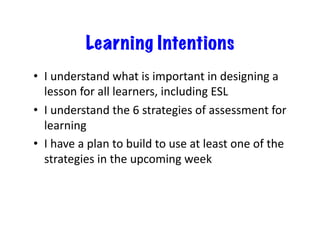
Learning Intentions
•  I	
  understand	
  what	
  is	
  important	
  in	
  designing	
  a	
  
   lesson	
  for	
  all	
  learners,	
  including	
  ESL	
  
•  I	
  understand	
  the	
  6	
  strategies	
  of	
  assessment	
  for	
  
   learning	
  
•  I	
  have	
  a	
  plan	
  to	
  build	
  to	
  use	
  at	
  least	
  one	
  of	
  the	
  
   strategies	
  in	
  the	
  upcoming	
  week	
  
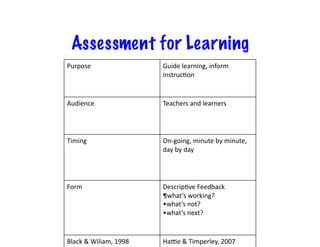
Assessment for Learning
Purpose	
                           Guide	
  learning,	
  inform	
  
                                    instruc,on	


Audience	
  	
                      Teachers	
  and	
  learners	


Timing	
  	
                        On-­‐going,	
  minute	
  by	
  minute,	
  
                                    day	
  by	
  day	


Form	
  	
                          Descrip,ve	
  Feedback	
  
                                    ¶what’s	
  working?	
  
                                    •what’s	
  not?	
  
                                    •what’s	
  next?	


Black	
  &	
  Wiliam,	
  1998	
     HaXe	
  &	
  Timperley,	
  2007	
  
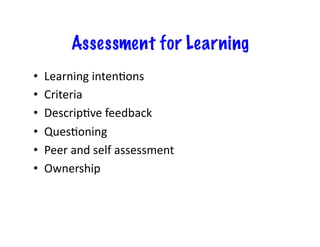
Assessment for Learning
•    Learning	
  inten,ons	
  
•    Criteria	
  
•    Descrip,ve	
  feedback	
  
•    Ques,oning	
  
•    Peer	
  and	
  self	
  assessment	
  
•    Ownership	
  
Essential Lesson Components


•    Essen,al	
  ques,on/learning	
  inten,on/a	
  big	
  idea	
  
•    Open-­‐ended	
  strategies:	
  	
  connect-­‐process-­‐transform	
  
•    Differen,a,on	
  –	
  choice,	
  choice,	
  choice	
  
•    Assessment	
  for	
  learning	
  
•    Gradual	
  release	
  of	
  responsibility	
  
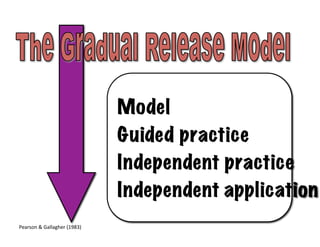
Model
                                          Guided practice
                                          Independent practice
                                          Independent application	
  
Pearson	
  &	
  Gallagher	
  (1983)	
  
Communicating Mathematically
•  Sit	
  back	
  to	
  back	
  with	
  a	
  partner	
  
•  Partner	
  A	
  observes	
  the	
  diagram	
  and	
  describes	
  
   it	
  to	
  partner	
  B	
  
•  Partner	
  B	
  draws	
  what	
  he	
  hears	
  Partner	
  A	
  
   describing	
  
•  Reflect:	
  	
  what	
  worked	
  in	
  the	
  partnership?	
  	
  
   What	
  didn’t?	
  	
  How	
  can	
  it	
  be	
  improved?	
  
Chunking	
  Text	
  to	
  Respond	
  
•  Divide	
  a	
  poem	
  or	
  an	
  ar,cle	
  in	
  chunks,	
  several	
  
   lines	
  long,	
  and	
  place	
  these	
  on	
  separate	
  papers.	
  
•  In	
  teams,	
  learners	
  consider	
  one	
  chunk	
  and	
  
   respond	
  to	
  it.	
  	
  Circle	
  challenging	
  vocabulary.	
  
•  Share	
  the	
  text	
  among	
  the	
  groups.	
  
•  Learners	
  read	
  the	
  en,re	
  text	
  and	
  respond	
  	
  
    –  As	
  a	
  free	
  write	
  or	
  a	
  power	
  paragraph	
  
    –  To	
  create	
  a	
  found	
  poem	
  
    –  To	
  create	
  an	
  image	
  that	
  reflects	
  their	
  understanding	
  
    –  To	
  present	
  orally,	
  a	
  soundbite	
  on	
  their	
  understanding	
  
       of	
  the	
  text…	
  
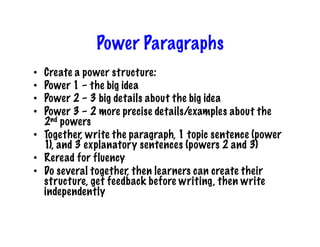
Power Paragraphs
•  Create a power structure:
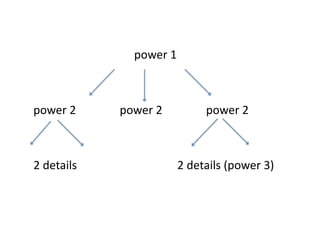
•  Power 1 – the big idea
•  Power 2 – 3 big details about the big idea
•  Power 3 – 2 more precise details/examples about the
   2nd powers
•  Together, write the paragraph, 1 topic sentence (power
   1), and 3 explanatory sentences (powers 2 and 3)
•  Reread for fluency
•  Do several together, then learners can create their
   structure, get feedback before writing, then write
   independently


  power	
  1	


power	
  2	


  power	
  2	


  power	
  2	


2	
  details 	


  2	
  details	
  (power	
  3)	
  
References	
  
•  Grand Conversations, Thoughtful Responses –	
  
   Brownlie	
  (2005).	
  	
  Portage	
  and	
  Main	
  Press.	
  
•  Student Diversity, 2nd ed (2006)	
  –	
  Brownlie	
  and	
  
   Schnellert.	
  	
  Pembroke	
  Publishers	
  
•  It’s All about Thinking – Humanities, Social
   Studies and English (2009)	
  –	
  Brownlie	
  and	
  
   Schnellert.	
  	
  Portage	
  and	
  Main	
  Press.	
  
•  Assessment Instruction of ESL Learners –	
  
   Brownlie,	
  Feniak,	
  McCarthy.	
  	
  Portage	
  and	
  Main	
  
   Press.	
  

Coq continuing ed.feb.2011

  • 1.
    Assessment for Learning– improving practice in the adult classroom Coquitlam  Con,nuing  Educa,on   February  18th,  2011   Faye  Brownlie   www.slideshare.net  
  • 2.
    Learning Intentions •  I  understand  what  is  important  in  designing  a   lesson  for  all  learners,  including  ESL   •  I  understand  the  6  strategies  of  assessment  for   learning   •  I  have  a  plan  to  build  to  use  at  least  one  of  the   strategies  in  the  upcoming  week  
  • 3.
    Assessment for Learning Purpose   Guide  learning,  inform   instruc,on   Audience     Teachers  and  learners   Timing     On-­‐going,  minute  by  minute,   day  by  day   Form     Descrip,ve  Feedback   ¶what’s  working?   •what’s  not?   •what’s  next?   Black  &  Wiliam,  1998   HaXe  &  Timperley,  2007  
  • 4.
    Assessment for Learning •  Learning  inten,ons   •  Criteria   •  Descrip,ve  feedback   •  Ques,oning   •  Peer  and  self  assessment   •  Ownership  
  • 5.
    Essential Lesson Components •  Essen,al  ques,on/learning  inten,on/a  big  idea   •  Open-­‐ended  strategies:    connect-­‐process-­‐transform   •  Differen,a,on  –  choice,  choice,  choice   •  Assessment  for  learning   •  Gradual  release  of  responsibility  
  • 6.
    Model Guided practice Independent practice Independent application   Pearson  &  Gallagher  (1983)  
  • 7.
    Communicating Mathematically •  Sit  back  to  back  with  a  partner   •  Partner  A  observes  the  diagram  and  describes   it  to  partner  B   •  Partner  B  draws  what  he  hears  Partner  A   describing   •  Reflect:    what  worked  in  the  partnership?     What  didn’t?    How  can  it  be  improved?  
  • 10.
    Chunking  Text  to  Respond   •  Divide  a  poem  or  an  ar,cle  in  chunks,  several   lines  long,  and  place  these  on  separate  papers.   •  In  teams,  learners  consider  one  chunk  and   respond  to  it.    Circle  challenging  vocabulary.   •  Share  the  text  among  the  groups.   •  Learners  read  the  en,re  text  and  respond     –  As  a  free  write  or  a  power  paragraph   –  To  create  a  found  poem   –  To  create  an  image  that  reflects  their  understanding   –  To  present  orally,  a  soundbite  on  their  understanding   of  the  text…  
  • 11.
    Power Paragraphs •  Createa power structure: •  Power 1 – the big idea •  Power 2 – 3 big details about the big idea •  Power 3 – 2 more precise details/examples about the 2nd powers •  Together, write the paragraph, 1 topic sentence (power 1), and 3 explanatory sentences (powers 2 and 3) •  Reread for fluency •  Do several together, then learners can create their structure, get feedback before writing, then write independently
  • 12.
                   power  1   power  2        power  2        power  2   2  details              2  details  (power  3)  
  • 13.
    References   •  GrandConversations, Thoughtful Responses –   Brownlie  (2005).    Portage  and  Main  Press.   •  Student Diversity, 2nd ed (2006)  –  Brownlie  and   Schnellert.    Pembroke  Publishers   •  It’s All about Thinking – Humanities, Social Studies and English (2009)  –  Brownlie  and   Schnellert.    Portage  and  Main  Press.   •  Assessment Instruction of ESL Learners –   Brownlie,  Feniak,  McCarthy.    Portage  and  Main   Press.