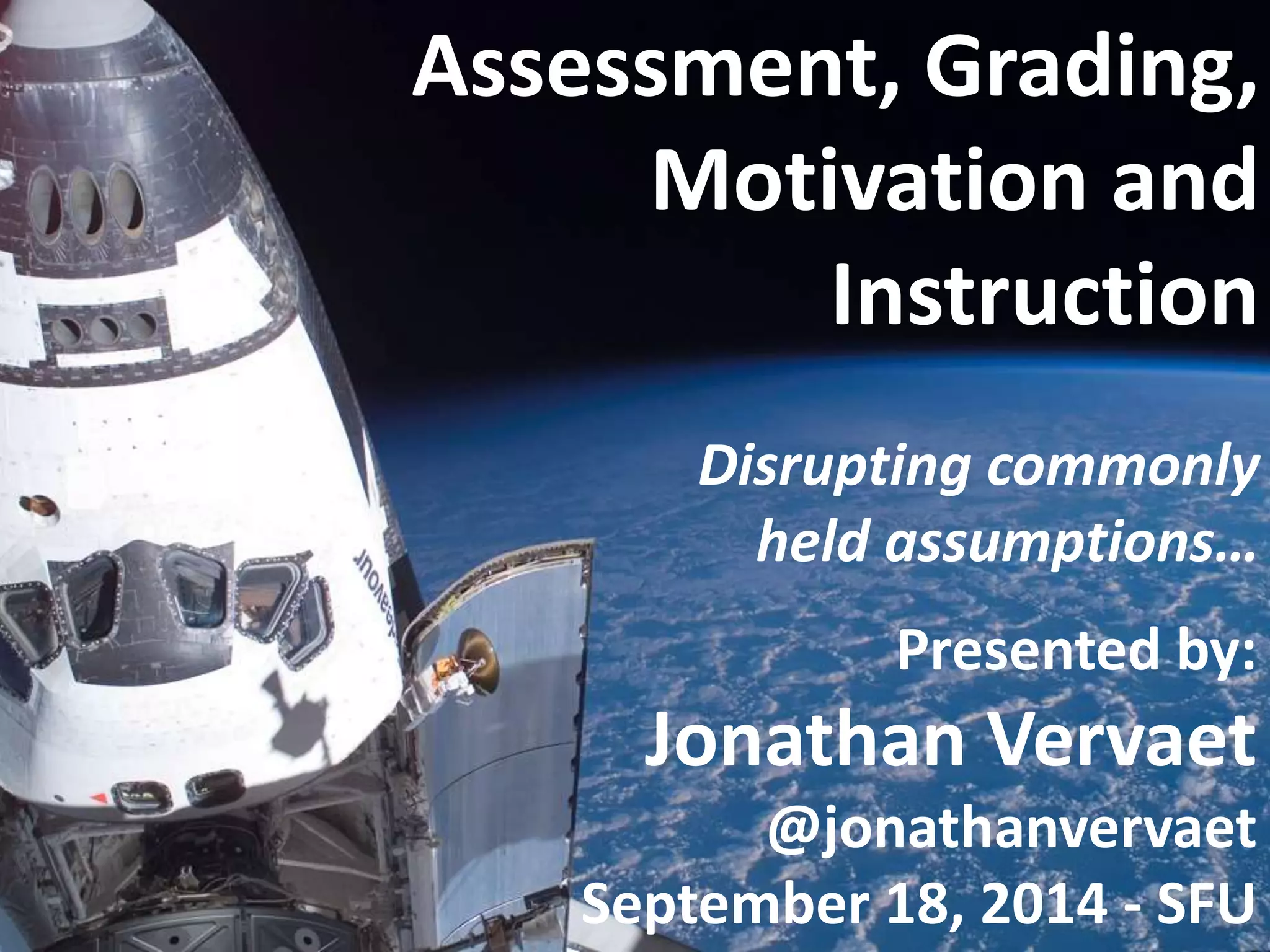















Assessment, Grading, 
Motivation and 
Instruction 
Disrupting commonly 
held assumptions… 
Presented by: 
Jonathan Vervaet 
@jonathanvervaet 
September 18, 2014 - SFU
“Stories matter. Many stories 
matter.” 
- Chimamanda Ngozi Adichie
“If students have not been told 
where they are going, it is 
unlikely that they will arrive.” 
– Shirley Clark
Learning Intentions 
“I can find evidence of current 
assessment research 
in my practice.”
Learning Intentions 
“I can identify ways to use 
assessment to inform my 
instructional decisions .”
Learning Intentions 
“I can become curious about 
something in the research I 
want to inquire further into.”
“Assessment is the beginning and the end 
of my teaching. It defines my culture, my 
relationships, my learning community, my 
values, and my beliefs about teaching and 
learning.” - Matt Rosati
The habit of critical 
reflection is crucial 
for teacher’s 
survival. 
- Stephen 
Brookfield
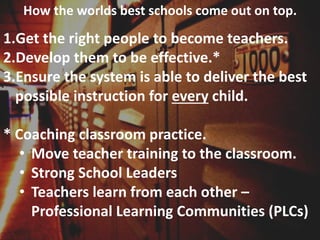
How the worlds best schools come out on top. 
1.Get the right people to become teachers. 
2.Develop them to be effective.* 
3.Ensure the system is able to deliver the best 
possible instruction for every child. 
* Coaching classroom practice. 
• Move teacher training to the classroom. 
• Strong School Leaders 
• Teachers learn from each other – 
Professional Learning Communities (PLCs)
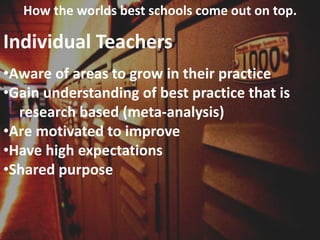
How the worlds best schools come out on top. 
Individual Teachers 
•Aware of areas to grow in their practice 
•Gain understanding of best practice that is 
research based (meta-analysis) 
•Are motivated to improve 
•Have high expectations 
•Shared purpose
Reflection: How 
is seeing 
ourselves as 
learners 
important for 
us as teachers?
Instructional Design 
The Science of Learning
Instructional Design 
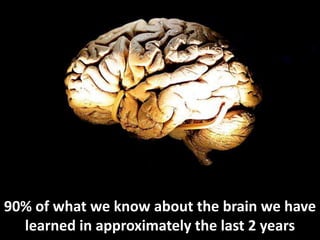
90% of what we know about the brain we have 
learned in approximately the last 2 years
Instructional Design 
The same will be true 10 years from now
Motivation 2.0 
True or False: 
Rewarding an 
activity will get you 
more of it. Punishing 
an activity will get 
you less of it.
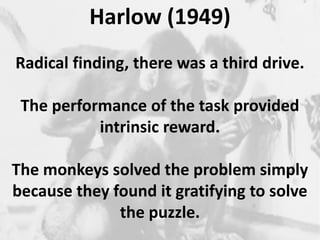
Harlow (1949) 
Radical finding, there was a third drive. 
The performance of the task provided 
intrinsic reward. 
The monkeys solved the problem simply 
because they found it gratifying to solve 
the puzzle.
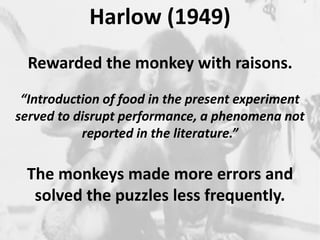
Harlow (1949) 
2 
Rewarded the monkey with raisons. 
“Introduction of food in the present experiment 
served to disrupt performance, a phenomena not 
reported in the literature.” 
The monkeys made more errors and 
solved the puzzles less frequently.
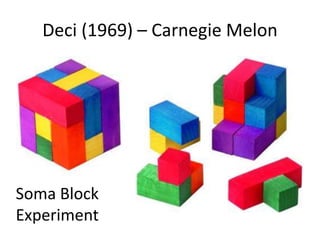
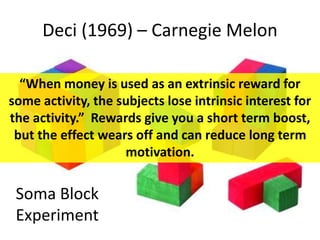
Deci (1969) – Carnegie Melon 
Soma Block 
Experiment
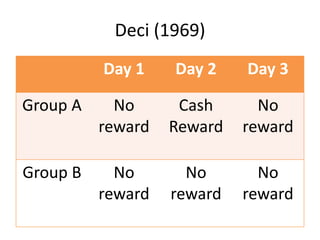
Deci (1969) 
Day 1 Day 2 Day 3 
Group A No 
reward 
Cash 
Reward 
No 
reward 
Group B No 
reward 
No 
reward 
No 
reward
Deci (1969) – Carnegie Melon 
“When money is used as an extrinsic reward for 
some activity, the subjects lose intrinsic interest for 
the activity.” Rewards give you a short term boost, 
but the effect wears off and can reduce long term 
Soma Block 
Experiment 
motivation.
Commissioned 
vs. 
Non- 
Commissioned 
Art
Rewards transform 
interesting tasks 
into drudgery.
Offering an award 
signals that the 
task is undesirable.
Focus on Short Term vs. 
Long Term Benefits
When goals are imposed and 
incentivized… 
Focus is narrowed on 
achieving only that goal.
and… 
Here’s the kicker…
It leads to unethical 
behaviour in an attempt to 
reach the goal. 
aka..
Cheating…
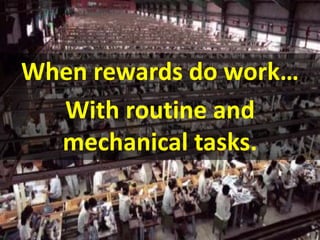
When rewards do work… 
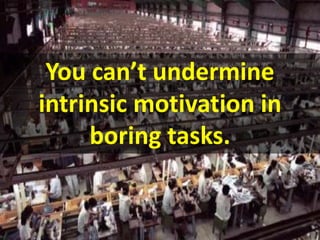
With routine and 
mechanical tasks.
You can’t undermine 
intrinsic motivation in 
boring tasks.
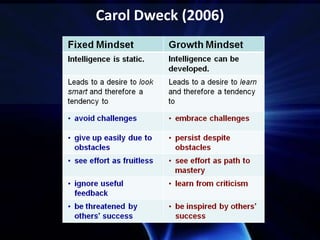
Carol Dweck (2006) 
Fixed vs. Growth Mindset. 
Fixed – Believe they have to work with 
whatever intelligence they have because it 
can’t be increased. 
They resist novel challenges if they can’t 
succeed immediately. 
They’d rather not try than be perceived as 
dumb.
Carol Dweck (2006) 
Fixed vs. Growth Mindset. 
Growth – Believe intelligence can be built 
through life. 
See working harder as a way to improve. 
They persist and try a wide variety of solutions 
when given novel tasks.
Carol Dweck (2006)
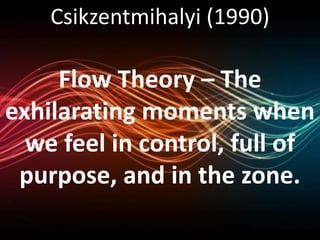
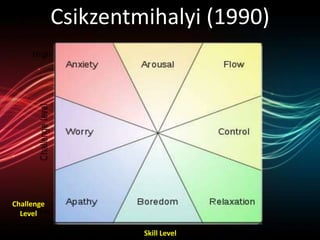
Csikzentmihalyi (1990) 
Flow Theory – The 
exhilarating moments when 
we feel in control, full of 
purpose, and in the zone.
Csikzentmihalyi (1990) 
Skill Level 
Challenge 
Level
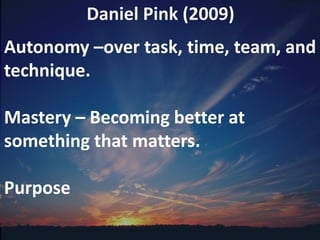
Daniel Pink (2009) 
Autonomy –over task, time, team, and 
technique. 
Mastery – Becoming better at 
something that matters. 
Purpose
G.O.S.S.I.P. Strategy 
Go out and 
selectively 
search for 
important 
points.
Strategy: 
Mining for Gold
A/B Partner – Mining for Gold 
A – says what the most important 
idea was from the reading. 
B – asks “Why is that important?” 
A – answers and explains. 
B – again, asks “Why is that 
important?” 
Do this until A can synthesize 
thought to a single word or phrase; 
Repeat for partner B.
Marks or levels tell students more 
about their success or failure than 
about how to make 
progress in their 
learning. 
“Is this for marks?”
Constantly weighing the pig 
won’t make it fatter... 
The Benefits of Formative Assessment
Assessment 
is done 
with, and 
not to, 
students to 
help them 
grow in 
their 
learning.
The Latin root word for assessment is 
"assidere" which means to sit beside.
The Trouble with Marks
The research shows 
very clearly that three 
things tend to happen 
when students are 
encouraged 
to focus on 
getting 
good grades.
The first is 
that they become less 
excited about 
the learning 
itself.
The second is that 
they tend to 
become less 
likely to 
think deeply.
The third thing that happens 
is when you get kids focused 
on grades they pick the 
easiest possible task 
when given 
a choice.
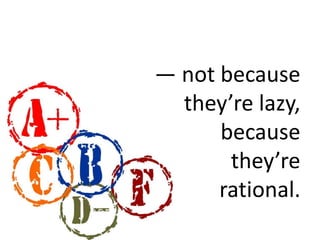
— not because 
they’re lazy, 
because 
they’re 
rational.
Marks or levels tell students more 
about their success or failure than 
about how to make 
progress in their 
learning. 
“Is this for marks?”
If you are going to put a mark on a 
piece of work, you are 
wasting your time 
writing descriptive 
feedback comments. 
“Is this for marks?”
Core Competencies 
The Ministry has defined three 
core competencies at the 
centre of the curriculum and 
assessment redesign:
Core Competencies 
Thinking competency 
Communication competency 
Social and Personal competency
Core Competencies 
Table Talk: 
How might these competencies 
be addressed in different 
subject areas at different grade 
levels?
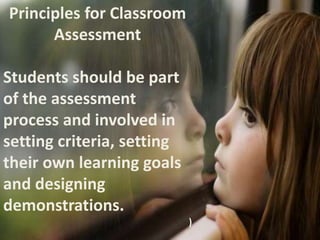
Principles for Classroom 
Assessment 
Students should be part 
of the assessment 
process and involved in 
setting criteria, setting 
their own learning goals 
and designing 
demonstrations. 
)
"We must constantly remind 
ourselves that the ultimate 
purpose of evaluation is to 
have students become self 
evaluating. If students 
graduate from our schools 
still dependent upon others 
to tell them when they are 
adequate, good, or 
excellent, then we’ve 
missed the whole point of 
what education is about.” 
- Costa and Kallick (1992)
The Paradigm Shift 
• Learning vs. Teaching 
• Outcomes / Standards vs. Tasks 
• Quality vs. Quantity 
• If students learn vs. When students learn 
• Confidence vs. Anxiety 
• Practice vs. One Chance 
• Improvement vs. Coverage 
Tom Schimmer
Teaching is not rocket science. It is, in 
fact, far more complex and demanding 
work than rocket science. 
- Richard Elmore (Professor of Education Leadership at Harvard 
Graduate School of Education)
“Mistakes are not mistakes; they are 
calibrations for the mind.” 
- Jane A. Kearns
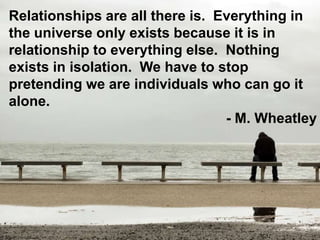
Relationships are all there is. Everything in 
the universe only exists because it is in 
relationship to everything else. Nothing 
exists in isolation. We have to stop 
pretending we are individuals who can go it 
alone. 
- M. Wheatley
“I’m still learning.” 
- Michelangelo, Age 87
Contact Information 
Jonathan Vervaet 
Email: jonathanvervaet@gmail.com 
or 
Twitter: @jonathanvervaet

Assessment, Grading, Motivation and Instruction

  • 1.
    Assessment, Grading, Motivationand Instruction Disrupting commonly held assumptions… Presented by: Jonathan Vervaet @jonathanvervaet September 18, 2014 - SFU
  • 2.
    “Stories matter. Manystories matter.” - Chimamanda Ngozi Adichie
  • 3.
    “If students havenot been told where they are going, it is unlikely that they will arrive.” – Shirley Clark
  • 4.
    Learning Intentions “Ican find evidence of current assessment research in my practice.”
  • 5.
    Learning Intentions “Ican identify ways to use assessment to inform my instructional decisions .”
  • 6.
    Learning Intentions “Ican become curious about something in the research I want to inquire further into.”
  • 7.
    “Assessment is thebeginning and the end of my teaching. It defines my culture, my relationships, my learning community, my values, and my beliefs about teaching and learning.” - Matt Rosati
  • 9.
    The habit ofcritical reflection is crucial for teacher’s survival. - Stephen Brookfield
  • 12.
    How the worldsbest schools come out on top. 1.Get the right people to become teachers. 2.Develop them to be effective.* 3.Ensure the system is able to deliver the best possible instruction for every child. * Coaching classroom practice. • Move teacher training to the classroom. • Strong School Leaders • Teachers learn from each other – Professional Learning Communities (PLCs)
  • 13.
    How the worldsbest schools come out on top. Individual Teachers •Aware of areas to grow in their practice •Gain understanding of best practice that is research based (meta-analysis) •Are motivated to improve •Have high expectations •Shared purpose
  • 14.
    Reflection: How isseeing ourselves as learners important for us as teachers?
  • 15.
    Instructional Design TheScience of Learning
  • 16.
    Instructional Design 90%of what we know about the brain we have learned in approximately the last 2 years
  • 17.
    Instructional Design Thesame will be true 10 years from now
  • 18.
    Motivation 2.0 Trueor False: Rewarding an activity will get you more of it. Punishing an activity will get you less of it.
  • 19.
    Harlow (1949) Radicalfinding, there was a third drive. The performance of the task provided intrinsic reward. The monkeys solved the problem simply because they found it gratifying to solve the puzzle.
  • 20.
    Harlow (1949) 2 Rewarded the monkey with raisons. “Introduction of food in the present experiment served to disrupt performance, a phenomena not reported in the literature.” The monkeys made more errors and solved the puzzles less frequently.
  • 21.
    Deci (1969) –Carnegie Melon Soma Block Experiment
  • 22.
    Deci (1969) Day1 Day 2 Day 3 Group A No reward Cash Reward No reward Group B No reward No reward No reward
  • 23.
    Deci (1969) –Carnegie Melon “When money is used as an extrinsic reward for some activity, the subjects lose intrinsic interest for the activity.” Rewards give you a short term boost, but the effect wears off and can reduce long term Soma Block Experiment motivation.
  • 24.
    Commissioned vs. Non- Commissioned Art
  • 26.
    Rewards transform interestingtasks into drudgery.
  • 27.
    Offering an award signals that the task is undesirable.
  • 28.
    Focus on ShortTerm vs. Long Term Benefits
  • 29.
    When goals areimposed and incentivized… Focus is narrowed on achieving only that goal.
  • 30.
  • 31.
    It leads tounethical behaviour in an attempt to reach the goal. aka..
  • 32.
  • 33.
    When rewards dowork… With routine and mechanical tasks.
  • 34.
    You can’t undermine intrinsic motivation in boring tasks.
  • 36.
    Carol Dweck (2006) Fixed vs. Growth Mindset. Fixed – Believe they have to work with whatever intelligence they have because it can’t be increased. They resist novel challenges if they can’t succeed immediately. They’d rather not try than be perceived as dumb.
  • 37.
    Carol Dweck (2006) Fixed vs. Growth Mindset. Growth – Believe intelligence can be built through life. See working harder as a way to improve. They persist and try a wide variety of solutions when given novel tasks.
  • 38.
  • 39.
    Csikzentmihalyi (1990) FlowTheory – The exhilarating moments when we feel in control, full of purpose, and in the zone.
  • 40.
    Csikzentmihalyi (1990) SkillLevel Challenge Level
  • 41.
    Daniel Pink (2009) Autonomy –over task, time, team, and technique. Mastery – Becoming better at something that matters. Purpose
  • 42.
    G.O.S.S.I.P. Strategy Goout and selectively search for important points.
  • 43.
  • 44.
    A/B Partner –Mining for Gold A – says what the most important idea was from the reading. B – asks “Why is that important?” A – answers and explains. B – again, asks “Why is that important?” Do this until A can synthesize thought to a single word or phrase; Repeat for partner B.
  • 45.
    Marks or levelstell students more about their success or failure than about how to make progress in their learning. “Is this for marks?”
  • 46.
    Constantly weighing thepig won’t make it fatter... The Benefits of Formative Assessment
  • 47.
    Assessment is done with, and not to, students to help them grow in their learning.
  • 48.
    The Latin rootword for assessment is "assidere" which means to sit beside.
  • 49.
  • 50.
    The research shows very clearly that three things tend to happen when students are encouraged to focus on getting good grades.
  • 51.
    The first is that they become less excited about the learning itself.
  • 52.
    The second isthat they tend to become less likely to think deeply.
  • 53.
    The third thingthat happens is when you get kids focused on grades they pick the easiest possible task when given a choice.
  • 54.
    — not because they’re lazy, because they’re rational.
  • 55.
    Marks or levelstell students more about their success or failure than about how to make progress in their learning. “Is this for marks?”
  • 56.
    If you aregoing to put a mark on a piece of work, you are wasting your time writing descriptive feedback comments. “Is this for marks?”
  • 57.
    Core Competencies TheMinistry has defined three core competencies at the centre of the curriculum and assessment redesign:
  • 58.
    Core Competencies Thinkingcompetency Communication competency Social and Personal competency
  • 59.
    Core Competencies TableTalk: How might these competencies be addressed in different subject areas at different grade levels?
  • 60.
    Principles for Classroom Assessment Students should be part of the assessment process and involved in setting criteria, setting their own learning goals and designing demonstrations. )
  • 61.
    "We must constantlyremind ourselves that the ultimate purpose of evaluation is to have students become self evaluating. If students graduate from our schools still dependent upon others to tell them when they are adequate, good, or excellent, then we’ve missed the whole point of what education is about.” - Costa and Kallick (1992)
  • 62.
    The Paradigm Shift • Learning vs. Teaching • Outcomes / Standards vs. Tasks • Quality vs. Quantity • If students learn vs. When students learn • Confidence vs. Anxiety • Practice vs. One Chance • Improvement vs. Coverage Tom Schimmer
  • 64.
    Teaching is notrocket science. It is, in fact, far more complex and demanding work than rocket science. - Richard Elmore (Professor of Education Leadership at Harvard Graduate School of Education)
  • 65.
    “Mistakes are notmistakes; they are calibrations for the mind.” - Jane A. Kearns
  • 66.
    Relationships are allthere is. Everything in the universe only exists because it is in relationship to everything else. Nothing exists in isolation. We have to stop pretending we are individuals who can go it alone. - M. Wheatley
  • 67.
    “I’m still learning.” - Michelangelo, Age 87
  • 68.
    Contact Information JonathanVervaet Email: jonathanvervaet@gmail.com or Twitter: @jonathanvervaet