ARCHITECTURE SEM 3
BUILDING CONSTRUCTION 2
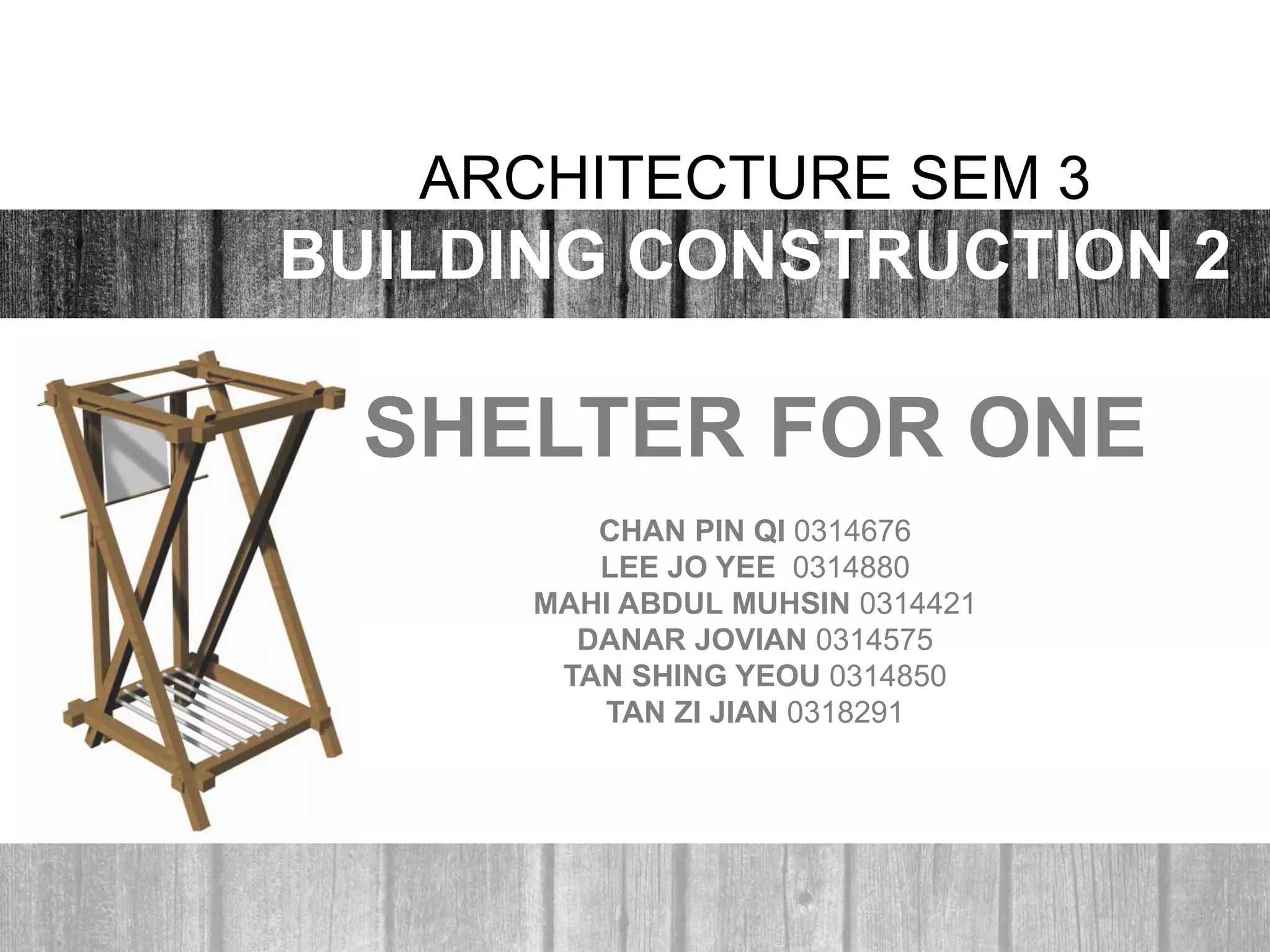
SHELTER FOR ONE
CHAN PIN QI 0314676
LEE JO YEE 0314880
MAHI ABDUL MUHSIN 0314421
DANAR JOVIAN 0314575
TAN SHING YEOU 0314850
TAN ZI JIAN 0318291
A skeletal structure is the basic essence and root of any built structure. It is essential as it provides the support for a
structure to stand firm and gives it the strength to support any external loads exerted on it. The right material and system of
construction is the key to building a strong skeletal structure. Materials should be appropriate for its function,
simultaneously delighting the user with its aesthetics. This project required us to build a ‘Shelter for one’ using recycled
materials. Materials were to be experimented and used carefully to serve its specific function. As a group, we have utilized
discarded wooden planks and pallets for the core structure and used canvas banners as a comfortable back support. As it is
designed to fit one person in a sitting position, the maximum height is 1.5 m and the base size about 0.75m x 0.75 m. The
completed structure needed to be strong enough to sustain at least 60 kg of weight, while being elevated at least 5 inches
off the ground.
This project has taught us to understand how skeletal structures react under loading and also why they reject loads in
certain circumstances. It has established our understanding and ability to manipulate skeletal construction to solve an
oblique design problem. We were able to recognize the implications of construction in design, and were able to analyze the
issues of strength, stability, stiffness and aesthetics of a built structure.
Our Design for the shelter was gradually improvised during the course of analyzing certain strengths and weaknesses due to
proposed materials, stress and strength of joints etc... We thoroughly enjoyed applying what we have learnt in the module
into the design through a first hand experience of building it.
DESIGN INSPIRATIONS
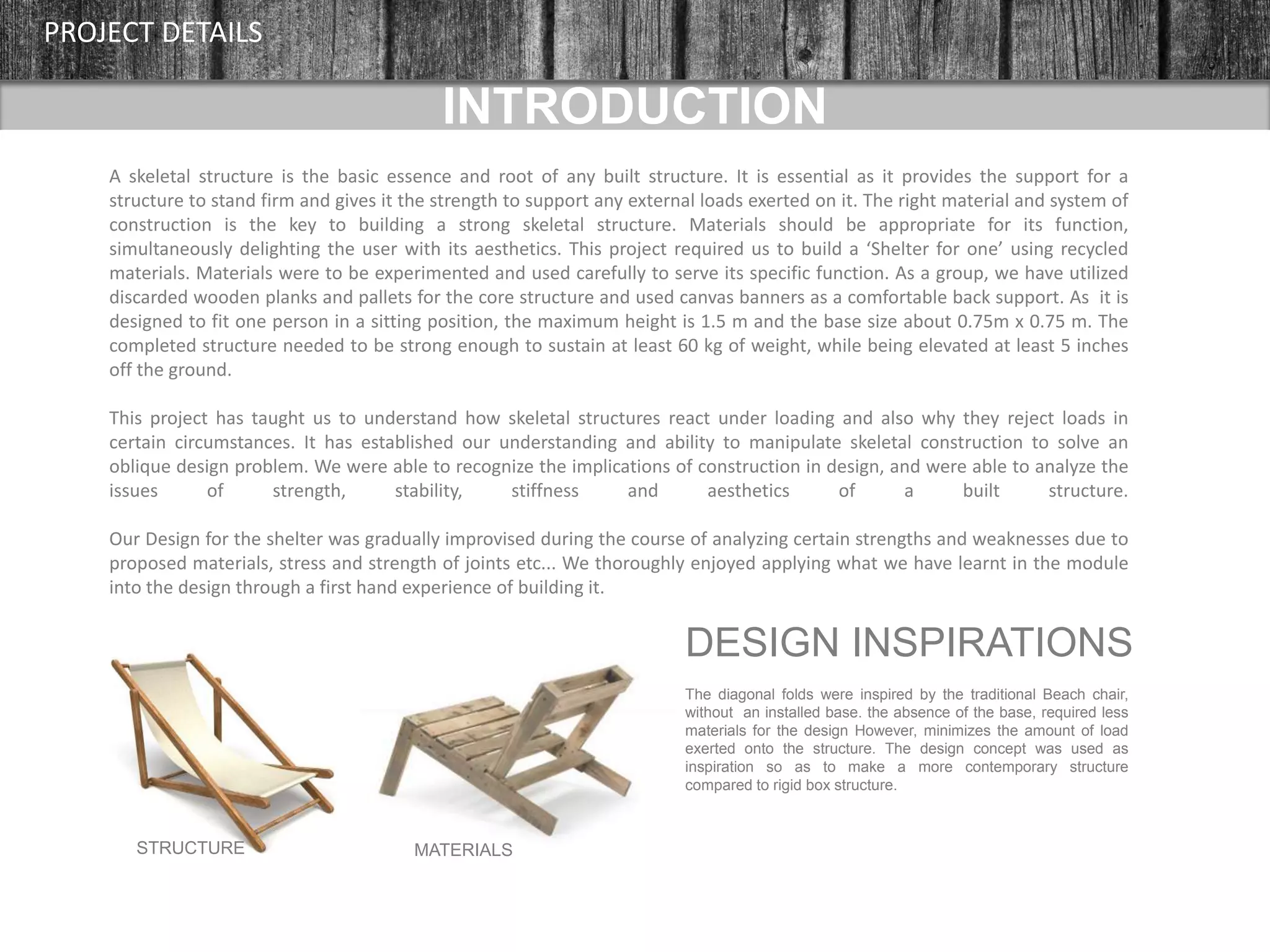
The diagonal folds were inspired by the traditional Beach chair,
without an installed base. the absence of the base, required less
materials for the design However, minimizes the amount of load
exerted onto the structure. The design concept was used as
inspiration so as to make a more contemporary structure
compared to rigid box structure.
STRUCTURE MATERIALS
INTRODUCT
INTRODUCTION
PROJECT DETAILS
IDEA DEVELOPMENT
INSPIRATION :
THE BEACH FOLD
PRELIMINARY WORK
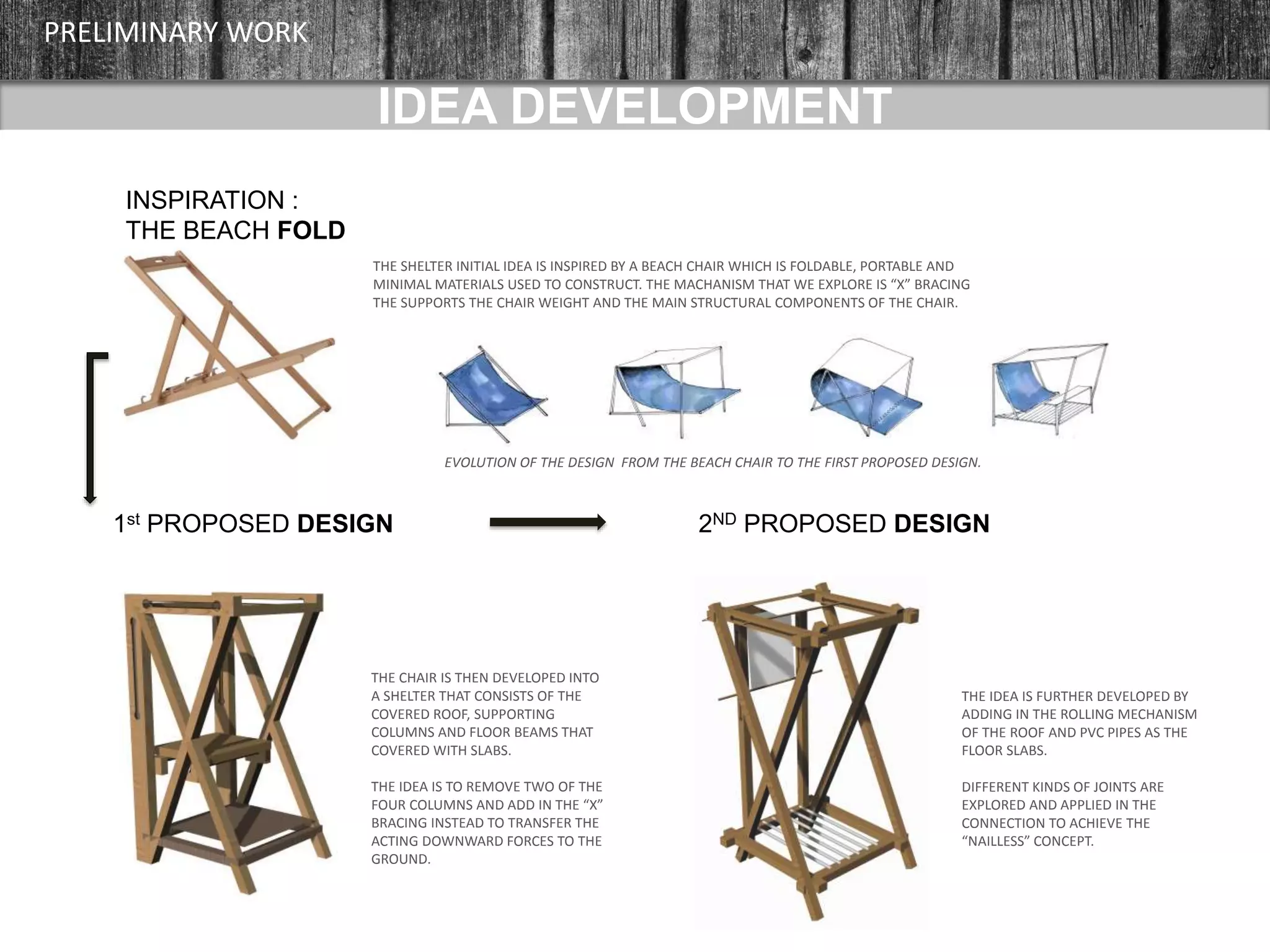
THE SHELTER INITIAL IDEA IS INSPIRED BY A BEACH CHAIR WHICH IS FOLDABLE, PORTABLE AND
MINIMAL MATERIALS USED TO CONSTRUCT. THE MACHANISM THAT WE EXPLORE IS “X” BRACING
THE SUPPORTS THE CHAIR WEIGHT AND THE MAIN STRUCTURAL COMPONENTS OF THE CHAIR.
1st PROPOSED DESIGN 2ND PROPOSED DESIGN
THE CHAIR IS THEN DEVELOPED INTO
A SHELTER THAT CONSISTS OF THE
COVERED ROOF, SUPPORTING
COLUMNS AND FLOOR BEAMS THAT
COVERED WITH SLABS.
THE IDEA IS TO REMOVE TWO OF THE
FOUR COLUMNS AND ADD IN THE “X”
BRACING INSTEAD TO TRANSFER THE
ACTING DOWNWARD FORCES TO THE
GROUND.
THE IDEA IS FURTHER DEVELOPED BY
ADDING IN THE ROLLING MECHANISM
OF THE ROOF AND PVC PIPES AS THE
FLOOR SLABS.
DIFFERENT KINDS OF JOINTS ARE
EXPLORED AND APPLIED IN THE
CONNECTION TO ACHIEVE THE
“NAILLESS” CONCEPT.
EVOLUTION OF THE DESIGN FROM THE BEACH CHAIR TO THE FIRST PROPOSED DESIGN.
CONSTRUCTION PROCESS
DAY 1 : CHOOSING AND COLLECTING MATERIALS
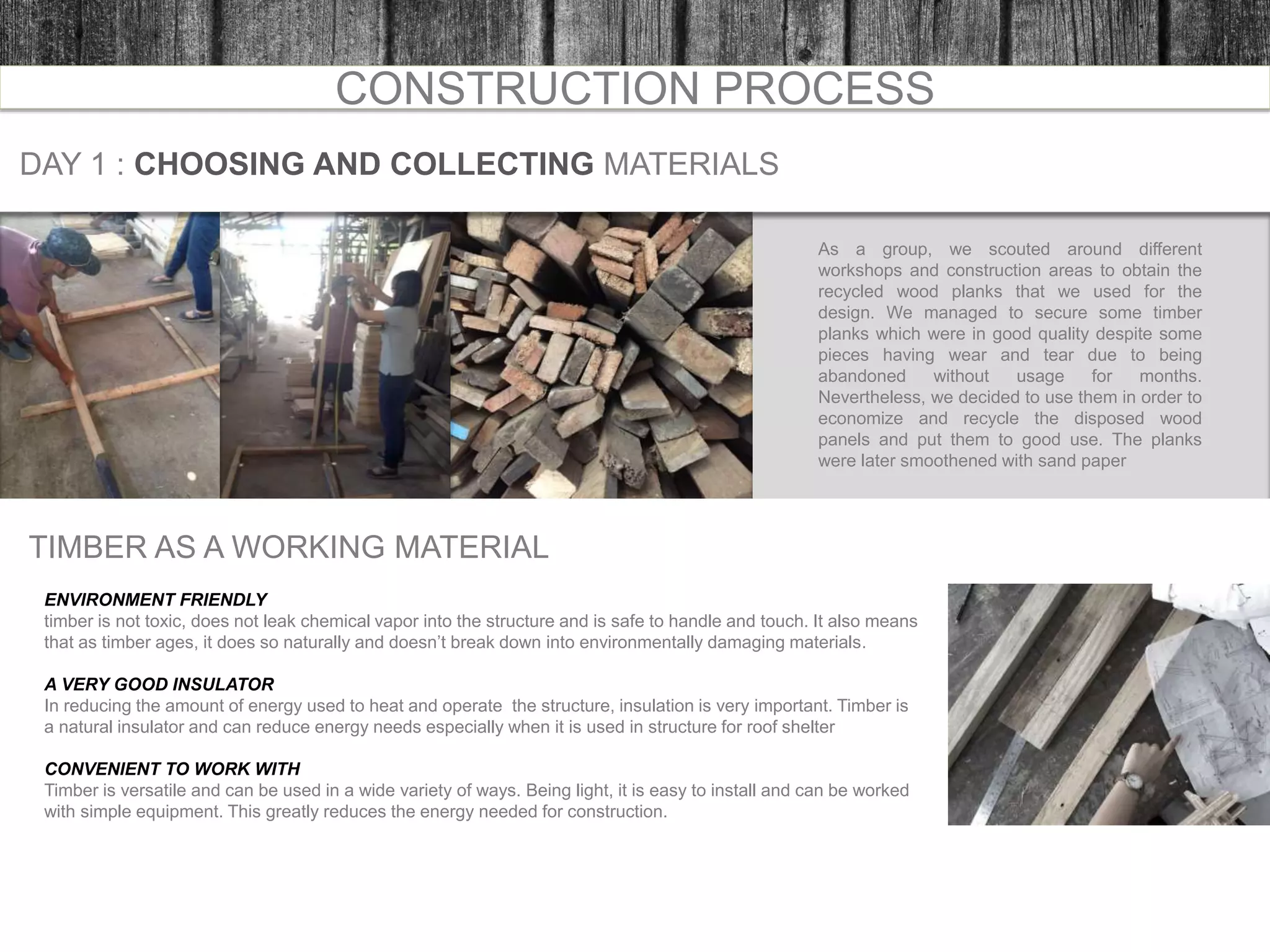
As a group, we scouted around different
workshops and construction areas to obtain the
recycled wood planks that we used for the
design. We managed to secure some timber
planks which were in good quality despite some
pieces having wear and tear due to being
abandoned without usage for months.
Nevertheless, we decided to use them in order to
economize and recycle the disposed wood
panels and put them to good use. The planks
were later smoothened with sand paper
TIMBER AS A WORKING MATERIAL
ENVIRONMENT FRIENDLY
timber is not toxic, does not leak chemical vapor into the structure and is safe to handle and touch. It also means
that as timber ages, it does so naturally and doesn’t break down into environmentally damaging materials.
A VERY GOOD INSULATOR
In reducing the amount of energy used to heat and operate the structure, insulation is very important. Timber is
a natural insulator and can reduce energy needs especially when it is used in structure for roof shelter
CONVENIENT TO WORK WITH
Timber is versatile and can be used in a wide variety of ways. Being light, it is easy to install and can be worked
with simple equipment. This greatly reduces the energy needed for construction.
CONSTRUCTION PROCESS
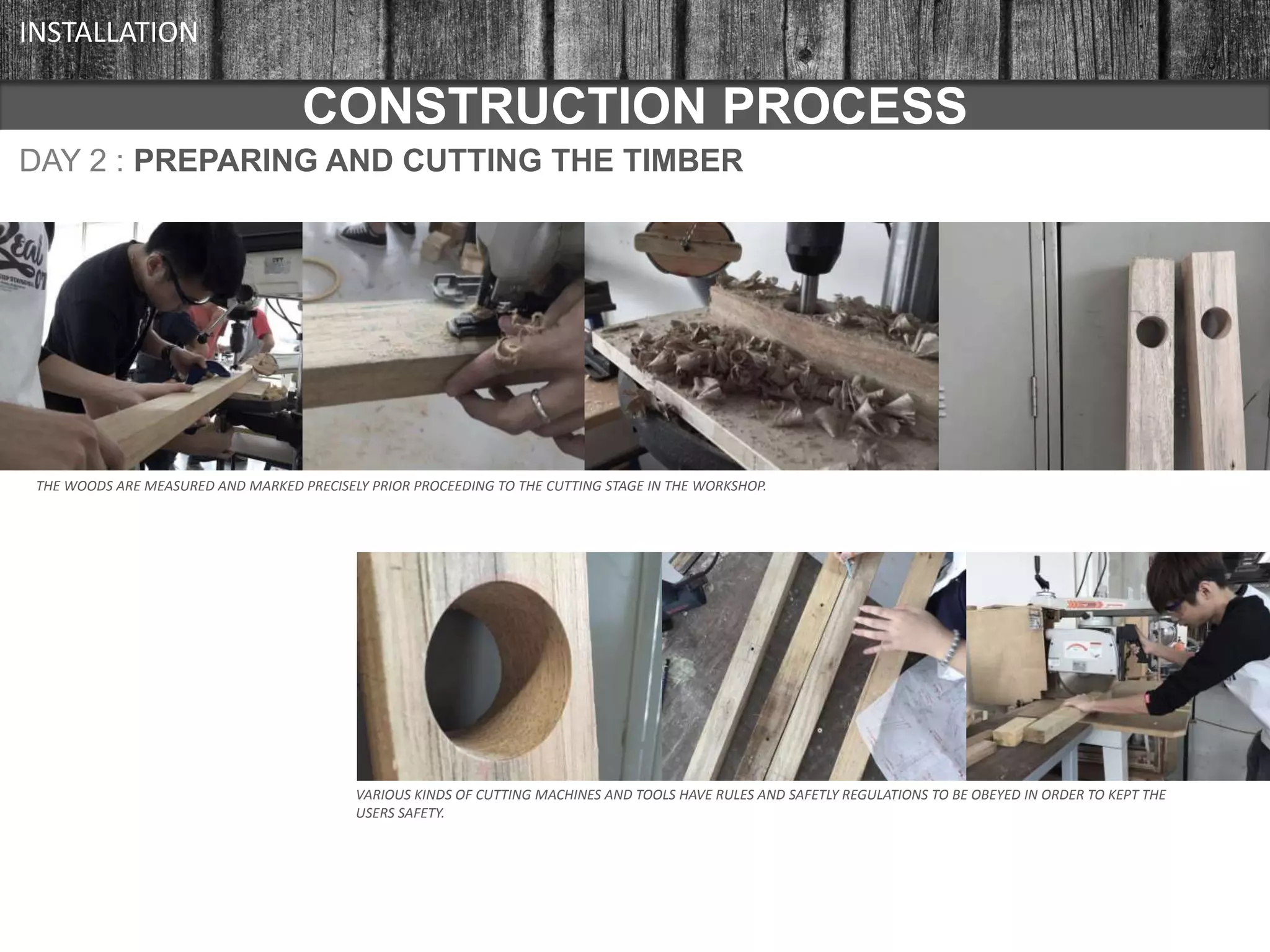
DAY 2 : PREPARING AND CUTTING THE TIMBER
CONSTRUCTION PROCESS
INSTALLATION
THE WOODS ARE MEASURED AND MARKED PRECISELY PRIOR PROCEEDING TO THE CUTTING STAGE IN THE WORKSHOP.
VARIOUS KINDS OF CUTTING MACHINES AND TOOLS HAVE RULES AND SAFETLY REGULATIONS TO BE OBEYED IN ORDER TO KEPT THE
USERS SAFETY.
CONSTRUCTION PROCESS
INSTALLATION
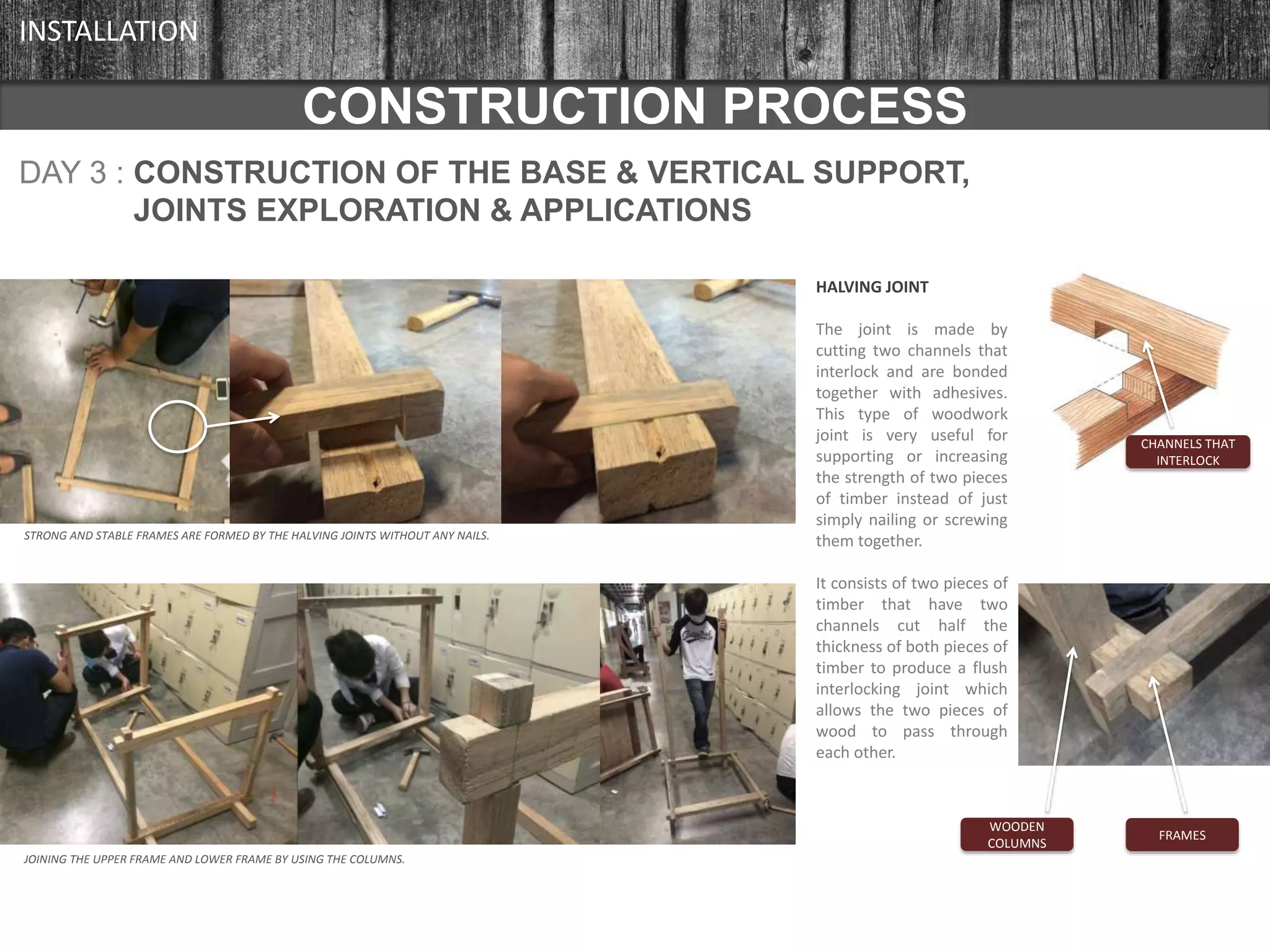
DAY 3 : CONSTRUCTION OF THE BASE & VERTICAL SUPPORT,
JOINTS EXPLORATION & APPLICATIONS
HALVING JOINT
The joint is made by
cutting two channels that
interlock and are bonded
together with adhesives.
This type of woodwork
joint is very useful for
supporting or increasing
the strength of two pieces
of timber instead of just
simply nailing or screwing
them together.
It consists of two pieces of
timber that have two
channels cut half the
thickness of both pieces of
timber to produce a flush
interlocking joint which
allows the two pieces of
wood to pass through
each other.
JOINING THE UPPER FRAME AND LOWER FRAME BY USING THE COLUMNS.
STRONG AND STABLE FRAMES ARE FORMED BY THE HALVING JOINTS WITHOUT ANY NAILS.
WOODEN
COLUMNS
FRAMES
CHANNELS THAT
INTERLOCK
CONSTRUCTION PROCESS
INSTALLATION
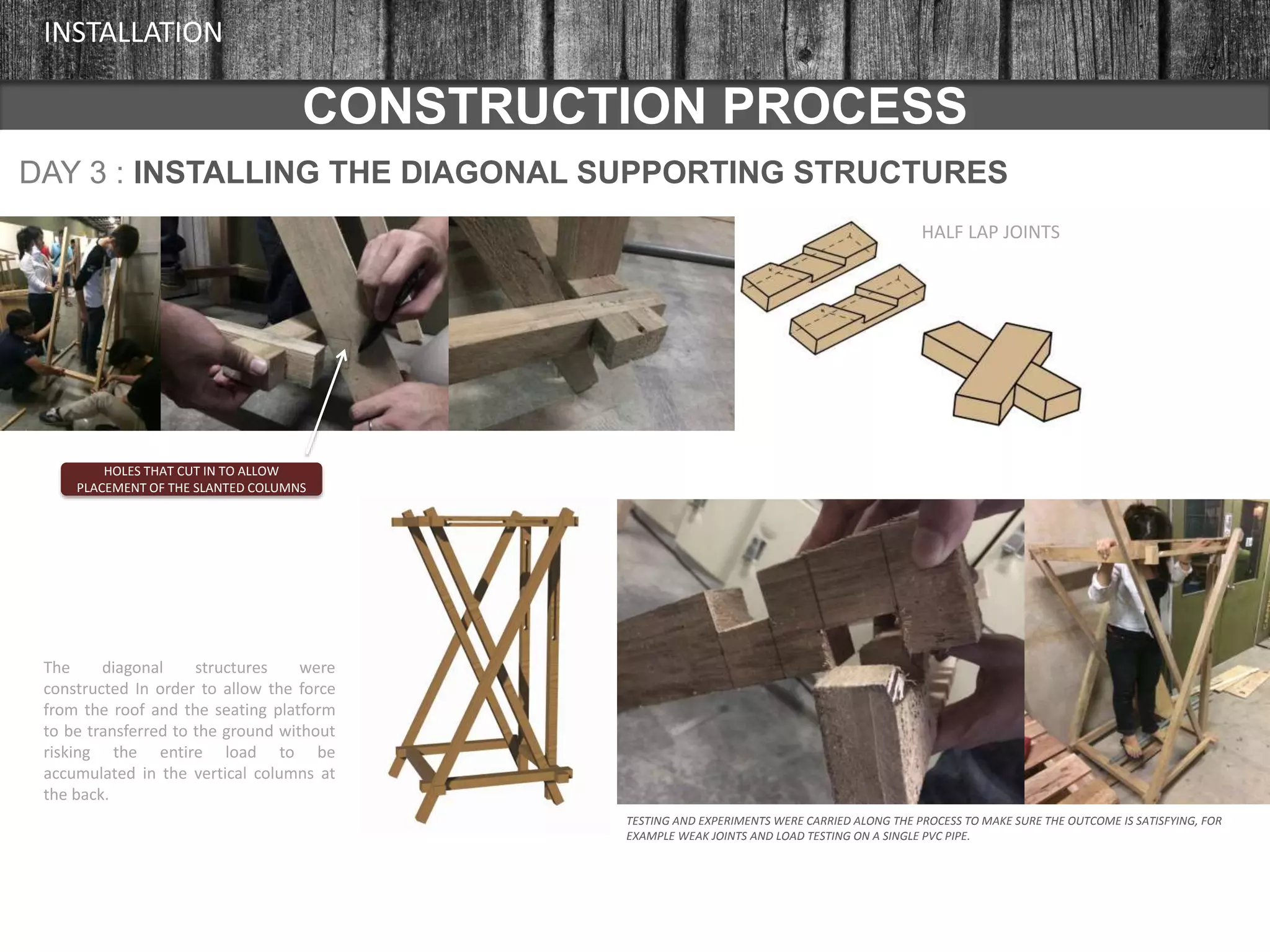
DAY 3 : INSTALLING THE DIAGONAL SUPPORTING STRUCTURES
HALF LAP JOINTS
The diagonal structures were
constructed In order to allow the force
from the roof and the seating platform
to be transferred to the ground without
risking the entire load to be
accumulated in the vertical columns at
the back.
HOLES THAT CUT IN TO ALLOW
PLACEMENT OF THE SLANTED COLUMNS
TESTING AND EXPERIMENTS WERE CARRIED ALONG THE PROCESS TO MAKE SURE THE OUTCOME IS SATISFYING, FOR
EXAMPLE WEAK JOINTS AND LOAD TESTING ON A SINGLE PVC PIPE.
CONSTRUCTION PROCESS
INSTALLATION
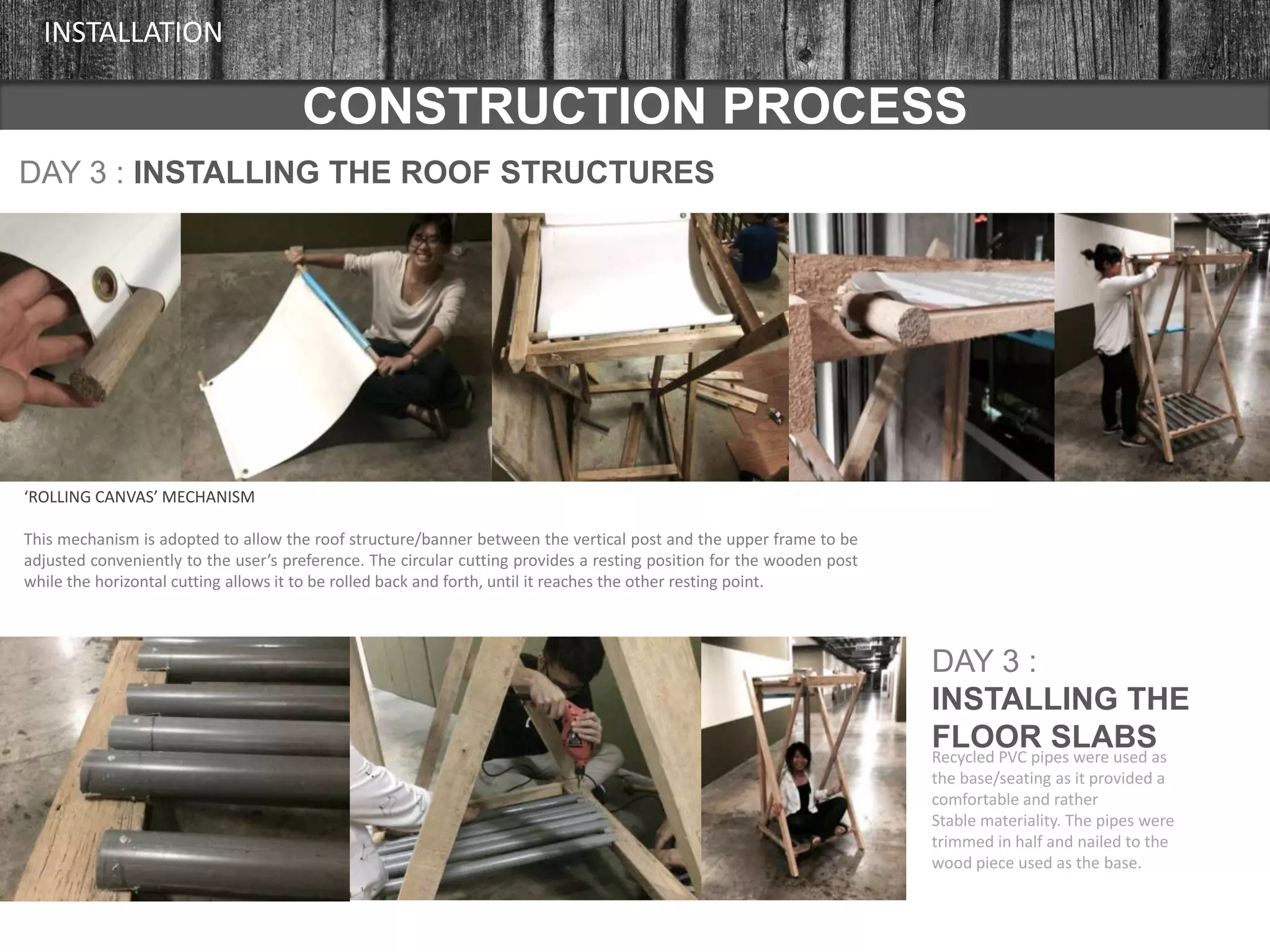
DAY 3 : INSTALLING THE ROOF STRUCTURES
‘ROLLING CANVAS’ MECHANISM
This mechanism is adopted to allow the roof structure/banner between the vertical post and the upper frame to be
adjusted conveniently to the user’s preference. The circular cutting provides a resting position for the wooden post
while the horizontal cutting allows it to be rolled back and forth, until it reaches the other resting point.
DAY 3 :
INSTALLING THE
FLOOR SLABSRecycled PVC pipes were used as
the base/seating as it provided a
comfortable and rather
Stable materiality. The pipes were
trimmed in half and nailed to the
wood piece used as the base.
FORCE DIAGRAMS
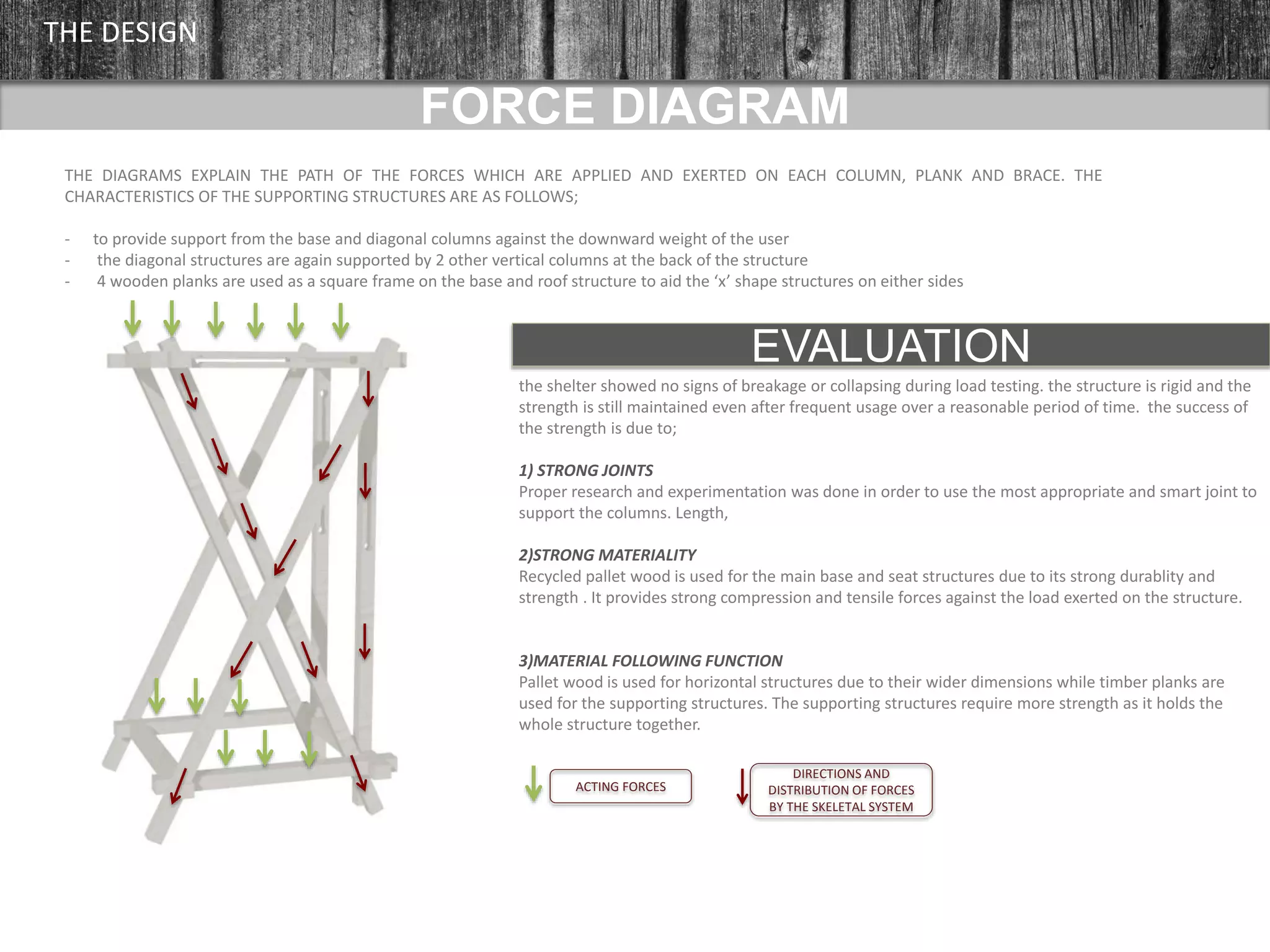
THE DIAGRAMS EXPLAIN THE PATH OF THE FORCES WHICH ARE APPLIED AND EXERTED ON EACH COLUMN, PLANK AND BRACE. THE
CHARACTERISTICS OF THE SUPPORTING STRUCTURES ARE AS FOLLOWS;
- to provide support from the base and diagonal columns against the downward weight of the user
- the diagonal structures are again supported by 2 other vertical columns at the back of the structure
- 4 wooden planks are used as a square frame on the base and roof structure to aid the ‘x’ shape structures on either sides
FORCE DIAGRAM
THE DESIGN
EVALUATION
the shelter showed no signs of breakage or collapsing during load testing. the structure is rigid and the
strength is still maintained even after frequent usage over a reasonable period of time. the success of
the strength is due to;
1) STRONG JOINTS
Proper research and experimentation was done in order to use the most appropriate and smart joint to
support the columns. Length,
2)STRONG MATERIALITY
Recycled pallet wood is used for the main base and seat structures due to its strong durablity and
strength . It provides strong compression and tensile forces against the load exerted on the structure.
3)MATERIAL FOLLOWING FUNCTION
Pallet wood is used for horizontal structures due to their wider dimensions while timber planks are
used for the supporting structures. The supporting structures require more strength as it holds the
whole structure together.
DIRECTIONS AND
DISTRIBUTION OF FORCES
BY THE SKELETAL SYSTEM
ACTING FORCES
INSTALLATION PROCESS
OVER VIEW
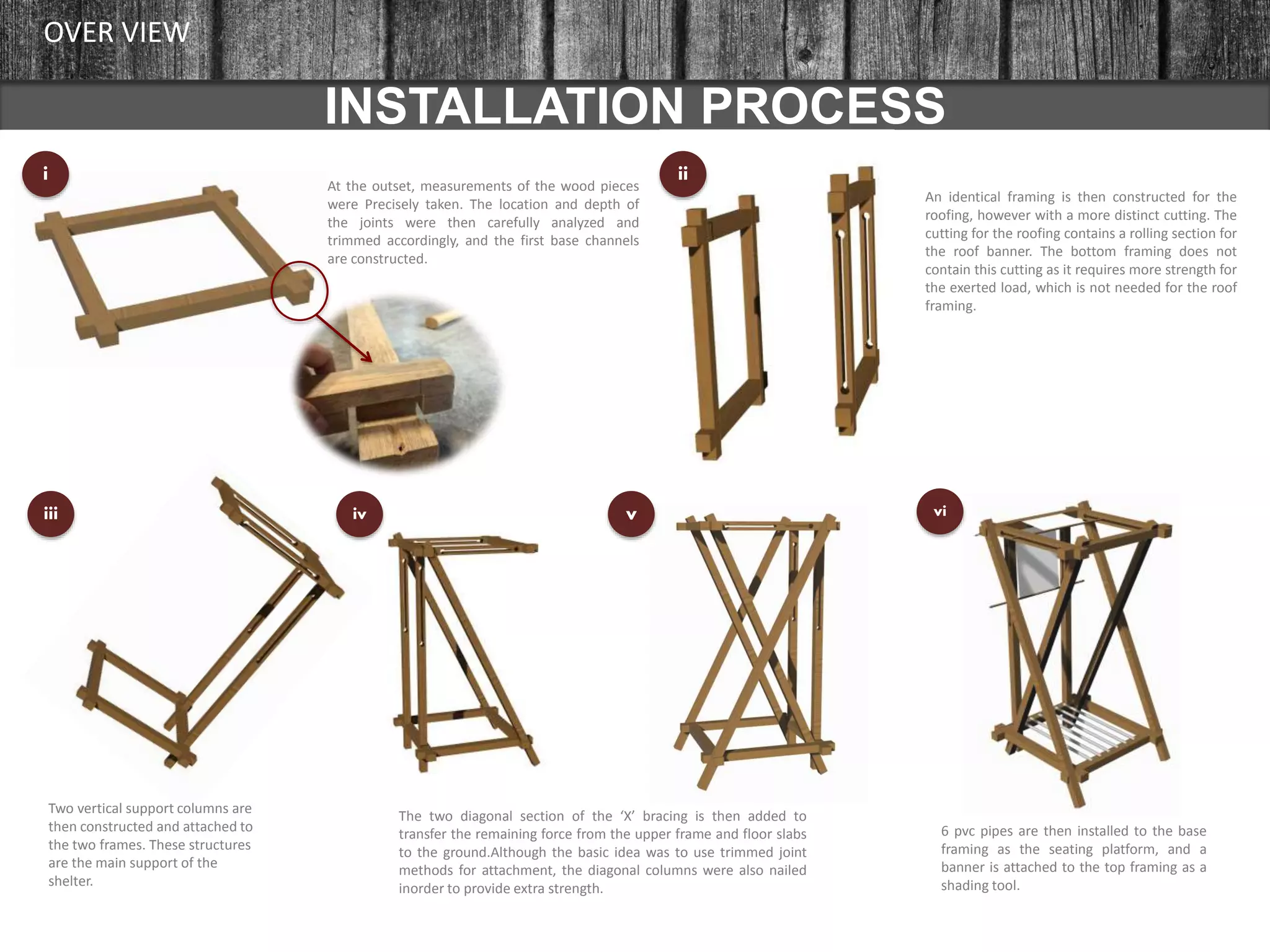
At the outset, measurements of the wood pieces
were Precisely taken. The location and depth of
the joints were then carefully analyzed and
trimmed accordingly, and the first base channels
are constructed.
An identical framing is then constructed for the
roofing, however with a more distinct cutting. The
cutting for the roofing contains a rolling section for
the roof banner. The bottom framing does not
contain this cutting as it requires more strength for
the exerted load, which is not needed for the roof
framing.
Two vertical support columns are
then constructed and attached to
the two frames. These structures
are the main support of the
shelter.
The two diagonal section of the ‘X’ bracing is then added to
transfer the remaining force from the upper frame and floor slabs
to the ground.Although the basic idea was to use trimmed joint
methods for attachment, the diagonal columns were also nailed
inorder to provide extra strength.
6 pvc pipes are then installed to the base
framing as the seating platform, and a
banner is attached to the top framing as a
shading tool.
i ii
iii iv v vi
CONSTRUCTION DETAILS
THE DESIGN
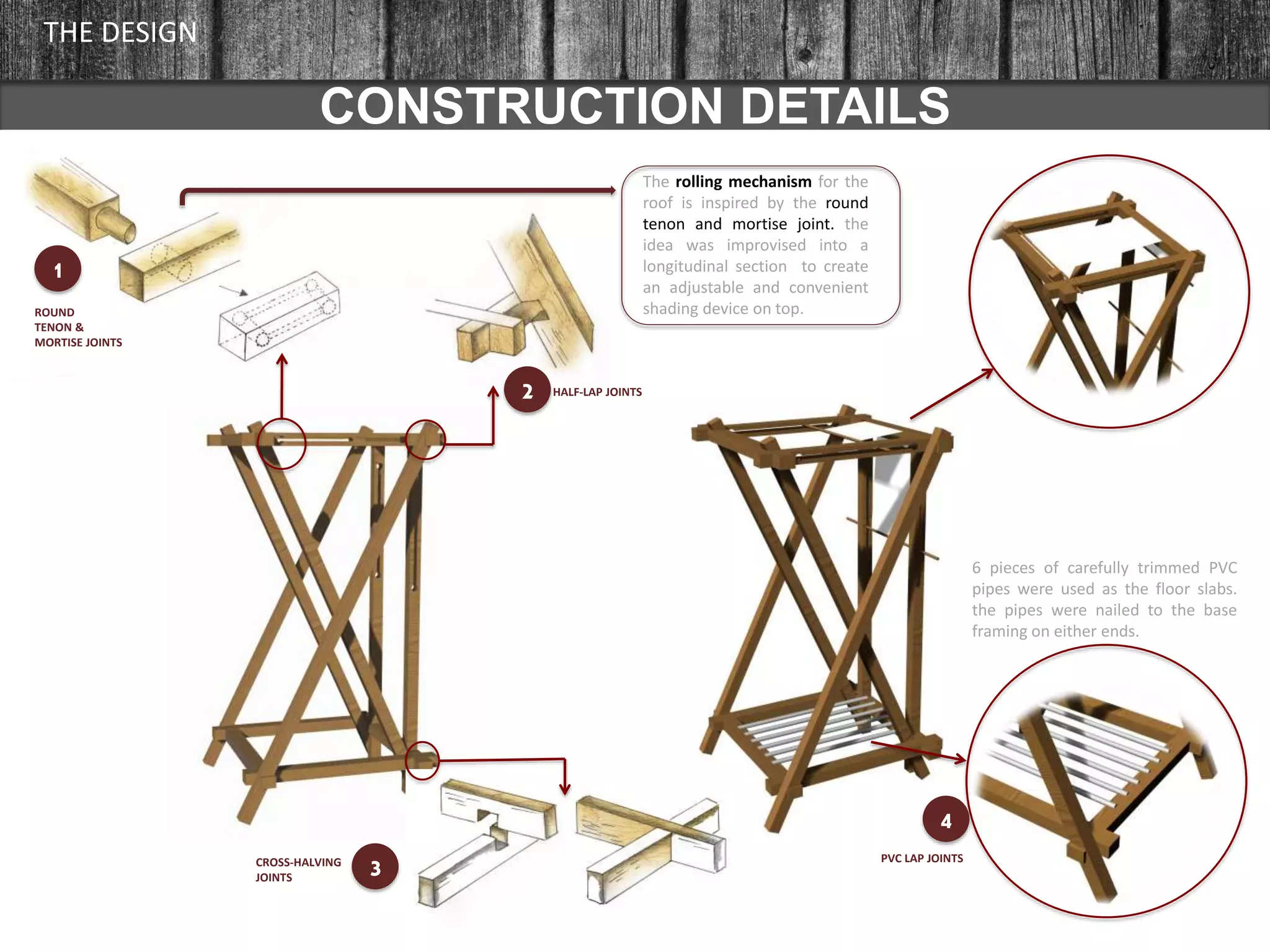
The rolling mechanism for the
roof is inspired by the round
tenon and mortise joint. the
idea was improvised into a
longitudinal section to create
an adjustable and convenient
shading device on top.
6 pieces of carefully trimmed PVC
pipes were used as the floor slabs.
the pipes were nailed to the base
framing on either ends.
1
2
3
4
ROUND
TENON &
MORTISE JOINTS
HALF-LAP JOINTS
CROSS-HALVING
JOINTS
PVC LAP JOINTS
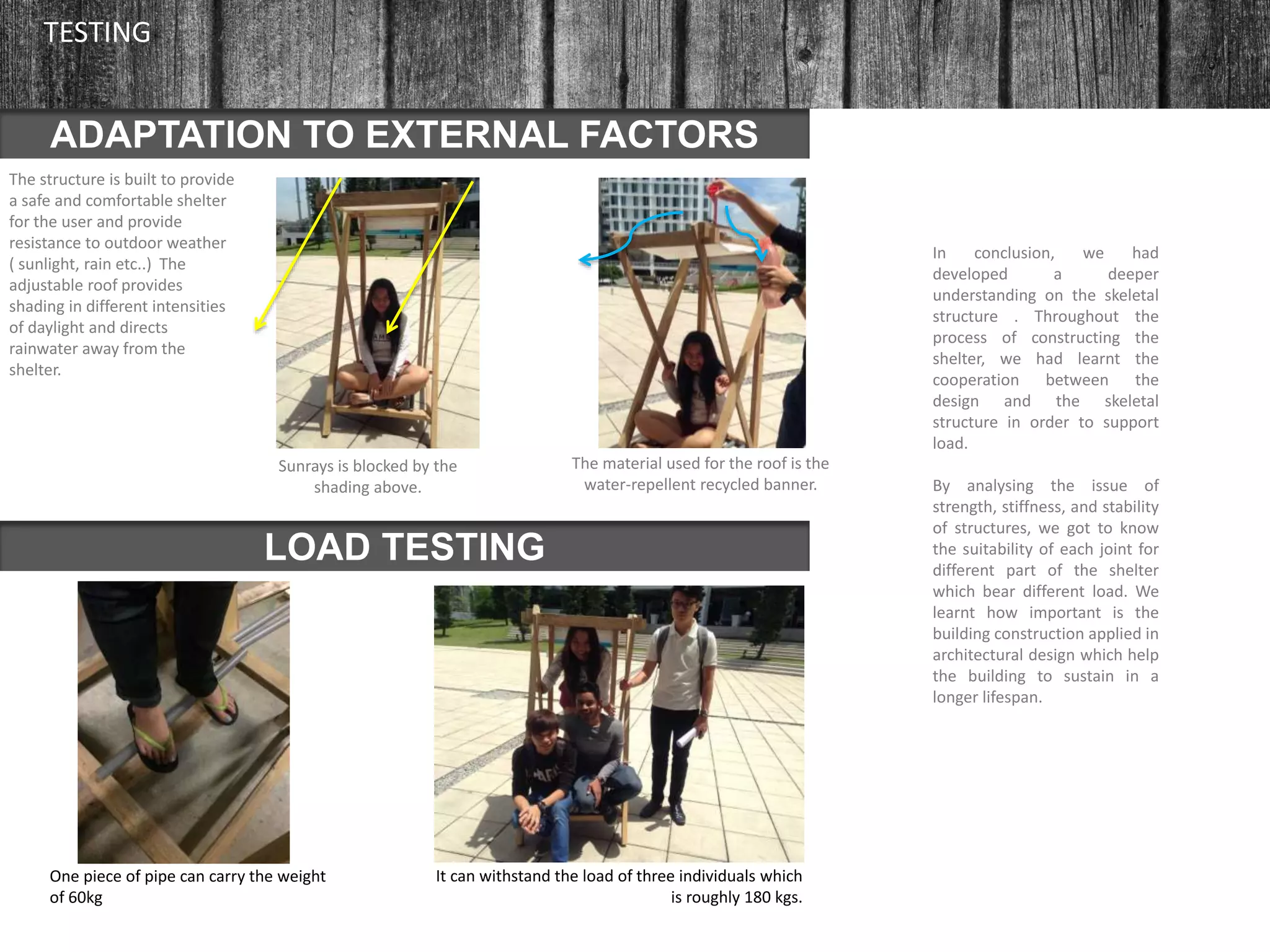
The structure is built to provide
a safe and comfortable shelter
for the user and provide
resistance to outdoor weather
( sunlight, rain etc..) The
adjustable roof provides
shading in different intensities
of daylight and directs
rainwater away from the
shelter.
ADAPTATION TO EXTERNAL FACTORS
TESTING
LOAD TESTING
One piece of pipe can carry the weight
of 60kg
In conclusion, we had
developed a deeper
understanding on the skeletal
structure . Throughout the
process of constructing the
shelter, we had learnt the
cooperation between the
design and the skeletal
structure in order to support
load.
By analysing the issue of
strength, stiffness, and stability
of structures, we got to know
the suitability of each joint for
different part of the shelter
which bear different load. We
learnt how important is the
building construction applied in
architectural design which help
the building to sustain in a
longer lifespan.
Sunrays is blocked by the
shading above.
The material used for the roof is the
water-repellent recycled banner.
It can withstand the load of three individuals which
is roughly 180 kgs.

Building Construction Project 1 Shelter Report

  • 1.
    ARCHITECTURE SEM 3 BUILDINGCONSTRUCTION 2 SHELTER FOR ONE CHAN PIN QI 0314676 LEE JO YEE 0314880 MAHI ABDUL MUHSIN 0314421 DANAR JOVIAN 0314575 TAN SHING YEOU 0314850 TAN ZI JIAN 0318291
  • 2.
    A skeletal structureis the basic essence and root of any built structure. It is essential as it provides the support for a structure to stand firm and gives it the strength to support any external loads exerted on it. The right material and system of construction is the key to building a strong skeletal structure. Materials should be appropriate for its function, simultaneously delighting the user with its aesthetics. This project required us to build a ‘Shelter for one’ using recycled materials. Materials were to be experimented and used carefully to serve its specific function. As a group, we have utilized discarded wooden planks and pallets for the core structure and used canvas banners as a comfortable back support. As it is designed to fit one person in a sitting position, the maximum height is 1.5 m and the base size about 0.75m x 0.75 m. The completed structure needed to be strong enough to sustain at least 60 kg of weight, while being elevated at least 5 inches off the ground. This project has taught us to understand how skeletal structures react under loading and also why they reject loads in certain circumstances. It has established our understanding and ability to manipulate skeletal construction to solve an oblique design problem. We were able to recognize the implications of construction in design, and were able to analyze the issues of strength, stability, stiffness and aesthetics of a built structure. Our Design for the shelter was gradually improvised during the course of analyzing certain strengths and weaknesses due to proposed materials, stress and strength of joints etc... We thoroughly enjoyed applying what we have learnt in the module into the design through a first hand experience of building it. DESIGN INSPIRATIONS The diagonal folds were inspired by the traditional Beach chair, without an installed base. the absence of the base, required less materials for the design However, minimizes the amount of load exerted onto the structure. The design concept was used as inspiration so as to make a more contemporary structure compared to rigid box structure. STRUCTURE MATERIALS INTRODUCT INTRODUCTION PROJECT DETAILS
  • 3.
    IDEA DEVELOPMENT INSPIRATION : THEBEACH FOLD PRELIMINARY WORK THE SHELTER INITIAL IDEA IS INSPIRED BY A BEACH CHAIR WHICH IS FOLDABLE, PORTABLE AND MINIMAL MATERIALS USED TO CONSTRUCT. THE MACHANISM THAT WE EXPLORE IS “X” BRACING THE SUPPORTS THE CHAIR WEIGHT AND THE MAIN STRUCTURAL COMPONENTS OF THE CHAIR. 1st PROPOSED DESIGN 2ND PROPOSED DESIGN THE CHAIR IS THEN DEVELOPED INTO A SHELTER THAT CONSISTS OF THE COVERED ROOF, SUPPORTING COLUMNS AND FLOOR BEAMS THAT COVERED WITH SLABS. THE IDEA IS TO REMOVE TWO OF THE FOUR COLUMNS AND ADD IN THE “X” BRACING INSTEAD TO TRANSFER THE ACTING DOWNWARD FORCES TO THE GROUND. THE IDEA IS FURTHER DEVELOPED BY ADDING IN THE ROLLING MECHANISM OF THE ROOF AND PVC PIPES AS THE FLOOR SLABS. DIFFERENT KINDS OF JOINTS ARE EXPLORED AND APPLIED IN THE CONNECTION TO ACHIEVE THE “NAILLESS” CONCEPT. EVOLUTION OF THE DESIGN FROM THE BEACH CHAIR TO THE FIRST PROPOSED DESIGN.
  • 4.
    CONSTRUCTION PROCESS DAY 1: CHOOSING AND COLLECTING MATERIALS As a group, we scouted around different workshops and construction areas to obtain the recycled wood planks that we used for the design. We managed to secure some timber planks which were in good quality despite some pieces having wear and tear due to being abandoned without usage for months. Nevertheless, we decided to use them in order to economize and recycle the disposed wood panels and put them to good use. The planks were later smoothened with sand paper TIMBER AS A WORKING MATERIAL ENVIRONMENT FRIENDLY timber is not toxic, does not leak chemical vapor into the structure and is safe to handle and touch. It also means that as timber ages, it does so naturally and doesn’t break down into environmentally damaging materials. A VERY GOOD INSULATOR In reducing the amount of energy used to heat and operate the structure, insulation is very important. Timber is a natural insulator and can reduce energy needs especially when it is used in structure for roof shelter CONVENIENT TO WORK WITH Timber is versatile and can be used in a wide variety of ways. Being light, it is easy to install and can be worked with simple equipment. This greatly reduces the energy needed for construction.
  • 5.
    CONSTRUCTION PROCESS DAY 2: PREPARING AND CUTTING THE TIMBER CONSTRUCTION PROCESS INSTALLATION THE WOODS ARE MEASURED AND MARKED PRECISELY PRIOR PROCEEDING TO THE CUTTING STAGE IN THE WORKSHOP. VARIOUS KINDS OF CUTTING MACHINES AND TOOLS HAVE RULES AND SAFETLY REGULATIONS TO BE OBEYED IN ORDER TO KEPT THE USERS SAFETY.
  • 6.
    CONSTRUCTION PROCESS INSTALLATION DAY 3: CONSTRUCTION OF THE BASE & VERTICAL SUPPORT, JOINTS EXPLORATION & APPLICATIONS HALVING JOINT The joint is made by cutting two channels that interlock and are bonded together with adhesives. This type of woodwork joint is very useful for supporting or increasing the strength of two pieces of timber instead of just simply nailing or screwing them together. It consists of two pieces of timber that have two channels cut half the thickness of both pieces of timber to produce a flush interlocking joint which allows the two pieces of wood to pass through each other. JOINING THE UPPER FRAME AND LOWER FRAME BY USING THE COLUMNS. STRONG AND STABLE FRAMES ARE FORMED BY THE HALVING JOINTS WITHOUT ANY NAILS. WOODEN COLUMNS FRAMES CHANNELS THAT INTERLOCK
  • 7.
    CONSTRUCTION PROCESS INSTALLATION DAY 3: INSTALLING THE DIAGONAL SUPPORTING STRUCTURES HALF LAP JOINTS The diagonal structures were constructed In order to allow the force from the roof and the seating platform to be transferred to the ground without risking the entire load to be accumulated in the vertical columns at the back. HOLES THAT CUT IN TO ALLOW PLACEMENT OF THE SLANTED COLUMNS TESTING AND EXPERIMENTS WERE CARRIED ALONG THE PROCESS TO MAKE SURE THE OUTCOME IS SATISFYING, FOR EXAMPLE WEAK JOINTS AND LOAD TESTING ON A SINGLE PVC PIPE.
  • 8.
    CONSTRUCTION PROCESS INSTALLATION DAY 3: INSTALLING THE ROOF STRUCTURES ‘ROLLING CANVAS’ MECHANISM This mechanism is adopted to allow the roof structure/banner between the vertical post and the upper frame to be adjusted conveniently to the user’s preference. The circular cutting provides a resting position for the wooden post while the horizontal cutting allows it to be rolled back and forth, until it reaches the other resting point. DAY 3 : INSTALLING THE FLOOR SLABSRecycled PVC pipes were used as the base/seating as it provided a comfortable and rather Stable materiality. The pipes were trimmed in half and nailed to the wood piece used as the base.
  • 9.
    FORCE DIAGRAMS THE DIAGRAMSEXPLAIN THE PATH OF THE FORCES WHICH ARE APPLIED AND EXERTED ON EACH COLUMN, PLANK AND BRACE. THE CHARACTERISTICS OF THE SUPPORTING STRUCTURES ARE AS FOLLOWS; - to provide support from the base and diagonal columns against the downward weight of the user - the diagonal structures are again supported by 2 other vertical columns at the back of the structure - 4 wooden planks are used as a square frame on the base and roof structure to aid the ‘x’ shape structures on either sides FORCE DIAGRAM THE DESIGN EVALUATION the shelter showed no signs of breakage or collapsing during load testing. the structure is rigid and the strength is still maintained even after frequent usage over a reasonable period of time. the success of the strength is due to; 1) STRONG JOINTS Proper research and experimentation was done in order to use the most appropriate and smart joint to support the columns. Length, 2)STRONG MATERIALITY Recycled pallet wood is used for the main base and seat structures due to its strong durablity and strength . It provides strong compression and tensile forces against the load exerted on the structure. 3)MATERIAL FOLLOWING FUNCTION Pallet wood is used for horizontal structures due to their wider dimensions while timber planks are used for the supporting structures. The supporting structures require more strength as it holds the whole structure together. DIRECTIONS AND DISTRIBUTION OF FORCES BY THE SKELETAL SYSTEM ACTING FORCES
  • 10.
    INSTALLATION PROCESS OVER VIEW Atthe outset, measurements of the wood pieces were Precisely taken. The location and depth of the joints were then carefully analyzed and trimmed accordingly, and the first base channels are constructed. An identical framing is then constructed for the roofing, however with a more distinct cutting. The cutting for the roofing contains a rolling section for the roof banner. The bottom framing does not contain this cutting as it requires more strength for the exerted load, which is not needed for the roof framing. Two vertical support columns are then constructed and attached to the two frames. These structures are the main support of the shelter. The two diagonal section of the ‘X’ bracing is then added to transfer the remaining force from the upper frame and floor slabs to the ground.Although the basic idea was to use trimmed joint methods for attachment, the diagonal columns were also nailed inorder to provide extra strength. 6 pvc pipes are then installed to the base framing as the seating platform, and a banner is attached to the top framing as a shading tool. i ii iii iv v vi
  • 11.
    CONSTRUCTION DETAILS THE DESIGN Therolling mechanism for the roof is inspired by the round tenon and mortise joint. the idea was improvised into a longitudinal section to create an adjustable and convenient shading device on top. 6 pieces of carefully trimmed PVC pipes were used as the floor slabs. the pipes were nailed to the base framing on either ends. 1 2 3 4 ROUND TENON & MORTISE JOINTS HALF-LAP JOINTS CROSS-HALVING JOINTS PVC LAP JOINTS
  • 12.
    The structure isbuilt to provide a safe and comfortable shelter for the user and provide resistance to outdoor weather ( sunlight, rain etc..) The adjustable roof provides shading in different intensities of daylight and directs rainwater away from the shelter. ADAPTATION TO EXTERNAL FACTORS TESTING LOAD TESTING One piece of pipe can carry the weight of 60kg In conclusion, we had developed a deeper understanding on the skeletal structure . Throughout the process of constructing the shelter, we had learnt the cooperation between the design and the skeletal structure in order to support load. By analysing the issue of strength, stiffness, and stability of structures, we got to know the suitability of each joint for different part of the shelter which bear different load. We learnt how important is the building construction applied in architectural design which help the building to sustain in a longer lifespan. Sunrays is blocked by the shading above. The material used for the roof is the water-repellent recycled banner. It can withstand the load of three individuals which is roughly 180 kgs.