SCHOOL OF ARCHITECTURE, BUILDING & DESIGN 
Bachelor of Quantity Surveying (Honours) 
MEASUREMENT 1 [QSB 60104] 
CONSTRUCTION TECHNOLOGY I [BLD 60104] 
BUILDING MATERIALS [BLD 62003] 
Title : Site Visit To D’Latour Construction Site Report 
Name : Muhammad Hasif bin Alias 
Student ID : 0316413
Content 
1. Introduction Pg. 1 
2. Objectives Pg. 2 
3. Content Pg. 3 
-Site 
-Formwork 
-Scaffolding 
-Concrete 
4. Conclusion
Introduction 
On 21st of November 2014, a construction site visit is organized by Sr. Ang Fuey Lin in D’Latour 
Construction Site, Bandar Sunway, PJS 7, Selangor which is very near to Taylor’s University Lakeside 
Campus. The project description is as stated below : 
Project 2 Blocks of 27-Storey SoHo and a 28 Storey Serviced Apartment 
Developer DK - My Properties Sdn. Bhd. 
Architect RDA - Harris Architects Sdn. Bhd. 
Quantity Sr. Alpha-Omega Matrix 
Contractor Pasukhas Construction Sdn. Bhd. 
The site visit is joined by 45 students and 5 lecturers. We are divided by 2 groups. The site visit begin with 
the first group at 9.00am sharp guided by construction site safety officer, Encik Kamarul and his teams. We 
are allowed to visit the basement ground floor and first floor as the site is still under heavy construction. 
The first session ended at 10.00am and continued with the second group. 
Objectives
 To exposed one self to the actual working environment on site. 
 To identify and observe the usage materials and machineries at the construction site. 
 To understand the importance of personal safety in construction site. 
 To understand and observe the construction process techniques and applications. 
Starter bars (Fig 2.1) 
To increase the speed of construction at 
joints where continuity of reinforcement 
is required. 
 To strengthen communication skills and to see the importance of teamwork in the building team. 
 To analyze the formworks, scaffoldings and concretes used in site. 
 To identify the items measurable for sub-structure and reinforced concrete frame works. 
Content 
Outside the Building 
Inside the Building 
Temporary Access (Fig 2.2) 
Road, passage ways, hand-drails etc 
made for construction. 
Floor Hardener (Fig. 2.3) 
For hardening the upper matrix of 
Portland cement concrete surface. 
Forklift (Fig. 2.4) 
Lift and move materials in a short 
distance. 
Concrete ( Building Materials BLD62003 ) 
Figure 1.0 
Concrete used on site - GRADE 40 
Advantages: 
- High compressive strength. 
- High load bearings capacity. 
- Widely use for high-rise building. 
Disadvantages: 
- Slightly expensive. 
Column with Hardener (Fig. 2.5) 
Comparison of a column with(left) and 
without(right) a hardener. 
Figure 1.6 Figure 1.9 
Steel Scaffolding (Fig. 2.6) 
In figure show the pipe support 
scaffolding. 
Figure 2.1 Figure 2.5 
Alternative Figure concrete 1.1 
- GRADE 30 
Advantages: 
- Cheaper than Concrete Grade 40 
Figure 1.2 
Figure 1.3 
Concrete in slabs and columns. 
Figure 1.4 
Figure 1.5 
Description Board (Fig. 1.0) 
Used to provide details on the planned 
construction for references. 
Site Safety Board (Fig. 1.1) 
Shows site safety measurement which 
is a requirement for every site. 
Hoarding (Fig. 1.1) 
Used to define the limit of site and to 
prevent trespasser. 
Temporary House (Fig. 1.2) 
Accommodation for the construction 
workers to ensure speed and efficiency. 
Construction Container( Fig. 1.3) 
Act a material storage and a carrier to 
transport materials to multiple level 
building. 
Power Plugs (Fig. 2.7) 
Generator send electricity here for 
multiple uses. However, in the figure 
show a dangerous method of handling 
electrical power source. 
Water Tank (Fig. 1.4) 
Elevation water storage for the function 
of the nearby toilet. 
Bar Bending Spaces (Fig. 1.5) 
This space is used to place and prepare 
the required reinforcement bars readied 
by the bar bender. 
Figure 1.7 
1.8 
Figure 2.0 
Reinforcement-Stirrups (Fig. 1.6) 
A type or form of rebar used to support 
main rebars. 
Mobile Crane (Fig. 1.7) 
Movable crane, able to withstand high 
loads. 
Tower Crane (Fig. 1.8) 
Modern form of balance crane which is 
fixed to ground. Widely used for high-rise 
building. 
Electrical Generator (Fig. 1.9) 
A device that convert mechanical 
energy to electrical energy to provide 
electricity to power grid. 
Temporary Road (Fig. 2.0) 
Road used specifically for construction 
purpose to avoid road damages. Usually 
poured wasted concrete from 
construction. 
Portlant Cement (Fig. 2.8) 
Use to make concrete grade 30 and 
Figure 2.2 above. Figure 2.6 
FFiigguurree 22..34 FiFgiugruer e2 .27.8
Disadvantages: 
- Lower compressive strength and load bearings capacity, however, it is sufficient because it met the 
requirement of a strong concrete mixture proportion of 1:2:3 (cement:sand:gravel) . 
Formwork ( Construction Technology BLD 60104 ) 
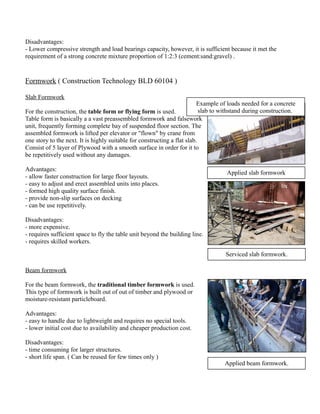
Slab Formwork 
For the construction, the table form or flying form is used. 
Table form is basically a a vast preassembled formwork and falsework 
unit, frequently forming complete bay of suspended floor section. The 
assembled formwork is lifted per elevator or "flown" by crane from 
one story to the next. It is highly suitable for constructing a flat slab. 
Consist of 5 layer of Plywood with a smooth surface in order for it to 
be repetitively used without any damages. 
Advantages: 
- allow faster construction for large floor layouts. 
- easy to adjust and erect assembled units into places. 
- formed high quality surface finish. 
- provide non-slip surfaces on decking 
- can be use repetitively. 
Disadvantages: 
- more expensive. 
- requires sufficient space to fly the table unit beyond the building line. 
- requires skilled workers. 
Beam formwork 
For the beam formwork, the traditional timber formwork is used. 
This type of formwork is built out of out of timber and plywood or 
moisture-resistant particleboard. 
Advantages: 
- easy to handle due to lightweight and requires no special tools. 
- lower initial cost due to availability and cheaper production cost. 
Disadvantages: 
- time consuming for larger structures. 
- short life span. ( Can be reused for few times only ) 
Example of loads needed for a concrete 
slab to withstand during construction. 
Applied slab formwork 
Serviced slab formwork. 
Applied beam formwork.
Column Formwork 
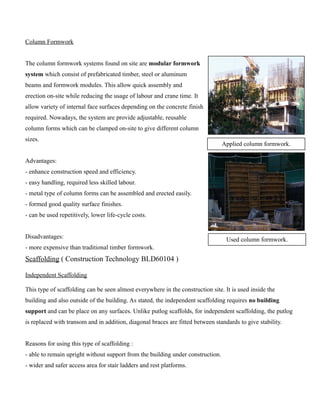
The column formwork systems found on site are modular formwork 
system which consist of prefabricated timber, steel or aluminum 
beams and formwork modules. This allow quick assembly and 
erection on-site while reducing the usage of labour and crane time. It 
allow variety of internal face surfaces depending on the concrete finish 
required. Nowadays, the system are provide adjustable, reusable 
column forms which can be clamped on-site to give different column 
sizes. 
Advantages: 
- enhance construction speed and efficiency. 
- easy handling, required less skilled labour. 
- metal type of column forms can be assembled and erected easily. 
- formed good quality surface finishes. 
- can be used repetitively, lower life-cycle costs. 
Disadvantages: 
- more expensive than traditional timber formwork. 
Scaffolding ( Construction Technology BLD60104 ) 
Independent Scaffolding 
This type of scaffolding can be seen almost everywhere in the construction site. It is used inside the 
building and also outside of the building. As stated, the independent scaffolding requires no building 
support and can be place on any surfaces. Unlike putlog scaffolds, for independent scaffolding, the putlog 
is replaced with transom and in addition, diagonal braces are fitted between standards to give stability. 
Reasons for using this type of scaffolding : 
- able to remain upright without support from the building under construction. 
- wider and safer access area for stair ladders and rest platforms. 
Applied column formwork. 
Used column formwork.
- easy to assemble and disassemble. 
- increase construction speed and efficiency. 
Conclusion 
The site visit showed me a lot of things that I learned based on theory and books only. Even though we 
did not get the chance to go further to upper floor, it was a very great experience for first timer like 
students to go to such site visit. It allowed the students to adjust themselves in the construction 
environment which Figure are proved shows to independent be hot and noisy. scaffoldings Furthermore, prepared it fulfilled outside most of building. 
of our objectives, 
especially getting to know more of construction process and identifying the materials and equipments used. 
I am now able to appreciate a building construction more and this inspired me more of becoming a site 
Quantity Surveyor. 
Figure shows independent scaffoldings prepared around the building and provide accesses.

BQS Site Visit Report

  • 1.
    SCHOOL OF ARCHITECTURE,BUILDING & DESIGN Bachelor of Quantity Surveying (Honours) MEASUREMENT 1 [QSB 60104] CONSTRUCTION TECHNOLOGY I [BLD 60104] BUILDING MATERIALS [BLD 62003] Title : Site Visit To D’Latour Construction Site Report Name : Muhammad Hasif bin Alias Student ID : 0316413
  • 2.
    Content 1. IntroductionPg. 1 2. Objectives Pg. 2 3. Content Pg. 3 -Site -Formwork -Scaffolding -Concrete 4. Conclusion
  • 3.
    Introduction On 21stof November 2014, a construction site visit is organized by Sr. Ang Fuey Lin in D’Latour Construction Site, Bandar Sunway, PJS 7, Selangor which is very near to Taylor’s University Lakeside Campus. The project description is as stated below : Project 2 Blocks of 27-Storey SoHo and a 28 Storey Serviced Apartment Developer DK - My Properties Sdn. Bhd. Architect RDA - Harris Architects Sdn. Bhd. Quantity Sr. Alpha-Omega Matrix Contractor Pasukhas Construction Sdn. Bhd. The site visit is joined by 45 students and 5 lecturers. We are divided by 2 groups. The site visit begin with the first group at 9.00am sharp guided by construction site safety officer, Encik Kamarul and his teams. We are allowed to visit the basement ground floor and first floor as the site is still under heavy construction. The first session ended at 10.00am and continued with the second group. Objectives
  • 4.
     To exposedone self to the actual working environment on site.  To identify and observe the usage materials and machineries at the construction site.  To understand the importance of personal safety in construction site.  To understand and observe the construction process techniques and applications. Starter bars (Fig 2.1) To increase the speed of construction at joints where continuity of reinforcement is required.  To strengthen communication skills and to see the importance of teamwork in the building team.  To analyze the formworks, scaffoldings and concretes used in site.  To identify the items measurable for sub-structure and reinforced concrete frame works. Content Outside the Building Inside the Building Temporary Access (Fig 2.2) Road, passage ways, hand-drails etc made for construction. Floor Hardener (Fig. 2.3) For hardening the upper matrix of Portland cement concrete surface. Forklift (Fig. 2.4) Lift and move materials in a short distance. Concrete ( Building Materials BLD62003 ) Figure 1.0 Concrete used on site - GRADE 40 Advantages: - High compressive strength. - High load bearings capacity. - Widely use for high-rise building. Disadvantages: - Slightly expensive. Column with Hardener (Fig. 2.5) Comparison of a column with(left) and without(right) a hardener. Figure 1.6 Figure 1.9 Steel Scaffolding (Fig. 2.6) In figure show the pipe support scaffolding. Figure 2.1 Figure 2.5 Alternative Figure concrete 1.1 - GRADE 30 Advantages: - Cheaper than Concrete Grade 40 Figure 1.2 Figure 1.3 Concrete in slabs and columns. Figure 1.4 Figure 1.5 Description Board (Fig. 1.0) Used to provide details on the planned construction for references. Site Safety Board (Fig. 1.1) Shows site safety measurement which is a requirement for every site. Hoarding (Fig. 1.1) Used to define the limit of site and to prevent trespasser. Temporary House (Fig. 1.2) Accommodation for the construction workers to ensure speed and efficiency. Construction Container( Fig. 1.3) Act a material storage and a carrier to transport materials to multiple level building. Power Plugs (Fig. 2.7) Generator send electricity here for multiple uses. However, in the figure show a dangerous method of handling electrical power source. Water Tank (Fig. 1.4) Elevation water storage for the function of the nearby toilet. Bar Bending Spaces (Fig. 1.5) This space is used to place and prepare the required reinforcement bars readied by the bar bender. Figure 1.7 1.8 Figure 2.0 Reinforcement-Stirrups (Fig. 1.6) A type or form of rebar used to support main rebars. Mobile Crane (Fig. 1.7) Movable crane, able to withstand high loads. Tower Crane (Fig. 1.8) Modern form of balance crane which is fixed to ground. Widely used for high-rise building. Electrical Generator (Fig. 1.9) A device that convert mechanical energy to electrical energy to provide electricity to power grid. Temporary Road (Fig. 2.0) Road used specifically for construction purpose to avoid road damages. Usually poured wasted concrete from construction. Portlant Cement (Fig. 2.8) Use to make concrete grade 30 and Figure 2.2 above. Figure 2.6 FFiigguurree 22..34 FiFgiugruer e2 .27.8
  • 5.
    Disadvantages: - Lowercompressive strength and load bearings capacity, however, it is sufficient because it met the requirement of a strong concrete mixture proportion of 1:2:3 (cement:sand:gravel) . Formwork ( Construction Technology BLD 60104 ) Slab Formwork For the construction, the table form or flying form is used. Table form is basically a a vast preassembled formwork and falsework unit, frequently forming complete bay of suspended floor section. The assembled formwork is lifted per elevator or "flown" by crane from one story to the next. It is highly suitable for constructing a flat slab. Consist of 5 layer of Plywood with a smooth surface in order for it to be repetitively used without any damages. Advantages: - allow faster construction for large floor layouts. - easy to adjust and erect assembled units into places. - formed high quality surface finish. - provide non-slip surfaces on decking - can be use repetitively. Disadvantages: - more expensive. - requires sufficient space to fly the table unit beyond the building line. - requires skilled workers. Beam formwork For the beam formwork, the traditional timber formwork is used. This type of formwork is built out of out of timber and plywood or moisture-resistant particleboard. Advantages: - easy to handle due to lightweight and requires no special tools. - lower initial cost due to availability and cheaper production cost. Disadvantages: - time consuming for larger structures. - short life span. ( Can be reused for few times only ) Example of loads needed for a concrete slab to withstand during construction. Applied slab formwork Serviced slab formwork. Applied beam formwork.
  • 6.
    Column Formwork Thecolumn formwork systems found on site are modular formwork system which consist of prefabricated timber, steel or aluminum beams and formwork modules. This allow quick assembly and erection on-site while reducing the usage of labour and crane time. It allow variety of internal face surfaces depending on the concrete finish required. Nowadays, the system are provide adjustable, reusable column forms which can be clamped on-site to give different column sizes. Advantages: - enhance construction speed and efficiency. - easy handling, required less skilled labour. - metal type of column forms can be assembled and erected easily. - formed good quality surface finishes. - can be used repetitively, lower life-cycle costs. Disadvantages: - more expensive than traditional timber formwork. Scaffolding ( Construction Technology BLD60104 ) Independent Scaffolding This type of scaffolding can be seen almost everywhere in the construction site. It is used inside the building and also outside of the building. As stated, the independent scaffolding requires no building support and can be place on any surfaces. Unlike putlog scaffolds, for independent scaffolding, the putlog is replaced with transom and in addition, diagonal braces are fitted between standards to give stability. Reasons for using this type of scaffolding : - able to remain upright without support from the building under construction. - wider and safer access area for stair ladders and rest platforms. Applied column formwork. Used column formwork.
  • 7.
    - easy toassemble and disassemble. - increase construction speed and efficiency. Conclusion The site visit showed me a lot of things that I learned based on theory and books only. Even though we did not get the chance to go further to upper floor, it was a very great experience for first timer like students to go to such site visit. It allowed the students to adjust themselves in the construction environment which Figure are proved shows to independent be hot and noisy. scaffoldings Furthermore, prepared it fulfilled outside most of building. of our objectives, especially getting to know more of construction process and identifying the materials and equipments used. I am now able to appreciate a building construction more and this inspired me more of becoming a site Quantity Surveyor. Figure shows independent scaffoldings prepared around the building and provide accesses.