Structural System and
Importance
Course Code ARC 234
Lovely School of Architecture & Design
Lovely Professional University
Lecture 1
Structural Systems, LSAD 2
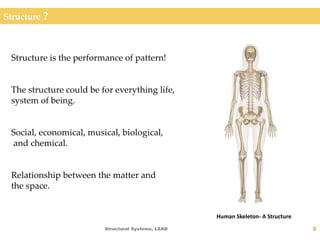
Structure is the performance of pattern!
The structure could be for everything life,
system of being.
Social, economical, musical, biological,
and chemical.
Relationship between the matter and
the space.
Structure ?
Human Skeleton- A Structure
Structural Systems, LSAD 3
Man-made structures are made by humans, whereas natural structures are structures
that occur naturally.
Man-Made Structures and Natural structures
Man Made Structures Natural Structures
Structural Systems, LSAD 4
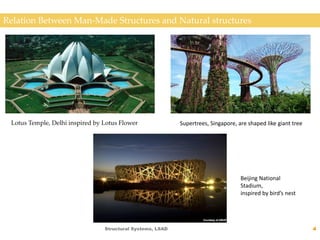
Relation Between Man-Made Structures and Natural structures
Lotus Temple, Delhi inspired by Lotus Flower
Beijing National
Stadium,
inspired by bird’s nest
Supertrees, Singapore, are shaped like giant tree
Structural Systems, LSAD 5
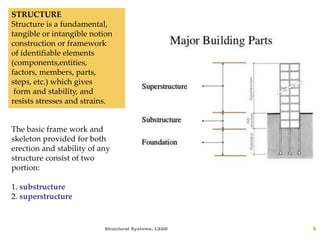
STRUCTURE
Structure is a fundamental,
tangible or intangible notion
construction or framework
of identifiable elements
(components,entities,
factors, members, parts,
steps, etc.) which gives
form and stability, and
resists stresses and strains.
The basic frame work and
skeleton provided for both
erection and stability of any
structure consist of two
portion:
1. substructure
2. superstructure
Structural Systems, LSAD
6
The relationship of structure to building
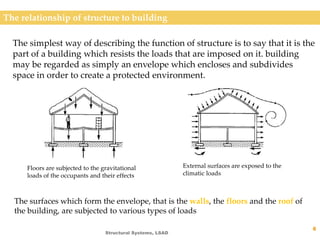
The simplest way of describing the function of structure is to say that it is the
part of a building which resists the loads that are imposed on it. building
may be regarded as simply an envelope which encloses and subdivides
space in order to create a protected environment.
The surfaces which form the envelope, that is the walls, the floors and the roof of
the building, are subjected to various types of loads
Floors are subjected to the gravitational
loads of the occupants and their effects
External surfaces are exposed to the
climatic loads
STRUCTURESYSTEM
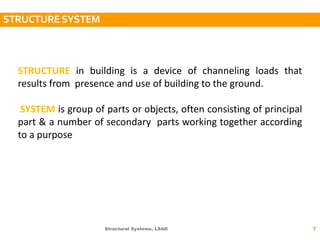
STRUCTURE in building is a device of channeling loads that
results from presence and use of building to the ground.
SYSTEM is group of parts or objects, often consisting of principal
part & a number of secondary parts working together according
to a purpose
Structural Systems, LSAD 7
Structural Systems, LSAD 8
Structural Requirements
• EQUILIBRIUM
• GEOMETRICALLY STABLE
• STRENGTH
• ADEQUATE RIGIDITY
Structural Systems, LSAD 9
Why we need the Structural Systems?
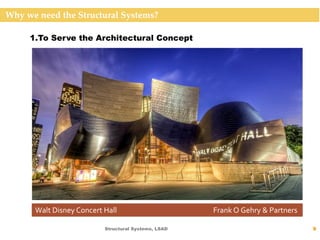
1.To Serve the Architectural Concept
Walt Disney Concert Hall Frank O Gehry & Partners
Structural Systems, LSAD 10
Why we need the Structural Systems?
2.To Carry Long Spans
Golden Gate Bridge, USA American Society of Civil Engineers
Structural Systems, LSAD 11
Why we need the Structural Systems?
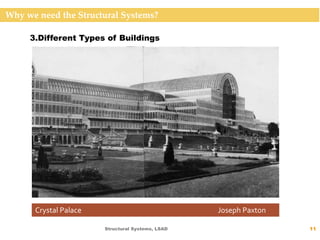
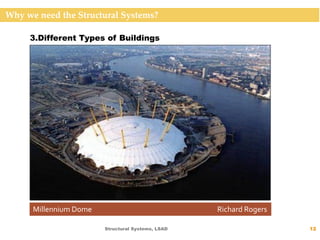
3.Different Types of Buildings
Crystal Palace Joseph Paxton
Structural Systems, LSAD 12
Why we need the Structural Systems?
3.Different Types of Buildings
Millennium Dome Richard Rogers
Structural Systems, LSAD 13
Why we need the Structural Systems?
4.Tall Structures
Burj Khalifa, Dubai Skidmore, Owings & Merrill (SOM)
Section/ Bulk Active Structural Systems
Section active structural systems are systems of rigid, solid, linear elements, in
which redirection of forces is effected by mobilization of sectional forces. They
transmit building loads to the ground mainly through bending moments.
Example of structures:
1. Beam structures
2. Frame structures
3. Slab structures
Structural Systems, LSAD 14
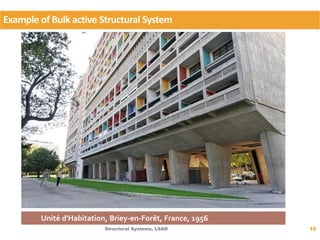
Example of Bulk active Structural System
Unité d'Habitation, Briey-en-Forêt, France, 1956
Structural Systems, LSAD 15
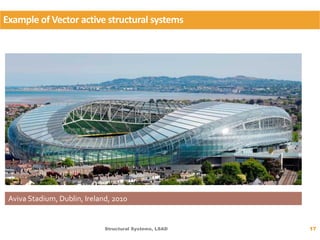
Vector active structural systems
Vector active structural systems are systems of short, solid, straight linear
members, in which the redirection of forces is effected by vector partition, i.e.
by multidirectional splitting of single force simply to tension or compressive
elements.
The individual members of these structures are subject only to coactive stress
condition compression and tension
Example of structures:
1. Flat trusses
2. Curved trusses
3. Space trusses
Structural Systems, LSAD 16
Example of Vector active structural systems
Aviva Stadium, Dublin, Ireland, 2010
Structural Systems, LSAD 17
Form ActiveStructuralSystems
Form Active Structural Systems are systems of flexible, non-rigid matter, in
which the redirection of forces is effected by particular form design and
characteristic form stabilization. These structural systems are exposed to
single stress condition (compression or tension).
Example of structures:
1. Cable structures
2. Tent structures
3. Pneumatic structures
4. Arch structures
Structural Systems, LSAD 18
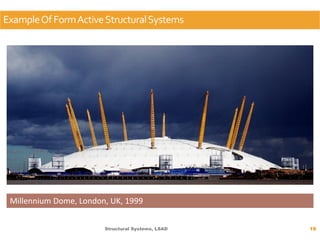
ExampleOfFormActiveStructuralSystems
Millennium Dome, London, UK, 1999
Structural Systems, LSAD 19
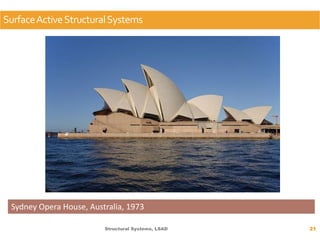
SurfaceActiveStructuralSystems
Surface Active Structural Systems are systems of flexible or rigid planes able to
resist tension, compression or shear, in which the redirection of forces is
effected by mobilization of sectional Forces. They are in surface stress
condition (bending moment or compression)
Example of structures:
1. Plate structures
2. Folded structures
3. Shell structures
Structural Systems, LSAD 20
SurfaceActiveStructuralSystems
Sydney Opera House, Australia, 1973
Structural Systems, LSAD 21
Structural Systems, LSAD 22
Questions?

Lecture 1 Structure Systems Basics

  • 1.
    Structural System and Importance CourseCode ARC 234 Lovely School of Architecture & Design Lovely Professional University Lecture 1
  • 2.
    Structural Systems, LSAD2 Structure is the performance of pattern! The structure could be for everything life, system of being. Social, economical, musical, biological, and chemical. Relationship between the matter and the space. Structure ? Human Skeleton- A Structure
  • 3.
    Structural Systems, LSAD3 Man-made structures are made by humans, whereas natural structures are structures that occur naturally. Man-Made Structures and Natural structures Man Made Structures Natural Structures
  • 4.
    Structural Systems, LSAD4 Relation Between Man-Made Structures and Natural structures Lotus Temple, Delhi inspired by Lotus Flower Beijing National Stadium, inspired by bird’s nest Supertrees, Singapore, are shaped like giant tree
  • 5.
    Structural Systems, LSAD5 STRUCTURE Structure is a fundamental, tangible or intangible notion construction or framework of identifiable elements (components,entities, factors, members, parts, steps, etc.) which gives form and stability, and resists stresses and strains. The basic frame work and skeleton provided for both erection and stability of any structure consist of two portion: 1. substructure 2. superstructure
  • 6.
    Structural Systems, LSAD 6 Therelationship of structure to building The simplest way of describing the function of structure is to say that it is the part of a building which resists the loads that are imposed on it. building may be regarded as simply an envelope which encloses and subdivides space in order to create a protected environment. The surfaces which form the envelope, that is the walls, the floors and the roof of the building, are subjected to various types of loads Floors are subjected to the gravitational loads of the occupants and their effects External surfaces are exposed to the climatic loads
  • 7.
    STRUCTURESYSTEM STRUCTURE in buildingis a device of channeling loads that results from presence and use of building to the ground. SYSTEM is group of parts or objects, often consisting of principal part & a number of secondary parts working together according to a purpose Structural Systems, LSAD 7
  • 8.
    Structural Systems, LSAD8 Structural Requirements • EQUILIBRIUM • GEOMETRICALLY STABLE • STRENGTH • ADEQUATE RIGIDITY
  • 9.
    Structural Systems, LSAD9 Why we need the Structural Systems? 1.To Serve the Architectural Concept Walt Disney Concert Hall Frank O Gehry & Partners
  • 10.
    Structural Systems, LSAD10 Why we need the Structural Systems? 2.To Carry Long Spans Golden Gate Bridge, USA American Society of Civil Engineers
  • 11.
    Structural Systems, LSAD11 Why we need the Structural Systems? 3.Different Types of Buildings Crystal Palace Joseph Paxton
  • 12.
    Structural Systems, LSAD12 Why we need the Structural Systems? 3.Different Types of Buildings Millennium Dome Richard Rogers
  • 13.
    Structural Systems, LSAD13 Why we need the Structural Systems? 4.Tall Structures Burj Khalifa, Dubai Skidmore, Owings & Merrill (SOM)
  • 14.
    Section/ Bulk ActiveStructural Systems Section active structural systems are systems of rigid, solid, linear elements, in which redirection of forces is effected by mobilization of sectional forces. They transmit building loads to the ground mainly through bending moments. Example of structures: 1. Beam structures 2. Frame structures 3. Slab structures Structural Systems, LSAD 14
  • 15.
    Example of Bulkactive Structural System Unité d'Habitation, Briey-en-Forêt, France, 1956 Structural Systems, LSAD 15
  • 16.
    Vector active structuralsystems Vector active structural systems are systems of short, solid, straight linear members, in which the redirection of forces is effected by vector partition, i.e. by multidirectional splitting of single force simply to tension or compressive elements. The individual members of these structures are subject only to coactive stress condition compression and tension Example of structures: 1. Flat trusses 2. Curved trusses 3. Space trusses Structural Systems, LSAD 16
  • 17.
    Example of Vectoractive structural systems Aviva Stadium, Dublin, Ireland, 2010 Structural Systems, LSAD 17
  • 18.
    Form ActiveStructuralSystems Form ActiveStructural Systems are systems of flexible, non-rigid matter, in which the redirection of forces is effected by particular form design and characteristic form stabilization. These structural systems are exposed to single stress condition (compression or tension). Example of structures: 1. Cable structures 2. Tent structures 3. Pneumatic structures 4. Arch structures Structural Systems, LSAD 18
  • 19.
  • 20.
    SurfaceActiveStructuralSystems Surface Active StructuralSystems are systems of flexible or rigid planes able to resist tension, compression or shear, in which the redirection of forces is effected by mobilization of sectional Forces. They are in surface stress condition (bending moment or compression) Example of structures: 1. Plate structures 2. Folded structures 3. Shell structures Structural Systems, LSAD 20
  • 21.
    SurfaceActiveStructuralSystems Sydney Opera House,Australia, 1973 Structural Systems, LSAD 21
  • 22.