BUILDING CONSTRUCTION II ( BLD 60703/ARC 2513 )
PROJECT 1:
SKELETAL CONSTRUCTION (Temporary bus station)
Yew Wing Kee
Chong Yi Hui
Vun Tze Lin
Wong Cho Mun
Tung Siew Hui
0323555
0324404
0323301
0322723
0323823
Tutor : Mr. Mohamed Rizal Mohamed
1
INDEX
I. Abstract
II. Design Process
III. Design Consideration
IV. Skeletal Structure
V. Material Selection
VI. Axonometric
VII. Construction Detail
VIII. Joints
IX. Structural Strength
X. Orthographic drawings
2
CHONG YI HUI 0324404
TUNG SIEW HUI 0323823
VUN TZE LIN 0323301
WONG CHO MUN 0322723
YEW WING KEE 0323555
ABSTRACT : SKELETAL CONSTRUCTION
Skeletal Construction is one of the widely used structures for building support, thus it is important for us to
experience and gain knowledge to understand it. A skeletal structure is in which weight is conveyed by a
framework, rather than being upheld by walls. A frame is a structure used to resists vertical forces such as
gravity, rain, dead and live load and also resists lateral forces such as wind.
For this assignment, we were assigned into groups to construct a temporary bus stop in a scale 1:5 to
demonstrate our insight into skeletal structure in and applying the use of recyclable materials relating with its
function.
After exploring on different types of materials for our shelter, we decided to use timber and steel joints for
our skeletal structure. Timber is an easily renewed material which can be recycled after usage.
4
DESIGN PROCESS
MOCK UP 1
Scale: 1:50
A small model is made to show the joints
connection and for better understanding of the
structure.
MOCK UP 2
Scale: 1 : 1
An improvised to scale digital model is made for
clearer understanding of the skeletal structure
and materials used.
5
DESIGN PROCESS
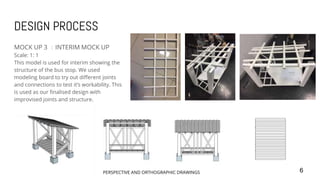
MOCK UP 3 :INTERIM MOCK UP
Scale: 1: 1
This model is used for interim showing the
structure of the bus stop. We used
modeling board to try out different joints
and connections to test it’s workability. This
is used as our finalised design with
improvised joints and structure.
6PERSPECTIVE AND ORTHOGRAPHIC DRAWINGS
DESIGN CONSIDERATION
Weather Resistant
The design of our bus stop is
to accommodate with our
tropical climate, where the
users would be protected
from direct sunlight and also
rain.
Ventilation
Openings throughout the bus
stop to ensure the users
receive sufficient ventilation.
Assesibility
The bus stop can only be
accessed through the front
to enable a ‘one-way’
circulation.
Function
The function of the bus stop
varies, depending on the
users themselves. It works
as a shed and resting area
for users while waiting for
their bus.
7
SKELETAL STRUCTURE
8
PRIMARY STRUCTURE SECONDARY STRUCTURE
FLOOR JOIST
COLUMN
ROOF BEAM
PURLIN
BRACING
MATERIAL SELECTION
The materials used for our shelter is one of the important
factor to ensure our building structural strength. We used
wood for our temporary shelter, as wood is a readily available
material which can be renewed.
Our group sourced our recycled wood from the leftovers of
the carpentry workshop, and our joint connectors from
hardware shop.
Plastic corrugated roof decking is used as an alternative
material metal roof decking because it is easily combined, the
decking panels are mechanically fastened
9
MATERIAL SELECTION
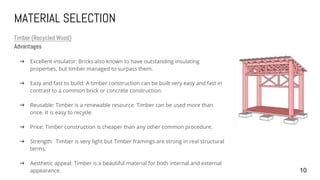
Timber (Recycled Wood)
Advantages
➔ Excellent insulator: Bricks also known to have outstanding insulating
properties, but timber managed to surpass them.
➔ Easy and fast to build: A timber construction can be built very easy and fast in
contrast to a common brick or concrete construction.
➔ Reusable: Timber is a renewable resource. Timber can be used more than
once. It is easy to recycle
➔ Price: Timber construction is cheaper than any other common procedure.
➔ Strength: Timber is very light but Timber framings are strong in real structural
terms.
➔ Aesthetic appeal: Timber is a beautiful material for both internal and external
appearance. 10
MATERIAL SELECTION
Timber (Recycled Wood)
Disadvantages
➔ Shrinking and swelling: Timber has a natural ability to absorb water.
➔ Fire resistance: If timber has not passed a special treatment which ensure a
special fire rating, timber is highly combustable.
➔ Discolouration: With the time untreated timber which is exposed to the
different weather influences it discolours turns to a dark and dirty optic.
➔ Mouldiness: If timber is treated wrong or the installation is not regulated
accordingly, timber has the ability to mould.
11
MATERIAL SELECTION
Transparent polycarbonate corrugated roofing
Advantages
➔ Better optical properties: It is only corrugated plastic roofing sheets which will
guarantee a more sustainable property. Semi-translucent semi corrugated plastics to
create skylights so that no need to turn on electricity during the day since this
material will allow sufficient amount of light during the day.
➔ Low maintenance costs: Corrugated plastics are extremely easy to clean thus.
➔ They are durable: Most corrugated plastic roofing sheets are coated with anti-scratch
coating and ultraviolet protection.
➔ Cost effectiveness: Economically, it is perfect choice for both short-term and long-
term investment. The installation process is pretty simple and not labor intensive.
Disadvantages
➔ Initial Expenses: It is quite expensive due to the advantages above.
12
MATERIAL SELECTION
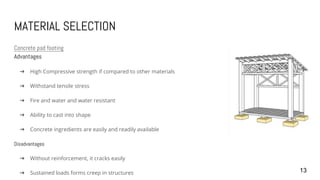
Concrete pad footing
Advantages
➔ High Compressive strength if compared to other materials
➔ Withstand tensile stress
➔ Fire and water and water resistant
➔ Ability to cast into shape
➔ Concrete ingredients are easily and readily available
Disadvantages
➔ Without reinforcement, it cracks easily
➔ Sustained loads forms creep in structures 13
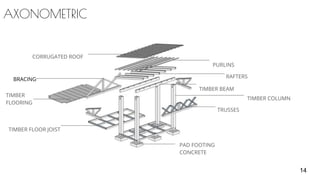
AXONOMETRIC
14
CORRUGATED ROOF
TIMBER
FLOORING
TIMBER FLOOR JOIST
PURLINS
RAFTERS
TIMBER BEAM
TIMBER COLUMN
TRUSSES
PAD FOOTING
CONCRETE
BRACING
CONSTRUCTION DETAIL: Joints
Clip angles for superimposed
beams; provide for lateral
stability
Dado joint will be used to
hold the beam and column
together and then secured
with brackets
Rabbet joints is used to
connect the floor to the
column
The flooring of the bus stop
is secured with lap joints.
The flooring is nailed to the
floor joist.
15
JOINTS
16
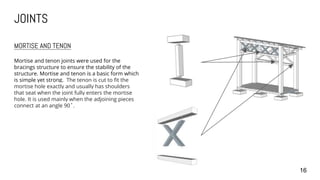
MORTISE AND TENON
Mortise and tenon joints were used for the
bracings structure to ensure the stability of the
structure. Mortise and tenon is a basic form which
is simple yet strong. The tenon is cut to fit the
mortise hole exactly and usually has shoulders
that seat when the joint fully enters the mortise
hole. It is used mainly when the adjoining pieces
connect at an angle 90˚.
17
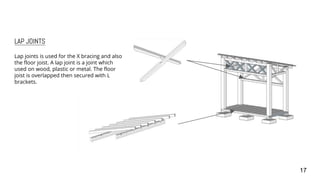
LAP JOINTS
Lap joints is used for the X bracing and also
the floor joist. A lap joint is a joint which
used on wood, plastic or metal. The floor
joist is overlapped then secured with L
brackets.
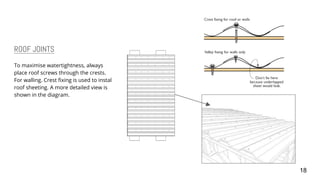
ROOF JOINTS
To maximise watertightness, always
place roof screws through the crests.
For walling. Crest fixing is used to instal
roof sheeting. A more detailed view is
shown in the diagram.
18
STRUCTURAL STRENGTH
19
Skeletal load transfer - Two way system
● Uniform load distributed in two direction
● Force is channeled from beams to column
External Forces - Loads
● Static load
- The weight of the roof structure is distributed to the column
● Dynamic load
- When users get on and off the structure
The main load is carried by the the beams and columns. Load is distributed
evenly throughout the structure, with suitable joints and connections the
structure can be strengthened. Bracings are added to increase lateral and
vertical rigidity.
ORTHOGRAPHIC DRAWINGS
PLANS
Plan View Left elevation
Right elevation
20
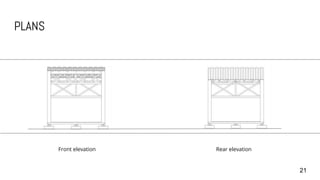
PLANS
Front elevation Rear elevation
21
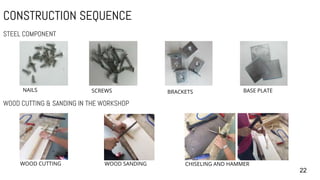
CONSTRUCTION SEQUENCE
22
STEEL COMPONENT
WOOD CUTTING & SANDING IN THE WORKSHOP
NAILS SCREWS BRACKETS BASE PLATE
WOOD CUTTING WOOD SANDING CHISELING AND HAMMER
23
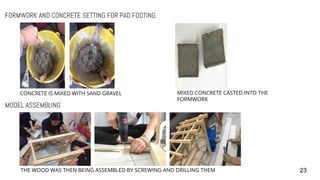
FORMWORK AND CONCRETE SETTING FOR PAD FOOTING
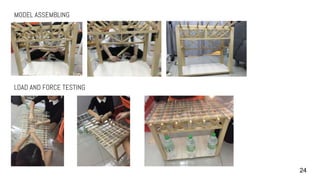
MODEL ASSEMBLING
CONCRETE IS MIXED WITH SAND GRAVEL MIXED CONCRETE CASTED INTO THE
FORMWORK
THE WOOD WAS THEN BEING ASSEMBLED BY SCREWING AND DRILLING THEM
24
MODEL ASSEMBLING
LOAD AND FORCE TESTING
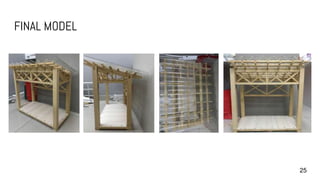
FINAL MODEL
25
REFERENCE
Ching, F. (2014). Building construction illustrated. Hoboken, NJ: Wiley.
https://www.pinterest.com/pin/520939881887632147/
McKay, W. B., & McKay, J. K. (1975). Building construction. London: Longman.
Lecture slides
26
CONCLUSION
In this assignment, we were given the task to construct a temporary bus shelter in order to
present our knowledge of the skeletal structure in and applying the usage of recyclable
materials relating to its function. The building process should demonstrate the
understanding of skeletal frames and its joints. Besides that, it should clearly express all
building elements such as column, roof, walls, and floor. The joints which we apply should
reflect actual joints. Lastly, the model is to be built in the scale 1:5.
Throughout this project, we manage to get the grasp of the skeletal construction to analyse
the subject of strength and stability of structures including the modes of structural system,
forces, stress and strain of skeletal structures. We also learnt how to overcome the force and
stress applied to a structure with suitable construction methods.
27

Building construction report

  • 1.
    BUILDING CONSTRUCTION II( BLD 60703/ARC 2513 ) PROJECT 1: SKELETAL CONSTRUCTION (Temporary bus station) Yew Wing Kee Chong Yi Hui Vun Tze Lin Wong Cho Mun Tung Siew Hui 0323555 0324404 0323301 0322723 0323823 Tutor : Mr. Mohamed Rizal Mohamed 1
  • 2.
    INDEX I. Abstract II. DesignProcess III. Design Consideration IV. Skeletal Structure V. Material Selection VI. Axonometric VII. Construction Detail VIII. Joints IX. Structural Strength X. Orthographic drawings 2
  • 3.
    CHONG YI HUI0324404 TUNG SIEW HUI 0323823 VUN TZE LIN 0323301 WONG CHO MUN 0322723 YEW WING KEE 0323555
  • 4.
    ABSTRACT : SKELETALCONSTRUCTION Skeletal Construction is one of the widely used structures for building support, thus it is important for us to experience and gain knowledge to understand it. A skeletal structure is in which weight is conveyed by a framework, rather than being upheld by walls. A frame is a structure used to resists vertical forces such as gravity, rain, dead and live load and also resists lateral forces such as wind. For this assignment, we were assigned into groups to construct a temporary bus stop in a scale 1:5 to demonstrate our insight into skeletal structure in and applying the use of recyclable materials relating with its function. After exploring on different types of materials for our shelter, we decided to use timber and steel joints for our skeletal structure. Timber is an easily renewed material which can be recycled after usage. 4
  • 5.
    DESIGN PROCESS MOCK UP1 Scale: 1:50 A small model is made to show the joints connection and for better understanding of the structure. MOCK UP 2 Scale: 1 : 1 An improvised to scale digital model is made for clearer understanding of the skeletal structure and materials used. 5
  • 6.
    DESIGN PROCESS MOCK UP3 :INTERIM MOCK UP Scale: 1: 1 This model is used for interim showing the structure of the bus stop. We used modeling board to try out different joints and connections to test it’s workability. This is used as our finalised design with improvised joints and structure. 6PERSPECTIVE AND ORTHOGRAPHIC DRAWINGS
  • 7.
    DESIGN CONSIDERATION Weather Resistant Thedesign of our bus stop is to accommodate with our tropical climate, where the users would be protected from direct sunlight and also rain. Ventilation Openings throughout the bus stop to ensure the users receive sufficient ventilation. Assesibility The bus stop can only be accessed through the front to enable a ‘one-way’ circulation. Function The function of the bus stop varies, depending on the users themselves. It works as a shed and resting area for users while waiting for their bus. 7
  • 8.
    SKELETAL STRUCTURE 8 PRIMARY STRUCTURESECONDARY STRUCTURE FLOOR JOIST COLUMN ROOF BEAM PURLIN BRACING
  • 9.
    MATERIAL SELECTION The materialsused for our shelter is one of the important factor to ensure our building structural strength. We used wood for our temporary shelter, as wood is a readily available material which can be renewed. Our group sourced our recycled wood from the leftovers of the carpentry workshop, and our joint connectors from hardware shop. Plastic corrugated roof decking is used as an alternative material metal roof decking because it is easily combined, the decking panels are mechanically fastened 9
  • 10.
    MATERIAL SELECTION Timber (RecycledWood) Advantages ➔ Excellent insulator: Bricks also known to have outstanding insulating properties, but timber managed to surpass them. ➔ Easy and fast to build: A timber construction can be built very easy and fast in contrast to a common brick or concrete construction. ➔ Reusable: Timber is a renewable resource. Timber can be used more than once. It is easy to recycle ➔ Price: Timber construction is cheaper than any other common procedure. ➔ Strength: Timber is very light but Timber framings are strong in real structural terms. ➔ Aesthetic appeal: Timber is a beautiful material for both internal and external appearance. 10
  • 11.
    MATERIAL SELECTION Timber (RecycledWood) Disadvantages ➔ Shrinking and swelling: Timber has a natural ability to absorb water. ➔ Fire resistance: If timber has not passed a special treatment which ensure a special fire rating, timber is highly combustable. ➔ Discolouration: With the time untreated timber which is exposed to the different weather influences it discolours turns to a dark and dirty optic. ➔ Mouldiness: If timber is treated wrong or the installation is not regulated accordingly, timber has the ability to mould. 11
  • 12.
    MATERIAL SELECTION Transparent polycarbonatecorrugated roofing Advantages ➔ Better optical properties: It is only corrugated plastic roofing sheets which will guarantee a more sustainable property. Semi-translucent semi corrugated plastics to create skylights so that no need to turn on electricity during the day since this material will allow sufficient amount of light during the day. ➔ Low maintenance costs: Corrugated plastics are extremely easy to clean thus. ➔ They are durable: Most corrugated plastic roofing sheets are coated with anti-scratch coating and ultraviolet protection. ➔ Cost effectiveness: Economically, it is perfect choice for both short-term and long- term investment. The installation process is pretty simple and not labor intensive. Disadvantages ➔ Initial Expenses: It is quite expensive due to the advantages above. 12
  • 13.
    MATERIAL SELECTION Concrete padfooting Advantages ➔ High Compressive strength if compared to other materials ➔ Withstand tensile stress ➔ Fire and water and water resistant ➔ Ability to cast into shape ➔ Concrete ingredients are easily and readily available Disadvantages ➔ Without reinforcement, it cracks easily ➔ Sustained loads forms creep in structures 13
  • 14.
    AXONOMETRIC 14 CORRUGATED ROOF TIMBER FLOORING TIMBER FLOORJOIST PURLINS RAFTERS TIMBER BEAM TIMBER COLUMN TRUSSES PAD FOOTING CONCRETE BRACING
  • 15.
    CONSTRUCTION DETAIL: Joints Clipangles for superimposed beams; provide for lateral stability Dado joint will be used to hold the beam and column together and then secured with brackets Rabbet joints is used to connect the floor to the column The flooring of the bus stop is secured with lap joints. The flooring is nailed to the floor joist. 15
  • 16.
    JOINTS 16 MORTISE AND TENON Mortiseand tenon joints were used for the bracings structure to ensure the stability of the structure. Mortise and tenon is a basic form which is simple yet strong. The tenon is cut to fit the mortise hole exactly and usually has shoulders that seat when the joint fully enters the mortise hole. It is used mainly when the adjoining pieces connect at an angle 90˚.
  • 17.
    17 LAP JOINTS Lap jointsis used for the X bracing and also the floor joist. A lap joint is a joint which used on wood, plastic or metal. The floor joist is overlapped then secured with L brackets.
  • 18.
    ROOF JOINTS To maximisewatertightness, always place roof screws through the crests. For walling. Crest fixing is used to instal roof sheeting. A more detailed view is shown in the diagram. 18
  • 19.
    STRUCTURAL STRENGTH 19 Skeletal loadtransfer - Two way system ● Uniform load distributed in two direction ● Force is channeled from beams to column External Forces - Loads ● Static load - The weight of the roof structure is distributed to the column ● Dynamic load - When users get on and off the structure The main load is carried by the the beams and columns. Load is distributed evenly throughout the structure, with suitable joints and connections the structure can be strengthened. Bracings are added to increase lateral and vertical rigidity.
  • 20.
    ORTHOGRAPHIC DRAWINGS PLANS Plan ViewLeft elevation Right elevation 20
  • 21.
  • 22.
    CONSTRUCTION SEQUENCE 22 STEEL COMPONENT WOODCUTTING & SANDING IN THE WORKSHOP NAILS SCREWS BRACKETS BASE PLATE WOOD CUTTING WOOD SANDING CHISELING AND HAMMER
  • 23.
    23 FORMWORK AND CONCRETESETTING FOR PAD FOOTING MODEL ASSEMBLING CONCRETE IS MIXED WITH SAND GRAVEL MIXED CONCRETE CASTED INTO THE FORMWORK THE WOOD WAS THEN BEING ASSEMBLED BY SCREWING AND DRILLING THEM
  • 24.
  • 25.
  • 26.
    REFERENCE Ching, F. (2014).Building construction illustrated. Hoboken, NJ: Wiley. https://www.pinterest.com/pin/520939881887632147/ McKay, W. B., & McKay, J. K. (1975). Building construction. London: Longman. Lecture slides 26
  • 27.
    CONCLUSION In this assignment,we were given the task to construct a temporary bus shelter in order to present our knowledge of the skeletal structure in and applying the usage of recyclable materials relating to its function. The building process should demonstrate the understanding of skeletal frames and its joints. Besides that, it should clearly express all building elements such as column, roof, walls, and floor. The joints which we apply should reflect actual joints. Lastly, the model is to be built in the scale 1:5. Throughout this project, we manage to get the grasp of the skeletal construction to analyse the subject of strength and stability of structures including the modes of structural system, forces, stress and strain of skeletal structures. We also learnt how to overcome the force and stress applied to a structure with suitable construction methods. 27