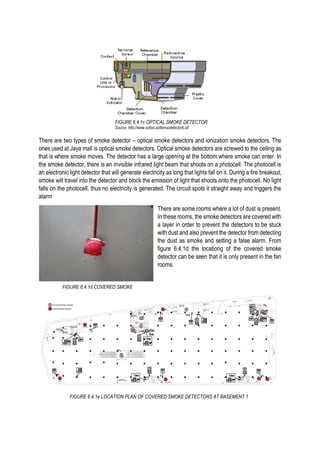
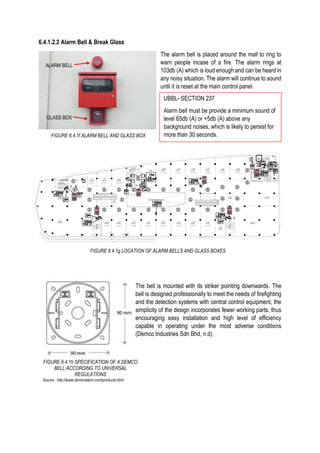
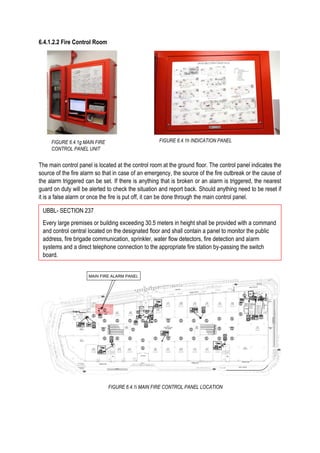
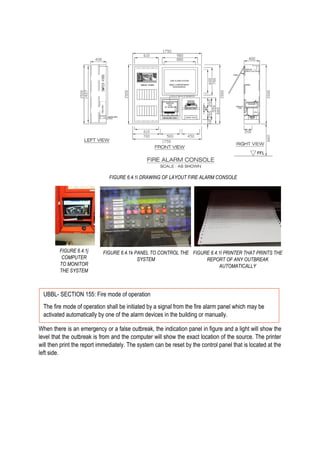
BUILDINGSERVICE
GROUPMEMBERS
CHANPINQI 0314676
CHOONGLAIMUN 0313573
JOLENEHOR 0313751
LEEJOYEE 0314880
NAAJID NASEEM 0311649
PRESPRESTONLIEWRUPING 0313822
LECTURER
MRSIVAMANKUPPUSAMY
CASESTUDYANDDOCUMENTATION
OFBUILDINGSERVICESSYSTEM
JAYASHOPPINGMALLSEKSYEN14,PETALINGJAYA
ARC2423
TABLE OF CONTENT
1. ABSTRACT
2. ACKNOWLEDGEMENT
3. INTRODUCTION
4. MECHANICAL VENTILATION SYSTEM
4.1 INTRODUCTION
4.2 LITERATURE REVIEW
4.3 CASE STUDY
4.3.1 SUPPLY VENTILATION SYSTEM
4.3.2 EXHAUST VENTILATION SYSTEM
4.3.3 COMBINED VENTILATION SYSTEM
4.4 COMPONENTS OF THE SYSTEM
4.4.1.1 FAN
4.4.1.1.1 PROPELLER FAN
4.4.1.1.2 AXIAL FLOW FAN
4.4.1.2 FIRE DAMPER
4.4.1.3 DUCTWORKS
4.4.1.4 FILTER
4.4.1.5 DIFFUSER
4.5 CONCLUSION
5. AIR-CONDITIONING SYSTEM
5.1 INTRODUCTION
5.2 LITERATURE REVIEW
5.3 CASE STUDY
5.4 COMPONENTS OF THE SYSTEM
5.4.1 REFRIGERANT CYCLE
5.4.1.1 WATER TANKS
5.4.1.2 COOLING TOWER
5.4.1.3 CHILLER PLANTS ROOM
5.4.1.3 CHILLERS
5.4.1.4 CONTROL UNIT
5.4.1.5 WATER PUMP SETS
5.4.2 AIR CYCLE
5.4.2.1 AIR HANDLING UNIT (A.H.U.)
5.4.2.2 AIR FILTER
5.4.2.3 BLOWER FAN
5.4.2.4 DUCTWORK AND DIFFUSERS
5.4.2.5 FAN COIL UNITS (F.C.U.)
5.5 CONTROL SYSTEM
5.6 CONCLUSION
6. FIRE PROTECTION SYSTEM
6.1 INTRODUCTION
6.2 LITERATURE REVIEW
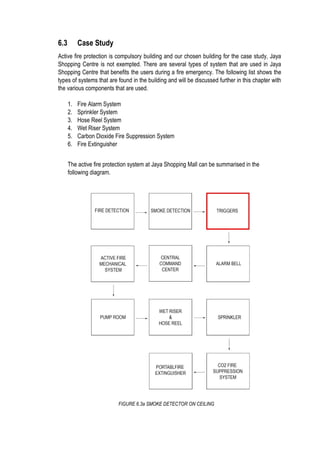
6.3 CASE STUDY
6.4 ACTIVE FIRE PROTECTION SYSTEM
6.4.1 FIRE ALARM SYSTEM
6.4.1.1 OVERVIEW
6.4.1.2 COMPONENTS
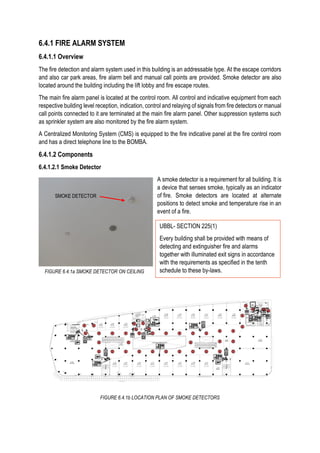
6.4.1.2.1 SMOKE DETECTOR
6.4.1.2.2 ALARM BELL & BREAK GLASS
6.4.1.2.3 FIRE CONTROL ROOM
6.4.1.2.4 VOICE COMMUNICATION
6.4.1.2.5 FIRE SWITCH
6.4.1.2.6 MANUAL PULL SWITCH
6.4.1.3 SYSTEM OPERATION
6.4.2 SPINKLER SYSTEM
6.4.2.1 OVERVIEW
6.4.2.2 COMPONENTS
6.4.2.2.1 SPRINKLER
6.4.2.2.2 BUTTERFLY VALVE
6.4.2.2.3 PUMPS
6.4.2.2.4 WATER TANK
6.4.2.3 SYSTEM OPERATION
6.4.3 HOSE REEL SYSTEM
6.4.3.1 OVERVIEW
6.4.3.2 COMPONENTS
6.4.3.2.1 HOSE REEL DRUM
6.4.3.2.2 HOSE REEL DRUM PUMPS
6.4.3.3 SYSTEM OPERATION
6.4.4 WET RISER SYSTEM
6.4.4.1 OVERVIEW
6.4.4.2 COMPONENTS
6.4.4.2.1 WET RISER
6.4.4.2.2 WET RISER PUMP SETS
6.4.4.2.3 WET RISER PUMPS
6.4.4.3 SYSTEM OPERATION
6.4.5 CARBON DIOXIDE FIRE SUPPRESSION SYSTEM 6.4.4.1 OVERVIEW
6.4.5.1 OVERVIEW
6.4.5.2 COMPONENTS
6.4.5.2.1 CO2
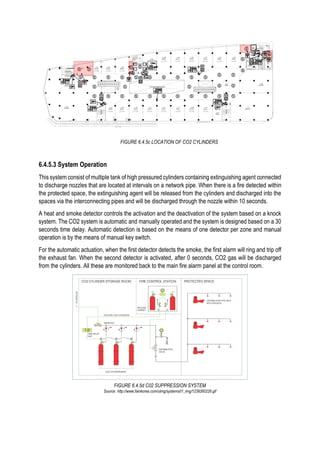
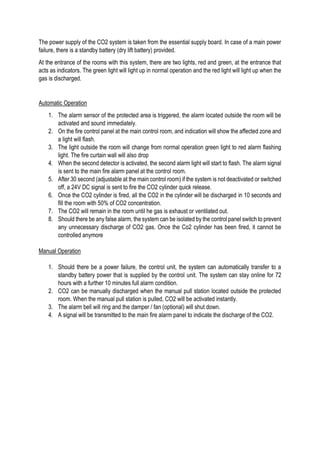
6.4.5.3 SYSTEM OPERATION
6.4.6 FIRE EXTINGUISHER
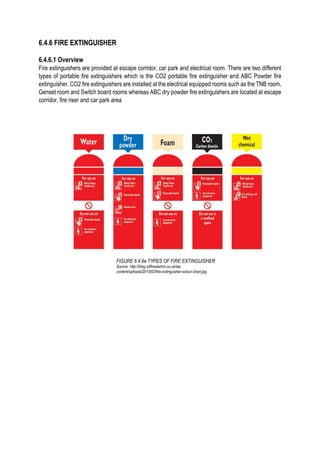
6.4.6.1 OVERVIEW
6.4.6.2 COMPONENTS
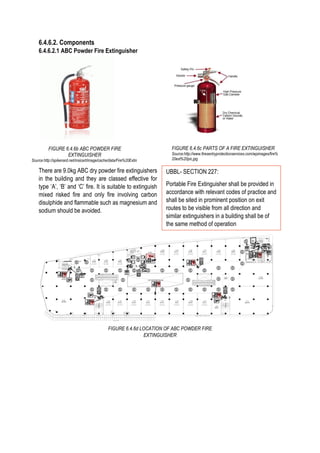
6.4.6.2.1 ABC POWDER FIRE EXTINGUISHER
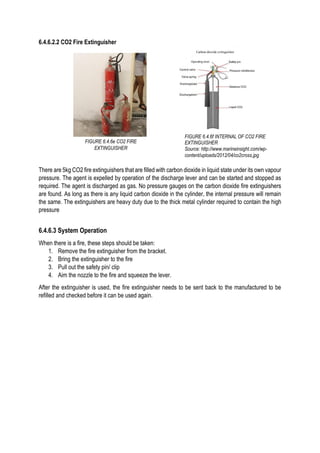
6.4.6.2.2 CO2 FIRE EXTINGUISHER
6.4.6.3 SYSTEM OPERATION
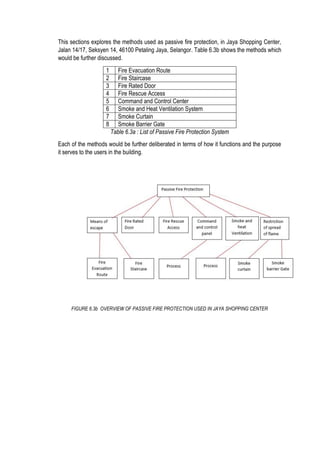
6.5 PASSIVE FIRE PROTECTION SYSTEM
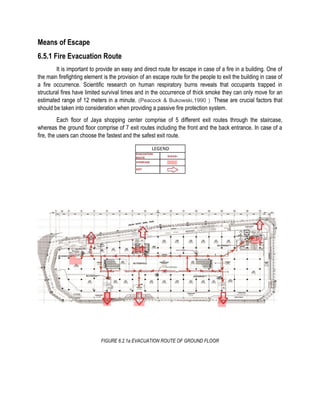
6.5.1 FIRE EVACUATION ROUTE
6.5.2 FIRE STAIRCASE
6.5.3 FIRE RATED DOOR
6.5.4 FIRE RESCUE ACCESS
6.5.5 COMMAND AND CONTROL CENTER
6.5.6 SMOKE CURTAIN
6.5.7 FIRE BARRIER GATE
6.6 CONCLUSION
7. MECHANICAL TRANSPORTATION SYSTEM
7.1 INTRODUCTION
7.2 LITERATURE REVIEW
7.2.1 ELEVATOR
7.2.2 ESCALATOR
7.2.3 TRAVELATOR
7.3 ELEVATOR
7.3.1 PASSENGER LIFT
7.3.2 SERVICE LIFT
7.3.3 EMERGENCY INDICATORS
7.4 ESCALATOR
7.5 TRAVELATOR
7.6 ANALYSIS
7.7 CONCLUSION
8. CONCLUSION
9. REFERENCES
1CHAPTER
ABSTRACT
For this project, we were assigned to select a building 5 storey high and perform a
thorough analysis on how some of the service systems in the building functions in a qualitative
form. This was to be achieved by experimental learning, through own observations and experience.
Our task was to produce an A4 bounded report with detailed analysis on how the services
components function in the building works. This was to be summarized in diagrammatic forms and
images.Therefore, this report is mainly about how the various service components in Jaya
shopping center functions exploring the advantages and disadvantages of the systems used.
Furthermore, each of the system is compared with the UBBL Law requirement in order to
get a better understanding of the space implications and the regulations related to different service
buildings. The positioning and the connections of the various service equipments are also
discussed in addition with diagrammatic images of how each of the system functions.
2CHAPTER
ACKNOWLEDGEMENT
This project was a success due to the help of a lot of people. To start with, on behalf of all
members of our group we would like to express our deepest gratitude to Mr. William, who
contributed his time to guide us through the visit to Jaya shopping Centre. It is also important to
acknowledge the whole management of Jaya shopping centre as they really helped in making this
visit a success.
On the visit to the shopping centre, we were guided by Mr.William and the facilities
manager officer to all the required service rooms where he briefly explained us how each of the
system functions. They were also kind enough to test out some of the machines in front of us to
make us understand better.
In addition to this, we would also like to thank our Lecturer Mr.Siva, who has guided us in
terms of getting a better understanding of the systems which were being used and helped us
develop our report throughout.
To sum up, this project helped us get a better understanding about the different services which
are provided in the building and this certainly was achieved once again due the help of MR William,
Jaya shopping centre management, and our lecturer.
3
CHAPTER
INTRODUCTION
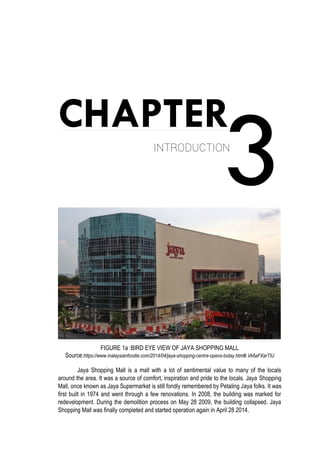
FIGURE 1a :BIRD EYE VIEW OF JAYA SHOPPING MALL
Source:https://www.malaysianfoodie.com/2014/04/jaya-shopping-centre-opens-today.html#.Vk6aFXarTIU
Jaya Shopping Mall is a mall with a lot of sentimental value to many of the locals
around the area. It was a source of comfort, inspiration and pride to the locals. Jaya Shopping
Mall, once known as Jaya Supermarket is still fondly remembered by Petaling Jaya folks. It was
first built in 1974 and went through a few renovations. In 2008, the building was marked for
redevelopment. During the demolition process on May 28 2009, the building collapsed. Jaya
Shopping Mall was finally completed and started operation again in April 28 2014.
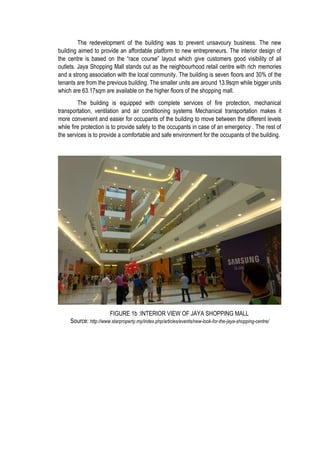
The redevelopment of the building was to prevent unsavoury business. The new
building aimed to provide an affordable platform to new entrepreneurs. The interior design of
the centre is based on the “race course” layout which give customers good visibility of all
outlets. Jaya Shopping Mall stands out as the neighbourhood retail centre with rich memories
and a strong association with the local community. The building is seven floors and 30% of the
tenants are from the previous building. The smaller units are around 13.9sqm while bigger units
which are 63.17sqm are available on the higher floors of the shopping mall.
The building is equipped with complete services of fire protection, mechanical
transportation, ventilation and air conditioning systems Mechanical transportation makes it
more convenient and easier for occupants of the building to move between the different levels
while fire protection is to provide safety to the occupants in case of an emergency . The rest of
the services is to provide a comfortable and safe environment for the occupants of the building.
FIGURE 1b :INTERIOR VIEW OF JAYA SHOPPING MALL
Source: http://www.starproperty.my/index.php/articles/events/new-look-for-the-jaya-shopping-centre/
4CHAPTER
MECHANICAL VENTILATION SYSTEM
4.1 Introduction
Ventilation is a process of exchanging air. It includes both replacing air from outside or
circulating air within a space. It is important in obtaining healthy and comfort condition. Ventilation
helps to prevent heat concentration (heat produced by lighting, machine and human) and air
humidity. Ventilation is also used to remove carbon dioxide, unpleasant smells, excessive moisture
and contaminants such as airborne bacteria, smoke to replenish the indoor space with oxygen to
maintain the percentage of oxygen at 21%. The disposal of gas plays a crucial role in fire
prevention. Therefore, a building should ensure a good air circulation for comfort and safety
purpose. Ventilation is divided into natural ventilation and mechanical ventilation. Natural
ventilation occurs when there’s air difference. It can be achieved via operable windows. Warm air
in the building rises to the upper openings and cool air is forced in to ventilate the building.
Although natural ventilation is energy saving, it is very climatic based and varies due to different
location. That’s when mechanical ventilation is introduced to reach the standard required of air in a
building.
Mechanical Ventilation is used for application where natural ventilation is not appropriate.
Without mechanical ventilation brings in fresh air, contaminants, heat, moisture, odors may be left
in the building and caused health problem as well as fire. Mechanical ventilation circulates fresh air
by using fans, ductwork rather than relying on openings. Air is being pushed inward or outward by
motorized fan, resulting in different air pressure state, and thus allowing the air to circulate around
the building in a mechanical way. This is more efficient than natural ventilation when the building is
built below ground level and has a huge coverage area.
The purpose of having mechanical ventilation primarily goes to the importance of fresh
outdoor air. Sometimes, indoor air is much more polluted than outdoor air. Mechanical ventilation
can thus provide a good air quality condition. Besides, mechanical ventilation is much more
controllable compare to the natural ventilation. Relying on airflow via openings through walls,
windows or roof, there’s no control of the source and the amount of airflow. In fact, air leaking in
the house may from undesirable area like garage or crawl space and thus increase the level of
pollutant in the air. The system is planned before-handed on the sources of airflow and is filtered
before entering the building. Air is brought in and pollutant is extracted out consistently and thus
provides a comfort living condition.
4.2 Literature Review
Mechanical ventilation can be found in various systems according to the function of the
space. There are three type of system, which are, supply ventilation system, extract ventilation and
combined ventilation system.
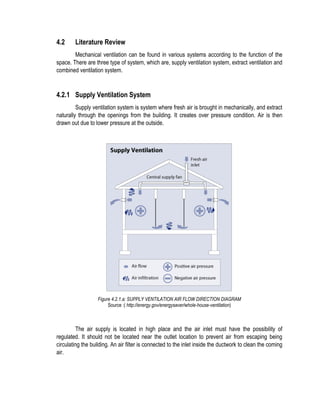
4.2.1 Supply Ventilation System
Supply ventilation system is system where fresh air is brought in mechanically, and extract
naturally through the openings from the building. It creates over pressure condition. Air is then
drawn out due to lower pressure at the outside.
Figure 4.2.1.a: SUPPLY VENTILATION AIR FLOW DIRECTION DIAGRAM
Source :( http://energy.gov/energysaver/whole-house-ventilation)
The air supply is located in high place and the air inlet must have the possibility of
regulated. It should not be located near the outlet location to prevent air from escaping being
circulating the building. An air filter is connected to the inlet inside the ductwork to clean the coming
air.
A fan or a set of ductwork is used to distribute the fresh air from outside or it can be
connect with the returning air duct, allowing the heating and cooling system’s fan and ducts to
process the outdoor air before being distributed.
The benefit of connecting to returning air duct is the outdoor air can be air-conditioned or
dehumidified before it is introduced into the room. At the same time refreshing the returning indoor
air. Supply ventilation system suitable for hot or mixed climates. It is because they pressurize the
house, but may have the potential to create moisture problem in cold climates.
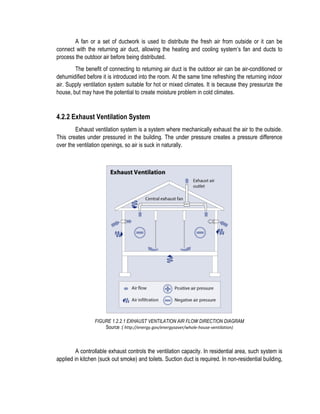
4.2.2 Exhaust Ventilation System
Exhaust ventilation system is a system where mechanically exhaust the air to the outside.
This creates under pressured in the building. The under pressure creates a pressure difference
over the ventilation openings, so air is suck in naturally.
FIGURE 1.2.2.1 EXHAUST VENTILATION AIR FLOW DIRECTION DIAGRAM
Source :( http://energy.gov/energysaver/whole-house-ventilation)
A controllable exhaust controls the ventilation capacity. In residential area, such system is
applied in kitchen (suck out smoke) and toilets. Suction duct is required. In non-residential building,
such system is applied in places like basement, corridor, food court and etc. The extraction of air
processes a loud noise. Thus, baffle filters can be used.
Single fan is installed in the duct connect to the central exhaust point to be expel to outside.
Passive vents are installed for the air to flow in. Passive vents however needed a large pressure
difference compare to those induced by mechanical supply system.
One concern of the exhaust ventilation system is that the possibilities of pollutants existence,
including Radon and molds from a crawlspace
 Dust from an attic
 Fumes from an attached garage
 Flue gases from a fireplace or fossil-fuel-fired water heater and furnace.
Exhaust ventilation contributes to higher operation energy and cost in heating or cooling the
air because the air supply is brought in naturally with contaminants and moisture.
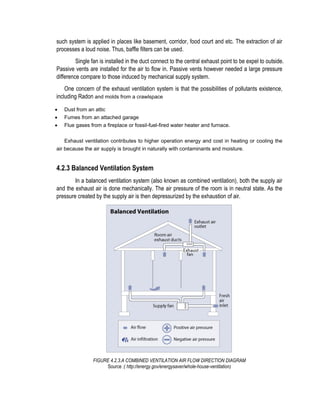
4.2.3 Balanced Ventilation System
In a balanced ventilation system (also known as combined ventilation), both the supply air
and the exhaust air is done mechanically. The air pressure of the room is in neutral state. As the
pressure created by the supply air is then depressurized by the exhaustion of air.
FIGURE 4.2.3.A COMBINED VENTILATION AIR FLOW DIRECTION DIAGRAM
Source :( http://energy.gov/energysaver/whole-house-ventilation)
This system is known as the most efficient way in ventilating the air as it is independence of
outdoor weather despite of noisy environment and high installation cost. The combination of
system requires two ducts and fan system. This system usually applied in the area where natural
ventilation hardly access or hard to control such as basement and suitable for all climates.
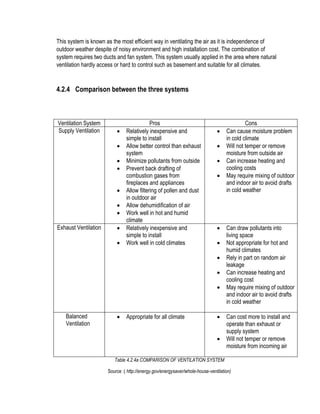
4.2.4 Comparison between the three systems
Table 4.2.4a COMPARISON OF VENTILATION SYSTEM
Source :( http://energy.gov/energysaver/whole-house-ventilation)
Ventilation System Pros Cons
Supply Ventilation  Relatively inexpensive and
simple to install
 Allow better control than exhaust
system
 Minimize pollutants from outside
 Prevent back drafting of
combustion gases from
fireplaces and appliances
 Allow filtering of pollen and dust
in outdoor air
 Allow dehumidification of air
 Work well in hot and humid
climate
 Can cause moisture problem
in cold climate
 Will not temper or remove
moisture from outside air
 Can increase heating and
cooling costs
 May require mixing of outdoor
and indoor air to avoid drafts
in cold weather
Exhaust Ventilation  Relatively inexpensive and
simple to install
 Work well in cold climates
 Can draw pollutants into
living space
 Not appropriate for hot and
humid climates
 Rely in part on random air
leakage
 Can increase heating and
cooling cost
 May require mixing of outdoor
and indoor air to avoid drafts
in cold weather
Balanced
Ventilation
 Appropriate for all climate  Can cost more to install and
operate than exhaust or
supply system
 Will not temper or remove
moisture from incoming air
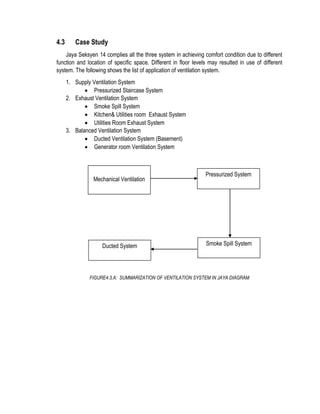
4.3 Case Study
Jaya Seksyen 14 complies all the three system in achieving comfort condition due to different
function and location of specific space. Different in floor levels may resulted in use of different
system. The following shows the list of application of ventilation system.
1. Supply Ventilation System
 Pressurized Staircase System
2. Exhaust Ventilation System
 Smoke Spill System
 Kitchen& Utilities room Exhaust System
 Utilities Room Exhaust System
3. Balanced Ventilation System
 Ducted Ventilation System (Basement)
 Generator room Ventilation System
FIGURE4.3.A: SUMMARIZATION OF VENTILATION SYSTEM IN JAYA DIAGRAM
Mechanical Ventilation
Pressurized System
Smoke Spill SystemDucted System
4.3.1. Pressurized System
Pressurization system is sometimes required especially in high-rise and under-ground
buildings. Pressurized an area with aspect to another adjacent area so that the smoke cannot enter
it. Pressurization of staircase occurred when a constant volume of fan running, pushing air through
any stair door that opens, create slightly higher pressure condition compare to the function space.
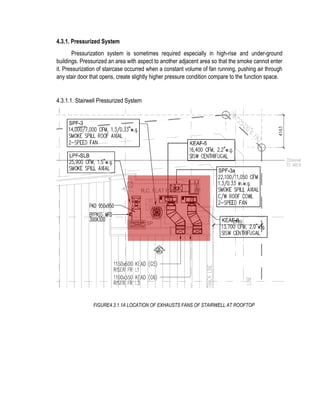
4.3.1.1. Stairwell Pressurized System
FIGURE4.3.1.1A LOCATION OF EXHAUSTS FANS OF STAIRWELL AT ROOFTOP
Source: Actuated-Dampers-In-Smoke-Control-System Pg26
For staircase pressurization system, all the fans are dual-speed completed with roof cowl
and located at the rooftop of staircase shaft. During normal condition, the fans will run in normal
speed for pressurization during fire mode.
The fans are controlled by the BAS (Building Automation System), will be overwritten by
fire signal and run at higher speed during fire mode to provide a highly pressured condition,
avoiding the smoke from entering.
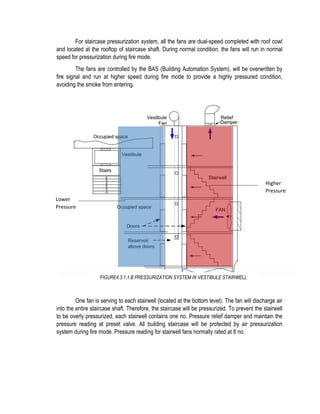
One fan is serving to each stairwell (located at the bottom level). The fan will discharge air
into the entire staircase shaft. Therefore, the staircase will be pressurized. To prevent the stairwell
to be overly pressurized, each stairwell contains one no. Pressure relief damper and maintain the
pressure reading at preset valve. All building staircase will be protected by air pressurization
system during fire mode. Pressure reading for stairwell fans normally rated at 8 no.
Higher
Pressure
Lower
Pressure
FIGURE4.3.1.1.B PRESSURIZATION SYSTEM IN VESTIBULE STAIRWELL
Source: Actuated-Dampers-In-Smoke-Control-System Pg26
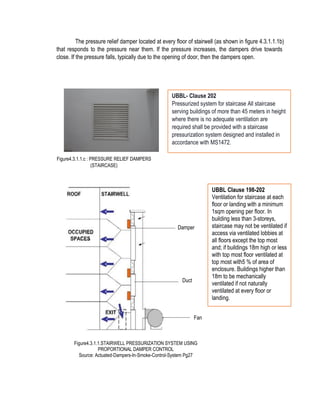
The pressure relief damper located at every floor of stairwell (as shown in figure 4.3.1.1.1b)
that responds to the pressure near them. If the pressure increases, the dampers drive towards
close. If the pressure falls, typically due to the opening of door, then the dampers open.
UBBL- Clause 202
Pressurized system for staircase All staircase
serving buildings of more than 45 meters in height
where there is no adequate ventilation are
required shall be provided with a staircase
pressurization system designed and installed in
accordance with MS1472.
Damper
Duct
Fan
Figure4.3.1.1.STAIRWELL PRESSURIZATION SYSTEM USING
PROPORTIONAL DAMPER CONTROL
Source: Actuated-Dampers-In-Smoke-Control-System Pg27
Figure4.3.1.1.c : PRESSURE RELIEF DAMPERS
(STAIRCASE)
UBBL Clause 198-202
Ventilation for staircase at each
floor or landing with a minimum
1sqm opening per floor. In
building less than 3-storeys,
staircase may not be ventilated if
access via ventilated lobbies at
all floors except the top most
and; if buildings 18m high or less
with top most floor ventilated at
top most with5 % of area of
enclosure. Buildings higher than
18m to be mechanically
ventilated if not naturally
ventilated at every floor or
landing.
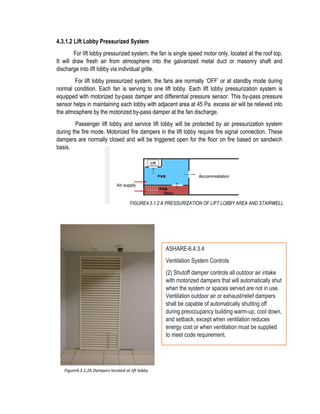
4.3.1.2 Lift Lobby Pressurized System
For lift lobby pressurized system, the fan is single speed motor only, located at the roof top.
It will draw fresh air from atmosphere into the galvanized metal duct or masonry shaft and
discharge into lift lobby via individual grille.
For lift lobby pressurized system, the fans are normally ‘OFF’ or at standby mode during
normal condition. Each fan is serving to one lift lobby. Each lift lobby pressurization system is
equipped with motorized by-pass damper and differential pressure sensor. This by-pass pressure
sensor helps in maintaining each lobby with adjacent area at 45 Pa. excess air will be relieved into
the atmosphere by the motorized by-pass damper at the fan discharge.
Passenger lift lobby and service lift lobby will be protected by air pressurization system
during the fire mode. Motorized fire dampers in the lift lobby require fire signal connection. These
dampers are normally closed and will be triggered open for the floor on fire based on sandwich
basis.
FIGURE4.3.1.2 A PRESSURIZATION OF LIFT LOBBY AREA AND STAIRWELL
ASHARE-6.4.3.4
Ventilation System Controls
(2) Shutoff damper controls all outdoor air intake
with motorized dampers that will automatically shut
when the system or spaces served are not in use.
Ventilation outdoor air or exhaust/relief dampers
shall be capable of automatically shutting off
during preoccupancy building warm-up, cool down,
and setback, except when ventilation reduces
energy cost or when ventilation must be supplied
to meet code requirement.
Figure4.3.1.2b Dampers located at lift lobby
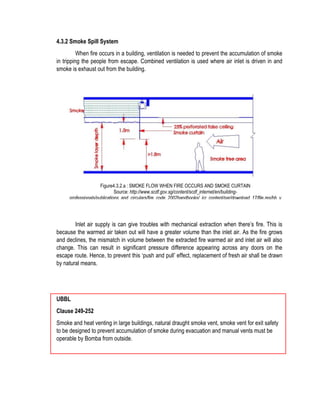
4.3.2 Smoke Spill System
When fire occurs in a building, ventilation is needed to prevent the accumulation of smoke
in tripping the people from escape. Combined ventilation is used where air inlet is driven in and
smoke is exhaust out from the building.
Inlet air supply is can give troubles with mechanical extraction when there’s fire. This is
because the warmed air taken out will have a greater volume than the inlet air. As the fire grows
and declines, the mismatch in volume between the extracted fire warmed air and inlet air will also
change. This can result in significant pressure difference appearing across any doors on the
escape route. Hence, to prevent this ‘push and pull’ effect, replacement of fresh air shall be drawn
by natural means.
UBBL
Clause 249-252
Smoke and heat venting in large buildings, natural draught smoke vent, smoke vent for exit safety
to be designed to prevent accumulation of smoke during evacuation and manual vents must be
operable by Bomba from outside.
Figure4.3.2.a : SMOKE FLOW WHEN FIRE OCCURS AND SMOKE CURTAIN
Source: http://www.scdf.gov.sg/content/scdf_internet/en/building-
professionals/publications_and_circulars/fire_code_2002handbooks/_jcr_content/par/download_17/file.res/hb_v
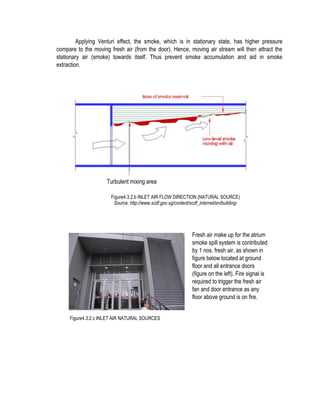
Applying Venturi effect, the smoke, which is in stationary state, has higher pressure
compare to the moving fresh air (from the door). Hence, moving air stream will then attract the
stationary air (smoke) towards itself. Thus prevent smoke accumulation and aid in smoke
extraction.
Figure4.3.2.b INLET AIR FLOW DIRECTION (NATURAL SOURCE)
Source: http://www.scdf.gov.sg/content/scdf_internet/en/building-
Turbulent mixing area
Figure4.3.2.c INLET AIR NATURAL SOURCES
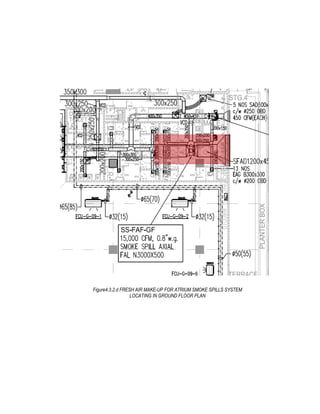
Fresh air make up for the atrium
smoke spill system is contributed
by 1 nos. fresh air, as shown in
figure below located at ground
floor and all entrance doors
(figure on the left). Fire signal is
required to trigger the fresh air
fan and door entrance as any
floor above ground is on fire.
Figure4.3.2.d FRESH AIR MAKE-UP FOR ATRIUM SMOKE SPILLS SYSTEM
LOCATING IN GROUND FLOOR PLAN
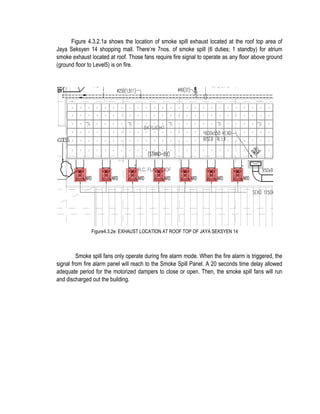
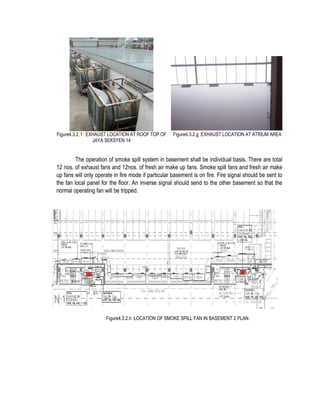
Figure4.3.2e: EXHAUST LOCATION AT ROOF TOP OF JAYA SEKSYEN 14
Figure 4.3.2.1a shows the location of smoke spill exhaust located at the roof top area of
Jaya Seksyen 14 shopping mall. There’re 7nos. of smoke spill (6 duties; 1 standby) for atrium
smoke exhaust located at roof. Those fans require fire signal to operate as any floor above ground
(ground floor to Level5) is on fire.
Smoke spill fans only operate during fire alarm mode. When the fire alarm is triggered, the
signal from fire alarm panel will reach to the Smoke Spill Panel. A 20 seconds time delay allowed
adequate period for the motorized dampers to close or open. Then, the smoke spill fans will run
and discharged out the building.
Figure4.3.2. f : EXHAUST LOCATION AT ROOF TOP OF
JAYA SEKSYEN 14
Figure4.3.2.g :EXHAUST LOCATION AT ATRIUM AREA
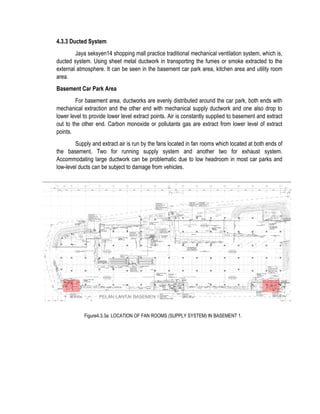
The operation of smoke spill system in basement shall be individual basis. There are total
12 nos. of exhaust fans and 12nos. of fresh air make up fans. Smoke spill fans and fresh air make
up fans will only operate in fire mode if particular basement is on fire. Fire signal should be sent to
the fan local panel for the floor. An inverse signal should send to the other basement so that the
normal operating fan will be tripped.
Figure4.3.2.h :LOCATION OF SMOKE SPILL FAN IN BASEMENT 2 PLAN.
4.3.3 Ducted System
Jaya seksyen14 shopping mall practice traditional mechanical ventilation system, which is,
ducted system. Using sheet metal ductwork in transporting the fumes or smoke extracted to the
external atmosphere. It can be seen in the basement car park area, kitchen area and utility room
area.
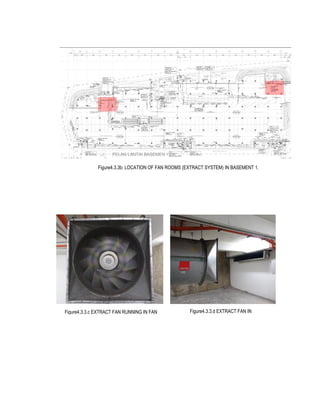
Basement Car Park Area
For basement area, ductworks are evenly distributed around the car park, both ends with
mechanical extraction and the other end with mechanical supply ductwork and one also drop to
lower level to provide lower level extract points. Air is constantly supplied to basement and extract
out to the other end. Carbon monoxide or pollutants gas are extract from lower level of extract
points.
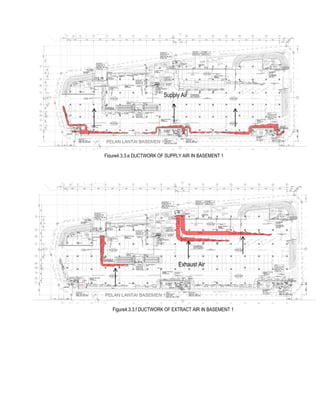
Supply and extract air is run by the fans located in fan rooms which located at both ends of
the basement. Two for running supply system and another two for exhaust system.
Accommodating large ductwork can be problematic due to low headroom in most car parks and
low-level ducts can be subject to damage from vehicles.
Figure4.3.3a: LOCATION OF FAN ROOMS (SUPPLY SYSTEM) IN BASEMENT 1.
Figure4.3.3b: LOCATION OF FAN ROOMS (EXTRACT SYSTEM) IN BASEMENT 1.
Figure4.3.3.d EXTRACT FAN IN
FAN ROOM
Figure4.3.3.c EXTRACT FAN RUNNING IN FAN
ROOM
Figure4.3.3.e DUCTWORK OF SUPPLY AIR IN BASEMENT 1
Supply Air
Figure4.3.3.f DUCTWORK OF EXTRACT AIR IN BASEMENT 1
Exhaust Air
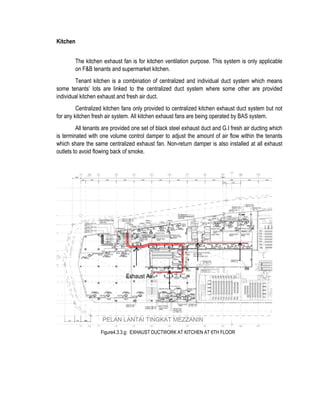
Kitchen
The kitchen exhaust fan is for kitchen ventilation purpose. This system is only applicable
on F&B tenants and supermarket kitchen.
Tenant kitchen is a combination of centralized and individual duct system which means
some tenants’ lots are linked to the centralized duct system where some other are provided
individual kitchen exhaust and fresh air duct.
Centralized kitchen fans only provided to centralized kitchen exhaust duct system but not
for any kitchen fresh air system. All kitchen exhaust fans are being operated by BAS system.
All tenants are provided one set of black steel exhaust duct and G.I fresh air ducting which
is terminated with one volume control damper to adjust the amount of air flow within the tenants
which share the same centralized exhaust fan. Non-return damper is also installed at all exhaust
outlets to avoid flowing back of smoke.
Figure4.3.3.g: EXHAUST DUCTWORK AT KITCHEN AT 6TH FLOOR
Exhaust Air
Exhaust Airflow direction
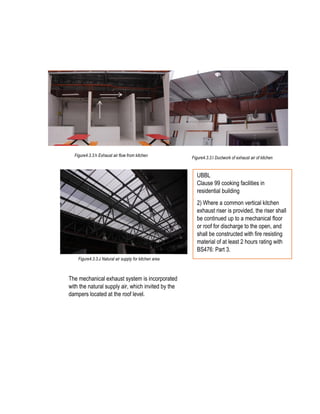
Figure4.3.3.h Exhaust air flow from kitchen
itchen
Figure4.3.3.I Ductwork of exhaust air of kitchen
Figure4.3.3.J Natural air supply for kitchen area
The mechanical exhaust system is incorporated
with the natural supply air, which invited by the
dampers located at the roof level.
UBBL
Clause 99 cooking facilities in
residential building
2) Where a common vertical kitchen
exhaust riser is provided, the riser shall
be continued up to a mechanical floor
or roof for discharge to the open, and
shall be constructed with fire resisting
material of at least 2 hours rating with
BS476: Part 3.
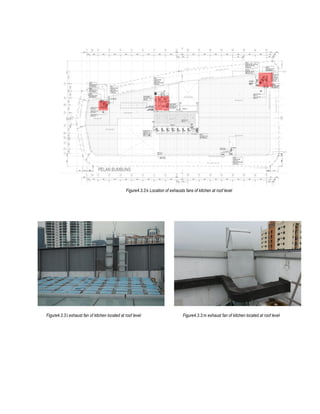
Figure4.3.3.k Location of exhausts fans of kitchen at roof level
Figure4.3.3.l exhaust fan of kitchen located at roof level Figure4.3.3.m exhaust fan of kitchen located at roof level
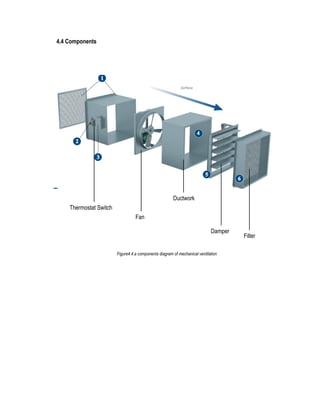
4.4 Components
Fan
Ductwork
Damper
Filter
Thermostat Switch
Figure4.4.a components diagram of mechanical ventilation
4.4.1 Fan
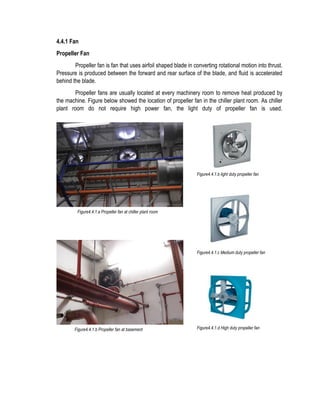
Propeller Fan
Propeller fan is fan that uses airfoil shaped blade in converting rotational motion into thrust.
Pressure is produced between the forward and rear surface of the blade, and fluid is accelerated
behind the blade.
Propeller fans are usually located at every machinery room to remove heat produced by
the machine. Figure below showed the location of propeller fan in the chiller plant room. As chiller
plant room do not require high power fan, the light duty of propeller fan is used.
Figure4.4.1.b light duty propeller fan
Figure4.4.1.c Medium duty propeller fan
Figure4.4.1.d High duty propeller fan
Figure4.4.1.a Propeller fan at chiller plant room
Figure4.4.1.b Propeller fan at basement
Axial Flow Flan
An axial fan is a type of compressor that increases the pressure of the air flowing through it.
The blades of the axial fan forces air to flow parallel to the shaft about which the blade rotate. The
flow is axially, linearly, and hence their name. Axial fan is used for relatively high flow rate.
They are generally selected for simple extraction or cooling applications with very low
system resistance, such as moving air from one large space to another (i.e. from factory to outside),
desk fans and condenser cooling in refrigeration. The axial fans are located at the fan rooms at
basement and places of air exhaustion normally involve big machine.
FIGURE4.4.1.E LOCATION OF AXIAL FLOW FAN
FIGURE4.4.1.F AXIAL FLOW FAN FRONT VIEW FIGURE4.4.1.G AXIAL FLOW FAN SIDE
VIEW
4.4.2 Ductwork
Ductwork is used in mechanical ventilation in delivering and removes air. The needed
airflow include supply air, return air and exhaust air. As such, air ducts are one method of ensuring
acceptable indoor air quality as well as thermal comfort. A duct system is also called ductwork.
The ductwork used in galvanized ductwork. Galvanized steel is the most common material
used in fabricating ductwork. To provide insulation purpose, fiberglass in inserted in the ductwork.
FIGURE4.4.2.A BASEMENT CAR PARK DUCTWORK
FIGURE4.4.2.B KITCHEN DUCTWORK
FIGURE4.4.2.C BASEMENT DUCTWORK FIGURE4.4.2.D BASEMENT DUCTWORK
FIGURE4.4.2.E BASEMENT DUCTWORK FIGURE4.4.2.F DUCTWORK WITH LOWER
DIFFUSER
FIGURE4.4.2.G KITCHEN DUCTWORK
Poor designed ductwork may result in conditioned air being forced outside or outdoor air
drawn being into the house. This increases energy consumption by the machine and can result in
air quality and building pressure.
Ventilation ducts should not be passing through smoke-stop or fire fighting lobby. If
unavoidable, the part of ventilation duct within the lobby shall be enclosed with fire resistance
elements. Such construction shall be in masonry or shall be fitted with fire damper.
Poor designed ductwork may result in conditioned air being forced outside or outdoor air
drawn being into the house. This increases energy consumption by the machine and can result in
air quality and building pressure.
4.4.3 Fire Damper
Fire dampers are installed to prevent the passage of fire through walls or ducts from one
space to another. Fire dampers are compartmentation dampers.
Unless specially made for out-of-wall installation, fire dampers must be within the plane of
the wall they are protecting. For this reason, when combination fire and smoke dampers, discussed
below, are installed, jackshafts are used. (As shown in figure 4.4.3.a) This allows attaching the
actuator to the jackshaft where it is accessible from outside while the damper blades are still within
the wall plane. Many smoke dampers are jack shafted also as the same damper is used in the
combination fire and smoke application. However, a smoke damper may be installed up to two feet
away from the wall.
FIGURE4.4.3.A COMBINATION OF
SMOKES AND FIRE DAMPERS
FIGURE4.4.3.B FIRE AND SMOKE
DAMPERS IN CHILLER PLANT ROOM
Fire dampers shall not be fitted in any of the supply airshaft or extract airshaft. The smoke
purging system would fail, as the fire dampers when in closed position would prevent movement of
air within the shaft.
Fire dampers shall not be fitted in the following locations:
 Openings in walls of a smoke extract shaft or return air shaft which also serves as a smoke
extract shaft;
 Openings in walls of a protected shaft when the openings have a kitchen exhaust duct
passing through it; or
 Anywhere in an air pressurizing system
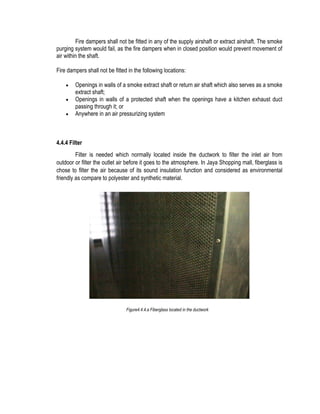
4.4.4 Filter
Filter is needed which normally located inside the ductwork to filter the inlet air from
outdoor or filter the outlet air before it goes to the atmosphere. In Jaya Shopping mall, fiberglass is
chose to filter the air because of its sound insulation function and considered as environmental
friendly as compare to polyester and synthetic material.
Figure4.4.4.a Fiberglass located in the ductwork
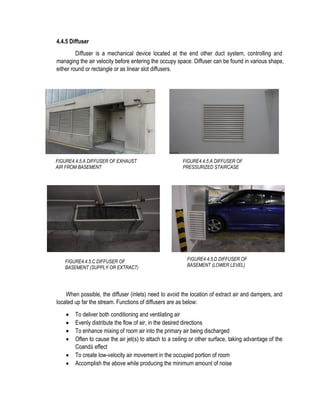
4.4.5 Diffuser
Diffuser is a mechanical device located at the end other duct system, controlling and
managing the air velocity before entering the occupy space. Diffuser can be found in various shape,
either round or rectangle or as linear slot diffusers.
When possible, the diffuser (inlets) need to avoid the location of extract air and dampers, and
located up far the stream. Functions of diffusers are as below:
 To deliver both conditioning and ventilating air
 Evenly distribute the flow of air, in the desired directions
 To enhance mixing of room air into the primary air being discharged
 Often to cause the air jet(s) to attach to a ceiling or other surface, taking advantage of the
Coandă effect
 To create low-velocity air movement in the occupied portion of room
 Accomplish the above while producing the minimum amount of noise
FIGURE4.4.5.A DIFFUSER OF EXHAUST
AIR FROM BASEMENT
FIGURE4.4.5.A DIFFUSER OF
PRESSURIZED STAIRCASE
FIGURE4.4.5.C DIFFUSER OF
BASEMENT (SUPPLY OR EXTRACT)
FIGURE4.4.5.D DIFFUSER OF
BASEMENT (LOWER LEVEL)
4.5 Conclusion
Mechanical ventilation in Jaya, Seksyen 14 shopping mall is considered moderate and
done in a traditional way. All the system is arranged in an organized way for example all the
ductwork is neatly hidden inside the ceiling. However, poor natural ventilation is considered in the
higher floor of Jaya shopping mall, as temperature is warmer compare to other place. Application
of ductwork system is good and common nowadays but with the introduction of the new way of
exhausting the air (Impulsion system-Jet fan), working time is shorter and low in maintenance.
Space of the basement will look wider if apply of new exhaust and supply system.
The ductwork may create lower ceiling and disturb the moving of people or air in case of
emergency. Fan system in Jaya is good as it uses thermostat in controlling the fan running system
percentage. If the temperature is not high, the fan will run 50% or less, resulting low energy
consumption. Most of the area is mechanical ventilation, resulted in little natural openings, which
will be a problem when fire occurred above the ground level, (insufficient natural inlet air). Overall,
Jaya shopping mall practice good mechanical ventilation and achieved thermal comfort in human
satisfy level.
5
CHAPTER
AIR-CONDITIONING SYSTEM
5.1 INTRODUCTION
Malaysia poses tropical rainforest climate which is generally sunny throughout the year
and have high precipitation rate every month. Hence, the thermal comfort in a building is having a
filtered supplied air, with a temperature range of 22 to 27 degree Celsius and relative humidity of
55-70%. In this hot and humid climate, air-conditioning system as part of the ACMV (Air-
Conditioned and Mechanical Ventilation) system is one of the crucial building service in most of the
buildings typically in Malaysia to provide thermal comfort.
Differ from mechanical ventilation, air-conditioning is considered as an active system that removing
heat from the air inside the room and releasing this collected heat into the air outdoors with the aid
of electrical supply and water supply (if building in large scale). Like other HVAC (Heating
Ventilating and Air Conditioning) technology, the role of air-conditioning do more that providing
acceptable indoor air quality and ensuring thermal comfort. It prevents smoke, dust and haze from
outdoors to protect human health and some are used as cooling device to chill electrical appliances
or machinery for better performance.
5.2 LITERATURE REVIEWS
Air-conditioners can be easily be found anywhere ranging from homes, restaurants, hotels,
offices, hospitals, factories, office to toilets, public transportation, kiosk and etc. They are designed
in different ways to accommodate different users’ need. Below are four types of air-conditioning
system:
1. Window Air Conditioning System
2. Split Air Conditioning System
3. Centralized Air Conditioning System
4. Packaged Air Conditioning System
In this project, we are asked to do a case study on a medium to large scale building with at
least 4 storeys height. We have found out that the most efficient method to manipulate and ensure
the building thermal comfort is by using the centralized air conditioning system. Like others, this
sophisticated air-conditioning system is made up of two major cycles: Refrigeration Cycle and Air
Cycle.
Refrigeration Cycle is a process of removing heat from one place to another.
The principles of Refrigeration are as follows: (Hoffman, 2006)
 Liquids absorb heat when changed from liquid to gas.
 Gases give off heat when changed from gas to liquid.
For an air conditioning system to operate with economy, the refrigerant must be used
repeatedly. For this reason, all air conditioners use the same cycle of compression, condensation,
expansion, and evaporation in a closed circuit. The same refrigerant is used to move the heat, to
cool, and to expel this heat in another area.
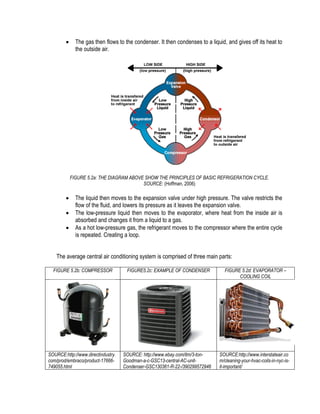
 The refrigerant comes into the compressor as a low-pressure gas, it is compressed and
then moves out of the compressor as a high-pressure gas.
 The gas then flows to the condenser. It then condenses to a liquid, and gives off its heat to
the outside air.
FIGURE 5.2a: THE DIAGRAM ABOVE SHOW THE PRINCIPLES OF BASIC REFRIGERATION CYCLE.
SOURCE: (Hoffman, 2006)
 The liquid then moves to the expansion valve under high pressure. The valve restricts the
flow of the fluid, and lowers its pressure as it leaves the expansion valve.
 The low-pressure liquid then moves to the evaporator, where heat from the inside air is
absorbed and changes it from a liquid to a gas.
 As a hot low-pressure gas, the refrigerant moves to the compressor where the entire cycle
is repeated. Creating a loop.
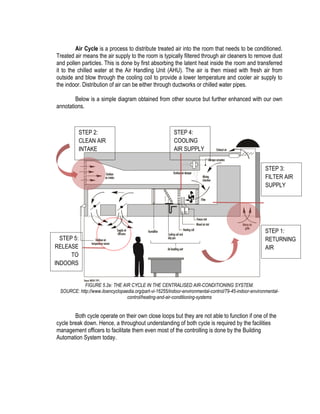
The average central air conditioning system is comprised of three main parts:
FIGURE 5.2b: COMPRESSOR FIGURE5.2c: EXAMPLE OF CONDENSER FIGURE 5.2d: EVAPORATOR –
COOLING COIL
SOURCE:http://www.directindustry.
com/prod/embraco/product-17666-
749055.html
SOURCE: http://www.ebay.com/itm/3-ton-
Goodman-a-c-GSC13-central-AC-unit-
Condenser-GSC130361-R-22-/390299572946
SOURCE:http://www.interstateair.co
m/cleaning-your-hvac-coils-in-nyc-is-
it-important/
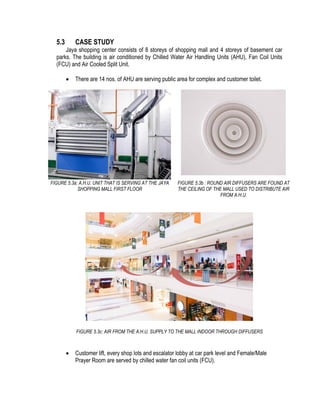
Air Cycle is a process to distribute treated air into the room that needs to be conditioned.
Treated air means the air supply to the room is typically filtered through air cleaners to remove dust
and pollen particles. This is done by first absorbing the latent heat inside the room and transferred
it to the chilled water at the Air Handling Unit (AHU). The air is then mixed with fresh air from
outside and blow through the cooling coil to provide a lower temperature and cooler air supply to
the indoor. Distribution of air can be either through ductworks or chilled water pipes.
Below is a simple diagram obtained from other source but further enhanced with our own
annotations.
FIGURE 5.2e: THE AIR CYCLE IN THE CENTRALISED AIR-CONDITIONING SYSTEM.
SOURCE: http://www.iloencyclopaedia.org/part-vi-16255/indoor-environmental-control/79-45-indoor-environmental-
control/heating-and-air-conditioning-systems
Both cycle operate on their own close loops but they are not able to function if one of the
cycle break down. Hence, a throughout understanding of both cycle is required by the facilities
management officers to facilitate them even most of the controlling is done by the Building
Automation System today.
STEP 1:
RETURNING
AIR
STEP 2:
CLEAN AIR
INTAKE
STEP 5:
RELEASE
TO
INDOORS
STEP 4:
COOLING
AIR SUPPLY
STEP 3:
FILTER AIR
SUPPLY
5.3 CASE STUDY
Jaya shopping center consists of 8 storeys of shopping mall and 4 storeys of basement car
parks. The building is air conditioned by Chilled Water Air Handling Units (AHU), Fan Coil Units
(FCU) and Air Cooled Split Unit.
 There are 14 nos. of AHU are serving public area for complex and customer toilet.
FIGURE 5.3a: A.H.U. UNIT THAT IS SERVING AT THE JAYA
SHOPPING MALL FIRST FLOOR
FIGURE 5.3b : ROUND AIR DIFFUSERS ARE FOUND AT
THE CEILING OF THE MALL USED TO DISTRIBUTE AIR
FROM A.H.U.
FIGURE 5.3c: AIR FROM THE A.H.U. SUPPLY TO THE MALL INDOOR THROUGH DIFFUSERS
 Customer lift, every shop lots and escalator lobby at car park level and Female/Male
Prayer Room are served by chilled water fan coil units (FCU).
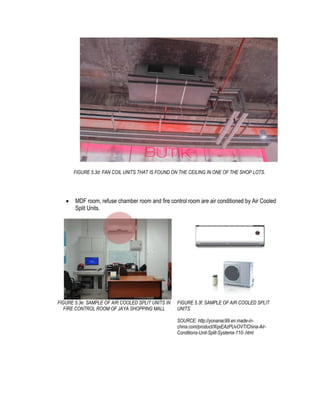
FIGURE 5.3d: FAN COIL UNITS THAT IS FOUND ON THE CEILING IN ONE OF THE SHOP LOTS.
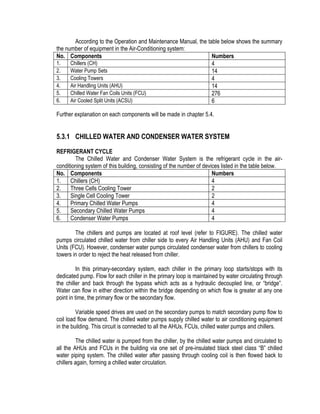
 MDF room, refuse chamber room and fire control room are air conditioned by Air Cooled
Split Units.
FIGURE 5.3e: SAMPLE OF AIR COOLED SPLIT UNITS IN
FIRE CONTROL ROOM OF JAYA SHOPPING MALL
FIGURE 5.3f: SAMPLE OF AIR COOLED SPLIT
UNITS
SOURCE: http://yonanac99.en.made-in-
china.com/product/XqxEAzPUvOVT/China-Air-
Conditions-Unit-Split-Systems-110-.html
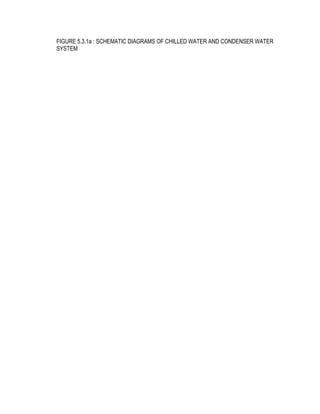
According to the Operation and Maintenance Manual, the table below shows the summary
the number of equipment in the Air-Conditioning system:
No. Components Numbers
1. Chillers (CH) 4
2. Water Pump Sets 14
3. Cooling Towers 4
4. Air Handling Units (AHU) 14
5. Chilled Water Fan Coils Units (FCU) 276
6. Air Cooled Split Units (ACSU) 6
Further explanation on each components will be made in chapter 5.4.
5.3.1 CHILLED WATER AND CONDENSER WATER SYSTEM
REFRIGERANT CYCLE
The Chilled Water and Condenser Water System is the refrigerant cycle in the air-
conditioning system of this building, consisting of the number of devices listed in the table below.
No. Components Numbers
1. Chillers (CH) 4
2. Three Cells Cooling Tower 2
3. Single Cell Cooling Tower 2
4. Primary Chilled Water Pumps 4
5. Secondary Chilled Water Pumps 4
6. Condenser Water Pumps 4
The chillers and pumps are located at roof level (refer to FIGURE). The chilled water
pumps circulated chilled water from chiller side to every Air Handling Units (AHU) and Fan Coil
Units (FCU). However, condenser water pumps circulated condenser water from chillers to cooling
towers in order to reject the heat released from chiller.
In this primary-secondary system, each chiller in the primary loop starts/stops with its
dedicated pump. Flow for each chiller in the primary loop is maintained by water circulating through
the chiller and back through the bypass which acts as a hydraulic decoupled line, or “bridge”.
Water can flow in either direction within the bridge depending on which flow is greater at any one
point in time, the primary flow or the secondary flow.
Variable speed drives are used on the secondary pumps to match secondary pump flow to
coil load flow demand. The chilled water pumps supply chilled water to air conditioning equipment
in the building. This circuit is connected to all the AHUs, FCUs, chilled water pumps and chillers.
The chilled water is pumped from the chiller, by the chilled water pumps and circulated to
all the AHUs and FCUs in the building via one set of pre-insulated black steel class “B” chilled
water piping system. The chilled water after passing through cooling coil is then flowed back to
chillers again, forming a chilled water circulation.
FIGURE 5.3.1a : SCHEMATIC DIAGRAMS OF CHILLED WATER AND CONDENSER WATER
SYSTEM
Before the chilled water is circulated to the building AHUs and FCUs, the chilled water is
passing through flow meter and temperature sensor (refer to FIGURE) where BTU consumption
of the building is measured. There is one number of BTU meter is installed for Cineplex. BTU
meters measure the energy content of liquid flow in British thermal units (BTU), a basic measure of
thermal energy. (Customer Services - What is a BTU meter, 2015) BTU meters are used in chilled
water system for both commercial, industrial and office buildings. These meters are used to bill
users for energy usage.
FIGURE 5.3.1b: THE TEMPERATURE SENSOR LOCATED ALONGSIDE THE PUMP SET
AND PRESSURE GAUGE TO MEASURE THE REFRIGERANT STATE
The condenser water pumps supply condenser water to chillers in chiller plant room. This
circuit is connected between chillers and cooling towers which are located at the roof. The
condenser water is circulated between chillers and cooling tower via one set of GI class “B”
condenser water pipe.
FIGURE 5.3.1c: LOCATION OF THE CHILLER PLANT ROOM SHOWING ON THE SIXTH FLOOR PLAN
SOURCE: Jaya Shopping Mall Facilities Management
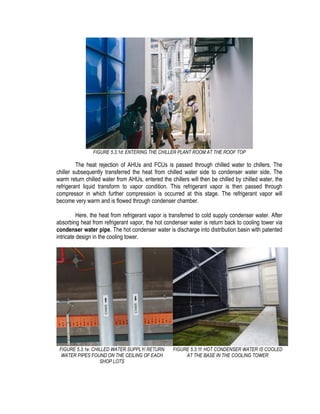
FIGURE 5.3.1d: ENTERING THE CHILLER PLANT ROOM AT THE ROOF TOP
The heat rejection of AHUs and FCUs is passed through chilled water to chillers. The
chiller subsequently transferred the heat from chilled water side to condenser water side. The
warm return chilled water from AHUs, entered the chillers will then be chilled by chilled water, the
refrigerant liquid transform to vapor condition. This refrigerant vapor is then passed through
compressor in which further compression is occurred at this stage. The refrigerant vapor will
become very warm and is flowed through condenser chamber.
Here, the heat from refrigerant vapor is transferred to cold supply condenser water. After
absorbing heat from refrigerant vapor, the hot condenser water is return back to cooling tower via
condenser water pipe. The hot condenser water is discharge into distribution basin with patented
intricate design in the cooling tower.
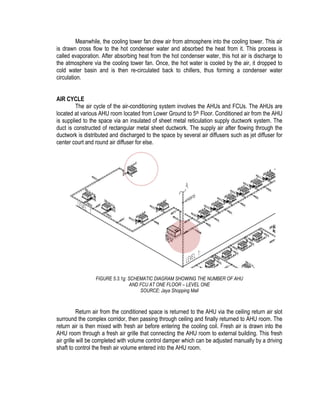
FIGURE 5.3.1e: CHILLED WATER SUPPLY/ RETURN
WATER PIPES FOUND ON THE CEILING OF EACH
SHOP LOTS
FIGURE 5.3.1f: HOT CONDENSER WATER IS COOLED
AT THE BASE IN THE COOLING TOWER
Meanwhile, the cooling tower fan drew air from atmosphere into the cooling tower. This air
is drawn cross flow to the hot condenser water and absorbed the heat from it. This process is
called evaporation. After absorbing heat from the hot condenser water, this hot air is discharge to
the atmosphere via the cooling tower fan. Once, the hot water is cooled by the air, it dropped to
cold water basin and is then re-circulated back to chillers, thus forming a condenser water
circulation.
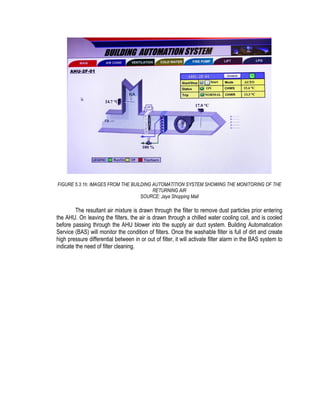
AIR CYCLE
The air cycle of the air-conditioning system involves the AHUs and FCUs. The AHUs are
located at various AHU room located from Lower Ground to 5th Floor. Conditioned air from the AHU
is supplied to the space via an insulated of sheet metal reticulation supply ductwork system. The
duct is constructed of rectangular metal sheet ductwork. The supply air after flowing through the
ductwork is distributed and discharged to the space by several air diffusers such as jet diffuser for
center court and round air diffuser for else.
FIGURE 5.3.1g: SCHEMATIC DIAGRAM SHOWING THE NUMBER OF AHU
AND FCU AT ONE FLOOR – LEVEL ONE
SOURCE: Jaya Shopping Mall
Return air from the conditioned space is returned to the AHU via the ceiling return air slot
surround the complex corridor, then passing through ceiling and finally returned to AHU room. The
return air is then mixed with fresh air before entering the cooling coil. Fresh air is drawn into the
AHU room through a fresh air grille that connecting the AHU room to external building. This fresh
air grille will be completed with volume control damper which can be adjusted manually by a driving
shaft to control the fresh air volume entered into the AHU room.
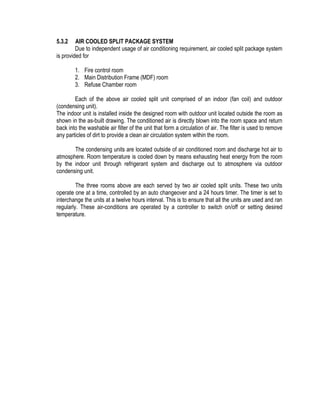
FIGURE 5.3.1h: IMAGES FROM THE BUILDING AUTOMATITION SYSTEM SHOWING THE MONITORING OF THE
RETURNING AIR
SOURCE: Jaya Shopping Mall
The resultant air mixture is drawn through the filter to remove dust particles prior entering
the AHU. On leaving the filters, the air is drawn through a chilled water cooling coil, and is cooled
before passing through the AHU blower into the supply air duct system. Building Automatication
Service (BAS) will monitor the condition of filters. Once the washable filter is full of dirt and create
high pressure differential between in or out of filter, it will activate filter alarm in the BAS system to
indicate the need of filter cleaning.
5.3.2 AIR COOLED SPLIT PACKAGE SYSTEM
Due to independent usage of air conditioning requirement, air cooled split package system
is provided for
1. Fire control room
2. Main Distribution Frame (MDF) room
3. Refuse Chamber room
Each of the above air cooled split unit comprised of an indoor (fan coil) and outdoor
(condensing unit).
The indoor unit is installed inside the designed room with outdoor unit located outside the room as
shown in the as-built drawing. The conditioned air is directly blown into the room space and return
back into the washable air filter of the unit that form a circulation of air. The filter is used to remove
any particles of dirt to provide a clean air circulation system within the room.
The condensing units are located outside of air conditioned room and discharge hot air to
atmosphere. Room temperature is cooled down by means exhausting heat energy from the room
by the indoor unit through refrigerant system and discharge out to atmosphere via outdoor
condensing unit.
The three rooms above are each served by two air cooled split units. These two units
operate one at a time, controlled by an auto changeover and a 24 hours timer. The timer is set to
interchange the units at a twelve hours interval. This is to ensure that all the units are used and ran
regularly. These air-conditions are operated by a controller to switch on/off or setting desired
temperature.
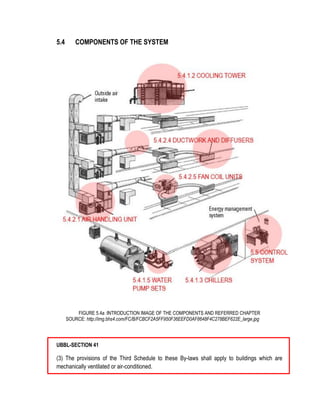
5.4 COMPONENTS OF THE SYSTEM
FIGURE 5.4a :INTRODUCTION IMAGE OF THE COMPONENTS AND REFERRED CHAPTER
SOURCE: http://img.bhs4.com/FC/B/FCBCF2A5FF950F36EEFD0AF8648F4C278BEF622E_large.jpg
UBBL-SECTION 41
(3) The provisions of the Third Schedule to these By-laws shall apply to buildings which are
mechanically ventilated or air-conditioned.
5.4.1 Refrigerant Cycles
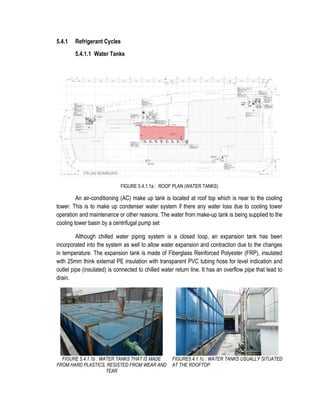
5.4.1.1 Water Tanks
FIGURE 5.4.1.1a : ROOF PLAN (WATER TANKS)
An air-conditioning (AC) make up tank is located at roof top which is near to the cooling
tower. This is to make up condenser water system if there any water loss due to cooling tower
operation and maintenance or other reasons. The water from make-up tank is being supplied to the
cooling tower basin by a centrifugal pump set
Although chilled water piping system is a closed loop, an expansion tank has been
incorporated into the system as well to allow water expansion and contraction due to the changes
in temperature. The expansion tank is made of Fiberglass Reinforced Polyester (FRP), insulated
with 25mm think external PE insulation with transparent PVC tubing hose for level indication and
outlet pipe (insulated) is connected to chilled water return line. It has an overflow pipe that lead to
drain.
FIGURE 5.4.1.1b : WATER TANKS THAT IS MADE
FROM HARD PLASTICS, RESISTED FROM WEAR AND
TEAR
FIGURE5.4.1.1c : WATER TANKS USUALLY SITUATED
AT THE ROOFTOP
5.4.1.2 Cooling Tower
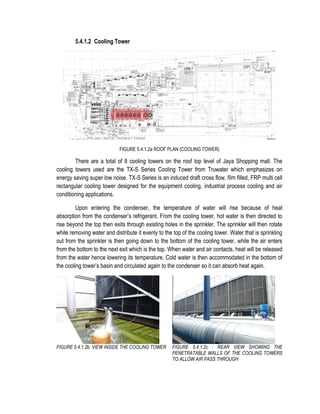
FIGURE 5.4.1.2a ROOF PLAN (COOLING TOWER)
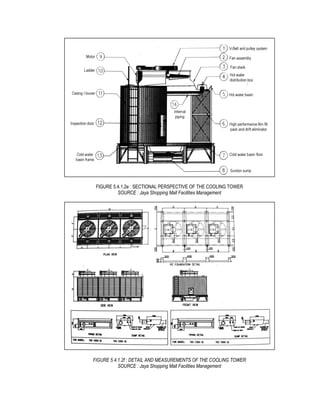
There are a total of 8 cooling towers on the roof top level of Jaya Shopping mall. The
cooling towers used are the TX-S Series Cooling Tower from Truwater which emphasizes on
energy saving super low noise. TX-S Series is an induced draft cross flow, film filled, FRP multi cell
rectangular cooling tower designed for the equipment cooling, industrial process cooling and air
conditioning applications.
Upon entering the condenser, the temperature of water will rise because of heat
absorption from the condenser’s refrigerant. From the cooling tower, hot water is then directed to
rise beyond the top then exits through existing holes in the sprinkler. The sprinkler will then rotate
while removing water and distribute it evenly to the top of the cooling tower. Water that is sprinkling
out from the sprinkler is then going down to the bottom of the cooling tower, while the air enters
from the bottom to the next exit which is the top. When water and air contacts, heat will be released
from the water hence lowering its temperature. Cold water is then accommodated in the bottom of
the cooling tower’s basin and circulated again to the condenser so it can absorb heat again.
FIGURE 5.4.1.2b: VIEW INSIDE THE COOLING TOWER FIGURE 5.4.1.2c : REAR VIEW SHOWING THE
PENETRATABLE WALLS OF THE COOLING TOWERS
TO ALLOW AIR PASS THROUGH
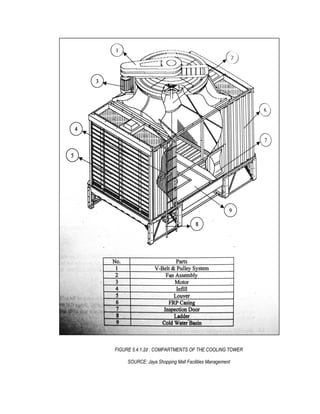
FIGURE 5.4.1.2d : COMPARTMENTS OF THE COOLING TOWER
SOURCE: Jaya Shopping Mall Facilities Management
FIGURE 5.4.1.2e : SECTIONAL PERSPECTIVE OF THE COOLING TOWER
SOURCE : Jaya Shopping Mall Facilities Management
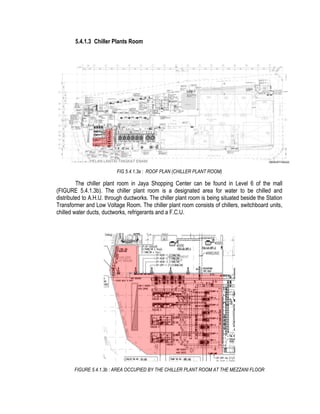
FIGURE 5.4.1.2f : DETAIL AND MEASUREMENTS OF THE COOLING TOWER
SOURCE : Jaya Shopping Mall Facilities Management
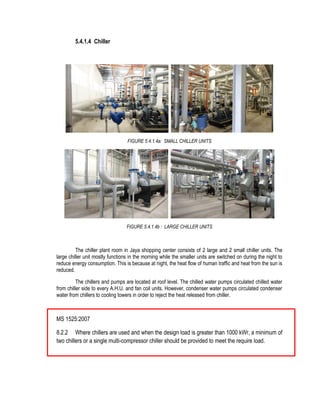
5.4.1.3 Chiller Plants Room
FIG 5.4.1.3a : ROOF PLAN (CHILLER PLANT ROOM)
The chiller plant room in Jaya Shopping Center can be found in Level 6 of the mall
(FIGURE 5.4.1.3b). The chiller plant room is a designated area for water to be chilled and
distributed to A.H.U. through ductworks. The chiller plant room is being situated beside the Station
Transformer and Low Voltage Room. The chiller plant room consists of chillers, switchboard units,
chilled water ducts, ductworks, refrigerants and a F.C.U.
FIGURE 5.4.1.3b : AREA OCCUPIED BY THE CHILLER PLANT ROOM AT THE MEZZANI FLOOR
5.4.1.4 Chiller
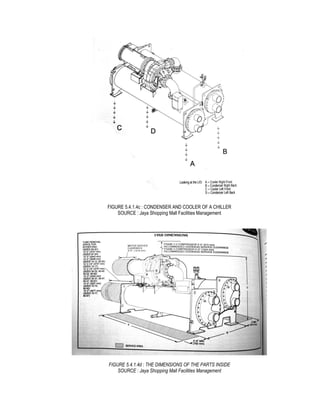
FIGURE 5.4.1.4a: SMALL CHILLER UNITS
FIGURE 5.4.1.4b : LARGE CHILLER UNITS
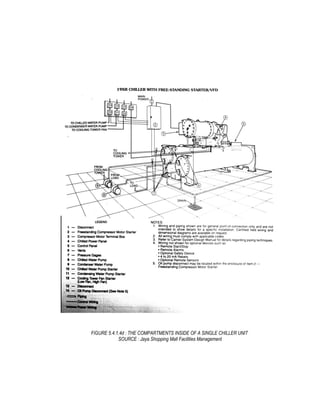
The chiller plant room in Jaya shopping center consists of 2 large and 2 small chiller units. The
large chiller unit mostly functions in the morning while the smaller units are switched on during the night to
reduce energy consumption. This is because at night, the heat flow of human traffic and heat from the sun is
reduced.
The chillers and pumps are located at roof level. The chilled water pumps circulated chilled water
from chiller side to every A.H.U. and fan coil units. However, condenser water pumps circulated condenser
water from chillers to cooling towers in order to reject the heat released from chiller.
MS 1525:2007
8.2.2 Where chillers are used and when the design load is greater than 1000 kWr, a minimum of
two chillers or a single multi-compressor chiller should be provided to meet the require load.
FIGURE 5.4.1.4c : CONDENSER AND COOLER OF A CHILLER
SOURCE : Jaya Shopping Mall Facilities Management
FIGURE 5.4.1.4d : THE DIMENSIONS OF THE PARTS INSIDE
SOURCE : Jaya Shopping Mall Facilities Management
FIGURE 5.4.1.4d : THE COMPARTMENTS INSIDE OF A SINGLE CHILLER UNIT
SOURCE : Jaya Shopping Mall Facilities Management
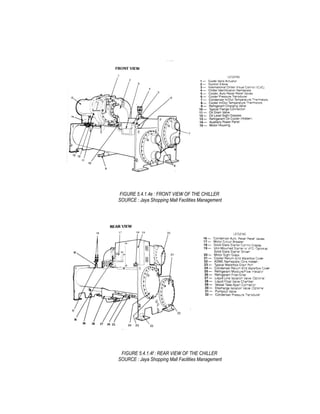
FIGURE 5.4.1.4e : FRONT VIEW OF THE CHILLER
SOURCE : Jaya Shopping Mall Facilities Management
FIGURE 5.4.1.4f : REAR VIEW OF THE CHILLER
SOURCE : Jaya Shopping Mall Facilities Management
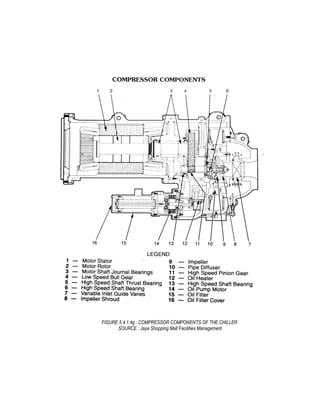
FIGURE 5.4.1.4g : COMPRESSOR COMPONENTS OF THE CHILLER
SOURCE : Jaya Shopping Mall Facilities Management
5.4.1.5 Control Unit
FIGURE 5.4.1.5a : ROOF PLAN (CONTROL UNIT)
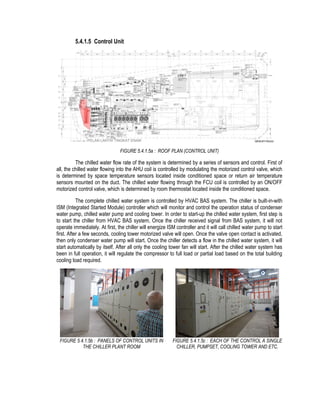
The chilled water flow rate of the system is determined by a series of sensors and control. First of
all, the chilled water flowing into the AHU coil is controlled by modulating the motorized control valve, which
is determined by space temperature sensors located inside conditioned space or return air temperature
sensors mounted on the duct. The chilled water flowing through the FCU coil is controlled by an ON/OFF
motorized control valve, which is determined by room thermostat located inside the conditioned space.
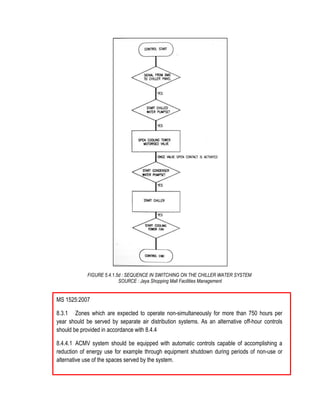
The complete chilled water system is controlled by HVAC BAS system. The chiller is built-in-with
ISM (Integrated Started Module) controller which will monitor and control the operation status of condenser
water pump, chilled water pump and cooling tower. In order to start-up the chilled water system, first step is
to start the chiller from HVAC BAS system, Once the chiller received signal from BAS system, it will not
operate immediately. At first, the chiller will energize ISM controller and it will call chilled water pump to start
first. After a few seconds, cooling tower motorized valve will open. Once the valve open contact is activated,
then only condenser water pump will start. Once the chiller detects a flow in the chilled water system, it will
start automatically by itself. After all only the cooling tower fan will start. After the chilled water system has
been in full operation, it will regulate the compressor to full load or partial load based on the total building
cooling load required.
FIGURE 5.4.1.5b : PANELS OF CONTROL UNITS IN
THE CHILLER PLANT ROOM
FIGURE 5.4.1.5c : EACH OF THE CONTROL A SINGLE
CHILLER, PUMPSET, COOLING TOWER AND ETC.
FIGURE 5.4.1.5d : SEQUENCE IN SWITCHING ON THE CHILLER WATER SYSTEM
SOURCE : Jaya Shopping Mall Facilities Management
MS 1525:2007
8.3.1 Zones which are expected to operate non-simultaneously for more than 750 hours per
year should be served by separate air distribution systems. As an alternative off-hour controls
should be provided in accordance with 8.4.4
8.4.4.1 ACMV system should be equipped with automatic controls capable of accomplishing a
reduction of energy use for example through equipment shutdown during periods of non-use or
alternative use of the spaces served by the system.
5.4.1.6 Water Pump Sets
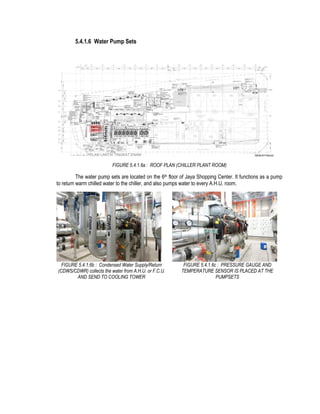
FIGURE 5.4.1.6a : ROOF PLAN (CHILLER PLANT ROOM)
The water pump sets are located on the 6th floor of Jaya Shopping Center. It functions as a pump
to return warm chilled water to the chiller, and also pumps water to every A.H.U. room.
FIGURE 5.4.1.6b : Condensed Water Supply/Return
(CDWS/CDWR) collects the water from A.H.U. or F.C.U.
AND SEND TO COOLING TOWER
FIGURE 5.4.1.6c : PRESSURE GAUGE AND
TEMPERATURE SENSOR IS PLACED AT THE
PUMPSETS
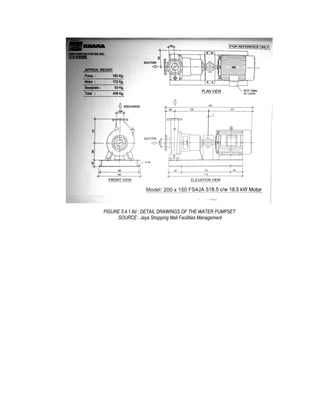
FIGURE 5.4.1.6d : DETAIL DRAWINGS OF THE WATER PUMPSET
SOURCE : Jaya Shopping Mall Facilities Management
5.4.2 AIR CYCLE
5.4.2.1 AIR HANDLING UNIT (A.H.U.)
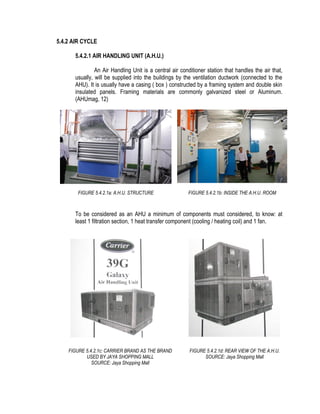
An Air Handling Unit is a central air conditioner station that handles the air that,
usually, will be supplied into the buildings by the ventilation ductwork (connected to the
AHU). It is usually have a casing ( box ) constructed by a framing system and double skin
insulated panels. Framing materials are commonly galvanized steel or Aluminum.
(AHUmag, 12)
FIGURE 5.4.2.1a: A.H.U. STRUCTURE FIGURE 5.4.2.1b: INSIDE THE A.H.U. ROOM
To be considered as an AHU a minimum of components must considered, to know: at
least 1 filtration section, 1 heat transfer component (cooling / heating coil) and 1 fan.
FIGURE 5.4.2.1c: CARRIER BRAND AS THE BRAND
USED BY JAYA SHOPPING MALL
SOURCE: Jaya Shopping Mall
FIGURE 5.4.2.1d: REAR VIEW OF THE A.H.U.
SOURCE: Jaya Shopping Mall
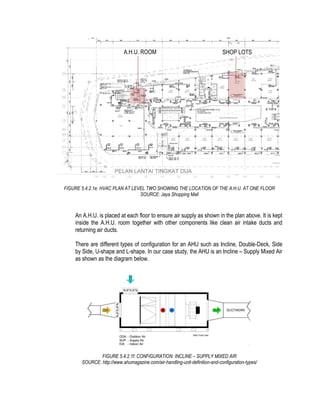
FIGURE 5.4.2.1e: HVAC PLAN AT LEVEL TWO SHOWING THE LOCATION OF THE A.H.U. AT ONE FLOOR
SOURCE: Jaya Shopping Mall
An A.H.U. is placed at each floor to ensure air supply as shown in the plan above. It is kept
inside the A.H.U. room together with other components like clean air intake ducts and
returning air ducts.
There are different types of configuration for an AHU such as Incline, Double-Deck, Side
by Side, U-shape and L-shape. In our case study, the AHU is an Incline – Supply Mixed Air
as shown as the diagram below.
FIGURE 5.4.2.1f: CONFIGURATION: INCLINE – SUPPLY MIXED AIR
SOURCE: http://www.ahumagazine.com/air-handling-unit-definition-and-configuration-types/
SHOP LOTSA.H.U. ROOM
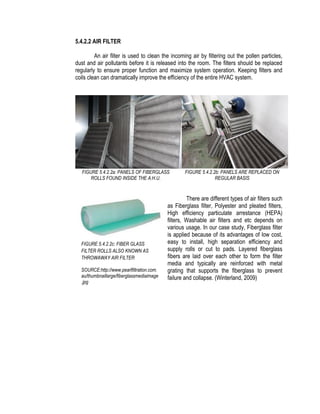
5.4.2.2 AIR FILTER
An air filter is used to clean the incoming air by filtering out the pollen particles,
dust and air pollutants before it is released into the room. The filters should be replaced
regularly to ensure proper function and maximize system operation. Keeping filters and
coils clean can dramatically improve the efficiency of the entire HVAC system.
FIGURE 5.4.2.2a: PANELS OF FIBERGLASS
ROLLS FOUND INSIDE THE A.H.U.
FIGURE 5.4.2.2b: PANELS ARE REPLACED ON
REGULAR BASIS
There are different types of air filters such
as Fiberglass filter, Polyester and pleated filters,
High efficiency particulate arrestance (HEPA)
filters, Washable air filters and etc depends on
various usage. In our case study, Fiberglass filter
is applied because of its advantages of low cost,
easy to install, high separation efficiency and
supply rolls or cut to pads. Layered fiberglass
fibers are laid over each other to form the filter
media and typically are reinforced with metal
grating that supports the fiberglass to prevent
failure and collapse. (Winterland, 2009)
FIGURE 5.4.2.2c: FIBER GLASS
FILTER ROLLS ALSO KNOWN AS
THROWAWAY AIR FILTER
SOURCE:http://www.pearlfiltration.com.
au/thumbnaillarge/fiberglassmediaimage
.jpg
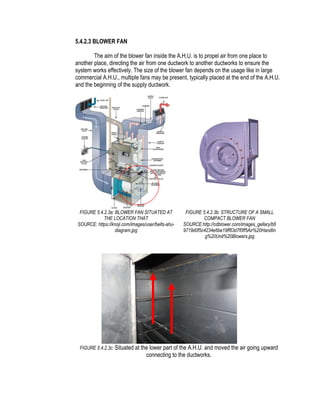
5.4.2.3 BLOWER FAN
The aim of the blower fan inside the A.H.U. is to propel air from one place to
another place, directing the air from one ductwork to another ductworks to ensure the
system works effectively. The size of the blower fan depends on the usage like in large
commercial A.H.U., multiple fans may be present, typically placed at the end of the A.H.U.
and the beginning of the supply ductwork.
FIGURE 5.4.2.3a: BLOWER FAN SITUATED AT
THE LOCATION THAT
SOURCE: https://knoji.com/images/user/belts-ahu-
diagram.jpg
FIGURE 5.4.2.3b: STRUCTURE OF A SMALL
COMPACT BLOWER FAN
SOURCE:http://cdblower.com/images_gellary/b6
9719d0f5c4234e6be19ff63d7f0ff5Air%20Handlin
g%20Unit%20Blowers.jpg
FIGURE 5.4.2.3c: Situated at the lower part of the A.H.U. and moved the air going upward
connecting to the ductworks.
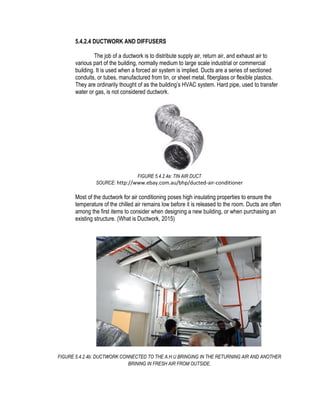
5.4.2.4 DUCTWORK AND DIFFUSERS
The job of a ductwork is to distribute supply air, return air, and exhaust air to
various part of the building, normally medium to large scale industrial or commercial
building. It is used when a forced air system is implied. Ducts are a series of sectioned
conduits, or tubes, manufactured from tin, or sheet metal, fiberglass or flexible plastics.
They are ordinarily thought of as the building’s HVAC system. Hard pipe, used to transfer
water or gas, is not considered ductwork.
FIGURE 5.4.2.4a: TIN AIR DUCT
SOURCE: http://www.ebay.com.au/bhp/ducted-air-conditioner
Most of the ductwork for air conditioning poses high insulating properties to ensure the
temperature of the chilled air remains low before it is released to the room. Ducts are often
among the first items to consider when designing a new building, or when purchasing an
existing structure. (What is Ductwork, 2015)
FIGURE 5.4.2.4b: DUCTWORK CONNECTED TO THE A.H.U BRINGING IN THE RETURNING AIR AND ANOTHER
BRINING IN FRESH AIR FROM OUTSIDE.
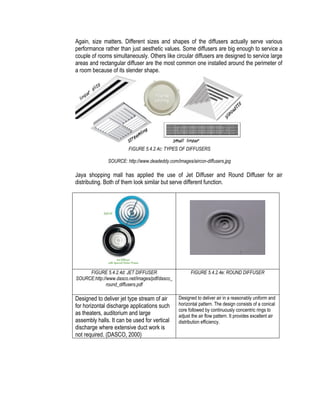
Again, size matters. Different sizes and shapes of the diffusers actually serve various
performance rather than just aesthetic values. Some diffusers are big enough to service a
couple of rooms simultaneously. Others like circular diffusers are designed to service large
areas and rectangular diffuser are the most common one installed around the perimeter of
a room because of its slender shape.
FIGURE 5.4.2.4c: TYPES OF DIFFUSERS
SOURCE: http://www.deadeddy.com/images/aircon-diffusers.jpg
Jaya shopping mall has applied the use of Jet Diffuser and Round Diffuser for air
distributing. Both of them look similar but serve different function.
FIGURE 5.4.2.4d: JET DIFFUSER
SOURCE:http://www.dasco.net/images/pdf/dasco_
round_diffusers.pdf
FIGURE 5.4.2.4e: ROUND DIFFUSER
Designed to deliver jet type stream of air
for horizontal discharge applications such
as theaters, auditorium and large
assembly halls. It can be used for vertical
discharge where extensive duct work is
not required. (DASCO, 2000)
Designed to deliver air in a reasonably uniform and
horizontal pattern. The design consists of a conical
core followed by continuously concentric rings to
adjust the air flow pattern. It provides excellent air
distribution efficiency.
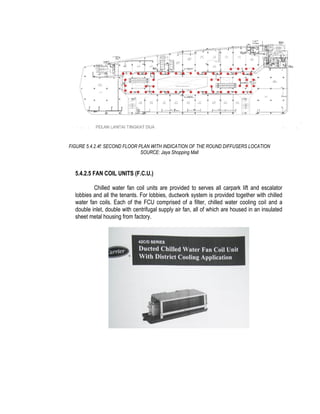
FIGURE 5.4.2.4f: SECOND FLOOR PLAN WITH INDICATION OF THE ROUND DIFFUSERS LOCATION
SOURCE: Jaya Shopping Mall
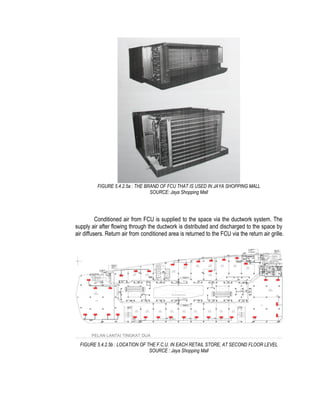
5.4.2.5 FAN COIL UNITS (F.C.U.)
Chilled water fan coil units are provided to serves all carpark lift and escalator
lobbies and all the tenants. For lobbies, ductwork system is provided together with chilled
water fan coils. Each of the FCU comprised of a filter, chilled water cooling coil and a
double inlet, double with centrifugal supply air fan, all of which are housed in an insulated
sheet metal housing from factory.
FIGURE 5.4.2.5a : THE BRAND OF FCU THAT IS USED IN JAYA SHOPPING MALL
SOURCE: Jaya Shopping Mall
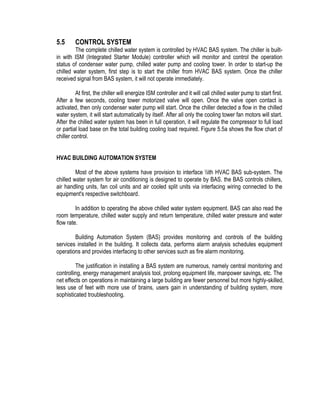
Conditioned air from FCU is supplied to the space via the ductwork system. The
supply air after flowing through the ductwork is distributed and discharged to the space by
air diffusers. Return air from conditioned area is returned to the FCU via the return air grille.
FIGURE 5.4.2.5b : LOCATION OF THE F.C.U. IN EACH RETAIL STORE, AT SECOND FLOOR LEVEL
SOURCE : Jaya Shopping Mall
5.5 CONTROL SYSTEM
The complete chilled water system is controlled by HVAC BAS system. The chiller is built-
in with ISM (Integrated Starter Module) controller which will monitor and control the operation
status of condenser water pump, chilled water pump and cooling tower. In order to start-up the
chilled water system, first step is to start the chiller from HVAC BAS system. Once the chiller
received signal from BAS system, it will not operate immediately.
At first, the chiller will energize ISM controller and it will call chilled water pump to start first.
After a few seconds, cooling tower motorized valve will open. Once the valve open contact is
activated, then only condenser water pump will start. Once the chiller detected a flow in the chilled
water system, it will start automatically by itself. After all only the cooling tower fan motors will start.
After the chilled water system has been in full operation, it will regulate the compressor to full load
or partial load base on the total building cooling load required. Figure 5.5a shows the flow chart of
chiller control.
HVAC BUILDING AUTOMATION SYSTEM
Most of the above systems have provision to interface ith HVAC BAS sub-system. The
chilled water system for air conditioning is designed to operate by BAS. the BAS controls chillers,
air handling units, fan coil units and air cooled split units via interfacing wiring connected to the
equipment's respective switchboard.
In addition to operating the above chilled water system equipment. BAS can also read the
room temperature, chilled water supply and return temperature, chilled water pressure and water
flow rate.
Building Automation System (BAS) provides monitoring and controls of the building
services installed in the building. It collects data, performs alarm analysis schedules equipment
operations and provides interfacing to other services such as fire alarm monitoring.
The justification in installing a BAS system are numerous, namely central monitoring and
controlling, energy management analysis tool, prolong equipment life, manpower savings, etc. The
net effects on operations in maintaining a large building are fewer personnel but more highly-skilled,
less use of feet with more use of brains, users gain in understanding of building system, more
sophisticated troubleshooting.
5.6 CONCLUSION
In a nutshell, the HVAC system of Jaya Shopping has complied with the standards set by the
government by following the By-Laws stated in the UBBL SECTION 41 and guidelines provided in MS1525.
Sufficient equipment, backup plans and regular maintenance basis is planned and designed for the building.
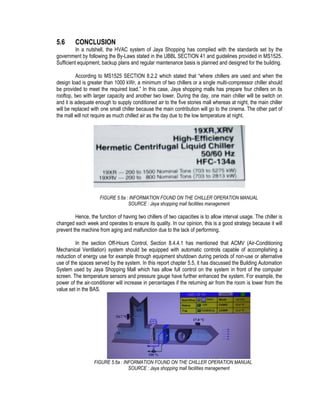
According to MS1525 SECTION 8.2.2 which stated that “where chillers are used and when the
design load is greater than 1000 kWr, a minimum of two chillers or a single multi-compressor chiller should
be provided to meet the required load.” In this case, Jaya shopping malls has prepare four chillers on its
rooftop, two with larger capacity and another two lower. During the day, one main chiller will be switch on
and it is adequate enough to supply conditioned air to the five stories mall whereas at night, the main chiller
will be replaced with one small chiller because the main contribution will go to the cinema. The other part of
the mall will not require as much chilled air as the day due to the low temperature at night.
FIGURE 5.6a : INFORMATION FOUND ON THE CHILLER OPERATION MANUAL
SOURCE : Jaya shopping mall facilities management
Hence, the function of having two chillers of two capacities is to allow interval usage. The chiller is
changed each week and operates to ensure its quality. In our opinion, this is a good strategy because it will
prevent the machine from aging and malfunction due to the lack of performing.
In the section Off-Hours Control, Section 8.4.4.1 has mentioned that ACMV (Air-Conditioning
Mechanical Ventilation) system should be equipped with automatic controls capable of accomplishing a
reduction of energy use for example through equipment shutdown during periods of non-use or alternative
use of the spaces served by the system. In this report chapter 5.5, it has discussed the Building Automation
System used by Jaya Shopping Mall which has allow full control on the system in front of the computer
screen. The temperature sensors and pressure gauge have further enhanced the system. For example, the
power of the air-conditioner will increase in percentages if the returning air from the room is lower from the
value set in the BAS.
FIGURE 5.6a : INFORMATION FOUND ON THE CHILLER OPERATION MANUAL
SOURCE : Jaya shopping mall facilities management
6CHAPTER
FIRE PROTECTION SYSTEM
6.1 Introduction
Fire is the rapid, oxidation of a material in the exothermic chemical process of combustion,
releasing heat, light and various reaction products. Basically, a fire is a chemical reaction in
which a carbon based material (fuel), mixes with oxygen (usually as a component of air), and is
heated to a point where flammable vapours are produced. These vapours can then come in
contact with something that is hot enough to cause vapour ignition, and a resulting fire. In
simple terms, something that can burn touches something that is hot, and a fire is produced.
Fire is very dangerous as not only can it cause collateral damage to a building when it spreads
but it can also cause people to lose their life. Fire protection consist of methods to prevent fire
from turning destructive and also to minimize the impact of the uncontrolled fire to reduce harm
or damage. Safety planning practice and drills are included as well as education in fire,
research, investigation, safety planning, building construction, safe operations, training and
testing of mitigating systems (Cuthbert, 2015).
6.2 Literature Review
There are two basic systems for fire protection which are namely passive and active fire
protection system. Design and infrastructure, materials used, provision of isolating fire, fire
walls and doors of the building that takes fire protection into consideration can be classified as
passive fire protecting. Active fire protection consist of manual or automatic detection of fire,
use of fore and smoke alarms, firefighting as well as first aid (Nulfire, 2014).
Active Fire Protection
Active fire protection is the process of protecting a building or structure from fire with methods
that use the action of moving parts. These system can be automatic or operated manually, but
they require some sort of action in order to work. A couple of example of active fire protection
would be building sprinkler system and fire alarm systems. These system are an extremely
important part of protecting property and the lives of the people within.
According to Nulfire (2014), the overall aim of active system is to extinguish fire by detecting
the fire early and evacuating the building, alerting emergency services at an early stage of the
fire, control the movement of smoke and fire and suppress and starve the fire of oxygen and
fuel.
There are several systems in the active fire protection.
Sprinkler System
Sprinkler system consist of a water supply system that provides to a series of water pipes. At a
selected interval along the pipe, there are independent valves known as sprinkler heads. The
sprinklers are usually activated by heat from fire, resulting a discharge of water into the fire
area
Hose Reel System
The hose reel system is intended for the early stages of a fire for the occupants of the building.
It is to provide the occupants with first aid means of fighting a fire whilst awaiting the arrival of
the local fire service. When the hose reel is used, the pressure of the pipe will drop below the
field adjusted pressure setting of the pressure switch. This will trigger the pump to come into
operation automatically to feed a steady supply of water to discharge through the hose.
Water Riser System
Wet riser is a vertical pipe installed in a building for firefighting purposes internally and
permanently charged with water from a pressurized supply, and fitted with landing valves on
various floors. The provision of a built-in water distribution system means that fire fighters do
not need to create their own distribution system in order to fight a fire and avoids the breaching
of fire compartments by running hose lines between them.
Fire Alarm System
A key aspect of fire protection is to identify a developing fire emergency in a timely manner,
and to alert the building's occupants and fire emergency organizations. This is the role of fire
detection and alarm systems. A fire alarm system is number of devices working together to
detect and warn people through visual and audio appliances when smoke, fire, carbon
monoxide or other emergencies are present and allow appropriate firefighting action. These
alarms may be activated from smoke detectors, and heat detectors. They may also be
activated via manual fire alarm activation devices such as manual call points or pull stations. As
all systems are designed primarily to protect life and property, this places a great responsibility
on the designer because each building will have different risk and set of problems that are
related to the spreading of fire. Therefore, each fire detection and alarm system needs to be
designed specially to meet those requirements.
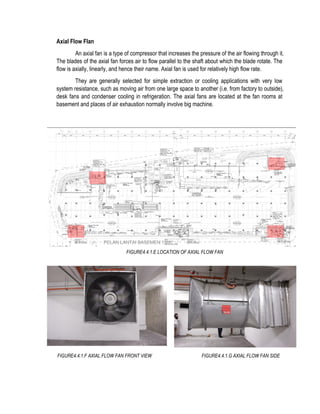
Fire Suppression System
Fire suppression systems are used to protect special hazard or sensitive area, like bank and
computer rooms. The use of conventional fire sprinkler systems may be appropriate for special
hazard area as it might cause the fire to be bigger or cause more damage to the situation. Fire
suppression systems are environmentally friendly clean agents.
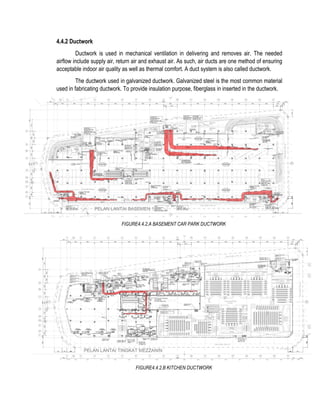
Fire Extinguisher System
Portable fire extinguishers are important to fire prevention as most fire starts small and can be
easily extinguished. It is designed to be operated easily by anyone who follows simple
introductions labelled on the extinguishers. The type of fire extinguisher used depends on the
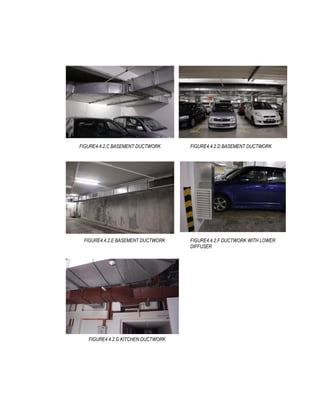
type of fire that is in the area.
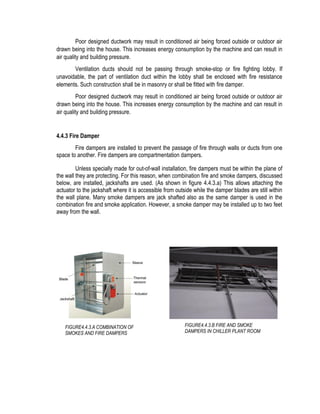
Passive Fire Protection
Using effective measures against fire is not at all a new idea! Since many decades it is
systematically followed in the field of Industrial plants, storage facilities, warehouse
departments and public assembly places.
One of the most effective method against fire in a building is the use of passive fire protection.
It is defined as systems that are included as part of the very fabric of buildings with fire resistant
walls floors and doors serving all as examples.
The passive fire protection begins at the design and concept stages which includes, providing
fire evacuation routes and fire appliance access. In addition to this, the use of fire resistant
materials in walls and floor with providing groups and compartments is also considered as
passive fire protection. It is important to note that each mentioned area has a variety of different
solutions that are suited to varying build requirements. For example, in case of fire resistant
walls, it can be constructed using panels of reinforced cement with steel sheets bonded to each
side or through the application of a cementitious fire spray.
Considering all this, it is important to use passive fire protection in the building in the modern
day. Alfred Haack states that passive fire protection can avoid structural disintegration and can
reduce spalling. (Haack, 2013) Therefore, it is essential to have a fire safety concept with best
evacuation routes for a successful escape in order to provide optimum safety for the building
users.
6.3 Case Study
Active fire protection is compulsory building and our chosen building for the case study, Jaya
Shopping Centre is not exempted. There are several types of system that are used in Jaya
Shopping Centre that benefits the users during a fire emergency. The following list shows the
types of systems that are found in the building and will be discussed further in this chapter with
the various components that are used.
1. Fire Alarm System
2. Sprinkler System
3. Hose Reel System
4. Wet Riser System
5. Carbon Dioxide Fire Suppression System
6. Fire Extinguisher
The active fire protection system at Jaya Shopping Mall can be summarised in the
following diagram.
FIGURE 6.3a SMOKE DETECTOR ON CEILING
This sections explores the methods used as passive fire protection, in Jaya Shopping Center,
Jalan 14/17, Seksyen 14, 46100 Petaling Jaya, Selangor. Table 6.3b shows the methods which
would be further discussed.
1 Fire Evacuation Route
2 Fire Staircase
3 Fire Rated Door
4 Fire Rescue Access
5 Command and Control Center
6 Smoke and Heat Ventilation System
7 Smoke Curtain
8 Smoke Barrier Gate
Table 6.3a : List of Passive Fire Protection System
Each of the methods would be further deliberated in terms of how it functions and the purpose
it serves to the users in the building.
FIGURE 6.3b OVERVIEW OF PASSIVE FIRE PROTECTION USED IN JAYA SHOPPING CENTER
6.4.1 FIRE ALARM SYSTEM
6.4.1.1 Overview
The fire detection and alarm system used in this building is an addressable type. At the escape corridors
and also car park areas, fire alarm bell and manual call points are provided. Smoke detector are also
located around the building including the lift lobby and fire escape routes.
The main fire alarm panel is located at the control room. All control and indicative equipment from each
respective building level reception, indication, control and relaying of signals from fire detectors or manual
call points connected to it are terminated at the main fire alarm panel. Other suppression systems such
as sprinkler system are also monitored by the fire alarm system.
A Centralized Monitoring System (CMS) is equipped to the fire indicative panel at the fire control room
and has a direct telephone line to the BOMBA.
6.4.1.2 Components
6.4.1.2.1 Smoke Detector
A smoke detector is a requirement for all building. It is
a device that senses smoke, typically as an indicator
of fire. Smoke detectors are located at alternate
positions to detect smoke and temperature rise in an
event of a fire.
SMOKE DETECTOR
FIGURE 6.4.1a SMOKE DETECTOR ON CEILING
FIGURE 6.4.1b LOCATION PLAN OF SMOKE DETECTORS
UBBL- SECTION 225(1)
Every building shall be provided with means of
detecting and extinguisher fire and alarms
together with illuminated exit signs in accordance
with the requirements as specified in the tenth
schedule to these by-laws.
There are two types of smoke detector – optical smoke detectors and ionization smoke detectors. The
ones used at Jaya mall is optical smoke detectors. Optical smoke detectors are screwed to the ceiling as
that is where smoke moves. The detector has a large opening at the bottom where smoke can enter. In
the smoke detector, there is an invisible infrared light beam that shoots on a photocell. The photocell is
an electronic light detector that will generate electricity as long that lights fall on it. During a fire breakout,
smoke will travel into the detector and block the emission of light that shoots onto the photocell. No light
falls on the photocell, thus no electricity is generated. The circuit spots it straight away and triggers the
alarm
There are some rooms where a lot of dust is present.
In these rooms, the smoke detectors are covered with
a layer in order to prevent the detectors to be stuck
with dust and also prevent the detector from detecting
the dust as smoke and setting a false alarm. From
figure 6.4.1d the locationg of the covered smoke
detector can be seen that it is only present in the fan
rooms.
FIGURE 6.4.1d COVERED SMOKE
DETECTOR
FIGURE 6.4.1e LOCATION PLAN OF COVERED SMOKE DETECTORS AT BASEMENT 1
FIGURE 6.4.1c OPTICAL SMOKE DETECTOR
Source: http://www.scfpd.us/items/detector6.gif
6.4.1.2.2 Alarm Bell & Break Glass
The alarm bell is placed around the mall to ring to
warn people incase of a fire. The alarm rings at
103db (A) which is loud enough and can be heard in
any noisy situation. The alarm will continue to sound
until it is reset at the main control panel.
The bell is mounted with its striker pointing downwards. The
bell is designed professionally to meet the needs of firefighting
and the detection systems with central control equipment, the
simplicity of the design incorporates fewer working parts, thus
encouraging easy installation and high level of efficiency
capable in operating under the most adverse conditions
(Demco Industries Sdn Bhd, n.d).
FIGURE 6.4.1f ALARM BELL AND GLASS BOX
ALARM BELL
GLASS BOX
FIGURE 6.4.1g LOCATION OF ALARM BELLS AND GLASS BOXES
UBBL- SECTION 237
Alarm bell must be provide a minimum sound of
level 65db (A) or +5db (A) above any
background noises, which is likely to persist for
more than 30 seconds.
FIGURE 6.4.1h SPECIFICATION OF A DEMCO
BELL ACCORDING TO UNIVERSAL
REGULATIONS
Source : http://www.demcoalarm.com/products.html
6.4.1.2.2 Fire Control Room
The main control panel is located at the control room at the ground floor. The control panel indicates the
source of the fire alarm so that in case of an emergency, the source of the fire outbreak or the cause of
the alarm triggered can be set. If there is anything that is broken or an alarm is triggered, the nearest
guard on duty will be alerted to check the situation and report back. Should anything need to be reset if
it is a false alarm or once the fire is put off, it can be done through the main control panel.
FIGURE 6.4.1g MAIN FIRE
CONTROL PANEL UNIT
FIGURE 6.4.1i MAIN FIRE CONTROL PANEL LOCATION
FIGURE 6.4.1h INDICATION PANEL
UBBL- SECTION 237
Every large premises or building exceeding 30.5 meters in height shall be provided with a command
and control central located on the designated floor and shall contain a panel to monitor the public
address, fire brigade communication, sprinkler, water flow detectors, fire detection and alarm
systems and a direct telephone connection to the appropriate fire station by-passing the switch
board.
When there is an emergency or a false outbreak, the indication panel in figure and a light will show the
level that the outbreak is from and the computer will show the exact location of the source. The printer
will then print the report immediately. The system can be reset by the control panel that is located at the
left side.
FIGURE 6.4.1i DRAWING OF LAYOUT FIRE ALARM CONSOLE
FIGURE 6.4.1j
COMPUTER
TO MONITOR
THE SYSTEM
FIGURE 6.4.1k PANEL TO CONTROL THE
SYSTEM
FIGURE 6.4.1l PRINTER THAT PRINTS THE
REPORT OF ANY OUTBREAK
AUTOMATICALLY
UBBL- SECTION 155: Fire mode of operation
The fire mode of operation shall be initiated by a signal from the fire alarm panel which may be
activated automatically by one of the alarm devices in the building or manually.
6.4.1.2.2 Voice Communication
The fireman intercom system provides a reliable two-way emergency voice communication system
between the Master Console handset at the fire control room and the remote handset stations which is
located at the escape routes of the building. The master control panel comprise of the master handset, a
system control module and zone control modules. During a fire outbreak, a call lamp will flash with audible
signals at the master control panel to indicate where the call is coming from. As the handset is lifted to
answer the call, the audible signal will be silenced. The master control panel is also equipped with a fault
indicator unit which provide easier identification should there be a false alarm. The master control console
is located at the fire control room. When the master console handset is lifted and there is no incoming
call, there will be an outgoing call straight to the BOMBA. Should the BOMBA need to contact anyone in
the mall, the call will be transferred immediately to the phone at the fire control room.
6.4.1.2.2 Fire Switch
Should there be a fire, when the fire fighter arrives, only
they will be able to operate and off the fire switch. These
fire switch are located in each level and controls the
electrical appliances of each of the level. This is so that
there will be no explosion during the spread of the fire that
can cause more damage to the building. The fire switches
are located at the fire escape stairs. The switch can also
be used to run the under voltage relaose or stunt trip in the
main incoming breaker. If there is a fire in the building, the
fireman uses an insulateed rod to pull the handle which
isolates the utility supply to the building (ABB,2012).
FIGURE 6.4.1m FIREMAN INTERCOM
AT ESCAPE ROUTES
FIGURE 6.4.1o FIRE
SWITCH
FIGURE 6.4.1n MASTER CONSOLE
AT FIRE CONTROL ROOM
6.4.1.2.2 Manual Pull Switch
Incase of an emergencies, there are manual pull
switch that are located at the exit of the mall through
the fire escape routes. As people exit due to a fire,
there are able to pull this switch to warn the other
occupants of the building. The pull switch is linked to
the alarm system and functions just like the glass box.
It will trigger the alarm to ring when it is switched on.
Also, it will send an indication to the main fire control
panel to signal where the warning is from.
6.4.1.3 System Operation
In an event of a fire and the glass box is broken and the manual switch is pulled and the alarm at the
control room will sound for 30 minutes before the whole alarm system in the mall is activated. When this
happens, an indication on the main fire panel with show where the source of the alarm is coming from
and the BOMBA will be alerted. The person in charge will verify the fire and if there is a fire, the alarm
system in the mall will be activated to evacuate the building. The BOMBA will come to the building if they
have not been updated about the situation after 30 minutes. This shows that the system is a two stage
system
If it was a false alarm, the system is reset by the person in charge and the situation is reported to BOMBA.
After everything, the system is reset.
FIGURE 6.4.1p MANUAL PULL SWITCH
6.4.2 SPINKLER SYSTEM
6.4.2.1 Overview
The basement (car park area) of Jaya Mall is provided with an automatic sprinkler system except for the
electrical rooms such as TNB switch room, genset room and electrical riser room. This system consists
of an integrated network of pipes connecting water supplies to sprinkler nozzle installed at specific areas
in the building. The network of piping has valves that controls the sprinkles piping and includes a device
for actuating an alarm when the system is in operation.
6.4.2.2 Components
6.4.2.2.1 Sprinkler
Inside the mall, the sprinkler heads are recessed
inside the ceiling. This is for asthetic values so that the
ceiling will look clean. When there is a fire outbreak,
the cover wil be lowered and the sprinklers will drop
slightly to spray water out of the pipe. In the basement
where asethetic values are not so important, the
sprinkler hear is not hidden.
FIGURE 6.4.2a INDOOR SPRINKLERS FIGURE 6.4.2b BASEMENT SPRINKLERS
FIGURE 6.4.2c LOCATION OF MAIN SPRINKLER PIPES
UBBL- SECTION 25 (2)
All sprinkler system shall be electricity
connected to the nearest fire station to
provide immediate and automatic relay of
the alarm when activated
It is a requirement to install a sprinkler system when the building exceeds 700m3 of volume. It is a small
device that shoots water downwards by a deflector plate that directs the water in a circular patter over
the fire. Each sprinkler has an open compartment that holds a friable heat-sensing quartz build,
containing a coloured liquid that is usually red, that seals the water inlet.
The sprinklers at Jaya Mall are coated with corrosion resistant coatings to extend the life of copper alloy
sprinklers beyond that which would otherwise be obtained when exposed to corrosive atmosphere.
6.4.2.2.2 Butterfly Valve
The butterfly valves is to control the flow of water
of the sprinklers. Should the flow of the water of
the sprinklers need to be cut, the butterfly valves
are used.
FIGURE 6.4.2f LOCATION OF BUTTERFLY VALVE
UBBL- SECTION 25 (2)
Sprinkler Valves shall be located in a safe
and enclosed position on the exterior wall
and shall be readily accessible to the Fire
Authority
FIGURE 6.4.2d SPRINKLER PARTS
FIGURE 6.4.2e BUTTERFLY VALVE
Valmatic Rubber Lined Butterfly Valve is used at Jaya Mall. This butterfly valve is designed for perfect
shut off in both directions. This valve featured with one piece through shaft ensures dependable and
positive disk control. The body is protected with fusion bonded epoxy coating and is not in contact with
line media, hence corrosion free. The valve seat is stretch resistant and can be easily field replaced
without the requirement of any special tools.
6.4.2.2.2 Pumps
FIGURE 6.4.2h DUTY AND STANDBY PUMP FOR
SPINKLERS
FIGURE 6.4.2i SPRINKLER PUMPSETS
FIGURE 6.4.2j FIRE PUMP ROOM
UBBL- SECTION 247:
Main water storage tanks within the building,
other than for the hose reel system, shall be
located at ground, first or second basement
levels, with fire brigade pumping inlet connection
accessible to fire appliances.
FIGURE 6.4.2g BUTTERFLY VALVE PARTS
FIGURE 6.4.2k
Pumps are required in order to provide adequate supply of water to the sprinkler riser at all times. All the
pumps are connected in parallel, with their suctions permanently filled with water when the tank it filled.
There are three main pups which is the Jockey Pump, Duty Pump and Standby Pump.
Jockey Pump: Jockey pumps are also known as pressure maintenance pump as it maintains the pressure
in the sprinkler piping system. It also assist in the prevention of drainage when a fire breaks out and water
starts to rush into the pipe. The jockey pump will fill in the pressure in the sprinkler pipes should the
pressure decrease at any time so that if there is an emergency, there will always be enough pressure to
pump the water out of the nozzles.
Duty Pump: The duty will start to function when the pressure drops to 60psi and provide enough pressure
of water so that the system can be activated in order. The duty pump runs with an electrical motor pump
to channel water to the sprinkler system.
Standby Pump: The standby pump will be automatically activated when the duty pump fails to operate
when the pressure drops to 60psi. The standby pump has the exact function as the duty pump. It replaces
the duty pump when the duty pump is not functioning. The standby pump runs on diesel.
FIGURE 6.4.2l LOCATION OF FIRE PUMP ROOM AT
BASEMENT 1
FIGURE 6.4.2m VALVES THAT CONTROL THE WATER FLOW AT THE VARIOUS ZONES AS SHOWN
IN THE SCHEMATIC DRAWING
6.4.2.2.3 Water Tank
The source of water of the tank comes from the main pipe from SYABAS and is stored into the water tank
as showed in figure 6.4.2p. The water is channelled into the tank at the fire pump room through the green
pipes. The water level indication is to show the level of water in the tank stored to ensure that there is
always sufficient water in case of an emergency.
The water storage for the sprinkler system, hose reel system and the wet riser system is all located in the
fire pump room. The same water tank is used to provide water for all these systems.
FIGURE 6.4.2n MAIN PIPE SOURCE FIGURE 6.4.2o GREEN PIPE THAT CHANNELS WATER
FROM MAIN SOURE TO THE WATER TANK
FIGURE 6.4.2q WATER
LEVEL INDICATION
UBBL- SECTION 247:
1. Water storage capacity and water flow rate for the firefighting system and installation shall
be provided in accordance with the scale as set out in the tenth schedule to these by-laws.
2. Storage tank for automatic sprinkler installation where full capacity if provided without the
need for replenishment shall be exempted from the restrictions in their locations.
FIGURE 6.4.2p WATER TANK
6.4.2.3 System Operation
The sprinkler system is designed to operate automatically in event of a fire. When a fire occurs, a silicone-
based liquid contained inside the glass bulb of the nearest sprinkler nozzle absorbs heat rising from the
fire. This causes an air bubble inside the glass bulb to expand.
When the temperature surrounding the sprinkle rises above the rated temperature of the sprinkler nozzle,
the glass bulb breaks and ruptures the seal between the sprinkler head orifice and the network pipe. This
allows water from the sprinkler system to discharge through the sprinkler nozzle in a pre-determined
pattern.
Each sprinkler nozzle is designed to operate independently, so in an event of a fire, only the sprinkler
nozzles that have detected a high temperature will be activated. The flow switch installed for the system
will then detect the flow of water through the sprinkler network pipe when the sprinkler nozzle is activated.
This detection will be send a signal to the fire alarm panel that will send a visual and audible signal to the
fire affected area and to the fire brigade.
As water flows in through the network pipe when the sprinkler nozzle is activated, the pressure in the
pipe will decrease. When the pressure drops to a pre-determined setting in the pressure switch, the
Sprinkler Pump sets will operate.
When the Sprinkler Pump sets are activated, standby and duty pumps must be switched off manually in
the pump room.
1. Once the fire has been put off completely, the fire officer in charge has to carry out the following
procedures
2. The isolator valve on the relevant sprinkler rig has to be closed.
3. The main fire pump in the pump room must be manually stopped.
4. The sprinkler head must be replaced.
5. The isolation valve on the sprinkler rig has to be opened.
Once the isolation valve on the sprinkler rig is re-opened after a fire, the re-opened system standing
pressure will fall as the local pipework is filled up. The jockey pump will automatically cut in and boost the
pressure until the required system standing pressure is reached.
6.4.3 HOSE REEL SYSTEM
6.4.3.1 Overview
Jaya building is protected by a hose reel system running throughout the building and serve by the hose
reel pump set at fire pump room at basement 1 next to the pump set. The system consists of a series of
pipes pressurized system. The operation of the pump sets is controlled by pressure switches that are
pre-set to start the pump automatically when the pre-determined pressure subject to the adjustment as
follows :-
Pump set Cut-In Pressure (Psi) Cut-Out (Psi)
Duty Pump 150 Psi 160 Psi
Standby Pump 135 Psi 160 Psi
Great care has to be taken when the hose reel pump set are switch to “Auto” to ensure immediate
checking and attention when the hose reel pump starts automatically.
6.4.3.2 Components
6.4.3.2.1 Hose Reel Drum
The hose reel drum is of 25mm diameter swing type. Each reel is complete with 30m long 25mm diameter
bore non-kink braided rubber hose conforming to BS 3167. The maximum bursting pressure of the rubber
hose is 600psi while the working pressure is around 150psi.
At Jaya mall, SRI Fire Hose Reel is used. This hose reel are tested and approved to European Standard
EN671 by British Standards Institution and Australian Standards AS1221 by QAS Australia. These
approval require the certification authority to carry out regular inspections of the hose reel manufacturing
facility. With vigorous inspection and testing, SRI Fire Hose Reel is reliable and is at the highest standards
(SRI, n.d ).
The stop valve is of 25mm diameter conforming to BS1218. The indication of the open and shut position
is fixed on the wheel spindle of the valve and the direction of flow is marked on the body.
FIGURE 6.4.3a HOSE REEL DRUMS
STOP VALVE
6.4.3.2.1 Hose Reel Drum Pumps
Just like the sprinkler pumps, the hose reel pumps also have pumps. As water tank provides water to the
hose reel directing, standby pumps and duty pumps are needed to push the water to the upper floor. The
hose reel operates automatically when there is a drop of pressure or a flow of water is detected. Both the
pumps are prepared at all times. Should the duty pump fail, the stand by pump will start to operate.
FIGURE 6.4.3b LOCATION OF HOSE REEL DRUMS
UBBL- SECTION 244(c):
Hose reel shall be located at every 45 meters (depends on the building form).Besides, fire hose reel
should be located at the strategic places in buildings, especially nearer to firefighting access lobbies
in order to provide a reasonably accessible and controlled supply of water for fire extinguishing
FIGURE 6.4.3c PUMPS FOR HOSE
REEL
FIGURE 6.4.3d PUMP SET FOR
HOSE REEL
FIGURE 6.4.3e
6.4.3.3 System Operation
The hose reel system is installed, tested and commissioned to the specification of the local Fire Authority.
The hose reel system installed at the building consists of the following:-
Shut-Off Nozzle
The shut-off nozzle assembly is constructed from a corrosive resistant material conforming to BS 336
and the nozzle size is 0.25 internal smooth surface finishes. Spray pattern can be adjusted.
The horse reel system is easily to operate by one person and requires minimal operator instruction.
1. Proceed to the nearest hose reel in an event of a fire.
2. Turn open the 25mm nozzle that is located at the hose reel compartment.
3. Swing the hose reel out and extend it to the area of the fire.
4. Direct the nozzle to the fire and turn the adjustable nozzle.
5. Ensure the hose reel pump is turn on.
After the fire has been extinguished:-
1. Turn the adjustable nozzle to shut the water.
2. Wind the hose reel back to the drum without damaging it.
3. Swing the drum back to its original position
4. Turn off the 25mm valve to shut the system completely.
FIGURE 6.4.3f HOSE REEL SYSTEM
Source: http://dynoklang.com.my/site/data/images/item/img_49_Hose%20Reel%20System.JPG
6.4.4 WET RISER SYSTEM
6.4.4.1 Overview
At Jaya Mall, one set of wet riser system completed with all firefighting accessories inside is provided for
all the levels in the building including the basement. The system consist of a network of pipes connecting
water supplies to the landing of the valves. In case of a fire, hoses are connected to this valve and are
used to direct water to the fire. All block shares a same water supply RC tank at Basement Fire Pump
Room.
The pump starter and the control panel for the wet riser is located respectively in the fire pump room next
to the pump set. An electrical motor runs this wet rise pump set with a permanent power supply, backed
up with emergency power generator in case of a failure of main power supply from TNB.
Only fire brigade or trained personnel are permitted to use the system as it is high pressured and it
involves the use of water at high flow in large diameter hoses.
Wet Riser Tank
The tank is located at the fire pump room at basement 1. The compartment of the concrete water tank is
to make sure that at least half of the water capacity is available for use during routine maintenance.
Wet Riser Pump
Located at the fire pump room at basement 1, the wet riser pumps are all electrical motor driven. Each
set of pump consist of a duty pump, standby pump and a jockey pump. The duty pump will run during the
operation of the wet rise system. The standby pump will operate when the standby pump fails. The jockey
pump will operate when there is a drop in pressure by compensating the pressure to avoid having the
main pump in starting unnecessarily.
The pumps are all pre-set and controlled by a pressure switch. The pumps will be automatically started
when the pressure subject to the adjustment as follow:-
Pump sets Cut-In Pressure (Psi) Cut-Out Pressure (Psi)
Jockey Pump 190 Psi 230 Psi
Duty Pump 140 Psi 230 Psi
Standby Pump 125 Psi 230 Psi
6.4.4.2 Components
6.4.4.2.1 Wet Riser
Wet risers are mean for fire fighters to use to put of
the fire. At Jaya Mall, the wet risers are located in a
small rooms in that are mainly near the fire escape
route. This is for easier access for the firemen to get
to the wet riser should there be a fire.
FIGURE 6.4.4b LOCATION OF WET RISERS
FIGURE 6.4.4a WET RISERS LOCATED NEAR EXITS
UBBL- SECTION 231:
1. Wet rising system shall be provided in
every building in which the top most
floor is more than 30.5 meters above
the fire appliance access level.
2. A hose connection shall be provided
in each firefighting access lobby.
6.4.4.2.2 Wet Riser Pump Sets
At the pump start arrangement assembly, there
are pressure switch and gauges that are installed
to control the operation of the pump sets and also
monitor the pressure of the system.
6.4.4.2.3 Wet Riser Pumps
The wet riser pumps are machines that are used
to pump to water to the wet risers so that there is
a source of water in case of a fire.
The pump control panel is to control the
operation and function of the various wet riser
pump. The control panel is located next to the
pump set to facilitate operation and testing.
FIGURE 6.4.4d WET RISER PUMPS AT THE FIRE PUMP
CONTROL ROOM
FIGURE 6.4.4c WET RISER PUMP SET AT THE FIRE
PUMP CONTROL ROOM
PUMP CONTROL
PANEL
FIGURE 6.4.4e LOCATION OF WATER SOURCE PIPES FOR WET RISERS
FIGURE 6.4.4f
6.4.4.2 System Operation
A 4-way breeching inlet c/w box and wired glass that has provided the ground floor with easy access for
the fire brigade to pump water in directly into the RC tank.
Pressure regulating landing valve for the wet riser system are installed at the locations indicated on the
plan. Hoses completed with the required nozzles and coupling for connection to the landing valves are
also installed on hose cradles. Landing valves are set between 4.5 bar to 5.0 bar.
A network of pipe connects the water from the tanks and pumps to the landing valves. Pipe up to 6’’
conforms to the BS 1387 heavy grade pipes. All the pipes ae galvanized.
FIGURE 6.4.4g WET RISER SYSTEM
Source: http://www.highrisefirefighting.co.uk/images/WetRiserSys.jpg
6.4.5 CARBON DIOXIDE FIRE SUPPRESSION SYSTEM
6.4.5.1 Overview
CO2 fire extinguishers are located at rooms where there are machines and many electrical devices such
as the control room or high voltage electrical rooms. Carbon dioxide is chosen as not only it is fast
efficient, adaptable to a wide range of hazards without damage and it is also low-cost.
Area Protection Location Carbon Dioxide Quantity
Genset Room Lower Ground 12 x 45kg CO2 cylinder
Low Voltage Switch Room Lower Ground 14 x 45kg CO2 cylinder
Consumer High Tension Room Lower Ground 11 x 45 CO2 cylinder
Chiller High Tension Room Lower Ground 6 x 45 CO2 cylinder
6.4.5.3 Components
6.4.5.3.1 CO2 Cylinders
CO2 fire extinguishers contains chemical gas agents (Carbon Dioxide) that extinguishes the fire by
oxygen depletion by lowering the normal oxygen concentration in the air from 21% to about 12%-10%
below the limit required for combustion whilst providing a safe and breathable atmosphere which can be
tolerated by humans for a short period of time. Amongst the other gases that act as a suppression
comprises of halocarbon agent and sopropenyl-1 methyl cyclohexene. Carbon dioxide is not toxic and
will not break down into toxic or corrosive decomposition such as hydrogen fluoride upon contact with fire
form by-products unlike chemically derived Halogen 1301 derivatives.
FIGURE 6.4.5b CO2 CYLINDERSFIGURE 6.4.5a CO2 CYLINDERS AT HIGH VOLTAGE ROOMS
UBBL- SECTION 236: Special Hazards
Places constituting special hazards or risks due to the nature of storage, trade, occupancy, or size
shall be required to be protected by fixed installations, protective devices and systems and special
extinguishers as may be required by the Fire Authority.
6.4.5.3 System Operation
This system consist of multiple tank of high pressured cylinders containing extinguishing agent connected
to discharge nozzles that are located at intervals on a network pipe. When there is a fire detected within
the protected space, the extinguishing agent will be released from the cylinders and discharged into the
spaces via the interconnecting pipes and will be discharged through the nozzle within 10 seconds.
A heat and smoke detector controls the activation and the deactivation of the system based on a knock
system. The CO2 system is automatic and manually operated and the system is designed based on a 30
seconds time delay. Automatic detection is based on the means of one detector per zone and manual
operation is by the means of manual key switch.
For the automatic actuation, when the first detector detects the smoke, the first alarm will ring and trip off
the exhaust fan. When the second detector is activated, after 0 seconds, CO2 gas will be discharged
from the cylinders. All these are monitored back to the main fire alarm panel at the control room.
FIGURE 6.4.5c LOCATION OF CO2 CYLINDERS
FIGURE 6.4.5d C02 SUPPRESSION SYSTEM
Source: http://www.fainkorea.com/uimg/systems01_img/1239260226.gif
The power supply of the CO2 system is taken from the essential supply board. In case of a main power
failure, there is a standby battery (dry lift battery) provided.
At the entrance of the rooms with this system, there are two lights, red and green, at the entrance that
acts as indicators. The green light will light up in normal operation and the red light will light up when the
gas is discharged.
Automatic Operation
1. The alarm sensor of the protected area is triggered, the alarm located outside the room will be
activated and sound immediately.
2. On the fire control panel at the main control room, and indication will show the affected zone and
a light will flash.
3. The light outside the room will change from normal operation green light to red alarm flashing
light. The fire curtain wall will also drop
4. When the second detector is activated, the second alarm light will start to flash. The alarm signal
is sent to the main fire alarm panel at the control room.
5. After 30 second (adjustable at the main control room) if the system is not deactivated or switched
off, a 24V DC signal is sent to fire the CO2 cylinder quick release.
6. Once the CO2 cylinder is fired, all the CO2 in the cylinder will be discharged in 10 seconds and
fill the room with 50% of CO2 concentration.
7. The CO2 will remain in the room until he gas is exhaust or ventilated out.
8. Should there be any false alarm, the system can be isolated by the control panel switch to prevent
any unnecessary discharge of CO2 gas. Once the Co2 cylinder has been fired, it cannot be
controlled anymore
Manual Operation
1. Should there be a power failure, the control unit, the system can automatically transfer to a
standby battery power that is supplied by the control unit. The system can stay online for 72
hours with a further 10 minutes full alarm condition.
2. CO2 can be manually discharged when the manual pull station located outside the protected
room. When the manual pull station is pulled, CO2 will be activated instantly.
3. The alarm bell will ring and the damper / fan (optional) will shut down.
4. A signal will be transmitted to the main fire alarm panel to indicate the discharge of the CO2.
6.4.6 FIRE EXTINGUISHER
6.4.6.1 Overview
Fire extinguishers are provided at escape corridor, car park and electrical room. There are two different
types of portable fire extinguishers which is the CO2 portable fire extinguisher and ABC Powder fire
extinguisher. CO2 fire extinguishers are installed at the electrical equipped rooms such as the TNB room,
Genset room and Switch board rooms whereas ABC dry powder fire extinguishers are located at escape
corridor, fire riser and car park area
FIGURE 6.4.6a TYPES OF FIRE EXTINGUISHER
Source: http://blog.sdfirealarms.co.uk/wp-
content/uploads/2015/02/fire-extinguisher-colour-chart.jpg
6.4.6.2. Components
6.4.6.2.1 ABC Powder Fire Extinguisher
There are 9.0kg ABC dry powder fire extinguishers
in the building and they are classed effective for
type ‘A’, ‘B’ and ‘C’ fire. It is suitable to extinguish
mixed risked fire and only fire involving carbon
disulphide and flammable such as magnesium and
sodium should be avoided.
FIGURE 6.4.6d LOCATION OF ABC POWDER FIRE
EXTINGUISHER
FIGURE 6.4.6b ABC POWDER FIRE
EXTINGUISHER
Source:http://spikenard.net/msicart/image/cache/data/Fire%20Extin
g4kg-500x500.gif
UBBL- SECTION 227:
Portable Fire Extinguisher shall be provided in
accordance with relevant codes of practice and
shall be sited in prominent position on exit
routes to be visible from all direction and
similar extinguishers in a building shall be of
the same method of operation
FIGURE 6.4.6c PARTS OF A FIRE EXTINGUISHER
Source:http://www.firesentryprotectionservices.com/wpimages/fire%
20ext%20pic.jpg
6.4.6.2.2 CO2 Fire Extinguisher
There are 5kg CO2 fire extinguishers that are filled with carbon dioxide in liquid state under its own vapour
pressure. The agent is expelled by operation of the discharge lever and can be started and stopped as
required. The agent is discharged as gas. No pressure gauges on the carbon dioxide fire extinguishers
are found. As long as there is any liquid carbon dioxide in the cylinder, the internal pressure will remain
the same. The extinguishers are heavy duty due to the thick metal cylinder required to contain the high
pressure
6.4.6.3 System Operation
When there is a fire, these steps should be taken:
1. Remove the fire extinguisher from the bracket.
2. Bring the extinguisher to the fire
3. Pull out the safety pin/ clip
4. Aim the nozzle to the fire and squeeze the lever.
After the extinguisher is used, the fire extinguisher needs to be sent back to the manufactured to be
refilled and checked before it can be used again.
FIGURE 6.4.6e CO2 FIRE
EXTINGUISHER
FIGURE 6.4.6f INTERNAL OF CO2 FIRE
EXTINGUISHER
Source: http://www.marineinsight.com/wp-
content/uploads/2012/04/co2cross.jpg
Conclusion
Upon the extensive analysis of each individual passive fire systems provided in the Jaya
shopping Center, it can be concluded that they’ve met all the conditions stated in the UBBL Law (PART
VII - FIRE REQUIREMENTS ) that are related to passive and active fire protection system.
To start with, UBBL law requires not less than two exits to be provided from each storey in case
of an evacuation fire. The building contains 5 fire escape routes in each floor with 7 routes in the
ground floor.
In addition with this, the conditions required for the fire rated doors and the fire staircase in the
UBBL are also met in the building. UBBL law requires staircases to be of such width that in the event of
any staircase not being available for escape purpose the remaining staircases to be able to carry the
highest occupancy load for that respective floor. As mentioned before, Jaya shopping mall contains 5
fire escape routes in each floor with 7 routes in the ground floor. It is indeed clear that alternative routes
are provided to carry all the users of that respective floor to safety, even if one of the evacuation route
gets blocked.
Looking into the section Fire appliance access under the UBBL Law, it is stated that all building
in excess of 7000 cubic metres should be abut upon a street or road or open space of not less than 12
meters width and accessible to fire brigade appliances. This building provides 13.05 meter’s in the back
gate as an access for fire brigade appliances also providing access for firefighting personals through
the back entrance
It is important to note that the UBBL Laws in regards to, ventilation system in staircase are
considered and well applied in addition with introducing methods to restrict the spread of fire such as
smoke curtains and smoke barrier gates.
In fact, considering the analysis I conducted, I personally believe that the management of Jaya
shopping center has allocated the best features of passive fire protection in relation to the design of the
building and the in terms of efficiency and the use of the systems. For instance, the fact that Jaya
shopping center has a system which could constantly monitor the fire protection systems and its
conditions is an example. This shows high degree in which the security measures in regards to fire are
monitored and controlled.
As the UUBL stated that all building must be provided with detecting and extinguishing of fire
and alarms, Jaya Shopping centre has complied with the rule. This shopping mall is equipped
completely with a detector, which detects smoke when there is a fire, an alarm bell and a glass break to
alert the occupants of the building during a fire emergency to evacuate the building. Since the building
exceeded 30.5 meters in height, a control central is located at the ground floor to monitor the public as
well as handle the other systems should there be an emergency. As stated in the UBBL in Section 155,
the fire mode shall be initiated by a single fire alarm panel that can be operated manually as well. This
is so that if the electric supply fails of the machine fails to do the job, human can correct it and help fix
the problem. To ease communication to alert or to instruct occupants of the building, is a voice
communication that provides a reliable two-way emergency voice communication system between the
Master Console handset at the fire control room and the remote handset stations which is located at the
escape routes of the building.
For the sprinkler system, the basement (car park area) of Jaya Mall is provided with an
automatic sprinkler system except for the electrical rooms. This is so water can be sprayed out when it
is triggered immediately without wasting time as a fire may cost life. It is a building requirement that is
stated in the UBBL that all sprinkler system shall be connected to the nearest first station to provide
immediate and automatic relay of the alarm when it is located. This is so that the fireman will be
immediately notified should there be a fire and they can act accordingly immediately.
Hose reels are also located around the shopping mall to protect the building. According to the
UBBL, hose reel has to be located at every 45 meters and at strategic places where it is easy to access
and spot. The hose reel at Jaya Shopping Mall are located at a strategic place which is the exit where it
can be access easily by the firemen during an emergency. The shopping mall is also completed with a
set of a complete wet riser system. As stated in the UBBL, the system must be provided if the building
is 30.5 meters or more. A hose connection must be provided in each firefighting lobby. Jaya Shopping
Mall complies with these rules and therefore is prepared should a fire outbreak happen.
Places constituting special hazards or risks is required to be protected by fixed installations,
protective devices and systems and special extinguishers as may be required by the Fire Authority.
Jaya Shipping Mall follows this by-law and have installed Co2 suppression units at the electrical rooms.
This is so that the fire appliances will cause further damage unlike if water is used, which may bring
more danger instead of putting off the fire. Portable fire extinguishers are also provided according to the
requirement of the UBBL for the occupants to use when there is a fire as more people are familiar with
this quick and easy method of putting of the fire which require less knowledge.
In a nutshell, active and passive fire protection in Jaya Shopping Mall has is complete and have
been installed according to the Uniform Building By-Law of Malaysia and also the BOMBA
requirements.. The overall system is very systematic as a control panel controls the while system. This
not only allows the people in charge to monitor the fire out breaks but also prevent the cause of a false
alarm in the building that will cause disturbance. In conclusion, should and emergency happen, the
building is prepared and big damages to the building can be avoided as well as the occupants will be
more safe. There are no further suggestions that can be made as the fire safety coverage area in the
building is wide enough to ensure the occupants safety.
Means of Escape
6.5.1 Fire Evacuation Route
It is important to provide an easy and direct route for escape in case of a fire in a building. One of
the main firefighting element is the provision of an escape route for the people to exit the building in case of
a fire occurrence. Scientific research on human respiratory burns reveals that occupants trapped in
structural fires have limited survival times and in the occurrence of thick smoke they can only move for an
estimated range of 12 meters in a minute. (Peacock & Bukowski,1990 ) These are crucial factors that
should be taken into consideration when providing a passive fire protection system.
Each floor of Jaya shopping center comprise of 5 different exit routes through the staircase,
whereas the ground floor comprise of 7 exit routes including the front and the back entrance. In case of a
fire, the users can choose the fastest and the safest exit route.
FIGURE 6.2.1a EVACUATION ROUTE OF GROUND FLOOR
FIGURE 6.2.1 b EVACUATION ROUTE OF FIRST FLOOR
UBBL SECTION 165 : EXITS TO BE ACCESSIBLE AT ALL TIMES (1) Except as permitted by by-law 167
not less than two separate exits shall be provided from each storey together with such additional exits as
may be necessary
6.5.2 Fire Staircase
Fire staircases are constructed to offer a safe and convenient passage to exit in case of a fire. It is
designed so that any person who is likely to use them can do so comfortably with minimum amount of
difficulty. In the case of fire, it is highly possible for an accident involving falling to occur in the fire staircase
with young and elderly people particularly at risk. The design should also eliminate any possible trip
hazards and should provide appropriate guarding for a safe passage.
UBBL SECTION – 168
(2) Staircases shall be of such width that in the event of any one staircase not being available for escape
purpose the remaining staircases shall accommodate the highest occupancy load of any one floor
discharging into it calculated in accordance with provisions in the Seventh Schedule to these Bylaws
FIGURE 6.2.2a FIRE ESCAPE STAIRCASE FIGURE 6.2.2b WIDTH OF FIRE ESCAPE STAIRCASE
UBBL SECTION 168
(4) The required width of a staircase shall be maintained throughout its length including at landings
FIGURE 6.2.2c FIRE ESCAPE STAIRCASE FIGURE 6.2.2d FIRE ESCAPE STAIRCASE LANDING
UBBL SECTION 168
(5) Doors giving access to staircases shall be so positioned that their swing shall at no point encroach on
the required width of the staircase or landing.
FIGURE 6.2.2e DOOR GIVINGACCESS TO STAIRCASE FIGURE 6.2.2f STAIRCASE LANDING AND DOOR
6.5.3 Fire Rated Door
Fire resistant barriers such as fire doors, smoke barrier gates are used in a building to separate it
to compartments to help stop the spread of fire. Hence, fire doors are a vital part of the buildings passive
fire protection system. It helps to suppress the fire by restricting the flow of oxygen as well as the spread of
fire through the building.
This will eventually allow a safe evacuation for the people to escape the building safely and provide
safety to the fire fighters as well. Therefore a correct design and configuration of the fire rated doors are
extremely essential.
In case of Jaya Shopping center, fire doors are often seen on lift lobby area and entrance to the fire
staircase. Materials used in the fire rated doors include gypsum and vermiculite board. There are two types
of fire doors seen on Jaya shopping center which is specified in Table 6.4.1
Type Dimension
Single leaf door 900 mm * 2100 mm
Double leaf door 1600 mm * 2100 mm
TABLE 6.3 : TYPES OF DOORS IN JAYA SHOPPING CENTER
FIGURE 6.3a FIRE DOOR IN JAYA SHOPPING CENTER
FIGURE 6.3b: SINGLE LEAF DOOR FIGURE 6.3c :DOUBLE LEAF DOOR
UBBL SECTION – 173. Exit doors
(1) All exit door should be openable from the inside without the use of a key or any special knowledge or
effort.
(2) Exit doors shall close automatically when released and all door devices including magnetic door
holders, shall release the doors upon power failure or actuation of the firm alarm.
6.5.4 Fire Rescue Access
It is an approved route through the surrounding building that is always available for the use by fire
trucks and provides an easy and a safe access for the fire rescue team. It is designed to meet the fire
equipment and load requirements. Providing safe and an easy route for the firefighting is the best mean of
stopping the fire as fast as possible.
Jaya shopping center has fire access routes for both fighter fighting personals and fire vehicles to
easily access the building. In case of a fire, the specified route for the fire rescue team is through the back
entrance of the building as shown in Figure 6.5.1. However, in case the back entrance is not usable access
can also be provided through the main entrance as well.
FIGURE 6.4a VEHICULAR ACCESS FIGURE 6.4b FIRE PERSONNAL ACCESS
FIGURE 6.4c WIDTH FOR FIRE BRIGADE ACCESS PROVIDED AT THE BACK ENTRANCE (13507 m)
UBBLSECTION-140.Fire Appliance Access
All building in excess of 7000 cubic metres shall abut upon a street or road or open space of not less than
12 metres width and accessible to fire brigade appliances
6.5.5 Command and Control Center
The command and control center in Jaya Shopping center provides control of systems such as
mechanical control systems and fire systems. The room is allocated in the ground floor and is mainly
observed by 3 – 5 guards on shift.
FIGURE 6.5a: LOCATION OF COMMAND AND CONTROL CENTER
In case of fire, if the break glass is used or of if the smoke detector detects any smoke, signal will
be sent directly to the control panel. The control panel is connected directly to the digital alarm
communicator which is linked to Jabatan Bomba. Through CCTV camera’s and the main computer, the
security will check the presence of fire and respond to the call from Jabatan bomba. Depending on the
severity of fire, the security will activate the sprinkler systems and other active fire protection systems
FIGURE 6.5b EMERGENCY PROCESS IN CASE OF FIRE
For easier monitoring, the condition of the mentioned systems in the Table 6.6.1 can be observed
through the main computer for each of the floor in the building. Therefore, the staff can be confident that the
systems are in the right condition in case of a fire.
 Smoke detector
 Break glass
 Alarm bell
 Butterfly valve/Flow switch
FIGURE 6.5c SYSTEM MONITORING THROUGH MAIN COMPUTER
Color Indication
Green System okay to use
Yellow Some malfunctions/ Can be repaired
Red Cannot be used/ Need replacing
TABLE 6.6.2 : COLOR INDICATION
UBBL SECTION - 238. Command and control center.
Every large premises or building exceeding 30.5 metres in height shall be provided with a command and
control centre located on the designated floor and shall contain a panel to monitor the public address, fire
brigade communication, sprinkler, water flow detectors, fire detection and alarm systems and with a direct
telephone connection to the appropriate fire station by-passing the switchboard.
6.5.6 Smoke and Heat Ventilation
In case of a fire, it is important to provide a safe pathway to exit. However, the smoke from the fire
which is harmful for humans can get accumulated in exit pathways such as the fire exit staircase. Therefore
it is important to have a system installed which would tackle this problem.
Jaya Shopping Center uses a simple stair way smoke ventilation system in which smoke present in
the stair core is extracted out through smoke ventilators. Each of the fire escape staircase has at least 3
smoke ventilators located at different floors.
When smoke is present in the stair core, the Smoke Detector sends a signal to the Control Panel
FIGURE 6.6a SMOKE DETECTOR AND CONTROL PANEL
On receipt of the resultant signal from the Control Panel, the Ventilator is activated, fully opening
within 60 seconds.
FIGURE 6.6b VENTILATOR
The smoke in the stair core is then able to vent out through the highest point in the stairs, due to
the natural buoyancy of the hotter air.
FIGURE 6.6c : SMOKE EXCAPES FROM THE TOP
SOURCE: http://www.coltinfo.co.uk/pressurisation-system-smoke-fire-ventilation.html
The break glass which is located on each floor of the fire escape staircase can be used by the fire
service personal to override the automatic controls, providing ventilation to exhaust heat in the staircase.
UBBL SECTION 200. Ventilation of staircase
enclosures in buildings exceeding 18 metres.
(a) permanent ventilation at the top of the staircase
enclosure of not less than 5% of the area of the
enclosure and in addition at suitable intervals in the
height of the staircase a mechanically ventilated
shaft to achieve not less than 20 air charges per
hour to be automatically activated by a signal from
the fire alarm panel;
6.5.7 Restriction of Spread of Flame
6.5.7.1 Smoke Curtain
Smoke curtains are used to control the spread of fire and prevent it from spreading to other areas
of the building. This is essential especially in a building used by the public such as a shopping mall.
Each floor of Jaya shopping center has 2 smoke curtains located with a space allocated to control smoke
curtains.
FIGURE 6.7.1a SMOKE CURTAIN IN JAYA SHOPPING CENTER
FIGURE 6.7.1b SMOKE CURTAIN CONTROL ROOM
Smoke curtain control room allows the user to control the curtain rise levels and the curtain alarm
when needed.
FIGURE 6.8.1.3 SMOKE CURTAIN CONTROLLER
6.5.7.2 Fire Barrier Gate
Most of the service rooms in Jaya shopping mall comprise of a fire barrier gate at the exit door. If a
fire occurs in the room, fire barrier gates prevent the fire from spreading to alternate areas of the building.
Fire barrier gates in Jaya shopping center is located in service rooms which are allocated for higher voltage
equipment.
Fire barrier gate at Jaya Shopping center contains an alarm and a rolled in canvas which is a fire
resistant material which when activated would block the exit door and prevent spreading of fire. The alarm
for the fire barrier gate can be controlled by the command and control center.
FIGURE 6.7.2a SMOKE CURTAIN CONTROLLER
Service rooms with fire barrier gate
LV Room
Genset Room
Chiller Room
6.8 Conclusion
Upon the extensive analysis of each individual passive fire systems provided in the Jaya shopping Center,
it can be concluded that they’ve met all the conditions stated in the UBBL Law (PART VII - FIRE
REQUIREMENTS ) that are related to passive fire protection system.
To start with, UBBL law requires not less than two exits to be provided from each storey in case of an
evacuation fire. The building contains 5 fire escape routes in each floor with 7 routes in the ground floor.
In addition with this, the conditions required for the fire rated doors and the fire staircase in the UBBL are
also met in the building. UBBL law requires staircases to be of such width that in the event of any staircase
not being available for escape purpose the remaining staircases to be able to carry the highest occupancy
load for that respective floor. As mentioned before, Jaya shopping mall contains 5 fire escape routes in
each floor with 7 routes in the ground floor. It is indeed clear that alternative routes are provided to carry all
the users of that respective floor to safety, even if one of the evacuation route gets blocked.
Looking into the section Fire appliance access under the UBBL Law, it is stated that all building in excess of
7000 cubic metres should be abut upon a street or road or open space of not less than 12 meters width and
accessible to fire brigade appliances. This building provides 13.05 meter’s in the back gate as an access
for fire brigade appliances also providing access for firefighting personals through the back entrance
It is important to note that the UBBL Laws in regards to, ventilation system in staircase are considered and
well applied in addition with introducing methods to restrict the spread of fire such as smoke curtains and
smoke barrier gates.
In fact, considering the analysis I conducted, I personally believe that the management of Jaya shopping
center has allocated the best features of passive fire protection in relation to the design of the building and
the in terms of efficiency and the use of the systems. For instance, the fact that Jaya shopping center has a
system which could constantly monitor the fire protection systems and its conditions is an example. This
shows high degree in which the security measures in regards to fire are monitored and controlled.
7
CHAPTER
MECHANICAL VENTILATION SYSTEM
7.1 Literature Review
Mechanical transportation is a system found within, around and in general association
with modern buildings and developments mainly functioned to transport goods and people
vertically or horizontally in a more efficient way. The common types of mechanical transportation
system found are elevators, escalators and travelators.
7.1.1 Elevator
Elevator is an example of vertical transportation system, which is an apparatus for raising
and lowering people or goods to different floors of building. In commercial buildings, it is definite
to have vertical transportation requirements because the arrival and departure of their
populations are usually concentrated within certain periods of the working day. According to the
By-Law 124 of UBBL 1984, an elevator shall be provided for non-residential building which
exceeds 4 storeys above or below the main entrance. It is also essential in building less than 4
storeys if access for elderly or disabled is required. There are a few factors affecting the
installation of the elevators such as the position of the elevators, speeds and types of elevators.
Usually, elevators are positioned at locations which provide easy access for all building users
with a maximum walking distance of 45m to the lift lobby. An elevator grouping is usually required
when there are a number of elevators installed to reduce waiting time and cost of installation.
The numbers of elevators are normally determined by the population of the building, type of
occupancy, the number of floors and height, the initial cost and finally the maintenance cost.
The commonly used elevators are:
1. Electric elevator
2. Hydraulic elevator
Electric elevator can be divided into 2 types – Traction with machine room & Machine-room-
less traction. The traction principle is a means of transmitting lifting force to the hoist ropes of an
elevator by friction between the grooves in the machine drive sheave and the hoist ropes. The
ropes are simply connected from the car to the counterweight and wrapped over the machine
drive sheave in grooves. The weight of both car and the counterweight ensures the seating of
the ropes in the groove.
UBBL SECTION 124 - Lift
For all non-residential buildings exceeding 4 storeys above or below the main access level
at least one lift shall be provided.
For Traction with machine room elevator, a machine room is sited at the top of lift shaft to
minimize the length of rope and optimize the efficiency. Traction elevator is further divided into2
main types, geared traction elevators which have a gearbox that is attached to the motor that
drives the wheel to move the ropes, and the gear-less traction elevator which have the wheel
attached directly to the motor.
Whereas for machine-room-less elevator, it does not have a dedicated machine room
above the elevator shaft. The machine sits in the override space and is accessed from the top of
the elevator cab when maintenance or repairs are required. The control boxes are located in a
control room that is adjacent to the elevator shaft on the highest landing and within around 150
feet of the machine.
FIGURE 7.1.1a EXAMPLE IMAGE OF MACHINE ROOM ELEVATOR
SOURCE: (http://construction.com/CE/CE_images/0709kone4.jpg)
FIGURE 7.1.1b EXAMPLE OF IMAGE MACHINE-ROOM-LESS ELEVATOR
SOURCE: (http://cdn.ferret.com.au/c/Kone-Elevators/images/KONE-Transys-freight-elevators-from-Kone-
Elevators-627676-l.jpg)
Hydraulic elevators on the other hand, are supported by a piston at the bottom of the
elevator that pushes the elevator up as electric motor forces oil or another hydraulic fluid into the
piston. The elevator descends as a valve releases the fluid from the piston.
FIGURE 7.1.1c EXAMPLE IMAGE OF HYDRAULIC ELEVATOR
SOURCE: (http://kvmelevatormanufacturers.com/wp-content/uploads/2014/12/hydraulic_elevator.jpg)
7.1.2 Escalator
Escalator is a moving stairway that provides an immediate means of transportation. It
continuously conveys to move large number of people from one level to another to speed
circulation and avoid congestion. With the help of escalator, everyone can be moved at a
constant speed, and are carried efficiently from one place to another. When people are walking,
some are slow, some are fast, some with baggage, and others might accompanied by children,
so walking is often slowed to the speed of the slowest pedestrian. With a moving device, the
velocity is established and constant. There are a few types of arrangement commonly found in
buildings, such as single bank with interrupted traffic in one direction, single bank with traffic in
one direction, parallel arrangement and criss-cross arrangement.
7.1.3 Travelator
Travelator is a moving walkway which has a similar function and installation as escalator.
It is normally intended for horizontal movements which usually found at air terminals and railway
stations whereas vertical movements can also be found in shopping centre to allow trolleys to
access and carried from on floor to another.
FIGURE 7.1.3b EXAMPLE IMAGE OF TRAVELATOR
SOURCE: (http://i01.i.aliimg.com/photo/v1/480594471/Travelator.jpg)
FIGURE 7.1.2a EXAMPLE IMAGE OF ESCALATOR
SOURCE:
(http://www.mitsubishielectric.com/company/environment/policy/product/energy/escalator/images/img_01.jpg)
7.2 Introduction
After the literature review, which explains the general types, functions and operation of
the mechanical transportation, the report will then further research on the mechanical
transportation found in the choice of our building for case study which is the Jaya Shopping
Centre by identifying the components and the operation of the system along with supporting
information such as UBBL requirement or related regulations as well as images and diagrams of
the system to further elaborate the explanation. The research will then conclude with an analysis
and comments based on observations on the mechanical transportation of the Jaya Shopping
Centre building.
The mechanical transportation system in Jaya Shopping Centre building is provided by
Antah Schindler SDN. BHD. Antah Schindler is an authorized distributor and service provider for
Schindler elevators and escalators for the whole of Malaysia. Schindler has been involved in the
design, supply, installation, modernization and maintenance of Schindler elevators and
escalators found in many buildings for both the public and private sectors. Schindler solutions
are currently operating in hospitals, airports, government buildings, offices, condominiums,
shopping malls, factories and many other areas throughout Malaysia.
After the site visit conducted, it can be seen that Schindler provides three kinds of mechanical
transportation systems to the Jaya Shopping Centre, which are elevator, escalator and
travelators.
FIGURE 7.2a IMAGE OF JAYA SHOPPING CENTRE BUILDING
(SOURCE: http://vault.starproperty.my.s3.amazonaws.com/wp-content/uploads/2013/07/v1-ye-edited-c.jpg)
FIGURE 7.2b ANTAH SCHINDLER LOGO
SOURCE: (https://upload.wikimedia.org/wikipedia/en/d/d2/Logo-schindler.png)
7.3 Elevator
According to By-Law 124 of UBBL 1984, it stated that for all non-residential buildings
exceeding 4 storeys above or below the main access level at least one lift shall be provided. With
the total of 7 floors along with 4 basement levels, there are 5 units of elevators, 4 passenger lifts
and 1 service lift. This can be clearly proven that Jaya Shopping Centre successfully achieved
the requirement. The type of elevator used for passenger lifts is the Motor-Room-Less (MRL)
Traction elevators whereas the type of elevator used for service lift is the Traction with Motor
Room or known as Mini Motor Room (MMR).
When the control system receives signal, the motor will drive the traction sheave, which then
transmits the force to the car by suspension ropes. The car is balanced by the counter weight. In
terms of safety components, the safety gear on the car brakes the car if it travels downwards or
upwards at an excessive speed. The safety gear is tripped by the speed governor. The traction
sheave brake on the motor brakes the car, if it travels upwards at excessive speed. The traction
sheave brake is triggered by the speed governor. The buffer brakes the car in the event of over
travel into the hoist way pit. The door interlock on the other hand will prevents the landing doors
and car door from opening during travel and when outside the interlock zone.
FIGURE 7.3a DIAGRAM BREIFLY SHOWING HOW ELEVATOR SYSTEM WORKS
FIGURE 7.3b IMAGE INDICATING THE PARTS AND
COMPONENTS OF MRL TRACTION ELEVATOR
SOURCE:
(http://www.schindler.com/com/internet/en/home.html)
Figure 7.3c IMAGE INDICATING THE COMPONENTS OF
TRACTION WITH MOTOR ROOM ELEVATOR
SOURCE: (http://2.bp.blogspot.com/-xioIClJzOsg/T3ncUa-
0KqI/AAAAAAAABhU/Em57QGkMBZE/s1600/geared+1.JPG)
7.3.1 Passenger Lift
The 4 units of passenger lifts used in Jaya Shopping Centre are the Motor-Room-Less
(MRL) Traction elevators, it is also known as Schindler 300P-MRL-lift. This lift is a new innovative
system structure designed by Schindler that contains a bundle of three guide rails including 1 car
guide rail, 1 counterweight guide rail and 1 addition guide rail. On top of this triple bundle the
hoisting motor installed without any additional fixings in the hoistway. The additional required
guide rails for the counterweight and the car are fixed to the well in a conventional way. Each
units is able to carry a load of 1430kg (21person), with a travel height of 52.18m and speed of
1.75m/s. The elevators tops at a total of 12 levels including B4-B1, LG, G and 1-6. The reason
this type of elevator is chosen by the contractor is because of the space constraint of the building.
Since there are a total of 4 elevators, the contractor decided to group the 4 elevators together
and positioned near to the entrance of the building to reduce waiting time and cost of installation.
The levels that the passenger lifts stops are from Basement 4 to 6th floor however the passenger
lift will not stop at the mezzanine level as it is a cinema area.
According to the manager, all elevators will be switched off 10.00pm, leaving only 2 elevators for
the use of cinema. The 2 left over elevators will be switched off at 3.00am along with the air-
conditioner.
FIGURE7.3.1b SCHEMATIC DIAGRAM INDICATING THE
DIMENSION & POSITION OF THE ELEVATOR
FIGURE 7.3.1c FRONT VIEW OF THE PASSENGER LIFTS INDICATING THE COMPONENTS &
DIMENSIONS
The openings on every floor are protected with
suitable amount of ceiling height and area of landings
which follows the By-Law 152(1) of UBBL 1984
UBBL SECTION 152 CLAUSE 1 - Openings in lift
shafts.
(1) Every opening in a lift shaft or lift entrance shall open
into a protected lobby unless other suitable means of
protection to the opening to the satisfaction of the local
authority is provided. These requirements shall not apply
to open type industrial and other special buildings as
may be approved by the D.G.F.S.
FIGURE 7.3.1d IMAGE OF THE FRONT
VIEW OF PASSENGER LIFT ON FIRST
FLOOR
FIGURE 7.3.1e IMAGE OF THE
OPERATING PANEL WITH CAR
POSITION INDICATOR, AN INDICATION
OF LIFT NUMBER, BRIEF
REGULATIONS TO BE FOLLOWED BY
USERS
FIGURE 7.3.1f IMAGE OF ELEVATOR
SWTICH BANK LOCATED AT THE
HIGHEST LEVEL – FUNCTION AS THE
BRAIN OF THE ELEVATOR
FIGURE7.3.1g IMAGE OF
OPERATING PANEL
7.3.2 Service Lift
A geared traction elevator, Mini Motor Room (MMR) type is used as single service lift.
The MMR is able to withstand 1635kg which equivalent to 24persons and it travels at the speed
of 1.6m/s. The elevator also travels in a total height of 52.18m which stops at 13 levels including
B4-B1, LG, G, 1-5, M and 6. The service lift is used by the authorities to carry and move goods.
Unlike the passenger lifts which uses MRL traction elevator, the service lift uses MMR traction
elevator. According to the staff, the reason of choice is that the MMR is able to carry a larger
load in a larger car size; it is also because it has a lower cost. Same as the passenger lift, the
service lift will be switched off at 10.00pm.
FIGURE 7.3.2b SCHEMATIC DIAGRAM INDICATING THE
DIMENSION & POSITION OF THE MMR ELEVATOR
FIGURE 7.3.2c FRONT VIEW OF SERVICE LIFT INDICATING THE COMPONENTS & DIMENSION
FIGURE 7.3.2e SERVICE LIFT (MMR) MACHINE ROOM
Traction sheave MotorManual wheel – controls the movement of the elevator
manually if there are a cut-off in electricity
It can be seen that a SIM card is
connected to the core of the system. The
SIM card is the brain of the whole function
of the service lift, controlling the whole
operation of the elevator.
A small screen indicating the movement of
the elevator - the speed of the car and the
position of the car.
FIGURE 7.3.2d CONTROL SYSTEM PANEL OF THE SERVICE LIFT
FIGURE 7.3.2f OVERSPEED GOVERNOR FIGURE 7.3.2g A SEPARATE POWER SUPPLY TO
SUPPORT MMR ELEVATOR
FIGURE 7.3.2h OPENING ALLOW FRESH AIR
TO ENTER
FIGURE 7.3.2i VENT TO VENTILATE THE INTERIOR
AIR
7.3.3 Emergency
7.3.3.1Cut-off in Electricity
If there is a cut-off in electricity, the lift will automatically stops at the nearest landing.
Genset will be generated immediately as a backup power supply, the car will then land at the
ground floor and door is opened to allow user to leave the car immediately. This follows the
By-Law 154 of UBBL 1984, stating the emergency mode of operation in the event of mains power
failure.
7.3.3.2 Fire Emergency
If fire happens, fire service indicator will
illuminate, a buzzer will ring. The elevator
will home to the ground floor, where the
main entrance of the building located, to
allow users to leave the building
immediately. There are also smoke
detectors outside the elevator.
FIGURE 7.3.3.2a SMOKE DETECTOR AT LIFT
LOBBY
UBBL SECTION 154 - Emergency mode of operation in the event of mains power failure.
(1) On failure of mains power of lifts shall return in sequence directly to the designated floor,
commencing with the fire lifts, without answering any car or landing calls and park with
doors open.
(2) After all lifts are parked the lifts on emergency power shall resume normal operation:
Provided that where sufficient emergency power is available for operation of all lifts, this
mode of operation need not apply.
UBBL SECTION 153 - Smoke
detectors for lift lobbies.
(1) All lift lobbies shall be provided with
smoke detectors.
7.3.3.3 Emergency Procedure
1. Emergency Situation
If for any reason the car stops, and it is not possible to leave the car in the normal way, there is
no danger to users in the car. The car is secured against uncontrolled descent. Ventilation slits
allow air into the car. If the power supply fails, emergency lighting will provide light in the car
immediately.
2. Use of Alarm
The alarm button in the car should only be pressed in an emergency. When the alarm button is
pressed, the alarm call is acknowledged and passed on automatically. After a short time, the
person on duty at the responsible service centre replies. The person gives instructions to the
user, and organizes whatever action is necessary.
FIGURE 7.3.3.3b ALARM
BUTTON AND INTERCOM
FIGURE 7.3.3.3b LIFT SUPERVISORY PANEL
FIGURE 7.3.3.3a VENTILATION SLIT IN LIFT
UBBL SECTION 151 - Ventilation to lift
shafts.
Where openings to lift shafts are not
connected to protected lobbies, such lift
shafts shall be provided with vents of not less
than 0.09 square metre per lift located at the
top of the shaft. Where the vent does not
discharge directly to the open air the lift
shafts shall be vented to the exterior through
a duct of the required FRP as for the lift
shafts.
3. Rescue of Trapped Passengers
Only competent or trained persons are allowed to rescue
trapped passengers. When rescuing trapped passengers,
the procedure displayed in the machine room must be
followed. According to the manager, if for any reason the
instruction notice in the machine room or in the control
cabinet is missing, the maintenance company must be
contacted immediately to allow them to rescue passengers.
Missing instruction notice must also be replaced as soon
as on request of the owner of the installation by the
maintenance company. There is also an emergency
unlocking key for opening the landing and car door.
However it is strictly limited to competent or trained persons
only.
FIGURE 7.3.3.3c EVACUATION
INSTRUCTION IN THE MACHINE ROOM
7.4 Escalator & Travelator
7.4.1 Escalator
As mentioned before, escalator provides an immediate and efficient means of
transportation, bringing users from one floor to another floor. Therefore in the large size of
shopping mall, designers and engineers allocated two pairs of escalators almost every floor in
the Jaya Shopping Centre at 2 ends for convenient transportation means. Therefore, there are a
total of 30 escalators with 28 for general usage and 2 special escalators allocated in the cinema.
All escalators can withstand a capacity of 6000 person per hour at the speed of 0.50 minute per
second with a travel height range from 3200m to 6000m.
FIGURE 7.4.1b LIST OF THE ESCALATOR INFO FROM THE MANUAL BOOK
FIGURE 7.4.1a ESCALATOR IN JAYA SHOPPING MALL
The arrangement of the escalator is in single bank with interrupted traffic in one direction. From
my own observation and analysis, this arrangement is used to suit the building plan with a
longitudinal shape and further reduce space wastage.
7.4.2 Travelator
As there is a hypermarket allocated in the Jaya Shopping Centre, travelator is allocated
so that trolley can be transported for the usage of customers that visit the hypermarket in Jaya
Shopping Centre. There is only one pair of travelator used in this building where it located on the
connection of basement 1 and lower ground floor where the hypermarket is located. The capacity
of the travelator is 6000 person per hour at the speed of 0.50m/s with a travel height of 3100m.
FIGURE 7.4.1d IMAGE OF THE ARRANGEMENT OF ESCALATOR IN JAYA SHOPPING CENTRE
FIGURE 7.4.2a TRAVELATOR IN JAYA SHOPPING CENTRE
7.4.3 Function and Overview of Escalator & Travelator
The steel truss forms the frame of the escalator/travelator. The truss is designed to
receive the static and dynamic loads. The total load is transferred to the 2 ends of the
escalator/travelator. It is of the utmost importance that the building structures are of sufficient
strength to withstand such loads. The guides attached to the steel truss where the escalator
pallets seat and guided in their movement. The guides are accurately machined and aligned to
ensure proper and smooth running of the pallets. The pallets are designed with cleats which will
fit into friction wheel of most trolleys.
Fixed to the truss is the profile to guide the handrail and to fix the glass balustrade. The top
landing of the escalator houses the drive motor chain and controller. The supporting ends of the
building structure must be constructed accurately in distance-wise as any deviation from the
required dimension will affect the escalator installation. Any structure constructed to the side and
top of the escalator must not pose hazards to the escalator passengers.
FIGURE 7.4.3a DIAGRAM OF ESCALATOR (SIMILARLY TO TRAVELATOR)
SOURCE: (http://www.robsonforensic.com/upload/articles/Forensic-Escalator-Header.jpg)
1. Landing platform
At the top of the landing platform, a motor is installed along with the main gear for easier
accessible during maintenance work. The platform provides a space for the passengers
to stand before stepping onto the moving stairs and land after stepping away from the
moving stairs.
2. Truss
Under the external aluminum, is the truss of the escalator/travelator that provides
supporting to the transportation system. Among the truss, fire sprinkle is also installed
to prevent further damage on the escalator/travelator as well as for the safety of user
during fire.
FIGURE 7.4.3b LANDING PLATFORM
FIGURE 7.4.3c BOTTOM VIEW OF THE ESCALATOR
3. Steps/Pallets
On the escalator we called it steps, whereas on the travelator, is is called pallets. The
steps and pallets on the escalator and travelator are a precision die-cast unit, thread
surfacer, riser and side shields form an integral unit made of corrosion proof light-metal.
The thread surface is longitudinally cleated to a fine pitch and affords a secure foothold.
The cleating meshes with the cleated riser of the neighbouring step, thus eliminating the
hazard of shoe tops, for example from getting caught between the two steps/pallets.
4. Motion Sensor
All the escalators and travelators in the Jaya Shopping Centre are all installed with
motion sensor to help in energy saving.
FIGURE 7.4.3d CLOSE SHOT OF THE STEPS ON ESCALATOR
Motion sensor
FIGURE 4.3.2e MOTION SENSOR ABOVE THE LANDING
PLATFORM
7.4.4 Safety Measures
1. Skirt Deflector Brushes
The skirt brushes are mounted on the sides of the escalator, just above the moving steps.
A continuous length of bristles projects out from the skirt, gently deflecting and guiding
riders away from the step-to-skirt gap. The brushes are made with durable monofi
laments, and provide a soft surface to warn passengers and encourage them to keep
away from the extreme sides of the step.
2. Handrail Sign
A combination of words and illustration is provided on the balustrade of the
escalator/travelator to announce the important safe ridership rules.
Skirt Deflector
Brushes
FIGURE 7.4.4a IMAGE SHOWING THE LOCATION OF THE SKIRT DELFECTOR BRUSHES
FIGURE 7.4.4b HANDRAIL SIGN LOCATED ON THE BALUSTRADE
OF THE ESCALATOR/TRAVELATOR
7.5 Conclusion
In overall, I think that the both the engineer and architect had worked well to create a
great experience for the users by providing transportation systems to the users in order to allow
users to move from one floor to another safely. This can be proven by looking at how they follows
the rules stated in the By-Law of UBBL 1984.
Advantages:
Each positions of the mechanical transportation are located very strategically allowing users to
be able to use it comfortably and conveniently. As the plan of the building is longitudinal, the
escalator is allocated right at the 2 sides of the wing, therefore preventing the users to have to
walk far away to move from one floor to another. As for the middle part, users can choose to use
the escalator, or they can use the elevator which positioned right in the middle of the building. In
overall, users do not need to travel more than 40metre to use any mechanical transportation.
The great idea of the Jaya Shopping Mall contractors and designers for installing a motion
detector-escalator as this allows a great energy saving of the building, benefit both the Shopping
Mall as well as the environment.
Disadvantage:
However, through my own observation as well as through some question and answer session
with the manager and staff, I found out that the elevator often experience malfunction. Even
during the day of our site visit, there are two out of four elevators are experiencing malfunction.
This problem effects the users who are to use the lift, causing them to wait for more than 5
minutes before the elevator reach. Due to this malfunction, some workers in Jaya Shopping
Escalators
Elevator
FIGURE 7.5a GROUND FLOOR PLAN INDICATING THE POSITION
OF MECHANICAL TRANSPORTATION
Centre would rather take the escalator to their destination area. This might due to the
inexperience of the staff from the maintenance department and also according to the
maintenance staff, the elevator used in the Jaya Shopping Centre is a new product of elevator
by the company, therefore causing malfunctioning.
In my opinion, the maintenance staff from Jaya Shopping Centre and the staff from the elevator
company should meet up in order to have a better communication and discuss on how to solve
the problem so that users will not be effected.
8
CHAPTER
CONCLUSION
Overall, the building services in Jaya Shopping Mall have showed a good performance and
most of the equipment are new due to its recent establishment which is two years ago. We have
noticed that the Facilities Management has taken good care of the facilities by having regular
maintenance and patrolling every day even most of the system is controlled by the BAS (Building
Automation System). Below are some summaries on each building system before we can conclude
In Fire Protection System, systems are installed in a complete and sufficient strategy for
both active and passive design. Clear instructions and direction are given to the public so that
proper evacuation and escapes can be carried out immediately during any emergencies. A good
job is done in designing the fire-fighting system.
ACMV system (Air-Conditioning Mechanical Ventilation) is carried out effectively in this five
stories mall. One of the suggestions is to locate more ventilation fans on the fourth and fifth floor so
that it would not be so suffocated. And proper energy saving strategy is implied like the main
functioning chiller will switch to a smaller power chiller at nights because only the cinema has a
higher usage that time.
After some site observation and in-depth study, there is a minor problem in Mechanical
Transportation which is the quality of the product which does not perform as promised. Hence, the
officers and technicians have to pay extra attention to them especially the travelators. Apart from
that, the facilities are placed in a strategic location which it is within the people walking distance.
The building has followed the rules and regulations set by the Department of Standards
Malaysia such as MS1525 for most of the HVAC (Heating,Ventilation and Air-Conditioning System)
and UBBL which stands for Uniform Building By Law. One of the suggestions will be the systems
can be implied in a more creative and innovative way rather than the conservative and traditional
way. For instance, in the field of mechanical ventilation, Jaya could have used ductless ventilation
rather than the old-fashioned ductwork which will does increase the efficiency in medium scale
building like Jaya.
9
CHAPTER
REFERENCES
MECHANICAL VENTILATION SYSTEM
1. Group, C. (n.d.). Colt Ventilation system for Carparks, Loading Bays and services areas.
Retrieved November 19, 2015, from coltgroup.com:
http://www.coltgroup.com/files/pdf/Smoke%20Control/Colt%20ventilation%20systems
%20for%20car%20parks%20and%20service%20areas.pdf
2. Malaysia, D. o. (2007). MS 1525 . Retrieved November 19, 2015, from
http://www.utm.my/: http://www.utm.my/energymanagement/files/2014/07/MS-
1525-2007.pdf
3. Whole-House Ventilation. (n.d.). Retrieved November 19, 2015, from U.S. Department of
Energy: http://energy.gov/energysaver/whole-house-ventilation
AIR CONDITIONING SYSTEM
4. Customer Services - What is a BTU meter. (2015, November 11). Retrieved from
www.emicool.com: https://www.emicool.net/en/SitePages/whatisbtu.aspx
5. What is Ductwork. (2015, November). Retrieved from wisegeek.com:
http://www.wisegeek.com/what-is-ductwork.htm
6. AHUmag. (12, February 2015). AHU - Defination and Configuration Types. Retrieved from
www.ahumagazine.com: http://www.ahumagazine.com/air-handling-unit-definition-and-
configuration-types/
7. DASCO. (2000). Product Bulletin - Round & Jet Diffusers. Retrieved from dasco.net:
http://www.dasco.net/images/pdf/dasco_round_diffusers.pdf
8. Hoffman, P. (2006). Basic Refrigeration Cycle. Retrieved from Southwest Wisconsin
Technical College Website:
https://www.swtc.edu/ag_power/air_conditioning/lecture/basic_cycle.htm
9. Winterland, P. (2009, October). The Three Types of Air-Filters. Retrieved from
facilitiesnet.com: http://www.facilitiesnet.com/iaq/article/The-Three-Types-of-Air-Filters-
Facility-Management-IAQ-Feature--11235
FIRE PROTECTION SYSTEM
10. Haack , A.H. . (2014, 8th December). Tunnel Safety and Security.[Weblog]. Retrieved 16
November 2015, from
http://www.sp.se/sv/units/fire/Documents/Skydd/ISTSS2008/KN4%20Thu%200930%20Ha
ack%20ISTSS_2008.pdf
11. Peacock , R.D.P. & Bukowski , W.B. (1990 ). A Prototype Methodology for Fire Hazard
Analysis . United States : US National Institute of Standards and Technology .
a. In-text citation: (Peacock & Bukowski , 1990 )
MECHANICAL TRANSPORTATION SYSTEM
12. Harris, T. (n.d.). Retrieved November 18, 2015, from
http://science.howstuffworks.com/transport/engines-equipment/elevator.htm
13. Schindler Home. (n.d.). Retrieved November 18, 2015, from
http://www.schindler.com/com/internet/en/home.html
14. Stein, B., & Reynolds, J. (1992). Mechanical and electrical equipment for buildings (8th
ed.). New York: J. Wiley & Sons
15. Strakosch, G. (2010). The vertical transportation handbook (4th ed.). Hoboken, N.J.: John
Wiley & Sons

Building Service Project 2 Case Study Report

  • 1.
    BUILDINGSERVICE GROUPMEMBERS CHANPINQI 0314676 CHOONGLAIMUN 0313573 JOLENEHOR0313751 LEEJOYEE 0314880 NAAJID NASEEM 0311649 PRESPRESTONLIEWRUPING 0313822 LECTURER MRSIVAMANKUPPUSAMY CASESTUDYANDDOCUMENTATION OFBUILDINGSERVICESSYSTEM JAYASHOPPINGMALLSEKSYEN14,PETALINGJAYA ARC2423
  • 2.
    TABLE OF CONTENT 1.ABSTRACT 2. ACKNOWLEDGEMENT 3. INTRODUCTION 4. MECHANICAL VENTILATION SYSTEM 4.1 INTRODUCTION 4.2 LITERATURE REVIEW 4.3 CASE STUDY 4.3.1 SUPPLY VENTILATION SYSTEM 4.3.2 EXHAUST VENTILATION SYSTEM 4.3.3 COMBINED VENTILATION SYSTEM 4.4 COMPONENTS OF THE SYSTEM 4.4.1.1 FAN 4.4.1.1.1 PROPELLER FAN 4.4.1.1.2 AXIAL FLOW FAN 4.4.1.2 FIRE DAMPER 4.4.1.3 DUCTWORKS 4.4.1.4 FILTER 4.4.1.5 DIFFUSER 4.5 CONCLUSION 5. AIR-CONDITIONING SYSTEM 5.1 INTRODUCTION 5.2 LITERATURE REVIEW 5.3 CASE STUDY 5.4 COMPONENTS OF THE SYSTEM 5.4.1 REFRIGERANT CYCLE 5.4.1.1 WATER TANKS 5.4.1.2 COOLING TOWER 5.4.1.3 CHILLER PLANTS ROOM 5.4.1.3 CHILLERS
  • 3.
    5.4.1.4 CONTROL UNIT 5.4.1.5WATER PUMP SETS 5.4.2 AIR CYCLE 5.4.2.1 AIR HANDLING UNIT (A.H.U.) 5.4.2.2 AIR FILTER 5.4.2.3 BLOWER FAN 5.4.2.4 DUCTWORK AND DIFFUSERS 5.4.2.5 FAN COIL UNITS (F.C.U.) 5.5 CONTROL SYSTEM 5.6 CONCLUSION 6. FIRE PROTECTION SYSTEM 6.1 INTRODUCTION 6.2 LITERATURE REVIEW 6.3 CASE STUDY 6.4 ACTIVE FIRE PROTECTION SYSTEM 6.4.1 FIRE ALARM SYSTEM 6.4.1.1 OVERVIEW 6.4.1.2 COMPONENTS 6.4.1.2.1 SMOKE DETECTOR 6.4.1.2.2 ALARM BELL & BREAK GLASS 6.4.1.2.3 FIRE CONTROL ROOM 6.4.1.2.4 VOICE COMMUNICATION 6.4.1.2.5 FIRE SWITCH 6.4.1.2.6 MANUAL PULL SWITCH 6.4.1.3 SYSTEM OPERATION 6.4.2 SPINKLER SYSTEM 6.4.2.1 OVERVIEW 6.4.2.2 COMPONENTS 6.4.2.2.1 SPRINKLER 6.4.2.2.2 BUTTERFLY VALVE 6.4.2.2.3 PUMPS 6.4.2.2.4 WATER TANK 6.4.2.3 SYSTEM OPERATION 6.4.3 HOSE REEL SYSTEM 6.4.3.1 OVERVIEW 6.4.3.2 COMPONENTS 6.4.3.2.1 HOSE REEL DRUM 6.4.3.2.2 HOSE REEL DRUM PUMPS
  • 4.
    6.4.3.3 SYSTEM OPERATION 6.4.4WET RISER SYSTEM 6.4.4.1 OVERVIEW 6.4.4.2 COMPONENTS 6.4.4.2.1 WET RISER 6.4.4.2.2 WET RISER PUMP SETS 6.4.4.2.3 WET RISER PUMPS 6.4.4.3 SYSTEM OPERATION 6.4.5 CARBON DIOXIDE FIRE SUPPRESSION SYSTEM 6.4.4.1 OVERVIEW 6.4.5.1 OVERVIEW 6.4.5.2 COMPONENTS 6.4.5.2.1 CO2 6.4.5.3 SYSTEM OPERATION 6.4.6 FIRE EXTINGUISHER 6.4.6.1 OVERVIEW 6.4.6.2 COMPONENTS 6.4.6.2.1 ABC POWDER FIRE EXTINGUISHER 6.4.6.2.2 CO2 FIRE EXTINGUISHER 6.4.6.3 SYSTEM OPERATION 6.5 PASSIVE FIRE PROTECTION SYSTEM 6.5.1 FIRE EVACUATION ROUTE 6.5.2 FIRE STAIRCASE 6.5.3 FIRE RATED DOOR 6.5.4 FIRE RESCUE ACCESS 6.5.5 COMMAND AND CONTROL CENTER 6.5.6 SMOKE CURTAIN 6.5.7 FIRE BARRIER GATE 6.6 CONCLUSION 7. MECHANICAL TRANSPORTATION SYSTEM 7.1 INTRODUCTION 7.2 LITERATURE REVIEW 7.2.1 ELEVATOR 7.2.2 ESCALATOR 7.2.3 TRAVELATOR 7.3 ELEVATOR 7.3.1 PASSENGER LIFT 7.3.2 SERVICE LIFT 7.3.3 EMERGENCY INDICATORS
  • 5.
    7.4 ESCALATOR 7.5 TRAVELATOR 7.6ANALYSIS 7.7 CONCLUSION 8. CONCLUSION 9. REFERENCES
  • 7.
    1CHAPTER ABSTRACT For this project,we were assigned to select a building 5 storey high and perform a thorough analysis on how some of the service systems in the building functions in a qualitative form. This was to be achieved by experimental learning, through own observations and experience. Our task was to produce an A4 bounded report with detailed analysis on how the services components function in the building works. This was to be summarized in diagrammatic forms and images.Therefore, this report is mainly about how the various service components in Jaya shopping center functions exploring the advantages and disadvantages of the systems used. Furthermore, each of the system is compared with the UBBL Law requirement in order to get a better understanding of the space implications and the regulations related to different service buildings. The positioning and the connections of the various service equipments are also discussed in addition with diagrammatic images of how each of the system functions.
  • 8.
    2CHAPTER ACKNOWLEDGEMENT This project wasa success due to the help of a lot of people. To start with, on behalf of all members of our group we would like to express our deepest gratitude to Mr. William, who contributed his time to guide us through the visit to Jaya shopping Centre. It is also important to acknowledge the whole management of Jaya shopping centre as they really helped in making this visit a success. On the visit to the shopping centre, we were guided by Mr.William and the facilities manager officer to all the required service rooms where he briefly explained us how each of the system functions. They were also kind enough to test out some of the machines in front of us to make us understand better. In addition to this, we would also like to thank our Lecturer Mr.Siva, who has guided us in terms of getting a better understanding of the systems which were being used and helped us develop our report throughout. To sum up, this project helped us get a better understanding about the different services which are provided in the building and this certainly was achieved once again due the help of MR William, Jaya shopping centre management, and our lecturer.
  • 9.
    3 CHAPTER INTRODUCTION FIGURE 1a :BIRDEYE VIEW OF JAYA SHOPPING MALL Source:https://www.malaysianfoodie.com/2014/04/jaya-shopping-centre-opens-today.html#.Vk6aFXarTIU Jaya Shopping Mall is a mall with a lot of sentimental value to many of the locals around the area. It was a source of comfort, inspiration and pride to the locals. Jaya Shopping Mall, once known as Jaya Supermarket is still fondly remembered by Petaling Jaya folks. It was first built in 1974 and went through a few renovations. In 2008, the building was marked for redevelopment. During the demolition process on May 28 2009, the building collapsed. Jaya Shopping Mall was finally completed and started operation again in April 28 2014.
  • 10.
    The redevelopment ofthe building was to prevent unsavoury business. The new building aimed to provide an affordable platform to new entrepreneurs. The interior design of the centre is based on the “race course” layout which give customers good visibility of all outlets. Jaya Shopping Mall stands out as the neighbourhood retail centre with rich memories and a strong association with the local community. The building is seven floors and 30% of the tenants are from the previous building. The smaller units are around 13.9sqm while bigger units which are 63.17sqm are available on the higher floors of the shopping mall. The building is equipped with complete services of fire protection, mechanical transportation, ventilation and air conditioning systems Mechanical transportation makes it more convenient and easier for occupants of the building to move between the different levels while fire protection is to provide safety to the occupants in case of an emergency . The rest of the services is to provide a comfortable and safe environment for the occupants of the building. FIGURE 1b :INTERIOR VIEW OF JAYA SHOPPING MALL Source: http://www.starproperty.my/index.php/articles/events/new-look-for-the-jaya-shopping-centre/
  • 11.
  • 12.
    4.1 Introduction Ventilation isa process of exchanging air. It includes both replacing air from outside or circulating air within a space. It is important in obtaining healthy and comfort condition. Ventilation helps to prevent heat concentration (heat produced by lighting, machine and human) and air humidity. Ventilation is also used to remove carbon dioxide, unpleasant smells, excessive moisture and contaminants such as airborne bacteria, smoke to replenish the indoor space with oxygen to maintain the percentage of oxygen at 21%. The disposal of gas plays a crucial role in fire prevention. Therefore, a building should ensure a good air circulation for comfort and safety purpose. Ventilation is divided into natural ventilation and mechanical ventilation. Natural ventilation occurs when there’s air difference. It can be achieved via operable windows. Warm air in the building rises to the upper openings and cool air is forced in to ventilate the building. Although natural ventilation is energy saving, it is very climatic based and varies due to different location. That’s when mechanical ventilation is introduced to reach the standard required of air in a building. Mechanical Ventilation is used for application where natural ventilation is not appropriate. Without mechanical ventilation brings in fresh air, contaminants, heat, moisture, odors may be left in the building and caused health problem as well as fire. Mechanical ventilation circulates fresh air by using fans, ductwork rather than relying on openings. Air is being pushed inward or outward by motorized fan, resulting in different air pressure state, and thus allowing the air to circulate around the building in a mechanical way. This is more efficient than natural ventilation when the building is built below ground level and has a huge coverage area. The purpose of having mechanical ventilation primarily goes to the importance of fresh outdoor air. Sometimes, indoor air is much more polluted than outdoor air. Mechanical ventilation can thus provide a good air quality condition. Besides, mechanical ventilation is much more controllable compare to the natural ventilation. Relying on airflow via openings through walls, windows or roof, there’s no control of the source and the amount of airflow. In fact, air leaking in the house may from undesirable area like garage or crawl space and thus increase the level of pollutant in the air. The system is planned before-handed on the sources of airflow and is filtered before entering the building. Air is brought in and pollutant is extracted out consistently and thus provides a comfort living condition.
  • 13.
    4.2 Literature Review Mechanicalventilation can be found in various systems according to the function of the space. There are three type of system, which are, supply ventilation system, extract ventilation and combined ventilation system. 4.2.1 Supply Ventilation System Supply ventilation system is system where fresh air is brought in mechanically, and extract naturally through the openings from the building. It creates over pressure condition. Air is then drawn out due to lower pressure at the outside. Figure 4.2.1.a: SUPPLY VENTILATION AIR FLOW DIRECTION DIAGRAM Source :( http://energy.gov/energysaver/whole-house-ventilation) The air supply is located in high place and the air inlet must have the possibility of regulated. It should not be located near the outlet location to prevent air from escaping being circulating the building. An air filter is connected to the inlet inside the ductwork to clean the coming air.
  • 14.
    A fan ora set of ductwork is used to distribute the fresh air from outside or it can be connect with the returning air duct, allowing the heating and cooling system’s fan and ducts to process the outdoor air before being distributed. The benefit of connecting to returning air duct is the outdoor air can be air-conditioned or dehumidified before it is introduced into the room. At the same time refreshing the returning indoor air. Supply ventilation system suitable for hot or mixed climates. It is because they pressurize the house, but may have the potential to create moisture problem in cold climates. 4.2.2 Exhaust Ventilation System Exhaust ventilation system is a system where mechanically exhaust the air to the outside. This creates under pressured in the building. The under pressure creates a pressure difference over the ventilation openings, so air is suck in naturally. FIGURE 1.2.2.1 EXHAUST VENTILATION AIR FLOW DIRECTION DIAGRAM Source :( http://energy.gov/energysaver/whole-house-ventilation) A controllable exhaust controls the ventilation capacity. In residential area, such system is applied in kitchen (suck out smoke) and toilets. Suction duct is required. In non-residential building,
  • 15.
    such system isapplied in places like basement, corridor, food court and etc. The extraction of air processes a loud noise. Thus, baffle filters can be used. Single fan is installed in the duct connect to the central exhaust point to be expel to outside. Passive vents are installed for the air to flow in. Passive vents however needed a large pressure difference compare to those induced by mechanical supply system. One concern of the exhaust ventilation system is that the possibilities of pollutants existence, including Radon and molds from a crawlspace  Dust from an attic  Fumes from an attached garage  Flue gases from a fireplace or fossil-fuel-fired water heater and furnace. Exhaust ventilation contributes to higher operation energy and cost in heating or cooling the air because the air supply is brought in naturally with contaminants and moisture. 4.2.3 Balanced Ventilation System In a balanced ventilation system (also known as combined ventilation), both the supply air and the exhaust air is done mechanically. The air pressure of the room is in neutral state. As the pressure created by the supply air is then depressurized by the exhaustion of air. FIGURE 4.2.3.A COMBINED VENTILATION AIR FLOW DIRECTION DIAGRAM Source :( http://energy.gov/energysaver/whole-house-ventilation)
  • 16.
    This system isknown as the most efficient way in ventilating the air as it is independence of outdoor weather despite of noisy environment and high installation cost. The combination of system requires two ducts and fan system. This system usually applied in the area where natural ventilation hardly access or hard to control such as basement and suitable for all climates. 4.2.4 Comparison between the three systems Table 4.2.4a COMPARISON OF VENTILATION SYSTEM Source :( http://energy.gov/energysaver/whole-house-ventilation) Ventilation System Pros Cons Supply Ventilation  Relatively inexpensive and simple to install  Allow better control than exhaust system  Minimize pollutants from outside  Prevent back drafting of combustion gases from fireplaces and appliances  Allow filtering of pollen and dust in outdoor air  Allow dehumidification of air  Work well in hot and humid climate  Can cause moisture problem in cold climate  Will not temper or remove moisture from outside air  Can increase heating and cooling costs  May require mixing of outdoor and indoor air to avoid drafts in cold weather Exhaust Ventilation  Relatively inexpensive and simple to install  Work well in cold climates  Can draw pollutants into living space  Not appropriate for hot and humid climates  Rely in part on random air leakage  Can increase heating and cooling cost  May require mixing of outdoor and indoor air to avoid drafts in cold weather Balanced Ventilation  Appropriate for all climate  Can cost more to install and operate than exhaust or supply system  Will not temper or remove moisture from incoming air
  • 17.
    4.3 Case Study JayaSeksyen 14 complies all the three system in achieving comfort condition due to different function and location of specific space. Different in floor levels may resulted in use of different system. The following shows the list of application of ventilation system. 1. Supply Ventilation System  Pressurized Staircase System 2. Exhaust Ventilation System  Smoke Spill System  Kitchen& Utilities room Exhaust System  Utilities Room Exhaust System 3. Balanced Ventilation System  Ducted Ventilation System (Basement)  Generator room Ventilation System FIGURE4.3.A: SUMMARIZATION OF VENTILATION SYSTEM IN JAYA DIAGRAM Mechanical Ventilation Pressurized System Smoke Spill SystemDucted System
  • 18.
    4.3.1. Pressurized System Pressurizationsystem is sometimes required especially in high-rise and under-ground buildings. Pressurized an area with aspect to another adjacent area so that the smoke cannot enter it. Pressurization of staircase occurred when a constant volume of fan running, pushing air through any stair door that opens, create slightly higher pressure condition compare to the function space. 4.3.1.1. Stairwell Pressurized System FIGURE4.3.1.1A LOCATION OF EXHAUSTS FANS OF STAIRWELL AT ROOFTOP Source: Actuated-Dampers-In-Smoke-Control-System Pg26
  • 19.
    For staircase pressurizationsystem, all the fans are dual-speed completed with roof cowl and located at the rooftop of staircase shaft. During normal condition, the fans will run in normal speed for pressurization during fire mode. The fans are controlled by the BAS (Building Automation System), will be overwritten by fire signal and run at higher speed during fire mode to provide a highly pressured condition, avoiding the smoke from entering. One fan is serving to each stairwell (located at the bottom level). The fan will discharge air into the entire staircase shaft. Therefore, the staircase will be pressurized. To prevent the stairwell to be overly pressurized, each stairwell contains one no. Pressure relief damper and maintain the pressure reading at preset valve. All building staircase will be protected by air pressurization system during fire mode. Pressure reading for stairwell fans normally rated at 8 no. Higher Pressure Lower Pressure FIGURE4.3.1.1.B PRESSURIZATION SYSTEM IN VESTIBULE STAIRWELL Source: Actuated-Dampers-In-Smoke-Control-System Pg26
  • 20.
    The pressure reliefdamper located at every floor of stairwell (as shown in figure 4.3.1.1.1b) that responds to the pressure near them. If the pressure increases, the dampers drive towards close. If the pressure falls, typically due to the opening of door, then the dampers open. UBBL- Clause 202 Pressurized system for staircase All staircase serving buildings of more than 45 meters in height where there is no adequate ventilation are required shall be provided with a staircase pressurization system designed and installed in accordance with MS1472. Damper Duct Fan Figure4.3.1.1.STAIRWELL PRESSURIZATION SYSTEM USING PROPORTIONAL DAMPER CONTROL Source: Actuated-Dampers-In-Smoke-Control-System Pg27 Figure4.3.1.1.c : PRESSURE RELIEF DAMPERS (STAIRCASE) UBBL Clause 198-202 Ventilation for staircase at each floor or landing with a minimum 1sqm opening per floor. In building less than 3-storeys, staircase may not be ventilated if access via ventilated lobbies at all floors except the top most and; if buildings 18m high or less with top most floor ventilated at top most with5 % of area of enclosure. Buildings higher than 18m to be mechanically ventilated if not naturally ventilated at every floor or landing.
  • 21.
    4.3.1.2 Lift LobbyPressurized System For lift lobby pressurized system, the fan is single speed motor only, located at the roof top. It will draw fresh air from atmosphere into the galvanized metal duct or masonry shaft and discharge into lift lobby via individual grille. For lift lobby pressurized system, the fans are normally ‘OFF’ or at standby mode during normal condition. Each fan is serving to one lift lobby. Each lift lobby pressurization system is equipped with motorized by-pass damper and differential pressure sensor. This by-pass pressure sensor helps in maintaining each lobby with adjacent area at 45 Pa. excess air will be relieved into the atmosphere by the motorized by-pass damper at the fan discharge. Passenger lift lobby and service lift lobby will be protected by air pressurization system during the fire mode. Motorized fire dampers in the lift lobby require fire signal connection. These dampers are normally closed and will be triggered open for the floor on fire based on sandwich basis. FIGURE4.3.1.2 A PRESSURIZATION OF LIFT LOBBY AREA AND STAIRWELL ASHARE-6.4.3.4 Ventilation System Controls (2) Shutoff damper controls all outdoor air intake with motorized dampers that will automatically shut when the system or spaces served are not in use. Ventilation outdoor air or exhaust/relief dampers shall be capable of automatically shutting off during preoccupancy building warm-up, cool down, and setback, except when ventilation reduces energy cost or when ventilation must be supplied to meet code requirement. Figure4.3.1.2b Dampers located at lift lobby
  • 22.
    4.3.2 Smoke SpillSystem When fire occurs in a building, ventilation is needed to prevent the accumulation of smoke in tripping the people from escape. Combined ventilation is used where air inlet is driven in and smoke is exhaust out from the building. Inlet air supply is can give troubles with mechanical extraction when there’s fire. This is because the warmed air taken out will have a greater volume than the inlet air. As the fire grows and declines, the mismatch in volume between the extracted fire warmed air and inlet air will also change. This can result in significant pressure difference appearing across any doors on the escape route. Hence, to prevent this ‘push and pull’ effect, replacement of fresh air shall be drawn by natural means. UBBL Clause 249-252 Smoke and heat venting in large buildings, natural draught smoke vent, smoke vent for exit safety to be designed to prevent accumulation of smoke during evacuation and manual vents must be operable by Bomba from outside. Figure4.3.2.a : SMOKE FLOW WHEN FIRE OCCURS AND SMOKE CURTAIN Source: http://www.scdf.gov.sg/content/scdf_internet/en/building- professionals/publications_and_circulars/fire_code_2002handbooks/_jcr_content/par/download_17/file.res/hb_v
  • 23.
    Applying Venturi effect,the smoke, which is in stationary state, has higher pressure compare to the moving fresh air (from the door). Hence, moving air stream will then attract the stationary air (smoke) towards itself. Thus prevent smoke accumulation and aid in smoke extraction. Figure4.3.2.b INLET AIR FLOW DIRECTION (NATURAL SOURCE) Source: http://www.scdf.gov.sg/content/scdf_internet/en/building- Turbulent mixing area Figure4.3.2.c INLET AIR NATURAL SOURCES Fresh air make up for the atrium smoke spill system is contributed by 1 nos. fresh air, as shown in figure below located at ground floor and all entrance doors (figure on the left). Fire signal is required to trigger the fresh air fan and door entrance as any floor above ground is on fire.
  • 24.
    Figure4.3.2.d FRESH AIRMAKE-UP FOR ATRIUM SMOKE SPILLS SYSTEM LOCATING IN GROUND FLOOR PLAN
  • 25.
    Figure4.3.2e: EXHAUST LOCATIONAT ROOF TOP OF JAYA SEKSYEN 14 Figure 4.3.2.1a shows the location of smoke spill exhaust located at the roof top area of Jaya Seksyen 14 shopping mall. There’re 7nos. of smoke spill (6 duties; 1 standby) for atrium smoke exhaust located at roof. Those fans require fire signal to operate as any floor above ground (ground floor to Level5) is on fire. Smoke spill fans only operate during fire alarm mode. When the fire alarm is triggered, the signal from fire alarm panel will reach to the Smoke Spill Panel. A 20 seconds time delay allowed adequate period for the motorized dampers to close or open. Then, the smoke spill fans will run and discharged out the building.
  • 26.
    Figure4.3.2. f :EXHAUST LOCATION AT ROOF TOP OF JAYA SEKSYEN 14 Figure4.3.2.g :EXHAUST LOCATION AT ATRIUM AREA The operation of smoke spill system in basement shall be individual basis. There are total 12 nos. of exhaust fans and 12nos. of fresh air make up fans. Smoke spill fans and fresh air make up fans will only operate in fire mode if particular basement is on fire. Fire signal should be sent to the fan local panel for the floor. An inverse signal should send to the other basement so that the normal operating fan will be tripped. Figure4.3.2.h :LOCATION OF SMOKE SPILL FAN IN BASEMENT 2 PLAN.
  • 27.
    4.3.3 Ducted System Jayaseksyen14 shopping mall practice traditional mechanical ventilation system, which is, ducted system. Using sheet metal ductwork in transporting the fumes or smoke extracted to the external atmosphere. It can be seen in the basement car park area, kitchen area and utility room area. Basement Car Park Area For basement area, ductworks are evenly distributed around the car park, both ends with mechanical extraction and the other end with mechanical supply ductwork and one also drop to lower level to provide lower level extract points. Air is constantly supplied to basement and extract out to the other end. Carbon monoxide or pollutants gas are extract from lower level of extract points. Supply and extract air is run by the fans located in fan rooms which located at both ends of the basement. Two for running supply system and another two for exhaust system. Accommodating large ductwork can be problematic due to low headroom in most car parks and low-level ducts can be subject to damage from vehicles. Figure4.3.3a: LOCATION OF FAN ROOMS (SUPPLY SYSTEM) IN BASEMENT 1.
  • 28.
    Figure4.3.3b: LOCATION OFFAN ROOMS (EXTRACT SYSTEM) IN BASEMENT 1. Figure4.3.3.d EXTRACT FAN IN FAN ROOM Figure4.3.3.c EXTRACT FAN RUNNING IN FAN ROOM
  • 29.
    Figure4.3.3.e DUCTWORK OFSUPPLY AIR IN BASEMENT 1 Supply Air Figure4.3.3.f DUCTWORK OF EXTRACT AIR IN BASEMENT 1 Exhaust Air
  • 30.
    Kitchen The kitchen exhaustfan is for kitchen ventilation purpose. This system is only applicable on F&B tenants and supermarket kitchen. Tenant kitchen is a combination of centralized and individual duct system which means some tenants’ lots are linked to the centralized duct system where some other are provided individual kitchen exhaust and fresh air duct. Centralized kitchen fans only provided to centralized kitchen exhaust duct system but not for any kitchen fresh air system. All kitchen exhaust fans are being operated by BAS system. All tenants are provided one set of black steel exhaust duct and G.I fresh air ducting which is terminated with one volume control damper to adjust the amount of air flow within the tenants which share the same centralized exhaust fan. Non-return damper is also installed at all exhaust outlets to avoid flowing back of smoke. Figure4.3.3.g: EXHAUST DUCTWORK AT KITCHEN AT 6TH FLOOR Exhaust Air
  • 31.
    Exhaust Airflow direction Figure4.3.3.hExhaust air flow from kitchen itchen Figure4.3.3.I Ductwork of exhaust air of kitchen Figure4.3.3.J Natural air supply for kitchen area The mechanical exhaust system is incorporated with the natural supply air, which invited by the dampers located at the roof level. UBBL Clause 99 cooking facilities in residential building 2) Where a common vertical kitchen exhaust riser is provided, the riser shall be continued up to a mechanical floor or roof for discharge to the open, and shall be constructed with fire resisting material of at least 2 hours rating with BS476: Part 3.
  • 32.
    Figure4.3.3.k Location ofexhausts fans of kitchen at roof level Figure4.3.3.l exhaust fan of kitchen located at roof level Figure4.3.3.m exhaust fan of kitchen located at roof level
  • 33.
  • 34.
    4.4.1 Fan Propeller Fan Propellerfan is fan that uses airfoil shaped blade in converting rotational motion into thrust. Pressure is produced between the forward and rear surface of the blade, and fluid is accelerated behind the blade. Propeller fans are usually located at every machinery room to remove heat produced by the machine. Figure below showed the location of propeller fan in the chiller plant room. As chiller plant room do not require high power fan, the light duty of propeller fan is used. Figure4.4.1.b light duty propeller fan Figure4.4.1.c Medium duty propeller fan Figure4.4.1.d High duty propeller fan Figure4.4.1.a Propeller fan at chiller plant room Figure4.4.1.b Propeller fan at basement
  • 35.
    Axial Flow Flan Anaxial fan is a type of compressor that increases the pressure of the air flowing through it. The blades of the axial fan forces air to flow parallel to the shaft about which the blade rotate. The flow is axially, linearly, and hence their name. Axial fan is used for relatively high flow rate. They are generally selected for simple extraction or cooling applications with very low system resistance, such as moving air from one large space to another (i.e. from factory to outside), desk fans and condenser cooling in refrigeration. The axial fans are located at the fan rooms at basement and places of air exhaustion normally involve big machine. FIGURE4.4.1.E LOCATION OF AXIAL FLOW FAN FIGURE4.4.1.F AXIAL FLOW FAN FRONT VIEW FIGURE4.4.1.G AXIAL FLOW FAN SIDE VIEW
  • 36.
    4.4.2 Ductwork Ductwork isused in mechanical ventilation in delivering and removes air. The needed airflow include supply air, return air and exhaust air. As such, air ducts are one method of ensuring acceptable indoor air quality as well as thermal comfort. A duct system is also called ductwork. The ductwork used in galvanized ductwork. Galvanized steel is the most common material used in fabricating ductwork. To provide insulation purpose, fiberglass in inserted in the ductwork. FIGURE4.4.2.A BASEMENT CAR PARK DUCTWORK FIGURE4.4.2.B KITCHEN DUCTWORK
  • 37.
    FIGURE4.4.2.C BASEMENT DUCTWORKFIGURE4.4.2.D BASEMENT DUCTWORK FIGURE4.4.2.E BASEMENT DUCTWORK FIGURE4.4.2.F DUCTWORK WITH LOWER DIFFUSER FIGURE4.4.2.G KITCHEN DUCTWORK
  • 38.
    Poor designed ductworkmay result in conditioned air being forced outside or outdoor air drawn being into the house. This increases energy consumption by the machine and can result in air quality and building pressure. Ventilation ducts should not be passing through smoke-stop or fire fighting lobby. If unavoidable, the part of ventilation duct within the lobby shall be enclosed with fire resistance elements. Such construction shall be in masonry or shall be fitted with fire damper. Poor designed ductwork may result in conditioned air being forced outside or outdoor air drawn being into the house. This increases energy consumption by the machine and can result in air quality and building pressure. 4.4.3 Fire Damper Fire dampers are installed to prevent the passage of fire through walls or ducts from one space to another. Fire dampers are compartmentation dampers. Unless specially made for out-of-wall installation, fire dampers must be within the plane of the wall they are protecting. For this reason, when combination fire and smoke dampers, discussed below, are installed, jackshafts are used. (As shown in figure 4.4.3.a) This allows attaching the actuator to the jackshaft where it is accessible from outside while the damper blades are still within the wall plane. Many smoke dampers are jack shafted also as the same damper is used in the combination fire and smoke application. However, a smoke damper may be installed up to two feet away from the wall. FIGURE4.4.3.A COMBINATION OF SMOKES AND FIRE DAMPERS FIGURE4.4.3.B FIRE AND SMOKE DAMPERS IN CHILLER PLANT ROOM
  • 39.
    Fire dampers shallnot be fitted in any of the supply airshaft or extract airshaft. The smoke purging system would fail, as the fire dampers when in closed position would prevent movement of air within the shaft. Fire dampers shall not be fitted in the following locations:  Openings in walls of a smoke extract shaft or return air shaft which also serves as a smoke extract shaft;  Openings in walls of a protected shaft when the openings have a kitchen exhaust duct passing through it; or  Anywhere in an air pressurizing system 4.4.4 Filter Filter is needed which normally located inside the ductwork to filter the inlet air from outdoor or filter the outlet air before it goes to the atmosphere. In Jaya Shopping mall, fiberglass is chose to filter the air because of its sound insulation function and considered as environmental friendly as compare to polyester and synthetic material. Figure4.4.4.a Fiberglass located in the ductwork
  • 40.
    4.4.5 Diffuser Diffuser isa mechanical device located at the end other duct system, controlling and managing the air velocity before entering the occupy space. Diffuser can be found in various shape, either round or rectangle or as linear slot diffusers. When possible, the diffuser (inlets) need to avoid the location of extract air and dampers, and located up far the stream. Functions of diffusers are as below:  To deliver both conditioning and ventilating air  Evenly distribute the flow of air, in the desired directions  To enhance mixing of room air into the primary air being discharged  Often to cause the air jet(s) to attach to a ceiling or other surface, taking advantage of the Coandă effect  To create low-velocity air movement in the occupied portion of room  Accomplish the above while producing the minimum amount of noise FIGURE4.4.5.A DIFFUSER OF EXHAUST AIR FROM BASEMENT FIGURE4.4.5.A DIFFUSER OF PRESSURIZED STAIRCASE FIGURE4.4.5.C DIFFUSER OF BASEMENT (SUPPLY OR EXTRACT) FIGURE4.4.5.D DIFFUSER OF BASEMENT (LOWER LEVEL)
  • 41.
    4.5 Conclusion Mechanical ventilationin Jaya, Seksyen 14 shopping mall is considered moderate and done in a traditional way. All the system is arranged in an organized way for example all the ductwork is neatly hidden inside the ceiling. However, poor natural ventilation is considered in the higher floor of Jaya shopping mall, as temperature is warmer compare to other place. Application of ductwork system is good and common nowadays but with the introduction of the new way of exhausting the air (Impulsion system-Jet fan), working time is shorter and low in maintenance. Space of the basement will look wider if apply of new exhaust and supply system. The ductwork may create lower ceiling and disturb the moving of people or air in case of emergency. Fan system in Jaya is good as it uses thermostat in controlling the fan running system percentage. If the temperature is not high, the fan will run 50% or less, resulting low energy consumption. Most of the area is mechanical ventilation, resulted in little natural openings, which will be a problem when fire occurred above the ground level, (insufficient natural inlet air). Overall, Jaya shopping mall practice good mechanical ventilation and achieved thermal comfort in human satisfy level.
  • 42.
  • 43.
    5.1 INTRODUCTION Malaysia posestropical rainforest climate which is generally sunny throughout the year and have high precipitation rate every month. Hence, the thermal comfort in a building is having a filtered supplied air, with a temperature range of 22 to 27 degree Celsius and relative humidity of 55-70%. In this hot and humid climate, air-conditioning system as part of the ACMV (Air- Conditioned and Mechanical Ventilation) system is one of the crucial building service in most of the buildings typically in Malaysia to provide thermal comfort. Differ from mechanical ventilation, air-conditioning is considered as an active system that removing heat from the air inside the room and releasing this collected heat into the air outdoors with the aid of electrical supply and water supply (if building in large scale). Like other HVAC (Heating Ventilating and Air Conditioning) technology, the role of air-conditioning do more that providing acceptable indoor air quality and ensuring thermal comfort. It prevents smoke, dust and haze from outdoors to protect human health and some are used as cooling device to chill electrical appliances or machinery for better performance. 5.2 LITERATURE REVIEWS Air-conditioners can be easily be found anywhere ranging from homes, restaurants, hotels, offices, hospitals, factories, office to toilets, public transportation, kiosk and etc. They are designed in different ways to accommodate different users’ need. Below are four types of air-conditioning system: 1. Window Air Conditioning System 2. Split Air Conditioning System 3. Centralized Air Conditioning System 4. Packaged Air Conditioning System In this project, we are asked to do a case study on a medium to large scale building with at least 4 storeys height. We have found out that the most efficient method to manipulate and ensure the building thermal comfort is by using the centralized air conditioning system. Like others, this sophisticated air-conditioning system is made up of two major cycles: Refrigeration Cycle and Air Cycle. Refrigeration Cycle is a process of removing heat from one place to another. The principles of Refrigeration are as follows: (Hoffman, 2006)  Liquids absorb heat when changed from liquid to gas.  Gases give off heat when changed from gas to liquid. For an air conditioning system to operate with economy, the refrigerant must be used repeatedly. For this reason, all air conditioners use the same cycle of compression, condensation, expansion, and evaporation in a closed circuit. The same refrigerant is used to move the heat, to cool, and to expel this heat in another area.  The refrigerant comes into the compressor as a low-pressure gas, it is compressed and then moves out of the compressor as a high-pressure gas.
  • 44.
     The gasthen flows to the condenser. It then condenses to a liquid, and gives off its heat to the outside air. FIGURE 5.2a: THE DIAGRAM ABOVE SHOW THE PRINCIPLES OF BASIC REFRIGERATION CYCLE. SOURCE: (Hoffman, 2006)  The liquid then moves to the expansion valve under high pressure. The valve restricts the flow of the fluid, and lowers its pressure as it leaves the expansion valve.  The low-pressure liquid then moves to the evaporator, where heat from the inside air is absorbed and changes it from a liquid to a gas.  As a hot low-pressure gas, the refrigerant moves to the compressor where the entire cycle is repeated. Creating a loop. The average central air conditioning system is comprised of three main parts: FIGURE 5.2b: COMPRESSOR FIGURE5.2c: EXAMPLE OF CONDENSER FIGURE 5.2d: EVAPORATOR – COOLING COIL SOURCE:http://www.directindustry. com/prod/embraco/product-17666- 749055.html SOURCE: http://www.ebay.com/itm/3-ton- Goodman-a-c-GSC13-central-AC-unit- Condenser-GSC130361-R-22-/390299572946 SOURCE:http://www.interstateair.co m/cleaning-your-hvac-coils-in-nyc-is- it-important/
  • 45.
    Air Cycle isa process to distribute treated air into the room that needs to be conditioned. Treated air means the air supply to the room is typically filtered through air cleaners to remove dust and pollen particles. This is done by first absorbing the latent heat inside the room and transferred it to the chilled water at the Air Handling Unit (AHU). The air is then mixed with fresh air from outside and blow through the cooling coil to provide a lower temperature and cooler air supply to the indoor. Distribution of air can be either through ductworks or chilled water pipes. Below is a simple diagram obtained from other source but further enhanced with our own annotations. FIGURE 5.2e: THE AIR CYCLE IN THE CENTRALISED AIR-CONDITIONING SYSTEM. SOURCE: http://www.iloencyclopaedia.org/part-vi-16255/indoor-environmental-control/79-45-indoor-environmental- control/heating-and-air-conditioning-systems Both cycle operate on their own close loops but they are not able to function if one of the cycle break down. Hence, a throughout understanding of both cycle is required by the facilities management officers to facilitate them even most of the controlling is done by the Building Automation System today. STEP 1: RETURNING AIR STEP 2: CLEAN AIR INTAKE STEP 5: RELEASE TO INDOORS STEP 4: COOLING AIR SUPPLY STEP 3: FILTER AIR SUPPLY
  • 46.
    5.3 CASE STUDY Jayashopping center consists of 8 storeys of shopping mall and 4 storeys of basement car parks. The building is air conditioned by Chilled Water Air Handling Units (AHU), Fan Coil Units (FCU) and Air Cooled Split Unit.  There are 14 nos. of AHU are serving public area for complex and customer toilet. FIGURE 5.3a: A.H.U. UNIT THAT IS SERVING AT THE JAYA SHOPPING MALL FIRST FLOOR FIGURE 5.3b : ROUND AIR DIFFUSERS ARE FOUND AT THE CEILING OF THE MALL USED TO DISTRIBUTE AIR FROM A.H.U. FIGURE 5.3c: AIR FROM THE A.H.U. SUPPLY TO THE MALL INDOOR THROUGH DIFFUSERS  Customer lift, every shop lots and escalator lobby at car park level and Female/Male Prayer Room are served by chilled water fan coil units (FCU).
  • 47.
    FIGURE 5.3d: FANCOIL UNITS THAT IS FOUND ON THE CEILING IN ONE OF THE SHOP LOTS.  MDF room, refuse chamber room and fire control room are air conditioned by Air Cooled Split Units. FIGURE 5.3e: SAMPLE OF AIR COOLED SPLIT UNITS IN FIRE CONTROL ROOM OF JAYA SHOPPING MALL FIGURE 5.3f: SAMPLE OF AIR COOLED SPLIT UNITS SOURCE: http://yonanac99.en.made-in- china.com/product/XqxEAzPUvOVT/China-Air- Conditions-Unit-Split-Systems-110-.html
  • 48.
    According to theOperation and Maintenance Manual, the table below shows the summary the number of equipment in the Air-Conditioning system: No. Components Numbers 1. Chillers (CH) 4 2. Water Pump Sets 14 3. Cooling Towers 4 4. Air Handling Units (AHU) 14 5. Chilled Water Fan Coils Units (FCU) 276 6. Air Cooled Split Units (ACSU) 6 Further explanation on each components will be made in chapter 5.4. 5.3.1 CHILLED WATER AND CONDENSER WATER SYSTEM REFRIGERANT CYCLE The Chilled Water and Condenser Water System is the refrigerant cycle in the air- conditioning system of this building, consisting of the number of devices listed in the table below. No. Components Numbers 1. Chillers (CH) 4 2. Three Cells Cooling Tower 2 3. Single Cell Cooling Tower 2 4. Primary Chilled Water Pumps 4 5. Secondary Chilled Water Pumps 4 6. Condenser Water Pumps 4 The chillers and pumps are located at roof level (refer to FIGURE). The chilled water pumps circulated chilled water from chiller side to every Air Handling Units (AHU) and Fan Coil Units (FCU). However, condenser water pumps circulated condenser water from chillers to cooling towers in order to reject the heat released from chiller. In this primary-secondary system, each chiller in the primary loop starts/stops with its dedicated pump. Flow for each chiller in the primary loop is maintained by water circulating through the chiller and back through the bypass which acts as a hydraulic decoupled line, or “bridge”. Water can flow in either direction within the bridge depending on which flow is greater at any one point in time, the primary flow or the secondary flow. Variable speed drives are used on the secondary pumps to match secondary pump flow to coil load flow demand. The chilled water pumps supply chilled water to air conditioning equipment in the building. This circuit is connected to all the AHUs, FCUs, chilled water pumps and chillers. The chilled water is pumped from the chiller, by the chilled water pumps and circulated to all the AHUs and FCUs in the building via one set of pre-insulated black steel class “B” chilled water piping system. The chilled water after passing through cooling coil is then flowed back to chillers again, forming a chilled water circulation.
  • 49.
    FIGURE 5.3.1a :SCHEMATIC DIAGRAMS OF CHILLED WATER AND CONDENSER WATER SYSTEM
  • 50.
    Before the chilledwater is circulated to the building AHUs and FCUs, the chilled water is passing through flow meter and temperature sensor (refer to FIGURE) where BTU consumption of the building is measured. There is one number of BTU meter is installed for Cineplex. BTU meters measure the energy content of liquid flow in British thermal units (BTU), a basic measure of thermal energy. (Customer Services - What is a BTU meter, 2015) BTU meters are used in chilled water system for both commercial, industrial and office buildings. These meters are used to bill users for energy usage. FIGURE 5.3.1b: THE TEMPERATURE SENSOR LOCATED ALONGSIDE THE PUMP SET AND PRESSURE GAUGE TO MEASURE THE REFRIGERANT STATE The condenser water pumps supply condenser water to chillers in chiller plant room. This circuit is connected between chillers and cooling towers which are located at the roof. The condenser water is circulated between chillers and cooling tower via one set of GI class “B” condenser water pipe. FIGURE 5.3.1c: LOCATION OF THE CHILLER PLANT ROOM SHOWING ON THE SIXTH FLOOR PLAN SOURCE: Jaya Shopping Mall Facilities Management
  • 51.
    FIGURE 5.3.1d: ENTERINGTHE CHILLER PLANT ROOM AT THE ROOF TOP The heat rejection of AHUs and FCUs is passed through chilled water to chillers. The chiller subsequently transferred the heat from chilled water side to condenser water side. The warm return chilled water from AHUs, entered the chillers will then be chilled by chilled water, the refrigerant liquid transform to vapor condition. This refrigerant vapor is then passed through compressor in which further compression is occurred at this stage. The refrigerant vapor will become very warm and is flowed through condenser chamber. Here, the heat from refrigerant vapor is transferred to cold supply condenser water. After absorbing heat from refrigerant vapor, the hot condenser water is return back to cooling tower via condenser water pipe. The hot condenser water is discharge into distribution basin with patented intricate design in the cooling tower. FIGURE 5.3.1e: CHILLED WATER SUPPLY/ RETURN WATER PIPES FOUND ON THE CEILING OF EACH SHOP LOTS FIGURE 5.3.1f: HOT CONDENSER WATER IS COOLED AT THE BASE IN THE COOLING TOWER
  • 52.
    Meanwhile, the coolingtower fan drew air from atmosphere into the cooling tower. This air is drawn cross flow to the hot condenser water and absorbed the heat from it. This process is called evaporation. After absorbing heat from the hot condenser water, this hot air is discharge to the atmosphere via the cooling tower fan. Once, the hot water is cooled by the air, it dropped to cold water basin and is then re-circulated back to chillers, thus forming a condenser water circulation. AIR CYCLE The air cycle of the air-conditioning system involves the AHUs and FCUs. The AHUs are located at various AHU room located from Lower Ground to 5th Floor. Conditioned air from the AHU is supplied to the space via an insulated of sheet metal reticulation supply ductwork system. The duct is constructed of rectangular metal sheet ductwork. The supply air after flowing through the ductwork is distributed and discharged to the space by several air diffusers such as jet diffuser for center court and round air diffuser for else. FIGURE 5.3.1g: SCHEMATIC DIAGRAM SHOWING THE NUMBER OF AHU AND FCU AT ONE FLOOR – LEVEL ONE SOURCE: Jaya Shopping Mall Return air from the conditioned space is returned to the AHU via the ceiling return air slot surround the complex corridor, then passing through ceiling and finally returned to AHU room. The return air is then mixed with fresh air before entering the cooling coil. Fresh air is drawn into the AHU room through a fresh air grille that connecting the AHU room to external building. This fresh air grille will be completed with volume control damper which can be adjusted manually by a driving shaft to control the fresh air volume entered into the AHU room.
  • 53.
    FIGURE 5.3.1h: IMAGESFROM THE BUILDING AUTOMATITION SYSTEM SHOWING THE MONITORING OF THE RETURNING AIR SOURCE: Jaya Shopping Mall The resultant air mixture is drawn through the filter to remove dust particles prior entering the AHU. On leaving the filters, the air is drawn through a chilled water cooling coil, and is cooled before passing through the AHU blower into the supply air duct system. Building Automatication Service (BAS) will monitor the condition of filters. Once the washable filter is full of dirt and create high pressure differential between in or out of filter, it will activate filter alarm in the BAS system to indicate the need of filter cleaning.
  • 54.
    5.3.2 AIR COOLEDSPLIT PACKAGE SYSTEM Due to independent usage of air conditioning requirement, air cooled split package system is provided for 1. Fire control room 2. Main Distribution Frame (MDF) room 3. Refuse Chamber room Each of the above air cooled split unit comprised of an indoor (fan coil) and outdoor (condensing unit). The indoor unit is installed inside the designed room with outdoor unit located outside the room as shown in the as-built drawing. The conditioned air is directly blown into the room space and return back into the washable air filter of the unit that form a circulation of air. The filter is used to remove any particles of dirt to provide a clean air circulation system within the room. The condensing units are located outside of air conditioned room and discharge hot air to atmosphere. Room temperature is cooled down by means exhausting heat energy from the room by the indoor unit through refrigerant system and discharge out to atmosphere via outdoor condensing unit. The three rooms above are each served by two air cooled split units. These two units operate one at a time, controlled by an auto changeover and a 24 hours timer. The timer is set to interchange the units at a twelve hours interval. This is to ensure that all the units are used and ran regularly. These air-conditions are operated by a controller to switch on/off or setting desired temperature.
  • 55.
    5.4 COMPONENTS OFTHE SYSTEM FIGURE 5.4a :INTRODUCTION IMAGE OF THE COMPONENTS AND REFERRED CHAPTER SOURCE: http://img.bhs4.com/FC/B/FCBCF2A5FF950F36EEFD0AF8648F4C278BEF622E_large.jpg UBBL-SECTION 41 (3) The provisions of the Third Schedule to these By-laws shall apply to buildings which are mechanically ventilated or air-conditioned.
  • 56.
    5.4.1 Refrigerant Cycles 5.4.1.1Water Tanks FIGURE 5.4.1.1a : ROOF PLAN (WATER TANKS) An air-conditioning (AC) make up tank is located at roof top which is near to the cooling tower. This is to make up condenser water system if there any water loss due to cooling tower operation and maintenance or other reasons. The water from make-up tank is being supplied to the cooling tower basin by a centrifugal pump set Although chilled water piping system is a closed loop, an expansion tank has been incorporated into the system as well to allow water expansion and contraction due to the changes in temperature. The expansion tank is made of Fiberglass Reinforced Polyester (FRP), insulated with 25mm think external PE insulation with transparent PVC tubing hose for level indication and outlet pipe (insulated) is connected to chilled water return line. It has an overflow pipe that lead to drain. FIGURE 5.4.1.1b : WATER TANKS THAT IS MADE FROM HARD PLASTICS, RESISTED FROM WEAR AND TEAR FIGURE5.4.1.1c : WATER TANKS USUALLY SITUATED AT THE ROOFTOP
  • 57.
    5.4.1.2 Cooling Tower FIGURE5.4.1.2a ROOF PLAN (COOLING TOWER) There are a total of 8 cooling towers on the roof top level of Jaya Shopping mall. The cooling towers used are the TX-S Series Cooling Tower from Truwater which emphasizes on energy saving super low noise. TX-S Series is an induced draft cross flow, film filled, FRP multi cell rectangular cooling tower designed for the equipment cooling, industrial process cooling and air conditioning applications. Upon entering the condenser, the temperature of water will rise because of heat absorption from the condenser’s refrigerant. From the cooling tower, hot water is then directed to rise beyond the top then exits through existing holes in the sprinkler. The sprinkler will then rotate while removing water and distribute it evenly to the top of the cooling tower. Water that is sprinkling out from the sprinkler is then going down to the bottom of the cooling tower, while the air enters from the bottom to the next exit which is the top. When water and air contacts, heat will be released from the water hence lowering its temperature. Cold water is then accommodated in the bottom of the cooling tower’s basin and circulated again to the condenser so it can absorb heat again. FIGURE 5.4.1.2b: VIEW INSIDE THE COOLING TOWER FIGURE 5.4.1.2c : REAR VIEW SHOWING THE PENETRATABLE WALLS OF THE COOLING TOWERS TO ALLOW AIR PASS THROUGH
  • 58.
    FIGURE 5.4.1.2d :COMPARTMENTS OF THE COOLING TOWER SOURCE: Jaya Shopping Mall Facilities Management
  • 59.
    FIGURE 5.4.1.2e :SECTIONAL PERSPECTIVE OF THE COOLING TOWER SOURCE : Jaya Shopping Mall Facilities Management FIGURE 5.4.1.2f : DETAIL AND MEASUREMENTS OF THE COOLING TOWER SOURCE : Jaya Shopping Mall Facilities Management
  • 60.
    5.4.1.3 Chiller PlantsRoom FIG 5.4.1.3a : ROOF PLAN (CHILLER PLANT ROOM) The chiller plant room in Jaya Shopping Center can be found in Level 6 of the mall (FIGURE 5.4.1.3b). The chiller plant room is a designated area for water to be chilled and distributed to A.H.U. through ductworks. The chiller plant room is being situated beside the Station Transformer and Low Voltage Room. The chiller plant room consists of chillers, switchboard units, chilled water ducts, ductworks, refrigerants and a F.C.U. FIGURE 5.4.1.3b : AREA OCCUPIED BY THE CHILLER PLANT ROOM AT THE MEZZANI FLOOR
  • 61.
    5.4.1.4 Chiller FIGURE 5.4.1.4a:SMALL CHILLER UNITS FIGURE 5.4.1.4b : LARGE CHILLER UNITS The chiller plant room in Jaya shopping center consists of 2 large and 2 small chiller units. The large chiller unit mostly functions in the morning while the smaller units are switched on during the night to reduce energy consumption. This is because at night, the heat flow of human traffic and heat from the sun is reduced. The chillers and pumps are located at roof level. The chilled water pumps circulated chilled water from chiller side to every A.H.U. and fan coil units. However, condenser water pumps circulated condenser water from chillers to cooling towers in order to reject the heat released from chiller. MS 1525:2007 8.2.2 Where chillers are used and when the design load is greater than 1000 kWr, a minimum of two chillers or a single multi-compressor chiller should be provided to meet the require load.
  • 62.
    FIGURE 5.4.1.4c :CONDENSER AND COOLER OF A CHILLER SOURCE : Jaya Shopping Mall Facilities Management FIGURE 5.4.1.4d : THE DIMENSIONS OF THE PARTS INSIDE SOURCE : Jaya Shopping Mall Facilities Management
  • 63.
    FIGURE 5.4.1.4d :THE COMPARTMENTS INSIDE OF A SINGLE CHILLER UNIT SOURCE : Jaya Shopping Mall Facilities Management
  • 64.
    FIGURE 5.4.1.4e :FRONT VIEW OF THE CHILLER SOURCE : Jaya Shopping Mall Facilities Management FIGURE 5.4.1.4f : REAR VIEW OF THE CHILLER SOURCE : Jaya Shopping Mall Facilities Management
  • 65.
    FIGURE 5.4.1.4g :COMPRESSOR COMPONENTS OF THE CHILLER SOURCE : Jaya Shopping Mall Facilities Management
  • 66.
    5.4.1.5 Control Unit FIGURE5.4.1.5a : ROOF PLAN (CONTROL UNIT) The chilled water flow rate of the system is determined by a series of sensors and control. First of all, the chilled water flowing into the AHU coil is controlled by modulating the motorized control valve, which is determined by space temperature sensors located inside conditioned space or return air temperature sensors mounted on the duct. The chilled water flowing through the FCU coil is controlled by an ON/OFF motorized control valve, which is determined by room thermostat located inside the conditioned space. The complete chilled water system is controlled by HVAC BAS system. The chiller is built-in-with ISM (Integrated Started Module) controller which will monitor and control the operation status of condenser water pump, chilled water pump and cooling tower. In order to start-up the chilled water system, first step is to start the chiller from HVAC BAS system, Once the chiller received signal from BAS system, it will not operate immediately. At first, the chiller will energize ISM controller and it will call chilled water pump to start first. After a few seconds, cooling tower motorized valve will open. Once the valve open contact is activated, then only condenser water pump will start. Once the chiller detects a flow in the chilled water system, it will start automatically by itself. After all only the cooling tower fan will start. After the chilled water system has been in full operation, it will regulate the compressor to full load or partial load based on the total building cooling load required. FIGURE 5.4.1.5b : PANELS OF CONTROL UNITS IN THE CHILLER PLANT ROOM FIGURE 5.4.1.5c : EACH OF THE CONTROL A SINGLE CHILLER, PUMPSET, COOLING TOWER AND ETC.
  • 67.
    FIGURE 5.4.1.5d :SEQUENCE IN SWITCHING ON THE CHILLER WATER SYSTEM SOURCE : Jaya Shopping Mall Facilities Management MS 1525:2007 8.3.1 Zones which are expected to operate non-simultaneously for more than 750 hours per year should be served by separate air distribution systems. As an alternative off-hour controls should be provided in accordance with 8.4.4 8.4.4.1 ACMV system should be equipped with automatic controls capable of accomplishing a reduction of energy use for example through equipment shutdown during periods of non-use or alternative use of the spaces served by the system.
  • 68.
    5.4.1.6 Water PumpSets FIGURE 5.4.1.6a : ROOF PLAN (CHILLER PLANT ROOM) The water pump sets are located on the 6th floor of Jaya Shopping Center. It functions as a pump to return warm chilled water to the chiller, and also pumps water to every A.H.U. room. FIGURE 5.4.1.6b : Condensed Water Supply/Return (CDWS/CDWR) collects the water from A.H.U. or F.C.U. AND SEND TO COOLING TOWER FIGURE 5.4.1.6c : PRESSURE GAUGE AND TEMPERATURE SENSOR IS PLACED AT THE PUMPSETS
  • 69.
    FIGURE 5.4.1.6d :DETAIL DRAWINGS OF THE WATER PUMPSET SOURCE : Jaya Shopping Mall Facilities Management
  • 70.
    5.4.2 AIR CYCLE 5.4.2.1AIR HANDLING UNIT (A.H.U.) An Air Handling Unit is a central air conditioner station that handles the air that, usually, will be supplied into the buildings by the ventilation ductwork (connected to the AHU). It is usually have a casing ( box ) constructed by a framing system and double skin insulated panels. Framing materials are commonly galvanized steel or Aluminum. (AHUmag, 12) FIGURE 5.4.2.1a: A.H.U. STRUCTURE FIGURE 5.4.2.1b: INSIDE THE A.H.U. ROOM To be considered as an AHU a minimum of components must considered, to know: at least 1 filtration section, 1 heat transfer component (cooling / heating coil) and 1 fan. FIGURE 5.4.2.1c: CARRIER BRAND AS THE BRAND USED BY JAYA SHOPPING MALL SOURCE: Jaya Shopping Mall FIGURE 5.4.2.1d: REAR VIEW OF THE A.H.U. SOURCE: Jaya Shopping Mall
  • 71.
    FIGURE 5.4.2.1e: HVACPLAN AT LEVEL TWO SHOWING THE LOCATION OF THE A.H.U. AT ONE FLOOR SOURCE: Jaya Shopping Mall An A.H.U. is placed at each floor to ensure air supply as shown in the plan above. It is kept inside the A.H.U. room together with other components like clean air intake ducts and returning air ducts. There are different types of configuration for an AHU such as Incline, Double-Deck, Side by Side, U-shape and L-shape. In our case study, the AHU is an Incline – Supply Mixed Air as shown as the diagram below. FIGURE 5.4.2.1f: CONFIGURATION: INCLINE – SUPPLY MIXED AIR SOURCE: http://www.ahumagazine.com/air-handling-unit-definition-and-configuration-types/ SHOP LOTSA.H.U. ROOM
  • 72.
    5.4.2.2 AIR FILTER Anair filter is used to clean the incoming air by filtering out the pollen particles, dust and air pollutants before it is released into the room. The filters should be replaced regularly to ensure proper function and maximize system operation. Keeping filters and coils clean can dramatically improve the efficiency of the entire HVAC system. FIGURE 5.4.2.2a: PANELS OF FIBERGLASS ROLLS FOUND INSIDE THE A.H.U. FIGURE 5.4.2.2b: PANELS ARE REPLACED ON REGULAR BASIS There are different types of air filters such as Fiberglass filter, Polyester and pleated filters, High efficiency particulate arrestance (HEPA) filters, Washable air filters and etc depends on various usage. In our case study, Fiberglass filter is applied because of its advantages of low cost, easy to install, high separation efficiency and supply rolls or cut to pads. Layered fiberglass fibers are laid over each other to form the filter media and typically are reinforced with metal grating that supports the fiberglass to prevent failure and collapse. (Winterland, 2009) FIGURE 5.4.2.2c: FIBER GLASS FILTER ROLLS ALSO KNOWN AS THROWAWAY AIR FILTER SOURCE:http://www.pearlfiltration.com. au/thumbnaillarge/fiberglassmediaimage .jpg
  • 73.
    5.4.2.3 BLOWER FAN Theaim of the blower fan inside the A.H.U. is to propel air from one place to another place, directing the air from one ductwork to another ductworks to ensure the system works effectively. The size of the blower fan depends on the usage like in large commercial A.H.U., multiple fans may be present, typically placed at the end of the A.H.U. and the beginning of the supply ductwork. FIGURE 5.4.2.3a: BLOWER FAN SITUATED AT THE LOCATION THAT SOURCE: https://knoji.com/images/user/belts-ahu- diagram.jpg FIGURE 5.4.2.3b: STRUCTURE OF A SMALL COMPACT BLOWER FAN SOURCE:http://cdblower.com/images_gellary/b6 9719d0f5c4234e6be19ff63d7f0ff5Air%20Handlin g%20Unit%20Blowers.jpg FIGURE 5.4.2.3c: Situated at the lower part of the A.H.U. and moved the air going upward connecting to the ductworks.
  • 74.
    5.4.2.4 DUCTWORK ANDDIFFUSERS The job of a ductwork is to distribute supply air, return air, and exhaust air to various part of the building, normally medium to large scale industrial or commercial building. It is used when a forced air system is implied. Ducts are a series of sectioned conduits, or tubes, manufactured from tin, or sheet metal, fiberglass or flexible plastics. They are ordinarily thought of as the building’s HVAC system. Hard pipe, used to transfer water or gas, is not considered ductwork. FIGURE 5.4.2.4a: TIN AIR DUCT SOURCE: http://www.ebay.com.au/bhp/ducted-air-conditioner Most of the ductwork for air conditioning poses high insulating properties to ensure the temperature of the chilled air remains low before it is released to the room. Ducts are often among the first items to consider when designing a new building, or when purchasing an existing structure. (What is Ductwork, 2015) FIGURE 5.4.2.4b: DUCTWORK CONNECTED TO THE A.H.U BRINGING IN THE RETURNING AIR AND ANOTHER BRINING IN FRESH AIR FROM OUTSIDE.
  • 75.
    Again, size matters.Different sizes and shapes of the diffusers actually serve various performance rather than just aesthetic values. Some diffusers are big enough to service a couple of rooms simultaneously. Others like circular diffusers are designed to service large areas and rectangular diffuser are the most common one installed around the perimeter of a room because of its slender shape. FIGURE 5.4.2.4c: TYPES OF DIFFUSERS SOURCE: http://www.deadeddy.com/images/aircon-diffusers.jpg Jaya shopping mall has applied the use of Jet Diffuser and Round Diffuser for air distributing. Both of them look similar but serve different function. FIGURE 5.4.2.4d: JET DIFFUSER SOURCE:http://www.dasco.net/images/pdf/dasco_ round_diffusers.pdf FIGURE 5.4.2.4e: ROUND DIFFUSER Designed to deliver jet type stream of air for horizontal discharge applications such as theaters, auditorium and large assembly halls. It can be used for vertical discharge where extensive duct work is not required. (DASCO, 2000) Designed to deliver air in a reasonably uniform and horizontal pattern. The design consists of a conical core followed by continuously concentric rings to adjust the air flow pattern. It provides excellent air distribution efficiency.
  • 76.
    FIGURE 5.4.2.4f: SECONDFLOOR PLAN WITH INDICATION OF THE ROUND DIFFUSERS LOCATION SOURCE: Jaya Shopping Mall 5.4.2.5 FAN COIL UNITS (F.C.U.) Chilled water fan coil units are provided to serves all carpark lift and escalator lobbies and all the tenants. For lobbies, ductwork system is provided together with chilled water fan coils. Each of the FCU comprised of a filter, chilled water cooling coil and a double inlet, double with centrifugal supply air fan, all of which are housed in an insulated sheet metal housing from factory.
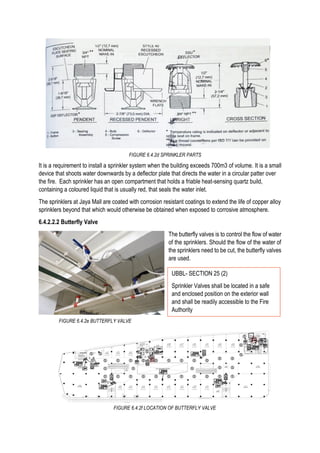
  • 77.
    FIGURE 5.4.2.5a :THE BRAND OF FCU THAT IS USED IN JAYA SHOPPING MALL SOURCE: Jaya Shopping Mall Conditioned air from FCU is supplied to the space via the ductwork system. The supply air after flowing through the ductwork is distributed and discharged to the space by air diffusers. Return air from conditioned area is returned to the FCU via the return air grille. FIGURE 5.4.2.5b : LOCATION OF THE F.C.U. IN EACH RETAIL STORE, AT SECOND FLOOR LEVEL SOURCE : Jaya Shopping Mall
  • 78.
    5.5 CONTROL SYSTEM Thecomplete chilled water system is controlled by HVAC BAS system. The chiller is built- in with ISM (Integrated Starter Module) controller which will monitor and control the operation status of condenser water pump, chilled water pump and cooling tower. In order to start-up the chilled water system, first step is to start the chiller from HVAC BAS system. Once the chiller received signal from BAS system, it will not operate immediately. At first, the chiller will energize ISM controller and it will call chilled water pump to start first. After a few seconds, cooling tower motorized valve will open. Once the valve open contact is activated, then only condenser water pump will start. Once the chiller detected a flow in the chilled water system, it will start automatically by itself. After all only the cooling tower fan motors will start. After the chilled water system has been in full operation, it will regulate the compressor to full load or partial load base on the total building cooling load required. Figure 5.5a shows the flow chart of chiller control. HVAC BUILDING AUTOMATION SYSTEM Most of the above systems have provision to interface ith HVAC BAS sub-system. The chilled water system for air conditioning is designed to operate by BAS. the BAS controls chillers, air handling units, fan coil units and air cooled split units via interfacing wiring connected to the equipment's respective switchboard. In addition to operating the above chilled water system equipment. BAS can also read the room temperature, chilled water supply and return temperature, chilled water pressure and water flow rate. Building Automation System (BAS) provides monitoring and controls of the building services installed in the building. It collects data, performs alarm analysis schedules equipment operations and provides interfacing to other services such as fire alarm monitoring. The justification in installing a BAS system are numerous, namely central monitoring and controlling, energy management analysis tool, prolong equipment life, manpower savings, etc. The net effects on operations in maintaining a large building are fewer personnel but more highly-skilled, less use of feet with more use of brains, users gain in understanding of building system, more sophisticated troubleshooting.
  • 79.
    5.6 CONCLUSION In anutshell, the HVAC system of Jaya Shopping has complied with the standards set by the government by following the By-Laws stated in the UBBL SECTION 41 and guidelines provided in MS1525. Sufficient equipment, backup plans and regular maintenance basis is planned and designed for the building. According to MS1525 SECTION 8.2.2 which stated that “where chillers are used and when the design load is greater than 1000 kWr, a minimum of two chillers or a single multi-compressor chiller should be provided to meet the required load.” In this case, Jaya shopping malls has prepare four chillers on its rooftop, two with larger capacity and another two lower. During the day, one main chiller will be switch on and it is adequate enough to supply conditioned air to the five stories mall whereas at night, the main chiller will be replaced with one small chiller because the main contribution will go to the cinema. The other part of the mall will not require as much chilled air as the day due to the low temperature at night. FIGURE 5.6a : INFORMATION FOUND ON THE CHILLER OPERATION MANUAL SOURCE : Jaya shopping mall facilities management Hence, the function of having two chillers of two capacities is to allow interval usage. The chiller is changed each week and operates to ensure its quality. In our opinion, this is a good strategy because it will prevent the machine from aging and malfunction due to the lack of performing. In the section Off-Hours Control, Section 8.4.4.1 has mentioned that ACMV (Air-Conditioning Mechanical Ventilation) system should be equipped with automatic controls capable of accomplishing a reduction of energy use for example through equipment shutdown during periods of non-use or alternative use of the spaces served by the system. In this report chapter 5.5, it has discussed the Building Automation System used by Jaya Shopping Mall which has allow full control on the system in front of the computer screen. The temperature sensors and pressure gauge have further enhanced the system. For example, the power of the air-conditioner will increase in percentages if the returning air from the room is lower from the value set in the BAS. FIGURE 5.6a : INFORMATION FOUND ON THE CHILLER OPERATION MANUAL SOURCE : Jaya shopping mall facilities management
  • 80.
  • 81.
    6.1 Introduction Fire isthe rapid, oxidation of a material in the exothermic chemical process of combustion, releasing heat, light and various reaction products. Basically, a fire is a chemical reaction in which a carbon based material (fuel), mixes with oxygen (usually as a component of air), and is heated to a point where flammable vapours are produced. These vapours can then come in contact with something that is hot enough to cause vapour ignition, and a resulting fire. In simple terms, something that can burn touches something that is hot, and a fire is produced. Fire is very dangerous as not only can it cause collateral damage to a building when it spreads but it can also cause people to lose their life. Fire protection consist of methods to prevent fire from turning destructive and also to minimize the impact of the uncontrolled fire to reduce harm or damage. Safety planning practice and drills are included as well as education in fire, research, investigation, safety planning, building construction, safe operations, training and testing of mitigating systems (Cuthbert, 2015). 6.2 Literature Review There are two basic systems for fire protection which are namely passive and active fire protection system. Design and infrastructure, materials used, provision of isolating fire, fire walls and doors of the building that takes fire protection into consideration can be classified as passive fire protecting. Active fire protection consist of manual or automatic detection of fire, use of fore and smoke alarms, firefighting as well as first aid (Nulfire, 2014). Active Fire Protection Active fire protection is the process of protecting a building or structure from fire with methods that use the action of moving parts. These system can be automatic or operated manually, but they require some sort of action in order to work. A couple of example of active fire protection would be building sprinkler system and fire alarm systems. These system are an extremely important part of protecting property and the lives of the people within. According to Nulfire (2014), the overall aim of active system is to extinguish fire by detecting the fire early and evacuating the building, alerting emergency services at an early stage of the fire, control the movement of smoke and fire and suppress and starve the fire of oxygen and fuel. There are several systems in the active fire protection. Sprinkler System Sprinkler system consist of a water supply system that provides to a series of water pipes. At a selected interval along the pipe, there are independent valves known as sprinkler heads. The sprinklers are usually activated by heat from fire, resulting a discharge of water into the fire area Hose Reel System The hose reel system is intended for the early stages of a fire for the occupants of the building. It is to provide the occupants with first aid means of fighting a fire whilst awaiting the arrival of the local fire service. When the hose reel is used, the pressure of the pipe will drop below the
  • 82.
    field adjusted pressuresetting of the pressure switch. This will trigger the pump to come into operation automatically to feed a steady supply of water to discharge through the hose. Water Riser System Wet riser is a vertical pipe installed in a building for firefighting purposes internally and permanently charged with water from a pressurized supply, and fitted with landing valves on various floors. The provision of a built-in water distribution system means that fire fighters do not need to create their own distribution system in order to fight a fire and avoids the breaching of fire compartments by running hose lines between them. Fire Alarm System A key aspect of fire protection is to identify a developing fire emergency in a timely manner, and to alert the building's occupants and fire emergency organizations. This is the role of fire detection and alarm systems. A fire alarm system is number of devices working together to detect and warn people through visual and audio appliances when smoke, fire, carbon monoxide or other emergencies are present and allow appropriate firefighting action. These alarms may be activated from smoke detectors, and heat detectors. They may also be activated via manual fire alarm activation devices such as manual call points or pull stations. As all systems are designed primarily to protect life and property, this places a great responsibility on the designer because each building will have different risk and set of problems that are related to the spreading of fire. Therefore, each fire detection and alarm system needs to be designed specially to meet those requirements. Fire Suppression System Fire suppression systems are used to protect special hazard or sensitive area, like bank and computer rooms. The use of conventional fire sprinkler systems may be appropriate for special hazard area as it might cause the fire to be bigger or cause more damage to the situation. Fire suppression systems are environmentally friendly clean agents. Fire Extinguisher System Portable fire extinguishers are important to fire prevention as most fire starts small and can be easily extinguished. It is designed to be operated easily by anyone who follows simple introductions labelled on the extinguishers. The type of fire extinguisher used depends on the type of fire that is in the area.
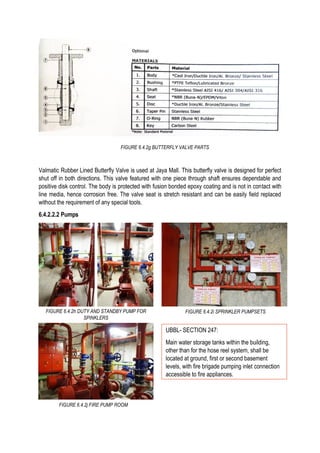

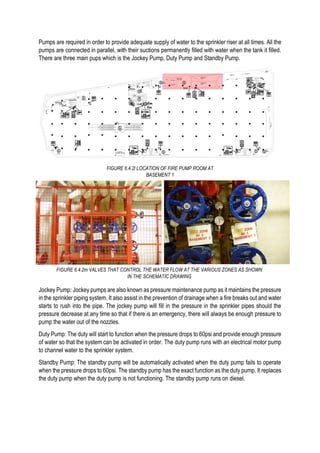
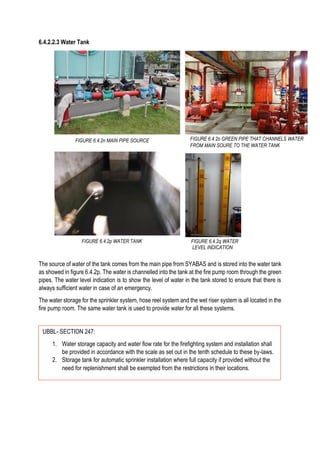
  • 83.
    Passive Fire Protection Usingeffective measures against fire is not at all a new idea! Since many decades it is systematically followed in the field of Industrial plants, storage facilities, warehouse departments and public assembly places. One of the most effective method against fire in a building is the use of passive fire protection. It is defined as systems that are included as part of the very fabric of buildings with fire resistant walls floors and doors serving all as examples. The passive fire protection begins at the design and concept stages which includes, providing fire evacuation routes and fire appliance access. In addition to this, the use of fire resistant materials in walls and floor with providing groups and compartments is also considered as passive fire protection. It is important to note that each mentioned area has a variety of different solutions that are suited to varying build requirements. For example, in case of fire resistant walls, it can be constructed using panels of reinforced cement with steel sheets bonded to each side or through the application of a cementitious fire spray. Considering all this, it is important to use passive fire protection in the building in the modern day. Alfred Haack states that passive fire protection can avoid structural disintegration and can reduce spalling. (Haack, 2013) Therefore, it is essential to have a fire safety concept with best evacuation routes for a successful escape in order to provide optimum safety for the building users.
  • 84.
    6.3 Case Study Activefire protection is compulsory building and our chosen building for the case study, Jaya Shopping Centre is not exempted. There are several types of system that are used in Jaya Shopping Centre that benefits the users during a fire emergency. The following list shows the types of systems that are found in the building and will be discussed further in this chapter with the various components that are used. 1. Fire Alarm System 2. Sprinkler System 3. Hose Reel System 4. Wet Riser System 5. Carbon Dioxide Fire Suppression System 6. Fire Extinguisher The active fire protection system at Jaya Shopping Mall can be summarised in the following diagram. FIGURE 6.3a SMOKE DETECTOR ON CEILING
  • 85.
    This sections exploresthe methods used as passive fire protection, in Jaya Shopping Center, Jalan 14/17, Seksyen 14, 46100 Petaling Jaya, Selangor. Table 6.3b shows the methods which would be further discussed. 1 Fire Evacuation Route 2 Fire Staircase 3 Fire Rated Door 4 Fire Rescue Access 5 Command and Control Center 6 Smoke and Heat Ventilation System 7 Smoke Curtain 8 Smoke Barrier Gate Table 6.3a : List of Passive Fire Protection System Each of the methods would be further deliberated in terms of how it functions and the purpose it serves to the users in the building. FIGURE 6.3b OVERVIEW OF PASSIVE FIRE PROTECTION USED IN JAYA SHOPPING CENTER
  • 86.
    6.4.1 FIRE ALARMSYSTEM 6.4.1.1 Overview The fire detection and alarm system used in this building is an addressable type. At the escape corridors and also car park areas, fire alarm bell and manual call points are provided. Smoke detector are also located around the building including the lift lobby and fire escape routes. The main fire alarm panel is located at the control room. All control and indicative equipment from each respective building level reception, indication, control and relaying of signals from fire detectors or manual call points connected to it are terminated at the main fire alarm panel. Other suppression systems such as sprinkler system are also monitored by the fire alarm system. A Centralized Monitoring System (CMS) is equipped to the fire indicative panel at the fire control room and has a direct telephone line to the BOMBA. 6.4.1.2 Components 6.4.1.2.1 Smoke Detector A smoke detector is a requirement for all building. It is a device that senses smoke, typically as an indicator of fire. Smoke detectors are located at alternate positions to detect smoke and temperature rise in an event of a fire. SMOKE DETECTOR FIGURE 6.4.1a SMOKE DETECTOR ON CEILING FIGURE 6.4.1b LOCATION PLAN OF SMOKE DETECTORS UBBL- SECTION 225(1) Every building shall be provided with means of detecting and extinguisher fire and alarms together with illuminated exit signs in accordance with the requirements as specified in the tenth schedule to these by-laws.
  • 87.
    There are twotypes of smoke detector – optical smoke detectors and ionization smoke detectors. The ones used at Jaya mall is optical smoke detectors. Optical smoke detectors are screwed to the ceiling as that is where smoke moves. The detector has a large opening at the bottom where smoke can enter. In the smoke detector, there is an invisible infrared light beam that shoots on a photocell. The photocell is an electronic light detector that will generate electricity as long that lights fall on it. During a fire breakout, smoke will travel into the detector and block the emission of light that shoots onto the photocell. No light falls on the photocell, thus no electricity is generated. The circuit spots it straight away and triggers the alarm There are some rooms where a lot of dust is present. In these rooms, the smoke detectors are covered with a layer in order to prevent the detectors to be stuck with dust and also prevent the detector from detecting the dust as smoke and setting a false alarm. From figure 6.4.1d the locationg of the covered smoke detector can be seen that it is only present in the fan rooms. FIGURE 6.4.1d COVERED SMOKE DETECTOR FIGURE 6.4.1e LOCATION PLAN OF COVERED SMOKE DETECTORS AT BASEMENT 1 FIGURE 6.4.1c OPTICAL SMOKE DETECTOR Source: http://www.scfpd.us/items/detector6.gif
  • 88.
    6.4.1.2.2 Alarm Bell& Break Glass The alarm bell is placed around the mall to ring to warn people incase of a fire. The alarm rings at 103db (A) which is loud enough and can be heard in any noisy situation. The alarm will continue to sound until it is reset at the main control panel. The bell is mounted with its striker pointing downwards. The bell is designed professionally to meet the needs of firefighting and the detection systems with central control equipment, the simplicity of the design incorporates fewer working parts, thus encouraging easy installation and high level of efficiency capable in operating under the most adverse conditions (Demco Industries Sdn Bhd, n.d). FIGURE 6.4.1f ALARM BELL AND GLASS BOX ALARM BELL GLASS BOX FIGURE 6.4.1g LOCATION OF ALARM BELLS AND GLASS BOXES UBBL- SECTION 237 Alarm bell must be provide a minimum sound of level 65db (A) or +5db (A) above any background noises, which is likely to persist for more than 30 seconds. FIGURE 6.4.1h SPECIFICATION OF A DEMCO BELL ACCORDING TO UNIVERSAL REGULATIONS Source : http://www.demcoalarm.com/products.html
  • 89.
    6.4.1.2.2 Fire ControlRoom The main control panel is located at the control room at the ground floor. The control panel indicates the source of the fire alarm so that in case of an emergency, the source of the fire outbreak or the cause of the alarm triggered can be set. If there is anything that is broken or an alarm is triggered, the nearest guard on duty will be alerted to check the situation and report back. Should anything need to be reset if it is a false alarm or once the fire is put off, it can be done through the main control panel. FIGURE 6.4.1g MAIN FIRE CONTROL PANEL UNIT FIGURE 6.4.1i MAIN FIRE CONTROL PANEL LOCATION FIGURE 6.4.1h INDICATION PANEL UBBL- SECTION 237 Every large premises or building exceeding 30.5 meters in height shall be provided with a command and control central located on the designated floor and shall contain a panel to monitor the public address, fire brigade communication, sprinkler, water flow detectors, fire detection and alarm systems and a direct telephone connection to the appropriate fire station by-passing the switch board.
  • 90.
    When there isan emergency or a false outbreak, the indication panel in figure and a light will show the level that the outbreak is from and the computer will show the exact location of the source. The printer will then print the report immediately. The system can be reset by the control panel that is located at the left side. FIGURE 6.4.1i DRAWING OF LAYOUT FIRE ALARM CONSOLE FIGURE 6.4.1j COMPUTER TO MONITOR THE SYSTEM FIGURE 6.4.1k PANEL TO CONTROL THE SYSTEM FIGURE 6.4.1l PRINTER THAT PRINTS THE REPORT OF ANY OUTBREAK AUTOMATICALLY UBBL- SECTION 155: Fire mode of operation The fire mode of operation shall be initiated by a signal from the fire alarm panel which may be activated automatically by one of the alarm devices in the building or manually.
  • 91.
    6.4.1.2.2 Voice Communication Thefireman intercom system provides a reliable two-way emergency voice communication system between the Master Console handset at the fire control room and the remote handset stations which is located at the escape routes of the building. The master control panel comprise of the master handset, a system control module and zone control modules. During a fire outbreak, a call lamp will flash with audible signals at the master control panel to indicate where the call is coming from. As the handset is lifted to answer the call, the audible signal will be silenced. The master control panel is also equipped with a fault indicator unit which provide easier identification should there be a false alarm. The master control console is located at the fire control room. When the master console handset is lifted and there is no incoming call, there will be an outgoing call straight to the BOMBA. Should the BOMBA need to contact anyone in the mall, the call will be transferred immediately to the phone at the fire control room. 6.4.1.2.2 Fire Switch Should there be a fire, when the fire fighter arrives, only they will be able to operate and off the fire switch. These fire switch are located in each level and controls the electrical appliances of each of the level. This is so that there will be no explosion during the spread of the fire that can cause more damage to the building. The fire switches are located at the fire escape stairs. The switch can also be used to run the under voltage relaose or stunt trip in the main incoming breaker. If there is a fire in the building, the fireman uses an insulateed rod to pull the handle which isolates the utility supply to the building (ABB,2012). FIGURE 6.4.1m FIREMAN INTERCOM AT ESCAPE ROUTES FIGURE 6.4.1o FIRE SWITCH FIGURE 6.4.1n MASTER CONSOLE AT FIRE CONTROL ROOM
  • 92.
    6.4.1.2.2 Manual PullSwitch Incase of an emergencies, there are manual pull switch that are located at the exit of the mall through the fire escape routes. As people exit due to a fire, there are able to pull this switch to warn the other occupants of the building. The pull switch is linked to the alarm system and functions just like the glass box. It will trigger the alarm to ring when it is switched on. Also, it will send an indication to the main fire control panel to signal where the warning is from. 6.4.1.3 System Operation In an event of a fire and the glass box is broken and the manual switch is pulled and the alarm at the control room will sound for 30 minutes before the whole alarm system in the mall is activated. When this happens, an indication on the main fire panel with show where the source of the alarm is coming from and the BOMBA will be alerted. The person in charge will verify the fire and if there is a fire, the alarm system in the mall will be activated to evacuate the building. The BOMBA will come to the building if they have not been updated about the situation after 30 minutes. This shows that the system is a two stage system If it was a false alarm, the system is reset by the person in charge and the situation is reported to BOMBA. After everything, the system is reset. FIGURE 6.4.1p MANUAL PULL SWITCH
  • 93.
    6.4.2 SPINKLER SYSTEM 6.4.2.1Overview The basement (car park area) of Jaya Mall is provided with an automatic sprinkler system except for the electrical rooms such as TNB switch room, genset room and electrical riser room. This system consists of an integrated network of pipes connecting water supplies to sprinkler nozzle installed at specific areas in the building. The network of piping has valves that controls the sprinkles piping and includes a device for actuating an alarm when the system is in operation. 6.4.2.2 Components 6.4.2.2.1 Sprinkler Inside the mall, the sprinkler heads are recessed inside the ceiling. This is for asthetic values so that the ceiling will look clean. When there is a fire outbreak, the cover wil be lowered and the sprinklers will drop slightly to spray water out of the pipe. In the basement where asethetic values are not so important, the sprinkler hear is not hidden. FIGURE 6.4.2a INDOOR SPRINKLERS FIGURE 6.4.2b BASEMENT SPRINKLERS FIGURE 6.4.2c LOCATION OF MAIN SPRINKLER PIPES UBBL- SECTION 25 (2) All sprinkler system shall be electricity connected to the nearest fire station to provide immediate and automatic relay of the alarm when activated
  • 94.
    It is arequirement to install a sprinkler system when the building exceeds 700m3 of volume. It is a small device that shoots water downwards by a deflector plate that directs the water in a circular patter over the fire. Each sprinkler has an open compartment that holds a friable heat-sensing quartz build, containing a coloured liquid that is usually red, that seals the water inlet. The sprinklers at Jaya Mall are coated with corrosion resistant coatings to extend the life of copper alloy sprinklers beyond that which would otherwise be obtained when exposed to corrosive atmosphere. 6.4.2.2.2 Butterfly Valve The butterfly valves is to control the flow of water of the sprinklers. Should the flow of the water of the sprinklers need to be cut, the butterfly valves are used. FIGURE 6.4.2f LOCATION OF BUTTERFLY VALVE UBBL- SECTION 25 (2) Sprinkler Valves shall be located in a safe and enclosed position on the exterior wall and shall be readily accessible to the Fire Authority FIGURE 6.4.2d SPRINKLER PARTS FIGURE 6.4.2e BUTTERFLY VALVE
  • 95.
    Valmatic Rubber LinedButterfly Valve is used at Jaya Mall. This butterfly valve is designed for perfect shut off in both directions. This valve featured with one piece through shaft ensures dependable and positive disk control. The body is protected with fusion bonded epoxy coating and is not in contact with line media, hence corrosion free. The valve seat is stretch resistant and can be easily field replaced without the requirement of any special tools. 6.4.2.2.2 Pumps FIGURE 6.4.2h DUTY AND STANDBY PUMP FOR SPINKLERS FIGURE 6.4.2i SPRINKLER PUMPSETS FIGURE 6.4.2j FIRE PUMP ROOM UBBL- SECTION 247: Main water storage tanks within the building, other than for the hose reel system, shall be located at ground, first or second basement levels, with fire brigade pumping inlet connection accessible to fire appliances. FIGURE 6.4.2g BUTTERFLY VALVE PARTS
  • 96.
  • 97.
    Pumps are requiredin order to provide adequate supply of water to the sprinkler riser at all times. All the pumps are connected in parallel, with their suctions permanently filled with water when the tank it filled. There are three main pups which is the Jockey Pump, Duty Pump and Standby Pump. Jockey Pump: Jockey pumps are also known as pressure maintenance pump as it maintains the pressure in the sprinkler piping system. It also assist in the prevention of drainage when a fire breaks out and water starts to rush into the pipe. The jockey pump will fill in the pressure in the sprinkler pipes should the pressure decrease at any time so that if there is an emergency, there will always be enough pressure to pump the water out of the nozzles. Duty Pump: The duty will start to function when the pressure drops to 60psi and provide enough pressure of water so that the system can be activated in order. The duty pump runs with an electrical motor pump to channel water to the sprinkler system. Standby Pump: The standby pump will be automatically activated when the duty pump fails to operate when the pressure drops to 60psi. The standby pump has the exact function as the duty pump. It replaces the duty pump when the duty pump is not functioning. The standby pump runs on diesel. FIGURE 6.4.2l LOCATION OF FIRE PUMP ROOM AT BASEMENT 1 FIGURE 6.4.2m VALVES THAT CONTROL THE WATER FLOW AT THE VARIOUS ZONES AS SHOWN IN THE SCHEMATIC DRAWING
  • 98.
    6.4.2.2.3 Water Tank Thesource of water of the tank comes from the main pipe from SYABAS and is stored into the water tank as showed in figure 6.4.2p. The water is channelled into the tank at the fire pump room through the green pipes. The water level indication is to show the level of water in the tank stored to ensure that there is always sufficient water in case of an emergency. The water storage for the sprinkler system, hose reel system and the wet riser system is all located in the fire pump room. The same water tank is used to provide water for all these systems. FIGURE 6.4.2n MAIN PIPE SOURCE FIGURE 6.4.2o GREEN PIPE THAT CHANNELS WATER FROM MAIN SOURE TO THE WATER TANK FIGURE 6.4.2q WATER LEVEL INDICATION UBBL- SECTION 247: 1. Water storage capacity and water flow rate for the firefighting system and installation shall be provided in accordance with the scale as set out in the tenth schedule to these by-laws. 2. Storage tank for automatic sprinkler installation where full capacity if provided without the need for replenishment shall be exempted from the restrictions in their locations. FIGURE 6.4.2p WATER TANK
  • 99.
    6.4.2.3 System Operation Thesprinkler system is designed to operate automatically in event of a fire. When a fire occurs, a silicone- based liquid contained inside the glass bulb of the nearest sprinkler nozzle absorbs heat rising from the fire. This causes an air bubble inside the glass bulb to expand. When the temperature surrounding the sprinkle rises above the rated temperature of the sprinkler nozzle, the glass bulb breaks and ruptures the seal between the sprinkler head orifice and the network pipe. This allows water from the sprinkler system to discharge through the sprinkler nozzle in a pre-determined pattern. Each sprinkler nozzle is designed to operate independently, so in an event of a fire, only the sprinkler nozzles that have detected a high temperature will be activated. The flow switch installed for the system will then detect the flow of water through the sprinkler network pipe when the sprinkler nozzle is activated. This detection will be send a signal to the fire alarm panel that will send a visual and audible signal to the fire affected area and to the fire brigade. As water flows in through the network pipe when the sprinkler nozzle is activated, the pressure in the pipe will decrease. When the pressure drops to a pre-determined setting in the pressure switch, the Sprinkler Pump sets will operate. When the Sprinkler Pump sets are activated, standby and duty pumps must be switched off manually in the pump room. 1. Once the fire has been put off completely, the fire officer in charge has to carry out the following procedures 2. The isolator valve on the relevant sprinkler rig has to be closed. 3. The main fire pump in the pump room must be manually stopped. 4. The sprinkler head must be replaced. 5. The isolation valve on the sprinkler rig has to be opened. Once the isolation valve on the sprinkler rig is re-opened after a fire, the re-opened system standing pressure will fall as the local pipework is filled up. The jockey pump will automatically cut in and boost the pressure until the required system standing pressure is reached.
  • 100.
    6.4.3 HOSE REELSYSTEM 6.4.3.1 Overview Jaya building is protected by a hose reel system running throughout the building and serve by the hose reel pump set at fire pump room at basement 1 next to the pump set. The system consists of a series of pipes pressurized system. The operation of the pump sets is controlled by pressure switches that are pre-set to start the pump automatically when the pre-determined pressure subject to the adjustment as follows :- Pump set Cut-In Pressure (Psi) Cut-Out (Psi) Duty Pump 150 Psi 160 Psi Standby Pump 135 Psi 160 Psi Great care has to be taken when the hose reel pump set are switch to “Auto” to ensure immediate checking and attention when the hose reel pump starts automatically. 6.4.3.2 Components 6.4.3.2.1 Hose Reel Drum The hose reel drum is of 25mm diameter swing type. Each reel is complete with 30m long 25mm diameter bore non-kink braided rubber hose conforming to BS 3167. The maximum bursting pressure of the rubber hose is 600psi while the working pressure is around 150psi. At Jaya mall, SRI Fire Hose Reel is used. This hose reel are tested and approved to European Standard EN671 by British Standards Institution and Australian Standards AS1221 by QAS Australia. These approval require the certification authority to carry out regular inspections of the hose reel manufacturing facility. With vigorous inspection and testing, SRI Fire Hose Reel is reliable and is at the highest standards (SRI, n.d ). The stop valve is of 25mm diameter conforming to BS1218. The indication of the open and shut position is fixed on the wheel spindle of the valve and the direction of flow is marked on the body. FIGURE 6.4.3a HOSE REEL DRUMS STOP VALVE
  • 101.
    6.4.3.2.1 Hose ReelDrum Pumps Just like the sprinkler pumps, the hose reel pumps also have pumps. As water tank provides water to the hose reel directing, standby pumps and duty pumps are needed to push the water to the upper floor. The hose reel operates automatically when there is a drop of pressure or a flow of water is detected. Both the pumps are prepared at all times. Should the duty pump fail, the stand by pump will start to operate. FIGURE 6.4.3b LOCATION OF HOSE REEL DRUMS UBBL- SECTION 244(c): Hose reel shall be located at every 45 meters (depends on the building form).Besides, fire hose reel should be located at the strategic places in buildings, especially nearer to firefighting access lobbies in order to provide a reasonably accessible and controlled supply of water for fire extinguishing FIGURE 6.4.3c PUMPS FOR HOSE REEL FIGURE 6.4.3d PUMP SET FOR HOSE REEL
  • 102.
  • 103.
    6.4.3.3 System Operation Thehose reel system is installed, tested and commissioned to the specification of the local Fire Authority. The hose reel system installed at the building consists of the following:- Shut-Off Nozzle The shut-off nozzle assembly is constructed from a corrosive resistant material conforming to BS 336 and the nozzle size is 0.25 internal smooth surface finishes. Spray pattern can be adjusted. The horse reel system is easily to operate by one person and requires minimal operator instruction. 1. Proceed to the nearest hose reel in an event of a fire. 2. Turn open the 25mm nozzle that is located at the hose reel compartment. 3. Swing the hose reel out and extend it to the area of the fire. 4. Direct the nozzle to the fire and turn the adjustable nozzle. 5. Ensure the hose reel pump is turn on. After the fire has been extinguished:- 1. Turn the adjustable nozzle to shut the water. 2. Wind the hose reel back to the drum without damaging it. 3. Swing the drum back to its original position 4. Turn off the 25mm valve to shut the system completely. FIGURE 6.4.3f HOSE REEL SYSTEM Source: http://dynoklang.com.my/site/data/images/item/img_49_Hose%20Reel%20System.JPG
  • 104.
    6.4.4 WET RISERSYSTEM 6.4.4.1 Overview At Jaya Mall, one set of wet riser system completed with all firefighting accessories inside is provided for all the levels in the building including the basement. The system consist of a network of pipes connecting water supplies to the landing of the valves. In case of a fire, hoses are connected to this valve and are used to direct water to the fire. All block shares a same water supply RC tank at Basement Fire Pump Room. The pump starter and the control panel for the wet riser is located respectively in the fire pump room next to the pump set. An electrical motor runs this wet rise pump set with a permanent power supply, backed up with emergency power generator in case of a failure of main power supply from TNB. Only fire brigade or trained personnel are permitted to use the system as it is high pressured and it involves the use of water at high flow in large diameter hoses. Wet Riser Tank The tank is located at the fire pump room at basement 1. The compartment of the concrete water tank is to make sure that at least half of the water capacity is available for use during routine maintenance. Wet Riser Pump Located at the fire pump room at basement 1, the wet riser pumps are all electrical motor driven. Each set of pump consist of a duty pump, standby pump and a jockey pump. The duty pump will run during the operation of the wet rise system. The standby pump will operate when the standby pump fails. The jockey pump will operate when there is a drop in pressure by compensating the pressure to avoid having the main pump in starting unnecessarily. The pumps are all pre-set and controlled by a pressure switch. The pumps will be automatically started when the pressure subject to the adjustment as follow:- Pump sets Cut-In Pressure (Psi) Cut-Out Pressure (Psi) Jockey Pump 190 Psi 230 Psi Duty Pump 140 Psi 230 Psi Standby Pump 125 Psi 230 Psi
  • 105.
    6.4.4.2 Components 6.4.4.2.1 WetRiser Wet risers are mean for fire fighters to use to put of the fire. At Jaya Mall, the wet risers are located in a small rooms in that are mainly near the fire escape route. This is for easier access for the firemen to get to the wet riser should there be a fire. FIGURE 6.4.4b LOCATION OF WET RISERS FIGURE 6.4.4a WET RISERS LOCATED NEAR EXITS UBBL- SECTION 231: 1. Wet rising system shall be provided in every building in which the top most floor is more than 30.5 meters above the fire appliance access level. 2. A hose connection shall be provided in each firefighting access lobby.
  • 106.
    6.4.4.2.2 Wet RiserPump Sets At the pump start arrangement assembly, there are pressure switch and gauges that are installed to control the operation of the pump sets and also monitor the pressure of the system. 6.4.4.2.3 Wet Riser Pumps The wet riser pumps are machines that are used to pump to water to the wet risers so that there is a source of water in case of a fire. The pump control panel is to control the operation and function of the various wet riser pump. The control panel is located next to the pump set to facilitate operation and testing. FIGURE 6.4.4d WET RISER PUMPS AT THE FIRE PUMP CONTROL ROOM FIGURE 6.4.4c WET RISER PUMP SET AT THE FIRE PUMP CONTROL ROOM PUMP CONTROL PANEL FIGURE 6.4.4e LOCATION OF WATER SOURCE PIPES FOR WET RISERS
  • 107.
  • 108.
    6.4.4.2 System Operation A4-way breeching inlet c/w box and wired glass that has provided the ground floor with easy access for the fire brigade to pump water in directly into the RC tank. Pressure regulating landing valve for the wet riser system are installed at the locations indicated on the plan. Hoses completed with the required nozzles and coupling for connection to the landing valves are also installed on hose cradles. Landing valves are set between 4.5 bar to 5.0 bar. A network of pipe connects the water from the tanks and pumps to the landing valves. Pipe up to 6’’ conforms to the BS 1387 heavy grade pipes. All the pipes ae galvanized. FIGURE 6.4.4g WET RISER SYSTEM Source: http://www.highrisefirefighting.co.uk/images/WetRiserSys.jpg
  • 109.
    6.4.5 CARBON DIOXIDEFIRE SUPPRESSION SYSTEM 6.4.5.1 Overview CO2 fire extinguishers are located at rooms where there are machines and many electrical devices such as the control room or high voltage electrical rooms. Carbon dioxide is chosen as not only it is fast efficient, adaptable to a wide range of hazards without damage and it is also low-cost. Area Protection Location Carbon Dioxide Quantity Genset Room Lower Ground 12 x 45kg CO2 cylinder Low Voltage Switch Room Lower Ground 14 x 45kg CO2 cylinder Consumer High Tension Room Lower Ground 11 x 45 CO2 cylinder Chiller High Tension Room Lower Ground 6 x 45 CO2 cylinder 6.4.5.3 Components 6.4.5.3.1 CO2 Cylinders CO2 fire extinguishers contains chemical gas agents (Carbon Dioxide) that extinguishes the fire by oxygen depletion by lowering the normal oxygen concentration in the air from 21% to about 12%-10% below the limit required for combustion whilst providing a safe and breathable atmosphere which can be tolerated by humans for a short period of time. Amongst the other gases that act as a suppression comprises of halocarbon agent and sopropenyl-1 methyl cyclohexene. Carbon dioxide is not toxic and will not break down into toxic or corrosive decomposition such as hydrogen fluoride upon contact with fire form by-products unlike chemically derived Halogen 1301 derivatives. FIGURE 6.4.5b CO2 CYLINDERSFIGURE 6.4.5a CO2 CYLINDERS AT HIGH VOLTAGE ROOMS UBBL- SECTION 236: Special Hazards Places constituting special hazards or risks due to the nature of storage, trade, occupancy, or size shall be required to be protected by fixed installations, protective devices and systems and special extinguishers as may be required by the Fire Authority.
  • 110.
    6.4.5.3 System Operation Thissystem consist of multiple tank of high pressured cylinders containing extinguishing agent connected to discharge nozzles that are located at intervals on a network pipe. When there is a fire detected within the protected space, the extinguishing agent will be released from the cylinders and discharged into the spaces via the interconnecting pipes and will be discharged through the nozzle within 10 seconds. A heat and smoke detector controls the activation and the deactivation of the system based on a knock system. The CO2 system is automatic and manually operated and the system is designed based on a 30 seconds time delay. Automatic detection is based on the means of one detector per zone and manual operation is by the means of manual key switch. For the automatic actuation, when the first detector detects the smoke, the first alarm will ring and trip off the exhaust fan. When the second detector is activated, after 0 seconds, CO2 gas will be discharged from the cylinders. All these are monitored back to the main fire alarm panel at the control room. FIGURE 6.4.5c LOCATION OF CO2 CYLINDERS FIGURE 6.4.5d C02 SUPPRESSION SYSTEM Source: http://www.fainkorea.com/uimg/systems01_img/1239260226.gif
  • 111.
    The power supplyof the CO2 system is taken from the essential supply board. In case of a main power failure, there is a standby battery (dry lift battery) provided. At the entrance of the rooms with this system, there are two lights, red and green, at the entrance that acts as indicators. The green light will light up in normal operation and the red light will light up when the gas is discharged. Automatic Operation 1. The alarm sensor of the protected area is triggered, the alarm located outside the room will be activated and sound immediately. 2. On the fire control panel at the main control room, and indication will show the affected zone and a light will flash. 3. The light outside the room will change from normal operation green light to red alarm flashing light. The fire curtain wall will also drop 4. When the second detector is activated, the second alarm light will start to flash. The alarm signal is sent to the main fire alarm panel at the control room. 5. After 30 second (adjustable at the main control room) if the system is not deactivated or switched off, a 24V DC signal is sent to fire the CO2 cylinder quick release. 6. Once the CO2 cylinder is fired, all the CO2 in the cylinder will be discharged in 10 seconds and fill the room with 50% of CO2 concentration. 7. The CO2 will remain in the room until he gas is exhaust or ventilated out. 8. Should there be any false alarm, the system can be isolated by the control panel switch to prevent any unnecessary discharge of CO2 gas. Once the Co2 cylinder has been fired, it cannot be controlled anymore Manual Operation 1. Should there be a power failure, the control unit, the system can automatically transfer to a standby battery power that is supplied by the control unit. The system can stay online for 72 hours with a further 10 minutes full alarm condition. 2. CO2 can be manually discharged when the manual pull station located outside the protected room. When the manual pull station is pulled, CO2 will be activated instantly. 3. The alarm bell will ring and the damper / fan (optional) will shut down. 4. A signal will be transmitted to the main fire alarm panel to indicate the discharge of the CO2.
  • 112.
    6.4.6 FIRE EXTINGUISHER 6.4.6.1Overview Fire extinguishers are provided at escape corridor, car park and electrical room. There are two different types of portable fire extinguishers which is the CO2 portable fire extinguisher and ABC Powder fire extinguisher. CO2 fire extinguishers are installed at the electrical equipped rooms such as the TNB room, Genset room and Switch board rooms whereas ABC dry powder fire extinguishers are located at escape corridor, fire riser and car park area FIGURE 6.4.6a TYPES OF FIRE EXTINGUISHER Source: http://blog.sdfirealarms.co.uk/wp- content/uploads/2015/02/fire-extinguisher-colour-chart.jpg
  • 113.
    6.4.6.2. Components 6.4.6.2.1 ABCPowder Fire Extinguisher There are 9.0kg ABC dry powder fire extinguishers in the building and they are classed effective for type ‘A’, ‘B’ and ‘C’ fire. It is suitable to extinguish mixed risked fire and only fire involving carbon disulphide and flammable such as magnesium and sodium should be avoided. FIGURE 6.4.6d LOCATION OF ABC POWDER FIRE EXTINGUISHER FIGURE 6.4.6b ABC POWDER FIRE EXTINGUISHER Source:http://spikenard.net/msicart/image/cache/data/Fire%20Extin g4kg-500x500.gif UBBL- SECTION 227: Portable Fire Extinguisher shall be provided in accordance with relevant codes of practice and shall be sited in prominent position on exit routes to be visible from all direction and similar extinguishers in a building shall be of the same method of operation FIGURE 6.4.6c PARTS OF A FIRE EXTINGUISHER Source:http://www.firesentryprotectionservices.com/wpimages/fire% 20ext%20pic.jpg
  • 114.
    6.4.6.2.2 CO2 FireExtinguisher There are 5kg CO2 fire extinguishers that are filled with carbon dioxide in liquid state under its own vapour pressure. The agent is expelled by operation of the discharge lever and can be started and stopped as required. The agent is discharged as gas. No pressure gauges on the carbon dioxide fire extinguishers are found. As long as there is any liquid carbon dioxide in the cylinder, the internal pressure will remain the same. The extinguishers are heavy duty due to the thick metal cylinder required to contain the high pressure 6.4.6.3 System Operation When there is a fire, these steps should be taken: 1. Remove the fire extinguisher from the bracket. 2. Bring the extinguisher to the fire 3. Pull out the safety pin/ clip 4. Aim the nozzle to the fire and squeeze the lever. After the extinguisher is used, the fire extinguisher needs to be sent back to the manufactured to be refilled and checked before it can be used again. FIGURE 6.4.6e CO2 FIRE EXTINGUISHER FIGURE 6.4.6f INTERNAL OF CO2 FIRE EXTINGUISHER Source: http://www.marineinsight.com/wp- content/uploads/2012/04/co2cross.jpg
  • 115.
    Conclusion Upon the extensiveanalysis of each individual passive fire systems provided in the Jaya shopping Center, it can be concluded that they’ve met all the conditions stated in the UBBL Law (PART VII - FIRE REQUIREMENTS ) that are related to passive and active fire protection system. To start with, UBBL law requires not less than two exits to be provided from each storey in case of an evacuation fire. The building contains 5 fire escape routes in each floor with 7 routes in the ground floor. In addition with this, the conditions required for the fire rated doors and the fire staircase in the UBBL are also met in the building. UBBL law requires staircases to be of such width that in the event of any staircase not being available for escape purpose the remaining staircases to be able to carry the highest occupancy load for that respective floor. As mentioned before, Jaya shopping mall contains 5 fire escape routes in each floor with 7 routes in the ground floor. It is indeed clear that alternative routes are provided to carry all the users of that respective floor to safety, even if one of the evacuation route gets blocked. Looking into the section Fire appliance access under the UBBL Law, it is stated that all building in excess of 7000 cubic metres should be abut upon a street or road or open space of not less than 12 meters width and accessible to fire brigade appliances. This building provides 13.05 meter’s in the back gate as an access for fire brigade appliances also providing access for firefighting personals through the back entrance It is important to note that the UBBL Laws in regards to, ventilation system in staircase are considered and well applied in addition with introducing methods to restrict the spread of fire such as smoke curtains and smoke barrier gates. In fact, considering the analysis I conducted, I personally believe that the management of Jaya shopping center has allocated the best features of passive fire protection in relation to the design of the building and the in terms of efficiency and the use of the systems. For instance, the fact that Jaya shopping center has a system which could constantly monitor the fire protection systems and its conditions is an example. This shows high degree in which the security measures in regards to fire are monitored and controlled. As the UUBL stated that all building must be provided with detecting and extinguishing of fire and alarms, Jaya Shopping centre has complied with the rule. This shopping mall is equipped completely with a detector, which detects smoke when there is a fire, an alarm bell and a glass break to alert the occupants of the building during a fire emergency to evacuate the building. Since the building exceeded 30.5 meters in height, a control central is located at the ground floor to monitor the public as well as handle the other systems should there be an emergency. As stated in the UBBL in Section 155, the fire mode shall be initiated by a single fire alarm panel that can be operated manually as well. This is so that if the electric supply fails of the machine fails to do the job, human can correct it and help fix the problem. To ease communication to alert or to instruct occupants of the building, is a voice communication that provides a reliable two-way emergency voice communication system between the Master Console handset at the fire control room and the remote handset stations which is located at the escape routes of the building. For the sprinkler system, the basement (car park area) of Jaya Mall is provided with an automatic sprinkler system except for the electrical rooms. This is so water can be sprayed out when it
  • 116.
    is triggered immediatelywithout wasting time as a fire may cost life. It is a building requirement that is stated in the UBBL that all sprinkler system shall be connected to the nearest first station to provide immediate and automatic relay of the alarm when it is located. This is so that the fireman will be immediately notified should there be a fire and they can act accordingly immediately. Hose reels are also located around the shopping mall to protect the building. According to the UBBL, hose reel has to be located at every 45 meters and at strategic places where it is easy to access and spot. The hose reel at Jaya Shopping Mall are located at a strategic place which is the exit where it can be access easily by the firemen during an emergency. The shopping mall is also completed with a set of a complete wet riser system. As stated in the UBBL, the system must be provided if the building is 30.5 meters or more. A hose connection must be provided in each firefighting lobby. Jaya Shopping Mall complies with these rules and therefore is prepared should a fire outbreak happen. Places constituting special hazards or risks is required to be protected by fixed installations, protective devices and systems and special extinguishers as may be required by the Fire Authority. Jaya Shipping Mall follows this by-law and have installed Co2 suppression units at the electrical rooms. This is so that the fire appliances will cause further damage unlike if water is used, which may bring more danger instead of putting off the fire. Portable fire extinguishers are also provided according to the requirement of the UBBL for the occupants to use when there is a fire as more people are familiar with this quick and easy method of putting of the fire which require less knowledge. In a nutshell, active and passive fire protection in Jaya Shopping Mall has is complete and have been installed according to the Uniform Building By-Law of Malaysia and also the BOMBA requirements.. The overall system is very systematic as a control panel controls the while system. This not only allows the people in charge to monitor the fire out breaks but also prevent the cause of a false alarm in the building that will cause disturbance. In conclusion, should and emergency happen, the building is prepared and big damages to the building can be avoided as well as the occupants will be more safe. There are no further suggestions that can be made as the fire safety coverage area in the building is wide enough to ensure the occupants safety.
  • 117.
    Means of Escape 6.5.1Fire Evacuation Route It is important to provide an easy and direct route for escape in case of a fire in a building. One of the main firefighting element is the provision of an escape route for the people to exit the building in case of a fire occurrence. Scientific research on human respiratory burns reveals that occupants trapped in structural fires have limited survival times and in the occurrence of thick smoke they can only move for an estimated range of 12 meters in a minute. (Peacock & Bukowski,1990 ) These are crucial factors that should be taken into consideration when providing a passive fire protection system. Each floor of Jaya shopping center comprise of 5 different exit routes through the staircase, whereas the ground floor comprise of 7 exit routes including the front and the back entrance. In case of a fire, the users can choose the fastest and the safest exit route. FIGURE 6.2.1a EVACUATION ROUTE OF GROUND FLOOR
  • 118.
    FIGURE 6.2.1 bEVACUATION ROUTE OF FIRST FLOOR UBBL SECTION 165 : EXITS TO BE ACCESSIBLE AT ALL TIMES (1) Except as permitted by by-law 167 not less than two separate exits shall be provided from each storey together with such additional exits as may be necessary 6.5.2 Fire Staircase Fire staircases are constructed to offer a safe and convenient passage to exit in case of a fire. It is designed so that any person who is likely to use them can do so comfortably with minimum amount of difficulty. In the case of fire, it is highly possible for an accident involving falling to occur in the fire staircase with young and elderly people particularly at risk. The design should also eliminate any possible trip hazards and should provide appropriate guarding for a safe passage. UBBL SECTION – 168 (2) Staircases shall be of such width that in the event of any one staircase not being available for escape purpose the remaining staircases shall accommodate the highest occupancy load of any one floor discharging into it calculated in accordance with provisions in the Seventh Schedule to these Bylaws
  • 119.
    FIGURE 6.2.2a FIREESCAPE STAIRCASE FIGURE 6.2.2b WIDTH OF FIRE ESCAPE STAIRCASE UBBL SECTION 168 (4) The required width of a staircase shall be maintained throughout its length including at landings FIGURE 6.2.2c FIRE ESCAPE STAIRCASE FIGURE 6.2.2d FIRE ESCAPE STAIRCASE LANDING UBBL SECTION 168 (5) Doors giving access to staircases shall be so positioned that their swing shall at no point encroach on the required width of the staircase or landing. FIGURE 6.2.2e DOOR GIVINGACCESS TO STAIRCASE FIGURE 6.2.2f STAIRCASE LANDING AND DOOR
  • 120.
    6.5.3 Fire RatedDoor Fire resistant barriers such as fire doors, smoke barrier gates are used in a building to separate it to compartments to help stop the spread of fire. Hence, fire doors are a vital part of the buildings passive fire protection system. It helps to suppress the fire by restricting the flow of oxygen as well as the spread of fire through the building. This will eventually allow a safe evacuation for the people to escape the building safely and provide safety to the fire fighters as well. Therefore a correct design and configuration of the fire rated doors are extremely essential. In case of Jaya Shopping center, fire doors are often seen on lift lobby area and entrance to the fire staircase. Materials used in the fire rated doors include gypsum and vermiculite board. There are two types of fire doors seen on Jaya shopping center which is specified in Table 6.4.1 Type Dimension Single leaf door 900 mm * 2100 mm Double leaf door 1600 mm * 2100 mm TABLE 6.3 : TYPES OF DOORS IN JAYA SHOPPING CENTER FIGURE 6.3a FIRE DOOR IN JAYA SHOPPING CENTER
  • 121.
    FIGURE 6.3b: SINGLELEAF DOOR FIGURE 6.3c :DOUBLE LEAF DOOR UBBL SECTION – 173. Exit doors (1) All exit door should be openable from the inside without the use of a key or any special knowledge or effort. (2) Exit doors shall close automatically when released and all door devices including magnetic door holders, shall release the doors upon power failure or actuation of the firm alarm. 6.5.4 Fire Rescue Access It is an approved route through the surrounding building that is always available for the use by fire trucks and provides an easy and a safe access for the fire rescue team. It is designed to meet the fire equipment and load requirements. Providing safe and an easy route for the firefighting is the best mean of stopping the fire as fast as possible. Jaya shopping center has fire access routes for both fighter fighting personals and fire vehicles to easily access the building. In case of a fire, the specified route for the fire rescue team is through the back entrance of the building as shown in Figure 6.5.1. However, in case the back entrance is not usable access can also be provided through the main entrance as well. FIGURE 6.4a VEHICULAR ACCESS FIGURE 6.4b FIRE PERSONNAL ACCESS
  • 122.
    FIGURE 6.4c WIDTHFOR FIRE BRIGADE ACCESS PROVIDED AT THE BACK ENTRANCE (13507 m) UBBLSECTION-140.Fire Appliance Access All building in excess of 7000 cubic metres shall abut upon a street or road or open space of not less than 12 metres width and accessible to fire brigade appliances 6.5.5 Command and Control Center The command and control center in Jaya Shopping center provides control of systems such as mechanical control systems and fire systems. The room is allocated in the ground floor and is mainly observed by 3 – 5 guards on shift. FIGURE 6.5a: LOCATION OF COMMAND AND CONTROL CENTER
  • 123.
    In case offire, if the break glass is used or of if the smoke detector detects any smoke, signal will be sent directly to the control panel. The control panel is connected directly to the digital alarm communicator which is linked to Jabatan Bomba. Through CCTV camera’s and the main computer, the security will check the presence of fire and respond to the call from Jabatan bomba. Depending on the severity of fire, the security will activate the sprinkler systems and other active fire protection systems FIGURE 6.5b EMERGENCY PROCESS IN CASE OF FIRE For easier monitoring, the condition of the mentioned systems in the Table 6.6.1 can be observed through the main computer for each of the floor in the building. Therefore, the staff can be confident that the systems are in the right condition in case of a fire.  Smoke detector  Break glass  Alarm bell  Butterfly valve/Flow switch
  • 124.
    FIGURE 6.5c SYSTEMMONITORING THROUGH MAIN COMPUTER Color Indication Green System okay to use Yellow Some malfunctions/ Can be repaired Red Cannot be used/ Need replacing TABLE 6.6.2 : COLOR INDICATION UBBL SECTION - 238. Command and control center. Every large premises or building exceeding 30.5 metres in height shall be provided with a command and control centre located on the designated floor and shall contain a panel to monitor the public address, fire brigade communication, sprinkler, water flow detectors, fire detection and alarm systems and with a direct telephone connection to the appropriate fire station by-passing the switchboard.
  • 125.
    6.5.6 Smoke andHeat Ventilation In case of a fire, it is important to provide a safe pathway to exit. However, the smoke from the fire which is harmful for humans can get accumulated in exit pathways such as the fire exit staircase. Therefore it is important to have a system installed which would tackle this problem. Jaya Shopping Center uses a simple stair way smoke ventilation system in which smoke present in the stair core is extracted out through smoke ventilators. Each of the fire escape staircase has at least 3 smoke ventilators located at different floors. When smoke is present in the stair core, the Smoke Detector sends a signal to the Control Panel FIGURE 6.6a SMOKE DETECTOR AND CONTROL PANEL On receipt of the resultant signal from the Control Panel, the Ventilator is activated, fully opening within 60 seconds. FIGURE 6.6b VENTILATOR
  • 126.
    The smoke inthe stair core is then able to vent out through the highest point in the stairs, due to the natural buoyancy of the hotter air. FIGURE 6.6c : SMOKE EXCAPES FROM THE TOP SOURCE: http://www.coltinfo.co.uk/pressurisation-system-smoke-fire-ventilation.html The break glass which is located on each floor of the fire escape staircase can be used by the fire service personal to override the automatic controls, providing ventilation to exhaust heat in the staircase. UBBL SECTION 200. Ventilation of staircase enclosures in buildings exceeding 18 metres. (a) permanent ventilation at the top of the staircase enclosure of not less than 5% of the area of the enclosure and in addition at suitable intervals in the height of the staircase a mechanically ventilated shaft to achieve not less than 20 air charges per hour to be automatically activated by a signal from the fire alarm panel;
  • 127.
    6.5.7 Restriction ofSpread of Flame 6.5.7.1 Smoke Curtain Smoke curtains are used to control the spread of fire and prevent it from spreading to other areas of the building. This is essential especially in a building used by the public such as a shopping mall. Each floor of Jaya shopping center has 2 smoke curtains located with a space allocated to control smoke curtains. FIGURE 6.7.1a SMOKE CURTAIN IN JAYA SHOPPING CENTER FIGURE 6.7.1b SMOKE CURTAIN CONTROL ROOM
  • 128.
    Smoke curtain controlroom allows the user to control the curtain rise levels and the curtain alarm when needed. FIGURE 6.8.1.3 SMOKE CURTAIN CONTROLLER 6.5.7.2 Fire Barrier Gate Most of the service rooms in Jaya shopping mall comprise of a fire barrier gate at the exit door. If a fire occurs in the room, fire barrier gates prevent the fire from spreading to alternate areas of the building. Fire barrier gates in Jaya shopping center is located in service rooms which are allocated for higher voltage equipment. Fire barrier gate at Jaya Shopping center contains an alarm and a rolled in canvas which is a fire resistant material which when activated would block the exit door and prevent spreading of fire. The alarm for the fire barrier gate can be controlled by the command and control center. FIGURE 6.7.2a SMOKE CURTAIN CONTROLLER Service rooms with fire barrier gate LV Room Genset Room Chiller Room
  • 129.
    6.8 Conclusion Upon theextensive analysis of each individual passive fire systems provided in the Jaya shopping Center, it can be concluded that they’ve met all the conditions stated in the UBBL Law (PART VII - FIRE REQUIREMENTS ) that are related to passive fire protection system. To start with, UBBL law requires not less than two exits to be provided from each storey in case of an evacuation fire. The building contains 5 fire escape routes in each floor with 7 routes in the ground floor. In addition with this, the conditions required for the fire rated doors and the fire staircase in the UBBL are also met in the building. UBBL law requires staircases to be of such width that in the event of any staircase not being available for escape purpose the remaining staircases to be able to carry the highest occupancy load for that respective floor. As mentioned before, Jaya shopping mall contains 5 fire escape routes in each floor with 7 routes in the ground floor. It is indeed clear that alternative routes are provided to carry all the users of that respective floor to safety, even if one of the evacuation route gets blocked. Looking into the section Fire appliance access under the UBBL Law, it is stated that all building in excess of 7000 cubic metres should be abut upon a street or road or open space of not less than 12 meters width and accessible to fire brigade appliances. This building provides 13.05 meter’s in the back gate as an access for fire brigade appliances also providing access for firefighting personals through the back entrance It is important to note that the UBBL Laws in regards to, ventilation system in staircase are considered and well applied in addition with introducing methods to restrict the spread of fire such as smoke curtains and smoke barrier gates. In fact, considering the analysis I conducted, I personally believe that the management of Jaya shopping center has allocated the best features of passive fire protection in relation to the design of the building and the in terms of efficiency and the use of the systems. For instance, the fact that Jaya shopping center has a system which could constantly monitor the fire protection systems and its conditions is an example. This shows high degree in which the security measures in regards to fire are monitored and controlled.
  • 130.
  • 131.
    7.1 Literature Review Mechanicaltransportation is a system found within, around and in general association with modern buildings and developments mainly functioned to transport goods and people vertically or horizontally in a more efficient way. The common types of mechanical transportation system found are elevators, escalators and travelators. 7.1.1 Elevator Elevator is an example of vertical transportation system, which is an apparatus for raising and lowering people or goods to different floors of building. In commercial buildings, it is definite to have vertical transportation requirements because the arrival and departure of their populations are usually concentrated within certain periods of the working day. According to the By-Law 124 of UBBL 1984, an elevator shall be provided for non-residential building which exceeds 4 storeys above or below the main entrance. It is also essential in building less than 4 storeys if access for elderly or disabled is required. There are a few factors affecting the installation of the elevators such as the position of the elevators, speeds and types of elevators. Usually, elevators are positioned at locations which provide easy access for all building users with a maximum walking distance of 45m to the lift lobby. An elevator grouping is usually required when there are a number of elevators installed to reduce waiting time and cost of installation. The numbers of elevators are normally determined by the population of the building, type of occupancy, the number of floors and height, the initial cost and finally the maintenance cost. The commonly used elevators are: 1. Electric elevator 2. Hydraulic elevator Electric elevator can be divided into 2 types – Traction with machine room & Machine-room- less traction. The traction principle is a means of transmitting lifting force to the hoist ropes of an elevator by friction between the grooves in the machine drive sheave and the hoist ropes. The ropes are simply connected from the car to the counterweight and wrapped over the machine drive sheave in grooves. The weight of both car and the counterweight ensures the seating of the ropes in the groove. UBBL SECTION 124 - Lift For all non-residential buildings exceeding 4 storeys above or below the main access level at least one lift shall be provided.
  • 132.
    For Traction withmachine room elevator, a machine room is sited at the top of lift shaft to minimize the length of rope and optimize the efficiency. Traction elevator is further divided into2 main types, geared traction elevators which have a gearbox that is attached to the motor that drives the wheel to move the ropes, and the gear-less traction elevator which have the wheel attached directly to the motor. Whereas for machine-room-less elevator, it does not have a dedicated machine room above the elevator shaft. The machine sits in the override space and is accessed from the top of the elevator cab when maintenance or repairs are required. The control boxes are located in a control room that is adjacent to the elevator shaft on the highest landing and within around 150 feet of the machine. FIGURE 7.1.1a EXAMPLE IMAGE OF MACHINE ROOM ELEVATOR SOURCE: (http://construction.com/CE/CE_images/0709kone4.jpg) FIGURE 7.1.1b EXAMPLE OF IMAGE MACHINE-ROOM-LESS ELEVATOR SOURCE: (http://cdn.ferret.com.au/c/Kone-Elevators/images/KONE-Transys-freight-elevators-from-Kone- Elevators-627676-l.jpg)
  • 133.
    Hydraulic elevators onthe other hand, are supported by a piston at the bottom of the elevator that pushes the elevator up as electric motor forces oil or another hydraulic fluid into the piston. The elevator descends as a valve releases the fluid from the piston. FIGURE 7.1.1c EXAMPLE IMAGE OF HYDRAULIC ELEVATOR SOURCE: (http://kvmelevatormanufacturers.com/wp-content/uploads/2014/12/hydraulic_elevator.jpg)
  • 134.
    7.1.2 Escalator Escalator isa moving stairway that provides an immediate means of transportation. It continuously conveys to move large number of people from one level to another to speed circulation and avoid congestion. With the help of escalator, everyone can be moved at a constant speed, and are carried efficiently from one place to another. When people are walking, some are slow, some are fast, some with baggage, and others might accompanied by children, so walking is often slowed to the speed of the slowest pedestrian. With a moving device, the velocity is established and constant. There are a few types of arrangement commonly found in buildings, such as single bank with interrupted traffic in one direction, single bank with traffic in one direction, parallel arrangement and criss-cross arrangement. 7.1.3 Travelator Travelator is a moving walkway which has a similar function and installation as escalator. It is normally intended for horizontal movements which usually found at air terminals and railway stations whereas vertical movements can also be found in shopping centre to allow trolleys to access and carried from on floor to another. FIGURE 7.1.3b EXAMPLE IMAGE OF TRAVELATOR SOURCE: (http://i01.i.aliimg.com/photo/v1/480594471/Travelator.jpg) FIGURE 7.1.2a EXAMPLE IMAGE OF ESCALATOR SOURCE: (http://www.mitsubishielectric.com/company/environment/policy/product/energy/escalator/images/img_01.jpg)
  • 135.
    7.2 Introduction After theliterature review, which explains the general types, functions and operation of the mechanical transportation, the report will then further research on the mechanical transportation found in the choice of our building for case study which is the Jaya Shopping Centre by identifying the components and the operation of the system along with supporting information such as UBBL requirement or related regulations as well as images and diagrams of the system to further elaborate the explanation. The research will then conclude with an analysis and comments based on observations on the mechanical transportation of the Jaya Shopping Centre building. The mechanical transportation system in Jaya Shopping Centre building is provided by Antah Schindler SDN. BHD. Antah Schindler is an authorized distributor and service provider for Schindler elevators and escalators for the whole of Malaysia. Schindler has been involved in the design, supply, installation, modernization and maintenance of Schindler elevators and escalators found in many buildings for both the public and private sectors. Schindler solutions are currently operating in hospitals, airports, government buildings, offices, condominiums, shopping malls, factories and many other areas throughout Malaysia. After the site visit conducted, it can be seen that Schindler provides three kinds of mechanical transportation systems to the Jaya Shopping Centre, which are elevator, escalator and travelators. FIGURE 7.2a IMAGE OF JAYA SHOPPING CENTRE BUILDING (SOURCE: http://vault.starproperty.my.s3.amazonaws.com/wp-content/uploads/2013/07/v1-ye-edited-c.jpg) FIGURE 7.2b ANTAH SCHINDLER LOGO SOURCE: (https://upload.wikimedia.org/wikipedia/en/d/d2/Logo-schindler.png)
  • 136.
    7.3 Elevator According toBy-Law 124 of UBBL 1984, it stated that for all non-residential buildings exceeding 4 storeys above or below the main access level at least one lift shall be provided. With the total of 7 floors along with 4 basement levels, there are 5 units of elevators, 4 passenger lifts and 1 service lift. This can be clearly proven that Jaya Shopping Centre successfully achieved the requirement. The type of elevator used for passenger lifts is the Motor-Room-Less (MRL) Traction elevators whereas the type of elevator used for service lift is the Traction with Motor Room or known as Mini Motor Room (MMR). When the control system receives signal, the motor will drive the traction sheave, which then transmits the force to the car by suspension ropes. The car is balanced by the counter weight. In terms of safety components, the safety gear on the car brakes the car if it travels downwards or upwards at an excessive speed. The safety gear is tripped by the speed governor. The traction sheave brake on the motor brakes the car, if it travels upwards at excessive speed. The traction sheave brake is triggered by the speed governor. The buffer brakes the car in the event of over travel into the hoist way pit. The door interlock on the other hand will prevents the landing doors and car door from opening during travel and when outside the interlock zone. FIGURE 7.3a DIAGRAM BREIFLY SHOWING HOW ELEVATOR SYSTEM WORKS
  • 137.
    FIGURE 7.3b IMAGEINDICATING THE PARTS AND COMPONENTS OF MRL TRACTION ELEVATOR SOURCE: (http://www.schindler.com/com/internet/en/home.html) Figure 7.3c IMAGE INDICATING THE COMPONENTS OF TRACTION WITH MOTOR ROOM ELEVATOR SOURCE: (http://2.bp.blogspot.com/-xioIClJzOsg/T3ncUa- 0KqI/AAAAAAAABhU/Em57QGkMBZE/s1600/geared+1.JPG)
  • 138.
    7.3.1 Passenger Lift The4 units of passenger lifts used in Jaya Shopping Centre are the Motor-Room-Less (MRL) Traction elevators, it is also known as Schindler 300P-MRL-lift. This lift is a new innovative system structure designed by Schindler that contains a bundle of three guide rails including 1 car guide rail, 1 counterweight guide rail and 1 addition guide rail. On top of this triple bundle the hoisting motor installed without any additional fixings in the hoistway. The additional required guide rails for the counterweight and the car are fixed to the well in a conventional way. Each units is able to carry a load of 1430kg (21person), with a travel height of 52.18m and speed of 1.75m/s. The elevators tops at a total of 12 levels including B4-B1, LG, G and 1-6. The reason this type of elevator is chosen by the contractor is because of the space constraint of the building. Since there are a total of 4 elevators, the contractor decided to group the 4 elevators together and positioned near to the entrance of the building to reduce waiting time and cost of installation. The levels that the passenger lifts stops are from Basement 4 to 6th floor however the passenger lift will not stop at the mezzanine level as it is a cinema area. According to the manager, all elevators will be switched off 10.00pm, leaving only 2 elevators for the use of cinema. The 2 left over elevators will be switched off at 3.00am along with the air- conditioner.
  • 140.
    FIGURE7.3.1b SCHEMATIC DIAGRAMINDICATING THE DIMENSION & POSITION OF THE ELEVATOR FIGURE 7.3.1c FRONT VIEW OF THE PASSENGER LIFTS INDICATING THE COMPONENTS & DIMENSIONS The openings on every floor are protected with suitable amount of ceiling height and area of landings which follows the By-Law 152(1) of UBBL 1984 UBBL SECTION 152 CLAUSE 1 - Openings in lift shafts. (1) Every opening in a lift shaft or lift entrance shall open into a protected lobby unless other suitable means of protection to the opening to the satisfaction of the local authority is provided. These requirements shall not apply to open type industrial and other special buildings as may be approved by the D.G.F.S.
  • 141.
    FIGURE 7.3.1d IMAGEOF THE FRONT VIEW OF PASSENGER LIFT ON FIRST FLOOR FIGURE 7.3.1e IMAGE OF THE OPERATING PANEL WITH CAR POSITION INDICATOR, AN INDICATION OF LIFT NUMBER, BRIEF REGULATIONS TO BE FOLLOWED BY USERS FIGURE 7.3.1f IMAGE OF ELEVATOR SWTICH BANK LOCATED AT THE HIGHEST LEVEL – FUNCTION AS THE BRAIN OF THE ELEVATOR FIGURE7.3.1g IMAGE OF OPERATING PANEL
  • 142.
    7.3.2 Service Lift Ageared traction elevator, Mini Motor Room (MMR) type is used as single service lift. The MMR is able to withstand 1635kg which equivalent to 24persons and it travels at the speed of 1.6m/s. The elevator also travels in a total height of 52.18m which stops at 13 levels including B4-B1, LG, G, 1-5, M and 6. The service lift is used by the authorities to carry and move goods. Unlike the passenger lifts which uses MRL traction elevator, the service lift uses MMR traction elevator. According to the staff, the reason of choice is that the MMR is able to carry a larger load in a larger car size; it is also because it has a lower cost. Same as the passenger lift, the service lift will be switched off at 10.00pm.
  • 144.
    FIGURE 7.3.2b SCHEMATICDIAGRAM INDICATING THE DIMENSION & POSITION OF THE MMR ELEVATOR FIGURE 7.3.2c FRONT VIEW OF SERVICE LIFT INDICATING THE COMPONENTS & DIMENSION
  • 145.
    FIGURE 7.3.2e SERVICELIFT (MMR) MACHINE ROOM Traction sheave MotorManual wheel – controls the movement of the elevator manually if there are a cut-off in electricity It can be seen that a SIM card is connected to the core of the system. The SIM card is the brain of the whole function of the service lift, controlling the whole operation of the elevator. A small screen indicating the movement of the elevator - the speed of the car and the position of the car. FIGURE 7.3.2d CONTROL SYSTEM PANEL OF THE SERVICE LIFT
  • 146.
    FIGURE 7.3.2f OVERSPEEDGOVERNOR FIGURE 7.3.2g A SEPARATE POWER SUPPLY TO SUPPORT MMR ELEVATOR FIGURE 7.3.2h OPENING ALLOW FRESH AIR TO ENTER FIGURE 7.3.2i VENT TO VENTILATE THE INTERIOR AIR
  • 147.
    7.3.3 Emergency 7.3.3.1Cut-off inElectricity If there is a cut-off in electricity, the lift will automatically stops at the nearest landing. Genset will be generated immediately as a backup power supply, the car will then land at the ground floor and door is opened to allow user to leave the car immediately. This follows the By-Law 154 of UBBL 1984, stating the emergency mode of operation in the event of mains power failure. 7.3.3.2 Fire Emergency If fire happens, fire service indicator will illuminate, a buzzer will ring. The elevator will home to the ground floor, where the main entrance of the building located, to allow users to leave the building immediately. There are also smoke detectors outside the elevator. FIGURE 7.3.3.2a SMOKE DETECTOR AT LIFT LOBBY UBBL SECTION 154 - Emergency mode of operation in the event of mains power failure. (1) On failure of mains power of lifts shall return in sequence directly to the designated floor, commencing with the fire lifts, without answering any car or landing calls and park with doors open. (2) After all lifts are parked the lifts on emergency power shall resume normal operation: Provided that where sufficient emergency power is available for operation of all lifts, this mode of operation need not apply. UBBL SECTION 153 - Smoke detectors for lift lobbies. (1) All lift lobbies shall be provided with smoke detectors.
  • 148.
    7.3.3.3 Emergency Procedure 1.Emergency Situation If for any reason the car stops, and it is not possible to leave the car in the normal way, there is no danger to users in the car. The car is secured against uncontrolled descent. Ventilation slits allow air into the car. If the power supply fails, emergency lighting will provide light in the car immediately. 2. Use of Alarm The alarm button in the car should only be pressed in an emergency. When the alarm button is pressed, the alarm call is acknowledged and passed on automatically. After a short time, the person on duty at the responsible service centre replies. The person gives instructions to the user, and organizes whatever action is necessary. FIGURE 7.3.3.3b ALARM BUTTON AND INTERCOM FIGURE 7.3.3.3b LIFT SUPERVISORY PANEL FIGURE 7.3.3.3a VENTILATION SLIT IN LIFT UBBL SECTION 151 - Ventilation to lift shafts. Where openings to lift shafts are not connected to protected lobbies, such lift shafts shall be provided with vents of not less than 0.09 square metre per lift located at the top of the shaft. Where the vent does not discharge directly to the open air the lift shafts shall be vented to the exterior through a duct of the required FRP as for the lift shafts.
  • 149.
    3. Rescue ofTrapped Passengers Only competent or trained persons are allowed to rescue trapped passengers. When rescuing trapped passengers, the procedure displayed in the machine room must be followed. According to the manager, if for any reason the instruction notice in the machine room or in the control cabinet is missing, the maintenance company must be contacted immediately to allow them to rescue passengers. Missing instruction notice must also be replaced as soon as on request of the owner of the installation by the maintenance company. There is also an emergency unlocking key for opening the landing and car door. However it is strictly limited to competent or trained persons only. FIGURE 7.3.3.3c EVACUATION INSTRUCTION IN THE MACHINE ROOM
  • 150.
    7.4 Escalator &Travelator 7.4.1 Escalator As mentioned before, escalator provides an immediate and efficient means of transportation, bringing users from one floor to another floor. Therefore in the large size of shopping mall, designers and engineers allocated two pairs of escalators almost every floor in the Jaya Shopping Centre at 2 ends for convenient transportation means. Therefore, there are a total of 30 escalators with 28 for general usage and 2 special escalators allocated in the cinema. All escalators can withstand a capacity of 6000 person per hour at the speed of 0.50 minute per second with a travel height range from 3200m to 6000m. FIGURE 7.4.1b LIST OF THE ESCALATOR INFO FROM THE MANUAL BOOK FIGURE 7.4.1a ESCALATOR IN JAYA SHOPPING MALL
  • 152.
    The arrangement ofthe escalator is in single bank with interrupted traffic in one direction. From my own observation and analysis, this arrangement is used to suit the building plan with a longitudinal shape and further reduce space wastage. 7.4.2 Travelator As there is a hypermarket allocated in the Jaya Shopping Centre, travelator is allocated so that trolley can be transported for the usage of customers that visit the hypermarket in Jaya Shopping Centre. There is only one pair of travelator used in this building where it located on the connection of basement 1 and lower ground floor where the hypermarket is located. The capacity of the travelator is 6000 person per hour at the speed of 0.50m/s with a travel height of 3100m. FIGURE 7.4.1d IMAGE OF THE ARRANGEMENT OF ESCALATOR IN JAYA SHOPPING CENTRE FIGURE 7.4.2a TRAVELATOR IN JAYA SHOPPING CENTRE
  • 154.
    7.4.3 Function andOverview of Escalator & Travelator The steel truss forms the frame of the escalator/travelator. The truss is designed to receive the static and dynamic loads. The total load is transferred to the 2 ends of the escalator/travelator. It is of the utmost importance that the building structures are of sufficient strength to withstand such loads. The guides attached to the steel truss where the escalator pallets seat and guided in their movement. The guides are accurately machined and aligned to ensure proper and smooth running of the pallets. The pallets are designed with cleats which will fit into friction wheel of most trolleys. Fixed to the truss is the profile to guide the handrail and to fix the glass balustrade. The top landing of the escalator houses the drive motor chain and controller. The supporting ends of the building structure must be constructed accurately in distance-wise as any deviation from the required dimension will affect the escalator installation. Any structure constructed to the side and top of the escalator must not pose hazards to the escalator passengers. FIGURE 7.4.3a DIAGRAM OF ESCALATOR (SIMILARLY TO TRAVELATOR) SOURCE: (http://www.robsonforensic.com/upload/articles/Forensic-Escalator-Header.jpg)
  • 155.
    1. Landing platform Atthe top of the landing platform, a motor is installed along with the main gear for easier accessible during maintenance work. The platform provides a space for the passengers to stand before stepping onto the moving stairs and land after stepping away from the moving stairs. 2. Truss Under the external aluminum, is the truss of the escalator/travelator that provides supporting to the transportation system. Among the truss, fire sprinkle is also installed to prevent further damage on the escalator/travelator as well as for the safety of user during fire. FIGURE 7.4.3b LANDING PLATFORM FIGURE 7.4.3c BOTTOM VIEW OF THE ESCALATOR
  • 156.
    3. Steps/Pallets On theescalator we called it steps, whereas on the travelator, is is called pallets. The steps and pallets on the escalator and travelator are a precision die-cast unit, thread surfacer, riser and side shields form an integral unit made of corrosion proof light-metal. The thread surface is longitudinally cleated to a fine pitch and affords a secure foothold. The cleating meshes with the cleated riser of the neighbouring step, thus eliminating the hazard of shoe tops, for example from getting caught between the two steps/pallets. 4. Motion Sensor All the escalators and travelators in the Jaya Shopping Centre are all installed with motion sensor to help in energy saving. FIGURE 7.4.3d CLOSE SHOT OF THE STEPS ON ESCALATOR Motion sensor FIGURE 4.3.2e MOTION SENSOR ABOVE THE LANDING PLATFORM
  • 157.
    7.4.4 Safety Measures 1.Skirt Deflector Brushes The skirt brushes are mounted on the sides of the escalator, just above the moving steps. A continuous length of bristles projects out from the skirt, gently deflecting and guiding riders away from the step-to-skirt gap. The brushes are made with durable monofi laments, and provide a soft surface to warn passengers and encourage them to keep away from the extreme sides of the step. 2. Handrail Sign A combination of words and illustration is provided on the balustrade of the escalator/travelator to announce the important safe ridership rules. Skirt Deflector Brushes FIGURE 7.4.4a IMAGE SHOWING THE LOCATION OF THE SKIRT DELFECTOR BRUSHES FIGURE 7.4.4b HANDRAIL SIGN LOCATED ON THE BALUSTRADE OF THE ESCALATOR/TRAVELATOR
  • 158.
    7.5 Conclusion In overall,I think that the both the engineer and architect had worked well to create a great experience for the users by providing transportation systems to the users in order to allow users to move from one floor to another safely. This can be proven by looking at how they follows the rules stated in the By-Law of UBBL 1984. Advantages: Each positions of the mechanical transportation are located very strategically allowing users to be able to use it comfortably and conveniently. As the plan of the building is longitudinal, the escalator is allocated right at the 2 sides of the wing, therefore preventing the users to have to walk far away to move from one floor to another. As for the middle part, users can choose to use the escalator, or they can use the elevator which positioned right in the middle of the building. In overall, users do not need to travel more than 40metre to use any mechanical transportation. The great idea of the Jaya Shopping Mall contractors and designers for installing a motion detector-escalator as this allows a great energy saving of the building, benefit both the Shopping Mall as well as the environment. Disadvantage: However, through my own observation as well as through some question and answer session with the manager and staff, I found out that the elevator often experience malfunction. Even during the day of our site visit, there are two out of four elevators are experiencing malfunction. This problem effects the users who are to use the lift, causing them to wait for more than 5 minutes before the elevator reach. Due to this malfunction, some workers in Jaya Shopping Escalators Elevator FIGURE 7.5a GROUND FLOOR PLAN INDICATING THE POSITION OF MECHANICAL TRANSPORTATION
  • 159.
    Centre would rathertake the escalator to their destination area. This might due to the inexperience of the staff from the maintenance department and also according to the maintenance staff, the elevator used in the Jaya Shopping Centre is a new product of elevator by the company, therefore causing malfunctioning. In my opinion, the maintenance staff from Jaya Shopping Centre and the staff from the elevator company should meet up in order to have a better communication and discuss on how to solve the problem so that users will not be effected.
  • 160.
  • 161.
    Overall, the buildingservices in Jaya Shopping Mall have showed a good performance and most of the equipment are new due to its recent establishment which is two years ago. We have noticed that the Facilities Management has taken good care of the facilities by having regular maintenance and patrolling every day even most of the system is controlled by the BAS (Building Automation System). Below are some summaries on each building system before we can conclude In Fire Protection System, systems are installed in a complete and sufficient strategy for both active and passive design. Clear instructions and direction are given to the public so that proper evacuation and escapes can be carried out immediately during any emergencies. A good job is done in designing the fire-fighting system. ACMV system (Air-Conditioning Mechanical Ventilation) is carried out effectively in this five stories mall. One of the suggestions is to locate more ventilation fans on the fourth and fifth floor so that it would not be so suffocated. And proper energy saving strategy is implied like the main functioning chiller will switch to a smaller power chiller at nights because only the cinema has a higher usage that time. After some site observation and in-depth study, there is a minor problem in Mechanical Transportation which is the quality of the product which does not perform as promised. Hence, the officers and technicians have to pay extra attention to them especially the travelators. Apart from that, the facilities are placed in a strategic location which it is within the people walking distance. The building has followed the rules and regulations set by the Department of Standards Malaysia such as MS1525 for most of the HVAC (Heating,Ventilation and Air-Conditioning System) and UBBL which stands for Uniform Building By Law. One of the suggestions will be the systems can be implied in a more creative and innovative way rather than the conservative and traditional way. For instance, in the field of mechanical ventilation, Jaya could have used ductless ventilation rather than the old-fashioned ductwork which will does increase the efficiency in medium scale building like Jaya.
  • 162.
    9 CHAPTER REFERENCES MECHANICAL VENTILATION SYSTEM 1.Group, C. (n.d.). Colt Ventilation system for Carparks, Loading Bays and services areas. Retrieved November 19, 2015, from coltgroup.com: http://www.coltgroup.com/files/pdf/Smoke%20Control/Colt%20ventilation%20systems %20for%20car%20parks%20and%20service%20areas.pdf 2. Malaysia, D. o. (2007). MS 1525 . Retrieved November 19, 2015, from http://www.utm.my/: http://www.utm.my/energymanagement/files/2014/07/MS- 1525-2007.pdf 3. Whole-House Ventilation. (n.d.). Retrieved November 19, 2015, from U.S. Department of Energy: http://energy.gov/energysaver/whole-house-ventilation AIR CONDITIONING SYSTEM 4. Customer Services - What is a BTU meter. (2015, November 11). Retrieved from www.emicool.com: https://www.emicool.net/en/SitePages/whatisbtu.aspx 5. What is Ductwork. (2015, November). Retrieved from wisegeek.com: http://www.wisegeek.com/what-is-ductwork.htm
  • 163.
    6. AHUmag. (12,February 2015). AHU - Defination and Configuration Types. Retrieved from www.ahumagazine.com: http://www.ahumagazine.com/air-handling-unit-definition-and- configuration-types/ 7. DASCO. (2000). Product Bulletin - Round & Jet Diffusers. Retrieved from dasco.net: http://www.dasco.net/images/pdf/dasco_round_diffusers.pdf 8. Hoffman, P. (2006). Basic Refrigeration Cycle. Retrieved from Southwest Wisconsin Technical College Website: https://www.swtc.edu/ag_power/air_conditioning/lecture/basic_cycle.htm 9. Winterland, P. (2009, October). The Three Types of Air-Filters. Retrieved from facilitiesnet.com: http://www.facilitiesnet.com/iaq/article/The-Three-Types-of-Air-Filters- Facility-Management-IAQ-Feature--11235 FIRE PROTECTION SYSTEM 10. Haack , A.H. . (2014, 8th December). Tunnel Safety and Security.[Weblog]. Retrieved 16 November 2015, from http://www.sp.se/sv/units/fire/Documents/Skydd/ISTSS2008/KN4%20Thu%200930%20Ha ack%20ISTSS_2008.pdf 11. Peacock , R.D.P. & Bukowski , W.B. (1990 ). A Prototype Methodology for Fire Hazard Analysis . United States : US National Institute of Standards and Technology . a. In-text citation: (Peacock & Bukowski , 1990 ) MECHANICAL TRANSPORTATION SYSTEM 12. Harris, T. (n.d.). Retrieved November 18, 2015, from http://science.howstuffworks.com/transport/engines-equipment/elevator.htm 13. Schindler Home. (n.d.). Retrieved November 18, 2015, from http://www.schindler.com/com/internet/en/home.html 14. Stein, B., & Reynolds, J. (1992). Mechanical and electrical equipment for buildings (8th ed.). New York: J. Wiley & Sons 15. Strakosch, G. (2010). The vertical transportation handbook (4th ed.). Hoboken, N.J.: John Wiley & Sons