
Dr f Dejahang (BSc CEng, BSc (Hons) Construction Mgmt, MSc, MCIOB, PhD)
http://www.cpi-team.com
 ScienceArt Religion Politics Scholarly Articles
For Mathematics and Productivity
 http://www.twitlonger.com/show/n_1sp9pjo?
new_post=true
 MICROSOFT OneDrive PPT’s PDF’s BOOK
LESSONS
Dr f Dejahang BSc CEng, BSc (Hons)
Construction Mgmt, MSc, PhD
1
•Most buildings are
designed with a life
expectancy of just a
few decades with no
consideration of what
will happen after their
service life.
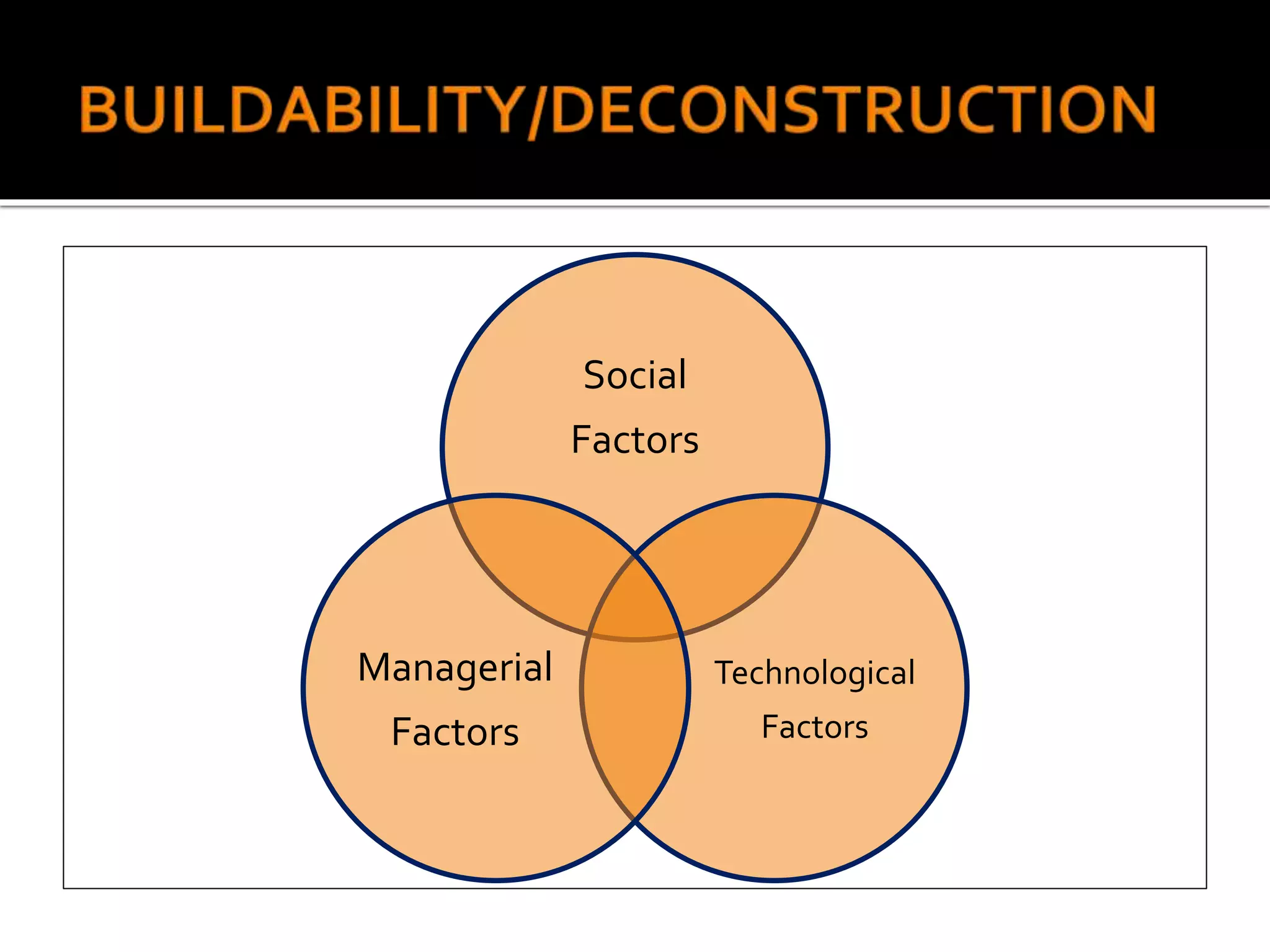
2
•One third of all solid
waste going to
landfill comes from
building
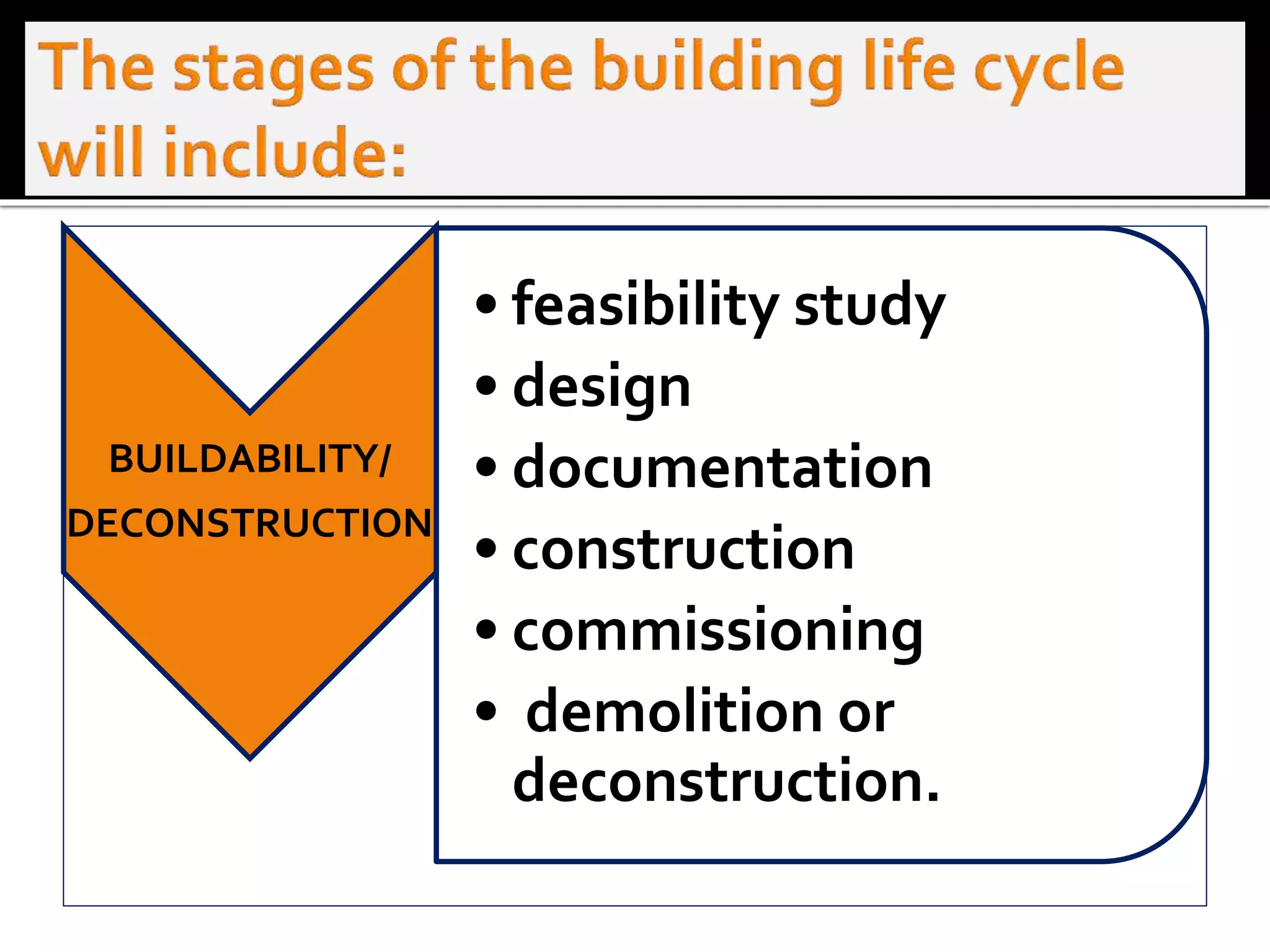
construction and
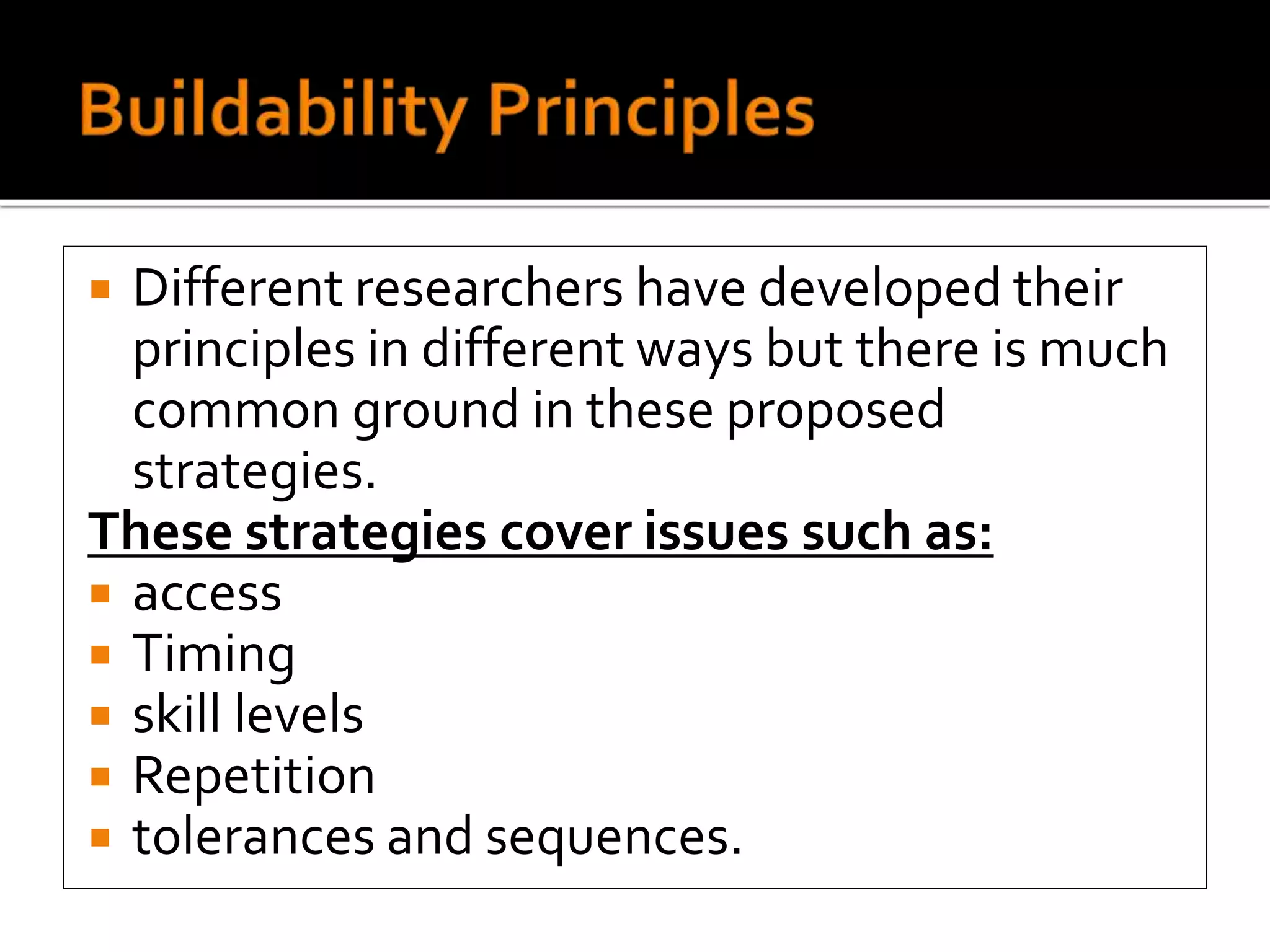
demolition.
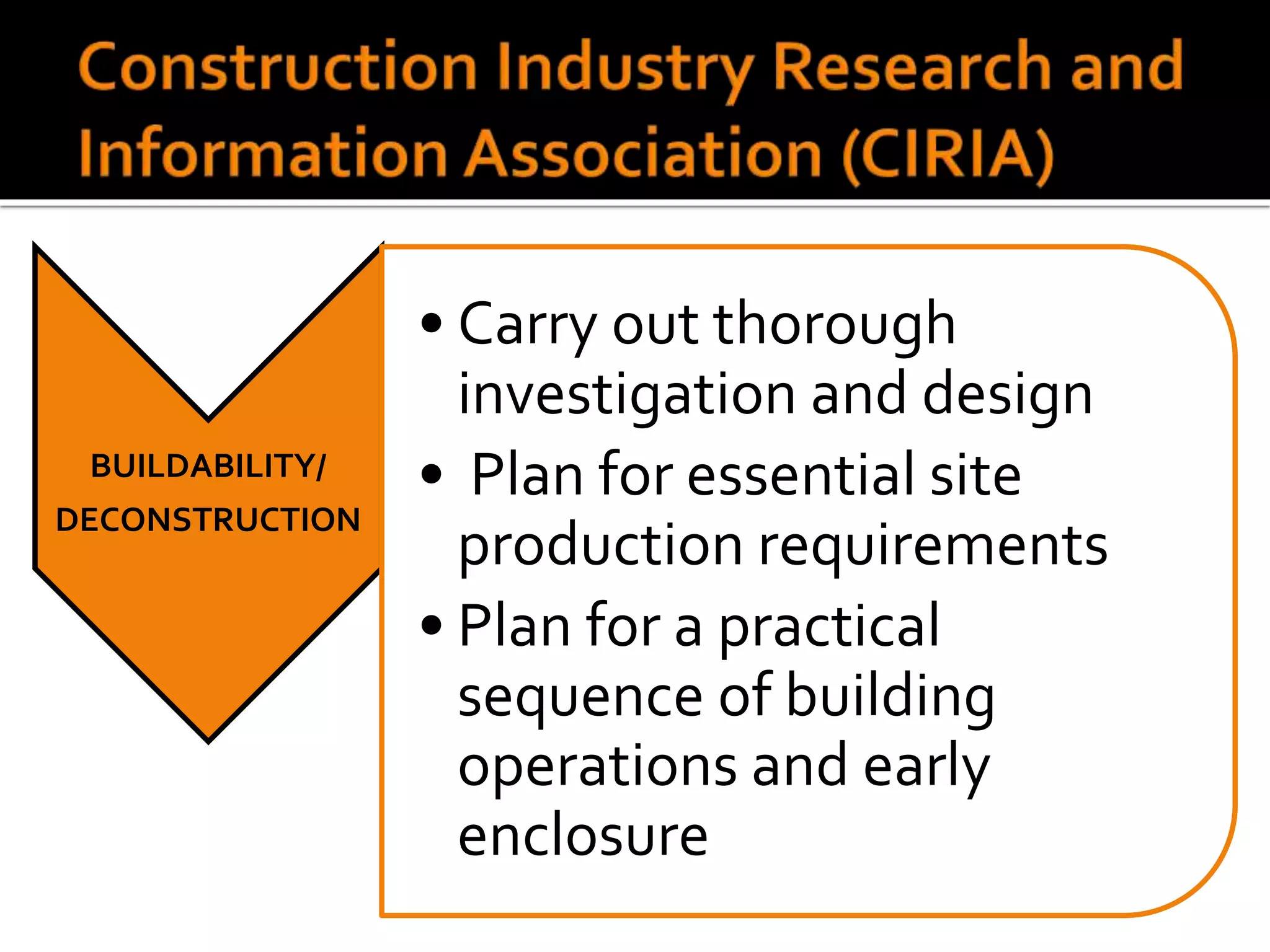
3-The negative
environmental
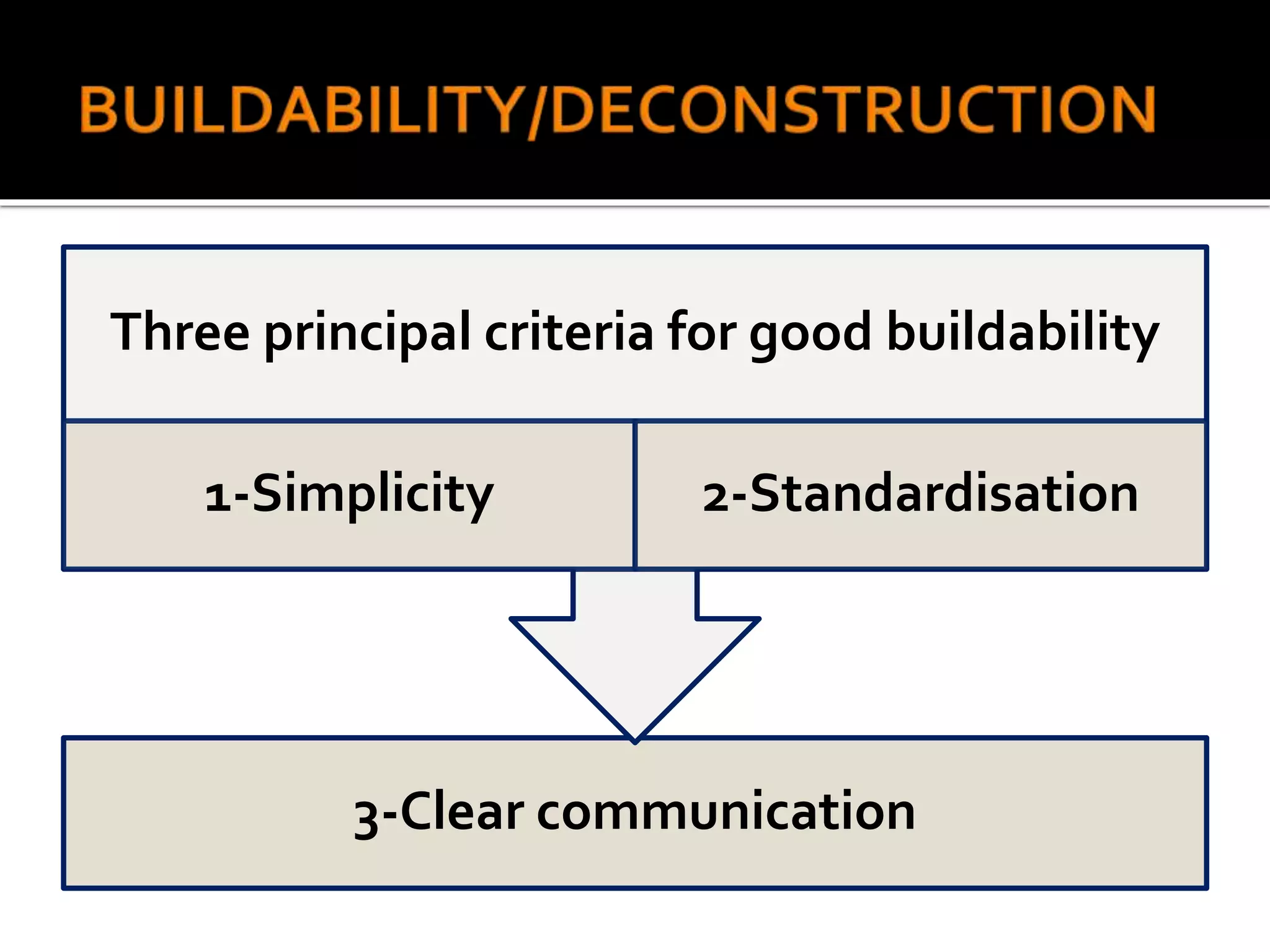
impacts of this waste
are substantial.
4
•Such waste can be
avoided or reduced by
increasing the current
rates of reuse and
recycling of building
materials and
components.
5
• One of the main obstacles
to such reuse is that
buildings are not designed
for such ease of
disassembly
• A developed knowledge
base for design for
disassembly does not yet
exist.
6
•There are a number of
related fields of
knowledge that might
offer information that
will be of use in
designing for
disassembly.
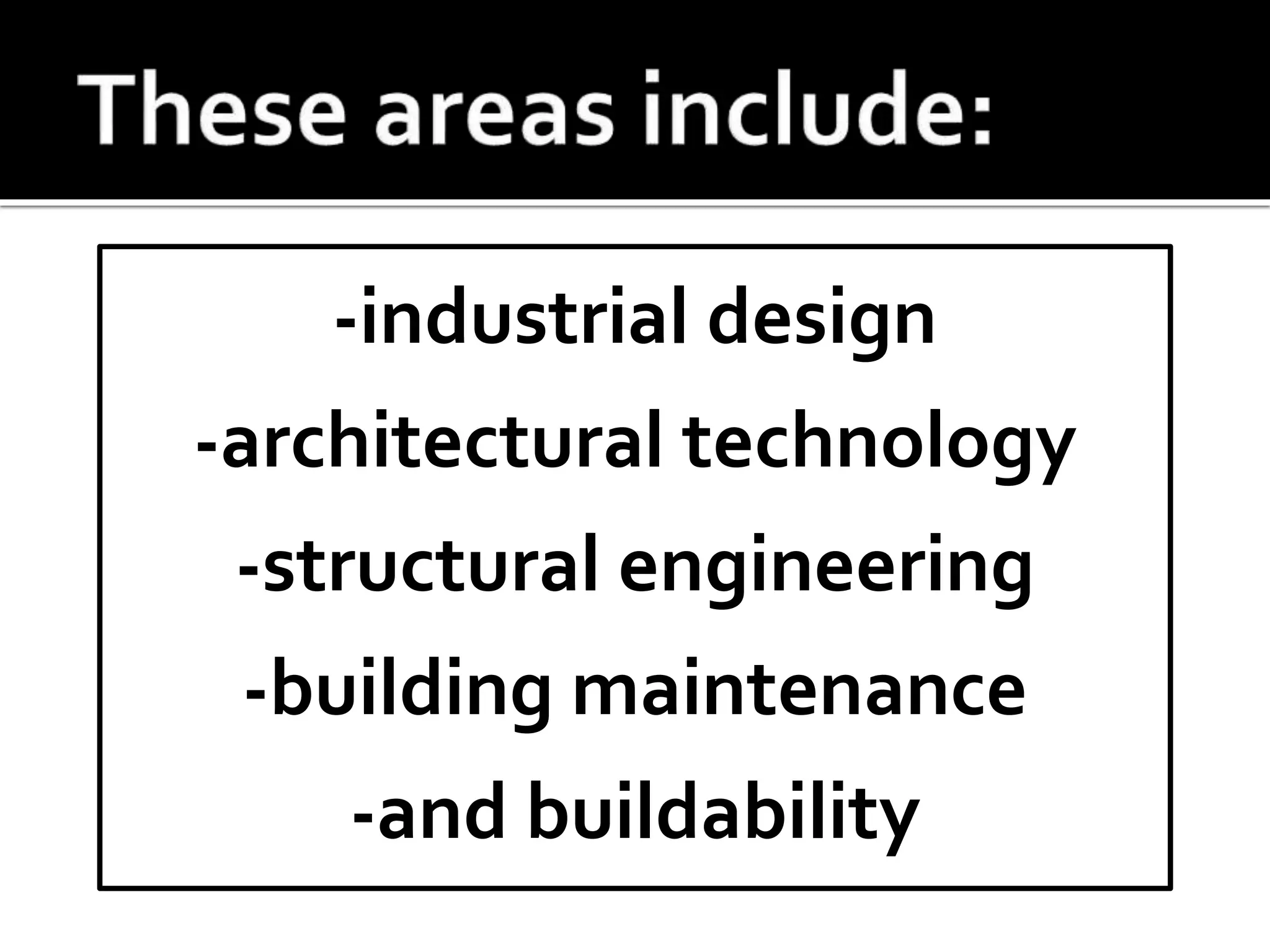
-industrial design
-architectural technology
-structural engineering
-building maintenance
-and buildability
Research into this last area of
buildability has already
established some broad
concepts and philosophies of
how to achieve this goal by
considering steps such as:
 ease of assembly
 Information on how to design for
ease of assembly
 This should be transferable to
create knowledge of how to
design for disassembly.
Meaning of Buildability
'buildability is the extent to
which the design of a building
facilitates ease of construction,
subject to the overall
requirements for the completed
building'
Further definitions of
buildability share the two main
points of this definition;
1-It is about designing for ease of
construction
2-It is within a holistic vision of the
building project
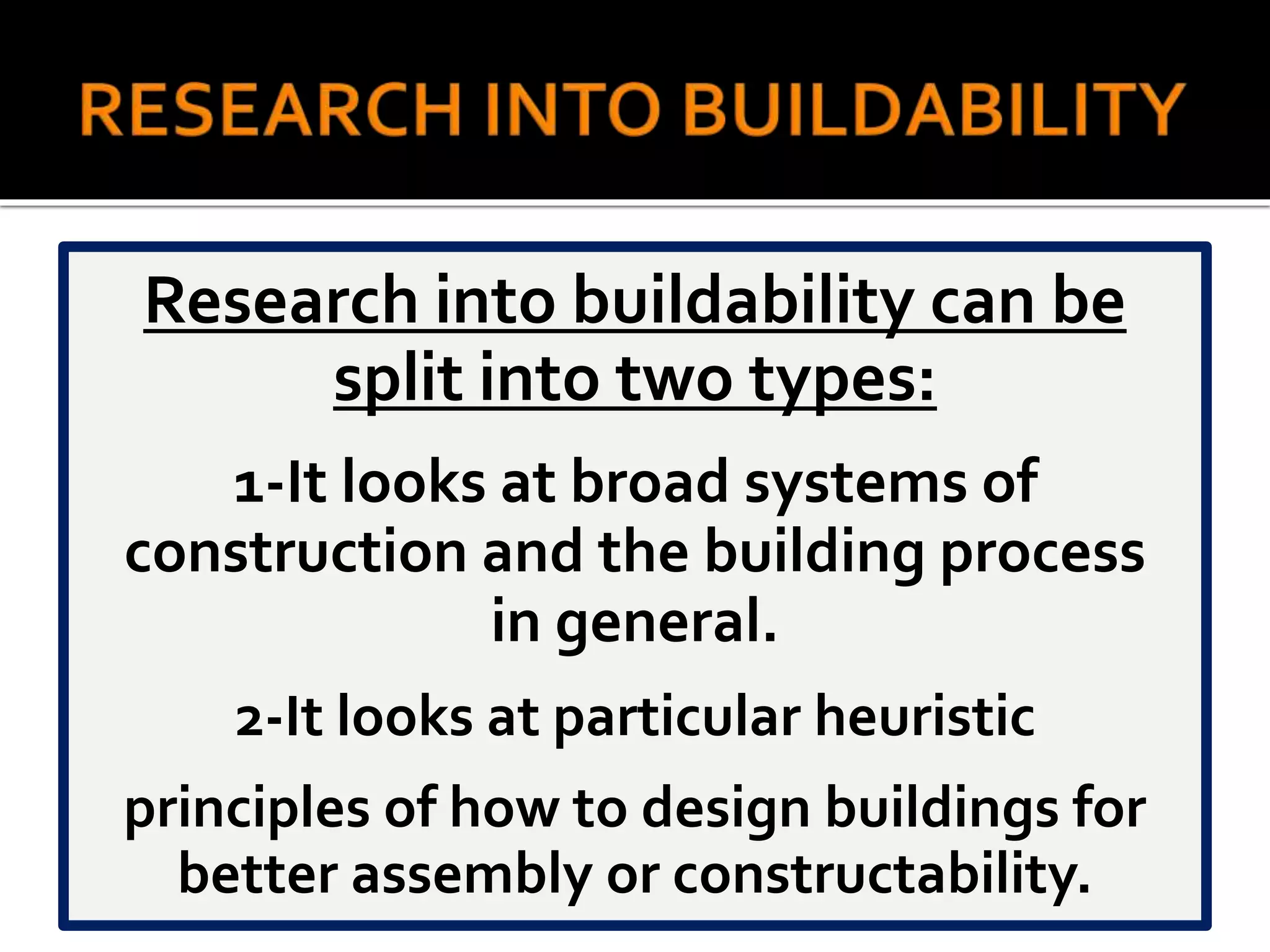
Research into buildability can be
split into two types:
1-It looks at broad systems of
construction and the building process
in general.
2-It looks at particular heuristic
principles of how to design buildings for
better assembly or constructability.
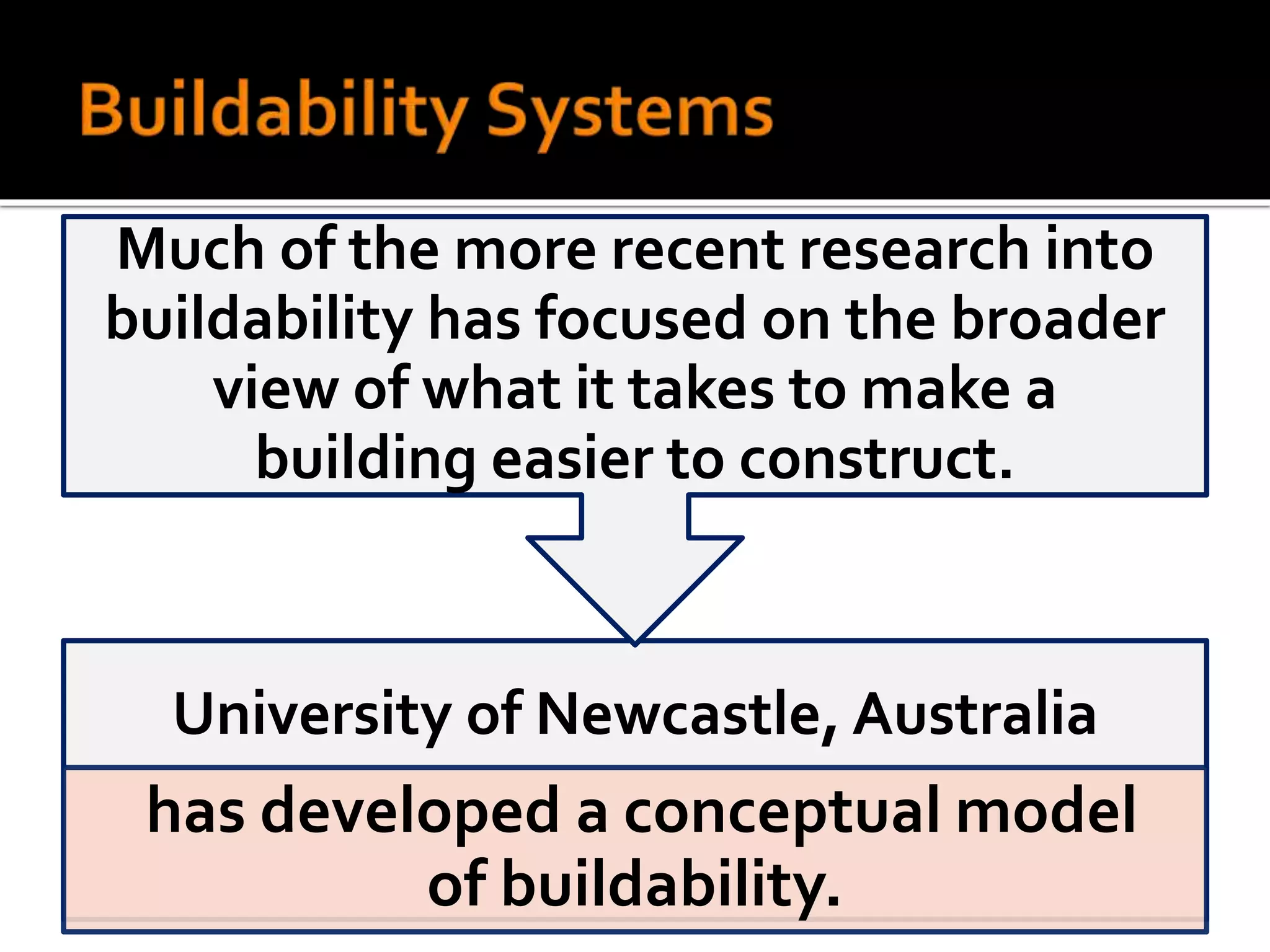
University of Newcastle, Australia
has developed a conceptual model
of buildability.
Much of the more recent research into
buildability has focused on the broader
view of what it takes to make a
building easier to construct.
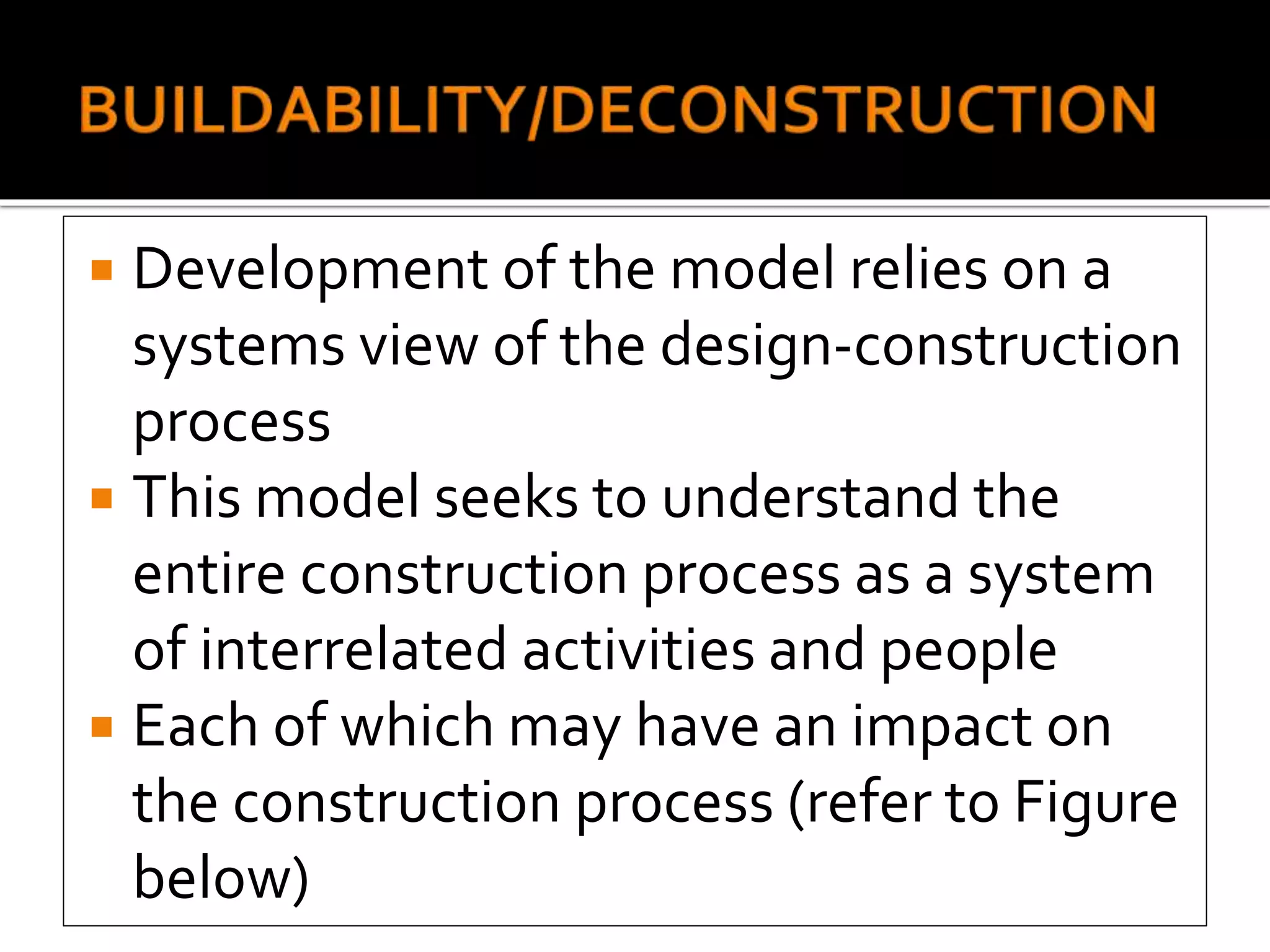
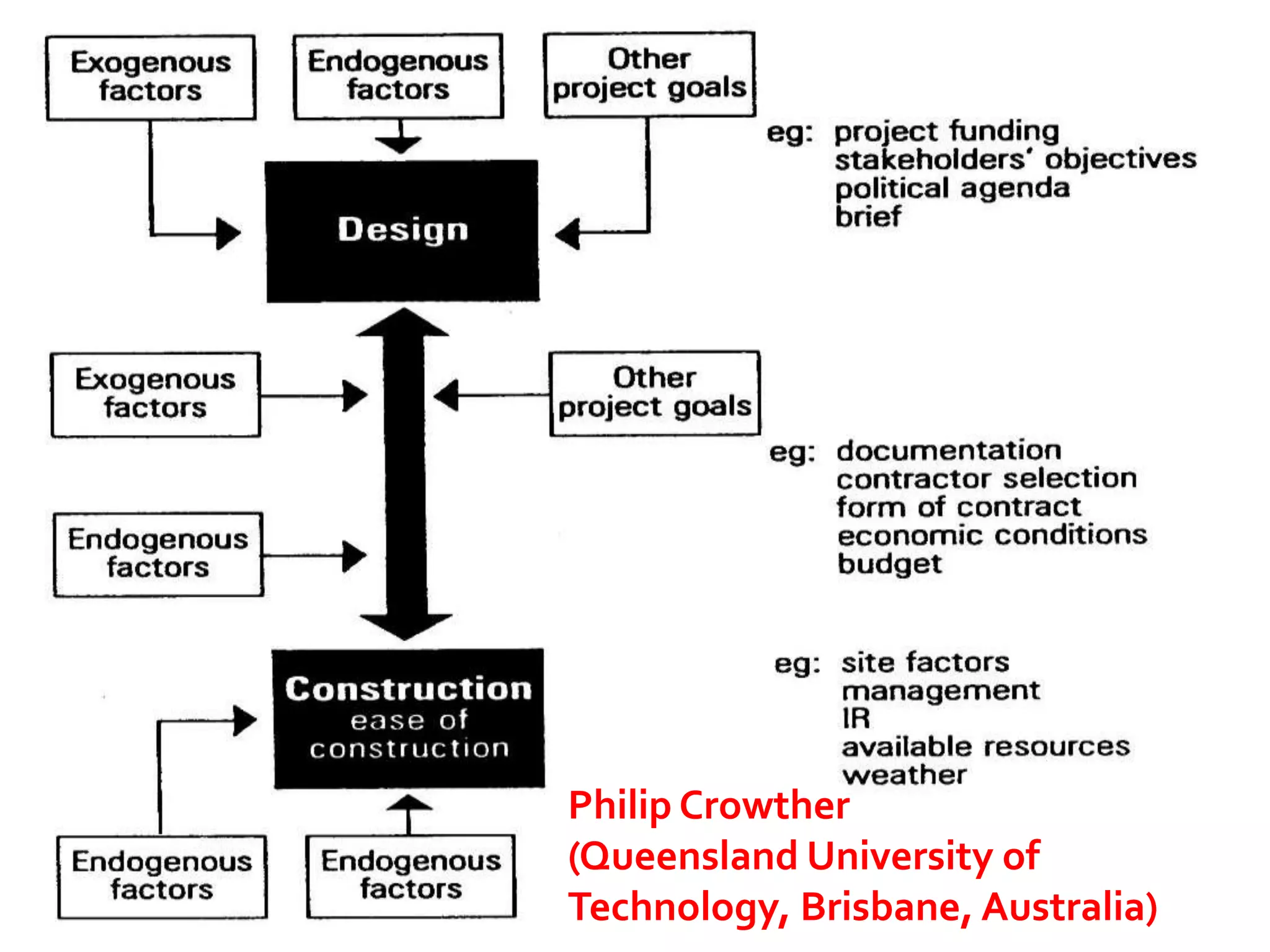
 Development of the model relies on a
systems view of the design-construction
process
 This model seeks to understand the
entire construction process as a system
of interrelated activities and people
 Each of which may have an impact on
the construction process (refer to Figure
below)
Philip Crowther
(Queensland University of
Technology, Brisbane, Australia)
Using such a systems
approach the researchers
have identified three
dimensions to the model
of buildability.
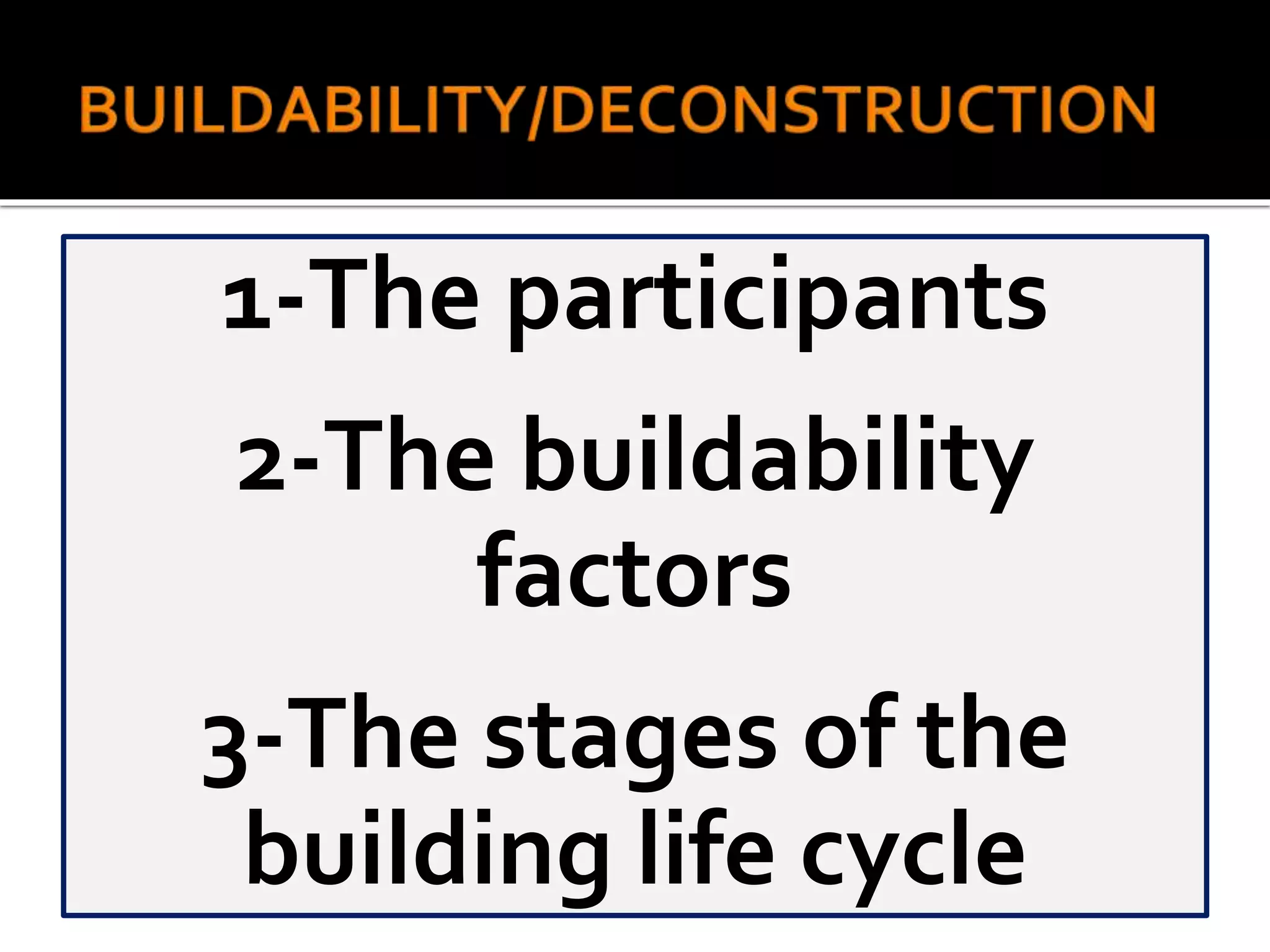
1-The participants
2-The buildability
factors
3-The stages of the
building life cycle
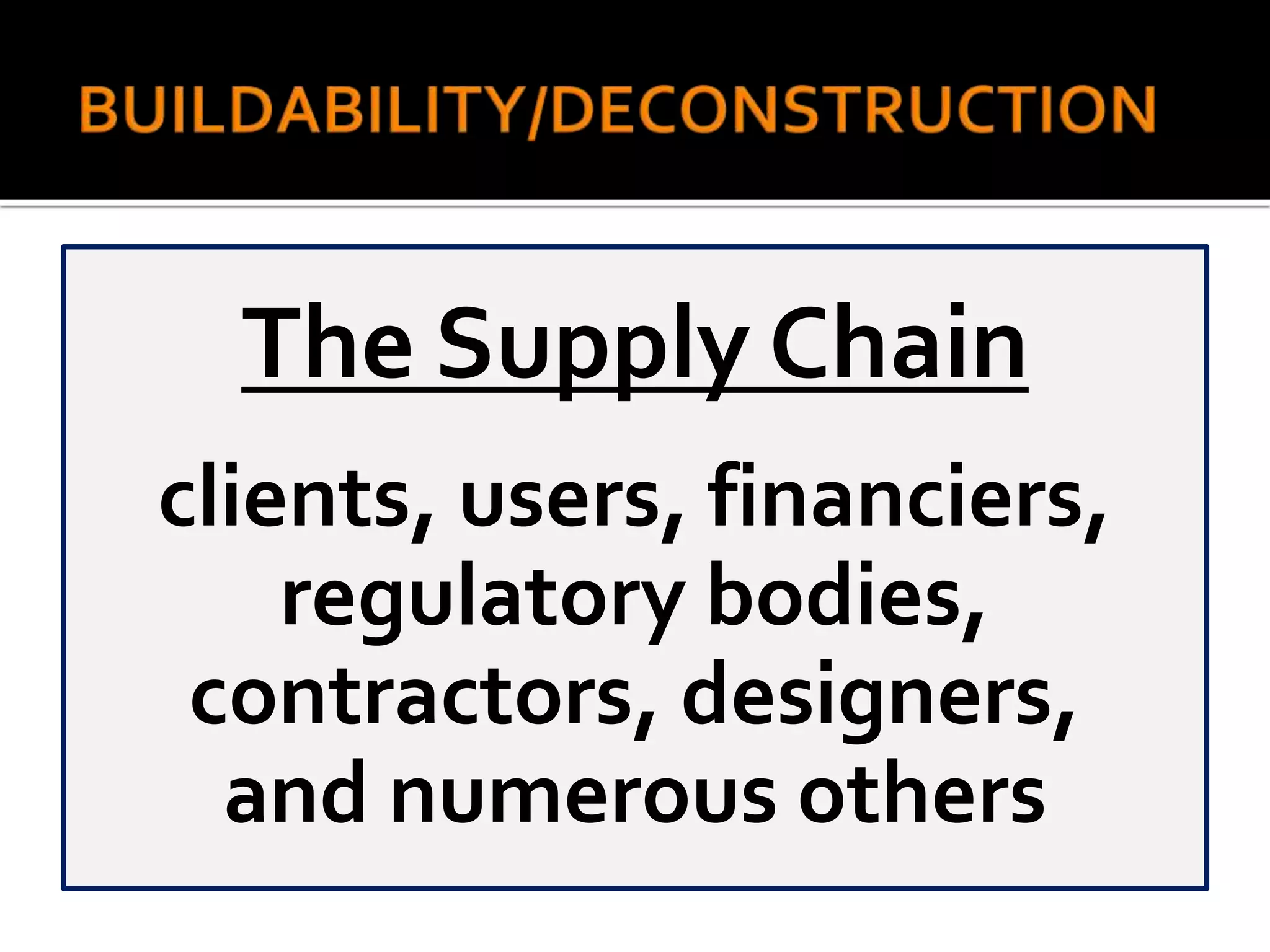
The Supply Chain
clients, users, financiers,
regulatory bodies,
contractors, designers,
and numerous others
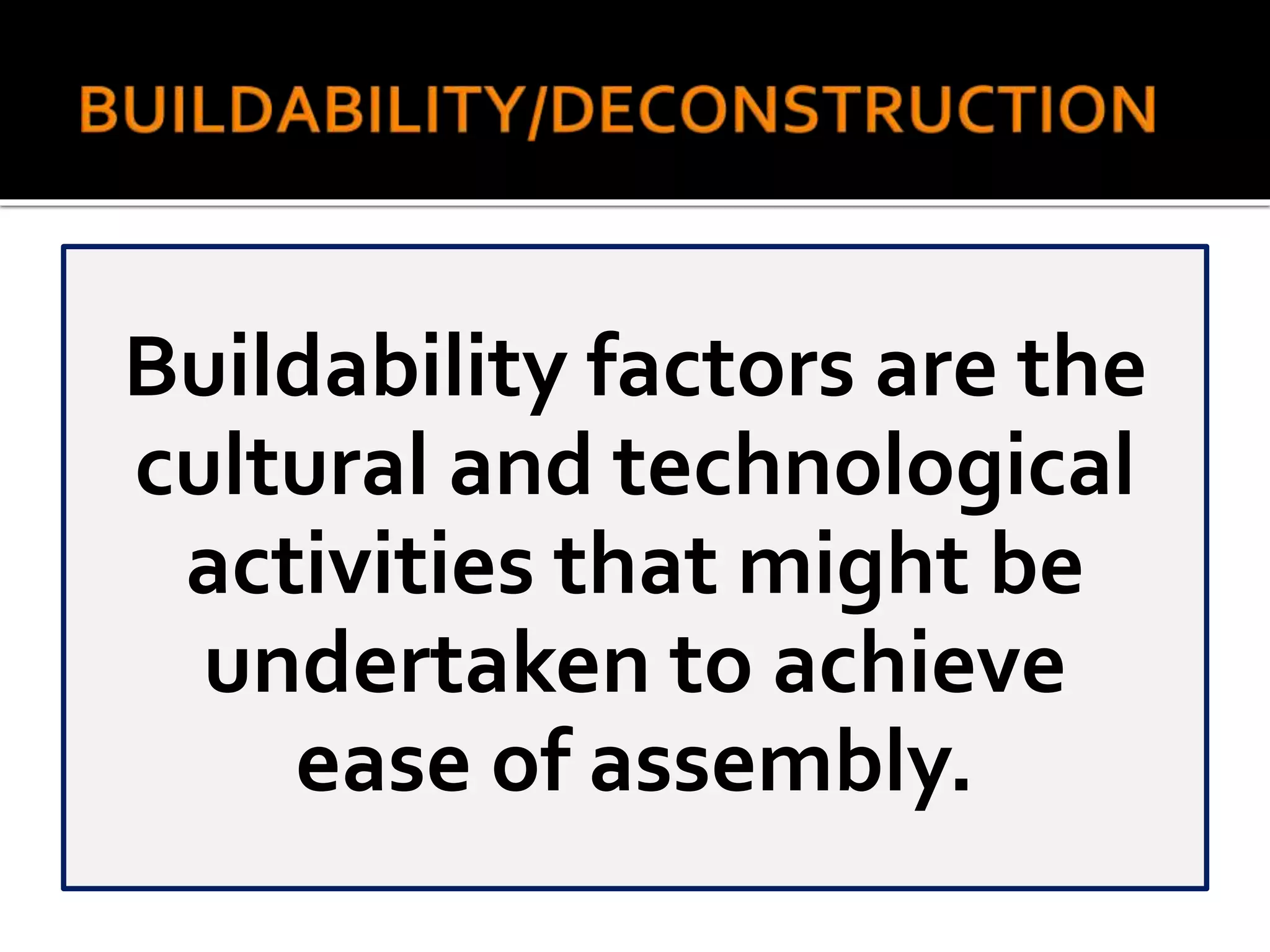
Buildability factors are the
cultural and technological
activities that might be
undertaken to achieve
ease of assembly.
Social
Factors
Technological
Factors
Managerial
Factors
BUILDABILITY/
DECONSTRUCTION
• feasibility study
• design
• documentation
• construction
• commissioning
• demolition or
deconstruction.
 Different researchers have developed their
principles in different ways but there is much
common ground in these proposed
strategies.
These strategies cover issues such as:
 access
 Timing
 skill levels
 Repetition
 tolerances and sequences.
BUILDABILITY/
DECONSTRUCTION
• Carry out thorough
investigation and design
• Plan for essential site
production requirements
• Plan for a practical
sequence of building
operations and early
enclosure
BUILDABILITY/
DECONSTRUCTIO
N
• Plan for simplicity of assembly
and logical trade sequences
• Detail for maximum repetition
and standardisation
• Detail for achievable tolerances
• Specify robust and suitable
materials
3-Clear communication
Three principal criteria for good buildability
1-Simplicity 2-Standardisation
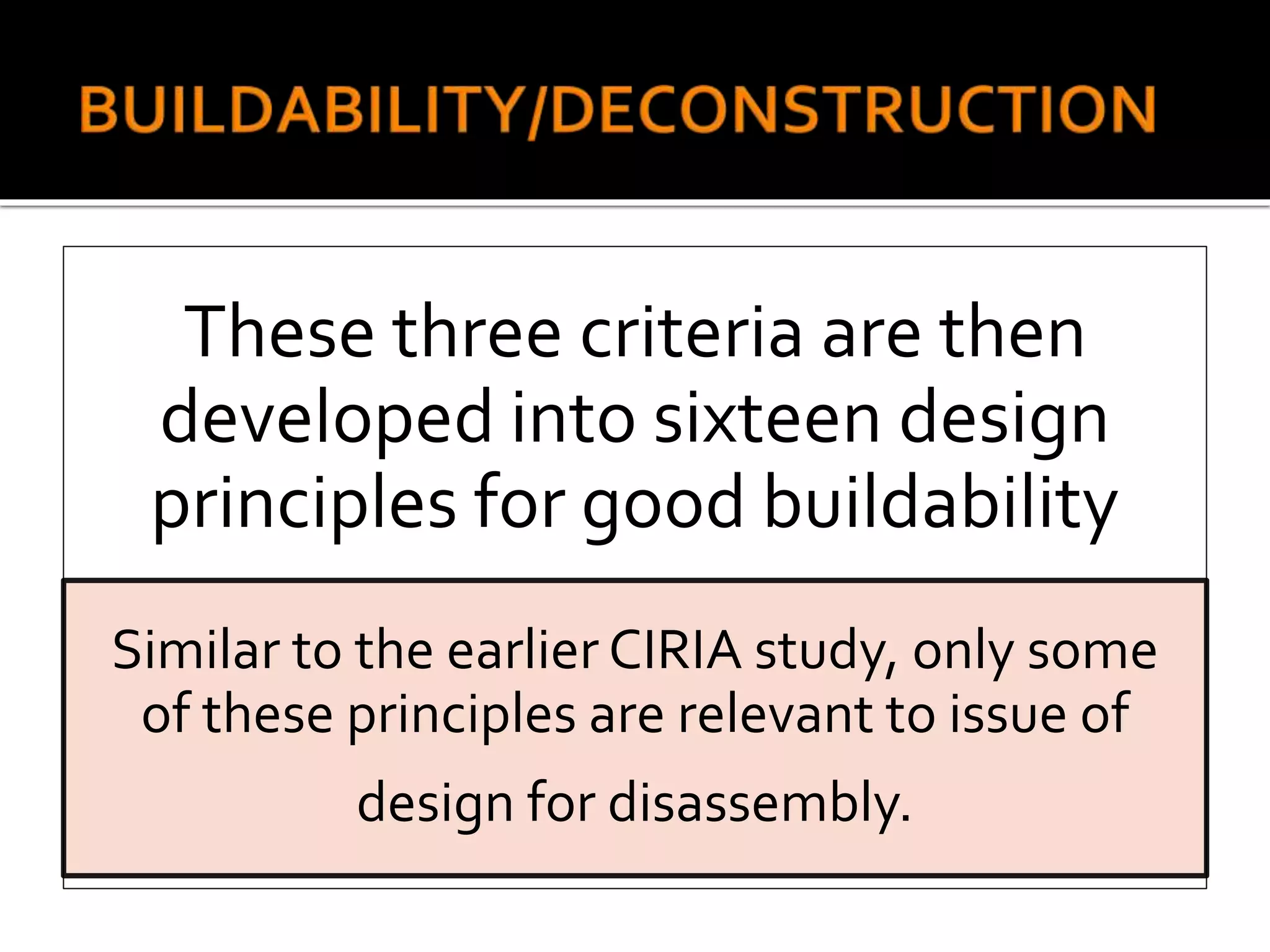
These three criteria are then
developed into sixteen design
principles for good buildability
Similar to the earlier CIRIA study, only some
of these principles are relevant to issue of
design for disassembly.
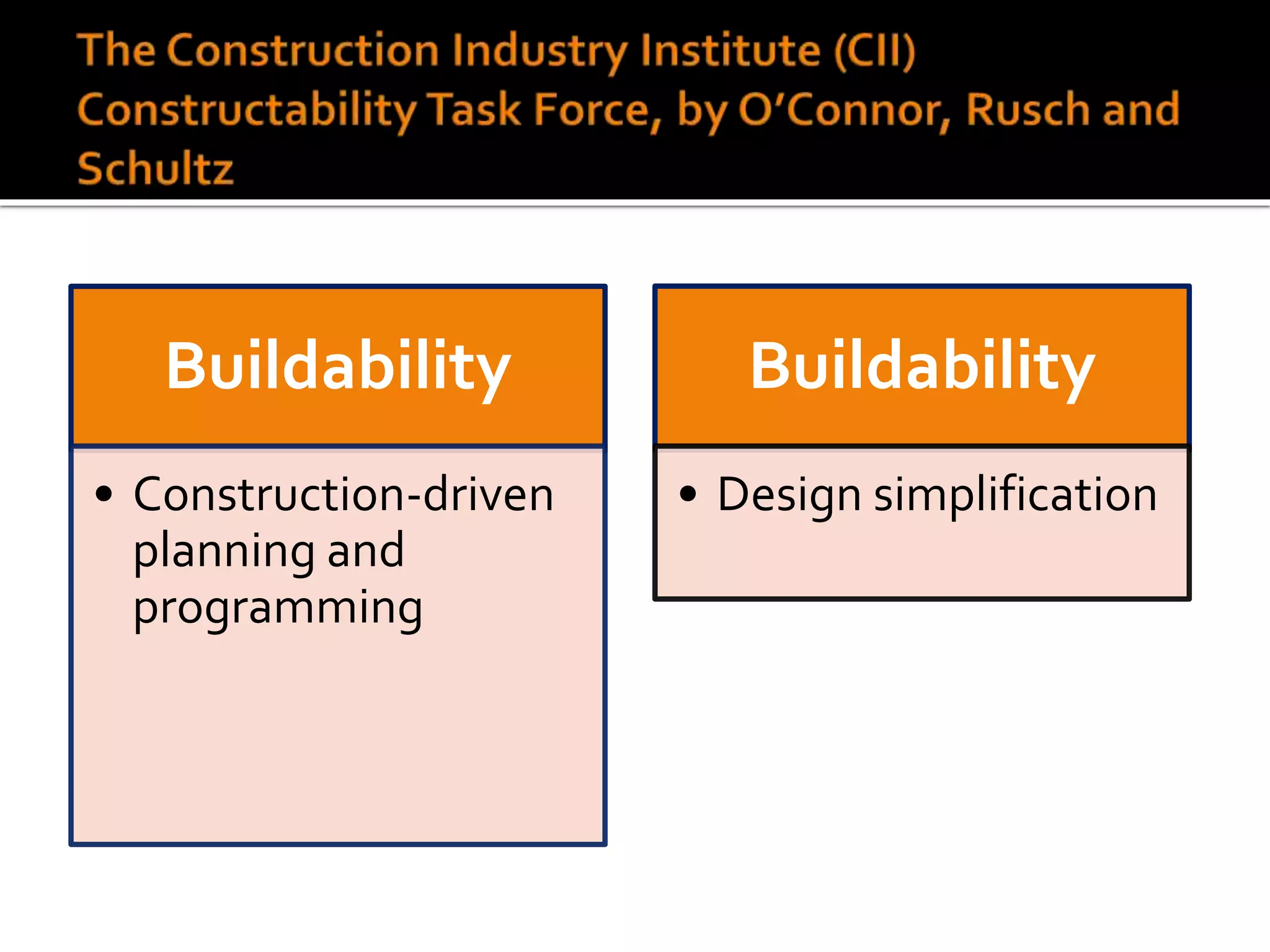
Buildability
• Construction-driven
planning and
programming
Buildability
• Design simplification
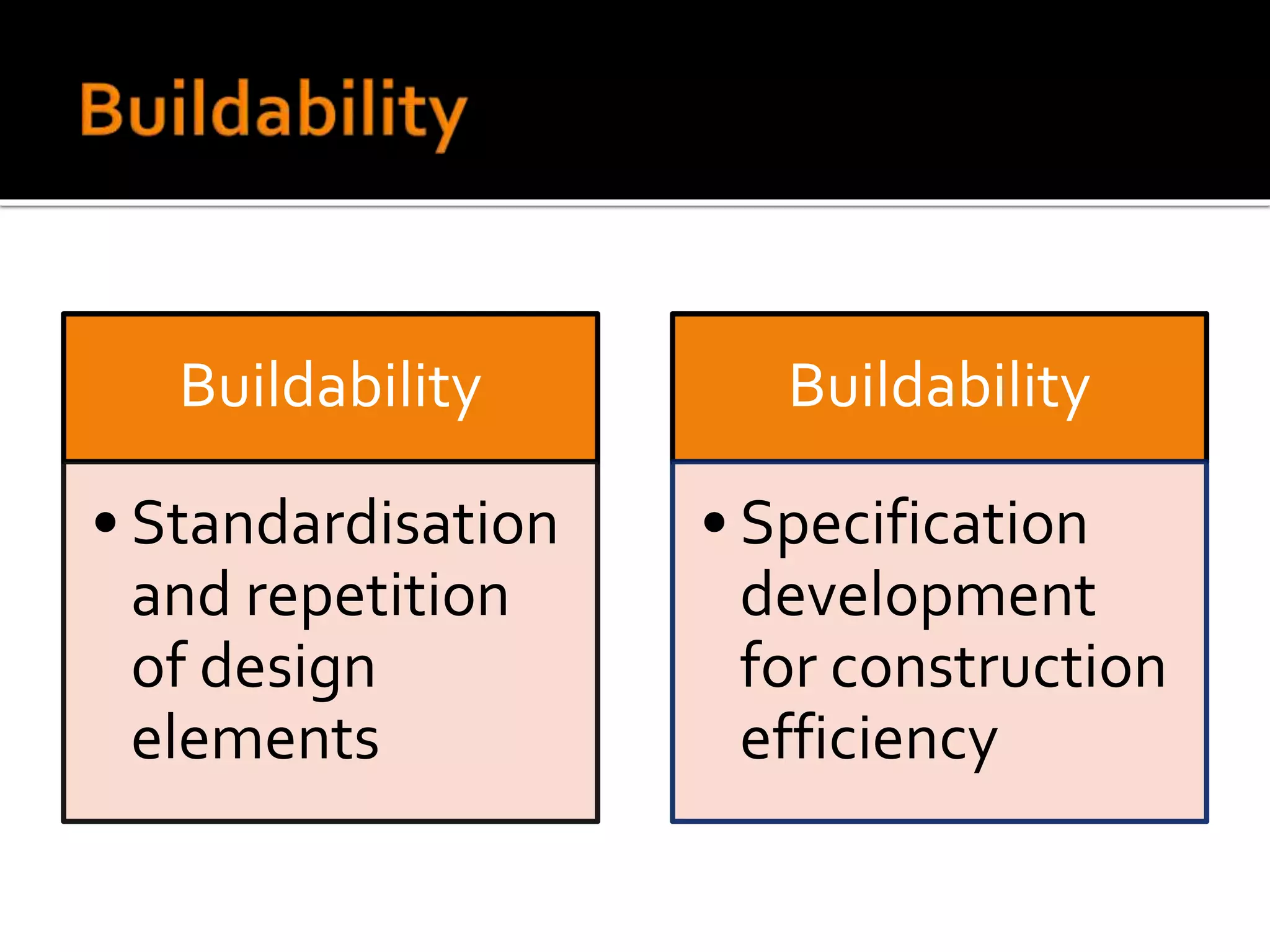
Buildability
• Standardisation
and repetition
of design
elements
Buildability
• Specification
development
for construction
efficiency
Buildability
• Modular and pre-
assembly designs
should be
developed to
facilitate
prefabrication and
installation
Buildability
• Designs should
allow for
accessibility of
labour, materials
and plant
Buildability
•Designs should facilitate
construction under
adverse weather
conditions
1. Integration
2. Construction knowledge
3. Team skills
4. Corporate objectives
5. Available resources
6. External factors
7. Program
8. Construction methodology
9. Accessibility
10. Specifications
11. Construction innovation
12. Feedback
 While not all principles of buildability
will be relevant to design for
disassembly
 it is also true that not all principles of
design for disassembly will come from
buildability.
 This table shows only those principles
that have been informed by buildability
sources.
Minimise the number of different
types of components
This will simplify the process of
sorting on site and make the
potential for reprocess more
attractive due to the larger
quantities of same or similar items.
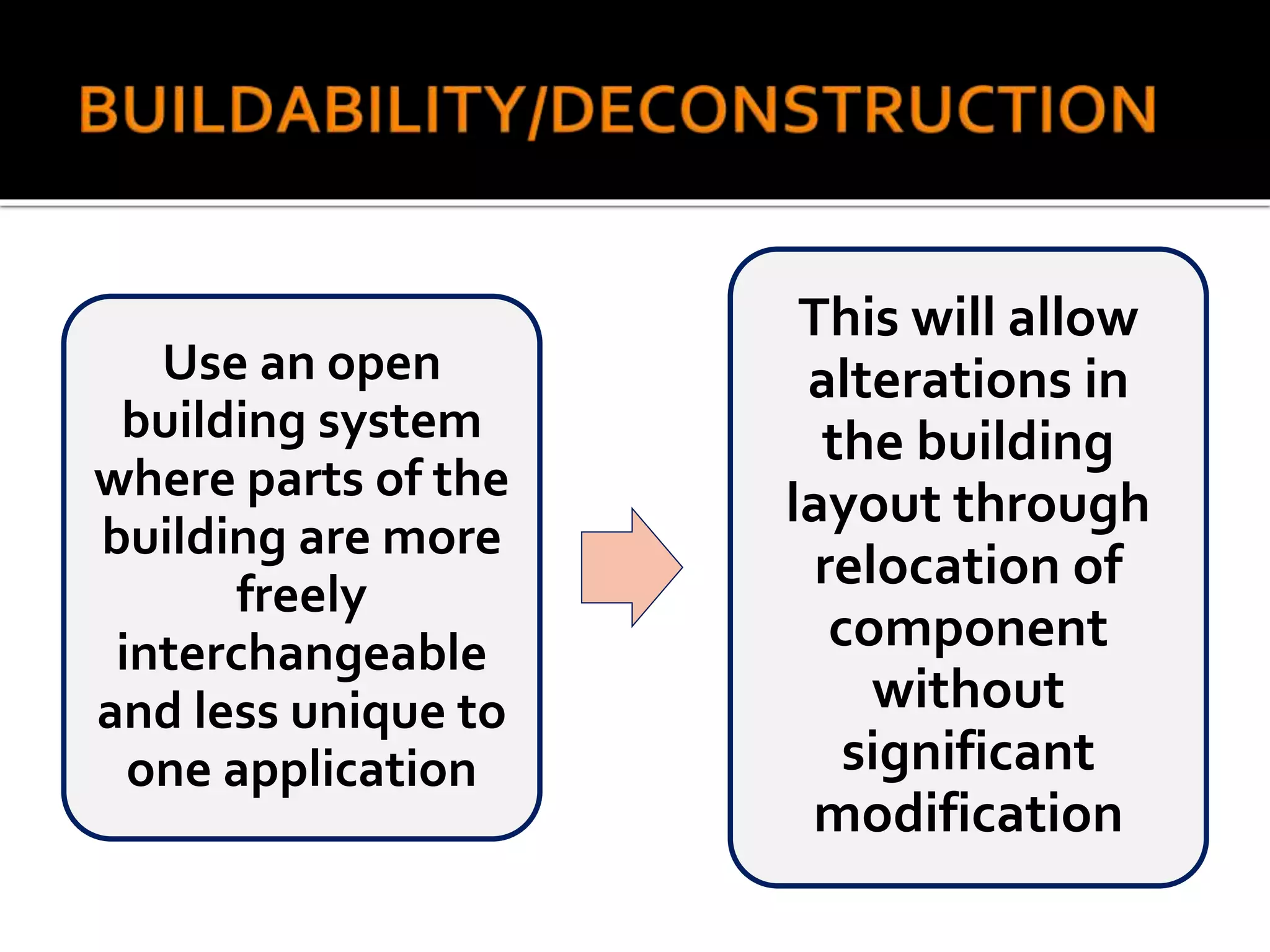
Use an open
building system
where parts of the
building are more
freely
interchangeable
and less unique to
one application
This will allow
alterations in
the building
layout through
relocation of
component
without
significant
modification
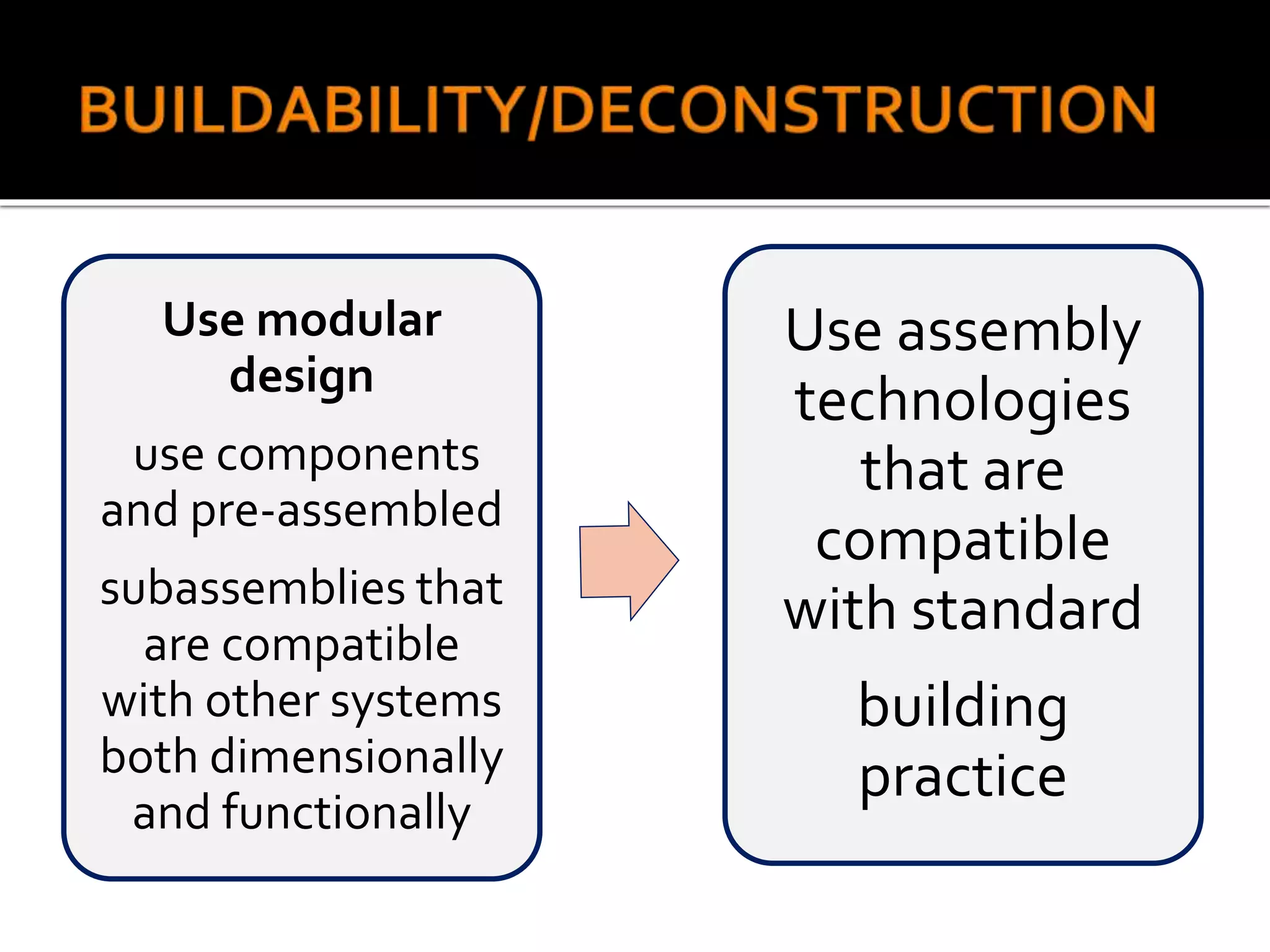
Use modular
design
use components
and pre-assembled
subassemblies that
are compatible
with other systems
both dimensionally
and functionally
Use assembly
technologies
that are
compatible
with standard
building
practice
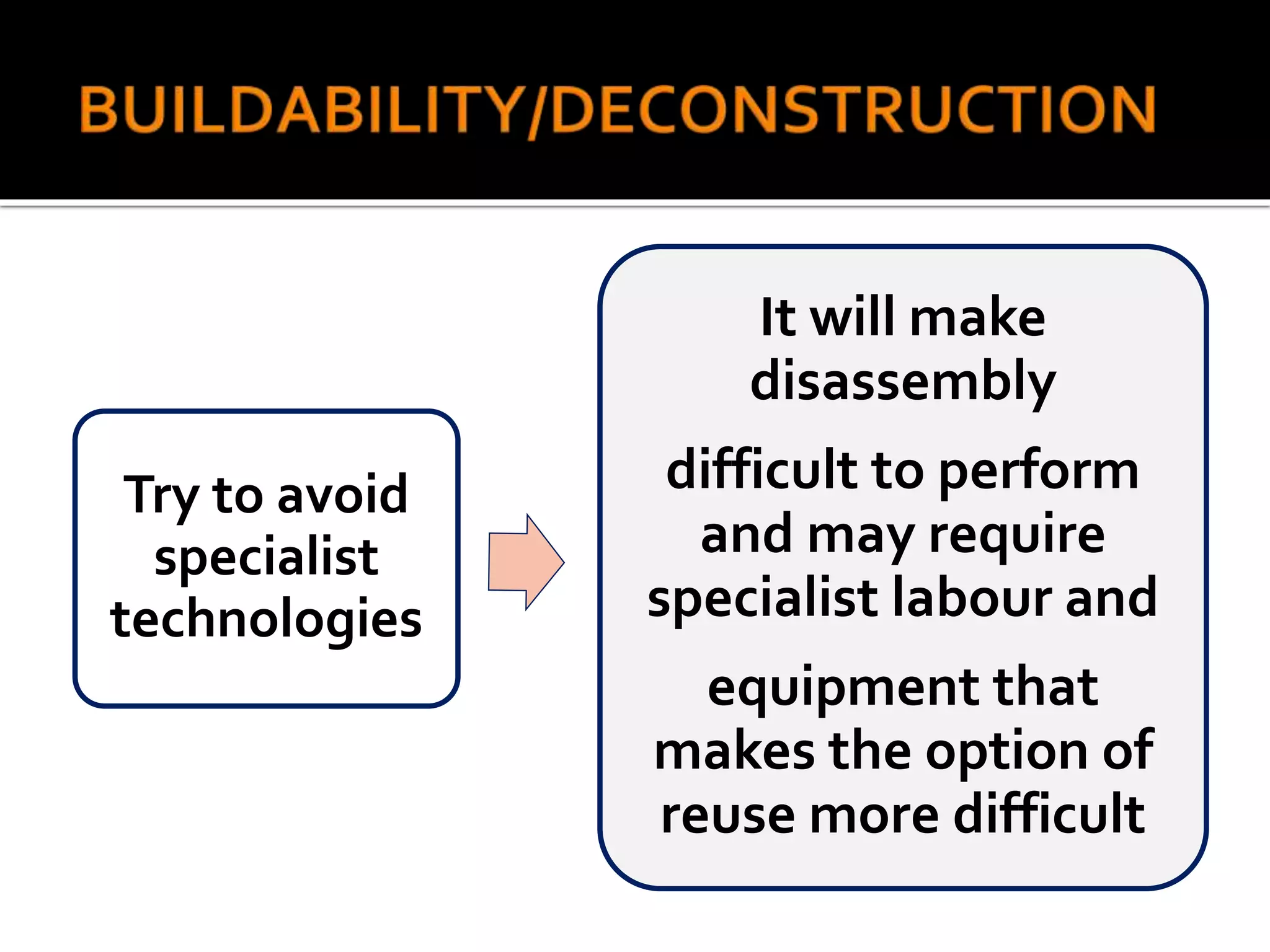
Try to avoid
specialist
technologies
It will make
disassembly
difficult to perform
and may require
specialist labour and
equipment that
makes the option of
reuse more difficult
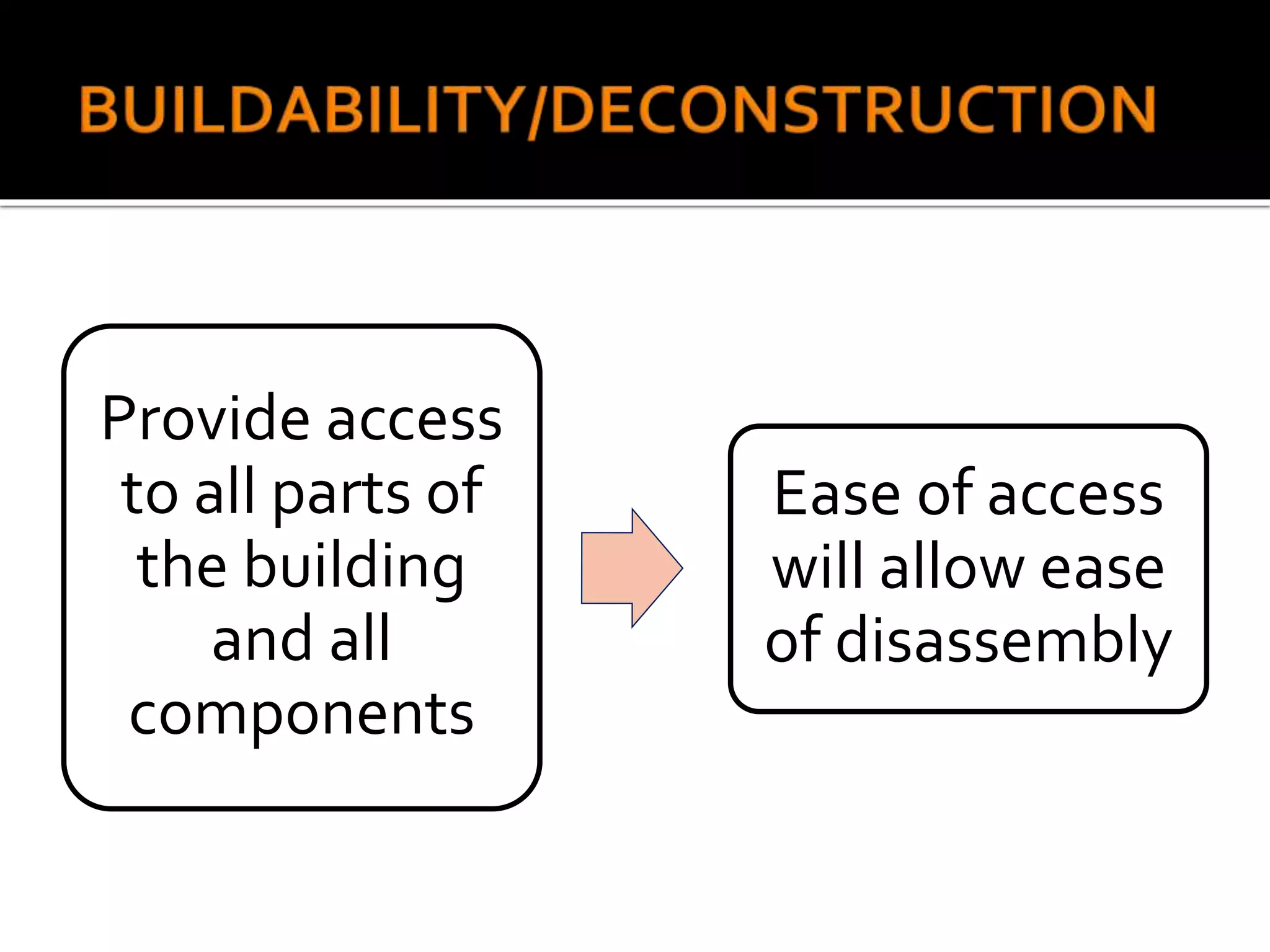
Provide access
to all parts of
the building
and all
components
Ease of access
will allow ease
of disassembly
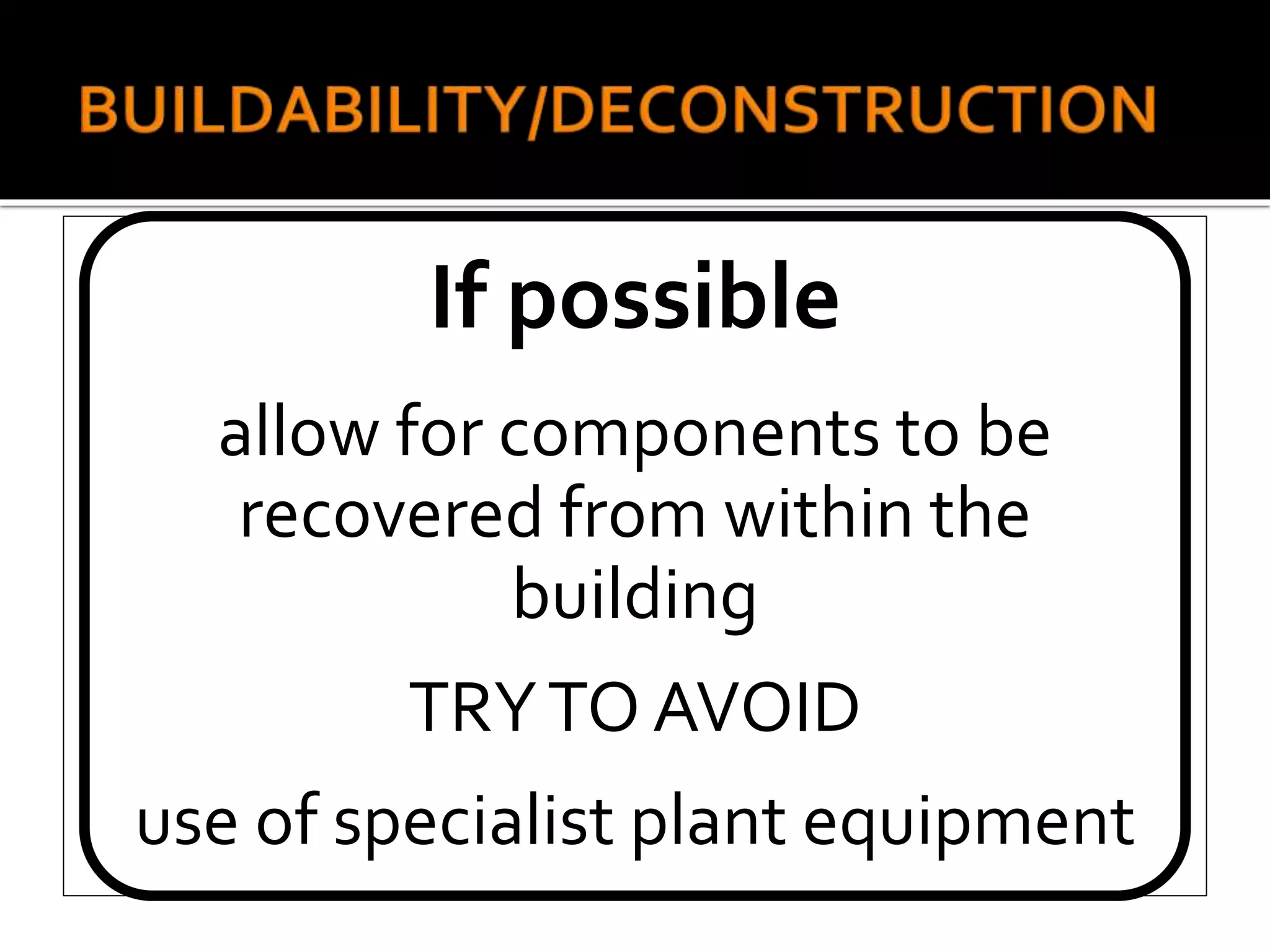
If possible
allow for components to be
recovered from within the
building
TRYTO AVOID
use of specialist plant equipment
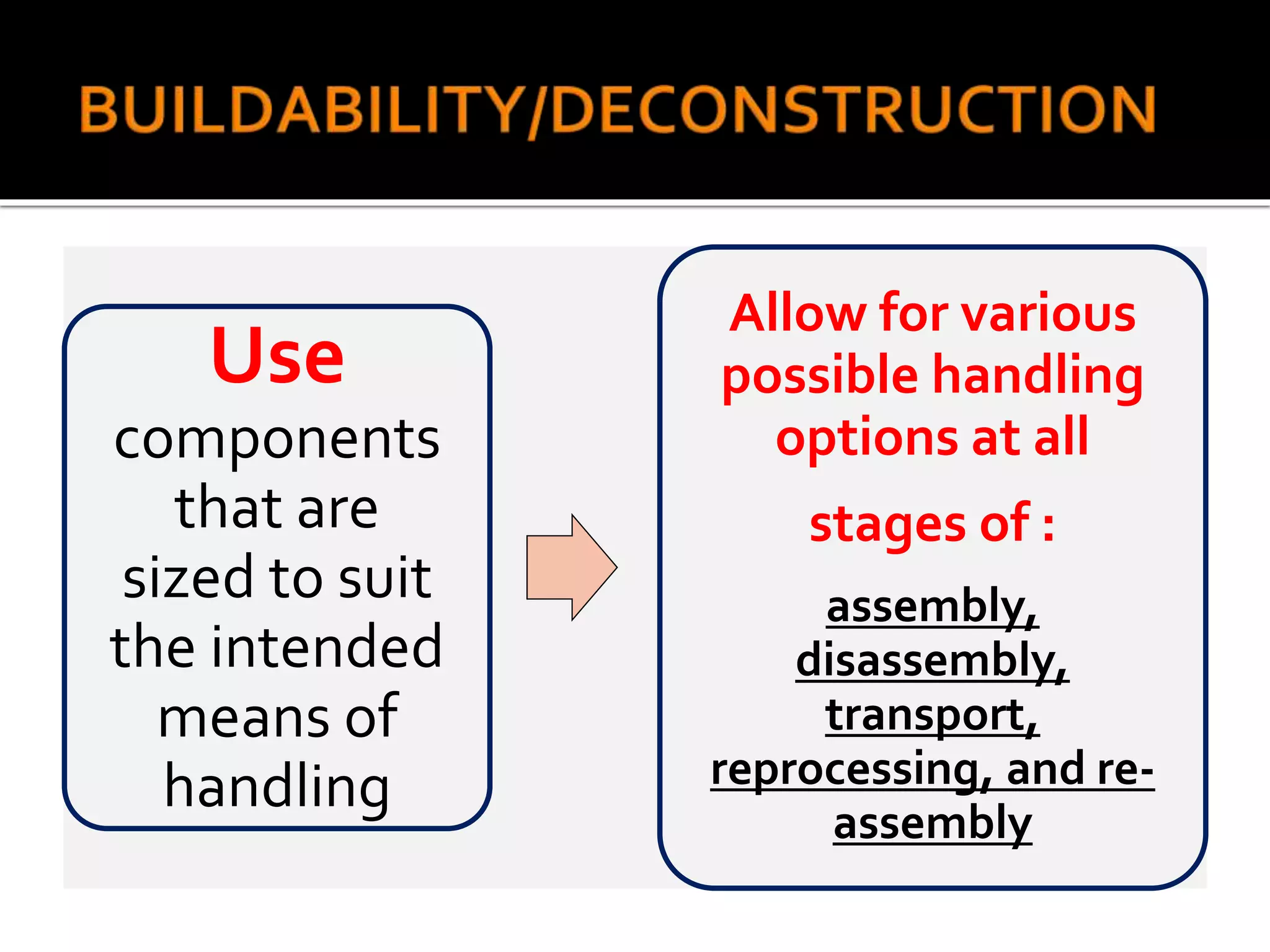
Use
components
that are
sized to suit
the intended
means of
handling
Allow for various
possible handling
options at all
stages of :
assembly,
disassembly,
transport,
reprocessing, and re-
assembly
Provide realistic
tolerances to
allow for
movement
during
disassembly
The disassembly
process may require
greater tolerances
than the
manufacture
process or the initial
assembly process
Design joints
and
connectors to
withstand
repeated use
Allow for
parallel
disassembly
rather than
sequential
disassembly
This will allow
components
or materials
be removed
without
disrupting
other
components
or material
Use prefabricated
subassemblies and
a system of mass
production - to
reduce site work
and allow greater
control over
component quality
and conformity
Sustain all
information on the
building manufacture
and assembly process

Buildability deconstruction

  • 1.
    Dr f Dejahang(BSc CEng, BSc (Hons) Construction Mgmt, MSc, MCIOB, PhD) http://www.cpi-team.com
  • 2.
     ScienceArt ReligionPolitics Scholarly Articles For Mathematics and Productivity  http://www.twitlonger.com/show/n_1sp9pjo? new_post=true  MICROSOFT OneDrive PPT’s PDF’s BOOK LESSONS Dr f Dejahang BSc CEng, BSc (Hons) Construction Mgmt, MSc, PhD
  • 3.
    1 •Most buildings are designedwith a life expectancy of just a few decades with no consideration of what will happen after their service life.
  • 4.
    2 •One third ofall solid waste going to landfill comes from building construction and demolition.
  • 5.
    3-The negative environmental impacts ofthis waste are substantial.
  • 6.
    4 •Such waste canbe avoided or reduced by increasing the current rates of reuse and recycling of building materials and components.
  • 7.
    5 • One ofthe main obstacles to such reuse is that buildings are not designed for such ease of disassembly • A developed knowledge base for design for disassembly does not yet exist.
  • 8.
    6 •There are anumber of related fields of knowledge that might offer information that will be of use in designing for disassembly.
  • 9.
    -industrial design -architectural technology -structuralengineering -building maintenance -and buildability
  • 10.
    Research into thislast area of buildability has already established some broad concepts and philosophies of how to achieve this goal by considering steps such as:
  • 11.
     ease ofassembly  Information on how to design for ease of assembly  This should be transferable to create knowledge of how to design for disassembly.
  • 12.
    Meaning of Buildability 'buildabilityis the extent to which the design of a building facilitates ease of construction, subject to the overall requirements for the completed building'
  • 13.
    Further definitions of buildabilityshare the two main points of this definition; 1-It is about designing for ease of construction 2-It is within a holistic vision of the building project
  • 14.
    Research into buildabilitycan be split into two types: 1-It looks at broad systems of construction and the building process in general. 2-It looks at particular heuristic principles of how to design buildings for better assembly or constructability.
  • 15.
    University of Newcastle,Australia has developed a conceptual model of buildability. Much of the more recent research into buildability has focused on the broader view of what it takes to make a building easier to construct.
  • 16.
     Development ofthe model relies on a systems view of the design-construction process  This model seeks to understand the entire construction process as a system of interrelated activities and people  Each of which may have an impact on the construction process (refer to Figure below)
  • 17.
    Philip Crowther (Queensland Universityof Technology, Brisbane, Australia)
  • 18.
    Using such asystems approach the researchers have identified three dimensions to the model of buildability.
  • 19.
    1-The participants 2-The buildability factors 3-Thestages of the building life cycle
  • 20.
    The Supply Chain clients,users, financiers, regulatory bodies, contractors, designers, and numerous others
  • 21.
    Buildability factors arethe cultural and technological activities that might be undertaken to achieve ease of assembly.
  • 22.
  • 23.
    BUILDABILITY/ DECONSTRUCTION • feasibility study •design • documentation • construction • commissioning • demolition or deconstruction.
  • 24.
     Different researchershave developed their principles in different ways but there is much common ground in these proposed strategies. These strategies cover issues such as:  access  Timing  skill levels  Repetition  tolerances and sequences.
  • 25.
    BUILDABILITY/ DECONSTRUCTION • Carry outthorough investigation and design • Plan for essential site production requirements • Plan for a practical sequence of building operations and early enclosure
  • 26.
    BUILDABILITY/ DECONSTRUCTIO N • Plan forsimplicity of assembly and logical trade sequences • Detail for maximum repetition and standardisation • Detail for achievable tolerances • Specify robust and suitable materials
  • 27.
    3-Clear communication Three principalcriteria for good buildability 1-Simplicity 2-Standardisation
  • 28.
    These three criteriaare then developed into sixteen design principles for good buildability Similar to the earlier CIRIA study, only some of these principles are relevant to issue of design for disassembly.
  • 29.
  • 30.
    Buildability • Standardisation and repetition ofdesign elements Buildability • Specification development for construction efficiency
  • 31.
    Buildability • Modular andpre- assembly designs should be developed to facilitate prefabrication and installation Buildability • Designs should allow for accessibility of labour, materials and plant
  • 32.
  • 33.
    1. Integration 2. Constructionknowledge 3. Team skills 4. Corporate objectives 5. Available resources 6. External factors 7. Program 8. Construction methodology 9. Accessibility 10. Specifications 11. Construction innovation 12. Feedback
  • 34.
     While notall principles of buildability will be relevant to design for disassembly  it is also true that not all principles of design for disassembly will come from buildability.  This table shows only those principles that have been informed by buildability sources.
  • 35.
    Minimise the numberof different types of components This will simplify the process of sorting on site and make the potential for reprocess more attractive due to the larger quantities of same or similar items.
  • 36.
    Use an open buildingsystem where parts of the building are more freely interchangeable and less unique to one application This will allow alterations in the building layout through relocation of component without significant modification
  • 37.
    Use modular design use components andpre-assembled subassemblies that are compatible with other systems both dimensionally and functionally Use assembly technologies that are compatible with standard building practice
  • 38.
    Try to avoid specialist technologies Itwill make disassembly difficult to perform and may require specialist labour and equipment that makes the option of reuse more difficult
  • 39.
    Provide access to allparts of the building and all components Ease of access will allow ease of disassembly
  • 40.
    If possible allow forcomponents to be recovered from within the building TRYTO AVOID use of specialist plant equipment
  • 41.
    Use components that are sized tosuit the intended means of handling Allow for various possible handling options at all stages of : assembly, disassembly, transport, reprocessing, and re- assembly
  • 42.
    Provide realistic tolerances to allowfor movement during disassembly The disassembly process may require greater tolerances than the manufacture process or the initial assembly process
  • 43.
    Design joints and connectors to withstand repeateduse Allow for parallel disassembly rather than sequential disassembly
  • 44.
    This will allow components ormaterials be removed without disrupting other components or material Use prefabricated subassemblies and a system of mass production - to reduce site work and allow greater control over component quality and conformity
  • 45.
    Sustain all information onthe building manufacture and assembly process