
Green Roof Design: The Landscape Architecture of Intensive Green Roofs in Urban SettingsBy: Delesia Hill
IntroductionThesis focus
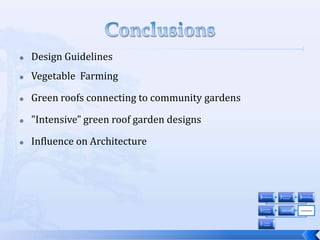
"Intensive" green roof garden designs
Influence on Architecture
Vegetable  Farming
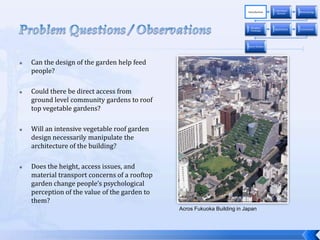
Green roofs connecting to community gardensProblem Questions / ObservationsCan the design of the garden help feed people? Could there be direct access from ground level community gardens to roof top vegetable gardens? Will an intensive vegetable roof garden design necessarily manipulate the architecture of the building?Does the height, access issues, and material transport concerns of a rooftop garden change people’s psychological perception of the value of the garden to them?Acros Fukuoka Building in Japan
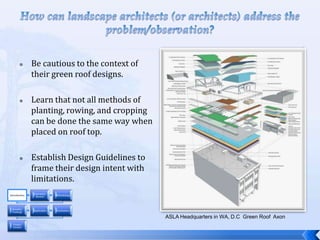
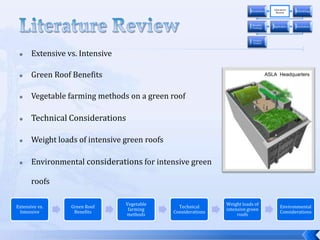
How can landscape architects (or architects) address the problem/observation?Be cautious to the context of their green roof designs.Learn that not all methods of  planting, rowing, and cropping can be done the same way when placed on roof top. Establish Design Guidelines to frame their design intent with limitations.ASLA Headquarters in WA, D.C  Green Roof  Axon
Literature Review Extensive vs. Intensive
Green Roof Benefits
Vegetable farming methods on a green roof
Technical Considerations
Weight loads of intensive green roofs
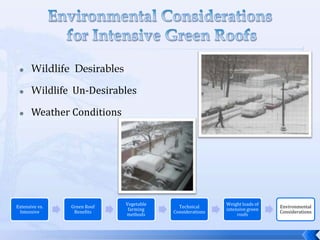
Environmental considerations for intensive green roofsASLA  Headquarters
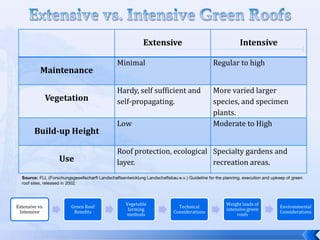
Extensive vs. Intensive Green RoofsSource: FLL (Forschungsgesellscharft Landschaftsentwicklung Landschaftsbau e.v.) Guideline for the planning, execution and upkeep of green roof sites, released in 2002.
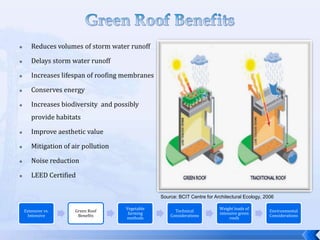
Green Roof BenefitsReduces volumes of storm water runoffDelays storm water runoffIncreases lifespan of roofing membranesConserves energyIncreases biodiversity  and possibly provide habitatsImprove aesthetic valueMitigation of air pollution Noise reductionLEED CertifiedSource: BCIT Centre for Architectural Ecology, 2006
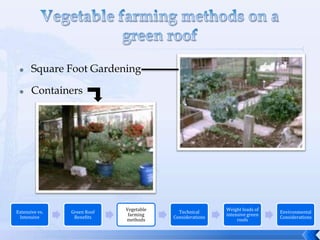
Vegetable farming methods on a green roofSquare Foot Gardening Containers
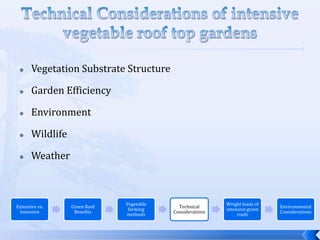
Technical Considerations of intensive vegetable roof top gardensVegetation Substrate StructureGarden EfficiencyEnvironmentWildlifeWeather
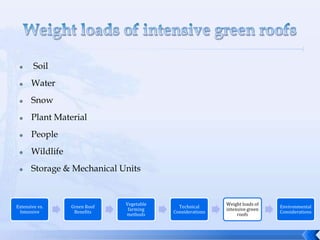
Weight loads of intensive green roofs SoilWaterSnowPlant MaterialPeopleWildlifeStorage & Mechanical Units
Environmental Considerations for Intensive Green RoofsWildlife  DesirablesWildlife  Un-DesirablesWeather Conditions
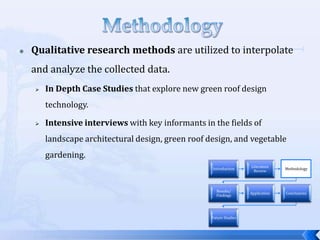
MethodologyQualitative research methods are utilized to interpolate and analyze the collected data.
In Depth Case Studies that explore new green roof design technology.
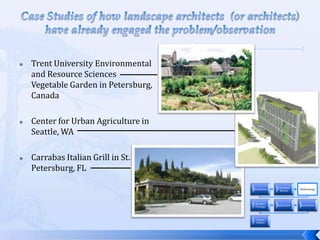
Intensive interviews with key informants in the fields of landscape architectural design, green roof design, and vegetable gardening.Case Studies of how landscape architects  (or architects) have already engaged the problem/observationTrent University Environmental and Resource Sciences Vegetable Garden in Petersburg, CanadaCenter for Urban Agriculture in Seattle, WACarrabas Italian Grill in St. Petersburg, FL
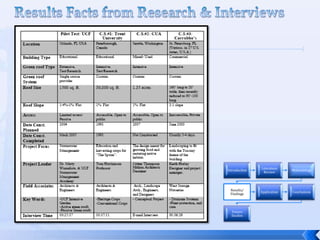
Results Facts from Research & Interviews
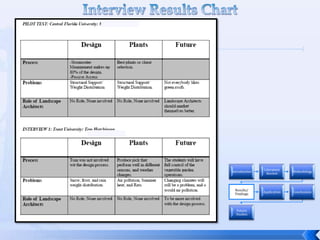
Interview Results Chart
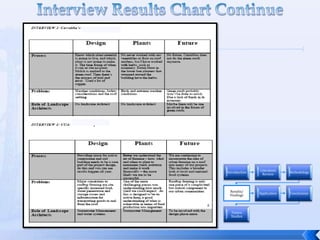
Interview Results Chart Continue
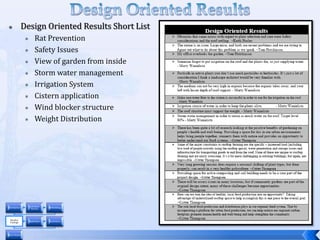
Design Oriented ResultsDesign Oriented Results Short ListRat PreventionSafety IssuesView of garden from insideStorm water managementIrrigation SystemCistern applicationWind blocker structureWeight Distribution
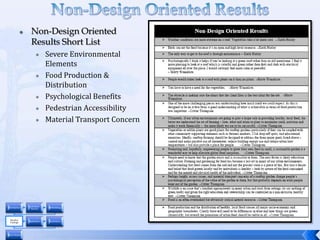
Non-Design Oriented Results Non-Design Oriented Results Short ListSevere Environmental ElementsFood Production & DistributionPsychological BenefitsPedestrian Accessibility Material Transport Concern
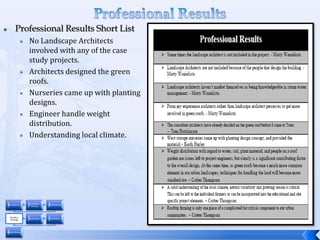
Professional ResultsProfessional Results Short List No Landscape Architects involved with any of the case study projects.Architects designed the green roofs.Nurseries came up with planting designs.Engineer handle weight distribution. Understanding local climate.
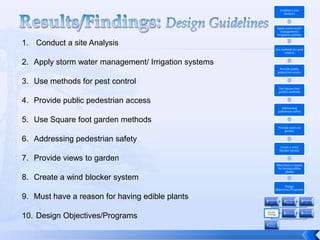
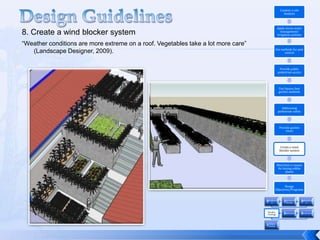
Results/Findings: Design Guidelines Conduct a site AnalysisApply storm water management/ Irrigation systemsUse methods for pest controlProvide public pedestrian accessUse Square foot garden methodsAddressing pedestrian safetyProvide views to garden Create a wind blocker systemMust have a reason for having edible plants Design Objectives/Programs
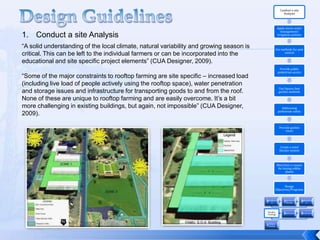
Design Guidelines Conduct a site Analysis“A solid understanding of the local climate, natural variability and growing season is critical. This can be left to the individual farmers or can be incorporated into the educational and site specific project elements” (CUA Designer, 2009). “Some of the major constraints to rooftop farming are site specific – increased load (including live load of people actively using the rooftop space), water penetration and storage issues and infrastructure for transporting goods to and from the roof. None of these are unique to rooftop farming and are easily overcome. It’s a bit more challenging in existing buildings, but again, not impossible” (CUA Designer, 2009).
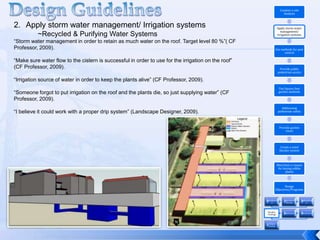
Design GuidelinesApply storm water management/ Irrigation systems            ~Recycled & Purifying Water Systems“Storm water management in order to retain as much water on the roof. Target level 80 %”( CF Professor, 2009).“Make sure water flow to the cistern is successful in order to use for the irrigation on the roof” (CF Professor, 2009).“Irrigation source of water in order to keep the plants alive” (CF Professor, 2009).“Someone forgot to put irrigation on the roof and the plants die, so just supplying water” (CF Professor, 2009).“I believe it could work with a proper drip system” (Landscape Designer, 2009).
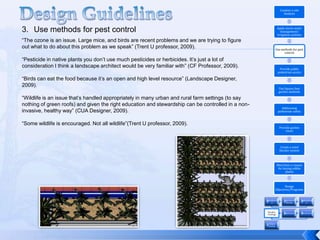
Design GuidelinesUse methods for pest control“The ozone is an issue. Large mice, and birds are recent problems and we are trying to figure out what to do about this problem as we speak” (Trent U professor, 2009).“Pesticide in native plants you don’t use much pesticides or herbicides. It’s just a lot of consideration I think a landscape architect would be very familiar with” (CF Professor, 2009).“Birds can eat the food because it’s an open and high level resource” (Landscape Designer, 2009).“Wildlife is an issue that’s handled appropriately in many urban and rural farm settings (to say nothing of green roofs) and given the right education and stewardship can be controlled in a non-invasive, healthy way” (CUA Designer, 2009).“Some wildlife is encouraged. Not all wildlife”(Trent U professor, 2009).
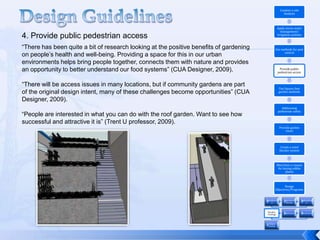
Design Guidelines4. Provide public pedestrian access“There has been quite a bit of research looking at the positive benefits of gardening on people’s health and well-being. Providing a space for this in our urban environments helps bring people together, connects them with nature and provides an opportunity to better understand our food systems” (CUA Designer, 2009).“There will be access issues in many locations, but if community gardens are part of the original design intent, many of these challenges become opportunities” (CUA Designer, 2009).“People are interested in what you can do with the roof garden. Want to see how successful and attractive it is” (Trent U professor, 2009).
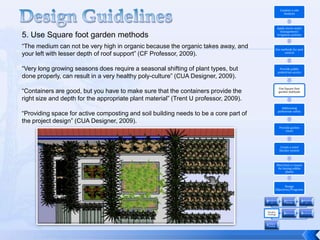
Design Guidelines5. Use Square foot garden methods“The medium can not be very high in organic because the organic takes away, and your left with lesser depth of roof support” (CF Professor, 2009).“Very long growing seasons does require a seasonal shifting of plant types, but done properly, can result in a very healthy poly-culture” (CUA Designer, 2009).“Containers are good, but you have to make sure that the containers provide the right size and depth for the appropriate plant material” (Trent U professor, 2009).“Providing space for active composting and soil building needs to be a core part of the project design” (CUA Designer, 2009).
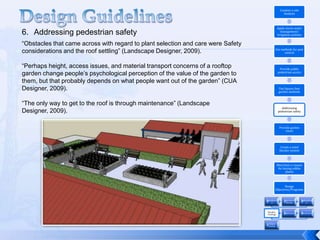
Design GuidelinesAddressing pedestrian safety“Obstacles that came across with regard to plant selection and care were Safety considerations and the roof settling” (Landscape Designer, 2009).“Perhaps height, access issues, and material transport concerns of a rooftop garden change people’s psychological perception of the value of the garden to them, but that probably depends on what people want out of the garden” (CUA Designer, 2009).“The only way to get to the roof is through maintenance” (Landscape Designer, 2009).
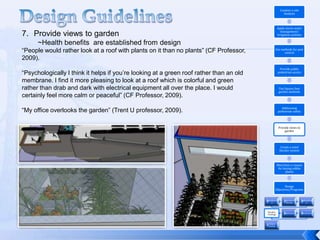
Design GuidelinesProvide views to garden         ~Health benefits  are established from design“People would rather look at a roof with plants on it than no plants” (CF Professor, 2009).“Psychologically I think it helps if you’re looking at a green roof rather than an old membrane. I find it more pleasing to look at a roof which is colorful and green rather than drab and dark with electrical equipment all over the place. I would certainly feel more calm or peaceful” (CF Professor, 2009).“My office overlooks the garden” (Trent U professor, 2009).

Thesis Defense Presentation

  • 1.
    Green Roof Design:The Landscape Architecture of Intensive Green Roofs in Urban SettingsBy: Delesia Hill
  • 2.
  • 3.
  • 4.
  • 5.
  • 6.
    Green roofs connectingto community gardensProblem Questions / ObservationsCan the design of the garden help feed people? Could there be direct access from ground level community gardens to roof top vegetable gardens? Will an intensive vegetable roof garden design necessarily manipulate the architecture of the building?Does the height, access issues, and material transport concerns of a rooftop garden change people’s psychological perception of the value of the garden to them?Acros Fukuoka Building in Japan
  • 7.
    How can landscapearchitects (or architects) address the problem/observation?Be cautious to the context of their green roof designs.Learn that not all methods of planting, rowing, and cropping can be done the same way when placed on roof top. Establish Design Guidelines to frame their design intent with limitations.ASLA Headquarters in WA, D.C Green Roof Axon
  • 8.
  • 9.
  • 10.
  • 11.
  • 12.
    Weight loads ofintensive green roofs
  • 13.
    Environmental considerations forintensive green roofsASLA Headquarters
  • 14.
    Extensive vs. IntensiveGreen RoofsSource: FLL (Forschungsgesellscharft Landschaftsentwicklung Landschaftsbau e.v.) Guideline for the planning, execution and upkeep of green roof sites, released in 2002.
  • 15.
    Green Roof BenefitsReducesvolumes of storm water runoffDelays storm water runoffIncreases lifespan of roofing membranesConserves energyIncreases biodiversity and possibly provide habitatsImprove aesthetic valueMitigation of air pollution Noise reductionLEED CertifiedSource: BCIT Centre for Architectural Ecology, 2006
  • 16.
    Vegetable farming methodson a green roofSquare Foot Gardening Containers
  • 17.
    Technical Considerations ofintensive vegetable roof top gardensVegetation Substrate StructureGarden EfficiencyEnvironmentWildlifeWeather
  • 18.
    Weight loads ofintensive green roofs SoilWaterSnowPlant MaterialPeopleWildlifeStorage & Mechanical Units
  • 19.
    Environmental Considerations forIntensive Green RoofsWildlife DesirablesWildlife Un-DesirablesWeather Conditions
  • 20.
    MethodologyQualitative research methodsare utilized to interpolate and analyze the collected data.
  • 21.
    In Depth CaseStudies that explore new green roof design technology.
  • 22.
    Intensive interviews withkey informants in the fields of landscape architectural design, green roof design, and vegetable gardening.Case Studies of how landscape architects (or architects) have already engaged the problem/observationTrent University Environmental and Resource Sciences Vegetable Garden in Petersburg, CanadaCenter for Urban Agriculture in Seattle, WACarrabas Italian Grill in St. Petersburg, FL
  • 23.
    Results Facts fromResearch & Interviews
  • 24.
  • 25.
  • 26.
    Design Oriented ResultsDesignOriented Results Short ListRat PreventionSafety IssuesView of garden from insideStorm water managementIrrigation SystemCistern applicationWind blocker structureWeight Distribution
  • 27.
    Non-Design Oriented ResultsNon-Design Oriented Results Short ListSevere Environmental ElementsFood Production & DistributionPsychological BenefitsPedestrian Accessibility Material Transport Concern
  • 28.
    Professional ResultsProfessional ResultsShort List No Landscape Architects involved with any of the case study projects.Architects designed the green roofs.Nurseries came up with planting designs.Engineer handle weight distribution. Understanding local climate.
  • 29.
    Results/Findings: Design GuidelinesConduct a site AnalysisApply storm water management/ Irrigation systemsUse methods for pest controlProvide public pedestrian accessUse Square foot garden methodsAddressing pedestrian safetyProvide views to garden Create a wind blocker systemMust have a reason for having edible plants Design Objectives/Programs
  • 30.
    Design Guidelines Conducta site Analysis“A solid understanding of the local climate, natural variability and growing season is critical. This can be left to the individual farmers or can be incorporated into the educational and site specific project elements” (CUA Designer, 2009). “Some of the major constraints to rooftop farming are site specific – increased load (including live load of people actively using the rooftop space), water penetration and storage issues and infrastructure for transporting goods to and from the roof. None of these are unique to rooftop farming and are easily overcome. It’s a bit more challenging in existing buildings, but again, not impossible” (CUA Designer, 2009).
  • 31.
    Design GuidelinesApply stormwater management/ Irrigation systems ~Recycled & Purifying Water Systems“Storm water management in order to retain as much water on the roof. Target level 80 %”( CF Professor, 2009).“Make sure water flow to the cistern is successful in order to use for the irrigation on the roof” (CF Professor, 2009).“Irrigation source of water in order to keep the plants alive” (CF Professor, 2009).“Someone forgot to put irrigation on the roof and the plants die, so just supplying water” (CF Professor, 2009).“I believe it could work with a proper drip system” (Landscape Designer, 2009).
  • 32.
    Design GuidelinesUse methodsfor pest control“The ozone is an issue. Large mice, and birds are recent problems and we are trying to figure out what to do about this problem as we speak” (Trent U professor, 2009).“Pesticide in native plants you don’t use much pesticides or herbicides. It’s just a lot of consideration I think a landscape architect would be very familiar with” (CF Professor, 2009).“Birds can eat the food because it’s an open and high level resource” (Landscape Designer, 2009).“Wildlife is an issue that’s handled appropriately in many urban and rural farm settings (to say nothing of green roofs) and given the right education and stewardship can be controlled in a non-invasive, healthy way” (CUA Designer, 2009).“Some wildlife is encouraged. Not all wildlife”(Trent U professor, 2009).
  • 33.
    Design Guidelines4. Providepublic pedestrian access“There has been quite a bit of research looking at the positive benefits of gardening on people’s health and well-being. Providing a space for this in our urban environments helps bring people together, connects them with nature and provides an opportunity to better understand our food systems” (CUA Designer, 2009).“There will be access issues in many locations, but if community gardens are part of the original design intent, many of these challenges become opportunities” (CUA Designer, 2009).“People are interested in what you can do with the roof garden. Want to see how successful and attractive it is” (Trent U professor, 2009).
  • 34.
    Design Guidelines5. UseSquare foot garden methods“The medium can not be very high in organic because the organic takes away, and your left with lesser depth of roof support” (CF Professor, 2009).“Very long growing seasons does require a seasonal shifting of plant types, but done properly, can result in a very healthy poly-culture” (CUA Designer, 2009).“Containers are good, but you have to make sure that the containers provide the right size and depth for the appropriate plant material” (Trent U professor, 2009).“Providing space for active composting and soil building needs to be a core part of the project design” (CUA Designer, 2009).
  • 35.
    Design GuidelinesAddressing pedestriansafety“Obstacles that came across with regard to plant selection and care were Safety considerations and the roof settling” (Landscape Designer, 2009).“Perhaps height, access issues, and material transport concerns of a rooftop garden change people’s psychological perception of the value of the garden to them, but that probably depends on what people want out of the garden” (CUA Designer, 2009).“The only way to get to the roof is through maintenance” (Landscape Designer, 2009).
  • 36.
    Design GuidelinesProvide viewsto garden ~Health benefits are established from design“People would rather look at a roof with plants on it than no plants” (CF Professor, 2009).“Psychologically I think it helps if you’re looking at a green roof rather than an old membrane. I find it more pleasing to look at a roof which is colorful and green rather than drab and dark with electrical equipment all over the place. I would certainly feel more calm or peaceful” (CF Professor, 2009).“My office overlooks the garden” (Trent U professor, 2009).