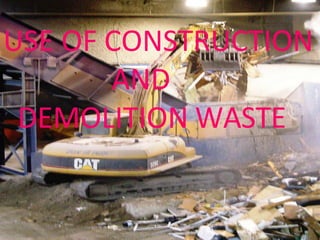
USE OF CONSTRUCTION
AND
DEMOLITION WASTE
Introduction:
Demolition sites & restoration schemes are large amounts of solid waste.
Recycling of concrete & other building materials is difficult &
uneconomical.
It is possible to reuse most of the building materials & components.
As the volume of demolition waste is huge allowing the waste to be
crushed, processed, & reused as aggregate in building works.
The recycling of construction materials like concrete, timber , glass, &
steel is primarily an attempt to reduce the cost of production of new
materials & construction & also reduce the consumption of natural
resources.
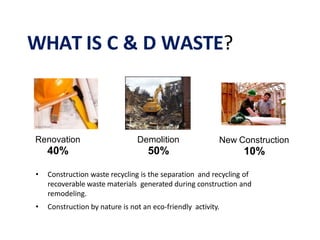
WHAT IS C & D WASTE?
Renovation
40%
Demolition
50%
New Construction
10%
• Construction waste recycling is the separation and recycling of
recoverable waste materials generated during construction and
remodeling.
• Construction by nature is not an eco-friendly activity.
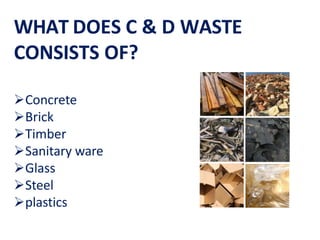
WHAT DOES C & D WASTE
CONSISTS OF?
Concrete
Brick
Timber
Sanitary ware
Glass
Steel
plastics
 Construction and demolition wastes are one of the largest waste
streams in the country.
 Almost all job site wastes are recyclable.
 It costs less – usually much less – to recycle job site wastes than
to throw them away.
 This C&D waste stream is enormous: about 130 million tons per
year, or about 25% of all of the solid waste that is discarded in
India.
 In total, from almost any job site, 90% to 95% of all waste
materials can be recycled.
 The civil construction consume around 2/3 of natural wood of
our forests(66 % wood).
 Construction, renovation and demolition activities leads to the
formation of waste.
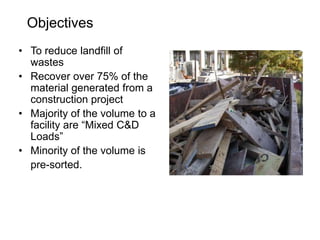
Objectives
• To reduce landfill of
wastes
• Recover over 75% of the
material generated from a
construction project
• Majority of the volume to a
facility are “Mixed C&D
Loads”
• Minority of the volume is
pre-sorted.
NEED FOR ADOPTION OF PROPER
METHODS OF RECYCLING
a)It reduces the demand up on new resources.
b)Cuts down the cost and effort of transport and
production.
c)Use waste which would otherwise be lost to
landfill sites.
Construction and
Demolition Wastes
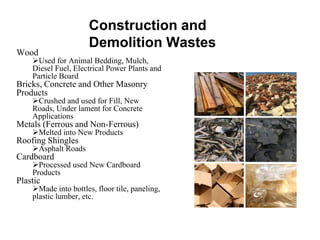
Wood
Used for Animal Bedding, Mulch,
Diesel Fuel, Electrical Power Plants and
Particle Board
Bricks, Concrete and Other Masonry
Products
Crushed and used for Fill, New
Roads, Under lament for Concrete
Applications
Metals (Ferrous and Non-Ferrous)
Melted into New Products
Roofing Shingles
Asphalt Roads
Cardboard
Processed used New Cardboard
Products
Plastic
Made into bottles, floor tile, paneling,
plastic lumber, etc.
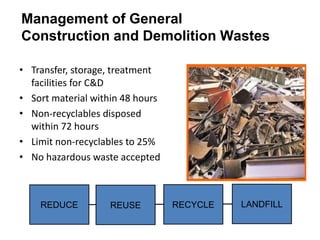
Management of General
Construction and Demolition Wastes
• Transfer, storage, treatment
facilities for C&D
• Sort material within 48 hours
• Non-recyclables disposed
within 72 hours
• Limit non-recyclables to 25%
• No hazardous waste accepted
REDUCE LANDFILLREUSE RECYCLE
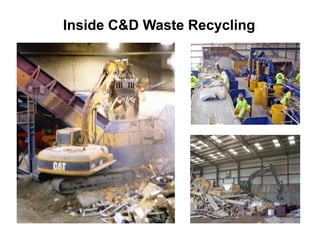
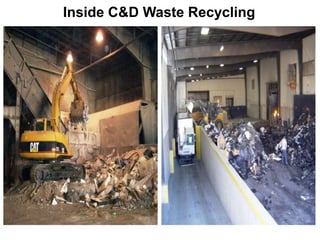
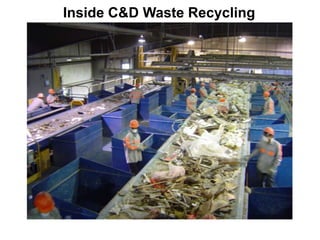
Inside C&D Waste Recycling
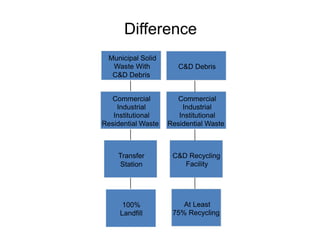
Difference
100%
Landfill
Transfer
Station
Commercial
Industrial
Institutional
Residential Waste
Municipal Solid
Waste With
At Least
75% Recycling
C&D Recycling
Facility
Commercial
Industrial
Institutional
Residential Waste
C&D Debris
C&D Debris
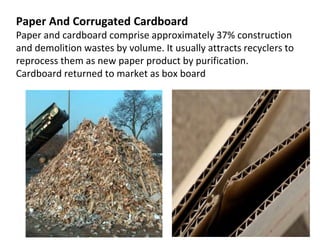
Paper And Corrugated Cardboard
Paper and cardboard comprise approximately 37% construction
and demolition wastes by volume. It usually attracts recyclers to
reprocess them as new paper product by purification.
Cardboard returned to market as box board
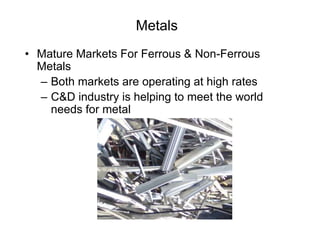
Metals
• Mature Markets For Ferrous & Non-Ferrous
Metals
– Both markets are operating at high rates
– C&D industry is helping to meet the world
needs for metal
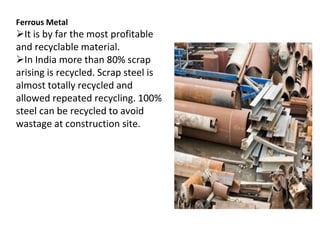
Ferrous Metal
It is by far the most profitable
and recyclable material.
In India more than 80% scrap
arising is recycled. Scrap steel is
almost totally recycled and
allowed repeated recycling. 100%
steel can be recycled to avoid
wastage at construction site.
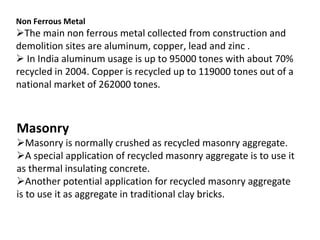
Non Ferrous Metal
The main non ferrous metal collected from construction and
demolition sites are aluminum, copper, lead and zinc .
 In India aluminum usage is up to 95000 tones with about 70%
recycled in 2004. Copper is recycled up to 119000 tones out of a
national market of 262000 tones.
Masonry
Masonry is normally crushed as recycled masonry aggregate.
A special application of recycled masonry aggregate is to use it
as thermal insulating concrete.
Another potential application for recycled masonry aggregate
is to use it as aggregate in traditional clay bricks.
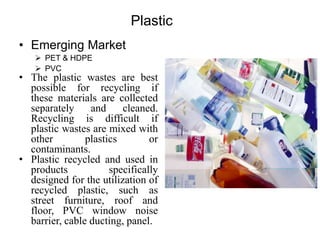
Plastic
• Emerging Market
 PET & HDPE
 PVC
• The plastic wastes are best
possible for recycling if
these materials are collected
separately and cleaned.
Recycling is difficult if
plastic wastes are mixed with
other plastics or
contaminants.
• Plastic recycled and used in
products specifically
designed for the utilization of
recycled plastic, such as
street furniture, roof and
floor, PVC window noise
barrier, cable ducting, panel.
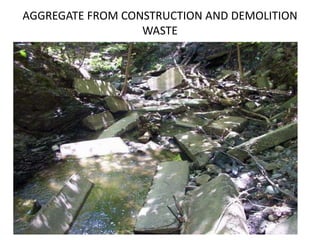
AGGREGATE FROM CONSTRUCTION AND DEMOLITION
WASTE
Wood Recycling
• Whole timber arising from construction and demolition works
can be utilized easily and directly for reused in other
construction projects after cleaning, denailing and sizing.
• Mulch
– C&D wood is used to create colored mulch.
– Less moisture in C&D wood allows for minimum coloring.
– C&D mulch last longer and does not decompose as fast.
• Animal Bedding
– C&D wood is an excellent source for making bedding.
• Wood Products
• Reprocessing of wood into other products (Pressboard).
• C&D wood has 80% the BTU value as coal.
• Fuel to energy is a very stable market for C&D wood.
• Most wood from Illinois, converted to energy, is done through
plants outside of Illinois.
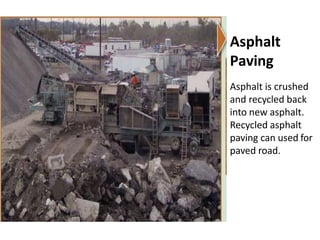
Asphalt
Paving
Asphalt is crushed
and recycled back
into new asphalt.
Recycled asphalt
paving can used for
paved road.
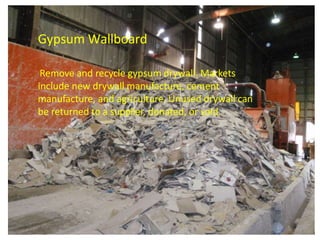
Gypsum Wallboard
Remove and recycle gypsum drywall. Markets
include new drywall manufacture, cement
manufacture, and agriculture. Unused drywall can
be returned to a supplier, donated, or sold.
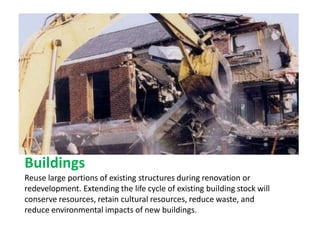
Buildings
Reuse large portions of existing structures during renovation or
redevelopment. Extending the life cycle of existing building stock will
conserve resources, retain cultural resources, reduce waste, and
reduce environmental impacts of new buildings.
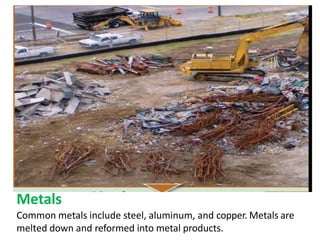
Metals
Common metals include steel, aluminum, and copper. Metals are
melted down and reformed into metal products.
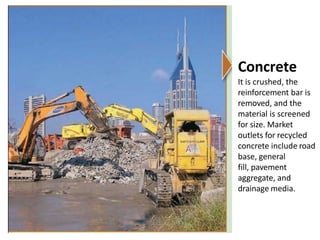
Concrete
It is crushed, the
reinforcement bar is
removed, and the
material is screened
for size. Market
outlets for recycled
concrete include road
base, general
fill, pavement
aggregate, and
drainage media.
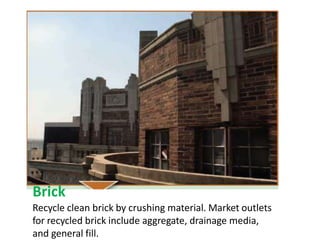
Brick
Recycle clean brick by crushing material. Market outlets
for recycled brick include aggregate, drainage media,
and general fill.
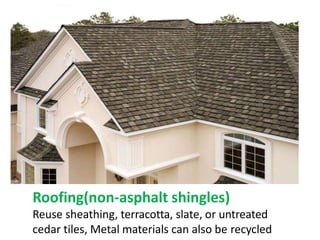
Roofing(non-asphalt shingles)
Reuse sheathing, terracotta, slate, or untreated
cedar tiles, Metal materials can also be recycled
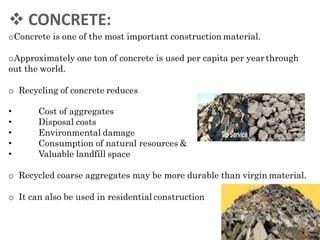
 CONCRETE:
oConcrete is one of the most important construction material.
oApproximately one ton of concrete is used per capita per yearthrough
out the world.
o Recycling of concrete reduces
•
•
•
•
•
Cost of aggregates
Disposal costs
Environmental damage
Consumption of natural resources &
Valuable landfill space
o Recycled coarse aggregates may be more durable than virgin material.
o It can also be used in residential construction
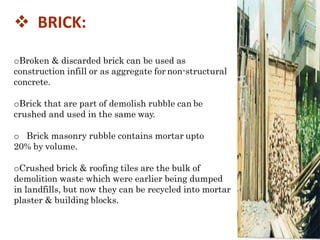
 BRICK:
oBroken & discarded brick can be used as
construction infill or as aggregate for non-structural
concrete.
oBrick that are part of demolish rubble can be
crushed and used in the same way.
o Brick masonry rubble contains mortar upto
20% by volume.
oCrushed brick & roofing tiles are the bulk of
demolition waste which were earlier being dumped
in landfills, but now they can be recycled into mortar
plaster & building blocks.
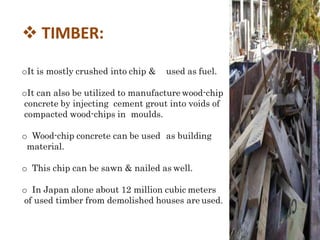
 TIMBER:
oIt is mostly crushed into chip & used as fuel.
oIt can also be utilized to manufacture wood-chip
concrete by injecting cement grout into voids of
compacted wood-chips in moulds.
o Wood-chip concrete can be used as building
material.
o This chip can be sawn & nailed as well.
o In Japan alone about 12 million cubic meters
of used timber from demolished houses are used.
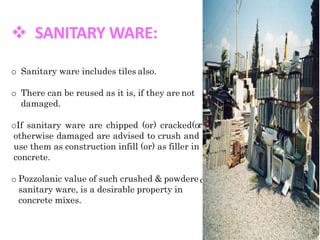
 SANITARY WARE:
r)
d
o Sanitary ware includes tiles also.
o There can be reused as it is, if they are not
damaged.
oIf sanitary ware are chipped (or) cracked(o
otherwise damaged are advised to crush and
use them as construction infill (or) as filler in
concrete.
o Pozzolanic value of such crushed & powdere
sanitary ware, is a desirable property in
concrete mixes.
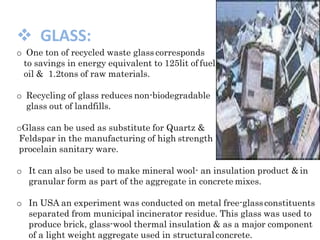
 GLASS:
o One ton of recycled waste glass corresponds
to savings in energy equivalent to 125lit of fuel
oil & 1.2tons of raw materials.
o Recycling of glass reduces non-biodegradable
glass out of landfills.
oGlass can be used as substitute for Quartz &
Feldspar in the manufacturing of high strength
procelain sanitary ware.
o It can also be used to make mineral wool- an insulation product &in
granular form as part of the aggregate in concrete mixes.
o In USA an experiment was conducted on metal free-glassconstituents
separated from municipal incinerator residue. This glass was used to
produce brick, glass-wool thermal insulation & as a major component
of a light weight aggregate used in structuralconcrete.
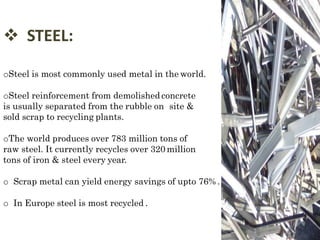
 STEEL:
oSteel is most commonly used metal in the world.
oSteel reinforcement from demolished concrete
is usually separated from the rubble on site &
sold scrap to recycling plants.
oThe world produces over 783 million tons of
raw steel. It currently recycles over 320 million
tons of iron & steel every year.
o Scrap metal can yield energy savings of upto 76% .
o In Europe steel is most recycled .
BENEFITS
• Reduces the production of greenhouse
gas emissions and other pollutants by
reducing the need to extract raw
materials and ship new materials long
distances.
• Conserves landfill space, reduces the
need for new landfills and their
associated cost.
• Saves energy and reduces the
environmental impact of producing new
materials.
• Creates employment opportunities and
economic activities in recycling
industries.
• Saves money
BARRIERS IN PROMOTING USE OF
RECYCLED MATERIALS
• Lack of appropriately located recycling
facilities.
• Absence of appropriate technology.
• Lack of awareness .
• Poor source separation practices at job
sites
CONCLUSION
In order to reduce the construction and demolition waste, during the
time of construction order only the correct amount of raw materials.
Proper care should be taken to ensure the protection of materials
being delivered and stored in the site.
When a structure is being demolished, salvage as much of the more
valuable fittings and materials as possible.
Any suitable substitute for aggregate should be considered during the
construction. It is the duty of an engineer to revaluate technical
specification for materials where strength and safety do not have to be
compromised to permit the use of recycled materials.
As sorting and recycling facilities become more wide spread and
better developed it will be easier to redirect our waste from landfill.
The important initiatives sited are::
1. Promoting separation of C&D waste at source
2. Promoting recycling
3. Ban on llandffilling of C&D waste
4. Developing market for recycled products
5. Production of concrete bricks and paving blocks
6. Guidelines for using C&D waste
7. Developing designs which ffacilitate
‘deconstruction’’ iinstead of outright demolition
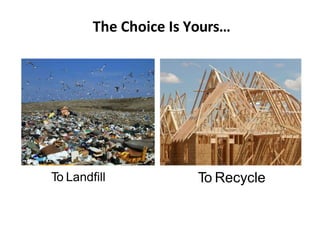
To Recycle
The Choice Is Yours…
To Landfill

Recycled materials

  • 2.
  • 3.
    Introduction: Demolition sites &restoration schemes are large amounts of solid waste. Recycling of concrete & other building materials is difficult & uneconomical. It is possible to reuse most of the building materials & components. As the volume of demolition waste is huge allowing the waste to be crushed, processed, & reused as aggregate in building works. The recycling of construction materials like concrete, timber , glass, & steel is primarily an attempt to reduce the cost of production of new materials & construction & also reduce the consumption of natural resources.
  • 4.
    WHAT IS C& D WASTE? Renovation 40% Demolition 50% New Construction 10% • Construction waste recycling is the separation and recycling of recoverable waste materials generated during construction and remodeling. • Construction by nature is not an eco-friendly activity.
  • 5.
    WHAT DOES C& D WASTE CONSISTS OF? Concrete Brick Timber Sanitary ware Glass Steel plastics
  • 6.
     Construction anddemolition wastes are one of the largest waste streams in the country.  Almost all job site wastes are recyclable.  It costs less – usually much less – to recycle job site wastes than to throw them away.  This C&D waste stream is enormous: about 130 million tons per year, or about 25% of all of the solid waste that is discarded in India.  In total, from almost any job site, 90% to 95% of all waste materials can be recycled.  The civil construction consume around 2/3 of natural wood of our forests(66 % wood).  Construction, renovation and demolition activities leads to the formation of waste.
  • 7.
    Objectives • To reducelandfill of wastes • Recover over 75% of the material generated from a construction project • Majority of the volume to a facility are “Mixed C&D Loads” • Minority of the volume is pre-sorted.
  • 8.
    NEED FOR ADOPTIONOF PROPER METHODS OF RECYCLING a)It reduces the demand up on new resources. b)Cuts down the cost and effort of transport and production. c)Use waste which would otherwise be lost to landfill sites.
  • 9.
    Construction and Demolition Wastes Wood Usedfor Animal Bedding, Mulch, Diesel Fuel, Electrical Power Plants and Particle Board Bricks, Concrete and Other Masonry Products Crushed and used for Fill, New Roads, Under lament for Concrete Applications Metals (Ferrous and Non-Ferrous) Melted into New Products Roofing Shingles Asphalt Roads Cardboard Processed used New Cardboard Products Plastic Made into bottles, floor tile, paneling, plastic lumber, etc.
  • 10.
    Management of General Constructionand Demolition Wastes • Transfer, storage, treatment facilities for C&D • Sort material within 48 hours • Non-recyclables disposed within 72 hours • Limit non-recyclables to 25% • No hazardous waste accepted REDUCE LANDFILLREUSE RECYCLE
  • 11.
  • 12.
  • 13.
  • 14.
    Difference 100% Landfill Transfer Station Commercial Industrial Institutional Residential Waste Municipal Solid WasteWith At Least 75% Recycling C&D Recycling Facility Commercial Industrial Institutional Residential Waste C&D Debris C&D Debris
  • 15.
    Paper And CorrugatedCardboard Paper and cardboard comprise approximately 37% construction and demolition wastes by volume. It usually attracts recyclers to reprocess them as new paper product by purification. Cardboard returned to market as box board
  • 16.
    Metals • Mature MarketsFor Ferrous & Non-Ferrous Metals – Both markets are operating at high rates – C&D industry is helping to meet the world needs for metal
  • 17.
    Ferrous Metal It isby far the most profitable and recyclable material. In India more than 80% scrap arising is recycled. Scrap steel is almost totally recycled and allowed repeated recycling. 100% steel can be recycled to avoid wastage at construction site.
  • 18.
    Non Ferrous Metal Themain non ferrous metal collected from construction and demolition sites are aluminum, copper, lead and zinc .  In India aluminum usage is up to 95000 tones with about 70% recycled in 2004. Copper is recycled up to 119000 tones out of a national market of 262000 tones. Masonry Masonry is normally crushed as recycled masonry aggregate. A special application of recycled masonry aggregate is to use it as thermal insulating concrete. Another potential application for recycled masonry aggregate is to use it as aggregate in traditional clay bricks.
  • 19.
    Plastic • Emerging Market PET & HDPE  PVC • The plastic wastes are best possible for recycling if these materials are collected separately and cleaned. Recycling is difficult if plastic wastes are mixed with other plastics or contaminants. • Plastic recycled and used in products specifically designed for the utilization of recycled plastic, such as street furniture, roof and floor, PVC window noise barrier, cable ducting, panel.
  • 20.
    AGGREGATE FROM CONSTRUCTIONAND DEMOLITION WASTE
  • 21.
    Wood Recycling • Wholetimber arising from construction and demolition works can be utilized easily and directly for reused in other construction projects after cleaning, denailing and sizing. • Mulch – C&D wood is used to create colored mulch. – Less moisture in C&D wood allows for minimum coloring. – C&D mulch last longer and does not decompose as fast. • Animal Bedding – C&D wood is an excellent source for making bedding. • Wood Products • Reprocessing of wood into other products (Pressboard). • C&D wood has 80% the BTU value as coal. • Fuel to energy is a very stable market for C&D wood. • Most wood from Illinois, converted to energy, is done through plants outside of Illinois.
  • 22.
    Asphalt Paving Asphalt is crushed andrecycled back into new asphalt. Recycled asphalt paving can used for paved road.
  • 23.
    Gypsum Wallboard Remove andrecycle gypsum drywall. Markets include new drywall manufacture, cement manufacture, and agriculture. Unused drywall can be returned to a supplier, donated, or sold.
  • 24.
    Buildings Reuse large portionsof existing structures during renovation or redevelopment. Extending the life cycle of existing building stock will conserve resources, retain cultural resources, reduce waste, and reduce environmental impacts of new buildings.
  • 25.
    Metals Common metals includesteel, aluminum, and copper. Metals are melted down and reformed into metal products.
  • 26.
    Concrete It is crushed,the reinforcement bar is removed, and the material is screened for size. Market outlets for recycled concrete include road base, general fill, pavement aggregate, and drainage media.
  • 27.
    Brick Recycle clean brickby crushing material. Market outlets for recycled brick include aggregate, drainage media, and general fill.
  • 28.
    Roofing(non-asphalt shingles) Reuse sheathing,terracotta, slate, or untreated cedar tiles, Metal materials can also be recycled
  • 29.
     CONCRETE: oConcrete isone of the most important construction material. oApproximately one ton of concrete is used per capita per yearthrough out the world. o Recycling of concrete reduces • • • • • Cost of aggregates Disposal costs Environmental damage Consumption of natural resources & Valuable landfill space o Recycled coarse aggregates may be more durable than virgin material. o It can also be used in residential construction
  • 30.
     BRICK: oBroken &discarded brick can be used as construction infill or as aggregate for non-structural concrete. oBrick that are part of demolish rubble can be crushed and used in the same way. o Brick masonry rubble contains mortar upto 20% by volume. oCrushed brick & roofing tiles are the bulk of demolition waste which were earlier being dumped in landfills, but now they can be recycled into mortar plaster & building blocks.
  • 31.
     TIMBER: oIt ismostly crushed into chip & used as fuel. oIt can also be utilized to manufacture wood-chip concrete by injecting cement grout into voids of compacted wood-chips in moulds. o Wood-chip concrete can be used as building material. o This chip can be sawn & nailed as well. o In Japan alone about 12 million cubic meters of used timber from demolished houses are used.
  • 32.
     SANITARY WARE: r) d oSanitary ware includes tiles also. o There can be reused as it is, if they are not damaged. oIf sanitary ware are chipped (or) cracked(o otherwise damaged are advised to crush and use them as construction infill (or) as filler in concrete. o Pozzolanic value of such crushed & powdere sanitary ware, is a desirable property in concrete mixes.
  • 33.
     GLASS: o Oneton of recycled waste glass corresponds to savings in energy equivalent to 125lit of fuel oil & 1.2tons of raw materials. o Recycling of glass reduces non-biodegradable glass out of landfills. oGlass can be used as substitute for Quartz & Feldspar in the manufacturing of high strength procelain sanitary ware. o It can also be used to make mineral wool- an insulation product &in granular form as part of the aggregate in concrete mixes. o In USA an experiment was conducted on metal free-glassconstituents separated from municipal incinerator residue. This glass was used to produce brick, glass-wool thermal insulation & as a major component of a light weight aggregate used in structuralconcrete.
  • 34.
     STEEL: oSteel ismost commonly used metal in the world. oSteel reinforcement from demolished concrete is usually separated from the rubble on site & sold scrap to recycling plants. oThe world produces over 783 million tons of raw steel. It currently recycles over 320 million tons of iron & steel every year. o Scrap metal can yield energy savings of upto 76% . o In Europe steel is most recycled .
  • 35.
    BENEFITS • Reduces theproduction of greenhouse gas emissions and other pollutants by reducing the need to extract raw materials and ship new materials long distances. • Conserves landfill space, reduces the need for new landfills and their associated cost.
  • 36.
    • Saves energyand reduces the environmental impact of producing new materials. • Creates employment opportunities and economic activities in recycling industries. • Saves money
  • 37.
    BARRIERS IN PROMOTINGUSE OF RECYCLED MATERIALS • Lack of appropriately located recycling facilities. • Absence of appropriate technology. • Lack of awareness . • Poor source separation practices at job sites
  • 38.
    CONCLUSION In order toreduce the construction and demolition waste, during the time of construction order only the correct amount of raw materials. Proper care should be taken to ensure the protection of materials being delivered and stored in the site. When a structure is being demolished, salvage as much of the more valuable fittings and materials as possible. Any suitable substitute for aggregate should be considered during the construction. It is the duty of an engineer to revaluate technical specification for materials where strength and safety do not have to be compromised to permit the use of recycled materials. As sorting and recycling facilities become more wide spread and better developed it will be easier to redirect our waste from landfill.
  • 39.
    The important initiativessited are:: 1. Promoting separation of C&D waste at source 2. Promoting recycling 3. Ban on llandffilling of C&D waste 4. Developing market for recycled products 5. Production of concrete bricks and paving blocks 6. Guidelines for using C&D waste 7. Developing designs which ffacilitate ‘deconstruction’’ iinstead of outright demolition
  • 40.
    To Recycle The ChoiceIs Yours… To Landfill