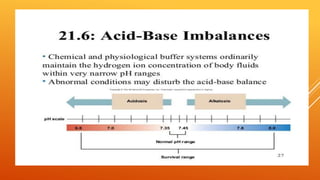
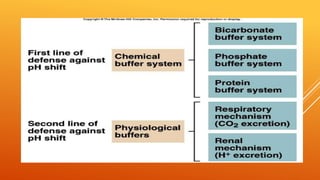
BUFFERS
By
Mehreen roohi
LEARNING OBJECTIVES:
BY THE END OF THIS LECTURE YOU WILL
BE ABLE TO:
Define buffers
Define pH
Describe different types of buffers
Describe bicarbonate buffer and phosphate
buffer.
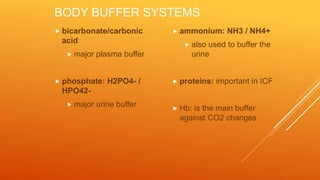
BODY BUFFER SYSTEMS
 bicarbonate/carbonic
acid
 major plasma buffer
 phosphate: H2PO4- /
HPO42-
 major urine buffer
 ammonium: NH3 / NH4+
 also used to buffer the
urine
 proteins: important in ICF
 Hb: is the main buffer
against CO2 changes
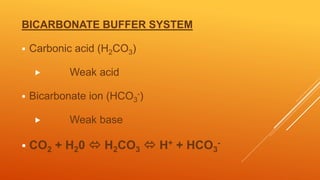
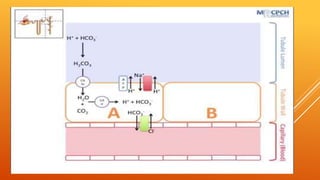
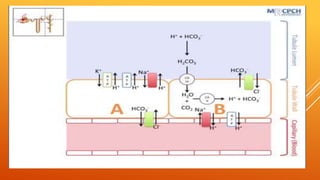
BICARBONATE BUFFER SYSTEM
 Carbonic acid (H2CO3)
 Weak acid
 Bicarbonate ion (HCO3
-)
 Weak base
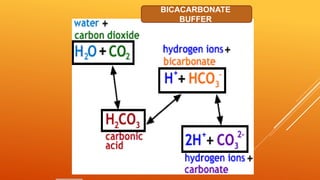
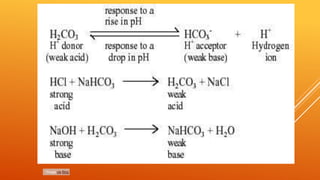
 CO2 + H20  H2CO3  H+ + HCO3
-
 Works along with respiratory and urinary system
These systems remove CO2 or HCO3
-
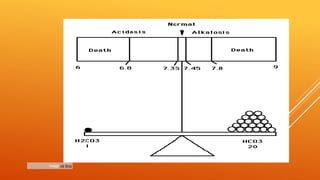
THE RATIO OF BICARBONATE TO CARBONIC ACID IS
NORMALLY 20:1
Alterations in the ratio alters Ph irrespective of absolute
concetrations
*Image via Bing
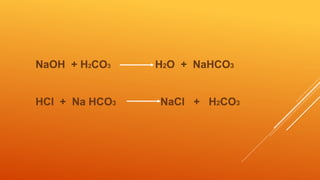
NaOH + H2CO3 H2O + NaHCO3
HCl + Na HCO3 NaCl + H2CO3
BICACARBONATE
BUFFER
*Image via Bing
 The most powerful extracellular
buffer in the body
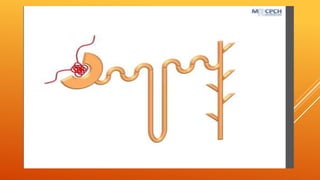
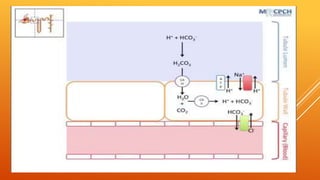
 The two elements of the buffer
system are regulated by the
kidneys and the lungs
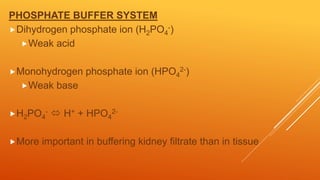
PHOSPHATE BUFFER SYSTEM
Dihydrogen phosphate ion (H2PO4
-)
Weak acid
Monohydrogen phosphate ion (HPO4
2-)
Weak base
H2PO4
-  H+ + HPO4
2-
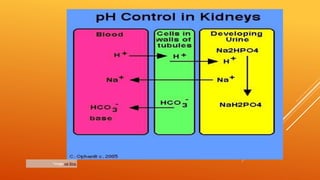
More important in buffering kidney filtrate than in tissue
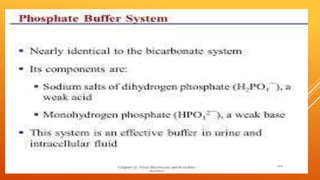
PHOSPHATE BUFFER SYSTEM
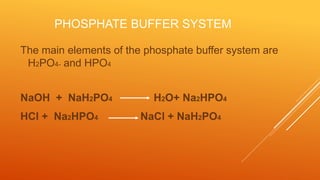
The main elements of the phosphate buffer system are
H2PO4- and HPO4
NaOH + NaH2PO4 H2O+ Na2HPO4
HCl + Na2HPO4 NaCl + NaH2PO4
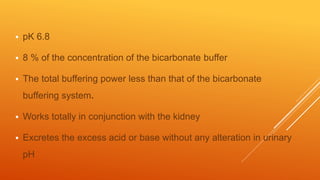
 pK 6.8
 8 % of the concentration of the bicarbonate buffer
 The total buffering power less than that of the bicarbonate
buffering system.
 Works totally in conjunction with the kidney
 Excretes the excess acid or base without any alteration in urinary
pH
*Image via Bing

Buffers

  • 1.
  • 2.
    LEARNING OBJECTIVES: BY THEEND OF THIS LECTURE YOU WILL BE ABLE TO: Define buffers Define pH Describe different types of buffers Describe bicarbonate buffer and phosphate buffer.
  • 5.
    BODY BUFFER SYSTEMS bicarbonate/carbonic acid  major plasma buffer  phosphate: H2PO4- / HPO42-  major urine buffer  ammonium: NH3 / NH4+  also used to buffer the urine  proteins: important in ICF  Hb: is the main buffer against CO2 changes
  • 6.
    BICARBONATE BUFFER SYSTEM Carbonic acid (H2CO3)  Weak acid  Bicarbonate ion (HCO3 -)  Weak base  CO2 + H20  H2CO3  H+ + HCO3 -
  • 7.
     Works alongwith respiratory and urinary system These systems remove CO2 or HCO3 - THE RATIO OF BICARBONATE TO CARBONIC ACID IS NORMALLY 20:1 Alterations in the ratio alters Ph irrespective of absolute concetrations
  • 8.
  • 9.
    NaOH + H2CO3H2O + NaHCO3 HCl + Na HCO3 NaCl + H2CO3
  • 10.
  • 11.
  • 12.
     The mostpowerful extracellular buffer in the body  The two elements of the buffer system are regulated by the kidneys and the lungs
  • 17.
    PHOSPHATE BUFFER SYSTEM Dihydrogenphosphate ion (H2PO4 -) Weak acid Monohydrogen phosphate ion (HPO4 2-) Weak base H2PO4 -  H+ + HPO4 2- More important in buffering kidney filtrate than in tissue
  • 19.
    PHOSPHATE BUFFER SYSTEM Themain elements of the phosphate buffer system are H2PO4- and HPO4 NaOH + NaH2PO4 H2O+ Na2HPO4 HCl + Na2HPO4 NaCl + NaH2PO4
  • 20.
     pK 6.8 8 % of the concentration of the bicarbonate buffer  The total buffering power less than that of the bicarbonate buffering system.  Works totally in conjunction with the kidney  Excretes the excess acid or base without any alteration in urinary pH
  • 21.