Bilad Alrafidain University
College
Dentistry department first stage
Dental chemistry lab
ACID-BASE BALANCE (2)
(Lac 3)
Edited by
Dr. Zeyad
The Body’s Defense Against Changes in [H+]
Three main systems:
1.Body fluid buffers.
Works within seconds.
2.Lungs
Works within minutes.
3.Kidneys
Works within hours-days.
The most powerful of the three.
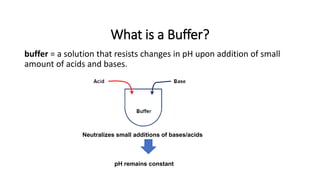
What is a Buffer?
buffer = a solution that resists changes in pH upon addition of small
amount of acids and bases.
Neutralizes small additions of bases/acids
pH remains constant
How do Buffers work?
buffer is a mixture of a weak acid and a weak base that are in equilibrium.
•To be more accurate, its either made of:
•A weak acid and its conjugated base (H2CO3 & NaHCO3-).
•A weak base and its conjugated acid (NH3 & NH4+).
Chemical Buffer Systems in the Body
There are 3 chemical buffers in the body;
1.The Bicarbonate buffer system.
2.The phosphate buffer system.
3.Proteins.
•They are the 1st line of defense against changes in pH i.e. [H+], act within seconds.
•Some are more powerful extracellularly and others are more powerful
intracellularly
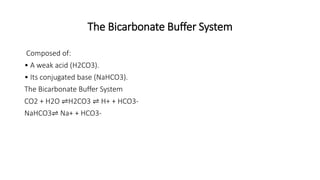
The Bicarbonate Buffer System
Composed of:
• A weak acid (H2CO3).
• Its conjugated base (NaHCO3).
The Bicarbonate Buffer System
CO2 + H2O ⇌H2CO3 ⇌ H+ + HCO3-
NaHCO3⇌ Na+ + HCO3-
The Bicarbonate Buffer System
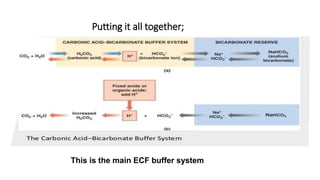
1.H2CO3 forms in the body by the reaction of CO2 & H2O
CO2 + H2O ⇌H2CO3
2.H2CO3 ionizes weakly to form small amounts of H+ & HCO3-
H2CO3 ⇌ H+ + HCO3-
3.The second component is NaHCO3 which dissociates to form Na+ & HCO3-
NaHCO3⇌ Na+ + HCO3-
Putting it all together;
This is the main ECF buffer system
Definition:
Conjugate acids and conjugate bases are characterized as the acids and
bases that lose or gain proton.
For example, H2CO3 is a weak acid, and HCO3 is its conjugate base.
Note that the conjugate base in this example is “the weak acid” minus
one proton “H”.
The main concept of buffers: When you add a strong acid to the body,
the body will convert it “by buffers” into weak acid. And when you add a
strong base to the body, the body will convert it into weak base. Because
weak acids and weak bases are less harmful to the body than the strong
ones.
Phosphates & Intracellular buffers:
•Phosphate is an intra and extracellular buffer
•Minor role compare to HCO3 or HB.
• Intracellular buffers (proteins & phosphate) are needed because H does not cross
PM. PM=Plasma membrane .
• Intracellular pH is more acidic .
Plays a major role in buffering intracellular & renal tubular fluid.
Composed of;
•H2PO4- (dihydrogen phosphate)
•HPO4-2 (Hydrogen phosphate)
Equationally, Phosphate is a better buffer than the bicarbonate .. Why??
Because the Pka of the phosphate is nearer to 7.4 (higher than the pka
of bicarbonate)
-But phosphate isn’t abundant as bicarbonate ( It’s mainly an
intracellular buffer).
-Intra cellular PH is more acidic, because there is a lot of metabolism
that is producing H ions inside the cell.
Pka: an acid dissociation constant used to describe the acidity of a particular molecule. ... In short, the stronger the acid, the
smaller the pKa value and strong acids have weak conjugate bases. pKa values describe the point where the acid is 50%
dissociated (i.e. deprotonated).
Proteins
Includes hemoglobin and plasma protein.
- Acidic and basic amino acids in plasma and cell protein act as buffers..
•– Carboxyl group gives up H+
•– Amino Group accepts H+
-Side chains that can buffer H+ are
present on 27 amino acids:
- Cannot be regulated physiologically. >> opposite to bicarbonate ( here if you
used all proteins you can’t add more
Proteinswhich mean, they act as an acid in basic environment & as a base in
acidic environment
Summary of Body’s Buffering Systems
Buffer systems do not work independently in body fluids but actually work together.
•A change in the balance in one buffer system, changes the balance of the other
systems.
•Buffers do not reverse the pH change, they only limit it.
•Buffers do not correct changes in [H+] or [HCO3-], they only limit the effect of
change on body pH until their concentration is properly adjusted by either the lungs
or the kidney.

Chemistry lect. 3.pdf

  • 1.
    Bilad Alrafidain University College Dentistrydepartment first stage Dental chemistry lab ACID-BASE BALANCE (2) (Lac 3) Edited by Dr. Zeyad
  • 2.
    The Body’s DefenseAgainst Changes in [H+] Three main systems: 1.Body fluid buffers. Works within seconds. 2.Lungs Works within minutes. 3.Kidneys Works within hours-days. The most powerful of the three.
  • 3.
    What is aBuffer? buffer = a solution that resists changes in pH upon addition of small amount of acids and bases. Neutralizes small additions of bases/acids pH remains constant
  • 4.
    How do Bufferswork? buffer is a mixture of a weak acid and a weak base that are in equilibrium. •To be more accurate, its either made of: •A weak acid and its conjugated base (H2CO3 & NaHCO3-). •A weak base and its conjugated acid (NH3 & NH4+).
  • 5.
    Chemical Buffer Systemsin the Body There are 3 chemical buffers in the body; 1.The Bicarbonate buffer system. 2.The phosphate buffer system. 3.Proteins. •They are the 1st line of defense against changes in pH i.e. [H+], act within seconds. •Some are more powerful extracellularly and others are more powerful intracellularly
  • 6.
    The Bicarbonate BufferSystem Composed of: • A weak acid (H2CO3). • Its conjugated base (NaHCO3). The Bicarbonate Buffer System CO2 + H2O ⇌H2CO3 ⇌ H+ + HCO3- NaHCO3⇌ Na+ + HCO3-
  • 7.
    The Bicarbonate BufferSystem 1.H2CO3 forms in the body by the reaction of CO2 & H2O CO2 + H2O ⇌H2CO3 2.H2CO3 ionizes weakly to form small amounts of H+ & HCO3- H2CO3 ⇌ H+ + HCO3- 3.The second component is NaHCO3 which dissociates to form Na+ & HCO3- NaHCO3⇌ Na+ + HCO3-
  • 8.
    Putting it alltogether; This is the main ECF buffer system
  • 9.
    Definition: Conjugate acids andconjugate bases are characterized as the acids and bases that lose or gain proton. For example, H2CO3 is a weak acid, and HCO3 is its conjugate base. Note that the conjugate base in this example is “the weak acid” minus one proton “H”. The main concept of buffers: When you add a strong acid to the body, the body will convert it “by buffers” into weak acid. And when you add a strong base to the body, the body will convert it into weak base. Because weak acids and weak bases are less harmful to the body than the strong ones.
  • 10.
    Phosphates & Intracellularbuffers: •Phosphate is an intra and extracellular buffer •Minor role compare to HCO3 or HB. • Intracellular buffers (proteins & phosphate) are needed because H does not cross PM. PM=Plasma membrane . • Intracellular pH is more acidic . Plays a major role in buffering intracellular & renal tubular fluid. Composed of; •H2PO4- (dihydrogen phosphate) •HPO4-2 (Hydrogen phosphate)
  • 11.
    Equationally, Phosphate isa better buffer than the bicarbonate .. Why?? Because the Pka of the phosphate is nearer to 7.4 (higher than the pka of bicarbonate) -But phosphate isn’t abundant as bicarbonate ( It’s mainly an intracellular buffer). -Intra cellular PH is more acidic, because there is a lot of metabolism that is producing H ions inside the cell. Pka: an acid dissociation constant used to describe the acidity of a particular molecule. ... In short, the stronger the acid, the smaller the pKa value and strong acids have weak conjugate bases. pKa values describe the point where the acid is 50% dissociated (i.e. deprotonated).
  • 12.
    Proteins Includes hemoglobin andplasma protein. - Acidic and basic amino acids in plasma and cell protein act as buffers.. •– Carboxyl group gives up H+ •– Amino Group accepts H+ -Side chains that can buffer H+ are present on 27 amino acids: - Cannot be regulated physiologically. >> opposite to bicarbonate ( here if you used all proteins you can’t add more Proteinswhich mean, they act as an acid in basic environment & as a base in acidic environment
  • 13.
    Summary of Body’sBuffering Systems Buffer systems do not work independently in body fluids but actually work together. •A change in the balance in one buffer system, changes the balance of the other systems. •Buffers do not reverse the pH change, they only limit it. •Buffers do not correct changes in [H+] or [HCO3-], they only limit the effect of change on body pH until their concentration is properly adjusted by either the lungs or the kidney.