Epilepsy and Behaviour 
- An Overview 
Dr. Ennapadam.S. Krishnamoorthy 
MD., DCN, PhD (Lond), FRCP (Lond, Glas, Edin), MAMS (India) 
Founder Director 
TRIMED I NEUROKRISH 
www.trimedtherapy.com I www.neurokrish.com
Epilepsy and Behaviour 
“Epilepsy and mental disorder are two states of 
illness of the very closest relationship; they 
represent identical pathological conditions in two 
different areas of the nervous system” 
Carl-Friedrich Flemming (1799-1880) 
Director of ‘Sachsenberg’
Epidemiology of psychiatric disorders in 
epilepsy 
• Most studies hospital or institution based 
• Few population based studies 
• Most studies cross-sectional 
• More recently cohort studies and nested case-control 
studies reported 
• Estimates of prevalence available but not other 
epidemiological indices
Large hospital based studies 
• 1971: Currie et al; 49% of 666 patients 
• 1991: Guruje; 37% of 204 patients 
• 1993: Mendez et al;Schizophrenia in 9.25% 
(epilepsy) vs.. 1.06% (migraine) 
• 1996: Manchanda et al; 47.3% of 300 patients met 
DSM-III-R criteria
Meta-analysis 
• Whitman (1984); Dodrill (1986) 
Patients with epilepsy 
- higher risk of psychopathology than normal controls 
- similar to patients with chronic illness 
- no differences between TLE and generalised 
epilepsy
Population Based Studies 
• 1960: Pond and Bidwell; 29% of 245 patients had 
psychological disorders 
• 1966: Gudmundsson; 512 (52%) of 987 patients 
showed mental changes 
• 1987: Edeh and Toone; 47.7% of 88 patients 
emerged as psychiatric cases 
• 1996: Cockerell et al; 64 incident cases/ 1 year 
with acute psychological disorders
Population based studies 
• Jalava (1996); 35 year cohort study - 4 fold risk of 
behavioural disorder epilepsy 
• Bredkjaer (1998); Record linkage- epilepsy and 
psychiatry registers; SIR-schizophreniform psychosis 
(p<10-8) 
• Stefansson (1998): disability register based case-control- 
epilepsy and somatic illness: no difference
Classification And Diagnosis Of 
Psychiatric Disorders In Epilepsy
Classification- current status 
• Both ILAE & WHO classifications of epilepsy do not 
code psychiatric disorders 
• Both ICD-10 & DSM-IV- “epilepsy” automatically 
subsumed under “organic” diagnosis category 
• Existing descriptions in these classifications often 
not comparable with psychiatric disorders specific to 
epilepsy
Ideal classification 
• Distinguish epilepsy specific psychiatric disorder 
from common mental disorder 
• Link with the ILAE classification of epilepsy 
• Code other data of relevance such as EEG and AED 
therapy 
• ILAE Commission on Psychobiology is working 
towards developing this
I. The problem of co-morbidity 
• Co-morbid behavioural disorders like anxiety and 
depression are common in epilepsy as in other 
chronic illnesses 
• Do not have specific distinguishing features that 
separate them from those seen in the community 
• Suggestion: Diagnose using ICD-10 and DSM-IV 
criteria; ignore “organic” label
II. Seizures as psychopathology 
• Clinical and sub-clinical seizure activity have 
psychiatric manifestations 
• Correlate clinical state with EEG for diagnosis 
- Complex partial status (impaired awareness) 
- Simple partial status (aura continua) 
- Absence status (spike-wave stupor)
III. Psychiatric disorders specific to 
epilepsy
Cognitive Dysfunction 
Due to epilepsy, its complications or due to anti-epileptic 
drugs 
General or specific difficulties with 
• memory 
• language 
• visuo-spatial ability 
• sensorimotor and perceptual functions
Management of Cognitive Dysfunction 
• Consider role of AED’s either singly or in 
combination 
• Newer AED’s like Topiramate cause considerable 
cognitive change 
• optimise prescription of drugs 
• Rule out sub-clinical status 
• Rule out metabolic/infectious cause
Case Vignette 
• Male/ 40’s/ refractory TLE 
• Admitted for investigation and treatment 
• Rapidly progressive cognitive decline after 
admission- dementia screen negative 
• Acute behavioural disturbance 
• High ammonia level and characteristic EEG change- 
“Valproate Encephalopathy” 
• reversed with Valproate withdrawal
Psychoses of epilepsy 
• Inter-ictal psychosis- unrelated to/ unaffected by 
seizures; schizophrenia like 
• Alternative psychosis- occurs during periods of 
seizure freedom with forced normalization of EEG 
• Post-ictal psychosis- follows cluster/ rarely single 
seizure; lucid interval of 24-48 hrs; lasts for as long 
as a month
Psychoses of epilepsy- features 
• preserved personality 
• warm affect 
• significant component of mood change 
• paranoid and religious themes 
• polymorphic in nature 
• often subtle
Management of Psychoses 
• Rule out metabolic or infectious causes/ sub-clinical 
status 
• Post-ictal- prevent seizures; indication for surgery; 
use Clobazam/ antipsychotics 
• Inter-ictal- new antipsychotic drugs (treatment and 
prophylaxis) 
• Alternate- complete seizure freedom is not always 
an ideal to aspire for
Depression in epilepsy 
Symptoms: irritability, depressive moods, 
anergia, insomnia, atypical pains, anxiety, phobic 
fears and euphoric moods (3 of 8) 
• Interictal dysphoric disorder- unrelated to/ 
largely unaffected by seizures 
• Prodromal dysphoric disorder- indicates the 
impending onset of seizures 
• Postictal dysphoric disorder-follows seizure
Management of Depression 
• Link with menstrual periods in women 
• Role of AED’s 
• SSRI’s can be used to prevent episodes 
• Post-ictal dysphoria: control of seizures; consider 
using Clobazam as prophylactic 
• Counselling (sharing information) 
• Cognitive Behavioural Therapy/ Psychotherapy
Case Vignette 
• 32/male/frontal lobe seizures 
• Topiramate- complete seizure freedom 
• developed Abulia without mood or psychotic 
symptoms 
• Newer antidepressant and Viagra prescribed by GP 
• Seizures returned- behaviour normalised
Geschwind Syndrome 
Inter-ictal syndrome characterised by 
• intensified and labile emotionality 
• viscosity (orderliness, excessive attention to detail 
and persistence) 
• hyposexuality 
• religiosity 
• hypergraphia
Sensory- Limbic 
Hyper-connection 
increased electrical activity-temporal lobe 
 
enhanced connection between sensory input and 
limbic processing 
 
sensory experience suffused with emotional 
coloration
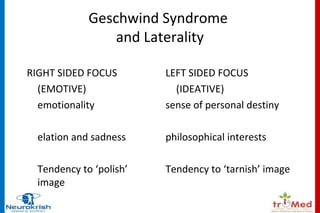
Geschwind Syndrome 
and Laterality 
RIGHT SIDED FOCUS 
(EMOTIVE) 
emotionality 
elation and sadness 
Tendency to ‘polish’ 
image 
LEFT SIDED FOCUS 
(IDEATIVE) 
sense of personal destiny 
philosophical interests 
Tendency to ‘tarnish’ image
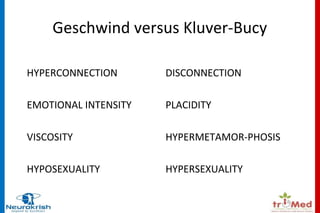
Geschwind versus Kluver-Bucy 
HYPERCONNECTION 
EMOTIONAL INTENSITY 
VISCOSITY 
HYPOSEXUALITY 
DISCONNECTION 
PLACIDITY 
HYPERMETAMOR-PHOSIS 
HYPERSEXUALITY
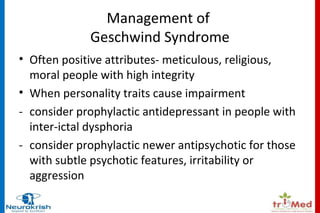
Management of 
Geschwind Syndrome 
• Often positive attributes- meticulous, religious, 
moral people with high integrity 
• When personality traits cause impairment 
- consider prophylactic antidepressant in people with 
inter-ictal dysphoria 
- consider prophylactic newer antipsychotic for those 
with subtle psychotic features, irritability or 
aggression
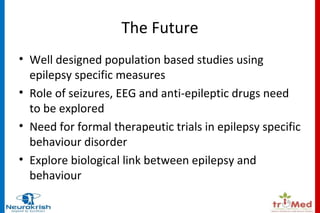
The Future 
• Well designed population based studies using 
epilepsy specific measures 
• Role of seizures, EEG and anti-epileptic drugs need 
to be explored 
• Need for formal therapeutic trials in epilepsy specific 
behaviour disorder 
• Explore biological link between epilepsy and 
behaviour
Selected Reading 
• M.R.Trimble. The Psychoses of Epilepsy, 1992, 
Raven Press, New York. 
• Krishnamoorthy & Trimble. (Forced 
Normalization); Lambert & Robertson. 
(Depression); both in 
Epilepsia 1999; vol.40 (suppl. 10) 
• D.Blumer & O.Devinsky- Evidence for and against 
temporal lobe syndrome. Neurology 1999; vol.53 
(suppl. 2)
Thank You 
email: research@neurokrish.com

Epilepsy and Behaviour - An Overview

  • 1.
    Epilepsy and Behaviour - An Overview Dr. Ennapadam.S. Krishnamoorthy MD., DCN, PhD (Lond), FRCP (Lond, Glas, Edin), MAMS (India) Founder Director TRIMED I NEUROKRISH www.trimedtherapy.com I www.neurokrish.com
  • 2.
    Epilepsy and Behaviour “Epilepsy and mental disorder are two states of illness of the very closest relationship; they represent identical pathological conditions in two different areas of the nervous system” Carl-Friedrich Flemming (1799-1880) Director of ‘Sachsenberg’
  • 3.
    Epidemiology of psychiatricdisorders in epilepsy • Most studies hospital or institution based • Few population based studies • Most studies cross-sectional • More recently cohort studies and nested case-control studies reported • Estimates of prevalence available but not other epidemiological indices
  • 4.
    Large hospital basedstudies • 1971: Currie et al; 49% of 666 patients • 1991: Guruje; 37% of 204 patients • 1993: Mendez et al;Schizophrenia in 9.25% (epilepsy) vs.. 1.06% (migraine) • 1996: Manchanda et al; 47.3% of 300 patients met DSM-III-R criteria
  • 5.
    Meta-analysis • Whitman(1984); Dodrill (1986) Patients with epilepsy - higher risk of psychopathology than normal controls - similar to patients with chronic illness - no differences between TLE and generalised epilepsy
  • 6.
    Population Based Studies • 1960: Pond and Bidwell; 29% of 245 patients had psychological disorders • 1966: Gudmundsson; 512 (52%) of 987 patients showed mental changes • 1987: Edeh and Toone; 47.7% of 88 patients emerged as psychiatric cases • 1996: Cockerell et al; 64 incident cases/ 1 year with acute psychological disorders
  • 7.
    Population based studies • Jalava (1996); 35 year cohort study - 4 fold risk of behavioural disorder epilepsy • Bredkjaer (1998); Record linkage- epilepsy and psychiatry registers; SIR-schizophreniform psychosis (p<10-8) • Stefansson (1998): disability register based case-control- epilepsy and somatic illness: no difference
  • 8.
    Classification And DiagnosisOf Psychiatric Disorders In Epilepsy
  • 9.
    Classification- current status • Both ILAE & WHO classifications of epilepsy do not code psychiatric disorders • Both ICD-10 & DSM-IV- “epilepsy” automatically subsumed under “organic” diagnosis category • Existing descriptions in these classifications often not comparable with psychiatric disorders specific to epilepsy
  • 10.
    Ideal classification •Distinguish epilepsy specific psychiatric disorder from common mental disorder • Link with the ILAE classification of epilepsy • Code other data of relevance such as EEG and AED therapy • ILAE Commission on Psychobiology is working towards developing this
  • 11.
    I. The problemof co-morbidity • Co-morbid behavioural disorders like anxiety and depression are common in epilepsy as in other chronic illnesses • Do not have specific distinguishing features that separate them from those seen in the community • Suggestion: Diagnose using ICD-10 and DSM-IV criteria; ignore “organic” label
  • 12.
    II. Seizures aspsychopathology • Clinical and sub-clinical seizure activity have psychiatric manifestations • Correlate clinical state with EEG for diagnosis - Complex partial status (impaired awareness) - Simple partial status (aura continua) - Absence status (spike-wave stupor)
  • 13.
    III. Psychiatric disordersspecific to epilepsy
  • 14.
    Cognitive Dysfunction Dueto epilepsy, its complications or due to anti-epileptic drugs General or specific difficulties with • memory • language • visuo-spatial ability • sensorimotor and perceptual functions
  • 15.
    Management of CognitiveDysfunction • Consider role of AED’s either singly or in combination • Newer AED’s like Topiramate cause considerable cognitive change • optimise prescription of drugs • Rule out sub-clinical status • Rule out metabolic/infectious cause
  • 16.
    Case Vignette •Male/ 40’s/ refractory TLE • Admitted for investigation and treatment • Rapidly progressive cognitive decline after admission- dementia screen negative • Acute behavioural disturbance • High ammonia level and characteristic EEG change- “Valproate Encephalopathy” • reversed with Valproate withdrawal
  • 17.
    Psychoses of epilepsy • Inter-ictal psychosis- unrelated to/ unaffected by seizures; schizophrenia like • Alternative psychosis- occurs during periods of seizure freedom with forced normalization of EEG • Post-ictal psychosis- follows cluster/ rarely single seizure; lucid interval of 24-48 hrs; lasts for as long as a month
  • 18.
    Psychoses of epilepsy-features • preserved personality • warm affect • significant component of mood change • paranoid and religious themes • polymorphic in nature • often subtle
  • 19.
    Management of Psychoses • Rule out metabolic or infectious causes/ sub-clinical status • Post-ictal- prevent seizures; indication for surgery; use Clobazam/ antipsychotics • Inter-ictal- new antipsychotic drugs (treatment and prophylaxis) • Alternate- complete seizure freedom is not always an ideal to aspire for
  • 20.
    Depression in epilepsy Symptoms: irritability, depressive moods, anergia, insomnia, atypical pains, anxiety, phobic fears and euphoric moods (3 of 8) • Interictal dysphoric disorder- unrelated to/ largely unaffected by seizures • Prodromal dysphoric disorder- indicates the impending onset of seizures • Postictal dysphoric disorder-follows seizure
  • 21.
    Management of Depression • Link with menstrual periods in women • Role of AED’s • SSRI’s can be used to prevent episodes • Post-ictal dysphoria: control of seizures; consider using Clobazam as prophylactic • Counselling (sharing information) • Cognitive Behavioural Therapy/ Psychotherapy
  • 22.
    Case Vignette •32/male/frontal lobe seizures • Topiramate- complete seizure freedom • developed Abulia without mood or psychotic symptoms • Newer antidepressant and Viagra prescribed by GP • Seizures returned- behaviour normalised
  • 23.
    Geschwind Syndrome Inter-ictalsyndrome characterised by • intensified and labile emotionality • viscosity (orderliness, excessive attention to detail and persistence) • hyposexuality • religiosity • hypergraphia
  • 24.
    Sensory- Limbic Hyper-connection increased electrical activity-temporal lobe  enhanced connection between sensory input and limbic processing  sensory experience suffused with emotional coloration
  • 25.
    Geschwind Syndrome andLaterality RIGHT SIDED FOCUS (EMOTIVE) emotionality elation and sadness Tendency to ‘polish’ image LEFT SIDED FOCUS (IDEATIVE) sense of personal destiny philosophical interests Tendency to ‘tarnish’ image
  • 26.
    Geschwind versus Kluver-Bucy HYPERCONNECTION EMOTIONAL INTENSITY VISCOSITY HYPOSEXUALITY DISCONNECTION PLACIDITY HYPERMETAMOR-PHOSIS HYPERSEXUALITY
  • 27.
    Management of GeschwindSyndrome • Often positive attributes- meticulous, religious, moral people with high integrity • When personality traits cause impairment - consider prophylactic antidepressant in people with inter-ictal dysphoria - consider prophylactic newer antipsychotic for those with subtle psychotic features, irritability or aggression
  • 28.
    The Future •Well designed population based studies using epilepsy specific measures • Role of seizures, EEG and anti-epileptic drugs need to be explored • Need for formal therapeutic trials in epilepsy specific behaviour disorder • Explore biological link between epilepsy and behaviour
  • 29.
    Selected Reading •M.R.Trimble. The Psychoses of Epilepsy, 1992, Raven Press, New York. • Krishnamoorthy & Trimble. (Forced Normalization); Lambert & Robertson. (Depression); both in Epilepsia 1999; vol.40 (suppl. 10) • D.Blumer & O.Devinsky- Evidence for and against temporal lobe syndrome. Neurology 1999; vol.53 (suppl. 2)
  • 30.
    Thank You email:research@neurokrish.com